


1 Kings 2:22
Bible text: King James Version (1769 Blayney text) · Public domain
Bible text: King James Version with Strong's numbers · Public domain
Bible text: Berean Standard Bible · Public domain
Bible text: American Standard Version (1901) · Public domain
Bible text: World English Bible, Messianic edition · Public domain
Bible text: Geneva Bible (1599) · Public domain
Bible text: Young's Literal Translation · Public domain
- וַיַּעַןvai·ya·'Anand he answeredH6030Conj-w ¦ V-Qal-ConsecImperf-3msVerb Qal Consecutive Imperfect 3rd Singular Masculineוַandיַּעַןhe answered
- הַמֶּלֶךְha·Me·lekhthe kingH4428Art ¦ N-msNoun Singular Masculine Absoluteהַtheמֶּלֶךְking
- שְׁלֹמֹהshe·lo·MohSolomonH8010N-proper-mNoun Proper Masculine
- וַיֹּאמֶרvai·Yo·merand he saidH559Conj-w ¦ V-Qal-ConsecImperf-3msVerb Qal Consecutive Imperfect 3rd Singular Masculineוַandיֹּאמֶרhe said
- לְאִמּוֹle·'i·Moto his motherH517Prep-l ¦ N-fsc ¦ 3msNoun Singular Feminine Constructלְtoאִמּmotherוֹhis
- וְלָמָהve·la·Mahand <to> why?H4100Conj-w ¦ Prep-l ¦ InterrogPronoun Interrogativeוְandלָ<to>מָהwhy?
- אַתְּ'at[are] youH859Pro-2fsPronoun Personal 2nd Singular Feminine
- שֹׁאֶלֶתsho·'E·letaskingH7592V-Qal-Prtcpl-fsVerb Qal Participle Singular Feminine Absolute
- אֶת'et<obj.>H853DirObjMParticle Object Indicator
- אֲבִישַׁג'a·vi·ShagAbishagH49N-proper-fNoun Proper Feminine
- הַשֻּׁנַמִּיתha·shu·na·Mitthe ShunammiteH7767Art ¦ N-fsNoun Gentilic Singular Feminine AbsoluteהַtheשֻּׁנַמִּיתShunammite
- לַאֲדֹנִיָּהוּla·'a·Do·ni·Ya·hufor AdonijahH138Prep-l ¦ N-proper-mNoun Proper MasculineלַforאֲדֹנִיָּהוּAdonijah
- וְשַׁאֲלִיve·sha·'a·liand askH7592Conj-w ¦ V-Qal-Imp-2fsVerb Qal Imperative 2nd Singular Feminineוְandשַׁאֲלִיask
- לוֹlofor himPrep-l ¦ 3msSuffix Personal 3rd Singular Masculineלforוֹhim
- אֶת'et<obj.>H853DirObjMParticle Object Indicator
- הַמְּלוּכָהha·me·lu·Khahthe kingshipH4410Art ¦ N-fsNoun Singular Feminine Absoluteהַtheמְּלוּכָהkingship
- כִּיkiforH3588PrtParticle Conditional
- הוּאhu'heH1931Pro-3msPronoun Personal 3rd Singular Masculine
- אָחִי'a·Chi[is] my brotherH251N-msc ¦ 1csNoun Singular Masculine Constructאָחִ[is] brotherיmy
- הַגָּדוֹלha·ga·Dol<the> oldH1419Art ¦ Adj-msAdjective Singular Masculine Absoluteהַ<the>גָּדוֹלold
- מִמֶּנִּיmi·Me·nimore than meH4480Prep ¦ 1csPrepositionמִמֶּmore thanנִּיme
- וְלוֹve·Loand for himConj-w ¦ Prep-l ¦ 3msSuffix Personal 3rd Singular Masculineוְandלforוֹhim
- וּלְאֶבְיָתָרu·le·'ev·ya·Tarand for AbiatharH54Conj-w ¦ Prep-l ¦ N-proper-mNoun Proper MasculineוּandלְforאֶבְיָתָרAbiathar
- הַכֹּהֵןha·ko·Henthe priestH3548Art ¦ N-msNoun Singular Masculine Absoluteהַtheכֹּהֵןpriest
- וּלְיוֹאָבu·le·yo·'Avand for JoabH3097Conj-w ¦ Prep-l ¦ N-proper-mNoun Proper MasculineוּandלְforיוֹאָבJoab
- בֶּןben[the] son ofH1121N-mscNoun Singular Masculine Construct
- צְרוּיָהtze·ru·YahZeruiahH6870N-proper-fNoun Proper Feminine
English is a literal word-by-word gloss of the Hebrew, not the KJV's wording. Why?
This is the original text the KJV's translators worked from — each Hebrew word with its own literal English meaning in this verse, prepared by scholars at Tyndale House, Cambridge. The KJV translates whole sentences, not word by word, so its wording differs: one Hebrew word can become several English words, and the KJV may choose “the LORD” where the gloss reads “Yahweh”. Both are faithful — they answer different questions. For the KJV's own rendering, switch to the KJV text.
Details
See on the biblical-era maps
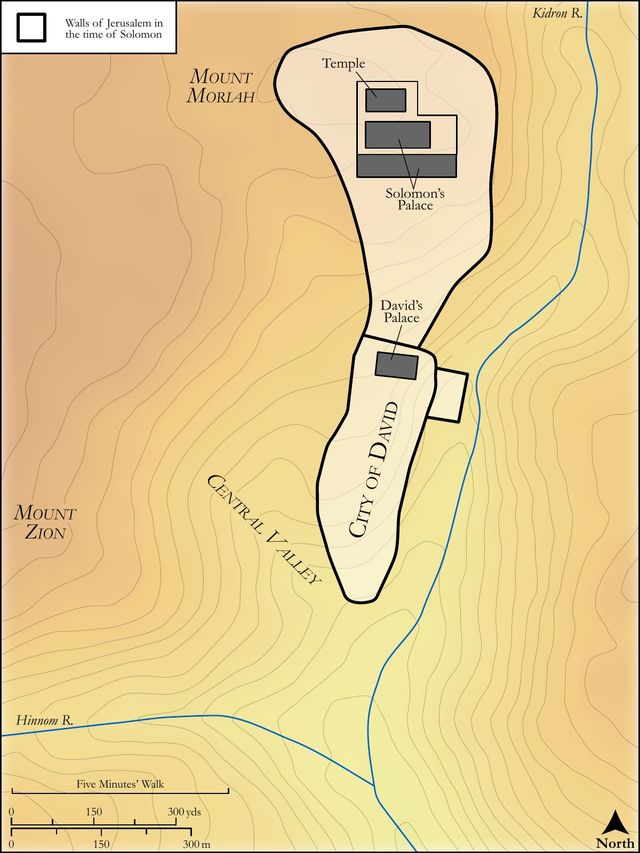
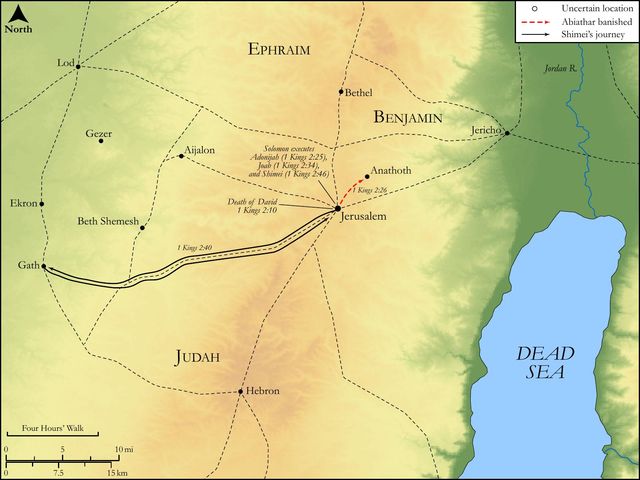
Study this verse
Public-domain commentary
Matthew Henry
From his Commentary on the Whole Bible. Henry comments on passages, not single verses — this entry covers 1 Kings 2:12–25. His three-level outline is real structure in the source text, so it is rendered as structure.
Here is, I. Solomon's accession to the throne, Kg1 2:12. He came to it much more easily and peaceably than David did, and much sooner saw his government established. It is happy for a kingdom when the end of one good reign is the beginning of another, as it was here.
II.His just and necessary removal of Adonijah his rival, in order to the establishment of his throne.
Adonijah had made some bold pretensions to the crown, but was soon obliged to let them fail and throw himself upon Solomon's mercy, who dismissed him upon his good behaviour, and, had he been easy, he might have been safe. But here we have him betraying himself into the hands of Solomon's justice, and falling by it, the righteous God leaving him to himself, that he might be punished for his former treason and that Solomon's throne might be established. Many thus ruin themselves, because they know not when they are well off, or well done to; and sinners, by presuming on God's patience, treasure up wrath to themselves. Now observe,
1.Adonijah's treasonable project, which was to marry Abishag, David's concubine, not because he was in love with her, but because, by her, he hoped to renew his claim to the crown, which might stand him in stead, or because it was then looked upon as a branch of the government to have the wives of the predecessor, Sa2 12:8. Absalom thought his pretensions much supported by lying with his father's concubines. Adonijah flatters himself that if he may succeed him in his bed, especially with the best of his wives, he may by that means step up to succeed him in his throne. Restless and turbulent spirits reach high. It was but a small game to play at, as it should seem, yet he hoped to make it an after-game for the kingdom, and now to gain that by a wife which he could not gain by force.
2.The means he used to compass this. he durst not make suit to Abishag immediately (he knew she was at Solomon's disposal, and he would justly resent it if his consent were not first obtained, as even Ishbosheth did, in a like case, Sa2 3:7), nor durst he himself apply immediately to Solomon, knowing that he lay under his displeasure; but he engaged Bathsheba to be his friend in this matter, who would be forward to believe it a matter of love, and not apt to suspect it a matter of policy. Bathsheba was surprised to see Adonijah in her apartment, and asked him if he did not come with a design to do her a mischief, because she had been instrumental to crush his late attempt. "No," says he, "I come peaceably (Kg1 2:13), and to beg a favour" (Kg1 2:14), that she would use the great interest she had in her son to gain his consent, that he might marry Abishag (Kg1 2:16, Kg1 2:17), and, if he may but obtain this, he will thankfully accept it,
(1.)As a compensation for his loss of the kingdom. He insinuates (Kg1 2:15), "Thou knowest the kingdom was mine, as my father's eldest son, living at the time of his death, and all Israel set their faces on me." This was false; they were but a few that he had on his side; yet thus he would represent himself as an object of compassion, that had been deprived of a crown, and therefore might well be gratified in a wife. If he may not inherit his father's throne, yet let him have something valuable that was his father's, to keep for his sake, and let it be Abishag.
(2.)As his reward for his acquiescence in that loss. He owns Solomon's right to the kingdom: "It was his from the Lord. I was foolish in offering to contest it; and now that it is turned about to him I am satisfied." Thus he pretends to be well pleased with Solomon's accession to the throne, when he is doing all he can to give him disturbance. His words were smoother than butter, but war was in his heart.
3.Bathsheba's address to Solomon on his behalf. She promised to speak to the king for him (Kg1 2:18) and did so, Kg1 2:19. Solomon received her with all the respect that was due to a mother, though he himself was a king: He rose up to meet her, bowed himself to her, and caused her to sit on his right hand, according to the law of the fifth commandment. Children, not only when grown up, but when grown great, must give honour to their parents, and behave dutifully and respectfully towards them. Despise not thy mother when she is old. As a further instance of the deference he paid to his mother's wisdom and authority, when he understood she had a petition to present to him, he promised not to say her nay, a promise which both he and she understood with this necessary limitation, provided it be just and reasonable and fit to be granted; but, if it were otherwise, he was sure he should convince her that it was so, and that then she would withdraw it. She tells him her errand at last (Kg1 2:21): Let Abishag be given to Adonijah thy brother. It was strange that she did not suspect the treason, but more strange that she did not abhor the incest, that was in the proposal. But either she did not take Abishag to be David's wife, because the marriage was not consummated, or she thought it might be dispensed with to gratify Adonijah, in consideration of his tame submission to Solomon. This was her weakness and folly: it was well that she was not regent. Note, Those that have the ear of princes and great men, as it is their wisdom not to be too prodigal of their interest, so it is their duty never to use it for the assistance of sin or the furtherance of any wicked design. Let not princes be asked that which they ought not to grant. It ill becomes a good man to prefer a bad request or appear in a bad cause.
4.Solomon's just and judicious rejection of the request. Though his mother herself was the advocate, and called it a small petition, and perhaps it was the first she had troubled him with since he was king, yet he denied it, without violation of the general promise he had made, Kg1 2:20. If Herod had not had a mind to cut off John Baptist's head, he would not have thought himself obliged to do it by a general promise, like this, made to Herodias. The best friend we have in the world must not have such an interest in us as to bring us to do a wrong thing, either unjust or unwise.
(1.)Solomon convinces his mother of the unreasonableness of the request, and shows her the tendency of it, which, before, she was not aware of. His reply is somewhat sharp: "Ask for him the kingdom also, Kg1 2:22. To ask that he may succeed the king in his bed is, in effect, to ask that he may succeed him in his throne; for that is it he aims at." Probably he had information, or cause for a strong suspicion, that Adonijah was plotting with Joab and Abiathar to give him disturbance, which warranted him to put this construction upon Adonijah's request.
(2.)He convicts and condemns Adonijah for his pretensions, and both with an oath. He convicts him out of his own mouth, Kg1 2:23. His own tongue shall fall upon him; and a heavier load a man needs not fall under. Bathsheba may be imposed upon, but Solomon cannot; he plainly sees what Adonijah aims at, and concludes, "He has spoken this word against his own life; he is snared in the words of his own lips; now he shows what he would be at." He condemns him to die immediately: He shall be put to death this day, Kg1 2:24. God had himself declared with an oath that he would establish David's throne (Psa 89:35), and therefore Solomon pledges the same assurance to secure that establishment, by cutting off the enemies of it. "As God liveth, that establisheth the government, Adonijah shall die, that would unsettle it." Thus the ruin of the enemies of Christ's kingdom is as sure as the stability of his kingdom, and both are as sure as the being and life of God, the founder of it. The warrant is immediately signed for his execution, and no less a man than Benaiah, the son of Jehoiada, general of the army, is ordered to be the executioner, Kg1 2:25. It is strange that Adonijah may not be heard to speak for himself: but Solomon's wisdom did not see it needful to examine the matter any further; it was plain enough that Adonijah aimed at the crown, and Solomon could not be safe while he lived. Ambitious turbulent spirits commonly prepare for themselves the instruments of death. Many a head has been lost by catching at a crown.
Continue studying 1 Kings 2:22 across the web’s major study libraries — every link below opens this exact verse, chapter, or book on the destination site.
Read & Compare
 BibleGatewayThis verse in more than 200 translations and 70 languages.
 Bible.comThe YouVersion reader — hundreds of translations, reading plans, and highlights.
 ESV.orgCrossway's official English Standard Version reader.
 NET BibleThe NET translation with 60,000+ translators' notes on every rendering decision.
 STEP BibleTyndale House's free study tool — original text, vocabulary, and scholarly resources.
 BibliaLogos Bible Software's free web reader.
 USCCBThe New American Bible (Revised Edition) with the U.S. bishops' study notes.
Commentaries
 BibleHub CommentariesDozens of classic commentaries on this verse, gathered on one page.
 StudyLightMore than 100 commentary sets — the largest collection on the web.
 BibleRefPlain-English commentary on what this verse means, verse by verse.
 Enduring WordDavid Guzik's free commentary on this chapter, widely used by Bible teachers.
 Bible Study ToolsVerse commentary alongside Greek and Hebrew study aids.
Original Language & Research
- BibleHub InterlinearThe verse word by word — original language, transliteration, and English.
- BibleHub LexiconEvery word's original-language definition and Strong's entry.
 Blue Letter BibleDeep-study tools — Strong's numbers, concordance, and word studies.
 SefariaThe Hebrew text with Rashi and centuries of Jewish commentary.
Sermons, Hymns & Audio


TrulyRandomVerse is not affiliated with these sites and doesn’t control their content. They’re linked because they’re genuinely useful.
Summary
King Solomon's incisive response to his mother Bathsheba marks a pivotal moment in the consolidation of his nascent reign. He immediately perceives that Adonijah's seemingly innocuous request for Abishag the Shunammite as a wife is, in fact, a thinly veiled and politically charged attempt to assert a claim to the throne, leveraging his status as the elder brother and his past alliances with powerful figures like Abiathar and Joab. This verse highlights Solomon's profound discernment and decisive action in securing his kingdom against lingering threats, demonstrating his early grasp of the intricate power dynamics inherent in royal succession.
Context
ShowHideLiterary Context
This verse is strategically positioned at a critical juncture following the death of King David and the tumultuous transition of power to Solomon. In 1 Kings 1, Adonijah, David's eldest surviving son, had prematurely declared himself king, gathering significant support from key figures such as Joab, the commander of the army, and Abiathar, a prominent priest (1 Kings 1:7). This attempted coup was swiftly thwarted by the intervention of Nathan the prophet and Bathsheba, leading to David's immediate anointing of Solomon as king (1 Kings 1:32-40). Though Adonijah was initially spared by Solomon on the condition of loyalty (1 Kings 1:52-53), his underlying ambition evidently remained. The narrative then progresses to Adonijah's cunning approach to Bathsheba, requesting Abishag, David's former companion, as his wife (1 Kings 2:17), which Bathsheba, perhaps naively, presents to Solomon (1 Kings 2:19-21). Solomon's sharp and immediate response in 1 Kings 2:22 serves as the decisive turning point, revealing his instant comprehension of the true danger and setting the stage for the swift and comprehensive elimination of these lingering threats to his divinely appointed reign.
Historical & Cultural Context
Among the kings of that day, royal succession was frequently a precarious and often violent affair, characterized by intense intrigue and challenges to the new king's authority. A crucial aspect of consolidating power involved eliminating potential rivals and asserting control over all symbols of the previous king's reign. One such potent symbol was the royal harem or those intimately associated with the former king's household. To take possession of a deceased king's concubines or companions was widely understood as a public declaration of one's claim to the throne and a direct usurpation of the previous king's authority. This cultural norm is vividly illustrated by Absalom's actions during his rebellion against David, where he publicly lay with his father's concubines on the rooftop, signaling his claim to the kingship (2 Samuel 16:20-22). Abishag, though described as a companion and caregiver rather than a concubine in the sexual sense (1 Kings 1:3-4), was intimately associated with King David's household and person during his final days. Her close proximity to David made her a symbolic extension of his royal authority. Therefore, Adonijah's request for her was far from a mere romantic overture; it was a deliberate and profound political maneuver, a subtle yet unmistakable challenge to Solomon's legitimacy and rule, calculated to garner support from those who might still favor Adonijah's claim based on primogeniture.
Key Themes
ShowHideThe passage powerfully underscores several key themes critical to understanding the early Solomonic reign. Firstly, Solomon's Discernment and Wisdom is paramount. Despite his youth, Solomon immediately grasps the true, sinister intent behind Adonijah's seemingly innocent request, demonstrating a sharp political acumen that profoundly foreshadows the divine wisdom he would later receive and for which he would become renowned (1 Kings 3:9-12). Secondly, Adonijah's Persistent Ambition is laid bare. Despite having been granted clemency, his desire for the kingship remains unchecked, manifesting in this subtle but dangerous attempt to undermine Solomon's authority, highlighting the destructive and relentless nature of unbridled ambition. Thirdly, the Gravity of Royal Succession and the King's Absolute Authority is profoundly emphasized. Any perceived challenge to the king's authority, no matter how indirect or seemingly benign, was treated as treason and met with severe, decisive consequences to maintain the stability and order of the kingdom. Solomon's firm and immediate response establishes his absolute authority and his unwillingness to tolerate any lingering threats to his divinely appointed rule.
Exposition and Analysis
ShowHideKey Word Analysis
ShowHideWhile the primary meaning is "to inquire" or "to request," Solomon's use of this word here carries a strong undertone of demanding or presuming. He perceives Adonijah's "request" as a veiled assertion of a right or a direct challenge to his authority, rather than a humble petition. This highlights Solomon's immediate recognition of the manipulative and politically charged nature of Adonijah's approach through Bathsheba.
This term refers to the royal dominion, the kingship, or the realm itself. Solomon's immediate and direct leap from "Abishag" to "the kingdom" reveals his profound understanding of the symbolic power dynamics at play. He sees beyond the person of Abishag to what she represents: a direct claim to the throne and the very foundation of his newly established rule. This word underscores the magnitude of the threat Adonijah posed.
Meaning "great" in any sense, and by extension, "older" or "elder." Adonijah's status as the elder brother was the primary basis of his initial claim to the throne (1 Kings 1:5). By explicitly mentioning this, Solomon acknowledges Adonijah's persistent reliance on primogeniture as a justification for his ambition, even though God had clearly designated Solomon as king. Solomon's reference to Adonijah's "elder brother" status, alongside his co-conspirators, underscores the calculated and comprehensive nature of Adonijah's ongoing threat to the legitimate succession.
Verse Breakdown
ShowHide"And king Solomon answered and said unto his mother,"
This opening clause immediately establishes Solomon's firm and direct engagement with the situation. He does not hesitate or defer, but confronts the issue head-on, indicating his resolve and the seriousness with which he views the request. This highlights his nascent authority and decisive character.
"And why dost thou ask Abishag the Shunammite for Adonijah?"
This rhetorical question from Solomon reveals his immediate and profound insight into the true nature of the request. He recognizes that the petition for Abishag is far from innocent. He challenges his mother's unwitting participation, implicitly questioning why she would present such a politically charged request to him without understanding its deeper, treasonous implications.
"ask for him the kingdom also; for he [is] mine elder brother;"
This is the very crux of Solomon's discernment and the turning point of the narrative. He explicitly and forcefully connects the seemingly benign request for Abishag to a direct demand for the kingship itself. He understands that Adonijah, by seeking a woman intimately associated with the former king, is attempting to symbolically claim the throne. The reference to Adonijah being his "elder brother" highlights the persistent claim based on primogeniture, which Adonijah continued to leverage despite God's clear choice of Solomon.
"even for him, and for Abiathar the priest, and for Joab the son of Zeruiah."
Solomon extends his understanding beyond Adonijah alone, implicating his past co-conspirators. This demonstrates Solomon's acute awareness that Adonijah's current move is not an isolated act but part of an ongoing, larger conspiracy involving the powerful and influential figures who had supported his initial rebellion (1 Kings 1:7). This comprehensive understanding of the network of opposition solidifies Solomon's resolve to decisively neutralize the entire threat to his reign.
Literary Devices
ShowHideThe verse employs several potent Literary Devices that amplify its dramatic and theological impact. Solomon's opening query, "And why dost thou ask Abishag the Shunammite for Adonijah?", functions as a powerful Rhetorical Question, not seeking information but rather expressing Solomon's immediate and profound understanding of Adonijah's true, malevolent motives. This question serves to highlight the absurdity and underlying malice of what was presented as a simple request. The request for Abishag herself is a clear example of Symbolism; she is not merely a woman, but a potent symbol of David's reign and, by extension, the royal succession. By seeking her, Adonijah is symbolically claiming the throne and challenging Solomon's legitimacy. Furthermore, Solomon's response, particularly the cutting phrase "ask for him the kingdom also," demonstrates keen Irony. What Bathsheba presents as a humble, perhaps even compassionate, request, Solomon immediately exposes as a bold, treasonous demand for the kingdom. This moment also serves as a strong Foreshadowing of Solomon's future reign, characterized by the divine wisdom that would enable him to discern truth from deception and rule with decisive justice, as famously seen in the case of the two prostitutes (1 Kings 3:16-28).
Theological and Thematic Connections
ShowHideSolomon's swift discernment in 1 Kings 2:22 is not merely a display of political shrewdness but an early manifestation of the divine wisdom that would characterize his reign. It underscores the profound theological truth that God is sovereign over kingship and succession, choosing whom He wills, and empowering His chosen with the necessary insight to govern justly and securely. Adonijah's persistent ambition, despite God's clear appointment of Solomon, highlights the futility and inherent danger of resisting God's ordained plan. This narrative serves as a powerful reminder that true authority comes from God, and attempts to usurp it, even through subtle means, will ultimately fail and face divine judgment. It also speaks to the nature of spiritual discernment, urging believers to look beyond superficial appearances to understand underlying motives and spiritual realities, recognizing that not all requests or actions are as innocent as they may seem.
Reflection and Application
ShowHideSolomon's immediate and profound discernment in 1 Kings 2:22 offers a crucial lesson for believers today: the imperative of spiritual discernment in all areas of life. Just as Solomon saw beyond the surface of Adonijah's request to its true, treasonous intent, we are called to develop the spiritual capacity to discern truth from deception, good from evil, and genuine motives from hidden agendas. This applies not only to major life decisions but also to the subtle temptations, half-truths, and manipulative tactics that can seek to undermine our faith, relationships, or the peace of our communities. Unchecked ambition, as exemplified by Adonijah, can lead to destructive outcomes, reminding us to examine our own desires and ensure they align with God's will and not selfish gain. Furthermore, the passage underscores the importance of recognizing and submitting to rightful authority, whether in the church, family, or civil society, understanding that God often works through established order for the sake of peace and justice. Solomon's decisive action, though severe, secured his kingdom and brought stability, teaching us that sometimes firm boundaries and clear consequences are necessary to protect what is right and preserve order.
Questions for Reflection
ShowHideFAQ
ShowHideWhy was Abishag the Shunammite so significant that asking for her was considered a claim to the throne?
ShowHideAbishag was not merely a concubine, but she had served King David as his companion and caregiver in his final days, sleeping beside him to keep him warm (1 Kings 1:3-4). This intimate association with the king, even if not sexual, made her a symbolic extension of his royal person and household. In Israel, taking possession of a former king's concubines or those intimately connected to his person was a recognized act of claiming the deceased king's authority and, by extension, the throne. Absalom's public act of lying with David's concubines (2 Samuel 16:20-22) is a prime example of this cultural understanding. Solomon immediately understood that Adonijah's request for Abishag was a subtle but clear attempt to assert his claim to the kingship and undermine Solomon's legitimacy.
Why did Bathsheba not understand the deeper implications of Adonijah's request?
ShowHideBathsheba likely acted out of a combination of factors. She may have genuinely believed Adonijah's request was innocent or motivated by a desire to settle down peacefully, perhaps underestimating Adonijah's persistent cunning. Her maternal compassion might have overridden her political acumen, as she had previously interceded for Adonijah's life (1 Kings 1:50-53). It's also possible that Adonijah, known for his charm, was very persuasive in presenting his request as a humble desire rather than a political maneuver. She might not have fully grasped the profound symbolic significance of Abishag in the context of royal succession, or she might have simply underestimated Adonijah's persistent ambition and cunning.
What happened to Adonijah, Abiathar, and Joab as a result of this plot?
ShowHideSolomon acted swiftly and decisively to eliminate these threats to his reign, solidifying his rule and removing all significant opposition. As a direct consequence of this request for Abishag, Adonijah was executed by Benaiah, Solomon's chief of staff (1 Kings 2:25). Abiathar the priest, who had supported Adonijah's initial rebellion, was banished to Anathoth and stripped of his priestly office, fulfilling the ancient prophecy against the house of Eli (1 Kings 2:26-27). Joab, the powerful army commander who had also supported Adonijah, fled to the altar for refuge but was executed there by Benaiah on Solomon's command, due to his past treachery and murders (1 Kings 2:28-34). These actions solidified Solomon's rule and removed all significant opposition.
Christ-Centered Fulfillment
ShowHideSolomon's discerning wisdom and decisive action in 1 Kings 2:22 powerfully foreshadow the perfect wisdom and ultimate kingship of Jesus Christ. Just as Solomon, God's chosen king, recognized and dealt with the subtle, insidious rebellion of Adonijah, so too does Christ, the true Son of David, perfectly discern every hidden motive and every challenge to His divine authority. Adonijah's persistent ambition and attempt to seize the throne through symbolic means mirrors humanity's ongoing rebellion against God's rightful King, seeking to establish its own rule apart from Him. However, unlike Solomon, whose reign was secured through the execution of rivals, Christ's eternal kingdom is established not by taking lives, but by giving His own life on the cross, triumphing over sin, death, and the true enemy, Satan (Colossians 2:15). His discernment is absolute, seeing into the hearts of all men (John 2:24-25), and His authority is unchallenged, for "all authority in heaven and on earth has been given to me" (Matthew 28:18). While Solomon secured an earthly kingdom for a time, Christ reigns eternally over a spiritual kingdom, bringing true peace and justice, and His decisive judgment will ultimately put an end to all rebellion and establish His righteous rule forever (Revelation 19:11-16).