


1 Kings 2:21
Bible text: King James Version (1769 Blayney text) · Public domain
Bible text: Berean Standard Bible · Public domain
Bible text: American Standard Version (1901) · Public domain
Bible text: World English Bible, Messianic edition · Public domain
Bible text: Geneva Bible (1599) · Public domain
Bible text: Young's Literal Translation · Public domain
- וַתֹּאמֶרva·To·merand she saidH559Conj-w ¦ V-Qal-ConsecImperf-3fsVerb Qal Consecutive Imperfect 3rd Singular Feminineוַandתֹּאמֶרshe said
- יֻתַּןyu·Tanlet it be givenH5414V-Hophal-Imperf-3msVerb Hophal Imperfect 3rd Singular Masculine
- אֶת'et<obj.>H853DirObjMParticle Object Indicator
- אֲבִישַׁג'a·vi·ShagAbishagH49N-proper-fNoun Proper Feminine
- הַשֻּׁנַמִּיתha·shu·na·Mitthe ShunammiteH7767Art ¦ N-fsNoun Gentilic Singular Feminine AbsoluteהַtheשֻּׁנַמִּיתShunammite
- לַאֲדֹנִיָּהוּla·'a·do·ni·Ya·huto AdonijahH138Prep-l ¦ N-proper-mNoun Proper MasculineלַtoאֲדֹנִיָּהוּAdonijah
- אָחִיךָ'a·Chi·khayour brotherH251N-msc ¦ 2msNoun Singular Masculine Constructאָחִיbrotherךָyour
- לְאִשָּׁהle·'i·Shahto a wifeH802Prep-l ¦ N-fsNoun Singular Feminine Absoluteלְtoאִשָּׁהa wife
English is a literal word-by-word gloss of the Hebrew, not the KJV's wording. Why?
This is the original text the KJV's translators worked from — each Hebrew word with its own literal English meaning in this verse, prepared by scholars at Tyndale House, Cambridge. The KJV translates whole sentences, not word by word, so its wording differs: one Hebrew word can become several English words, and the KJV may choose “the LORD” where the gloss reads “Yahweh”. Both are faithful — they answer different questions. For the KJV's own rendering, switch to the KJV text.
Details
See on the biblical-era maps

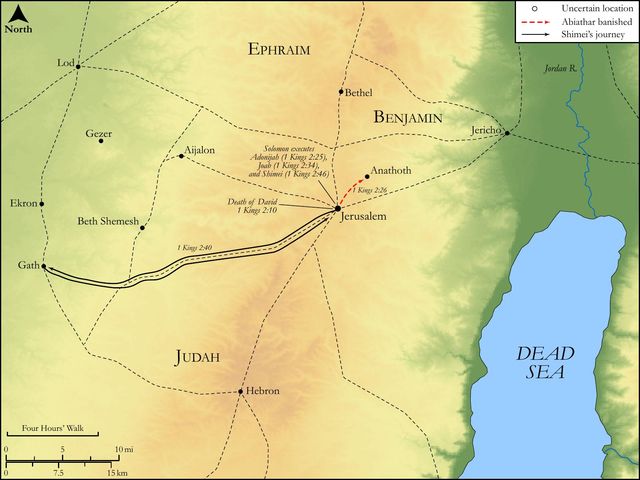
Study this verse
Public-domain commentary
Matthew Henry
From his Commentary on the Whole Bible. Henry comments on passages, not single verses — this entry covers 1 Kings 2:12–25. His three-level outline is real structure in the source text, so it is rendered as structure.
Here is, I. Solomon's accession to the throne, Kg1 2:12. He came to it much more easily and peaceably than David did, and much sooner saw his government established. It is happy for a kingdom when the end of one good reign is the beginning of another, as it was here.
II.His just and necessary removal of Adonijah his rival, in order to the establishment of his throne.
Adonijah had made some bold pretensions to the crown, but was soon obliged to let them fail and throw himself upon Solomon's mercy, who dismissed him upon his good behaviour, and, had he been easy, he might have been safe. But here we have him betraying himself into the hands of Solomon's justice, and falling by it, the righteous God leaving him to himself, that he might be punished for his former treason and that Solomon's throne might be established. Many thus ruin themselves, because they know not when they are well off, or well done to; and sinners, by presuming on God's patience, treasure up wrath to themselves. Now observe,
1.Adonijah's treasonable project, which was to marry Abishag, David's concubine, not because he was in love with her, but because, by her, he hoped to renew his claim to the crown, which might stand him in stead, or because it was then looked upon as a branch of the government to have the wives of the predecessor, Sa2 12:8. Absalom thought his pretensions much supported by lying with his father's concubines. Adonijah flatters himself that if he may succeed him in his bed, especially with the best of his wives, he may by that means step up to succeed him in his throne. Restless and turbulent spirits reach high. It was but a small game to play at, as it should seem, yet he hoped to make it an after-game for the kingdom, and now to gain that by a wife which he could not gain by force.
2.The means he used to compass this. he durst not make suit to Abishag immediately (he knew she was at Solomon's disposal, and he would justly resent it if his consent were not first obtained, as even Ishbosheth did, in a like case, Sa2 3:7), nor durst he himself apply immediately to Solomon, knowing that he lay under his displeasure; but he engaged Bathsheba to be his friend in this matter, who would be forward to believe it a matter of love, and not apt to suspect it a matter of policy. Bathsheba was surprised to see Adonijah in her apartment, and asked him if he did not come with a design to do her a mischief, because she had been instrumental to crush his late attempt. "No," says he, "I come peaceably (Kg1 2:13), and to beg a favour" (Kg1 2:14), that she would use the great interest she had in her son to gain his consent, that he might marry Abishag (Kg1 2:16, Kg1 2:17), and, if he may but obtain this, he will thankfully accept it,
(1.)As a compensation for his loss of the kingdom. He insinuates (Kg1 2:15), "Thou knowest the kingdom was mine, as my father's eldest son, living at the time of his death, and all Israel set their faces on me." This was false; they were but a few that he had on his side; yet thus he would represent himself as an object of compassion, that had been deprived of a crown, and therefore might well be gratified in a wife. If he may not inherit his father's throne, yet let him have something valuable that was his father's, to keep for his sake, and let it be Abishag.
(2.)As his reward for his acquiescence in that loss. He owns Solomon's right to the kingdom: "It was his from the Lord. I was foolish in offering to contest it; and now that it is turned about to him I am satisfied." Thus he pretends to be well pleased with Solomon's accession to the throne, when he is doing all he can to give him disturbance. His words were smoother than butter, but war was in his heart.
3.Bathsheba's address to Solomon on his behalf. She promised to speak to the king for him (Kg1 2:18) and did so, Kg1 2:19. Solomon received her with all the respect that was due to a mother, though he himself was a king: He rose up to meet her, bowed himself to her, and caused her to sit on his right hand, according to the law of the fifth commandment. Children, not only when grown up, but when grown great, must give honour to their parents, and behave dutifully and respectfully towards them. Despise not thy mother when she is old. As a further instance of the deference he paid to his mother's wisdom and authority, when he understood she had a petition to present to him, he promised not to say her nay, a promise which both he and she understood with this necessary limitation, provided it be just and reasonable and fit to be granted; but, if it were otherwise, he was sure he should convince her that it was so, and that then she would withdraw it. She tells him her errand at last (Kg1 2:21): Let Abishag be given to Adonijah thy brother. It was strange that she did not suspect the treason, but more strange that she did not abhor the incest, that was in the proposal. But either she did not take Abishag to be David's wife, because the marriage was not consummated, or she thought it might be dispensed with to gratify Adonijah, in consideration of his tame submission to Solomon. This was her weakness and folly: it was well that she was not regent. Note, Those that have the ear of princes and great men, as it is their wisdom not to be too prodigal of their interest, so it is their duty never to use it for the assistance of sin or the furtherance of any wicked design. Let not princes be asked that which they ought not to grant. It ill becomes a good man to prefer a bad request or appear in a bad cause.
4.Solomon's just and judicious rejection of the request. Though his mother herself was the advocate, and called it a small petition, and perhaps it was the first she had troubled him with since he was king, yet he denied it, without violation of the general promise he had made, Kg1 2:20. If Herod had not had a mind to cut off John Baptist's head, he would not have thought himself obliged to do it by a general promise, like this, made to Herodias. The best friend we have in the world must not have such an interest in us as to bring us to do a wrong thing, either unjust or unwise.
(1.)Solomon convinces his mother of the unreasonableness of the request, and shows her the tendency of it, which, before, she was not aware of. His reply is somewhat sharp: "Ask for him the kingdom also, Kg1 2:22. To ask that he may succeed the king in his bed is, in effect, to ask that he may succeed him in his throne; for that is it he aims at." Probably he had information, or cause for a strong suspicion, that Adonijah was plotting with Joab and Abiathar to give him disturbance, which warranted him to put this construction upon Adonijah's request.
(2.)He convicts and condemns Adonijah for his pretensions, and both with an oath. He convicts him out of his own mouth, Kg1 2:23. His own tongue shall fall upon him; and a heavier load a man needs not fall under. Bathsheba may be imposed upon, but Solomon cannot; he plainly sees what Adonijah aims at, and concludes, "He has spoken this word against his own life; he is snared in the words of his own lips; now he shows what he would be at." He condemns him to die immediately: He shall be put to death this day, Kg1 2:24. God had himself declared with an oath that he would establish David's throne (Psa 89:35), and therefore Solomon pledges the same assurance to secure that establishment, by cutting off the enemies of it. "As God liveth, that establisheth the government, Adonijah shall die, that would unsettle it." Thus the ruin of the enemies of Christ's kingdom is as sure as the stability of his kingdom, and both are as sure as the being and life of God, the founder of it. The warrant is immediately signed for his execution, and no less a man than Benaiah, the son of Jehoiada, general of the army, is ordered to be the executioner, Kg1 2:25. It is strange that Adonijah may not be heard to speak for himself: but Solomon's wisdom did not see it needful to examine the matter any further; it was plain enough that Adonijah aimed at the crown, and Solomon could not be safe while he lived. Ambitious turbulent spirits commonly prepare for themselves the instruments of death. Many a head has been lost by catching at a crown.
Continue studying 1 Kings 2:21 across the web’s major study libraries — every link below opens this exact verse, chapter, or book on the destination site.
Read & Compare
 BibleGatewayThis verse in more than 200 translations and 70 languages.
 Bible.comThe YouVersion reader — hundreds of translations, reading plans, and highlights.
 ESV.orgCrossway's official English Standard Version reader.
 NET BibleThe NET translation with 60,000+ translators' notes on every rendering decision.
 STEP BibleTyndale House's free study tool — original text, vocabulary, and scholarly resources.
 BibliaLogos Bible Software's free web reader.
 USCCBThe New American Bible (Revised Edition) with the U.S. bishops' study notes.
Commentaries
 BibleHub CommentariesDozens of classic commentaries on this verse, gathered on one page.
 StudyLightMore than 100 commentary sets — the largest collection on the web.
 BibleRefPlain-English commentary on what this verse means, verse by verse.
 Enduring WordDavid Guzik's free commentary on this chapter, widely used by Bible teachers.
 Bible Study ToolsVerse commentary alongside Greek and Hebrew study aids.
Original Language & Research
- BibleHub InterlinearThe verse word by word — original language, transliteration, and English.
- BibleHub LexiconEvery word's original-language definition and Strong's entry.
 Blue Letter BibleDeep-study tools — Strong's numbers, concordance, and word studies.
 SefariaThe Hebrew text with Rashi and centuries of Jewish commentary.
Sermons, Hymns & Audio


TrulyRandomVerse is not affiliated with these sites and doesn’t control their content. They’re linked because they’re genuinely useful.
Summary
This verse captures a pivotal moment at the very beginning of King Solomon's reign, where his half-brother Adonijah, through their mother Bathsheba, requests permission to marry Abishag the Shunammite, who had served King David in his old age. What appears on the surface to be a simple domestic request is, in fact, a deeply calculated political maneuver by Adonijah to subtly assert a claim to the throne, which Solomon immediately discerns and decisively counters.
Context
ShowHideLiterary Context
This verse is situated immediately after the death of King David and the tumultuous establishment of Solomon's kingship. The preceding chapter, 1 Kings 1, details Adonijah's initial, failed attempt to usurp the throne while David was still alive but frail. Solomon's anointing by Zadok the priest and Nathan the prophet, at Bathsheba's urging, secured his position. 1 Kings 2 opens with David's final charge to Solomon, emphasizing justice and loyalty. Adonijah's request in 1 Kings 2:21 is not an isolated incident but the final, desperate attempt by a rival claimant to undermine Solomon's authority, leading directly to Solomon's swift and firm consolidation of power, including the execution of Adonijah and other threats to his reign.
Historical & Cultural Context
In Israel, the harem of a deceased king was considered part of the royal inheritance. Marrying a former king's wife or concubine was a direct, symbolic act of claiming the throne and legitimacy of the previous monarch. This custom is famously illustrated by Absalom's public act of taking his father David's concubines during his rebellion, which was advised by Ahithophel as a means to "make himself odious to his father" and demonstrate his claim to the kingship. Abishag the Shunammite, though not intimate with David (1 Kings 1:4), was part of the royal household, chosen specifically to serve the king. Her association with David, even as a nurse, rendered her a symbol of the late king's personal property and, by extension, his royal authority. Adonijah's request, therefore, was not merely for a wife but for a symbol of royal succession, a subtle but potent challenge to Solomon's newly established reign.
Key Themes
ShowHideThis verse powerfully contributes to several key themes within 1 Kings. Firstly, it underscores the nature of kingship and succession in ancient Israel, revealing the intense political maneuvering and often ruthless consolidation of power required to secure the throne. Secondly, it highlights the theme of discernment and wisdom, as Solomon immediately perceives the hidden agenda behind Adonijah's seemingly innocent request, demonstrating the wisdom for which he would later become renowned (1 Kings 3:9). Thirdly, it speaks to the theme of divine sovereignty versus human ambition, showing that while human actors scheme for power, God's chosen king ultimately prevails. Adonijah's persistent ambition ultimately leads to his downfall, serving as a stark warning against challenging God's established order.
Exposition and Analysis
ShowHideKey Word Analysis
ShowHideHer name, H49, derived from "father of error" or "blundering," points less to her character and more to the fateful outcome of this request. As "the Shunammite" (H7767), she hailed from Shunem, a town in Issachar. Her unique status stemmed from her role as David's attendant in his final days (1 Kings 1:1-4), which placed her in intimate proximity to the royal person. Though not a traditional concubine, her association with the king made her a highly symbolic figure, a de facto part of the royal household, and thus, a sensitive political asset.
This verb, H5414, meaning "to give," "to place," or "to grant," is used here in the passive voice ("be given"). Bathsheba's phrasing implies a simple transaction or permission, framing it as a benign request for a marital arrangement. However, in the context of royal succession, the act of "giving" or receiving such a person carried immense political weight, signifying the transfer of legitimacy or a claim to the previous king's authority. Its broad semantic range underscores the various ways power and authority can be transferred or perceived.
The word H802, meaning "woman" or "wife," when combined with the preposition "to" (Hebrew l), clearly indicates a marital union. The simplicity of the phrase "to wife" belies the profound political implications. It is not merely about a woman; it is about the status that marriage to her would confer upon Adonijah, implicitly linking him to the deceased king's legacy and, by extension, to the throne. This seemingly domestic request was, in fact, a direct challenge to Solomon's newly established authority.
Verse Breakdown
ShowHide"And she said,"
This refers to Bathsheba, King Solomon's mother. Her role as an intercessor for Adonijah is significant, as she had previously been instrumental in securing Solomon's own ascent to the throne. Her willingness to present this request suggests either a genuine naivete regarding its true implications or a desperate attempt to appease Adonijah, perhaps out of fear or a misguided sense of compassion.
"Let Abishag the Shunammite be given"
This is the core of the request. Abishag's identity as David's former attendant is crucial. The passive construction "be given" places the decision squarely in Solomon's hands, making it appear as a humble petition rather than a demand. The very act of asking for "the Shunammite" rather than any other woman highlights the symbolic nature of the request.
"to Adonijah thy brother"
Bathsheba emphasizes the familial relationship ("thy brother"), perhaps hoping to appeal to Solomon's sense of kinship and soften any potential resistance. This phrasing attempts to normalize the request, framing it as a brotherly gesture rather than a political challenge, subtly attempting to leverage Solomon's affection or obligation.
"to wife."
This specifies the nature of the desired relationship. The marriage to Abishag, a woman associated with the former king, would symbolically transfer a measure of David's royal authority and legitimacy to Adonijah, making him a viable contender for the throne in the eyes of many. It was the final, critical piece of Adonijah's calculated move.
Literary Devices
ShowHideThe verse employs Irony, as Bathsheba's seemingly innocent and domestic request masks a profound political challenge. Her words, intended to secure a wife for Adonijah, unwittingly become the catalyst for his demise, demonstrating the dramatic irony between her stated intention and the actual outcome. Furthermore, Symbolism is central, with Abishag herself serving as a potent symbol of David's royal authority and legacy. Her person becomes a contested object, representing the very throne of Israel. The conciseness of the verse also contributes to its dramatic effect, creating a moment of suspense as the reader anticipates Solomon's reaction to this loaded request, which ultimately serves as a foreshadowing of Solomon's decisive and often ruthless actions to consolidate his power and eliminate all threats to his reign.
Theological and Thematic Connections
ShowHideThis seemingly simple request for a wife unveils the complex interplay between human ambition, political maneuvering, and divine sovereignty in the establishment of kingship. It highlights the importance of discernment, not just in matters of state, but in all areas of life, recognizing that intentions are not always as they appear. Solomon's immediate grasp of the hidden agenda behind Adonijah's request underscores the value of wisdom in leadership, a wisdom he would famously seek and receive from God. The narrative serves as a powerful reminder that while human beings may scheme and contend for power, ultimately, God's purposes prevail, and those who oppose His chosen instruments do so to their own peril.
Reflection and Application
ShowHideThe request in 1 Kings 2:21 serves as a profound lesson in discernment, urging us to look beyond the surface of situations and requests to understand the true motives at play. In our personal lives, we often encounter situations where seemingly innocent proposals or actions might harbor hidden agendas, whether in relationships, business, or even within the church. This passage challenges us to cultivate spiritual wisdom, asking God for the insight to perceive the underlying intentions of others and to guard against being unwitting pawns in someone else's schemes. It also reminds us of the importance of protecting what God has entrusted to us, whether it's our spiritual walk, our family, or our sphere of influence, by being vigilant against subtle attempts to undermine or usurp. Solomon's firm response, though severe, highlights the necessity of decisive action when faced with clear threats to established order or divine purpose.
Questions for Reflection
ShowHideFAQ
ShowHideWhy was marrying a former king's concubine or attendant such a significant political act in ancient Israel?
ShowHideIn Israel, a king's harem or concubines were considered part of his royal property and symbols of his authority and legacy. Upon his death, control over these women often passed to his successor. Therefore, for anyone else to marry or claim a woman who had been intimately associated with the former king was a direct, symbolic act of claiming the previous king's throne and legitimacy. It was a public declaration of one's right to succeed the deceased monarch. This is famously illustrated by Absalom's public act of taking his father David's concubines during his rebellion, which was advised as a way to make his claim to the throne undeniable and irreversible. Adonijah's request for Abishag, who had served King David, was therefore not a personal romantic desire but a calculated political maneuver to assert his claim to the kingship, even after Solomon had been established.
Was Bathsheba truly naive to the implications of Adonijah's request, or was she complicit in his scheme?
ShowHideWhile the text does not explicitly state Bathsheba's full awareness, most scholars lean towards her being genuinely naive or, at the very least, underestimating the profound political implications of Adonijah's request. Bathsheba had been instrumental in securing Solomon's ascent to the throne (1 Kings 1:11-31), and it would be highly illogical for her to knowingly participate in a scheme that would undermine her own son's reign and potentially put her own life in jeopardy, as Solomon's reaction clearly indicates. Adonijah likely exploited her maternal compassion and perhaps her lingering guilt or sympathy for him as David's son, presenting the request in a way that seemed innocuous ("he is my brother," 1 Kings 2:22). Solomon's response to Bathsheba, while firm, does not accuse her of complicity, but rather of being an unwitting pawn in Adonijah's final, desperate attempt to seize power.
Christ-Centered Fulfillment
ShowHideThe political intrigue and struggle for the throne in 1 Kings 2:21, culminating in Solomon's decisive and often violent consolidation of power, ultimately point to the superior and perfectly established kingship of Jesus Christ. Solomon's wisdom, which allowed him to discern Adonijah's hidden agenda, foreshadows the perfect and infallible discernment of Christ, who knows the hearts and intentions of all men (Hebrews 4:12). While Solomon's reign began with the elimination of rivals and the shedding of blood to secure his earthly kingdom, Christ's kingdom is "not of this world" (John 18:36), established not by human maneuvering or violence, but by divine appointment and His atoning sacrifice. Jesus is the true Son of David, the rightful heir to an eternal throne, whose authority is unchallenged and whose reign brings true peace and justice, unlike the temporary and often turbulent reigns of earthly kings. His kingdom is secured by divine decree, not by the execution of rivals, and His wisdom far surpasses that of Solomon, for in Him "are hidden all the treasures of wisdom and knowledge" (Colossians 2:3). He is the King who perfectly discerns and justly rules, ultimately bringing all opposition to naught, not through earthly force, but through His divine power and righteous judgment (Revelation 19:11-16).