


1 Kings 2:20
Bible text: King James Version (1769 Blayney text) · Public domain
Bible text: King James Version with Strong's numbers · Public domain
Bible text: Berean Standard Bible · Public domain
Bible text: American Standard Version (1901) · Public domain
Bible text: World English Bible, Messianic edition · Public domain
Bible text: Geneva Bible (1599) · Public domain
Bible text: Young's Literal Translation · Public domain
- וַתֹּאמֶרva·To·merand she saidH559Conj-w ¦ V-Qal-ConsecImperf-3fsVerb Qal Consecutive Imperfect 3rd Singular Feminineוַandתֹּאמֶרshe said
- שְׁאֵלָהshe·'e·Laha petitionH7596N-fsNoun Singular Feminine Absolute
- אַחַת'a·ChatoneH259N-fscNoun Singular Feminine Construct
- קְטַנָּהke·ta·NahsmallH6996Adj-fsAdjective Singular Feminine Absolute
- אָנֹכִי'a·no·KhiIH595Pro-1csPronoun Personal 1st Singular common gender
- שֹׁאֶלֶתsho·'E·let[am] askingH7592V-Qal-Prtcpl-fsVerb Qal Participle Singular Feminine Absolute
- מֵאִתָּךְme·'i·Takhfrom with <the> youH854Prep-m ¦ Prep ¦ 2msPreposition Definiteמֵfromאִתָּwith <the>ךְyou
- אַל'almay notH408NegParticle Negative
- תָּשֶׁבTa·shevyou turn awayH7725V-Hiphil-Imperf-2msVerb Hiphil Imperfect 2nd Singular Masculine
- אֶת'et<obj.>H853DirObjMParticle Object Indicator
- פָּנָיpa·Naimy faceH6440N-mpc ¦ 1csNoun Plural Masculine Constructפָּנָfaceיmy
- וַיֹּאמֶרvai·yo·merand he saidH559Conj-w ¦ V-Qal-ConsecImperf-3msVerb Qal Consecutive Imperfect 3rd Singular Masculineוַandיֹּאמֶרhe said
- לָהּlahto herPrep-l ¦ 3fsSuffix Personal 3rd Singular Feminineלָtoהּher
- הַמֶּלֶךְha·Me·lekhthe kingH4428Art ¦ N-msNoun Singular Masculine Absoluteהַtheמֶּלֶךְking
- שַׁאֲלִיsha·'a·LiaskH7592V-Qal-Imp-2fsVerb Qal Imperative 2nd Singular Feminine
- אִמִּי'i·Mimy O motherH517N-fsc ¦ 1csNoun Singular Feminine ConstructאִמִּO motherיmy
- כִּיkiforH3588PrtParticle Conditional
- לֹאlo'notH3808NegParticle Negative
- אָשִׁיב'a·ShivI will turn awayH7725V-Hiphil-Imperf-1csVerb Hiphil Imperfect 1st Singular common gender
- אֶת'et<obj.>H853DirObjMParticle Object Indicator
- פָּנָיִךְpa·Na·yikhyour faceH6440N-mpc ¦ 2fsNoun Plural Masculine Constructפָּנָיִfaceךְyour
English is a literal word-by-word gloss of the Hebrew, not the KJV's wording. Why?
This is the original text the KJV's translators worked from — each Hebrew word with its own literal English meaning in this verse, prepared by scholars at Tyndale House, Cambridge. The KJV translates whole sentences, not word by word, so its wording differs: one Hebrew word can become several English words, and the KJV may choose “the LORD” where the gloss reads “Yahweh”. Both are faithful — they answer different questions. For the KJV's own rendering, switch to the KJV text.
Details
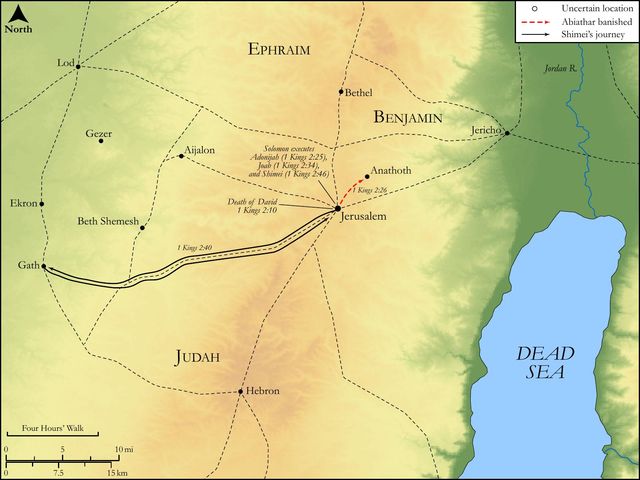
See on the biblical-era maps

Study this verse
Public-domain commentary
Matthew Henry
From his Commentary on the Whole Bible. Henry comments on passages, not single verses — this entry covers 1 Kings 2:12–25. His three-level outline is real structure in the source text, so it is rendered as structure.
Here is, I. Solomon's accession to the throne, Kg1 2:12. He came to it much more easily and peaceably than David did, and much sooner saw his government established. It is happy for a kingdom when the end of one good reign is the beginning of another, as it was here.
II.His just and necessary removal of Adonijah his rival, in order to the establishment of his throne.
Adonijah had made some bold pretensions to the crown, but was soon obliged to let them fail and throw himself upon Solomon's mercy, who dismissed him upon his good behaviour, and, had he been easy, he might have been safe. But here we have him betraying himself into the hands of Solomon's justice, and falling by it, the righteous God leaving him to himself, that he might be punished for his former treason and that Solomon's throne might be established. Many thus ruin themselves, because they know not when they are well off, or well done to; and sinners, by presuming on God's patience, treasure up wrath to themselves. Now observe,
1.Adonijah's treasonable project, which was to marry Abishag, David's concubine, not because he was in love with her, but because, by her, he hoped to renew his claim to the crown, which might stand him in stead, or because it was then looked upon as a branch of the government to have the wives of the predecessor, Sa2 12:8. Absalom thought his pretensions much supported by lying with his father's concubines. Adonijah flatters himself that if he may succeed him in his bed, especially with the best of his wives, he may by that means step up to succeed him in his throne. Restless and turbulent spirits reach high. It was but a small game to play at, as it should seem, yet he hoped to make it an after-game for the kingdom, and now to gain that by a wife which he could not gain by force.
2.The means he used to compass this. he durst not make suit to Abishag immediately (he knew she was at Solomon's disposal, and he would justly resent it if his consent were not first obtained, as even Ishbosheth did, in a like case, Sa2 3:7), nor durst he himself apply immediately to Solomon, knowing that he lay under his displeasure; but he engaged Bathsheba to be his friend in this matter, who would be forward to believe it a matter of love, and not apt to suspect it a matter of policy. Bathsheba was surprised to see Adonijah in her apartment, and asked him if he did not come with a design to do her a mischief, because she had been instrumental to crush his late attempt. "No," says he, "I come peaceably (Kg1 2:13), and to beg a favour" (Kg1 2:14), that she would use the great interest she had in her son to gain his consent, that he might marry Abishag (Kg1 2:16, Kg1 2:17), and, if he may but obtain this, he will thankfully accept it,
(1.)As a compensation for his loss of the kingdom. He insinuates (Kg1 2:15), "Thou knowest the kingdom was mine, as my father's eldest son, living at the time of his death, and all Israel set their faces on me." This was false; they were but a few that he had on his side; yet thus he would represent himself as an object of compassion, that had been deprived of a crown, and therefore might well be gratified in a wife. If he may not inherit his father's throne, yet let him have something valuable that was his father's, to keep for his sake, and let it be Abishag.
(2.)As his reward for his acquiescence in that loss. He owns Solomon's right to the kingdom: "It was his from the Lord. I was foolish in offering to contest it; and now that it is turned about to him I am satisfied." Thus he pretends to be well pleased with Solomon's accession to the throne, when he is doing all he can to give him disturbance. His words were smoother than butter, but war was in his heart.
3.Bathsheba's address to Solomon on his behalf. She promised to speak to the king for him (Kg1 2:18) and did so, Kg1 2:19. Solomon received her with all the respect that was due to a mother, though he himself was a king: He rose up to meet her, bowed himself to her, and caused her to sit on his right hand, according to the law of the fifth commandment. Children, not only when grown up, but when grown great, must give honour to their parents, and behave dutifully and respectfully towards them. Despise not thy mother when she is old. As a further instance of the deference he paid to his mother's wisdom and authority, when he understood she had a petition to present to him, he promised not to say her nay, a promise which both he and she understood with this necessary limitation, provided it be just and reasonable and fit to be granted; but, if it were otherwise, he was sure he should convince her that it was so, and that then she would withdraw it. She tells him her errand at last (Kg1 2:21): Let Abishag be given to Adonijah thy brother. It was strange that she did not suspect the treason, but more strange that she did not abhor the incest, that was in the proposal. But either she did not take Abishag to be David's wife, because the marriage was not consummated, or she thought it might be dispensed with to gratify Adonijah, in consideration of his tame submission to Solomon. This was her weakness and folly: it was well that she was not regent. Note, Those that have the ear of princes and great men, as it is their wisdom not to be too prodigal of their interest, so it is their duty never to use it for the assistance of sin or the furtherance of any wicked design. Let not princes be asked that which they ought not to grant. It ill becomes a good man to prefer a bad request or appear in a bad cause.
4.Solomon's just and judicious rejection of the request. Though his mother herself was the advocate, and called it a small petition, and perhaps it was the first she had troubled him with since he was king, yet he denied it, without violation of the general promise he had made, Kg1 2:20. If Herod had not had a mind to cut off John Baptist's head, he would not have thought himself obliged to do it by a general promise, like this, made to Herodias. The best friend we have in the world must not have such an interest in us as to bring us to do a wrong thing, either unjust or unwise.
(1.)Solomon convinces his mother of the unreasonableness of the request, and shows her the tendency of it, which, before, she was not aware of. His reply is somewhat sharp: "Ask for him the kingdom also, Kg1 2:22. To ask that he may succeed the king in his bed is, in effect, to ask that he may succeed him in his throne; for that is it he aims at." Probably he had information, or cause for a strong suspicion, that Adonijah was plotting with Joab and Abiathar to give him disturbance, which warranted him to put this construction upon Adonijah's request.
(2.)He convicts and condemns Adonijah for his pretensions, and both with an oath. He convicts him out of his own mouth, Kg1 2:23. His own tongue shall fall upon him; and a heavier load a man needs not fall under. Bathsheba may be imposed upon, but Solomon cannot; he plainly sees what Adonijah aims at, and concludes, "He has spoken this word against his own life; he is snared in the words of his own lips; now he shows what he would be at." He condemns him to die immediately: He shall be put to death this day, Kg1 2:24. God had himself declared with an oath that he would establish David's throne (Psa 89:35), and therefore Solomon pledges the same assurance to secure that establishment, by cutting off the enemies of it. "As God liveth, that establisheth the government, Adonijah shall die, that would unsettle it." Thus the ruin of the enemies of Christ's kingdom is as sure as the stability of his kingdom, and both are as sure as the being and life of God, the founder of it. The warrant is immediately signed for his execution, and no less a man than Benaiah, the son of Jehoiada, general of the army, is ordered to be the executioner, Kg1 2:25. It is strange that Adonijah may not be heard to speak for himself: but Solomon's wisdom did not see it needful to examine the matter any further; it was plain enough that Adonijah aimed at the crown, and Solomon could not be safe while he lived. Ambitious turbulent spirits commonly prepare for themselves the instruments of death. Many a head has been lost by catching at a crown.
Continue studying 1 Kings 2:20 across the web’s major study libraries — every link below opens this exact verse, chapter, or book on the destination site.
Read & Compare
 BibleGatewayThis verse in more than 200 translations and 70 languages.
 Bible.comThe YouVersion reader — hundreds of translations, reading plans, and highlights.
 ESV.orgCrossway's official English Standard Version reader.
 NET BibleThe NET translation with 60,000+ translators' notes on every rendering decision.
 STEP BibleTyndale House's free study tool — original text, vocabulary, and scholarly resources.
 BibliaLogos Bible Software's free web reader.
 USCCBThe New American Bible (Revised Edition) with the U.S. bishops' study notes.
Commentaries
 BibleHub CommentariesDozens of classic commentaries on this verse, gathered on one page.
 StudyLightMore than 100 commentary sets — the largest collection on the web.
 BibleRefPlain-English commentary on what this verse means, verse by verse.
 Enduring WordDavid Guzik's free commentary on this chapter, widely used by Bible teachers.
 Bible Study ToolsVerse commentary alongside Greek and Hebrew study aids.
Original Language & Research
- BibleHub InterlinearThe verse word by word — original language, transliteration, and English.
- BibleHub LexiconEvery word's original-language definition and Strong's entry.
 Blue Letter BibleDeep-study tools — Strong's numbers, concordance, and word studies.
 SefariaThe Hebrew text with Rashi and centuries of Jewish commentary.
Sermons, Hymns & Audio


TrulyRandomVerse is not affiliated with these sites and doesn’t control their content. They’re linked because they’re genuinely useful.
Summary
This pivotal verse captures a tense and strategically charged exchange between the newly enthroned King Solomon and his mother, Bathsheba. She approaches him with what she presents as a "one small petition," earnestly imploring him not to refuse her. Demonstrating profound filial respect and an initial willingness to honor his mother, the young king readily assents, promising not to deny her request. This brief dialogue sets the immediate stage for a critical moment of royal discernment, revealing the intricate web of political maneuvering at the dawn of Solomon's reign and foreshadowing the decisive consolidation of his authority.
Context
ShowHideLiterary Context
This verse is situated at a critical juncture in the narrative of King Solomon's ascension to the throne, immediately following the death of King David and Solomon's divinely sanctioned anointing as his successor, a process detailed in 1 Kings 1. The preceding chapter describes Adonijah's failed attempt to usurp the throne during David's final days (1 Kings 1:5-10), and Solomon's subsequent anointing (1 Kings 1:32-40). In 1 Kings 2, David gives his final charge to Solomon, urging him to walk in God's ways and deal with certain individuals. Adonijah, still harboring ambitions, then approaches Bathsheba with a seemingly innocuous request to marry Abishag the Shunammite (1 Kings 2:17), a young woman who had attended to King David in his old age. Bathsheba, in turn, presents this request to Solomon in 1 Kings 2:20, setting the stage for Solomon's decisive response and the consolidation of his reign.
Historical & Cultural Context
Among the kings of that day, the succession to the throne was frequently fraught with political intrigue, power struggles, and even violence. While primogeniture was a common practice, it was not an absolute rule; divine favor, a king's personal designation, or strategic alliances could override it. The role of the "queen mother" (Hebrew: gebirah) was often immensely significant, wielding considerable influence and frequently acting as an intercessor or mediator, as exemplified by Bathsheba's approach to Solomon. Furthermore, marrying a former concubine or attendant of a deceased king was a highly symbolic and politically charged act, frequently interpreted as a direct claim to the throne itself, signifying continuity of the royal household and succession to the previous king's authority and possessions. This crucial cultural understanding illuminates why Adonijah's seemingly personal request for Abishag was, in fact, a profound and dangerous political challenge, and why Solomon's subsequent response was so swift and severe.
Key Themes
ShowHideThis verse contributes to several foundational themes within 1 Kings. Firstly, it highlights the theme of royal succession and the consolidation of power. Solomon's ability to discern and decisively act upon the underlying threat of Adonijah's "small petition" demonstrates his emerging authority and nascent wisdom, a quality God later grants him in abundance (1 Kings 3:5-14). Secondly, the pervasive theme of political maneuvering and ambition is central, as Adonijah's request, though veiled, is a clear and calculated attempt to undermine Solomon's newly established reign. Thirdly, the verse subtly introduces the theme of divine sovereignty over human schemes; despite the intricate human plots and machinations, God's ultimate plan for Solomon's reign and the stability of his kingdom ultimately prevails. Lastly, it touches upon the complex theme of filial respect and its necessary limits within the context of royal duty, as Solomon's initial deference to his mother is quickly superseded by his supreme responsibility as king to protect his kingdom and ensure its security.
Exposition and Analysis
ShowHideKey Word Analysis
ShowHideThis adjective (H6996) denotes something abbreviated, diminutive, or of little quantity, size, or importance. Bathsheba's strategic use of "one small petition" (shᵉʼêlâh qâṭânnâh) is a deliberate understatement, designed to minimize the perceived significance of her request and to elicit an immediate, positive response from her son. The term itself carries no inherent judgment of size, making its qualification as "small" ironically misleading given the profound political implications that immediately follow.
This noun (H7596) refers to a request, a plea, or something asked for. When combined with "small," it forms the core of Bathsheba's deceptive framing. The word itself is neutral, but in this context, it becomes a vehicle for Adonijah's ambition, demonstrating how even a seemingly innocent request can carry immense weight and hidden agendas within the political sphere.
This idiomatic phrase, derived from the root H7725 meaning "to turn back" or "refuse," literally translates to "do not turn away my face" or "do not refuse my presence." It is a plea for favor and acceptance, emphasizing the earnestness of Bathsheba's request and her expectation that Solomon will honor her. It highlights the deeply personal nature of the appeal, leveraging the mother-son bond within the formal setting of the royal court. Solomon's echoing of this phrase, "I will not say thee nay," underscores his initial, seemingly unconditional, assent, creating dramatic tension.
Verse Breakdown
ShowHide"Then she said, I desire one small petition of thee;"
Bathsheba initiates the conversation, carefully framing her request as minor and insignificant. This opening serves to disarm Solomon and to leverage his natural inclination to grant his mother's wishes, setting a trap for the unsuspecting king or, more likely, testing his discernment and resolve.
"[I pray thee], say me not nay."
This is Bathsheba's direct appeal, an earnest plea for Solomon not to refuse her. It underscores her perceived vulnerability in making the request and her reliance on Solomon's filial love and respect. The KJV's "I pray thee" adds to the supplicatory and humble tone, further emphasizing her expectation of a positive response.
"And the king said unto her, Ask on, my mother:"
Solomon's immediate response demonstrates his deep respect and affection for Bathsheba. He grants her permission to speak without even knowing the content of her request, signaling an initial willingness to accede to whatever she might ask. This highlights the significant influence of the queen mother in the ancient Israelite court and Solomon's initial deference.
"for I will not say thee nay."
Solomon's emphatic promise echoes Bathsheba's plea, seemingly guaranteeing that her request will be granted. This unconditional promise, made before the petition is even revealed, creates profound dramatic tension and sets the stage for Solomon's later, unexpected, and decisive action, showcasing his emerging wisdom and political acumen in discerning the true nature of the request.
Literary Devices
ShowHideThe passage employs several potent literary devices to enhance its dramatic impact and convey its underlying messages. Dialogue is central, with the direct exchange between Bathsheba and Solomon efficiently revealing their relationship dynamics and advancing the plot. The most prominent device is dramatic irony: the audience, having witnessed Adonijah's earlier usurpation attempt and his subsequent request for Abishag, understands that Bathsheba's "one small petition" is anything but. This creates a tension between the characters' perception and the audience's knowledge, highlighting the gravity of the situation. Bathsheba's description of the petition as "small" is a clear understatement, strategically employed to downplay its political significance and manipulate Solomon's response. Furthermore, Solomon's seemingly unconditional promise, "I will not say thee nay," serves as a powerful foreshadowing device, hinting at the profound and unexpected consequences that will unfold as a direct result of this seemingly benign interaction, revealing Solomon's true character and resolve.
Theological and Thematic Connections
ShowHideThe interaction in 1 Kings 2:20 serves as a poignant illustration of the complexities of human relationships, the subtle and often deceptive nature of political ambition, and the critical need for divine wisdom in leadership. While Solomon initially demonstrates filial respect, his subsequent actions (detailed immediately after this verse in 1 Kings 2:22-25) reveal a profound discernment that looks beyond surface appearances to grasp the true, dangerous implications of Adonijah's request. This highlights the theological theme that true wisdom, often sought from God, is essential for righteous governance and for navigating the deceitful schemes of humanity. It underscores that God's plan for His chosen king will ultimately prevail, even amidst human machinations and attempts to subvert divine order, demonstrating His sovereignty over all earthly affairs.
Reflection and Application
ShowHideThis brief but potent exchange in 1 Kings 2:20 offers profound insights for our own lives, particularly concerning discernment, the nature of influence, and the consequences of unchecked ambition. Solomon's initial, seemingly unconditional promise to his mother underscores the importance of honoring family and those in positions of respect. However, his subsequent, decisive action (beyond this verse) demonstrates the vital necessity of looking beyond the surface of requests and situations to understand their true intentions and potential implications. In our own interactions, we are called to cultivate a spirit of wisdom and discernment, not merely reacting to what is presented, but seeking to understand the underlying motives and potential consequences of words and actions. This passage also reminds us that influence, whether personal or positional, carries significant responsibility. How we wield our influence, and how we respond to the influence of others, can have far-reaching effects, shaping not only our own lives but also the lives of those around us. Ultimately, it serves as a cautionary tale against unchecked ambition, reminding us that even seemingly "small" acts driven by selfish motives can lead to significant, often negative, outcomes, disrupting peace and order.
Questions for Reflection
ShowHideFAQ
ShowHideWhy did Bathsheba agree to present Adonijah's petition to Solomon?
ShowHideThe biblical text does not explicitly state Bathsheba's precise motives, leaving room for interpretation. She may have genuinely believed Adonijah's request was "small" and innocent, perhaps out of a degree of naivete, a desire to maintain peace within the royal family after David's death, or even a lingering maternal affection for Adonijah (who was also a son of David). Alternatively, a more astute interpretation suggests she might have suspected Adonijah's true intentions but chose to present the petition anyway, perhaps as a deliberate test of Solomon's wisdom and his ability to discern underlying threats to his newly established reign. Her unique role as queen mother gave her privileged access and significant influence with the king, which Adonijah shrewdly exploited (1 Kings 2:17).
What was the true significance of Adonijah asking for Abishag the Shunammite as his wife?
ShowHideAdonijah's request for Abishag was far from a "small petition"; it was a calculated and profound political maneuver with immense implications. In Israel, marrying a former concubine or attendant of a deceased king was often interpreted as a symbolic, yet very real, claim to the throne itself. It signified succession to the previous king's household, authority, and legacy. Although Abishag had not been intimate with David (1 Kings 1:4), her close association with the late king made her a potent symbol of royal legitimacy. By seeking to marry her, Adonijah was subtly, yet clearly, attempting to assert a claim to the kingship and undermine Solomon's newly established reign. Solomon immediately recognized this underlying challenge to his authority and acted swiftly and decisively to eliminate the threat (1 Kings 2:22-25).
Christ-Centered Fulfillment
ShowHideThe interaction between Solomon and Bathsheba in 1 Kings 2:20 subtly foreshadows the perfect wisdom, inherent discernment, and ultimate authority embodied in Jesus Christ. While Solomon, in his nascent reign, must navigate political intrigue and discern the true motives behind a seemingly innocuous request, Christ, as the King of Kings and Lord of Lords, possesses inherent, unchallengeable discernment that requires no testing or external information. He is the one who knows what is in man and whose judgments are always perfectly righteous and true (John 5:30). Unlike Solomon's initial, perhaps politically strategic, 'I will not say thee nay,' Christ's 'yes' is always absolute truth, and His 'no' is always perfect wisdom, for He is the Amen, the faithful and true witness. He is the ultimate wise King, whose throne is established not by human maneuvering or the fragile promises of men, but by divine decree, and whose eternal reign is perfectly just, offering true peace and security far beyond any earthly kingdom (Isaiah 9:6-7).