


Luke 11:9
Bible text: King James Version (1769 Blayney text) · Public domain
Bible text: Berean Standard Bible · Public domain
Bible text: American Standard Version (1901) · Public domain
Bible text: World English Bible, Messianic edition · Public domain
Bible text: Geneva Bible (1599) · Public domain
Bible text: Young's Literal Translation · Public domain
- κἀγὼkagōAnd I myselfG2532P-1NS + G2532=CONJ
- ὑμῖνhuminto youG4771P-2DPPersonal pronoun Dative 2nd Plural
- λέγω·legōsayG3004V-PAI-1SVerb Present Active Indicative 1st Singular
- αἰτεῖτεaiteitedo askG154V-PAM-2PVerb Present Active Imperative 2nd Plural
- καὶkaiandG2532CONJConjunction
- δοθήσεταιdothēsetaiit will be givenG1325V-FPI-3SVerb Future Passive Indicative 3rd Singular
- ὑμῖν·huminto youG4771P-2DPPersonal pronoun Dative 2nd Plural
- ζητεῖτεzēteitedo seekG2212V-PAM-2PVerb Present Active Imperative 2nd Plural
- καὶkaiandG2532CONJConjunction
- εὑρήσετε·heurēseteyou will findG2147V-FAI-2PVerb Future Active Indicative 2nd Plural
- κρούετεkrouetedo knockG2925V-PAM-2PVerb Present Active Imperative 2nd Plural
- καὶkaiandG2532CONJConjunction
- ἀνοιγήσεταιanoigēsetaiit will be openedG455V-2FPI-3SVerb 2nd Future Passive Indicative 3rd Singular
- ὑμῖνhuminto youG4771P-2DPPersonal pronoun Dative 2nd Plural
English is a literal word-by-word gloss of the Greek, not the KJV's wording. Why?
This is the original text the KJV's translators worked from — each Greek word with its own literal English meaning in this verse, prepared by scholars at Tyndale House, Cambridge. The KJV translates whole sentences, not word by word, so its wording differs: one Greek word can become several English words, and the KJV may choose “charity” where the gloss reads “love”. Both are faithful — they answer different questions. For the KJV's own rendering, switch to the KJV text.
Details
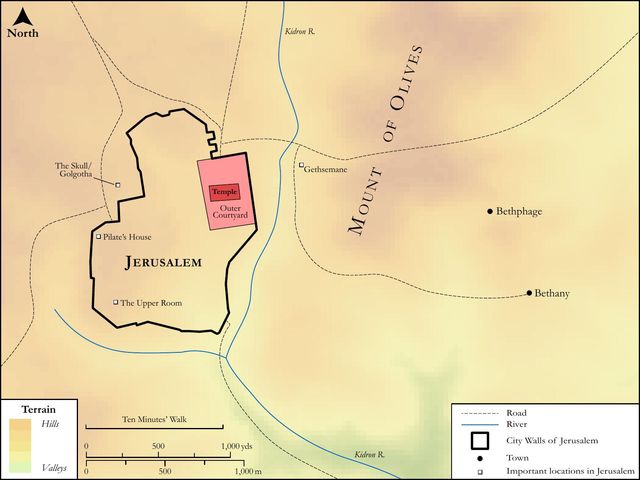
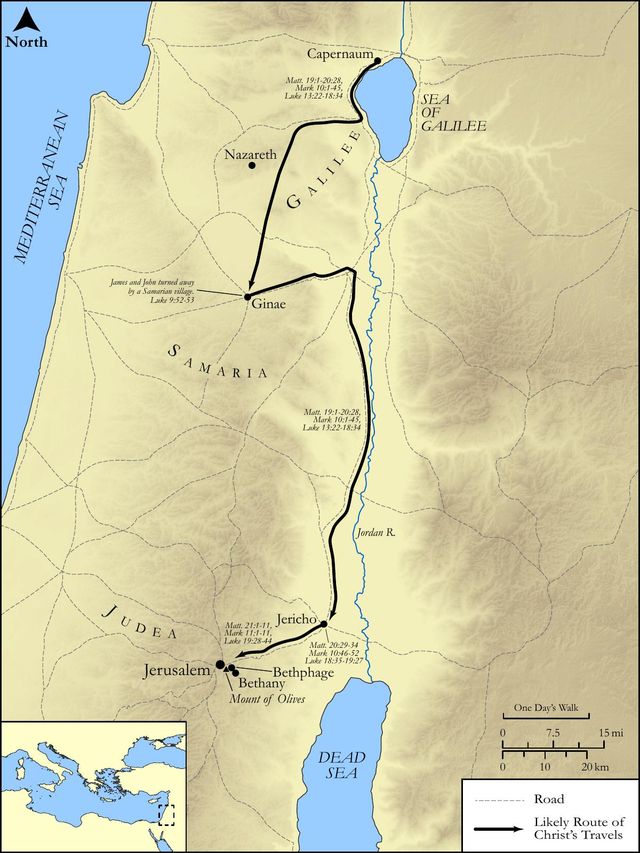
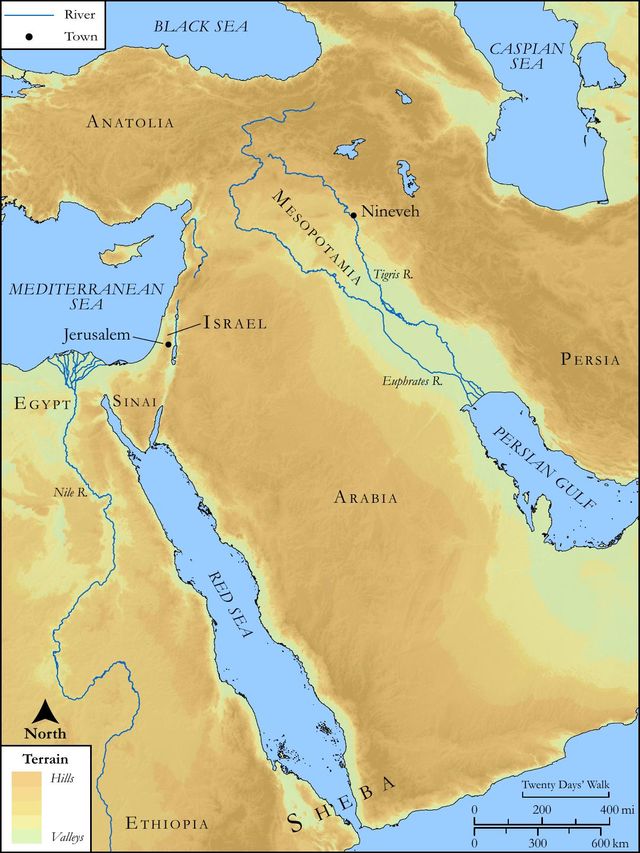
See on the biblical-era maps
Study this verse
Public-domain commentary
Matthew Henry
From his Commentary on the Whole Bible. Henry comments on passages, not single verses — this entry covers Luke 11:1–13. His four-level outline is real structure in the source text, so it is rendered as structure.
Prayer is one of the great laws of natural religion. That man is a brute, is a monster, that never prays, that never gives glory to his Maker, nor feels his favour, nor owns his dependence upon him. One great design therefore of Christianity is to assist us in prayer, to enforce the duty upon us, to instruct us in it, and encourage us to expect advantage by it. Now here,
I.We find Christ himself praying in a certain place, probably where he used to pray, Luk 11:1.
As God, he was prayed to; as man, he prayed; and, though he was a Son, yet learned he this obedience. This evangelist has taken particular notice of Christ's praying often, more than any other of the evangelists: when he was baptized (Luk 3:21), he was praying; he withdrew into the wilderness, and prayed (Luk 5:16); he went out into a mountain to pray, and continued all night in prayer (Luk 6:12); he was alone praying (Luk 9:18); soon after, he went up into a mountain to pray, and as he prayed he was transfigured (Luk 9:28, Luk 9:29); and here he was praying in a certain place. Thus, like a genuine son of David, he gave himself unto prayer, Psa 109:4. Whether Christ was now alone praying, and the disciples only knew that he was so, or whether he prayed with them, is uncertain; it is most probable that they were joining with him.
II.His disciples applied themselves to him for direction in prayer.
When he was praying, they asked, Lord, teach us to pray. Note, The gifts and graces of others should excite us to covet earnestly the same. Their zeal should provoke us to a holy imitation and emulation; why should not we do as well as they? Observe, They came to him with this request, when he ceased; for they would not disturb him when he was at prayer, no, not with this good motion. Every thing is beautiful in its season. One of his disciples, in the name of the rest, and perhaps by their appointment, said, Lord, teach us. Note, Though Christ is apt to teach, yet he will for this be enquired of, and his disciples must attend him for instruction.
Now, 1. Their request is, "Lord, teach us to pray; give us a rule or model by which to go in praying, and put words into our mouths." Note, It becomes the disciples of Christ to apply themselves to him for instruction in prayer. Lord, teach us to pray, is itself a good prayer, and a very needful one, for it is a hard thing to pray well and it is Jesus Christ only that can teach us, by his word and Spirit, how to pray. "Lord, teach me what it is to pray; Lord, excite and quicken me to the duty; Lord, direct me what to pray for; Lord, give me praying graces, that I may serve God acceptably in prayer; Lord, teach me to pray in proper words; give me a mouth and wisdom in prayer, that I may speak as I ought; teach me what I shall say."
2.Their plea is, "As John also taught his disciples. He took care to instruct his disciples in this necessary duty, and we would be taught as they were, for we have a better Master than they had." Dr. Lightfoot's notion of this is, That whereas the Jews' prayers were generally adorations, and praises of God, and doxologies, John taught his disciples such prayers as were more filled up with petitions and requests; for it is said of them that they did deēseis poiountai - make prayers, Luk 5:33. The word signifies such prayers as are properly petitionary. "Now, Lord, teach us this, to be added to those benedictions of the name of God which we have been accustomed to from our childhood." According to this sense, Christ did there teach them a prayer consisting wholly of petitions, and even omitting the doxology which had been affixed; and the Amen, which was usually said in the giving of thanks (Co1 14:16), and in the Psalms, is added to doxologies only. This disciple needed not to have urged John Baptist's example: Christ was more ready to teach than ever John Baptist was, and particularly taught to pray better than John did, or could, teach his disciples.
III.Christ gave them direction, much the same as he had given them before in his sermon upon the mount, Mat 6:9, etc.
We cannot think that they had forgotten it, but they ought to have had further and fuller instructions, and he did not, as yet, think fit to give them any; when the Spirit should be poured out upon them from on high, they would find all their requests couched in these few words, and would be able, in words of their own, to expatiate and enlarge upon them. In Matthew he had directed them to pray after this manner; here, When ye pray, say; which intimates that the Lord's prayer was intended to be used both as a form of prayer and a directory.
1.There are some differences between the Lord's prayer in Matthew and Luke, by which it appears that it was not the design of Christ that we should be tied up to these very words, for then there would have been no variation. Here is one difference in the translation only, which ought not to have been, when there is none in the original, and that is in the third petition: As in heaven, so in earth; whereas the words are the very same, and in the same order, as in Matthew. But there is a difference in the fourth petition. In Matthew we pray, "Give us daily bread this day:" here, "Give it us day by day" - kath' hēmeran. Day by day; that is, "Give us each day the bread which our bodies require, as they call for it:" not, "Give us this day bread for many days to come;" but as the Israelites had manna, "Let us have bread today for today, and tomorrow for tomorrow;" for thus we may be kept in a continual dependence upon God, as children upon their parents, and may have our mercies fresh from his hand daily, and may find ourselves under fresh obligations to do the work of every day in the day, according as the duty of the day requires, because we have from God the supplies of every day in the day, according as the necessity of the day requires. Here is likewise some difference in the fifth petition. In Matthew it is, Forgive us our debts, as we forgive: here it is, Forgive us our sins; which proves that our sins are our debts. For we forgive; not that our forgiving those that have offended us can merit pardon from God, or be an inducement to him to forgive us (he forgives for his own name's sake, and his Son's sake); but this is a very necessary qualification for forgiveness, and, if God have wrought it in us, we may plead that work of his grace for the enforcing of our petitions for the pardon of our sins: "Lord, forgive us, for thou hast thyself inclined us to forgive others." There is another addition here; we plead not only in general, We forgive our debtors, but in particular, "We profess to forgive every one that is indebted to us, without exception. We so forgive our debtors as not to bear malice or ill-will to any, but true love to all, without any exception whatsoever." Here also the doxology in the close is wholly omitted, and the Amen; for Christ would leave them at liberty to use that or any other doxology fetched out of David's psalms; or, rather, he left a vacuum here, to be filled up by a doxology more peculiar to the Christian institutes, ascribing glory to Father, Son, and Holy Ghost.
2.Yet it is, for substance, the same; and we shall therefore here only gather up some general lessons from it.
(1.)That in prayer we ought to come to God as children to a Father, a common Father to us and all mankind, but in a peculiar manner a Father to all the disciples of Jesus Christ. Let us therefore in our requests both for others and for ourselves, come to him with a humble boldness, confiding in his power and goodness.
(2.)That at the same time, and in the same petitions, which we address to God for ourselves, we should take in with us all the children of men, as God's creatures and our fellow-creatures. A rooted principle of catholic charity, and of Christian sanctified humanity, should go along with us, and dictate to us throughout this prayer, which is so worded as to be accommodated to that noble principle.
(3.)That in order to the confirming of the habit of heavenly-mindedness in us, which ought to actuate and govern us in the whole course of our conversation, we should, in all our devotions, with an eye of faith look heavenward, and view the God we pray to as our Father in heaven, that we may make the upper world more familiar to us, and may ourselves become better prepared for the future state.
(4.)That in prayer, as well as in the tenour of our lives, we must seek first the kingdom of God and the righteousness thereof, by ascribing honour to his name, his holy name, and power to his government, both that of his providence in the world and that of his grace in the church. O that both the one and the other may be more manifested, and we and others more manifestly brought into subjection to both!
(5.)That the principles and practices of the upper world, the unseen world (which therefore by faith only we are apprized of), are the great original - the archetupon, to which we should desire that the principles and practices of this lower world, both in others and in ourselves, may be more conformable. Those words, As in heaven, so on earth, refer to all the first three petitions: "Father, let thy name be sanctified and glorified, and thy kingdom prevail, and thy will be done on this earth that is now alienated from thy service, as it is in yonder heaven that is entirely devoted to thy service."
(6.)That those who faithfully and sincerely mind the kingdom of God, and the righteousness thereof, may humbly hope that all other things, as far as to Infinite Wisdom seems good, shall be added to them, and they may in faith pray for them. If our first chief desire and care be that God's name may be sanctified, his kingdom come, and his will be done, we may then come boldly to the throne of grace for our daily bread, which will then be sanctified to us when we are sanctified to God, and God is sanctified by us.
(7.)That in our prayers for temporal blessings we must moderate our desires, and confine them to a competency. The expression here used of day by day is the very same with our daily bread; and therefore some think that we must look for another signification of the word epiousios than that of daily, which we give it, and that it means our necessary bread, that bread that is suited to the craving of our nature, the fruit that is brought out of the earth for our bodies that are made of the earth and are earthly, Psa 104:14.
(8.)That sins are debts which we are daily contracting, and which therefore we should every day pray for the forgiveness of. We are not only going behind with our rent every day by omissions of duty and in duty, but are daily incurring the penalty of the law, as well as the forfeiture of our bond, by our commissions. Every day adds to the score of our guilt, and it is a miracle of mercy that we have so much encouragement given us to come every day to the throne of grace, to pray for the pardon of our sins of daily infirmity. God multiplies to pardon beyond seventy times seven.
(9.)That we have no reason to expect, nor can with any confidence pray, that God would forgive our sins against him, if we do not sincerely, and from a truly Christian principle of charity, forgive those that have at any time affronted us or been injurious to us. Though the words of our mouth be even this prayer to God, if the meditation of our heart at the same time be, as often it is, malice and revenge to our brethren, we are not accepted, nor can we expect an answer of peace.
(10.)That temptations to sin should be as much dreaded and deprecated by us as ruin by sin; and it should be as much our care and prayer to get the power of sin broken in us as to get the guilt of sin removed from us; and though temptation may be a charming, fawning, flattering thing, we must be as earnest with God that we may not be led into it as that we may not be led by that to sin, and by sin to ruin.
(11.)That God is to be depended upon, and sought unto, for our deliverance from all evil; and we should pray, not only that we may not be left to ourselves to run into evil, but that we may not be left to Satan to bring evil upon us. Dr. Lightfoot understands it of being delivered from the evil one, that is, the devil, and suggests that we should pray particularly against the apparitions of the devil and his possessions. The disciples were employed to cast out devils, and therefore were concerned to pray that they might be guarded against the particular spite he would always be sure to have against them.
IV.He stirs up and encourages importunity, fervency, and constancy, in prayer, by showing,
1.That importunity will go far in our dealings with men, Luk 11:5-8. Suppose a man, upon a sudden emergency, goes to borrow a loaf or two of bread of a neighbour, at an unseasonable time of night, not for himself, but for his friend that came unexpectedly to him. His neighbour will be loth to accommodate him, for he has wakened him with his knocking, and put him out of humour, and he has a great deal to say in his excuse. The door is shut and locked, his children are asleep in bed, in the same room with him, and, if he make a noise, he shall disturb them. His servants are asleep, and he cannot make them hear; and, for his own part, he shall catch cold if he rise to give him. But his neighbour will have no nay, and therefore he continues knocking still, and tells him he will do so till he has what he comes for; so that he must give it to him, to be rid of him: He will rise, and give him as many as he needs, because of his importunity. He speaks this parable with the same intent that he speaks that in Luk 18:1 : That men ought always to pray, and not to faint. Not that God can be wrought upon by importunity; we cannot be troublesome to him, nor by being so change his counsels. We prevail with men by importunity because they are displeased with it, but with God because he is pleased with it. Now this similitude may be of use to us,
(1.)To direct us in prayer.
[1.]We must come to God with boldness and confidence for what we need, as a man does to the house of his neighbour or friend, who, he knows, loves him, and is inclined to be kind to him.
[2.]We must come for bread, for that which is needful, and which we cannot be without.
[3.]We must come to him by prayer for others as well as for ourselves. This man did not come for bread for himself, but for his friend. The Lord accepted Job, when he prayed for his friends, Job 42:10. We cannot come to God upon a more pleasing errand than when we come to him for grace to enable us to do good, to feed many with our lips, to entertain and edify those that come to us.
[4.]We may come with the more boldness to God in a strait, if it be a strait that we have not brought ourselves into by our own folly and carelessness, but Providence has led us into it. This man would not have wanted bread if his friend had not come in unexpectedly. The care which Providence casts upon us, we may with cheerfulness cast back upon Providence.
[5.]We ought to continue instant in prayer, and watch in the same with all perseverance.
(2.)To encourage us in prayer. If importunity could prevail thus with a man who was angry at it, much more with a God who is infinitely more kind and ready to do good to us than we are to one another, and is not angry at our importunity, but accepts it, especially when it is for spiritual mercies that we are importunate. If he do not answer our prayers presently, yet he will in due time, if we continue to pray.
2.That God has promised to give us what we ask of him. We have not only the goodness of nature to take comfort fRom. but the word which he has spoken (Luk 11:9, Luk 11:10): "Ask, and it shall be given you; either the thing itself you shall ask or that which is equivalent; either the thorn in the flesh removed, or grace sufficient given in." - We had this before, Mat 7:7, Mat 7:8. I say unto you. We have it from Christ's own mouth, who knows his Father's mind, and in whom all promises are yea and amen. We must not only ask, but we must seek, in the use of means, must second our prayers with our endeavours; and, in asking and seeking, we must continue pressing, still knocking at the same door, and we shall at length prevail, not only by our prayers in concert, but by our particular prayers: Every one that asketh receiveth, even the meanest saint that asks in faith. This poor man cried, and the Lord heard him, Psa 34:6. When we ask of God those things which Christ has here directed us to ask, that his name may be sanctified, that his kingdom may come, and his will be done, in these requests we must be importunate, must never hold our peace day or night; we must not keep silence, nor give God any rest, until he establish, until he make Jerusalem a praise in the earth, Isa 62:6, Isa 62:7.
V.He gives us both instruction and encouragement in prayer from the consideration of our relation to God as a Father. Here is,
1.An appeal to the bowels of earthly fathers: "Let any of you that is a father, and knows the heart of a father, a father's affection to a child and care for a child, tell me, if his son ask bread for his breakfast, will he give him a stone to breakfast on? If he ask a fish for his dinner (when it may be a fish-day), will he for a fish give him a serpent, that will poison and sting him? Or, if he shall ask an egg for his supper (an egg and to bed), will he offer him a scorpion? You know you could not be so unnatural to your own children," Luk 11:11, Luk 11:12.
2.An application of this to the blessings of our heavenly Father (Luk 11:13): If ye then, being evil, give, and know how to give, good gifts to your children, much more shall God give you the Spirit. He shall give good things; so it is in Matthew. Observe,
(1.)The direction he gives us what to pray for. We must ask for the Holy Spirit, not only a necessary in order to our praying well, but as inclusive of all the good things we are to pray for; we need no more to make us happy, for the Spirit is the worker of spiritual life, and the earnest of eternal life. Note, The gift of the Holy Ghost is a gift we are every one of us concerned earnestly and constantly to pray for.
(2.)The encouragement he gives us to hope that we shall speed in this prayer: Your heavenly Father will give. It is in his power to give the Spirit; he has all good things to bestow, wrapped up in that one; but that is not all, it is in his promise, the gift of the Holy Ghost is in the covenant, Act 2:33, Act 2:38, and it is here inferred from parents' readiness to supply their children's needs, and gratify their desires, when they are natural and proper. If the child ask for a serpent, or a scorpion, the father, in kindness, will deny him, but not if he ask for what is needful, and will be nourishing. When God's children ask for the Spirit, they do, in effect, ask for bread; for the Spirit is the staff of life; nay, he is the Author of the soul's life. If our earthly parents, though evil, be yet so kind, if they, though weak, be yet so knowing, that they not only give, but give with discretion, give what is best, in the best manner and time, much more will our heavenly Father, who infinitely excels the fathers of our flesh both in wisdom and goodness, give us his Holy Spirit. If earthly parents be willing to lay out for the education of their children, to whom they design to leave their estates, much more will our heavenly Father give the spirit of sons to all those whom he has predestinated to the inheritance of sons.
Historical interpretation
Eleven Centuries of Reception
20 surviving comments on this verse. Each one is dated, so this reads as a timeline rather than a list.
Select a marker to jump to its quote. Markers stagger vertically where authors wrote within a few decades of each other.
But, on the contrary, the Barbarian philosophy, expelling all contention, said, "Seek, and ye shall find; knock, and it shall be opened unto you; ask, and it shall be given you."
"For to every one that asketh," says He, "it shall be given, and to him that knocketh it shall be opened, and by him that seeketh it shall be found." Away with the man who is ever seeking because he never finds; for he seeks there where nothing can be found.
Therefore, blessed ones, whom the grace of God awaits, when you ascend from that most sacred font of your new birth, and spread your hands for the first time in the house of your mother, together with your brethren, ask from the Father, ask from the Lord, that His own specialties of grace and distributions of gifts may be supplied you. "Ask," saith He, "and ye shall receive." Well, you have asked, and have received; you have knocked, and it has been opened to you.
In like manner, from whom must I ask that I may receive? Of whom seek, that I may find? To whom knock, that it may be opened to me? Who has to give to him that asks, but He to whom all things belong, and whose am I also that am the asker? What, however, have I lost before that other god, that I should seek of him and find it.
Since, however, the Lord, the Foreseer of human necessities, said separately, after delivering His Rule of Prayer, "Ask, and ye shall receive; " and since there are petitions which are made according to the circumstances of each individual; our additional wants have the right-after beginning with the legitimate and customary prayers as a foundation, as it were-of rearing an outer superstructure of petitions, yet with remembrance of the Master's precepts.
He who believes that the mouth of Jesus cannot lie would hesitate a moment to be persuaded to pray, when he says, "Ask, and it will be given you … for everyone who asks, receives." When we ask for the living bread, the good Father certainly gives him (and not the stone that his adversary wishes to give to Jesus and his disciples for food) to those who have received the Spirit of sonship from the Father. The Father gives a good gift, raining it down from heaven for those who ask him.
But some one may seek to know, how it comes that they who pray are not heard? To which we must answer, that whose sets about seeking in the right way, omitting none of those things which avail to the obtaining of our requests, shall really receive what he has prayed to be given him. But if a man turns away from the object of a right petition, and asks not as it becomes him, he does not ask. And therefore it is, that when he does not receive, as is here promised, there is no falsehood. For so also when a master says, "Whoever will come to me, he shall receive the gift of instruction;" we understand it to imply a person going in real earnest to a master, that he may zealously and diligently devote himself to his teaching. Hence too James says, Ye ask and receive not, because ye ask amiss, (James 4:3.) namely, for the sake of vain pleasures. But some one will say, Nay, when men ask to obtain divine knowledge, and to recover their virtue they do not obtain? To which we must answer, that they sought not to receive the good things for themselves, but that thereby they might reap praise.
(Dial. 1. de Trin.) Now unless the Holy Spirit were of the substance of God, Who alone is good, He would by no means be called good, since our Lord refused to be called good, inasmuch as He was made man.
(in Const. c. 1.) If also any one from indolence surrenders himself to his desires, and betrays himself into the hands of his enemies, God neither assists him nor hears him, because by sin he has alienated himself from God. It becomes then a man to offer whatever belongs to him, but to cry to God to assist him. Now we must ask for the Divine assistance not slackly, nor with a mind wavering to and fro, because such a one will not only not obtain what it seeks, but will the rather provoke God to anger. For if a man standing before a prince has his eye fixed within and without, lest perchance he should be punished, how much more before God ought he to stand watchful and trembling? But if when awakened by sin you are unable to pray stedfastly to the utmost of your power, check yourself, that when you stand before God you may direct your mind to Him. And God pardons you, because not from indifference, but infirmity, you cannot appear in His presence as you ought. If then you thus command yourself, do not depart until you receive. For whenever you ask and receive not, it is because your request was improperly made, either without faith, or lightly, or for things which are not good for you, or because you left off praying. But some frequently make the objection, "Why pray we? Is God then ignorant of what we have need?" He knows undoubtedly, and gives us richly all temporal things even before we ask. But we must first desire good works, and the kingdom of heaven; and then having desired, ask in faith and patience, bringing into our prayers whatever is good for us, convicted of no offence by our own conscience.
Now he who promises any thing ought to convey a hope of the thing promised, that obedience may follow commands, faith, promises. And therefore he adds, For every one that asketh receiveth.
(Hom. 23. in Matt.) Now by asking, He means prayer, but by seeking, zeal and anxiety, as He adds, Seek, and ye shall find. For those things which are sought require great care. And this is particularly the case with God. For there are many things which block up our senses. As then we search for lost gold, so let us anxiously seek after God. He shows also, that though He does not forthwith open the gates, we must yet wait. Hence he adds, Knock, and it shall be opened unto you; for if you continue seeking, you shall surely receive. For this reason, and as the door shut makes you knock, therefore he did not at once consent that you might entreat.
Of those three things that the apostle commends, faith is either signified by the fish, because of the water of baptism, or because it remains unharmed by the waves of this world. The Serpent is opposed to it, because it craftily and deceitfully persuaded man not to believe in God. The egg symbolizes hope, because the chick is not yet alive but will be; it is not yet seen but is hoped. "Hope that is seen is not hope." The scorpion is opposed to hope, because whoever hopes for eternal life forgets the things that are behind and reaches out to those that are before. It is dangerous for him to look backward, and he is on guard against the rear of the scorpion, which has a poisoned dart in its tail. Bread symbolizes love, because "the greatest of these is love," and among foods, bread certainly surpasses all others in value. The stone is opposed to it because the stonehearted cast out love. It may be that these gifts signify something more appropriate, yet he who knows how to give good gifts to his children urges us to ask, seek and knock.
(ubi sup.) Having laid aside the metaphor, our Lord added an exhortation, and expressly urged us to ask, seek, and knock, until we receive what we are seeking. Hence he says, And I say unto you, Ask, and it shall be given you.
(Serm. 105.) But He would not so encourage us to ask were He not willing to give. Let human slothfulness blush, He is more willing to give than we to receive.
(de Quæst. Ev. lib. ii. qu. 22.) Or by the bread is meant charity, because we have a greater desire of it, and it is so necessary, that without it all other things are nothing, as the table without bread is mean. Opposed to which is hardness of heart, which he compared to a stone. But by the fish is signified the belief in invisible things, either from the waters of baptism, or because it is taken out of invisible places which the eye cannot reach. Because also faith, though tossed about by the waves of this world, is not destroyed, it is rightly compared to a fish, in opposition to which he has placed the serpent on account of the poison of deceit, which by evil persuasion had its first seed in the first man. Or, by the egg is understood hope. For the egg is the young not yet formed, but hoped for through cherishing, opposed to which he has placed the scorpion, whose poisoned sting is to be dreaded behind; as the contrary to hope is to look back, since the hope of the future reaches forward to those things which are before.
(Serm. 105.) What great things the world speaks to thee, and roars them behind thy back to make thee look behind! O unclean world, why clamourest thou! Why attempt to turn him away! Thou wouldest detain him when thou art perishing, what wouldest thou if thou wert abiding for ever? Whom wouldest thou not deceive with sweetness, when bitter thou canst infuse false food?
(Serm. 105.) Therefore, O covetous man, what seekest thou? or if thou seekest any thing else, what will suffice thee to whom the Lord is not sufficient?
"Therefore I also say to you;" and it is the Bestower of divine gifts Who Himself enters, and speaks;----"I also say to you, Seek, and you shall find; knock, and it shall be opened to you: for every one that asks receives; and he who seeks finds: and whosoever knocks, it shall be opened to him." In those words, "I say to you" has the full force of an oath: not that God is false, even though the promise be not accompanied with an oath; but to show that the littleness of their faith was groundless, He sometimes confirms His hearers by an oath. For the Saviour is also found in many places prefacing His words by saying, "Verily, truly, I say to you." As therefore He makes this very promise on oath, it is not a thing free from guilt to disbelieve it.
In telling us therefore to seek, He bids us labour: for by labour, that which is needed is always, so to say, found; especially when it is something fit for us to possess. He who knocks, not once merely, but again and again, rattles the door with his hand, it may be, or with a stone, so that the master of the house, unable to endure the annoyance of the knocks, will open it even against his will. Learn therefore, even from what happens among us, the way to gain that which is to your profit. Knock, be urgent, ask. So must all act who ask any thing of God: for wise Paul writes, "Pray without ceasing."
The words, I say unto you, have the force of an oath. For God doth not lie, but whenever He makes known any thing to His hearers with an oath, he manifests the inexcusable littleness of our faith.
In these words our Saviour gives us a very necessary piece of instruction. For often-times we rashly, from the impulse of pleasure, give way to hurtful desires. When we ask any such thing from God, we shall not obtain it. To show this, He brings an obvious example from those things which are before our eyes, in our daily experience. For when thy son asks of thee bread, thou givest it him gladly, because he seeks a wholesome food. But when from want of understanding he asks for a stone to eat, thou givest it him not, but rather hinderest him from satisfying his hurtful desire. So that the sense may be, But which of you asking his father for bread, (which the father gives,) will he give him a stone? (that is, if he asked it.) There is the same argument also in the serpent and the fish; of which he adds, Or if he asks a fish, will he for a fish give him a serpent? And in like manner in the egg and scorpion, of which he adds, Or if he ask an egg, will he offer him a scorpion?
Now from the example just given he concludes, If then ye being evil, (i. e. having a mind capable of wickedness, and not uniform and settled in good, as God,) know how to give good gifts; how much more shall your heavenly Father?
Desiring that we arrive at the joys of the heavenly kingdom, our Lord and Savior taught us to ask these joys of him and promised that he would give them to us if we asked for them. “Ask,” he said, “and it will be given to you, seek and you will find, knock and it will be opened to you.” Dearly beloved …, we earnestly and with our whole heart must ponder these words of our Lord. He bears witness that the kingdom of heaven is not given to, found by and opened to those who are idle and unoccupied but to those who ask for it, seek after it and knock at its gates. The gate of the kingdom must be asked for by praying. It must be sought after by living properly. It must be knocked at by persevering.
If we look into the words of our Lord and Savior that he encourages us to ask God our Father after the example of an earthly parent, we quickly recognize what is the righteousness that can open for us the way to the heavenly kingdom. “Which one of you,” he says, “if his son asks his father for bread, will give him a stone? Or if he asks for a fish, will give him a serpent in place of the fish? Or if he asks for an egg, will hand him a scorpion?” This is truly a clear comparison, easy for all hearers to understand. Any human, mortal, weak and still burdened with sinful flesh, does not refuse to give the good things which he possesses, although they are earthly and weak, to the children whom he loves. Our heavenly Father, even more than this man, lavishes the good things of heaven, which do not perish, on those who ask of him and are endowed with fear and love of him.
Or, he calls the lovers of the world evil, who give those things which they judge good according to their sense, which are also good in their nature, and are useful to aid imperfect life. Hence he adds, Know how to give good gifts to your children. The Apostles even, who by the merit of their election had exceeded the goodness of mankind in general, are said to be evil in comparison with Divine goodness, since nothing is of itself good but God alone. But that which is added, How much more shall your heavenly Father give the Holy Spirit to them that ask him, for which Matthew has written, will give good things to them that ask him, shows that the Holy Spirit is the fulness of God's gifts, since all the advantages which are received from the grace of God's gifts flow from that source.
Or else, The midnight is the end of life, at which many come to God. But the friend is the Angel who receives the soul. Or, the midnight is the depth of temptations, in which he who has fallen, seeks from God three loaves, the relief of the wants of his body, soul, and spirit; through whom we run into no danger in our temptations. But the friend who comes from his journey is God Himself, who proves by temptations who has nothing to set before Him, and who is weakened in temptation. But when He says, And the door is shut, we must understand that we ought to be prepared before temptations. But after that we have fallen into them, the gate of preparation is shut, and being found unprepared, unless God keep us, we are in danger.
(Severus Antioch.) Or by the word knock perhaps he means seeking effectually, for one knocks with the hand, but the hand is the sign of a good work. Or these three may be distinguished in another way. For it is the beginning of virtue to ask to know the way of truth. But the second step is to seek how we must go by that way. The third step is when a man has reached the virtue to knock at the door, that he may enter upon the wide field of knowledge. All these things a man acquires by prayer. Or to ask indeed is to pray, but to seek is by good works to do things becoming our prayers. And to knock is to continue in prayer without ceasing.
Continue studying Luke 11:9 across the web’s major study libraries — every link below opens this exact verse, chapter, or book on the destination site.
Read & Compare
 BibleGatewayThis verse in more than 200 translations and 70 languages.
 Bible.comThe YouVersion reader — hundreds of translations, reading plans, and highlights.
 ESV.orgCrossway's official English Standard Version reader.
 NET BibleThe NET translation with 60,000+ translators' notes on every rendering decision.
 STEP BibleTyndale House's free study tool — original text, vocabulary, and scholarly resources.
 BibliaLogos Bible Software's free web reader.
 USCCBThe New American Bible (Revised Edition) with the U.S. bishops' study notes.
Commentaries
 BibleHub CommentariesDozens of classic commentaries on this verse, gathered on one page.
 StudyLightMore than 100 commentary sets — the largest collection on the web.
 BibleRefPlain-English commentary on what this verse means, verse by verse.
 Enduring WordDavid Guzik's free commentary on this chapter, widely used by Bible teachers.
 Bible Study ToolsVerse commentary alongside Greek and Hebrew study aids.
Original Language & Research
- BibleHub InterlinearThe verse word by word — original language, transliteration, and English.
- BibleHub LexiconEvery word's original-language definition and Strong's entry.
 Blue Letter BibleDeep-study tools — Strong's numbers, concordance, and word studies.
 CNTR CollationThe earliest Greek manuscripts of this verse, collated letter by letter.
Sermons, Hymns & Audio


TrulyRandomVerse is not affiliated with these sites and doesn’t control their content. They’re linked because they’re genuinely useful.
Summary
Luke 11:9 serves as a profound assurance from Jesus regarding the Father's benevolent readiness to respond to the persistent prayers of His children. Following the model prayer and the parable of the persistent friend, this verse encapsulates a core principle of divine accessibility: that earnest and sustained engagement in prayer will inevitably lead to a divine response, whether in the form of provision, discovery, or access to God's presence and will. It underscores God's character as a loving Father who delights in giving good gifts to those who approach Him with faith.
Context
ShowHideLiterary Context
This verse is an integral part of Jesus' extended teaching on prayer to His disciples, immediately following the Lord's Prayer and the Parable of the Persistent Friend. The disciples' request, "Lord, teach us to pray" (Luke 11:1), sets the stage. Jesus first provides a model prayer, then illustrates the principle of persistent prayer through the parable of a friend who, despite the late hour, grants a request due to his neighbor's shameless persistence. Luke 11:9-13 functions as the direct application and theological culmination of these teachings, moving from the human example of a reluctant friend to the infinitely more willing and generous nature of God the Father. The progression from "ask," "seek," to "knock" suggests an increasing intensity and intimacy in the prayer journey, culminating in the promise of the Holy Spirit in Luke 11:13.
Historical & Cultural Context
In ancient Jewish society, prayer was a central pillar of religious life, often formalized and communal. Rabbis commonly taught their disciples specific prayers or approaches to prayer. Jesus' teaching, however, often broke from rigid formalism, emphasizing a personal, relational approach to God as "Father" (Abba). The cultural context of hospitality, where a host was obligated to provide for guests even at great inconvenience, undergirds the Parable of the Persistent Friend. Jesus leverages this cultural expectation to highlight God's infinitely greater willingness to give. Unlike human reluctance or limitations, God is portrayed as eager to give good gifts. This teaching would have been revolutionary, granting ordinary people direct, confident access to the Creator, bypassing the need for intermediaries or elaborate rituals, and emphasizing a direct, familial relationship with God.
Key Themes
ShowHideLuke 11:9 contributes significantly to several major themes within Luke's Gospel and broader biblical theology. Firstly, it powerfully underscores Divine Accessibility and Responsiveness, assuring believers that God is not a distant or indifferent deity but a loving Father who desires to hear and respond to His children's cries. This is reinforced by the ultimate promise of the Holy Spirit in Luke 11:13. Secondly, the verse highlights the necessity of Active and Persistent Faith. The three imperatives—"ask," "seek," "knock"—are not passive suggestions but calls to earnest, diligent, and continuous engagement in prayer, echoing the message of the Parable of the Persistent Widow. This persistence is not to manipulate God but to demonstrate trust, dependence, and perseverance, refining the petitioner's desires. Thirdly, there is a strong emphasis on the Certainty of Outcome. The promises "it shall be given you," "ye shall find," and "it shall be opened unto you" convey a strong assurance of divine response, not necessarily granting every specific request exactly as imagined, but promising that God will meet needs according to His perfect will and wisdom. This certainty fosters a deeper Spiritual Growth through Seeking, as "seeking" often implies a pursuit of God's truth, His presence, and His righteousness, leading to profound spiritual discovery and a closer relationship with Him, as also seen in the parallel teaching in Matthew 7:7-8.
Exposition and Analysis
ShowHideKey Word Analysis
ShowHideThis word, G154, means "to ask (in general case); to beg, call for, crave, desire, require." In the context of prayer, it refers to making a request or petition to God. The present imperative tense ("Ask!") indicates a continuous or habitual action, implying "keep on asking." It denotes a humble yet confident approach to a superior, acknowledging dependence.
This word, G2212, means "to seek (literally or figuratively); specially, (by Hebraism) to worship (God), or (in a bad sense) to plot (against life)." In this verse, it implies a more active, intentional search, often for something hidden or requiring effort to find. The present imperative ("Seek!") suggests "keep on seeking," indicating a diligent pursuit, moving beyond a mere request to an active quest for understanding, truth, or God's will.
This word, G2925, means simply "to rap." The present imperative ("Knock!") translates to "keep on knocking." This action implies persistence at a closed door, signifying a desire for entry or access. It suggests a final, decisive effort, indicating an earnest desire for intimacy and breakthrough into God's presence or a new dimension of His provision.
Verse Breakdown
ShowHide"And I say unto you, Ask"
Jesus introduces a direct, authoritative command to His disciples, emphasizing the importance of prayer. The verb "ask" (G154) is in the present imperative, conveying the sense of "keep on asking" or "continue to ask." This is not a one-time request but an ongoing posture of dependence and petition before God.
"and it shall be given you; seek, and ye shall find"
This clause presents the first two promises linked to the actions of asking and seeking. The passive voice ("it shall be given," "ye shall find") implies divine agency – God is the one who gives and enables finding. "Seek" (G2212), also in the present imperative, suggests a more intense, diligent pursuit beyond mere verbal request, often implying a search for understanding, truth, or God's presence. The promise "ye shall find" assures that such earnest seeking will yield discovery.
"knock, and it shall be opened unto you."
This final clause escalates the intensity of the action and the promise. "Knock" (G2925) is likewise in the present imperative, implying "keep on knocking." This action signifies persistence at a closed door, representing a desire for access or breakthrough. The passive voice "it shall be opened" (G455) again points to God as the one who grants access, assuring that persistent, earnest appeal will ultimately lead to entry into His presence or the realization of His provision. The progression from asking to seeking to knocking suggests an increasing depth of desire and effort, met with corresponding levels of divine response.
Literary Devices
ShowHideLuke 11:9 is rich in literary devices that amplify its message. The most prominent is Parallelism, specifically a form of synonymous parallelism where each phrase repeats the same core idea (persistent action leads to divine response) with escalating intensity. The triadic structure ("ask...given; seek...find; knock...opened") creates a memorable and rhythmic pattern, making the teaching easy to recall and apply. This also functions as Climax, where the actions move from a simple request ("ask") to a more active search ("seek") and finally to an insistent demand for entry ("knock"), with the corresponding promises escalating in their implication of access and fulfillment. The verbs themselves are in the Imperative Mood, functioning as direct commands from Jesus, underscoring the non-optional nature of this call to prayer. Furthermore, the entire verse employs Metaphor and Analogy, particularly in "seek" and "knock," which are metaphorical for spiritual pursuit and persistent appeal for divine intervention or revelation. The "door" that is "opened" is a powerful symbol of access to God's presence, provision, or understanding.
Theological and Thematic Connections
ShowHideLuke 11:9 stands as a cornerstone of biblical teaching on prayer, profoundly shaping our understanding of God's character and the nature of our relationship with Him. Theologically, it reveals a God who is not distant or indifferent, but intimately involved and responsive to the cries of His children. The progression from "ask" to "seek" to "knock" reflects not a need to convince a reluctant God, but rather a process that deepens the believer's faith, clarifies their desires, and aligns their will with God's. It underscores that true prayer is not merely a monologue of requests but an interactive dialogue, a dynamic pursuit of God Himself and His kingdom. The certainty of the outcome, "it shall be given," "ye shall find," "it shall be opened," highlights God's unwavering faithfulness and generosity, assuring us that He will always respond in ways that are good and perfect, even if not always precisely as we initially imagine. This promise is rooted in God's paternal love, emphasizing His delight in providing for His beloved children.
Reflection and Application
ShowHideLuke 11:9 is a powerful invitation to a vibrant and persistent prayer life, challenging us to move beyond superficial petitions to a deep, sustained engagement with God. It calls us to approach our Heavenly Father with unwavering confidence, knowing that He desires to hear and respond. This verse encourages us to not give up when answers are not immediately apparent, understanding that persistence refines our faith and aligns our hearts more closely with God's perfect timing and will. The call to "seek" reminds us that prayer is not just about receiving, but about actively pursuing God's presence, truth, and righteousness. The act of "knocking" signifies a relentless pursuit of breakthrough and intimacy, trusting that God will open doors we cannot open ourselves. Ultimately, this passage fosters a spirit of dependence and expectation, drawing us into a deeper, more intimate relationship with the One who provides all things and desires our flourishing.
Questions for Reflection
ShowHideFAQ
ShowHideDoes Luke 11:9 mean God will always give me exactly what I ask for?
ShowHideWhile Luke 11:9 assures a divine response to persistent prayer, it does not guarantee that every specific request will be granted precisely as we imagine. The "good gifts" God promises are always aligned with His perfect will, wisdom, and love for us. As Luke 11:13 clarifies, the ultimate "good gift" God desires to give is the Holy Spirit, who guides us into all truth and helps us pray according to God's will (Romans 8:26-27). Sometimes, God's answer is "no," "not yet," or "something better," because He sees the bigger picture and knows what is truly best for our spiritual growth and His glory. The emphasis is on God's benevolent responsiveness, not on our ability to manipulate Him.
What is the difference between "ask," "seek," and "knock" in this verse?
ShowHideThe progression from "ask" to "seek" to "knock" suggests an increasing intensity and depth in prayer. "Ask" (Greek, aitéō) refers to a direct request or petition, a verbal articulation of a need or desire. "Seek" (Greek, zētéō) implies a more active, diligent pursuit, often for something not immediately apparent, like searching for truth, understanding, or God's will and presence. It goes beyond merely stating a request to actively engaging in a quest. "Knock" (Greek, kroúō) signifies persistent effort at a closed door, indicating a desire for access, breakthrough, or intimacy. It suggests a relentless, unwavering appeal for entry into a deeper dimension of God's provision or presence. Together, they describe a holistic and persistent approach to prayer that deepens over time.
Christ-Centered Fulfillment
ShowHideLuke 11:9, while a powerful teaching on prayer, finds its ultimate fulfillment and meaning in Jesus Christ. It is through Him that believers gain the very access to the Father that this verse promises. Jesus Himself declares, "I am the way, the truth, and the life. No one comes to the Father except through me" (John 14:6). Our ability to "ask," "seek," and "knock" with confidence is not based on our own merit or persistence, but on Christ's finished work on the cross, which tore the veil and opened the way to the Holy of Holies (Hebrews 10:19-22). He is the one who stands at the door and knocks (Revelation 3:20), inviting us into communion, and He is the one who intercedes for us before the Father (Romans 8:34). The "good gifts" that the Father delights to give, as mentioned in Luke 11:13, ultimately culminate in the gift of the Holy Spirit, who empowers us to pray effectively and guides us into Christlikeness (John 15:7). Thus, Luke 11:9 is not merely a formula for getting what we want, but an invitation to draw near to God through Christ, trusting in His mediation and the Father's perfect love.