


Luke 11:14
- ΚαὶKaiAndG2532CONJConjunction
- ἦνēnHe wasG1510V-IAI-3SVerb Imperfect Active Indicative 3rd Singular
- ἐκβάλλωνekballōncasting outG1544V-PAP-NSMVerb Present Active Participle Nominative Singular Masculine
- δαιμόνιονdaimoniona demonG1140N-ASNNoun Accusative Singular Neuter
- καὶkaiandG2532CONJConjunction
- αὐτὸautoitG846P-NSNPersonal pronoun Nominative Singular Neuter
- ἦνēnwasG1510V-IAI-3SVerb Imperfect Active Indicative 3rd Singular
- κωφόνkōphonmuteG2974A-ASNAdjective Accusative Singular Neuter
- ἐγένετοegenetoit came to passG1096V-2ADI-3SVerb 2nd Aorist Middle Deponent Indicative 3rd Singular
- δὲdethenG1161CONJConjunction
- τοῦtoufrom theG3588T-GSNDefinite article Genitive Singular Neuter
- δαιμονίουdaimonioudemonG1140N-GSNNoun Genitive Singular Neuter
- ἐξελθόντοςexelthontoshaving gone outG1831V-2AAP-GSNVerb 2nd Aorist Active Participle Genitive Singular Neuter
- ἐλάλησενelalēsenspokeG2980V-AAI-3SVerb Aorist Active Indicative 3rd Singular
- ὁhotheG3588T-NSMDefinite article Nominative Singular Masculine
- κωφόςkōphosmuteG2974A-NSMAdjective Nominative Singular Masculine
- καὶkaiAndG2532CONJConjunction
- ἐθαύμασανethaumasanmarveledG2296V-AAI-3PVerb Aorist Active Indicative 3rd Plural
- οἱhoitheG3588T-NPMDefinite article Nominative Plural Masculine
- ὄχλοιochloicrowdsG3793N-NPMNoun Nominative Plural Masculine
English is a literal word-by-word gloss of the Greek, not the KJV's wording. Why?
This is the original text the KJV's translators worked from — each Greek word with its own literal English meaning in this verse, prepared by scholars at Tyndale House, Cambridge. The KJV translates whole sentences, not word by word, so its wording differs: one Greek word can become several English words, and the KJV may choose “charity” where the gloss reads “love”. Both are faithful — they answer different questions. For the KJV's own rendering, switch to the KJV text.
Details
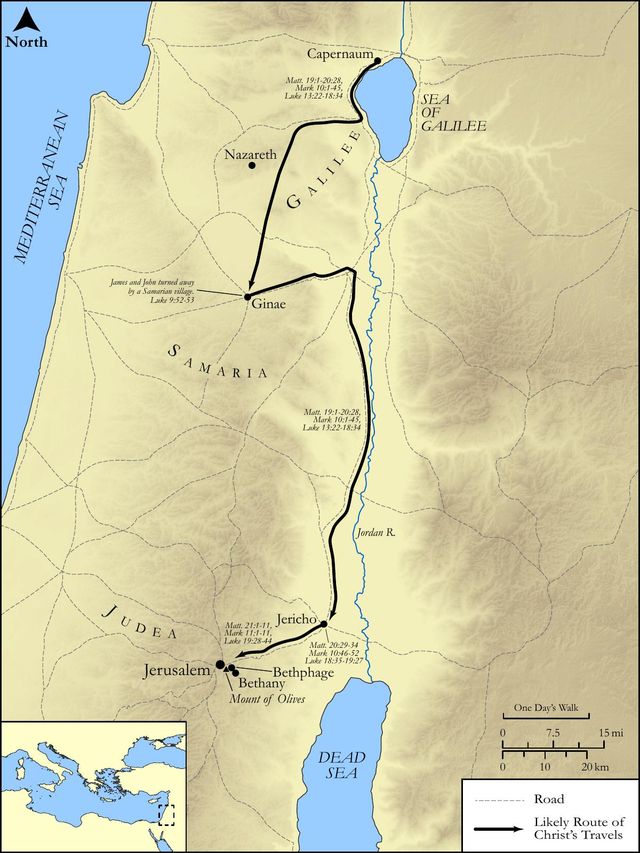
See on the biblical-era map


Study this verse
Public-domain commentary
Matthew Henry
From his Commentary on the Whole Bible. Henry comments on passages, not single verses — this entry covers Luke 11:14–26. His four-level outline is real structure in the source text, so it is rendered as structure.
The substance of these verses we had in Mat 12:22, etc. Christ is here giving a general proof of his divine mission, by a particular proof of his power over Satan, his conquest of whom was an indication of his great design in coming into the world, which was, to destroy the works of the devil. Here too he gives an earnest of the success of that undertaking. He is here casting out a devil that made the poor possessed man dumb: in Matthew we are told that he was blind and dumb. When the devil was forced out by the word of Christ, the dumb spoke immediately, echoed to Christ's word, and the lips were opened to show forth his praise. Now,
I.Some were affected with this miracle.
The people wondered; they admired the power of God, and especially that it should be exerted by the hand of one who made so small a figure, that one who did the work of the Messiah should have so little of that pomp of the Messiah which they expected.
II.Others were offended at it, and, to justify their infidelity, suggested that it was by virtue of a league with Beelzebub, the prince of the devils, that he did this, Luk 11:15. It seems, in the devil's kingdom there are chiefs, which supposes that there are subalterns. Now they would have it thought, or said at least, that there was a correspondence settled between Christ and the devil, that the devil should have the advantage in the main and be victorious at last, but that in order hereto, in particular instances, he should yield Christ the advantage and retire by consent. Some, to corroborate this suggestion, and confront the evidence of Christ's miraculous power, challenged him to give them a sign from heaven (Luk 11:16), to confirm his doctrine by some appearance in the clouds, such as was upon mount Sinai when the law was given; as if a sign from heaven, not disprovable by any sagacity of theirs, could not have been given them as well by a compact and collusion with the prince of the power of the air, who works with power and lying wonders, as the casting out of a devil; nay, that would not have been any present prejudice to his interest, which this manifestly was. Note, Obstinate infidelity will never be at a loss for something to say in its own excuse, though ever so frivolous and absurd. Now Christ here returns a full and direct answer to this cavil of theirs; in which he shows,
1.That it can by no means be imagined that such a subtle prince as Satan is should ever agree to measures that had such a direct tendency to his own overthrow, and the undermining of his own kingdom, Luk 11:17, Luk 11:18. What they objected they kept to themselves, afraid to speak it, lest it should be answered and baffled; but Jesus knew their thoughts, even when they industriously thought to conceal them, and he said, "You yourselves cannot but see the groundlessness, and consequently the spitefulness, of this charge; for it is an allowed maxim, confirmed by every day's experience, that no interest can stand that is divided against itself; not the more public interest of a kingdom, nor the private interest of a house or family; if either the one or the other be divided against itself, it cannot stand. Satan would herein act against himself; not only by the miracle which turned him out of possession of the bodies of people, but much more in the doctrine for the explication and confirmation of which the miracle was wrought, which had a direct tendency to the ruin of Satan's interest in the minds of men, by mortifying sin, and turning men to the service of God. Now, if Satan should thus be divided against himself, he would hasten his own overthrow, which you cannot suppose an enemy to do that acts so subtlely for his own establishment, and is so solicitous to have his kingdom stand."
2.That was a very partial ill-natured thing for them to impute that in him to a compact with Satan which yet they applauded and admired in others that were of their own nation (Luk 11:19): "By whom do your sons cast them out? Some of your own kindred, as Jews, nay, and some of your own followers, as Pharisees, have undertaken, in the name of the God of Israel, to cast out devils, and they were never charged with such a hellish combination as I am charged with." Note, It is gross hypocrisy to condemn that in those who reprove us which yet we allow in those that flatter us.
3.That, in opposing the conviction of this miracle, they were enemies to themselves, stood in their own light, and put a bar in their own door, for they thrust from them the kingdom of God (Luk 11:20): "If I with the finger of God cast out devils, as you may assure yourselves I do, no doubt the kingdom of God is come upon you, the kingdom of the Messiah offers itself and all its advantages to you, and, if you receive it not, it is at your peril." In Matthew it is by the Spirit of God, here by the finger of God; the Spirit is the arm of the Lord, Isa 53:1. His greatest and most mighty works were wrought by his Spirit; but, if the Spirit in this work is said to be the finger of the Lord, it perhaps may intimate how easily Christ did and could conquer Satan, even with the finger of God, the exerting of the divine power in a less and lower degree than in many other instances. He needed not make bare his everlasting arm; that roaring lion, when he pleases, is crushed, like a moth, with a touch of a finger. Perhaps here is an allusion to the acknowledgment of Pharaoh's magicians, when they were run aground (Exo 8:19): This is the finger of God. "Now if the kingdom of God be herein come to you, and you be found by those cavils and blasphemies fighting against it, it will come upon you as a victorious force which you cannot stand before."
4.That his casting out devils was really the destroying of them and their power, for it confirmed a doctrine which had a direct tendency to the ruining of his kingdom, Luk 11:21, Luk 11:22. Perhaps there had been some who had cast out the inferior devils by compact with Beelzebub their chief, but that was without any real damage or prejudice to Satan and his kingdom, what he lost one way he gained another. The devil and such exorcists played booty, as we say, and, while the forlorn hope of his army gave ground, the main body thereby gained ground; the interest of Satan in the souls of men was not weakened by it in the least. But, when Christ cast out devils, he needed not do it by any compact with them, for he was stronger than they, and could do it by force, and did it so as to ruin Satan's power and blast his great design by that doctrine and that grace which break the power of sin, and so rout Satan's main body, take from him all his armour, and divide his spoils, which no one devil ever did to another or ever will. Now this is applicable to Christ's victories over Satan both in the world and in the hearts of particular persons, by that power which went along with the preaching of his gospel, and does still. And so we may observe here,
(1.)The miserable condition of an unconverted sinner. In his heart, which was fitted to be a habitation of God, the devil has his palace; and all the powers and the faculties of the soul, being employed by him in the service of sin, are his goods. Note,
[1.]The heart of every unconverted sinner is the devil's palace, where he resides and where he rules; he works in the children of disobedience. The heart is a palace, a noble dwelling; but the unsanctified heart is the devil's palace. His will is obeyed, his interests are served, and the militia is in his hands; he usurps the throne in the soul.
[2.]The devil, as a strong man armed, keeps this palace, does all he can to secure it to himself, and to fortify it against Christ. All the prejudices with which he hardens men's hearts against truth and holiness are the strong-holds which he erects for the keeping of his palace; this palace is his garrison.
[3.]There is a kind of peace in the palace of an unconverted soul, while the devil, as a strong man armed, keeps it. The sinner has a good opinion of himself, is very secure and merry, has no doubt concerning the goodness of his state nor any dread of the judgment to come; he flatters himself in his own eyes, and cries peace to himself. Before Christ appeared, all was quiet, because all went one way; but the preaching of the gospel disturbed the peace of the devil's palace.
(2.)The wonderful change that is made in conversion, which is Christ's victory over this usurper. Satan is a strong man armed; but our Lord Jesus is stronger than he, as God, as Mediator. If we speak of strength, he is strong: more are with us than against us. Observe,
[1.]The manner of this victory: He comes upon him by surprise, when his goods are in peace and the devil thinks it is all his own for ever, and overcomes him. Note, The conversion of a soul to God is Christ's victory over the devil and his power in that soul, restoring the soul to its liberty, and recovering his own interest in it and dominion over it.
[2.]The evidences of this victory. First, He takes from him all his armour wherein he trusted. The devil is a confident adversary; he trusts to his armour, as Pharaoh to his rivers (Eze 29:3): but Christ disarms him. When the power of sin and corruption in the soul is broken, when the mistakes are rectified, the eyes opened, the heart humbled and changed, and made serious and spiritual, then Satan's armour is taken away. Secondly, He divides the spoils; he takes possession of them for himself. All the endowments of mind and body, the estate, power, interest, which before were made use of in the service of sin and Satan, are now converted to Christ's service and employed for him; yet this is not all; he makes a distribution of them among his followers, and, and having conquered Satan, gives to all believers the benefit of that victory. Hence Christ infers that, since the whole drift of his doctrine and miracles was to break the power of the devil, that great enemy of mankind, it was the duty of all to join with him and to follow his guidance, to receive his gospel and come heartily into the interests of it; for otherwise they would justly be reckoned as siding with the enemy (Luk 11:23): He that is not with me is against me. Those therefore who rejected the doctrine of Christ, and slighted his miracles, were looked upon as adversaries to him, and in the devil's interest.
5.That there was a vast difference between the devil's going out by compact and his being cast out by compulsion. Those out of whom Christ cast him he never entered into again, for so was Christ's charge (Mar 9:25); whereas, if he had gone out, whenever he saw fit he would have made a re-entry, for that is the way of the unclean spirit, when he voluntarily and with design goes out of a man, Luk 11:24-26. The prince of the devils may give leave, nay, may give order, to his forces to retreat, or make a feint, to draw the poor deluded soul into an ambush; but Christ, as he gives a total, so he gives a final, defeat to the enemy. In this part of the argument he has a further intention, which is to represent the state of those who have had fair offers made them, - among whom, and in whom, God has begun to break the devil's power and overthrow his kingdom, - but they reject his counsel against themselves, and relapse into a state of subjection to Satan. Here we have,
(1.)The condition of a formal hypocrite, his bright side and his dark side. His heart still remains the devil's house; he calls it his own, and he retains his interest in it; and yet,
[1.]The unclean spirit is gone out. He was not driven out by the power of converting grace; there was none of that violence which the kingdom of heaven suffers; but he went out, withdrew for a time, so that the man seemed not to be under the power of Satan as formerly, nor so followed with his temptations. Satan is gone, or has turned himself into an angel of light.
[2.]The house is swept from common pollutions, by a forced confession of sin, as Pharaoh's - a feigned contrition for it, as Ahab's, - and a partial reformation, as Herod's. There are those that have escaped the pollutions of the world, and yet are still under the power of the god of this world, Pe2 2:20. The house is swept, but it is not washed; and Christ hath said, If I wash thee not, thou hast no part with me; the house must be washed, or it is none of his. Sweeping takes off only the loose dirt, while the sin that besets the sinner, the beloved sin, is untouched. It is swept from the filth that lies open to the eye of the world, but it is not searched and ransacked for secret filthiness, Mat 23:25. It is swept, but the leprosy is in the wall, and will be till something more be done.
[3.]The house is garnished with common gifts and graces. It is not furnished with any true grace, but garnished with the pictures of all graces. Simon Magus was garnished with faith, Balaam with good desires, Herod with a respect for John, the Pharisees with many external performances. It is garnished, but it is like a potsherd covered with silver dross, it is all paint and varnish, not real, not lasting. The house is garnished, but the property is not altered; it was never surrendered to Christ, nor inhabited by the Spirit. Let us therefore take heed of resting in that which a man may have and yet come short.
(2.)Here is the condition of a final apostate, into whom the devil returns after he had gone out: Then goes he, and takes seven other spirits more wicked than himself (Luk 11:26); a certain number for an uncertain, as seven devils are said to be cast out of Mary Magdalene. Seven wicked spirits are opposed to the seven spirits of God, Rev 3:1. These are said to be more wicked than himself. It seems, even devils are not all alike wicked; probably, the degrees of their wickedness, now that they are fallen, are as the degrees of their holiness were while they stood. When the devil would do mischief most effectually, he employs those that are more mischievous than himself. These enter in without any difficulty or opposition; they are welcomed, and they dwell there; there they work, there they rule; and the last state of that man is worse than the first. Note,
[1.]Hypocrisy is the high road to apostasy. If the heart remains in the interest of sin and Satan, the shows and shadows will come to nothing; those that have not set that right will not long be stedfast. Where secret haunts of sin are kept up, under the cloak of a visible profession, conscience is debauched, God is provoked to withdraw his restraining grace, and the close hypocrite commonly proves an open apostate,
[2.]The last state of such is worse than the first, in respect both of sin and punishment. Apostates are usually the worst of men, the most vain and profligate, the most bold and daring; their consciences are seared, and their sins of all others the most aggravated. God often sets marks of his displeasure upon them in this world, and in the other world they will receive the greater damnation. Let us therefore hear, and fear, and hold fast our integrity.
Historical interpretation
Eleven Centuries of Reception
9 surviving comments on this verse. Each one is dated, so this reads as a timeline rather than a list.
Select a marker to jump to its quote. Markers stagger vertically where authors wrote within a few decades of each other.
In like manner, it is He who will give the Holy Spirit, at whose command is also the unholy spirit. When He cast out the "demon which was dumb" (and by a cure of this sort verified Isaiah), and having been charged with casting out demons by Beelzebub, He said, "If I by Beelzebub cast out demons, by whom do your sons cast them out? " By such a question what does He otherwise mean, than that He ejects the spirits by the same power by which their sons also did-that is, by the power of the Creator? For if you suppose the meaning to be, "If I by Beelzebub, etc.
Now He calls the devil deaf or dumb, as being the cause of this calamity, that the Divine word should not be heard. For the devil, by taking away the quickness of human feeling, blunts the hearing of our soul. Christ therefore comes that He might cast out the devil, and that we might hear the word of truth. For He healed one that He might create a universal foretaste of man's salvation. Hence it follows, And when he: he had cast out the devil, tile dumb spoke.
(in Matt.) Now He calls the devil deaf or dumb, as being the cause of this calamity, that the Divine word should not be heard. For the devil, by taking away the quickness of human feeling, blunts the hearing of our soul. Christ therefore comes that He might cast out the devil, and that we might hear the word of truth. For He healed one that He might create a universal foretaste of man's salvation. Hence it follows, And when he had cast out the devil, the dumb spake.
They were even grinding their teeth at Christ, the Savior of all, because he made the multitudes wonder by his many divine and astonishing miracles. The very devils cried out at his overwhelming and godlike power and authority.…"There was brought to him one who was possessed with a mute devil." Now mute devils are difficult for any one of the saints to rebuke. They are more obstinate than any other kind and excessively bold. There was nothing difficult to the all-powerful will of Christ, the Savior of us all.… Upon the accomplishment of this wonderful act, the multitude extolled him with praises and hastened to crown the worker of the miracle with godlike honor.
Now when the miracle was performed, the multitude extolled Him with loud praises, and the glory which was due to God. As it follows, And the people wondered.
But that demoniac is related by Matthew to have been not only dumb, but blind. Three miracles then were performed at the same time on one man. The blind see, the dumb speaks, and he that was possessed by a devil is set free. The like is daily accomplished in the conversion of believers, so that the devil being first cast out, they see the light, and then those mouths which were before silent are loosened to speak the praises of God.
But since the multitudes who were thought ignorant always marvelled at our Lord's actions, the Scribes and Pharisees took pains to deny them, or to pervert them by an artful interpretation, as though they were not the work of a Divine power, but of an unclean spirit. Hence it follows, But some of them said, He casteth out devils through Beelzebub the prince of the devils. Beelzebub was the God Accaron. For Beel is indeed Baal himself. But Zebub means a fly. Now he is called Beelzebub as the man of flies, from whose most foul practices the chief of the devils was so named.
And Jesus was casting out a demon, and it was mute. And when He had cast out the demon, the mute spoke, and the crowds marveled. This demon-possessed man is narrated in Matthew to have been not only mute but also blind, and it is said that he was healed by the Lord, so that he spoke and saw. Therefore, three signs were accomplished simultaneously in one man. The blind sees, the mute speaks, the one possessed by a demon is freed. This was indeed done physically at that time, but it is also completed daily in the lives of believers, so that, with the demon first expelled, they may behold the light of faith, and then the mouths previously silent may be opened to praise God.
Now he is called κωφὸς, as commonly meaning one who does not speak. It is also used for one who does not hear, but more properly who neither hears nor speaks. But he who has not heard from his birth necessarily cannot speak. For we speak those things which we are taught to speak by hearing. If however one has lost his hearing from a disease that has come upon him, there is nothing to hinder him from speaking. But He who was brought before the Lord was both dumb in speech, and deaf in hearing.
(non occ.) The Lord had promised that the Holy Spirit should be given to those that asked for it; the blessed effects whereof He indeed clearly shows in the following miracle. Hence it follows, And Jesus was casting out a devil, and it was dumb.
Continue studying Luke 11:14 across the web’s major study libraries — every link below opens this exact verse, chapter, or book on the destination site.
Read & Compare
 BibleGatewayThis verse in more than 200 translations and 70 languages.
 Bible.comThe YouVersion reader — hundreds of translations, reading plans, and highlights.
 ESV.orgCrossway's official English Standard Version reader.
 NET BibleThe NET translation with 60,000+ translators' notes on every rendering decision.
 STEP BibleTyndale House's free study tool — original text, vocabulary, and scholarly resources.
 BibliaLogos Bible Software's free web reader.
 USCCBThe New American Bible (Revised Edition) with the U.S. bishops' study notes.
Commentaries
 BibleHub CommentariesDozens of classic commentaries on this verse, gathered on one page.
 StudyLightMore than 100 commentary sets — the largest collection on the web.
 BibleRefPlain-English commentary on what this verse means, verse by verse.
 Enduring WordDavid Guzik's free commentary on this chapter, widely used by Bible teachers.
 Bible Study ToolsVerse commentary alongside Greek and Hebrew study aids.
Original Language & Research
- BibleHub InterlinearThe verse word by word — original language, transliteration, and English.
- BibleHub LexiconEvery word's original-language definition and Strong's entry.
 Blue Letter BibleDeep-study tools — Strong's numbers, concordance, and word studies.
 CNTR CollationThe earliest Greek manuscripts of this verse, collated letter by letter.
Sermons, Hymns & Audio


TrulyRandomVerse is not affiliated with these sites and doesn’t control their content. They’re linked because they’re genuinely useful.
Summary
Luke 11:14 vividly portrays Jesus' profound authority and compassionate power as He confronts and expels a demonic spirit that had rendered a man mute. The immediate and complete restoration of the man's speech serves as an undeniable sign of divine intervention, eliciting astonishment from the observing crowds and setting the stage for subsequent debates about the source of Jesus' miraculous power. This event underscores the tangible arrival of God's Kingdom, actively invading and overcoming the dominion of spiritual darkness.
Context
ShowHideLiterary Context
This miracle is strategically placed within Luke's narrative, following Jesus' profound teaching on prayer, including the model prayer often called the Lord's Prayer and the parable of the persistent friend, which emphasizes God's willingness to give good gifts to those who ask (Luke 11:5-13). The casting out of the demon, therefore, serves as a powerful, tangible demonstration of the very power and responsiveness of the Father that Jesus has just described. It is an immediate answer to prayer, a visible manifestation of God's active presence. Immediately following this miraculous deliverance, Jesus faces the infamous accusation that He casts out demons by the power of Beelzebul, the prince of demons (Luke 11:15), leading to a profound discourse on the nature of spiritual authority and the Kingdom of God (Luke 11:16-28). This sequence highlights the divisive nature of Jesus' ministry, where undeniable signs of God's power provoke both wonder and fierce opposition.
Historical & Cultural Context
In the first-century Jewish world, physical ailments, especially those involving speech or hearing, were often attributed to demonic influence or divine judgment. Exorcism was a recognized, though rare and often ineffective, practice among some Jewish groups. However, Jesus' exorcisms were distinct: they were immediate, complete, and performed with an inherent authority that astonished observers, unlike the often laborious and ritualistic attempts of others. The inability to speak (being "dumb" or mute) was a significant disability, isolating individuals from communal life and religious participation, as the spoken word was central to prayer, Torah study, and social interaction. A person restored to speech was not merely healed physically but re-integrated into society and the religious community, a powerful symbol of restoration. The public nature of this miracle, performed before "the people," was crucial for its impact, serving as a public declaration of Jesus' unique power and the inbreaking of God's reign.
Key Themes
ShowHideThis verse powerfully contributes to several overarching themes in Luke's Gospel and the broader biblical narrative. Firstly, it emphatically demonstrates Christ's absolute authority over evil and demonic forces, a recurring motif in Jesus' ministry that signals the decisive defeat of Satan's kingdom. Secondly, it highlights the theme of deliverance and holistic restoration, showing Jesus' concern not only for spiritual bondage but also for its physical manifestations, bringing wholeness to the afflicted. The restoration of speech is particularly significant, symbolizing the opening of communication with God and humanity. Thirdly, the reaction of "the people wondered" underscores the theme of public witness and the undeniable nature of Jesus' miracles, which served as irrefutable evidence of His divine identity and mission, even if some would later reject or misinterpret their source, as seen in Luke 11:15. This miracle, like others, points to the inauguration of God's Kingdom, where the reign of God actively breaks into the world, displacing the dominion of darkness and bringing freedom.
Exposition and Analysis
ShowHideKey Word Analysis
ShowHideThis term refers to a demonic being or evil spirit, distinct from Satan himself (who is diabolos). The use of daimónion here emphasizes that Jesus' power extends to all subordinate evil spirits, not just the chief adversary. The presence of such a spirit is directly linked to the man's inability to speak, indicating a spiritual root cause for a physical affliction.
This verb literally means "to eject," "drive out," or "expel." It conveys a forceful, decisive action, indicating Jesus' inherent authority and power over the demonic realm. It is not a negotiation or a plea, but a command that is immediately obeyed, demonstrating His complete mastery.
This adjective describes someone who is "blunted" in hearing or speech. In this specific context, as confirmed by the subsequent statement "the dumb spake," it clearly refers to the man's inability to speak, i.e., being mute. The demon's oppression manifested directly in the suppression of the man's vocal abilities.
This verb means "to wonder" or "to admire." It describes the people's astonished reaction to the miracle. Their wonder signifies that what they witnessed was beyond ordinary human capability, compelling them to acknowledge the extraordinary nature of Jesus' power, even if they didn't fully grasp its divine source.
Verse Breakdown
ShowHide"And he was casting out a devil, and it was dumb."
This opening clause immediately establishes the scene and the primary actors: Jesus, engaged in an ongoing act of "casting out" (imperfect tense, suggesting a process or habitual action, though the expulsion itself is instantaneous), and a "devil" or demon that had afflicted a person, specifically rendering them mute. The direct link between the demon and the muteness highlights the spiritual origin of the physical ailment.
"And it came to pass, when the devil was gone out, the dumb spake;"
This pivotal phrase describes the immediate and undeniable consequence of the exorcism. The departure of the demon (signified by "gone out") directly and instantaneously results in the restoration of the man's speech ("the dumb spake"). This cause-and-effect relationship powerfully demonstrates Jesus' authority over the demonic realm and His ability to reverse its destructive effects. The man's speaking confirms the complete nature of the deliverance.
"and the people wondered."
The final clause captures the public's reaction. Witnessing such a profound and immediate transformation, the crowds were filled with astonishment and awe. Their "wonder" underscores the miraculous nature of the event, acknowledging that something extraordinary and supernatural had occurred before their very eyes, a testament to Jesus' unique power.
Literary Devices
ShowHideLuke 11:14 employs several literary devices to convey its powerful message. The primary device is Miracle, serving as a concrete manifestation of divine power and authority. This specific miracle, an Exorcism, is a dramatic confrontation between the Kingdom of God, embodied by Jesus, and the kingdom of darkness. There is strong Symbolism in the restoration of speech; muteness can symbolize spiritual bondage and an inability to praise God or bear witness, while speaking represents freedom, communion, and the ability to declare God's glory. The people's reaction, "and the people wondered," functions as a form of Public Witness, emphasizing the undeniable nature of Jesus' work. This wonder also sets up a subtle Dramatic Irony, as the very miracle that causes astonishment will immediately precede accusations of demonic alliance, highlighting the blindness of some who witness divine power. The entire episode also serves as Foreshadowing of Jesus' ultimate victory over all forces of evil and the complete restoration He will bring.
Theological and Thematic Connections
ShowHideLuke 11:14 is a profound theological statement on the active invasion of God's Kingdom into a world held captive by sin and spiritual darkness. This exorcism is not merely an isolated act of healing but a direct confrontation in the cosmic conflict, demonstrating Jesus' divine nature and His mission to dismantle the works of the devil. The immediate restoration of speech signifies God's desire for humanity's holistic liberation—spiritual, physical, and relational. It underscores that true healing often involves addressing the spiritual roots of affliction, and that Jesus' authority extends over every dimension of human suffering. The people's wonder is a natural response to the inbreaking of divine power, inviting reflection on the awe-inspiring reality of God's presence and activity in the world through Christ.
Reflection and Application
ShowHideLuke 11:14 offers profound reassurance and challenge for believers today. It reminds us that Jesus Christ possesses absolute authority over all spiritual darkness and its manifestations, whether in direct demonic oppression, the spiritual roots of addiction, or the various forms of bondage that hinder human flourishing. His power is not diminished, and His compassion remains boundless. This passage calls us to recognize that God's Kingdom is not merely a future hope but a present reality, actively breaking into the world through the power of the Holy Spirit. We are encouraged to bring our deepest needs, including those with spiritual dimensions, to the One who delivers and restores. Furthermore, just as the people "wondered," we are invited to cultivate a spirit of awe and discernment, recognizing God's active work around us, even when it is met with skepticism or misunderstanding. This miracle also highlights the importance of spiritual freedom for enabling our voices to be used for God's glory, whether in worship, witness, or advocacy for truth.
Questions for Reflection
ShowHideFAQ
ShowHideWhat does "dumb" mean in this verse, and why was the man dumb?
ShowHideIn this context, "dumb" (Greek: kōphós) means mute or unable to speak. The verse explicitly states that the man's muteness was caused by the demonic spirit within him. When the "devil was gone out," the man "spake," confirming that the demon was directly responsible for suppressing his ability to communicate. This illustrates how demonic oppression can manifest in various physical or mental afflictions, directly impacting human faculties.
How does this miracle relate to the "Beelzebul accusation" that follows?
ShowHideThis miracle directly precipitates the "Beelzebul accusation" in Luke 11:15. Jesus' undeniable power to cast out demons, particularly one that caused muteness, was so profound that His critics, unable to deny the miracle itself, resorted to accusing Him of performing it by the power of Beelzebul, the ruler of demons. This accusation was a desperate attempt to discredit Jesus and His authority, leading to Jesus' powerful refutation about a kingdom divided against itself (Luke 11:17-23).
What is the significance of "the people wondered"?
ShowHideThe people's "wonder" (Greek: thaumázō) signifies their astonishment and awe at the extraordinary nature of the miracle. It indicates that they recognized the event as supernatural and beyond human capability. This public reaction validates the miracle's authenticity and impact, serving as a powerful witness to Jesus' unique authority. While their wonder didn't necessarily equate to full belief in Jesus' divine identity, it certainly demonstrated the undeniable power He wielded.
Christ-Centered Fulfillment
ShowHideLuke 11:14, with its vivid portrayal of Jesus' authority over a demonic spirit that caused muteness, finds its ultimate Christ-centered fulfillment in Jesus' comprehensive victory over sin, death, and the devil. This exorcism is a powerful preview of the greater spiritual liberation accomplished through Christ's atoning work on the cross and His glorious resurrection. Just as He "cast out" the demon from the mute man, Jesus, through His death and resurrection, decisively triumphed over the "prince of this world" (John 12:31) and disarmed the spiritual powers and authorities (Colossians 2:15). He became flesh to "destroy the works of the devil" (1 John 3:8) and to "deliver all those who through fear of death were subject to lifelong slavery" (Hebrews 2:14-15). The restoration of the mute man's speech foreshadows the spiritual restoration and freedom of expression that believers experience in Christ, enabling them to speak forth the praises of God and proclaim the good news of His Kingdom, no longer silenced by the enemy's oppression. Jesus is the Stronger Man (Luke 11:21-22) who binds the strong man and plunders his house, ultimately leading to the eternal defeat of Satan himself in the lake of fire (Revelation 20:10).