


1 Kings 1:49
Bible text: King James Version (1769 Blayney text) · Public domain
Bible text: Berean Standard Bible · Public domain
Bible text: American Standard Version (1901) · Public domain
Bible text: World English Bible, Messianic edition · Public domain
Bible text: Geneva Bible (1599) · Public domain
Bible text: Young's Literal Translation · Public domain
- וַיֶּחֶרְדוּvai·ye·cher·Duand they trembledH2729Conj-w ¦ V-Qal-ConsecImperf-3mpVerb Qal Consecutive Imperfect 3rd Plural Masculineוַandיֶּחֶרְדוּthey trembled
- וַיָּקֻמוּvai·ya·Ku·muand they rose upH6965Conj-w ¦ V-Qal-ConsecImperf-3mpVerb Qal Consecutive Imperfect 3rd Plural Masculineוַandיָּקֻמוּthey rose up
- כָּלkolallH3605N-mscNoun Singular Masculine Construct
- הַקְּרֻאִיםha·ke·ru·'Imthose [who] were invitedH7121Art ¦ V-Qal-PassPrtcpl-mpVerb Qal Participle Passive Plural Masculine Absoluteהַthoseקְּרֻאִים[who] were invited
- אֲשֶׁר'a·SherwhoH834RelParticle Relative
- לַאֲדֹנִיָּהוּla·'a·do·ni·Ya·hu[belonged] to AdonijahH138Prep-l ¦ N-proper-mNoun Proper Masculineלַ[belonged] toאֲדֹנִיָּהוּAdonijah
- וַיֵּלְכוּvai·ye·le·Khuand they wentH1980Conj-w ¦ V-Qal-ConsecImperf-3mpVerb Qal Consecutive Imperfect 3rd Plural Masculineוַandיֵּלְכוּthey went
- אִישׁ'isheachH376N-msNoun Singular Masculine Absolute
- לְדַרְכּוֹle·dar·Koto his wayH1870Prep-l ¦ N-csc ¦ 3msNoun Singular common gender Constructלְtoדַרְכּwayוֹhis
English is a literal word-by-word gloss of the Hebrew, not the KJV's wording. Why?
This is the original text the KJV's translators worked from — each Hebrew word with its own literal English meaning in this verse, prepared by scholars at Tyndale House, Cambridge. The KJV translates whole sentences, not word by word, so its wording differs: one Hebrew word can become several English words, and the KJV may choose “the LORD” where the gloss reads “Yahweh”. Both are faithful — they answer different questions. For the KJV's own rendering, switch to the KJV text.
Details
See on the biblical-era maps

Study this verse
Public-domain commentary
Matthew Henry
From his Commentary on the Whole Bible. Henry comments on passages, not single verses — this entry covers 1 Kings 1:41–53. His three-level outline is real structure in the source text, so it is rendered as structure.
We have here,
I.The tidings of Solomon's inauguration brought to Adonijah and his party, in the midst of their jollity:
They had made an end of eating, and, it should seem, it was a great while before they made an end, for all the affair of Solomon's anointing was ordered and finished while they were at dinner, glutting themselves. Thus those who serve not our Lord Christ, but oppose him, are commonly such as serve their own belly (Rom 16:18) and made a god of it, Phi 3:19. Their long feast intimates likewise that they were very secure and confident of their interest, else they would not have lost so much time. The old world and Sodom were eating and drinking, secure and sensual, when their destruction came, Luk 17:26, etc. When they made an end of eating, and were preparing themselves to proclaim their king, and bring him in triumph into the city, they heard the sound of the trumpet (Kg1 1:41), and a dreadful sound it was in their ears, Job 15:21. Joab was an old man, and was alarmed at it, apprehending the city to be in an uproar; but Adonijah was very confident that the messenger, being a worthy man, brought good tidings, Kg1 1:42. Usurpers flatter themselves with the hopes of success, and those are commonly least timorous whose condition is most dangerous. But how can those who do evil deeds expect to have good tidings? No, the worthiest man will bring them the worst news, as the priest's son did here to Adonijah, Kg1 1:43. "Verily, the best tidings I have to bring you is that Solomon is made king, so that your pretensions are all quashed." He relates to them very particularly,
1.With what great solemnity Solomon was made king (Kg1 1:44, Kg1 1:45), and that he was now sitting on the throne of the kingdom, Kg1 1:46. Adonijah thought to have stepped into the throne before him, but Solomon was too quick for him.
2.With what general satisfaction Solomon was made king, so that that which was done was not likely to be undone again.
(1.)The people were pleased, witness their joyful acclamations, Kg1 1:45.
(2.)The courtiers were pleased: The kings servants attended him with an address of congratulation upon this occasion, Kg1 1:47. We have here the heads of their address: They blessed king David, applauded his prudent care for the public welfare, acknowledged their happiness under his government, and prayed heartily for his recovery. They also prayed for Solomon, that God would make his name better than his father's, which it might well be when he had his father's foundation to build upon. A child, on a giant's shoulders, is higher than the giant himself.
(3.)The king himself was pleased: He bowed himself upon the bed, not only to signify his acceptance of his servants' address, but to offer up his own address to God (Kg1 1:48): "Blessed be the Lord God of Israel, who, as Israel's God, for Israel's good, has brought this matter to such a happy issue, my eyes even seeing it." Note, It is a great satisfaction to good men, when they are going out of the world, to see the affairs of their families in a good posture, their children rising up in their stead to serve God and their generation, and especially to see peace upon Israel and the establishment of it.
II.The effectual crush which this gave to Adonijah's attempt.
It spoiled the sport of his party, dispersed the company, and obliged every man to shift for his own safety. The triumphing of the wicked is short. They were building a castle in the air, which, having no foundation, would soon fall and crush them. They were afraid of being taken in the fact, while they were together hatching their treason, and therefore each one made the best of his way.
III.The terror Adonijah himself was in, and the course he took to secure himself.
he was now as much depressed as he had been elevated, Kg1 1:42, Kg1 1:50. He had despised Solomon as not worthy to be his guest (Kg1 1:10), but now he dreads him as his judge: He feared because of Solomon. Thus those who oppose Christ and his kingdom will shortly be made to tremble before him, and call in vain to rocks and mountains to shelter them from his wrath. He took hold on the horns of the altar, which was always looked upon as a sanctuary, or place of refuge (Exo 21:14), intimating hereby that he durst not stand a trial, but threw himself upon the mercy of his prince, in suing for which he relied upon no other plea than the mercy of God, which was manifested in the institution and acceptance of the sacrifices that were offered on that altar and the remission of sin thereupon. Perhaps Adonijah had formerly slighted the service of the altar, yet now he courts the protection of it. Many who in the day of their security neglect the great salvation, under the arrests of the terrors of the Lord would gladly be beholden to Christ and his merit, and, when it is too late, will catch hold of the horns of the altar.
IV.His humble address to Solomon for mercy.
By those who brought Solomon tidings where he was, he sent a request for his life (Kg1 1:51): Let king Solomon swear to me that he will not slay his servant. He owns Solomon for his prince, and himself his servant, dares not justify himself, but makes supplication to his judge. It was a great change with him. He that in the morning was grasping at a crown is before night begging for his life. Then Adonijah reigned, now Adonijah trembles, and cannot think himself safe unless Solomon promise, with an oath, not to put him to death.
V.The orders Solomon gave concerning him.
He discharges him upon his good behaviour, Kg1 1:52, Kg1 1:53. He considered that Adonijah was his brother, and that it was the first offence. Perhaps, being so soon made sensible of his error and then not persisting in his rebellion, he might prove not only a peaceable, but a serviceable subject, and therefore, if he will conduct himself well for the future, what is past shall be pardoned: but if he be fond disaffected, turbulent, and aspiring, this offence shall be remembered against him, he shall be called up upon his former conviction (as our law speaks), and execution shall be awarded against him. Thus the Son of David receives those to mercy that have been rebellious: if they will return to their allegiance, and be faithful to their Sovereign, their former crimes shall not be mentioned against them; but, if still they continue in the interests of the world and the flesh, this will be their ruin. Adonijah is sent for, and told upon what terms he stands, which he signifies his grateful submission to, and then is told to go to his house and live retired there. Solomon not only gave him his life, but his estate, thus establishing his throne by mercy.
Continue studying 1 Kings 1:49 across the web’s major study libraries — every link below opens this exact verse, chapter, or book on the destination site.
Read & Compare
 BibleGatewayThis verse in more than 200 translations and 70 languages.
 Bible.comThe YouVersion reader — hundreds of translations, reading plans, and highlights.
 ESV.orgCrossway's official English Standard Version reader.
 NET BibleThe NET translation with 60,000+ translators' notes on every rendering decision.
 STEP BibleTyndale House's free study tool — original text, vocabulary, and scholarly resources.
 BibliaLogos Bible Software's free web reader.
 USCCBThe New American Bible (Revised Edition) with the U.S. bishops' study notes.
Commentaries
 BibleHub CommentariesDozens of classic commentaries on this verse, gathered on one page.
 StudyLightMore than 100 commentary sets — the largest collection on the web.
 BibleRefPlain-English commentary on what this verse means, verse by verse.
 Enduring WordDavid Guzik's free commentary on this chapter, widely used by Bible teachers.
 Bible Study ToolsVerse commentary alongside Greek and Hebrew study aids.
Original Language & Research
- BibleHub InterlinearThe verse word by word — original language, transliteration, and English.
- BibleHub LexiconEvery word's original-language definition and Strong's entry.
 Blue Letter BibleDeep-study tools — Strong's numbers, concordance, and word studies.
 SefariaThe Hebrew text with Rashi and centuries of Jewish commentary.
Sermons, Hymns & Audio


TrulyRandomVerse is not affiliated with these sites and doesn’t control their content. They’re linked because they’re genuinely useful.
Summary
1 Kings 1:49 vividly portrays the dramatic and instantaneous collapse of Adonijah's attempted usurpation of the throne of Israel. As the news of Solomon's legitimate anointing and the overwhelming acclamation of the people reached Adonijah's celebratory feast, his co-conspirators were seized by profound fear, abandoning their presumed leader and scattering in desperate self-preservation. This pivotal verse marks the decisive end of one claim to power and the undeniable establishment of another, highlighting the swift and inevitable consequences of opposing God's divinely appointed order.
Context
ShowHideLiterary Context
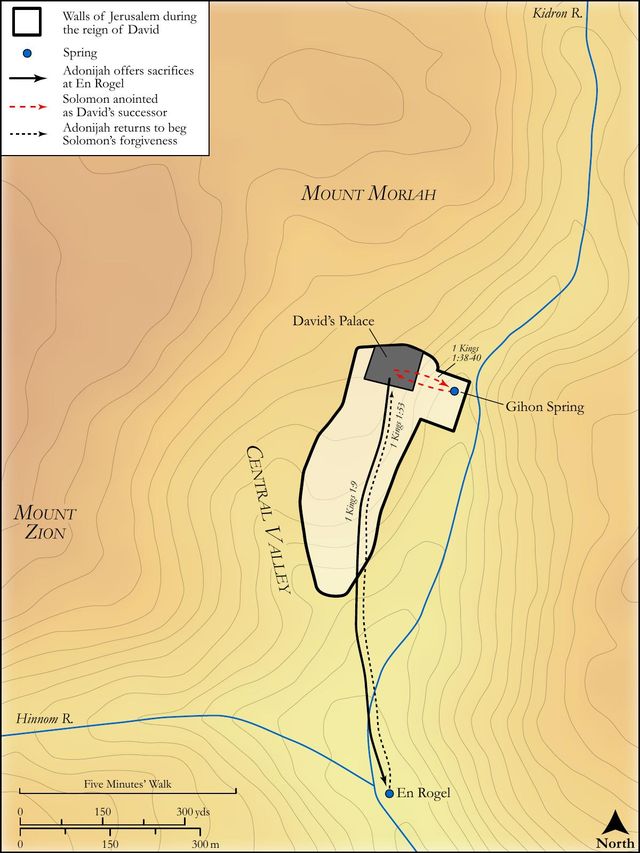
This verse serves as the climactic turning point in the rapidly unfolding succession crisis that defines the final days of King David's reign. Immediately preceding it, Jonathan, son of Abiathar the priest, delivers a shocking report to Adonijah's celebratory feast at En-rogel, announcing that King David has commanded the anointing of Solomon as king, and that the entire city of Jerusalem is now resounding with joy over his enthronement, as detailed in 1 Kings 1:41-48. The vibrant description of Solomon's procession, the trumpet blasts, and the overwhelming joy of the populace directly contrasts with the quiet, fearful dispersal of Adonijah's guests in verse 49. This abrupt narrative shift from feasting and presumed victory to terror and flight powerfully underscores the divine legitimacy of Solomon's ascent and the swift, decisive defeat of Adonijah's presumptuous rebellion, setting the stage for Solomon's secure reign.
Historical & Cultural Context
Among the kings of that day, royal succession was frequently a perilous and often violent affair, especially when an aging or infirm monarch had not clearly designated an heir. David's advanced age and physical frailty, as depicted in 1 Kings 1:1-4, created a power vacuum that ambitious sons, such as Adonijah, were keen to exploit. Adonijah's actions—amassing chariots, horsemen, and fifty men to run before him, and securing the allegiance of influential figures like Joab and Abiathar, as described in 1 Kings 1:5-7—were typical displays of a claimant asserting royal authority. The acute fear experienced by Adonijah's guests was entirely justified; participation in a failed coup against a newly established king was considered an act of high treason, punishable by death. Their immediate and uncoordinated flight was, therefore, a rational and desperate act of self-preservation within a brutal political landscape.
Key Themes
ShowHideThe central theme powerfully illuminated by this verse is the divine sovereignty in kingship. Despite human schemes, political maneuvering, and personal ambitions, God ultimately determines who occupies the throne. Adonijah's meticulously planned attempt, though initially appearing to garner significant support, crumbles instantly and utterly because it stood in direct opposition to God's revealed will. This narrative forcefully reinforces the biblical principle that true authority originates from God, not from human popularity, strategic alliances, or self-assertion, echoing sentiments found in Proverbs 21:30, which declares, "There is no wisdom nor understanding nor counsel against the LORD." Another crucial theme is the consequences of illegitimate authority and rebellion. The swift and panicked dispersal of Adonijah's guests vividly illustrates how rapidly a power base built on human presumption and opposition to God's divine plan can dissolve, leading inevitably to fear, disarray, and ultimate judgment. The narrative also subtly highlights the theme of discernment and loyalty, as those who had aligned themselves with Adonijah's cause quickly apprehended their perilous error and sought to distance themselves from a doomed enterprise.
Exposition and Analysis
ShowHideKey Word Analysis
ShowHideThis word (H2729) signifies a deep, sudden, and often trembling terror. While the root can also denote a reverential awe, in this context, it describes an overwhelming, paralyzing dread that seized Adonijah's guests. Their fear was not a moral or spiritual conviction but an immediate, visceral response to the realization that they had allied themselves with a rebellion against the legitimate, divinely appointed king. This profound fear propelled their swift and desperate flight, underscoring the grave danger and severe consequences associated with their failed enterprise.
This verb (H6965) denotes a sudden, decisive act of standing or rising, often implying readiness for action or departure. In the context of 1 Kings 1:49, it describes the instantaneous cessation of their feasting and their abrupt movement towards escape. There was no hesitation, no discussion, no attempt to console Adonijah. The act of "rising up" signifies a panicked, urgent physical response to the terrifying news, demonstrating the immediate and complete disruption of their celebration and their singular focus on self-preservation.
This noun (H1870) refers to a road or path, but figuratively, it can denote a course of life or mode of action. Here, in the phrase "went every man his way," it vividly depicts the complete disarray and self-preserving instinct of Adonijah's former allies. It implies not an orderly retreat, but a panicked, individualistic flight, each person seeking their own safety without regard for the others or for Adonijah himself. This immediate and total abandonment underscores the fragile nature of alliances built on ambition rather than true loyalty or divine mandate, signifying the utter collapse of Adonijah's support system.
Verse Breakdown
ShowHide"And all the guests that [were] with Adonijah were afraid"
This opening clause immediately establishes the dramatic reversal of fortune. The "guests" (from H7121, qârâʼ, meaning "the invited ones") were not casual attendees but key figures and supporters who had been explicitly invited to Adonijah's feast, signifying their active allegiance to his cause. The news of Solomon's anointing, delivered by Jonathan, instantly transforms their mood from one of celebratory confidence to profound, overwhelming fear. This fear is not mere apprehension but a sudden, paralyzing terror, as they grasp the severe implications of their participation in a failed coup against a newly established, legitimate king.
"and rose up"
This simple yet powerful phrase conveys the immediate and decisive physical reaction of the guests. There is no deliberation, no attempt to strategize, and no loyalty shown to Adonijah. The act of "rising up" signifies an abrupt end to their feasting and a rapid movement towards escape. It speaks to the urgency and panic that gripped them, prompting an instant, unthinking physical response to the terrifying news of Solomon's anointing and the potential retribution they now faced.
"and went every man his way"
This final clause vividly illustrates the complete dissolution of Adonijah's support base. The unity of the "guests," who had gathered for a common purpose (Adonijah's enthronement), shatters into individual, desperate flights. Each person seeks their own path to safety, abandoning the failed leader and the doomed enterprise. This immediate, uncoordinated dispersal highlights the self-serving nature of their allegiance and the utter collapse of Adonijah's power structure, leaving him isolated, vulnerable, and utterly defeated.
Literary Devices
ShowHideThe verse is powerfully imbued with Dramatic Irony, as Adonijah and his guests are celebrating their presumed victory and the culmination of their rebellious plot at the very moment King David is confirming Solomon's legitimate and divinely ordained succession. This creates a stark Contrast between the feasting, revelry, and misplaced confidence at En-rogel and the solemn, joyous, and divinely sanctioned anointing taking place in Gihon. The sudden and abrupt shift from presumed triumph to terror and flight is a masterful use of Narrative Pacing, accelerating the plot to a decisive and irreversible climax. The phrase "went every man his way" employs Synecdoche, where the individual action (each man going his own way) represents the complete disintegration and disunity of the collective group, emphasizing the utter disarray and self-preservation that instantly trumped any semblance of loyalty or shared purpose. The entire scene functions as a potent Symbolism of the inherent fragility and ultimate futility of human ambition when it stands in direct opposition to divine decree and God's sovereign will.
Theological and Thematic Connections
ShowHideThis pivotal moment in Israel's history profoundly illustrates the theological truth that God's sovereign will ultimately prevails over all human machinations and rebellious schemes. Adonijah's carefully orchestrated rebellion, though initially supported by powerful and influential figures, crumbled instantly and irrevocably when confronted with the divinely appointed king. This narrative serves as a powerful and enduring reminder that true authority flows solely from God, not from human ambition, fleeting popularity, or strategic alliances. The profound fear that gripped Adonijah's guests highlights the severe consequences of aligning oneself with plans or movements that oppose God's established order, underscoring the critical importance of discerning God's hand in leadership and humbly submitting to His chosen path. It teaches that genuine security, peace, and stability are found in obedience to divine will, while rebellion and self-assertion inevitably lead to fear, disarray, and ultimate failure.
Reflection and Application
ShowHideThe immediate and fearful dispersal of Adonijah's guests offers a timeless and profound lesson on the consequences of misplaced allegiance and the paramount importance of discerning and aligning with God's sovereign will. In our contemporary lives, we are continually faced with choices about who or what we will align ourselves with—whether it be a particular ideology, a career path, a relationship, a personal ambition, or even a specific church or ministry. This passage challenges us to critically examine the fundamental foundation of our loyalties: are they built upon human presumption, fleeting popularity, worldly success, or self-interest, or are they deeply rooted in God's revealed truth, His established order, and His divine purposes? Just as Adonijah's guests quickly abandoned a losing and dangerous cause, we are called to align ourselves with righteousness, truth, and God's kingdom, trusting implicitly in God's ultimate sovereignty and His perfect timing. True security and lasting peace are never found in human schemes, political maneuvering, or the strength of worldly alliances, but rather in humble submission to the Lord's plan, even when it seems counter-intuitive or unpopular in the eyes of worldly wisdom. This narrative powerfully encourages us to cultivate a profound "fear of the Lord" (a reverential awe, respect, and obedient submission to His authority) that actively prevents us from succumbing to the "fear of man" (panic, self-preservation, or conformity to worldly pressures) when God's will and truth become unmistakably clear.
Questions for Reflection
ShowHideFAQ
ShowHideWhy were Adonijah's guests so afraid, and why did they scatter so quickly?
ShowHideAdonijah's guests were struck with profound and immediate fear because they realized they had committed an act of high treason against the legitimate, divinely appointed king. They had openly supported Adonijah's coup, participating in a celebratory feast that symbolized his claim to the throne and a direct challenge to King David's authority. When Jonathan, son of Abiathar, arrived with the news that King David had officially anointed Solomon as king, and that the entire city of Jerusalem was now rejoicing in Solomon's enthronement, they instantly understood the grave danger they were in. Among the kings of that day, supporting a failed rebellion against a newly established king was an act of treason punishable by death, often with severe repercussions for all involved. Their immediate and uncoordinated scattering was an instinctive act of self-preservation, a desperate attempt to distance themselves from a doomed cause and avoid the king's inevitable retribution. It starkly demonstrated the fragile and self-serving nature of alliances built on ambition rather than true loyalty or divine mandate.
Christ-Centered Fulfillment
ShowHideThe dramatic events of 1 Kings 1:49, depicting the instantaneous collapse of Adonijah's illegitimate claim and the divinely orchestrated establishment of Solomon's kingship, powerfully foreshadow the ultimate and eternal kingship of Jesus Christ. Adonijah's attempt to seize the throne through self-exaltation and human manipulation stands in stark contrast to Christ's humble, yet divinely ordained, path to universal sovereignty. While Adonijah's kingdom was earthly, fleeting, and built on human presumption, Christ's kingdom is eternal, spiritual, and established by God's own unshakeable will, as Jesus Himself declared, "My kingdom is not of this world" (John 18:36). The fear and panicked dispersal of Adonijah's guests, who abandoned a false king and a doomed cause, point to the ultimate choice humanity faces: to align with the fleeting and ultimately failing kingdoms of this world or to bow the knee to the true King, Jesus, whose authority is absolute and whose reign will never end (Philippians 2:9-11). Just as Solomon's anointing brought joy, stability, and legitimate rule to Israel, Christ's enthronement at the right hand of the Father brings true peace, salvation, and eternal life to all who believe. His reign inspires not the fear of judgment for His followers, but the reverent awe and worship of His true disciples (Hebrews 12:28). His kingdom is not built on human schemes or ambition but on divine decree, and all who oppose Him will ultimately scatter in judgment, while those who trust in Him will find everlasting refuge and an unshakable inheritance (Psalm 2:10-12).