


Deuteronomy 31:23
Bible text: King James Version (1769 Blayney text) · Public domain
Bible text: King James Version with Strong's numbers · Public domain
Bible text: Berean Standard Bible · Public domain
Bible text: American Standard Version (1901) · Public domain
Bible text: World English Bible, Messianic edition · Public domain
Bible text: Geneva Bible (1599) · Public domain
Bible text: Young's Literal Translation · Public domain
- וַיְצַוvay·Tzavand he commissionedH6680Conj-w ¦ V-Piel-ConsecImperf-3msVerb Piel Consecutive Imperfect 3rd Singular Masculineוַandיְצַוhe commissioned
- אֶת'et<obj.>H853DirObjMParticle Object Indicator
- יְהוֹשֻׁעַye·ho·Shu·a'JoshuaH3091N-proper-mNoun Proper Masculine
- בִּןbin[the] son ofH1121N-mscNoun Singular Masculine Construct
- נוּןNunNunH5126N-proper-mNoun Proper Masculine
- וַיֹּאמֶרvai·yo·Merand he saidH559Conj-w ¦ V-Qal-ConsecImperf-3msVerb Qal Consecutive Imperfect 3rd Singular Masculineוַandיֹּאמֶרhe said
- חֲזַקcha·Zakbe strongH2388V-Qal-Imp-2msVerb Qal Imperative 2nd Singular Masculine
- וֶאֱמָץve·'e·Matzand be boldH553Conj-w ¦ V-Qal-Imp-2msVerb Qal Imperative 2nd Singular Masculineוֶandאֱמָץbe bold
- כִּיkiforH3588PrtParticle Conditional
- אַתָּה'a·TahyouH859Pro-2msPronoun Personal 2nd Singular Masculine
- תָּבִיאta·Vi'you will bringH935V-Hiphil-Imperf-2msVerb Hiphil Imperfect 2nd Singular Masculine
- אֶת'et<obj.>H853DirObjMParticle Object Indicator
- בְּנֵיbe·Nei[the] people ofH1121N-mpcNoun Plural Masculine Construct
- יִשְׂרָאֵלYis·ra·'ElIsraelH3478N-properNoun Proper Location
- אֶל'elintoH413PrepPreposition
- הָאָרֶץha·'A·retzthe landH776Art ¦ N-fsNoun Singular Feminine Absoluteהָtheאָרֶץland
- אֲשֶׁר'a·SherwhichH834RelParticle Relative
- נִשְׁבַּעְתִּיnish·Ba'·tiI sworeH7650V-Niphal-Perf-1csVerb Niphal Perfect 1st Singular common gender
- לָהֶםla·Hemto <the> themPrep-l ¦ 3mpSuffix Personal 3rd Plural Masculineלָto <the>הֶםthem
- וְאָנֹכִיve·'a·no·Khiand IH595Conj-w ¦ Pro-1csPronoun Personal 1st Singular common genderוְandאָנֹכִיI
- אֶהְיֶה'eh·YehI will beH1961V-Qal-Imperf-1csVerb Qal Imperfect 1st Singular common gender
- עִמָּךְ'i·Makhwith youH5973Prep ¦ 2msPreposition Definiteעִמָּwithךְyou
English is a literal word-by-word gloss of the Hebrew, not the KJV's wording. Why?
This is the original text the KJV's translators worked from — each Hebrew word with its own literal English meaning in this verse, prepared by scholars at Tyndale House, Cambridge. The KJV translates whole sentences, not word by word, so its wording differs: one Hebrew word can become several English words, and the KJV may choose “the LORD” where the gloss reads “Yahweh”. Both are faithful — they answer different questions. For the KJV's own rendering, switch to the KJV text.
Details
See on the biblical-era map
Study this verse
Public-domain commentary
Matthew Henry
From his Commentary on the Whole Bible. Henry comments on passages, not single verses — this entry covers Deuteronomy 31:22–30.
Here, I. The charge is given to Joshua, which God has said (v. 14) he would give him. The same in effect that Moses had given him. The same in effect that Moses had given him (v. 7): Be strong and of a good courage, v. 23. Joshua had now heard from God so much of the wickedness of the people whom he was to have the conduct of as could not but be a discouragement to him: "Nay," says God, "how bad soever they are, thou shalt go through thy understanding, for I will be with thee. Thou shalt put them into possession of Canaan. If they afterwards by their sin throw themselves out of it again, that will be no fault of thine, nor any dishonour to thee, therefore be of good courage."
II.The solemn delivery of the book of the law to the Levites, to be deposited in the side of the ark, is here again related (v.
24-26), of which before, v. 9. Only they are here directed where to treasure up this precious original, not in the ark (there only the two tables were preserved), but in another box by the side of the ark. It is probable that this was the very book that was found in the house of the Lord (having been somehow or other misplaced) in the days of Josiah (Ch2 34:14), and so perhaps the following words here, that it may be a witness against thee, may particularly point at that event, which happened so long after; for the finding of this very book occasioned the public reading of it by Josiah himself, for a witness against a people who were then almost ripe for their ruin by the Babylonians.
III.The song which follows in the next chapter is here delivered to Moses, and by him to the people.
He wrote it first (v. 22), as the Spirit of God indited it, and then spoke it in the ears of all the congregation (v. 30), and taught it to them (v. 22), that is, gave out copies of it, and ordered the people to learn it by heart. It was delivered by word of mouth first, and afterwards in writing, to the elders and officers, as the representatives of their respective tribes (v. 28), by them to be transmitted to their several families and households. It was delivered to them with a solemn appeal to heaven and earth concerning the fair warning which was given them by it of the fatal consequences of their apostasy from God, and with a declaration of the little joy and little hope Moses had in and concerning them. 1. He declares what little joy he had had of them while he was with them, v. 27. It is not in a passion that he says, I know thy rebellion (as once he said unadvisedly, Hear now, you rebels), but it is the result of a long acquaintance with them: you have been rebellious against the Lord. Their rebellions against himself he makes no mention of: these he had long since forgiven and forgotten; but they must be made to hear of their rebellions against God, that they may be ever repented of and never repeated. 2. What little hopes he had of them now that he was leaving them. From what God had now said to him (v. 16) more than from his own experience of them, though that was discouraging enough, he tells them (v. 29), I know that after my death you will utterly corrupt yourselves. Many a sad thought, no doubt, it occasioned to this good man, to foresee the apostasy and ruin of a people he had taken so much pains with, in order to them good and make them happy; but this was his comfort, that he had done his duty, and that God would be glorified, if not in their settlement, yet in their dispersion. Thus our Lord Jesus, a little before his death, foretold the rise of false Christs and false prophets (Mat 24:24), notwithstanding which, and all the apostasies of the latter times, we may be confident that the gates of hell shall not prevail against the church, for the foundation of God stands sure.
Continue studying Deuteronomy 31:23 across the web’s major study libraries — every link below opens this exact verse, chapter, or book on the destination site.
Read & Compare
 BibleGatewayThis verse in more than 200 translations and 70 languages.
 Bible.comThe YouVersion reader — hundreds of translations, reading plans, and highlights.
 ESV.orgCrossway's official English Standard Version reader.
 NET BibleThe NET translation with 60,000+ translators' notes on every rendering decision.
 STEP BibleTyndale House's free study tool — original text, vocabulary, and scholarly resources.
 BibliaLogos Bible Software's free web reader.
 USCCBThe New American Bible (Revised Edition) with the U.S. bishops' study notes.
Commentaries
 BibleHub CommentariesDozens of classic commentaries on this verse, gathered on one page.
 StudyLightMore than 100 commentary sets — the largest collection on the web.
 BibleRefPlain-English commentary on what this verse means, verse by verse.
 Enduring WordDavid Guzik's free commentary on this chapter, widely used by Bible teachers.
 Bible Study ToolsVerse commentary alongside Greek and Hebrew study aids.
Original Language & Research
- BibleHub InterlinearThe verse word by word — original language, transliteration, and English.
- BibleHub LexiconEvery word's original-language definition and Strong's entry.
 Blue Letter BibleDeep-study tools — Strong's numbers, concordance, and word studies.
 SefariaThe Hebrew text with Rashi and centuries of Jewish commentary.
Sermons, Hymns & Audio


TrulyRandomVerse is not affiliated with these sites and doesn’t control their content. They’re linked because they’re genuinely useful.
Summary
Deuteronomy 31:23 records a pivotal divine mandate given directly to Joshua, Moses' divinely appointed successor, as he stands on the cusp of leading the Israelites into the Promised Land. This verse encapsulates the Lord's personal commission, an empowering exhortation to strength and courage, and an unwavering promise of divine presence, all of which are absolutely essential for the monumental task of conquering and settling Canaan and fulfilling God's ancient covenant promises to Abraham, Isaac, and Jacob.
Context
ShowHideLiterary Context
This verse is strategically placed at a critical juncture in the book of Deuteronomy, specifically within Moses' valedictory discourses and the imminent conclusion of his earthly ministry. Chapters 29-30 detail the solemn renewal of the Mosaic covenant and the profound implications of obedience and disobedience, outlining blessings and curses. Chapter 31 opens with Moses formally presenting Joshua to the congregation as his successor and publicly encouraging him, a moment of significant leadership transition (Deuteronomy 31:1-8). Following this public affirmation, the narrative shifts to the Lord Himself directly addressing Joshua, reiterating and reinforcing the charge. This divine commissioning in Deuteronomy 31:23 serves as a capstone to Moses' transfer of leadership, establishing Joshua's authority not merely by human appointment but by explicit divine decree. This sets the theological and narrative stage for the subsequent book of Joshua, where this very commission is repeatedly affirmed and acted upon as Israel enters and conquers Canaan.
Historical & Cultural Context
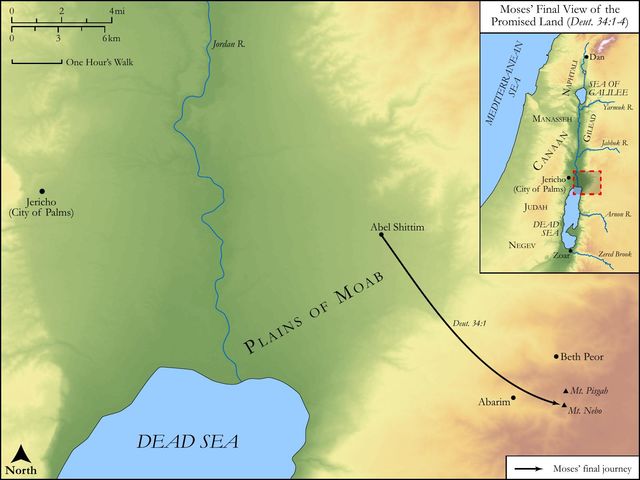
At this moment, the Israelites are encamped on the plains of Moab, poised to cross the Jordan River and enter Canaan, the land promised by God centuries earlier to their patriarchs. They have endured forty arduous years of wilderness wandering, a period that witnessed the death of the generation that rebelled at Kadesh-Barnea and the rise of a new generation, now ready to inherit the promise. Moses, the iconic leader who delivered them from Egyptian bondage and shepherded them through the wilderness, is forbidden from entering the land due to his act of disobedience at Meribah (Numbers 20:12). The transition of leadership from such a towering, divinely-anointed figure to Joshua, a military leader and Moses' long-time aide, was a moment of immense national significance and potential anxiety for a people accustomed to Moses' direct intercession and leadership. The task ahead—conquering established, fortified cities and displacing powerful inhabitants—was daunting. Therefore, a clear, unequivocal, and public divine commissioning of the new leader was absolutely crucial for maintaining unity, morale, and faith in God's continued guidance and power.
Key Themes
ShowHideDeuteronomy 31:23 powerfully articulates several foundational themes central to the book of Deuteronomy and the broader Pentateuch. It profoundly underscores the theme of Divine Sovereignty and Faithfulness, as God Himself initiates and guarantees the fulfillment of His ancient covenant promise to give the land to Israel, a promise first made to Abraham in Genesis 15:18 and reiterated throughout the patriarchal narratives. The verse also highlights Divine Commissioning, demonstrating that true leadership for God's people is not merely humanly chosen or inherited, but divinely appointed, empowered, and sanctioned. The repeated emphasis on "Be strong and of a good courage" speaks directly to the theme of Courage Born of Faith, recognizing the formidable challenges ahead but grounding fortitude firmly in God's presence rather than in human ability or self-reliance. Finally, the concluding promise, "and I will be with thee," encapsulates the overarching theme of God's Enduring Presence, assuring His people that He will never abandon them. This promise resonates throughout the Old Testament, finding echoes in passages like Isaiah 41:10, and culminates in the New Testament's ultimate assurance of Christ's perpetual presence with His church (Matthew 28:20).
Exposition and Analysis
ShowHideKey Word Analysis
ShowHideThis verb (H6680) signifies "to command," "to appoint," or "to give a formal instruction or commission." It is often used for authoritative directives from a superior to a subordinate, or, as here, from God to a human agent. In this context, it profoundly emphasizes that Joshua's authority and mission are not self-appointed, nor merely inherited from Moses, but are divinely ordained and specifically commanded by the Lord. This divine "charge" imbues Joshua's leadership with ultimate legitimacy and divine backing, transforming his daunting task into a sacred trust and a direct extension of God's will.
This word (H2388) conveys the idea of being firm, robust, resolute, or to seize hold of something with tenacity. When used as an imperative, as it is here, it functions as a powerful exhortation to inner fortitude, steadfastness, and resilience. It implies the necessity of unwavering determination in the face of immense obstacles, not a physical strength but a strength of will and spirit. Crucially, this strength is not self-generated but is enabled and sustained by the divine presence explicitly promised in the latter part of the verse. It is a command to be strong, implying a state of being empowered by God.
This term (H553) means "to be alert," "to be valiant," or "to be courageous." It speaks to the inner resolve and bravery required to confront difficult or dangerous situations without succumbing to fear. Paired with ḥāzaq ("strong"), it forms a powerful hendiadys, emphasizing both the internal disposition of courage and the outward demonstration of resolute action. This dual command acknowledges the formidable nature of the task ahead—conquering the land of Canaan—and calls Joshua to a faith-filled boldness that trusts implicitly in God's power and faithfulness over any human weakness or fear.
Verse Breakdown
ShowHide"And he gave Joshua the son of Nun a charge, and said,"
The "he" here refers unequivocally to the Lord God, as established by the preceding verses (e.g., Deuteronomy 31:14-15). This opening clause immediately emphasizes the divine origin of Joshua's commission. It is not Moses, but God Himself, who formally bestows the authority and responsibility upon Joshua, the son of Nun, Moses' faithful assistant and successor. This direct divine conferral of "a charge" (or command) elevates Joshua's leadership to a sacred calling, ensuring that the transition of power is seen as God's sovereign will, not merely a human succession.
"Be strong and of a good courage:"
This is a direct, imperative exhortation from God to Joshua. The repetition of similar commands (as seen earlier from Moses in Deuteronomy 31:7) underscores their critical importance for the daunting task ahead. It acknowledges the immense challenges Joshua will face—leading a nation, conquering formidable enemies, and establishing a new society in a hostile land. This is not a call to self-reliance or a naive dismissal of danger, but an imperative to draw upon a divinely supplied inner fortitude, trusting in God's power and faithfulness rather than one's own limited abilities.
"for thou shalt bring the children of Israel into the land which I sware unto them:"
This clause provides the specific reason and divine purpose for the command to be strong and courageous. Joshua's mission is explicitly defined: to lead the nation of Israel into the Promised Land. This land is not merely a geographical territory but the tangible fulfillment of God's ancient, solemn, and sworn covenant promises made centuries earlier to the patriarchs (e.g., Genesis 12:7, Genesis 15:18, Genesis 26:3, Genesis 28:13). Joshua's leadership is thus directly linked to the culmination of centuries of divine faithfulness, making his task a sacred act of covenant fulfillment and a testament to God's unwavering word.
"and I will be with thee."
This concluding promise is the ultimate source and foundation of Joshua's strength and courage. It is God's personal, unfailing assurance of His active presence, guidance, and unwavering support. This promise transcends mere moral encouragement; it signifies God's active involvement in Joshua's mission, empowering him for every challenge, providing wisdom, ensuring protection, and guaranteeing ultimate victory. It is the divine guarantee that undergirds the entire commission, transforming a humanly daunting task into a divinely-backed enterprise, making success inevitable according to God's will.
Literary Devices
ShowHideDeuteronomy 31:23 primarily employs Divine Commissioning and Exhortation as its central literary devices. The verse functions as a direct, authoritative Divine Commissioning of Joshua, clearly delineating his divinely appointed role and the ultimate divine backing for it. This is powerfully evident in the opening "And he gave Joshua... a charge," which unequivocally establishes God as the ultimate source of authority and the initiator of this monumental transition. Following this, the verse contains a potent Exhortation in the form of the imperative "Be strong and of a good courage." This direct address is a common biblical rhetorical device used to impress upon the recipient the gravity, urgency, and necessity of a particular action or disposition, especially in moments of significant challenge. The structure of the verse also demonstrates a clear logical progression, akin to Cause and Effect or Reasoning, where the imperative command ("Be strong and of a good courage") is immediately followed by its rationale or purpose ("for thou shalt bring the children of Israel into the land which I sware unto them") and then by the ultimate enabling factor and guarantee ("and I will be with thee"). This logical and theological progression reinforces the divine imperative and its foundation in God's immutable promise and presence.
Theological and Thematic Connections
ShowHideDeuteronomy 31:23 serves as a foundational text for understanding the nature of divine leadership and God's unwavering covenant faithfulness. It establishes unequivocally that true leadership within God's redemptive plan is not merely a human appointment or a matter of inherited status but a direct divine commission, supernaturally empowered by God's own presence and purpose. The imperative command to "be strong and courageous" is not a call to self-reliance or a stoic resilience, but rather a necessary disposition for those undertaking God's work, knowing that while the task may be formidable, the divine backing is absolute and sufficient. This verse encapsulates the profound theological truth that God equips those He calls, and His active, abiding presence is the ultimate guarantee of success in fulfilling His will. It powerfully underscores the continuity of God's redemptive plan, seamlessly linking the ancient promises made to the patriarchs with their imminent, tangible fulfillment through Joshua's divinely-empowered leadership.
Reflection and Application
ShowHideDeuteronomy 31:23 offers profound encouragement and timeless guidance for believers navigating the multifaceted challenges of life and ministry today. Just as Joshua was called to undertake a daunting and seemingly overwhelming task, we too are often called to step into new responsibilities, confront significant obstacles, or pursue God-given visions that appear to be far beyond our natural capabilities. This powerful verse reminds us that the command to "be strong and of a good courage" is not an exhortation to self-generated bravery or a demand for inherent fearlessness, but rather an invitation to draw strength from the very One who commissions us. Our courage, therefore, is not rooted in our own fortitude but in the unwavering, immutable promise, "I will be with thee." This means that when we feel overwhelmed, inadequate, or gripped by fear, we can consciously lean on God's active, empowering presence and infinite power. His presence is not a passive comfort but an active, dynamic empowerment, enabling us to fulfill the purposes He has set before us, whether in our personal lives, families, workplaces, communities, or ministries. It assures us that we are never truly alone in our endeavors for His kingdom, and His faithfulness guarantees the ultimate success of His sovereign plans.
Questions for Reflection
ShowHideFAQ
ShowHideWho is the "he" who gave Joshua a charge, and why is this significant?
ShowHideThe "he" in Deuteronomy 31:23 refers unequivocally to the Lord God Himself. This is profoundly significant because it establishes that Joshua's leadership and mission were not merely a human appointment by Moses, however legitimate, but a direct, divine commission originating from the sovereign will of God. This divine backing provided ultimate legitimacy and unparalleled authority to Joshua's role, assuring both Joshua himself and the entire nation of Israel that God was actively involved in this crucial transition of power and would personally empower Joshua to fulfill the monumental task of leading them into the Promised Land. It underscores that Joshua was God's chosen instrument, not just Moses' successor, which would have been crucial for the people to accept his authority and for Joshua to undertake such a monumental task with unwavering confidence. The Lord's personal involvement ensures the continuity and ultimate success of His eternal covenant plan.
Christ-Centered Fulfillment
ShowHideDeuteronomy 31:23 finds its ultimate and most profound fulfillment in the person and work of Jesus Christ. Joshua, whose Hebrew name (Yeshua) is the linguistic equivalent of Jesus, powerfully foreshadows Christ as the true and greater leader who brings God's people into their ultimate, eternal inheritance. Just as Joshua was divinely commissioned by God the Father to lead the Israelites into the earthly Promised Land of Canaan, Jesus, the Son of God, was divinely commissioned by His Father to lead His people into the spiritual and eternal rest, the true promised land of salvation, redemption, and perfect communion with God (Hebrews 4:8-10). The imperative command to "be strong and of a good courage" is perfectly and supremely embodied in Christ, who faced the ultimate challenge of sin, suffering, and death with unwavering resolve, empowered by the Father's perfect will and abiding presence (Luke 22:42). The divine promise "and I will be with thee" finds its highest and most enduring expression in Christ's perpetual presence with His church through the indwelling Holy Spirit (John 14:16-18), and His explicit assurance to His disciples, "I am with you always, even to the end of the age" (Matthew 28:20). Jesus not only embodies the strength and courage commanded to Joshua but also is the divine presence that empowers His followers to fulfill their mission in a hostile world, ultimately bringing them into the full spiritual blessings and eternal inheritance of God's kingdom, a far greater and more glorious reality than the earthly land of Canaan.