


Philippians 2:16
Bible text: King James Version (1769 Blayney text) · Public domain
Bible text: King James Version with Strong's numbers · Public domain
Bible text: Berean Standard Bible · Public domain
Bible text: American Standard Version (1901) · Public domain
Bible text: World English Bible, Messianic edition · Public domain
Bible text: Geneva Bible (1599) · Public domain
Bible text: Young's Literal Translation · Public domain
- λόγονlogon[the] wordG3056N-ASMNoun Accusative Singular Masculine
- ζωῆςzōēsof lifeG2222N-GSFNoun Genitive Singular Feminine
- ἐπέχοντεςepechontesholding forthG1907V-PAP-NPMVerb Present Active Participle Nominative Plural Masculine
- εἰςeisuntoG1519PREPPreposition
- καύχημαkauchēmaa boastG2745N-ASNNoun Accusative Singular Neuter
- ἐμοὶemoito me myselfG1473P-1DSPersonal pronoun Dative 1st Singular
- εἰςeisinG1519PREPPreposition
- ἡμέρανhēmeran[the] dayG2250N-ASFNoun Accusative Singular Feminine
- ΧριστοῦChristouof ChristG5547N-GSM-TNoun Genitive Singular Masculine Title
- ὅτιhotithatG3754CONJConjunction
- οὐκouknotG3756PRT-NNegative Particle Negative
- εἰςeisinG1519PREPPreposition
- κενὸνkenonvainG2756A-ASNAdjective Accusative Singular Neuter
- ἔδραμονedramonI did runG5143V-2AAI-1SVerb 2nd Aorist Active Indicative 1st Singular
- οὐδὲoudenorG3761CONJ-NConjunction Negative
- εἰςeisinG1519PREPPreposition
- κενὸνkenonvainG2756A-ASNAdjective Accusative Singular Neuter
- ἐκοπίασαekopiasatoilG2872V-AAI-1SVerb Aorist Active Indicative 1st Singular
English is a literal word-by-word gloss of the Greek, not the KJV's wording. Why?
This is the original text the KJV's translators worked from — each Greek word with its own literal English meaning in this verse, prepared by scholars at Tyndale House, Cambridge. The KJV translates whole sentences, not word by word, so its wording differs: one Greek word can become several English words, and the KJV may choose “charity” where the gloss reads “love”. Both are faithful — they answer different questions. For the KJV's own rendering, switch to the KJV text.
Details
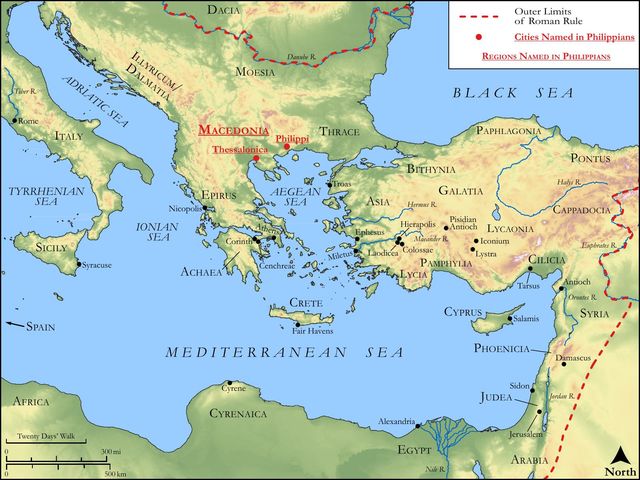
See on the biblical-era maps

Study this verse
Public-domain commentary
Matthew Henry
From his Commentary on the Whole Bible. Henry comments on passages, not single verses — this entry covers Philippians 2:14–18.
The apostle exhorts them in these verses to adorn their Christian profession by a suitable temper and behaviour, in several instances. 1. By a cheerful obedience to the commands of God (Phi 2:14): "Do all things, do your duty in every branch of it, without murmurings. Do it, and do not find fault with it. Mind your work, and do not quarrel with it." God's commands were given to be obeyed, not to be disputed. This greatly adorns our profession, and shows we serve a good Master, whose service is freedom and whose work is its own reward. 2. By peaceableness and love one to another. "Do all things without disputing, wrangling, and debating one another; because the light of truth and the life of religion are often lost in the heats and mists of disputation." 3. By a blameless conversation towards all men (Phi 2:15): "That you may be blameless and harmless, the sons of God, without rebuke; that you be not injurious to any in word or deed, and give no just occasion of offence." We should endeavour not only to be harmless, but to be blameless; not only not to do hurt, but not to come under the just suspicion of it. Blameless and sincere; so some read it. Blameless before men, sincere towards God. The sons of God. It becomes those to be blameless and harmless who stand in such a relation, and are favoured with such a privilege. The children of God should differ from the sons of men. Without rebuke - Amōmēta. Momus was a carping deity among the Greeks, mentioned by Hesiod and Lucian, who did nothing himself, and found fault with every body and every thing. From him all carpers at other men, and rigid censurers of their works, were called Momi. The sense of the expression is, "Walk so circumspectly that Momus himself may have no occasion to cavil at you, that the severest censurer may find no fault with you." We should aim and endeavour, not only to get to heaven, but to get thither without a blot; and, like Demetrius, to have a good report of all men, and of the truth, Jo3 1:12. In the midst of a crooked and perverse generation; that is, among the heathens, and those who are without. Observe, Where there is no true religion, little is to be expected but crookedness and perverseness; and the more crooked and perverse others are among whom we live, and the more apt to cavil, the more careful we should be to keep ourselves blameless and harmless. Abraham and Lot must not strive, because the Canaanite and Perizzite dwelt in the land, Gen 13:7. Among whom you shine as lights in the world. Christ is the light of the world, and good Christians are lights in the world. When God raises up a good man in any place, he sets up a light in that place. Or it may be read imperatively: Among whom shine you as lights: compare Mat 5:16, Let your light so shine before men. Christians should endeavour not only to approve themselves to God, but to recommend themselves to others, that they may also glorify God. They must shine as well as be sincere. - Holding forth the word of life, Phi 2:16. The gospel is called the word of life because it reveals and proposes to us eternal life through Jesus Christ. Life and immortality are brought to light by the gospel, Ti2 1:10. It is our duty not only to hold fast, but to hold forth the word of life; not only to hold it fast for our own benefit, but to hold it forth for the benefit of others, to hold it forth as the candlestick holds forth the candle, which makes it appear to advantage all around, or as the luminaries of the heavens, which shed their influence far and wide. This Paul tells them would be his joy: "That I may rejoice in the day of Christ; not only rejoice in your stedfastness, but in your usefulness." He would have them think his pains well bestowed, and that he had not run in vain, nor laboured in vain. Observe, (1.) The work of the ministry requires the putting forth of the whole man: all that is within us is little enough to be employed in it; as in running and labouring. Running denotes vehemence and vigour, and continual pressing forward; labour denotes constancy and close application. (2.) It is a great joy to ministers when they perceive that they have not run in vain, nor laboured in vain; and it will be their rejoicing in the day of Christ, when their converts will be their crown. What is our hope, or joy, or crown of rejoicing? Are not even you in the presence of our Lord Jesus Christ at his coming? For you are our glory and joy, Th1 2:19, Th1 2:20. The apostle not only ran and laboured for them with satisfaction, but shows that he was ready to suffer for their good (Phi 2:17): Yea, and if I be offered upon the sacrifice and service of your faith, I joy and rejoice with you all. He could reckon himself happy if he could promote the honour of Christ, the edification of the church, and the welfare of the souls of men; though it were not only by hazarding, but by laying down, his life: he could willingly be a sacrifice at their altars, to serve the faith of God's elect. Could Paul think it worth while to shed his blood for the service of the church, and shall we think it much to take a little pains? Is not that worth our labour which he thought worth his life? If I be offered, or poured out as the wine of the drink-offerings, spendomai. Ti2 4:6, I am now ready to be offered. He could rejoice to seal his doctrine with his blood (Phi 2:18): For the same cause also do you joy and rejoice with me. It is the will of God that good Christians should be much in rejoicing; and those who are happy in good ministers have a great deal of reason to joy and rejoice with them. If the minister loves the people, and is willing to spend and be spent for their welfare, the people have reason to love the minister and to joy and rejoice with him.
Historical interpretation
Historical reception
2 surviving comments on this verse. Each one is dated, so this reads as a timeline rather than a list.
Select a marker to jump to its quote. Markers stagger vertically where authors wrote within a few decades of each other.
“I have glory through you because you possess the word of life”—that is, because you know Christ, who is the Word of life, “because what was made in Christ was life.” Therefore Christ is the Word of life. From this we perceive how great is the profit and glory of those who correct the souls of others.
What means "holding fast the word of life"? i.e. "being destined to live, being of those that are gaining salvation." Observe how immediately he subjoins the rewards, which are in reserve. Lights [i.e. luminaries], he says, retain the principle of light; so do ye the principle of life. What means "the word of life"? Having the seed of life, i.e. having pledges of life, holding life itself, i.e. "having in yourselves the seed of life," this is what he calls "the word of life." Consequently the rest are all dead, for by these words he signified as much; for otherwise those others likewise would have held "the word of life." "That I may have whereof to glory," he says; what is this? I too participate in your good deeds, he says. So great is your virtue, as not only to save yourselves, but to render me illustrious. Strange kind of "boasting," thou blessed Paul! Thou art scourged, driven about, reviled for our sakes: therefore he adds, "in the day of Christ, that I did not run," he says, "in vain, nor labored in vain," but I always have a right to glory, he means, that I did not run in vain.
Continue studying Philippians 2:16 across the web’s major study libraries — every link below opens this exact verse, chapter, or book on the destination site.
Read & Compare
 BibleGatewayThis verse in more than 200 translations and 70 languages.
 Bible.comThe YouVersion reader — hundreds of translations, reading plans, and highlights.
 ESV.orgCrossway's official English Standard Version reader.
 NET BibleThe NET translation with 60,000+ translators' notes on every rendering decision.
 STEP BibleTyndale House's free study tool — original text, vocabulary, and scholarly resources.
 BibliaLogos Bible Software's free web reader.
 USCCBThe New American Bible (Revised Edition) with the U.S. bishops' study notes.
Commentaries
 BibleHub CommentariesDozens of classic commentaries on this verse, gathered on one page.
 StudyLightMore than 100 commentary sets — the largest collection on the web.
 BibleRefPlain-English commentary on what this verse means, verse by verse.
 Enduring WordDavid Guzik's free commentary on this chapter, widely used by Bible teachers.
 Bible Study ToolsVerse commentary alongside Greek and Hebrew study aids.
Original Language & Research
- BibleHub InterlinearThe verse word by word — original language, transliteration, and English.
- BibleHub LexiconEvery word's original-language definition and Strong's entry.
 Blue Letter BibleDeep-study tools — Strong's numbers, concordance, and word studies.
 CNTR CollationThe earliest Greek manuscripts of this verse, collated letter by letter.
Sermons, Hymns & Audio


TrulyRandomVerse is not affiliated with these sites and doesn’t control their content. They’re linked because they’re genuinely useful.
Summary
Philippians 2:16 serves as a powerful apostolic exhortation, urging believers to actively embody and proclaim the gospel message, thereby shining as lights in a dark world. Paul expresses his earnest desire that the Philippians' steadfastness in faith and their outward witness will validate his strenuous missionary efforts, ensuring his joy and vindication on the future "day of Christ," when all faithful service will be recognized and rewarded.
Context
ShowHideLiterary Context
This verse is deeply embedded within Paul's profound appeal for Christian unity and humility, which begins with the magnificent Christ hymn in Philippians 2:5-11. Having presented Christ's self-emptying as the ultimate model, Paul then transitions to the believers' responsibility to "work out their own salvation with fear and trembling" (Philippians 2:12). The immediate preceding verses (Philippians 2:14-15) call for a life "without murmurings and disputings," so that they may be "blameless and harmless, children of God without blemish in the midst of a crooked and twisted generation, among whom you shine as lights in the world." Thus, "holding forth the word of life" in Philippians 2:16 is the practical, outward expression of this blameless, light-shining existence, demonstrating the transforming power of the gospel to a watching world.
Historical & Cultural Context
The city of Philippi was a Roman colony, enjoying special privileges and populated by many Roman citizens. This meant a strong presence of Roman culture, law, and emperor worship, which often stood in direct contrast to Christian monotheism and allegiance to Christ alone. The "crooked and twisted generation" Paul mentions refers not only to the general moral decay of the pagan world but also specifically to the pressures and temptations of conforming to Roman societal norms. Paul himself was in prison while writing this letter, which adds a layer of urgency and personal investment to his exhortation. His concern that his labor not be "in vain" reflects the immense personal cost and suffering he endured for the sake of the gospel, a common theme in his epistles as he sought to encourage and validate his ministry among the churches he founded.
Key Themes
ShowHidePhilippians 2:16 contributes significantly to several key themes in the book of Philippians. Firstly, it underscores the theme of Christian Witness and Evangelism, emphasizing the active role believers play in proclaiming the life-giving message of the gospel, not just verbally but through their transformed lives, as "lights in the world" (Philippians 2:15). Secondly, it highlights Paul's Apostolic Concern and Joy, revealing his deep desire that his arduous ministry and personal sacrifices for the Philippian church would not prove fruitless, but rather result in their steadfastness and spiritual maturity, which would be his "boasting" or "rejoicing" on the "day of Christ" (Philippians 2:16). Finally, the verse reinforces the theme of Perseverance and Purpose in Ministry, using the athletic imagery of running and laboring to convey the intense effort and dedication required in Christian service, ensuring that such efforts are purposeful and ultimately rewarded, as seen in Paul's broader reflections on the Christian race (Philippians 3:12-14).
Exposition and Analysis
ShowHideKey Word Analysis
ShowHideThis verb, from epí (upon) and échō (to have, hold), carries a dual meaning: to hold fast to something and to hold it out or offer it. In this context, it primarily signifies "holding out," "presenting," or "offering" the word of life to others, much like one would hold out a lamp to illuminate darkness. It also subtly implies holding onto it oneself, demonstrating its truth through one's life.
While lógos broadly means "something said," "discourse," or "reasoning," in theological contexts, especially when paired with "life," it refers to the divine message, the gospel, or even the person of Christ as the ultimate revelation of God. Here, it is the content of the message that brings life.
This term denotes spiritual and eternal life, distinct from mere biological existence (bios). It refers to the divine life that God imparts through the gospel, a quality of life characterized by fellowship with God, righteousness, and eternal duration, contrasting with the spiritual death of the "crooked and twisted generation."
Meaning "empty" or "useless," this word emphasizes Paul's concern that his efforts and the Philippians' response would not be without ultimate purpose or fruit. It speaks to the effectiveness and lasting impact of their shared ministry and faith.
Verse Breakdown
ShowHide"Holding forth the word of life;"
This is an imperative for the Philippian believers, urging them to actively present, proclaim, and embody the gospel message. The "word of life" is the good news of salvation through Christ, which imparts spiritual and eternal life to those who believe. Their lives are to be a living demonstration of this life-giving truth.
"that I may rejoice in the day of Christ,"
Paul states the purpose and desired outcome of their faithful witness. Their steadfastness and fruitfulness in holding forth the word of life will be a source of profound joy and "boasting" (in a positive sense) for him on the "day of Christ." This refers to the eschatological day of the Lord's return, judgment, and the rewarding of believers.
"that I have not run in vain, neither laboured in vain."
This clause further clarifies Paul's anticipation of joy. He uses athletic metaphors, comparing his apostolic ministry to a race ("run") and hard work ("laboured"). His desire is that his immense efforts, suffering, and dedication in preaching the gospel and nurturing the Philippian church would prove to be purposeful and effective, not empty or without lasting spiritual fruit when Christ returns.
Literary Devices
ShowHidePaul employs several literary devices to convey his message. The phrase "Holding forth the word of life" functions as a powerful Metaphor, portraying believers as those who actively present a life-giving message, much like holding out a torch or a cup of water. This connects directly to the preceding verse's imagery of "shining as lights in the world," creating a cohesive visual of illumination and provision. The use of Parallelism is evident in the concluding phrase, "that I have not run in vain, neither laboured in vain," where two similar actions ("run," "laboured") are paired with the same outcome ("in vain") to emphasize the comprehensive nature of his concern and effort. This also hints at Athletic Imagery, a common motif in Paul's letters, comparing the Christian life and ministry to a demanding race or strenuous labor, underscoring the need for perseverance and dedication.
Theological and Thematic Connections
ShowHidePhilippians 2:16 profoundly connects the believer's present conduct to future eschatological hope and the validation of apostolic ministry. It highlights the indispensable role of the church in continuing Christ's mission of light and life in a fallen world. The "word of life" is not merely information but a transformative power that brings spiritual regeneration and eternal existence, echoing the very essence of God's redemptive plan. Paul's concern for his labor not being "in vain" underscores the biblical principle that faithful service in the Lord is never without purpose or reward, and that the spiritual fruit borne in the lives of converts is the ultimate vindication of gospel proclamation. This verse serves as a powerful reminder that our daily walk and witness have eternal significance, contributing to the glory of God and the joy of those who have invested in our spiritual journey.
Reflection and Application
ShowHidePhilippians 2:16 calls us to a dynamic and intentional faith. It challenges us to consider not only what we believe but how we embody and communicate that belief to a world desperately in need of life. "Holding forth the word of life" means living in such a way that the gospel is evident in our character, our choices, and our conversations. Are we truly shining as lights, or are we blending into the darkness? This verse also offers profound encouragement, reminding us that our efforts in the Lord, no matter how small they may seem, are never in vain. Every act of faithfulness, every word of truth shared, every prayer offered, contributes to an eternal purpose that will be fully revealed and rewarded on the "day of Christ." This should motivate us to persevere, knowing that our "run" and "labor" for the gospel have eternal significance and bring joy to both our spiritual mentors and, ultimately, to Christ Himself.
Questions for Reflection
ShowHideFAQ
ShowHideWhat does "holding forth the word of life" mean for believers today?
ShowHideFor believers today, "holding forth the word of life" means actively presenting and embodying the gospel message in both word and deed. It involves living a life that reflects the transformative power of Christ, making the truth of God's Word visible and attractive to others, as described in Philippians 2:15. This includes verbal proclamation of the good news, but also demonstrating its reality through our character, integrity, love, and hope in a world that often lacks these qualities. Our consistent walk and verbal witness are vital for the advancement of the gospel and for showing others the path to true, eternal life found in Christ.
Christ-Centered Fulfillment
ShowHidePhilippians 2:16 finds its ultimate fulfillment in Christ, who is Himself the very "Word of Life." As the Logos of God (John 1:1), Jesus is not merely the bearer of life but the source and embodiment of it (John 1:4). He perfectly "held forth" this word of life through His incarnation, ministry, and sacrificial death, illuminating the darkness of the world as the true "light of the world" (John 8:12). Paul's desire that his "run" and "labor" not be "in vain" ultimately points to Christ's own perfect and effective work; His suffering and death were assuredly not in vain, but achieved the complete redemption of humanity (Isaiah 53:11). The "day of Christ" is the day of His glorious return, when His work will be fully revealed and celebrated, and all who have faithfully held forth His word will share in His triumph and joy, having been made blameless and harmless by His perfect sacrifice (1 Corinthians 1:8).