


1 Corinthians 9:26
Bible text: King James Version (1769 Blayney text) · Public domain
Bible text: Berean Standard Bible · Public domain
Bible text: American Standard Version (1901) · Public domain
Bible text: World English Bible, Messianic edition · Public domain
Bible text: Geneva Bible (1599) · Public domain
Bible text: Young's Literal Translation · Public domain
- ἐγὼegōI myselfG1473P-1NSPersonal pronoun Nominative 1st Singular
- τοίνυνtoinunthereforeG5106CONJConjunction
- οὕτωςhoutōsthusG3779ADVAdverb
- τρέχωtrechōrunG5143V-PAI-1SVerb Present Active Indicative 1st Singular
- ὡςhōsasG5613PRTParticle or Disjunctive
- οὐκouknotG3756PRT-NNegative Particle Negative
- ἀδήλωςadēlōsuncertainlyG84ADVAdverb
- οὕτωςhoutōssoG3779ADVAdverb
- πυκτεύωpukteuōI fightG4438V-PAI-1SVerb Present Active Indicative 1st Singular
- ὡςhōsasG5613PRTParticle or Disjunctive
- οὐκouknotG3756PRT-NNegative Particle Negative
- ἀέραaera[the] airG109N-ASMNoun Accusative Singular Masculine
- δέρων·derōnbeatingG1194V-PAP-NSMVerb Present Active Participle Nominative Singular Masculine
English is a literal word-by-word gloss of the Greek, not the KJV's wording. Why?
This is the original text the KJV's translators worked from — each Greek word with its own literal English meaning in this verse, prepared by scholars at Tyndale House, Cambridge. The KJV translates whole sentences, not word by word, so its wording differs: one Greek word can become several English words, and the KJV may choose “charity” where the gloss reads “love”. Both are faithful — they answer different questions. For the KJV's own rendering, switch to the KJV text.
Details
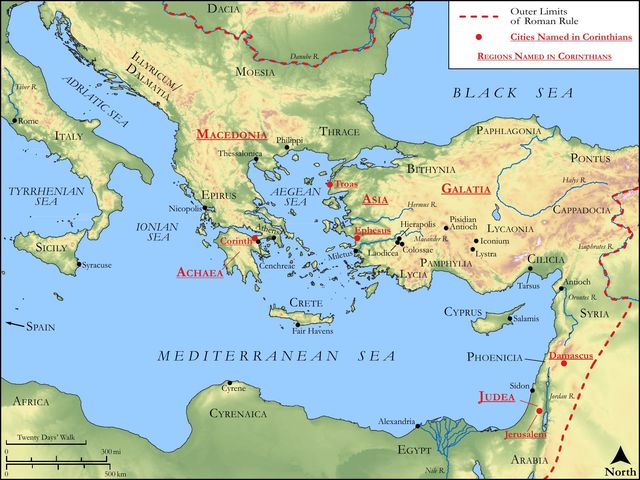
See on the biblical-era maps

Study this verse
Public-domain commentary
Matthew Henry
From his Commentary on the Whole Bible. Henry comments on passages, not single verses — this entry covers 1 Corinthians 9:24–27. His two-level outline is real structure in the source text, so it is rendered as structure.
In these verses the apostle hints at the great encouragement he had to act in this manner. He had a glorious prize, an incorruptible crown, in view. Upon this head he compares himself to the racers and combatants in the Isthmian games, an allusion well known to the Corinthians, because they were celebrated in their neighbourhood: "Know you not that those who run in a race run all, but one obtaineth the prize? Co1 9:24. All run at your games, but only one gets the race and wins the crown." And here,
I.He excites them to their duty:
"So run that you may obtain. It is quite otherwise in the Christian race than in your races; only one wins the prize in them. You may all run so as to obtain. You have great encouragement, therefore, to persist constantly, and diligently, and vigorously, in your course. There is room for all to get the prize. You cannot fail if you run well. Yet there should be a noble emulation; you should endeavour to outdo one another. And it is a glorious contest who shall get first to heaven, or have the best rewards in that blessed world. I make it my endeavour to run; so do you, as you see me go before you." Note, It is the duty of Christians to follow their ministers closely in the chase of eternal glory, and the honour and duty of ministers to lead them in the way.
II.He directs them in their course, by setting more fully to view his own example, still carrying on the allusion.
1. Those that ran in their games were kept to a set diet: "Every man that strives for the mastery is temperate in all things, Co1 9:23. The fighters and wrestlers in your exercises are kept to strict diet and discipline; nay, they keep themselves to it. They do not indulge themselves, but restrain themselves from the food they eat and so from the liberties they use on other occasions. And should not Christians much more abridge themselves of their liberty, for so glorious an end as winning the race, and obtaining the prize set before them? They used a very spare diet, and course food, and denied themselves much, to prepare for their race and combat; so do I; so should you, after my example. It is hard if, for the heavenly crown, you cannot abstain from heathen sacrifices." 2. They were not only temperate, but inured themselves to hardships. Those who fought with one another in these exercises prepared themselves by beating the air, as the apostle calls it, or by throwing out their arms, and thereby inuring themselves, beforehand, to deal about their blows in close combat, or brandish them by way of flourish. There is no room for any such exercise in the Christian warfare. Christians are ever in close combat. There enemies make fierce and hearty opposition, and are ever at hand; and for this reason they must lay about them in earnest, and never drop the contest, nor flag and faint in it. They must fight, not as those that beat the air, but must strive against their enemies with all their might. One enemy the apostle here mentions, namely, the body; this must be kept under, beaten black and blue, as the combatants were in these Grecian games, and thereby brought into subjection. By the body we are to understand fleshly appetites and inclinations. These the apostle set himself to curb and conquer, and in this the Corinthians were bound to imitate him. Note, Those who would aright pursue the interests of their souls must beat down their bodies, and keep them under. They must combat hard with fleshly lusts, and not indulge a wanton appetite, and long for heathenish sacrifices, nor eat them, to please their flesh, at the hazard of their brethren's souls. The body must be made to serve the mind, not suffered to lord over it.
III.The apostle presses this advice on the Corinthians by proper arguments drawn from the same contenders.
1.They take pains, and undergo all those hardships, to obtain a corruptible crown (Co1 9:25), but we an incorruptible. Those who conquered in these games were crowned only with the withering leaves or boughs of trees, of olive, bays, or laurel. But Christians have an incorruptible crown in view, a crown of glory that never fadeth away, an inheritance incorruptible, reserved in heaven for them. And would they yet suffer themselves to be outdone by these racers or wrestlers? Can they use abstinence in diet, exert themselves in racing, expose their bodies to so much hardship in a combat, who have no more in view than the trifling huzzas of a giddy multitude, or a crown of leaves? And shall not Christians, who hope for the approbation of the sovereign Judge, and a crown of glory from his hands, stretch forward in the heavenly race, and exert themselves in beating down their fleshly inclinations, and the strong-holds of sin?
2.The racers in these games run at uncertainty. All run, but one receives the prize, Co1 9:24. Every racer, therefore, is at a great uncertainty whether he shall win it or no. But the Christian racer is at no such uncertainty. Every one may run here so as to obtain; but then he must run within the lines, he must keep to the path of duty prescribed, which, some think, is the meaning of running not as uncertainly, Co1 9:26. He who keeps within the limits prescribed, and keeps on in his race, will never miss his crown, though others may get theirs before him. And would the Grecian racers keep within their bounds, and exert themselves to the very last, when one only could win, and all must be uncertain which that one would be? And shall not Christians be much more exact and vigorous when all are sure of a crown when they come to the end of their race?
3.He sets before himself and them the danger of yielding to fleshly inclinations, and pampering the body and its lusts and appetites: I keep my body under, lest that by any means, when I have preached to others, I myself should be a cast-away (Co1 9:27), rejected, disapproved, adokimos, one to whom the brabeutēs - the judge or umpire of the race, will not decree the crown. The allusion to the games runs through the whole sentence. Note, A preacher of salvation may yet miss it. He may show others the way to heaven, and never get thither himself. To prevent this, Paul took so much pains in subduing and keeping under bodily inclinations, lest by any means he himself, who had preached to others, should yet miss the crown, be disapproved and rejected by his sovereign Judge. A holy fear of himself was necessary to preserve the fidelity of an apostle; and how much more necessary is it to our preservation? Note, Holy fear of ourselves, and not presumptuous confidence, is the best security against apostasy from God, and final rejection by him.
Historical interpretation
Historical reception
10 surviving comments on this verse. Each one is dated, so this reads as a timeline rather than a list.
Select a marker to jump to its quote. Markers stagger vertically where authors wrote within a few decades of each other.
Paul means that he fights not merely with his words but with his deeds.
And so Paul, like a good athlete, not only knew how to avoid the blows of opposing powers, but also how to strike back. Therefore he says: I beat my body and make it my slave, so that after I have preached to others, I myself will not be disqualified for the prize. And so, like a good athlete, he deserved to reach the crown.
As a wrestler therefore he enters the lists last of all; he raises his eyes to heaven, he sees that even the heavenly creation was made subject to vanity, not willingly, but by reason of him who hath subjected the same in hope. He sees that the whole creation groaneth in pain together, waiting for redemption. He sees that labour awaits us all. He raises his eyes, he sees the circlets of lights, he surveys the orbs of the moon and stars: For the just, who overcome, shall be as the stars in heaven. And he chastises his body, that it may not be his enemy in the combat, he anoints it with the oil of mercy, he exercises it with daily trials of virtue, he smears himself with dust, he runs to the goal of the course but not as uncertainly, he aims his blows, he darts forth his arms, but not into empty space. Thus the earth is man's trial-ground, heaven is his crown.
"I therefore so run, as not uncertainly."
Thus having shamed them from those that are without, he next brings forward himself also, which kind of thing is a most excellent method of teaching: and accordingly we find him every where doing so.
But what is, "not uncertainly?" "Looking to some mark," saith he, "not at random and in vain, as ye do. For what profit have ye of entering into idol-temples, and exhibiting for-sooth that perfectness? None. But not such am I, but all things whatsoever I do, I do for the salvation of my neighbor. Whether I show forth perfectness, it is for their sake; or condescension, for their sake again: whether I surpass Peter in declining to receive [compensation], it is that they may not be offended; or descend lower than all, being circumcised and shaving my head, it is that they may not be subverted. This is, "not uncertainly." But thou, why dost thou eat in idol-temples, tell me? Nay, thou canst not assign any reasonable cause. For "meat commendeth thee not to God; neither if thou eat art thou the better, nor if thou eat not art thou the worse." Plainly then thou runnest at random: for this is, "uncertainly."
"So fight I, as not beating the air." This he saith, again intimating that he acted not at random nor in vain. "For I have one at whom I may strike, i.e., the devil. But thou dost not strike him, but simply throwest away thy strength."
Now so far then, altogether bearing with them, he thus speaks. For since he had dealt somewhat vehemently with them in the preceding part, he now on the contrary keeps back his rebuke, reserving for the end of the discourse the deep wound of all. Since here he says that they act at random and in vain; but afterwards signifies that it is at the risk of no less than utter ruin to their own soul, and that even apart from all injury to their brethren, neither are they themselves guiltless in daring so to act.
So run in this world as to obtain in the next.
The “air” here refers to the powers of evil.
She also said, ‘The devil sometimes sends a severe fast which is too prolonged; the devil’s disciples do this as well as holy men. How do we distinguish the fasting of our God and King from the fasting of that tyrant the devil? Clearly by its moderation. Throughout your life, then, you ought to keep an unvarying rule of fasting. Do you fast four or five days on end and then lose your spiritual strength by eating a feast? That really pleases the devil! Everything which is extreme is destructive. So do not suddenly throw away your armour, or you may be found unarmed in the battle and easily captured. Our body is the armour, our soul is the warrior. Take care of both, and you will be ready for whatever comes.’
They said that Dioscorus of Namisias made his bread out of barley, and his soup out of lentils. Every year he made one particular resolution: either not to meet anyone for a year, or not to speak, or not to taste cooked food, or not to eat any fruit, or not to eat vegetables. This was his system in everything. He made himself master of one thing, and then started on another, and so on each year...
They said of Helladius that he lived twenty years in his cell, and did not once raise his eyes to look at the roof.
Joseph asked Poemen, ‘How should we fast?’ Poemen said, ‘I suggest that everyone should eat a little less than he wants, every day.’ Joseph said to him, ‘When you were a young man, didn’t you fast for two days on end?’ He said to him, ‘That’s right, I used to fast three days on end, even for a week. But the great hermits have tested all these things, and they found that it is good to eat something every day, but on some days a little less. They have shown us that this is the king’s highway, for it is easy and light.’
John the Short said, ‘If a king wants to take a city filled with his enemies, he first captures their food and water, and when they are starving he subdues them. So it is with gluttony. If a man is sincere about fasting and is hungry, the enemies that trouble his soul will grow weak.’
Continue studying 1 Corinthians 9:26 across the web’s major study libraries — every link below opens this exact verse, chapter, or book on the destination site.
Read & Compare
 BibleGatewayThis verse in more than 200 translations and 70 languages.
 Bible.comThe YouVersion reader — hundreds of translations, reading plans, and highlights.
 ESV.orgCrossway's official English Standard Version reader.
 NET BibleThe NET translation with 60,000+ translators' notes on every rendering decision.
 STEP BibleTyndale House's free study tool — original text, vocabulary, and scholarly resources.
 BibliaLogos Bible Software's free web reader.
 USCCBThe New American Bible (Revised Edition) with the U.S. bishops' study notes.
Commentaries
 BibleHub CommentariesDozens of classic commentaries on this verse, gathered on one page.
 StudyLightMore than 100 commentary sets — the largest collection on the web.
 BibleRefPlain-English commentary on what this verse means, verse by verse.
 Enduring WordDavid Guzik's free commentary on this chapter, widely used by Bible teachers.
 Bible Study ToolsVerse commentary alongside Greek and Hebrew study aids.
Original Language & Research
- BibleHub InterlinearThe verse word by word — original language, transliteration, and English.
- BibleHub LexiconEvery word's original-language definition and Strong's entry.
 Blue Letter BibleDeep-study tools — Strong's numbers, concordance, and word studies.
 CNTR CollationThe earliest Greek manuscripts of this verse, collated letter by letter.
Sermons, Hymns & Audio


TrulyRandomVerse is not affiliated with these sites and doesn’t control their content. They’re linked because they’re genuinely useful.
Summary
The Apostle Paul, in 1 Corinthians 9:26, employs vivid athletic metaphors to articulate the profound intentionality and rigorous discipline that characterize his spiritual life and apostolic ministry. He asserts that his endeavors are neither aimless nor futile, but rather are directed with a clear purpose, akin to a runner striving for a visible finish line or a boxer striking a tangible opponent, thereby contrasting purposeful Christian living with unfocused or wasted effort.
Context
ShowHideLiterary Context
This verse is strategically placed within 1 Corinthians chapter 9, where Paul defends his apostolic authority and explains his willingness to forgo personal rights and privileges, such as financial support, for the greater advancement of the gospel. The immediate context, 1 Corinthians 9:24-27, introduces the powerful imagery of the Isthmian Games, a renowned athletic competition familiar to the Corinthian audience. Paul uses this analogy to underscore the discipline, self-control, and sacrifice required to win a perishable prize, drawing a direct parallel to the even greater commitment necessary for believers to secure an imperishable crown. His personal example serves as a model for the Corinthian believers, urging them to pursue their faith with similar intentionality and dedication.
Historical & Cultural Context
The city of Corinth was a major commercial and cultural hub, famous for its Isthmian Games, which were second only to the Olympic Games in prestige. These biennial athletic festivals included running, boxing, wrestling, and other contests, and would have been a common and highly visible part of Corinthian life. Athletes trained rigorously, often under strict diets and intense discipline, for the honor of winning a wreath of wild celery (later pine), a perishable symbol of victory. Paul's audience would have immediately grasped the implications of purposeful training, focused effort, and the stark contrast between a disciplined contender and an aimless participant. This cultural backdrop makes Paul's metaphors incredibly potent and relatable, emphasizing that spiritual pursuits demand even greater commitment than temporal athletic endeavors.
Key Themes
ShowHide1 Corinthians 9:26 contributes significantly to several overarching themes within 1 Corinthians and Paul's broader theology. It highlights the theme of Purposeful Living, asserting that the Christian life is not a haphazard journey but a deliberate pursuit with a defined goal, echoing the call to press on toward the prize in Philippians 3:14. The verse also underscores Spiritual Discipline and Self-Control, demonstrating that just as athletes subject their bodies to rigorous training, believers must exercise similar self-mastery to effectively serve God, a concept further elaborated in 1 Corinthians 9:27. Furthermore, it warns against Futility and Wasted Effort, emphasizing that a lackadaisical or unfocused approach to faith yields no spiritual fruit, contrasting sharply with the effective spiritual warfare described in Ephesians 6:12. Ultimately, the verse champions Intentional Ministry and a focused Christian walk, where every action is directed towards the advancement of the gospel and the glory of God.
Exposition and Analysis
ShowHideKey Word Analysis
ShowHideFrom a primary verb, this term refers to moving quickly or walking hastily, literally or figuratively. In the context of athletic contests, it specifically denotes competing in a footrace. Paul uses this word to convey the idea of a focused, energetic, and purposeful progression towards a goal, implying a deliberate and sustained effort rather than a casual stroll.
This adverb means "obscurely," "without a clear mark," or "aimlessly." It describes an action performed without a visible target, a definite aim, or a clear finish line. Paul uses it to contrast his own intentional and goal-oriented spiritual journey with a life lived without direction or a clear understanding of its ultimate purpose.
Derived from a word related to the fist, this verb specifically means "to box" or "to contend as a boxer" in the games. Figuratively, it denotes engaging in a struggle or conflict. Paul employs this term to depict his spiritual battles as real and impactful, involving direct engagement with adversaries rather than merely shadowboxing or expending effort without opposition.
Verse Breakdown
ShowHide"I therefore so run,"
Paul asserts his personal commitment and the manner of his spiritual journey. The "I" (G1473, egō) is emphatic in the Greek, highlighting his personal example. "Therefore" (G5106, toínyn) connects this statement to the preceding discussion about foregoing rights for the gospel's sake, indicating that his purposeful "running" is a logical consequence of his dedication to Christ. He is not merely participating, but running with a specific, determined pace and direction.
"not as uncertainly;"
This clause immediately clarifies the nature of Paul's "running." He does not run "without a clear mark" (G84, adḗlōs), meaning his race has a defined course and a visible finish line. His efforts are not random, aimless, or without a known objective. This implies a spiritual life lived with clear goals, understanding of God's will, and a focused pursuit of the heavenly prize.
"so fight I,"
Shifting metaphors from running to boxing, Paul again emphasizes the intentionality of his spiritual struggle. The "so" (G3779, hoútō) reiterates the manner of his engagement—with the same purposefulness and determination as his running. His "fight" (G4438, pyktéō) is a direct, confrontational engagement, not a passive or detached observation.
"not as one that beateth the air:"
This vivid image completes the boxing metaphor. To "beateth the air" (G1194, dérō G109, aḗr) refers to shadowboxing or striking without an opponent, signifying wasted energy, futile effort, or an action that has no real impact. Paul asserts that his spiritual battles are against real adversaries and have tangible outcomes, emphasizing the effectiveness and purposefulness of his ministry and personal walk.
Literary Devices
ShowHidePaul masterfully employs Metaphor and Analogy throughout 1 Corinthians 9:24-27, particularly in verse 26. He draws a direct comparison between the rigorous training and purposeful competition of athletes in the Isthmian Games and the spiritual discipline required of believers. The images of a runner and a boxer are not merely illustrative but serve as powerful analogies for the Christian life. Furthermore, Paul uses striking Contrast to highlight his intentionality: he runs "not as uncertainly" and fights "not as one that beateth the air." This rhetorical device effectively emphasizes the difference between a focused, effective spiritual life and one that is aimless or futile. The Parallelism in the two halves of the verse ("so run... not as uncertainly; so fight I... not as one that beateth the air") reinforces the unified theme of purposeful effort across different athletic disciplines, underscoring the comprehensive nature of Paul's commitment.
Theological and Thematic Connections
ShowHide1 Corinthians 9:26 profoundly underscores the theological imperative for intentionality and discipline in the Christian life. It moves beyond mere activity to purposeful engagement, highlighting that spiritual growth and effective ministry are not accidental but the result of deliberate effort and focused pursuit. This verse connects the concept of self-control, often seen as a fruit of the Spirit, with the active pursuit of God's will and the advancement of His kingdom. It challenges believers to live with a clear understanding of their spiritual objective, recognizing that their efforts have eternal consequences and should therefore be directed with utmost seriousness and dedication, mirroring the commitment of an athlete striving for an ultimate prize.
Reflection and Application
ShowHide1 Corinthians 9:26 serves as a powerful mirror for believers, inviting us to critically examine the intentionality and effectiveness of our own spiritual journey. Are we merely going through the motions, or are we actively pursuing the high calling of God in Christ Jesus with purpose and discipline? This verse challenges us to move beyond a passive faith to an engaged and strategic walk, recognizing that our spiritual efforts, like those of an athlete, must be directed towards a clear goal and against real adversaries. It calls for a life marked by self-control, focus, and a deep understanding of the spiritual battles we face, ensuring that our time, energy, and resources are invested wisely for eternal impact, rather than being squandered on aimless pursuits or futile struggles.
Questions for Reflection
ShowHideFAQ
ShowHideWhat does Paul mean by "not as uncertainly" and "not as one that beateth the air"?
ShowHidePaul uses these phrases to emphasize the purposeful and effective nature of his spiritual life and ministry, contrasting it with aimless or wasted effort. "Not as uncertainly" (Greek: adḗlōs) means he is not running a race without a visible finish line or a clear objective. His spiritual journey has a definite goal and direction. "Not as one that beateth the air" (Greek: dérō aéra) refers to shadowboxing, striking without an actual opponent, or expending energy in a way that yields no real impact. Paul asserts that his spiritual "fight" is against real adversaries (like sin, temptation, and spiritual forces, as mentioned in Ephesians 6:12) and is designed to be effective, not futile. Both metaphors underscore the necessity of intentionality, focus, and discipline in the Christian walk.
Christ-Centered Fulfillment
ShowHideWhile 1 Corinthians 9:26 speaks to Paul's personal discipline, its ultimate Christ-centered fulfillment lies in Jesus Himself, who perfectly embodied the purposeful life and the effective fight. Jesus "ran" His earthly race with absolute certainty, knowing His mission to redeem humanity and glorify the Father. From His baptism to His crucifixion, every step was intentional, leading towards the ultimate "prize" of salvation for all who believe, as prophesied in Isaiah 53:10-11. He "fought" not as one beating the air, but directly confronting sin, sickness, and the powers of darkness, culminating in His decisive victory over death and the grave through His resurrection, a triumph described in Colossians 2:15. Jesus' life was the epitome of a focused, disciplined pursuit of God's will, never wavering from the purpose for which He came, even to the point of enduring the cross (Hebrews 12:2). Therefore, Paul's exhortation for believers to run with purpose and fight effectively is a call to imitate the perfect intentionality and victorious struggle of Christ, who empowers us through His Spirit to live lives that are truly impactful for His kingdom.