


Philippians 3:14
Bible text: King James Version (1769 Blayney text) · Public domain
Bible text: Berean Standard Bible · Public domain
Bible text: American Standard Version (1901) · Public domain
Bible text: World English Bible, Messianic edition · Public domain
Bible text: Geneva Bible (1599) · Public domain
Bible text: Young's Literal Translation · Public domain
- κατὰkatatowardG2596PREPPreposition
- σκοπὸνskopon[the] goalG4649N-ASMNoun Accusative Singular Masculine
- διώκωdiōkōI press onG1377V-PAI-1SVerb Present Active Indicative 1st Singular
- εἰςeisforG1519PREPPreposition
- τὸtotheG3588T-ASNDefinite article Accusative Singular Neuter
- βραβεῖονbrabeionprizeG1017N-ASNNoun Accusative Singular Neuter
- τῆςtēsof theG3588T-GSFDefinite article Genitive Singular Feminine
- ἄνωanōupwardG507ADVAdverb
- κλήσεωςklēseōscallingG2821N-GSFNoun Genitive Singular Feminine
- τοῦtou<the>G3588T-GSMDefinite article Genitive Singular Masculine
- θεοῦtheouof GodG2316N-GSM-TNoun Genitive Singular Masculine Title
- ἐνeninG1722PREPPreposition
- ΧριστῷChristōChristG5547N-DSM-TNoun Dative Singular Masculine Title
- ἸησοῦIēsouJesusG2424N-DSM-PNoun Dative Singular Masculine Individual
English is a literal word-by-word gloss of the Greek, not the KJV's wording. Why?
This is the original text the KJV's translators worked from — each Greek word with its own literal English meaning in this verse, prepared by scholars at Tyndale House, Cambridge. The KJV translates whole sentences, not word by word, so its wording differs: one Greek word can become several English words, and the KJV may choose “charity” where the gloss reads “love”. Both are faithful — they answer different questions. For the KJV's own rendering, switch to the KJV text.
Details
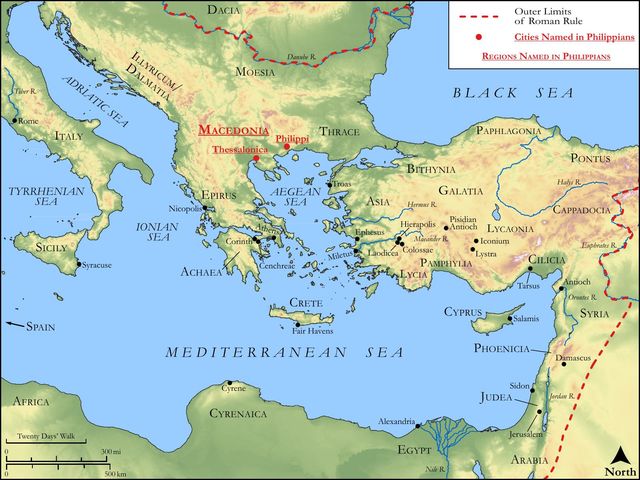
See on the biblical-era maps

Study this verse
Public-domain commentary
Matthew Henry
From his Commentary on the Whole Bible. Henry comments on passages, not single verses — this entry covers Philippians 3:9–14. His four-level outline is real structure in the source text, so it is rendered as structure.
We now heard what the apostle renounced; let us now see what he laid hold on, and resolved to cleave to, namely, Christ and heaven. He had his heart on these two great peculiarities of the Christian religion.
I.The apostle had his heart upon Christ as his righteousness. This is illustrated in several instances.
1.He desired to win Christ; and an unspeakable gainer he would reckon himself if he had but an interest in Christ and his righteousness, and if Christ became his Lord and his Saviour: That I may win him; as the runner wins the prize, as the sailor makes the port he is bound for. The expression intimates that we have need to strive for him and after him, and that all is little enough to win him.
2.That he might be found in him (Phi 3:9), as the manslayer was found in the city of refuge, where he was safe from the avenger of blood, Num 35:25. Or it alludes to a judicial appearance; so we are to be found of our Judge in peace, Pe2 3:14. We are undone without a righteousness wherein to appear before God, for we are guilty. There is a righteousness provided for us in Jesus Christ, and it is a complete and perfect righteousness. None can have interest or benefit by it but those who come off from confidence in themselves, and are brought heartily to believe in him. "Not having my own righteousness, which is of the law; not thinking that my outward observances and good deeds are able to atone for my bad ones, or that by setting the one over against the other I can come to balance accounts with God. No, the righteousness which I depend upon is that which is through the faith of Christ, not a legal, but evangelical righteousness: The righteousness which is of God by faith, ordained and appointed of God." The Lord Jesus Christ is the Lord our righteousness, Isa 45:24; Jer 23:6. Had he not been God, he could not have been our righteousness; the transcendent excellence of the divine nature put such a value upon, and such a virtue into, his sufferings, that they became sufficient to satisfy for the sins of the world, and to bring in a righteousness which will be effectual to all that believe. Faith is the ordained means of actual interest and saving benefit in all the purchase of his blood. It is by faith in his blood, Rom 3:25.
3.That he might know Christ (Phi 3:10): That I may know him, and the power of his resurrection, and the fellowship of his sufferings. Faith is called knowledge, Isa 53:11. Knowing him here is believing in him: it is an experimental knowledge of the power of his resurrection, and the fellowship of his sufferings, or feeling the transforming efficacy and virtue of them. Observe, The apostle was as ambitious of being sanctified as he was of being justified. He was as desirous to know the power of Christ's death and resurrection killing sin in him, and raising him up to newness of life, as he was to receive the benefit of Christ's death and resurrection in his justification.
4.That he might be conformable unto him, and this also is meant of his sanctification. We are then made conformable to his death when we die to sin, as Christ died for sin, when we are crucified with Christ, the flesh and affections of it mortified, and the world is crucified to us, and we to the world, by virtue of the cross of Christ. This is our conformity to his death.
II.The apostle had his heart upon heaven as his happiness: If by any means I might attain to the resurrection of the dead, Phi 3:11.
1.The happiness of heaven is here called the resurrection of the dead, because, though the souls of the faithful, when they depart, are immediately with Christ, yet their happiness will not be complete till the general resurrection of the dead at the last day, when soul and body shall be glorified together. Anastasis sometimes signifies the future state. This the apostle had his eye upon; this he would attain. There will be a resurrection of the unjust, who shall arise to shame and everlasting contempt; and our care must be to escape that: but the joyful and glorious resurrection of saints is called the resurrection, kat' exochēn - by eminence, because it is in virtue of Christ's resurrection, as their head and first-fruits; whereas the wicked shall rise only by the power of Christ, as their judge. To the saints it will be indeed a resurrection, a return to bliss, and life, and glory; while the resurrection of the wicked is a rising from the grave, but a return to a second death. It is called the resurrection of the just, and the resurrection of life (Joh 5:29), and they are counted worthy to obtain that world and the resurrection from the dead, Luk 20:35.
2.This joyful resurrection the apostle pressed towards. He was willing to do any thing, or suffer any thing, that he might attain that resurrection. The hope and prospect of it carried him with so much courage and constancy through all the difficulties he met with in his work. He speaks as if they were in danger of missing it, and coming short of it. A holy fear of coming short is an excellent means of perseverance. Observe, His care to be found in Christ was in order to his attaining the resurrection of the dead. Paul himself did not hope to attain it through his own merit and righteousness, but through the merit and righteousness of Jesus Christ. "Let me be found in Christ, that I may attain the resurrection of the dead, be found a believer in him, and interested in him by faith," Observe,
(1.)He looks upon himself to be in a state of imperfection and trial: Not as though I had already attained, or were already perfect, Phi 3:12. Observe, The best men in the world will readily own their imperfection in the present state. We have not yet attained, are not already perfect; there is still much wanting in all our duties, and graces, and comforts. If Paul had not attained to perfection (who had reached to so high a pitch of holiness), much less have we. Again, Brethren, I count not myself to have apprehended (Phi 3:13), ou logizomai. "I make this judgment of the case; I thus reason with myself." Observe, Those who think they have grace enough give proof that they have little enough, or rather that they have none at all; because, wherever there is true grace, there is a desire of more grace, and a pressing towards the perfection of grace.
(2.)What the apostle's actings were under this conviction. Considering that he had not already attained, and had not apprehended, he pressed forward: "I follow after (Phi 3:12), diōkō - I pursue with vigour, as one following after the game. I endeavour to get more grace and do more good, and never think I have done enough: If that I may apprehend that for which also I am apprehended of Christ Jesus." Observe,
[1.]Whence our grace comes - from our being apprehended of Christ Jesus. It is not our laying hold of Christ first, but his laying hold of us, which is our happiness and salvation. We love him because he first loved us, Jo1 4:19. Not our keeping hold of Christ, but his keeping hold of us, is our safety. We are kept by his mighty power through faith unto salvation, Pe1 1:5. Observe,
[2.]What the happiness of heaven is: it is to apprehend that for which we are apprehended of Christ. When Christ laid hold of us, it was to bring us to heaven; and to apprehend that for which he apprehended us is to attain the perfection of our bliss. He adds further (Phi 3:13): This one thing I do (this was his great care and concern), forgetting those things which are behind, and reaching forth to those things which are before. There is a sinful forgetting of past sins and past mercies, which ought to be remembered for the exercise of constant repentance and thankfulness to God. But Paul forgot the things which were behind so as not to be content with present measures of grace: he was still for having more and more. So he reaches forth, epekteinomenos - stretched himself forward, bearing towards his point: it is expressive of a vehement concern.
(3.)The apostle's aim in these actings: I press towards the mark, for the prize of the high calling of God in Christ Jesus, Phi 3:14. He pressed towards the mark. As he who runs a race never takes up short of the end, but is still making forwards as fast as he can, so those who have heaven in their eye must still be pressing forward to it in holy desires and hopes, and constant endeavours and preparations. The fitter we grow for heaven the faster we must press towards it. Heaven is called here the mark, because it is that which every good Christian has in his eye; as the archer has his eye fixed upon the mark he designs to hit. For the prize of the high calling. Observe, A Christian's calling is a high calling: it is from heaven, as its original; and it is to heaven in its tendency. Heaven is the prize of the high calling; to brabeion - the prize we fight for, and run for, and wrestle for, what we aim at in all we do, and what will reward all our pains. It is of great use in the Christian course to keep our eye upon heaven. This is proper to give us measures in all our service, and to quicken us every step we take; and it is of God, from whom we are to expect it. Eternal life is the gift of God (Rom 6:23), but it is in Christ Jesus; through his hand it must come to us, as it is procured for us by him. There is no getting to heaven as our home but by Christ as our way.
Historical interpretation
Three Centuries of Reception
6 surviving comments on this verse. Each one is dated, so this reads as a timeline rather than a list.
Select a marker to jump to its quote. Markers stagger vertically where authors wrote within a few decades of each other.
And it occurs to me to wonder how some dare call themselves perfect and gnostics, with ideas of themselves above the apostle, inflated and boastful, when Paul even owned respecting himself, "Not that I have already attained, or am already perfect; but I follow after, if that I may apprehend that for which I am apprehended of Christ. Brethren, I count not myself to have apprehended: but this one thing I do, forgetting the things which are behind, and stretching forth to those that are before, I press toward the mark, for the prize of the high calling in Christ Jesus." And yet he reckons himself perfect, because he has been emancipated from his former life, and strives after the better life, not as perfect in knowledge, but as aspiring after perfection.
Here then are two precepts for the one who is going to live the rest of life walking in the Christian way. First, the one who is still living under divine governance, however well and rightly he has acted in the past, should not think about all the actions he has already done as though he deserved to obtain something by them. Rather he should cast them into oblivion, always seeking the new tasks that remain. Second, he should nonetheless keep living under the divine rule, continually “pressing on” toward these things and observing the rule of Christ, even to death.
But I am solely engaged on "one thing," says he, "in stretching forward to the things which are before." But "one thing," says he, "forgetting the things which are behind, and stretching forward to the things which are before, I press on toward the goal unto the prize of the high calling of God in Christ Jesus." For what made him reach forward unto the things which are before, was his forgetting the things that are behind. He then, who thinks that all is accomplished, and that nothing is wanting to him for the perfecting of virtue, may cease running, as having apprehended all. But he who thinks that he is still distant from the goal, will never cease running. This then we should always consider, even though we have wrought ten thousand good deeds; for if Paul, after ten thousand deaths, after so many dangers, considered this, how much more should we? For I fainted not, saith he, although I availed not, after running so much; nor did I despair, but I still run, I still strive. This thing only I consider, that I may in truth advance.
Thus too we should act, we should forget our successes, and throw them behind us. For the runner reckons not up how many circuits he hath finished, but how many are left. We too should reckon up, not how far we are advanced in virtue, but how much remains for us. For what doth that which is finished profit us, when that which is deficient is not added? Moreover he did not say, I do not reckon up, but I do not even remember. For we thus become eager, when we apply all diligence to what is left, when we give to oblivion everything else. "Stretching forward," saith he; before we arrive, we strive to obtain. For he that stretches forward is one who, though his feet are running, endeavors to outstrip them with the rest of his body, stretching himself towards the front, and reaching out his hands, that he may accomplish somewhat more of the course. And this comes from great eagerness, from much warmth; thus the runner should run with great earnestness, with so great eagerness, without relaxation.
As far as one who so runs differs from him who lies supine, so far doth Paul differ from us. He died daily, he was approved daily, there was no season, there was no time in which his course advanced not. He wished not to take, but to snatch the prize; for in this way we may take it. He who giveth the prize standeth on high, the prize is laid up on high.
See how great a distance this is that must be run over! See how great an ascent! Thither we must fly up with the wings of the Spirit, otherwise it is impossible to surmount this height. Thither must we go with the body, for it is allowed.
"In Christ Jesus." See the humility of his mind; this I do, saith he, "in Christ Jesus," for it is impossible without an impulse from Him to pass over so vast an interval: we have need of much aid, of a mighty alliance; He hath willed that thou shouldest struggle below, on high He crowns thee. Not as in this world; the crown is not here, where the contest is; but the crown is in that bright place. See ye not, even here, that the most honored of the wrestlers and charioteers are not crowned in the course below, but the king calls them up, and crowns them there? Thus too is it here, in heaven thou receivest the prize.
This is how we should think about the crowns laid up for us. For even if we do not perceive exactly what these are like, we ought at least to know that God, as Master of the contest, will reveal this to us.
Pambo said to Antony, ‘What shall I do?’ Antony said, ‘Do not trust in your own righteousness. Do not go on sorrowing over a deed that is past. Keep your tongue and your belly under control.’
A hermit said, ‘We do not make progress because we do not realize how much we can do. We lose interest in the work we have begun, and we want to be good without even trying.’
Continue studying Philippians 3:14 across the web’s major study libraries — every link below opens this exact verse, chapter, or book on the destination site.
Read & Compare
 BibleGatewayThis verse in more than 200 translations and 70 languages.
 Bible.comThe YouVersion reader — hundreds of translations, reading plans, and highlights.
 ESV.orgCrossway's official English Standard Version reader.
 NET BibleThe NET translation with 60,000+ translators' notes on every rendering decision.
 STEP BibleTyndale House's free study tool — original text, vocabulary, and scholarly resources.
 BibliaLogos Bible Software's free web reader.
 USCCBThe New American Bible (Revised Edition) with the U.S. bishops' study notes.
Commentaries
 BibleHub CommentariesDozens of classic commentaries on this verse, gathered on one page.
 StudyLightMore than 100 commentary sets — the largest collection on the web.
 BibleRefPlain-English commentary on what this verse means, verse by verse.
 Enduring WordDavid Guzik's free commentary on this chapter, widely used by Bible teachers.
 Bible Study ToolsVerse commentary alongside Greek and Hebrew study aids.
Original Language & Research
- BibleHub InterlinearThe verse word by word — original language, transliteration, and English.
- BibleHub LexiconEvery word's original-language definition and Strong's entry.
 Blue Letter BibleDeep-study tools — Strong's numbers, concordance, and word studies.
 CNTR CollationThe earliest Greek manuscripts of this verse, collated letter by letter.
Sermons, Hymns & Audio


TrulyRandomVerse is not affiliated with these sites and doesn’t control their content. They’re linked because they’re genuinely useful.
Summary
Philippians 3:14 encapsulates the Apostle Paul's singular, unwavering focus on the ultimate goal of his Christian life: to attain the prize of God's heavenly calling, which is found exclusively in Christ Jesus. Through vivid athletic imagery, Paul declares his relentless pursuit of spiritual maturity and conformity to Christ, pressing forward with disciplined intensity towards the eschatological culmination of his faith, driven by divine purpose and empowered by his union with the Savior.
Context
ShowHideLiterary Context
This verse is situated within a pivotal section of Paul's letter to the Philippians, specifically Philippians 3, where he passionately contrasts his former reliance on Jewish legalistic accomplishments with the surpassing worth of knowing Christ. Immediately preceding Philippians 3:14, Paul recounts his radical spiritual re-evaluation, stating that he considers all his past religious credentials as "loss for the sake of Christ" (Philippians 3:7). He then expresses his profound desire to "gain Christ" and be found in Him, not having a righteousness of his own, but that which is through faith in Christ (Philippians 3:8-9). This intense spiritual ambition, including the desire to "know him and the power of his resurrection" and to "share in his sufferings" (Philippians 3:10), culminates in the declaration of his forward press, emphasizing that he has not yet "obtained" or "already perfected" this ultimate goal (Philippians 3:12). The athletic metaphor of a race, common among the Greeks and Romans, provides a powerful framework for understanding Paul's disciplined pursuit.
Historical & Cultural Context
Philippi was a Roman colony, and as such, it deeply embraced Roman culture, including its emphasis on public games, athletic contests, and military discipline. The imagery Paul employs—a runner pressing toward a mark for a prize—would have been immediately recognizable and highly resonant with the Philippian believers. Public athletic festivals, such as the Isthmian Games near Corinth (which Paul mentions in 1 Corinthians 9:24-27), were significant events, and the discipline, training, and singular focus required of athletes were well-understood. The "prize" (Greek: brabeîon) was not merely a symbolic wreath but a highly coveted public honor, signifying victory and excellence. Furthermore, the concept of a "calling" (Greek: klēsis) held significant weight, often referring to a divine summons or a specific purpose ordained by God, which would have been understood in contrast to human-initiated striving. Paul's message thus leverages familiar cultural concepts to convey profound spiritual truths about commitment, perseverance, and divine purpose.
Key Themes
ShowHidePhilippians 3:14 contributes significantly to several overarching themes within the letter and Paul's broader theology. A primary theme is Christian Perseverance and Spiritual Discipline, urging believers to maintain a disciplined, forward-looking posture in their faith journey, echoing the call to "work out your own salvation with fear and trembling" (Philippians 2:12). Another key theme is the Supremacy and All-Sufficiency of Christ, as Paul consistently points to Christ as the sole source of righteousness, the object of his pursuit, and the very context ("in Christ Jesus") of the divine calling. This contrasts sharply with the "false teachers" (often identified as Judaizers) who advocated for a righteousness based on human effort or adherence to the Law (Philippians 3:2-3). The Eschatological Hope and Future Glory are also central, as the "prize" and "high calling" point to the ultimate glorification and resurrection of believers, a hope that anchors the present struggle (Philippians 3:20-21). Finally, the theme of Divine Initiative and Human Response is evident: God issues the "high calling," and humanity responds by "pressing toward" it, highlighting both God's sovereign grace and the believer's active commitment.
Exposition and Analysis
ShowHideKey Word Analysis
ShowHideFrom the provided Strong's data, this verb signifies "to pursue (literally or figuratively); by implication, to persecute." In this context, it conveys an intense, relentless, and active pursuit, much like a hunter chasing prey or a runner sprinting to the finish line. It implies a singular focus and determined effort, leaving no room for wavering or looking back. Paul is not casually walking but is straining with all his might towards his objective.
This term refers to "a watch (sentry or scout), i.e. (by implication) a goal." It denotes a distant point or target that one keeps their eye on, serving as the fixed objective of a race or a journey. For Paul, this "mark" is not merely an abstract concept but the tangible, ultimate goal of Christlikeness and the full realization of God's purpose for his life.
Derived from a word related to an umpire, this noun means "an award (of arbitration), i.e. (specially) a prize in the public games." It represents the coveted reward given to the victor in an athletic contest. In Paul's spiritual metaphor, this prize is not a material possession but the ultimate spiritual reward: the full experience of salvation, glorification, and eternal fellowship with God, culminating in resurrection and perfect union with Christ.
Verse Breakdown
ShowHide"I press toward the mark"
This clause reveals Paul's active, intentional, and disciplined pursuit. The verb "press" ( diṓkō) denotes an intense, forward-straining effort, suggesting a runner fully engaged in a race, pushing past obstacles and distractions. The "mark" ( skopós) is the defined, ultimate goal—not a vague aspiration but a clear target, which for Paul is the full knowledge of Christ and conformity to His resurrection and suffering.
"for the prize"
This phrase clarifies the motivation and ultimate reward of Paul's relentless pursuit. The "prize" ( brabeîon) is the victor's crown, the ultimate reward in an athletic contest. Spiritually, it signifies the culmination of God's saving work in the believer, encompassing glorification, resurrection, and the complete realization of eternal life in Christ. It is the anticipated reward that fuels the present effort.
"of the high calling of God in Christ Jesus"
This final, crucial phrase defines the nature and source of the "prize" and the "mark." The "high calling" (Greek: ánō klēsis) refers to God's divine, upward summons, an invitation to a heavenly destiny and purpose. It emphasizes that this spiritual race is not self-initiated but is a response to God's gracious and sovereign invitation. The phrase "in Christ Jesus" is foundational, indicating that this entire calling, the pursuit, and the prize itself are rooted in, empowered by, and ultimately realized through one's union with Christ. He is the context, the means, and the ultimate end of this divine purpose.
Literary Devices
ShowHidePaul's declaration in Philippians 3:14 is rich with literary artistry, primarily employing an Athletic Metaphor. The entire verse functions as an extended simile, comparing the Christian life to a strenuous footrace. The "press" ( diṓkō) evokes the intense exertion of a runner, the "mark" ( skopós) represents the finish line or distant goal, and the "prize" ( brabeîon) is the victor's reward. This metaphor powerfully conveys the discipline, focus, and perseverance required in the spiritual journey. Furthermore, there is an implicit Contrast between Paul's former zeal for legalistic righteousness (as described in Philippians 3:4-6) and his current, Christ-centered ambition. His past achievements are now "loss" and "rubbish" compared to the surpassing worth of the "high calling." The phrase "in Christ Jesus" also functions as a Theological Framework, serving as a constant refrain throughout Paul's epistles, signifying the believer's new identity, position, and power derived from their mystical union with Christ.
Theological and Thematic Connections
ShowHidePhilippians 3:14 stands as a profound theological statement on the nature of Christian discipleship, emphasizing that salvation, while initiated by grace, calls for an active, lifelong pursuit of God's purposes. It underscores the eschatological tension of the Christian life—already saved, yet not yet fully glorified—and highlights the divine initiative in calling believers to a heavenly destiny. The "high calling" is not a human aspiration but a divine summons, rooted entirely in God's sovereign grace and culminating in perfect union with Christ. This verse reinforces the Pauline emphasis on Christ as the center of all Christian hope and endeavor, reminding believers that their ultimate prize is not merely an abstract reward but the very person of Jesus and the full experience of His glory.
Reflection and Application
ShowHidePhilippians 3:14 serves as a timeless challenge to every believer, urging us to examine the direction and intensity of our spiritual lives. In a world filled with distractions and competing priorities, Paul's singular focus on the "mark" and the "prize" calls us to a radical re-evaluation of what truly matters. Are we pressing forward with the same unwavering determination towards Christlikeness, or are we content with spiritual stagnation? This verse reminds us that the Christian life is not a passive journey but an active, disciplined pursuit, requiring us to "forget what lies behind and strain forward to what lies ahead" (Philippians 3:13). It encourages us to embrace perseverance, knowing that the "high calling of God" is a divine invitation to a glorious destiny, and the ultimate "prize" is worth every effort, every sacrifice, and every moment of focused dedication. Our ability to press on is not self-generated but flows from our vital union "in Christ Jesus," reminding us to rely on His grace and strength for every step of the race.
Questions for Reflection
ShowHideFAQ
ShowHideWhat does Paul mean by "the high calling of God"?
ShowHideThe "high calling of God" (Greek: ánō klēsis) refers to God's divine, upward summons to believers. It signifies a heavenly, transcendent invitation from God to a specific destiny and purpose. It's not merely a general invitation to salvation, but a call to live a life consecrated to Him, pursuing Christlikeness, and ultimately sharing in His glory in heaven. This calling is initiated by God's grace and is fundamentally tied to our union "in Christ Jesus," meaning it is a calling to be conformed to His image and to participate in His eternal kingdom. It emphasizes that our ultimate purpose and destination are heavenly, not earthly, and that this divine summons gives direction and meaning to our entire spiritual journey.
Christ-Centered Fulfillment
ShowHidePhilippians 3:14 finds its ultimate Christ-centered fulfillment not only as a call to imitate Christ's own unwavering obedience but also as a declaration of the believer's destiny in Him. The "high calling of God" is precisely a calling into Christ, to share in His resurrection life and future glory. Jesus Himself "pressed toward the mark" of the cross, enduring suffering and despising its shame "for the joy that was set before him" (Hebrews 12:2), ultimately achieving the "prize" of glorification at the right hand of God. Our "prize" is not a separate reward but participation in Christ's own victory and inheritance. The entire pursuit is "in Christ Jesus" because He is the very embodiment of the "mark" (the perfect image of God to which we are being conformed, as seen in Romans 8:29) and the source of the "prize" (eternal life and glorification, which is found only in Him, as Colossians 3:4 affirms: "When Christ who is your life appears, then you also will appear with him in glory"). Thus, the believer's race is run through Christ's power, towards Christ's likeness, and for the ultimate prize of an eternal, glorified existence with Christ.