


Revelation 3:21
- ὁhoThe [one]G3588T-NSMDefinite article Nominative Singular Masculine
- νικῶνnikōnovercomingG3528V-PAP-NSMVerb Present Active Participle Nominative Singular Masculine
- δώσωdōsōI will giveG1325V-FAI-1SVerb Future Active Indicative 1st Singular
- αὐτῷautōto himG846P-DSMPersonal pronoun Dative Singular Masculine
- καθίσαιkathisaito sitG2523V-AANVerb Aorist Active Infinitive
- μετ᾽met᾽withG3326PREPPreposition
- ἐμοῦemouMeG1473S-1SGSNPossessive pronoun Genitive 1st Person Singular Neuter
- ἐνenonG1722PREPPreposition
- τῷtōtheG3588T-DSMDefinite article Dative Singular Masculine
- θρόνῳthronōthroneG2362N-DSMNoun Dative Singular Masculine
- μουmouof MineG3165P-1GSPersonal pronoun Genitive 1st Singular
- ὡςhōsasG5613PRTParticle or Disjunctive
- κἀγὼkagōI myself alsoG2532P-1NS + G2532=CONJ
- ἐνίκησαenikēsaovercameG3528V-AAI-1SVerb Aorist Active Indicative 1st Singular
- καὶkaiandG2532CONJConjunction
- ἐκάθισαekathisaI sat downG2523V-AAI-1SVerb Aorist Active Indicative 1st Singular
- μετὰmetawithG3326PREPPreposition
- τοῦtoutheG3588T-GSMDefinite article Genitive Singular Masculine
- πατρόςpatrosFatherG3962N-GSM-TNoun Genitive Singular Masculine Title
- μουmouof MineG3165P-1GSPersonal pronoun Genitive 1st Singular
- ἐνenonG1722PREPPreposition
- τῷtōtheG3588T-DSMDefinite article Dative Singular Masculine
- θρόνῳthronōthroneG2362N-DSMNoun Dative Singular Masculine
- αὐτοῦautouof HimG846P-GSMPersonal pronoun Genitive Singular Masculine
English is a literal word-by-word gloss of the Greek, not the KJV's wording. Why?
This is the original text the KJV's translators worked from — each Greek word with its own literal English meaning in this verse, prepared by scholars at Tyndale House, Cambridge. The KJV translates whole sentences, not word by word, so its wording differs: one Greek word can become several English words, and the KJV may choose “charity” where the gloss reads “love”. Both are faithful — they answer different questions. For the KJV's own rendering, switch to the KJV text.
Details
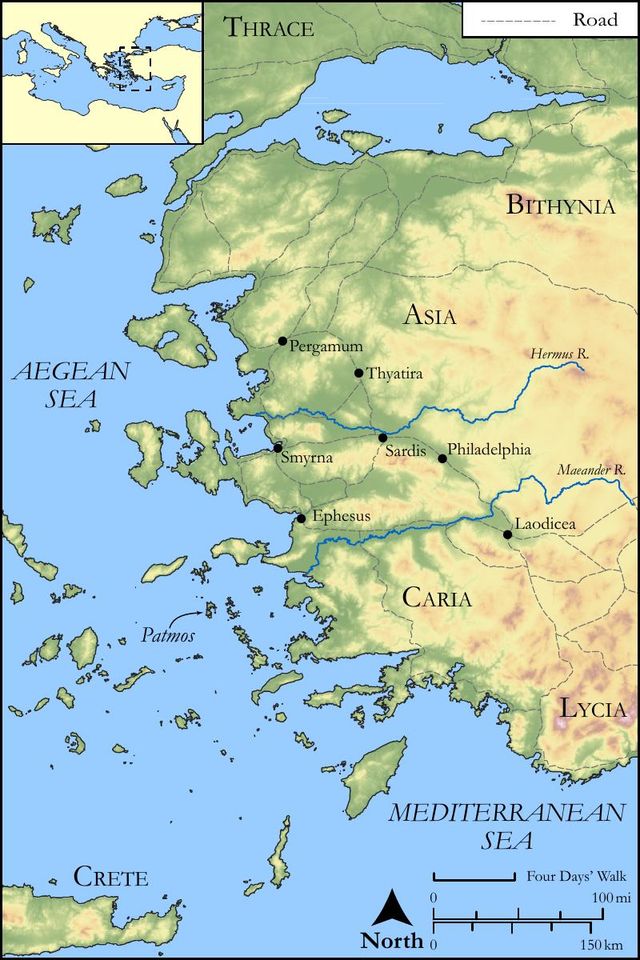
See on the biblical-era map

Study this verse
Public-domain commentary
Matthew Henry
From his Commentary on the Whole Bible. Henry comments on passages, not single verses — this entry covers Revelation 3:14–22. His four-level outline is real structure in the source text, so it is rendered as structure.
We now come to the last and worst of all the seven Asian churches, the reverse of the church of Philadelphia; for, as there was nothing reproved in that, here is nothing commended in this, and yet this was one of the seven golden candlesticks, for a corrupt church may still be a church. Here we have, as before,
I.The inscription, to whom, and from whom.
1.To whom: To the angel of the church of Laodicea. This was a once famous city near the river Lycus, had a wall of vast compass, and three marble theatres, and, like Rome, was built on seven hills. It seems, the apostle Paul was very instrumental in planting the gospel in this city, from which he wrote a letter, as he mentions in the epistle to the Colossians, the last chapter, in which he sends salutations to them, Laodicea not being above twenty miles distant from Colosse. In this city was held a council in the fourth century, but it has been long since demolished, and lies in its ruins to this day, an awful monument of the wrath of the Lamb.
2.From whom this message was sent. Here our Lord Jesus styles himself the Amen, the faithful and true witness, the beginning of the creation of God.
(1.)The Amen, one that is steady and unchangeable in all his purposes and promises, which are all yea, and all amen.
(2.)The faithful and true witness, whose testimony of God to men ought to be received and fully believed, and whose testimony of men to God will be fully believed and regarded, and will be a swift but true witness against all indifferent lukewarm professors.
(3.)The beginning of the creation of God, either of the first creation, and so he is the beginning, that is, the first cause, the Creator, and the Governor of it; or of the second creation, the church; and so he is the head of that body, the first-born from the dead, as it is in Rev 1:5, whence these titles are taken. Christ, having raised up himself by his own divine power, as the head of a new world, raises up dead souls to be a living temple and church to himself.
II.The subject-matter, in which observe,
1.The heavy charge drawn up against this church, ministers and people, by one who knew them better than they knew themselves: Thou art neither cold nor hot, but worse than either; I would thou wert cold or hot, Rev 3:15. Lukewarmness or indifference in religion is the worst temper in the world. If religion is a real thing, it is the most excellent thing, and therefore we should be in good earnest in it; if it is not a real thing, it is the vilest imposture, and we should be earnest against it. If religion is worth any thing, it is worth every thing; an indifference here is inexcusable: Why halt you between two opinions? If God be God, follow him; if Baal (be God), follow him. Here is no room for neutrality. An open enemy shall have a fairer quarter than a perfidious neuter; and there is more hope of a heathen than of such. Christ expects that men should declare themselves in earnest either for him or against him.
2.A severe punishment threatened: I will spue thee out of my mouth. As lukewarm water turns the stomach, and provokes to a vomit, lukewarm professors turn the heart of Christ against them. He is sick of them, and cannot long bear them. They may call their lukewarmness charity, meekness, moderation, and a largeness of soul; it is nauseous to Christ, and makes those so that allow themselves in it. They shall be rejected, and finally rejected; for far be it from the holy Jesus to return to that which has been thus rejected.
3.We have one cause of this indifference and inconsistency in religion assigned, and that is self-conceitedness or self-delusion. They thought they were very well already, and therefore they were very indifferent whether they grew better or no: Because thou sayest, I am rich, and increased with goods, etc., Rev 3:17. Here observe, What a difference there was between the thoughts they had of themselves and the thoughts that Christ had of them.
(1.)The high thoughts they had of themselves: Thou sayest, I am rich, and increased with goods, and have need of nothing, rich, and growing richer, and increased to such a degree as to be above all want or possibility of wanting. Perhaps they were well provided for as to their bodies, and this made them overlook the necessities of their souls. Or they thought themselves well furnished in their souls: they had learning, and they took it for religion; they had gifts, and they took them for grace; they had wit, and they took it for true wisdom; they had ordinances, and they took up with them instead of the God of ordinances. How careful should we be not to put the cheat upon our own souls! Doubtless there are many in hell that once thought themselves to be in the way to heaven. Let us daily beg of God that we may not be left to flatter and deceive ourselves in the concerns of our souls.
(2.)The mean thoughts that Christ had of them; and he was not mistaken. He knew, though they knew not, that they were wretched, and miserable, and poor, and blind, and naked. Their state was wretched in itself, and such as called for pity and compassion from others: though they were proud of themselves, they were pitied by all who knew their case. For,
[1.]They were poor, really poor, when they said and thought they were rich; they had no provision for their souls to live upon; their souls were starving in the midst of their abundance; they were vastly in debt to the justice of God, and had nothing to pay off the least part of the debt.
[2.]They were blind; they could not see their state, nor their way, nor their danger; they could not see into themselves; they could not look before them; they were blind, and yet they thought they saw; the very light that was in them was darkness, and then how great must that darkness be! They could not see Christ, though evidently set forth, and crucified, before their eyes. They could not see God by faith, though always present in them. They could not see death, though it was just before them. They could not look into eternity, though they stood upon the very brink of it continually.
[3.]They were naked, without clothing and without house and harbour for their souls. They were without clothing, had neither the garment of justification nor that of sanctification. Their nakedness both of guilt and pollution had no covering. They lay always exposed to sin and shame. Their righteousnesses were but filthy rags; they were rags, and would not cover them, filthy rags, and would defile them. And they were naked, without house or harbour, for they were without God, and he has been the dwelling-place of his people in all ages; in him alone the soul of man can find rest, and safety, and all suitable accommodations. The riches of the body will not enrich the soul; the sight of the body will not enlighten the soul; the most convenient house for the body will not afford rest nor safety to the soul. The soul is a different thing from the body, and must have accommodation suitable to its nature, or else in the midst of bodily prosperity it will be wretched and miserable.
4.We have good counsel given by Christ to this sinful people, and that is that they drop their vain and false opinion they had of themselves, and endeavour to be that really which they would seem to be: I counsel thee to buy of me, etc., Rev 3:18. Observe,
(1.)Our Lord Jesus Christ continues to give good counsel to those who have cast his counsels behind their backs.
(2.)The condition of sinners in never desperate, while they enjoy the gracious calls and counsels of Christ.
(3.)Our blessed Lord, the counsellor, always gives the best advice, and that which is most suitable to the sinner's case; as here, [1.] These people were poor; Christ counsels them to buy of him gold tried in the fire, that they might be rich. He lets them know where they might have true riches and how they might have them. First, Where they might have them - from himself; he sends them not to the streams of Pactolus, nor to the mines of Potosi, but invites them to himself, the pearl of price. Secondly, And how must they have this true gold from him? They must buy it. This seems to be unsaying all again. How can those that are poor buy gold? Just as they may buy of Christ wine and milk, that is, without money and without price, Isa 55:1. Something indeed must be parted with, but it is nothing of a valuable consideration, it is only to make room for receiving true riches. "Part with sin and self-sufficiency, and come to Christ with a sense of your poverty and emptiness, that you may be filled with his hidden treasure." [2.] These people were naked; Christ tells them where they might have clothing, and such as would cover the shame of their nakedness. This they must receive from Christ; and they must only put off their filthy rags that they might put on the white raiment which he had purchased and provided for them - his own imputed righteousness for justification and the garments of holiness and sanctification. [3.] They were blind; and he counsels them to buy of him eye-salve, that they might see, to give up their own wisdom and reason, which are but blindness in the things of God, and resign themselves to his word and Spirit, and their eyes shall be opened to see their way and their end, their duty and their true interest; a new and glorious scene would then open itself to their souls; a new world furnished with the most beautiful and excellent objects, and this light would be marvellous to those who were but just now delivered from the powers of darkness. This is the wise and good counsel Christ gives to careless souls; and, if they follow it, he will judge himself bound in honour to make it effectual.
5.Here is added great and gracious encouragement to this sinful people to take the admonition and advice well that Christ had given them, Rev 3:19, Rev 3:20. He tells them,
(1.)It was given them in true and tender affection: "Whom I love, I rebuke and chasten. You may think I have given you hard words and severe reproofs; it is all out of love to your souls. I would not have thus openly rebuked and corrected your sinful lukewarmness and vain confidence, if I had not been a lover of your souls; had I hated you, I would have let you alone, to go on in sin till it had been your ruin." Sinners ought to take the rebukes of God's word and rod as tokens of his good-will to their souls, and should accordingly repent in good earnest, and turn to him that smites them; better are the frowns and wounds of a friend than the flattering smiles of an enemy.
(2.)If they would comply with his admonitions, he was ready to make them good to their souls: Behold, I stand at the door and knock, etc., Rev 3:20. Here observe,
[1.]Christ is graciously pleased by his word and Spirit to come to the door of the heart of sinners; he draws near to them in a way of mercy, ready to make them a kind visit.
[2.]He finds this door shut against him; the heart of man is by nature shut up against Christ by ignorance, unbelief, sinful prejudices.
[3.]When he finds the heart shut, he does not immediately withdraw, but he waits to be gracious, even till his head be filled with the dew.
[4.]He uses all proper means to awaken sinners, and to cause them to open to him: he calls by his word, he knocks by the impulses of his Spirit upon their conscience.
[5.]Those who open to him shall enjoy his presence, to their great comfort and advantage. He will sup with them; he will accept of what is good in them; he will eat his pleasant fruit; and he will bring the best part of the entertainment with him. If what he finds would make but a poor feast, what he brings will make up the deficiency: he will give fresh supplies of graces and comforts, and thereby stir up fresh actings of faith, and love, and delight; and in all this Christ and his repenting people will enjoy pleasant communion with each other. Alas! what do careless obstinate sinners lose by refusing to open the door of the heart to Christ!
III.We now come to the conclusion of this epistle; and here we have as before,
1.The promise made to the overcoming believer. It is here implied,
(1.)That though this church seemed to be wholly overrun and overcome with lukewarmness and self-confidence, yet it was possible that by the reproofs and counsels of Christ they might be inspired with fresh zeal and vigour, and might come off conquerors in their spiritual warfare.
(2.)That, if they did so, all former faults should be forgiven, and they should have a great reward. And what is that reward? They shall sit down with me on my throne, as I also overcame, and have sat down with my Father on his throne, Rev 3:21. Here it is intimated,
[1.]That Christ himself had met with his temptations and conflicts.
[2.]That he overcame them all, and was more than a conqueror.
[3.]That, as the reward of his conflict and victory, he has sat down with God the Father on his throne, possessed of that glory which he had with the Father from eternity, but which he was pleased very much to conceal on earth, leaving it as it were in the hands of the Father, as a pledge that he would fulfil the work of a Saviour before he reassumed that manifestative glory; and, having done so, then pignus reposcere - he demands the pledge, to appear in his divine glory equal to the Father.
[4.]That those who are conformed to Christ in his trials and victories shall be conformed to him in his glory; they shall sit down with him on his throne, on his throne of judgment at the end of the world, on his throne of glory to all eternity, shining in his beams by virtue of their union with him and relation to him, as the mystical body of which he is the head.
2.All is closed up with the general demand of attention (Rev 3:22), putting all to whom these epistles shall come in mind that what is contained in them is not of private interpretation, not intended for the instruction, reproof, and correction of those particular churches only, but of all the churches of Christ in all ages and parts of the world: and as there will be a resemblance in all succeeding churches to these, both in their graces and sins, so they may expect that God will deal with them as he dealt with these, which are patterns to all ages what faithful, and fruitful churches may expect to receive from God, and what those who are unfaithful may expect to suffer from his hand; yea, that God's dealings with his churches may afford useful instruction to the rest of the world, to put them upon considering, If judgment begin at the house of God, what shall the end of those be that do not obey the gospel of Christ? Pe1 4:17. Thus end the messages of Christ to the Asian churches, the epistolary part of this book. We now come to the prophetical part.
Historical interpretation
Eight Centuries of Reception
12 surviving comments on this verse. Each one is dated, so this reads as a timeline rather than a list.
Select a marker to jump to its quote. Markers stagger vertically where authors wrote within a few decades of each other.
For avoiding it, remedies cannot be lacking; since, even if they be lacking, there remains that one by which you will be made a happier magistrate, not in the earth, but in the heavens.
"He sitteth at the Father's right hand " -not the Father at His own.
And thou shalt receive the kingdom of heaven, thou who, whilst thou didst sojourn in this life, didst know the Celestial King. And thou shalt be a companion of the Deity, and a co-heir with Christ, no longer enslaved by lusts or passions, and never again wasted by disease. For thou hast become God: for whatever sufferings thou didst undergo while being a man, these He gave to thee, because thou wast of mortal mould, but whatever it is consistent with God to impart, these God has promised to bestow upon thee, because thou hast been deified, and begotten unto immortality. This constitutes the import of the proverb, "Know thyself; "i.e., discover God within thyself, for He has formed thee after His own image. For with the knowledge of self is conjoined the being an object of God's knowledge, for thou art called by the Deity Himself.
But give me now your best attention, I pray you, for I wish to go back to the fountain of life, and to view the fountain that gushes with healing. The Father of immortality sent the immortal Son and Word into the world, who came to man in order to wash him with water and the Spirit; and He, begetting us again to incorruption of soul and body, breathed into us the breath (spirit) of life, and endued us with an incorruptible panoply. If, therefore, man has become immortal, he will also be God. And if he is made God by water and the Holy Spirit after the regeneration of the layer he is found to be also joint-heir with Christ after the resurrection from the dead. Wherefore I preach to this effect: Come, all ye kindreds of the nations, to the immortality of the baptism. I bring good tidings of life to you who tarry in the darkness of ignorance. Come into liberty from slavery, into a kingdom from tyranny, into incorruption from corruption. And how, saith one, shall we come? How? By water and the Holy Ghost. This is the water in conjunction with the Spirit, by which paradise is watered, by which the earth is enriched, by which plants grow, by which animals multiply, and (to sum up the whole in a single word) by which man is begotten again and endued with life, in which also Christ was baptized, and in which the Spirit descended in the form of a dove.
For to this battle our Lord, as with the trumpet of His Gospel, stimulates us when He says, "He that loveth father or mother more than me is not worthy of me: and he that loveth his own soul more than me is not worthy of me. And he that taketh not his cross, and followeth after me, is not worthy of me." And again, "Blessed are they which are persecuted for righteousness' sake: for theirs is the kingdom of heaven. Blessed shall ye be, when men shall persecute you, and hate you. Rejoice, and be exceeding glad: for so did their fathers persecute the prophets which were before you." And again," Because ye shall stand before kings and powers, and the brother shall deliver up the brother to death, and the father the son, and he that endureth to the end shall be saved; " and "To him that overcometh will I give to sit on my throne, even as I also overcame and am set down on the throne of my Father." Moreover the apostle: "Who shall separate us from the love of Christ? shall tribulation, or distress, or persecution, or famine, or nakedness, or peril, or sword? (As it is written, For thy sake are we killed all the day long; we are accounted as sheep for the slaughter.) Nay, in all these things we are more than conquerors for Him who hath loved us."
Moreover, the seventh association of the Church declares that they are rich men placed in positions of dignity, but believing that they are rich, among whom indeed the Scriptures are discussed in their bedchamber, while the faithful are outside; and they are understood by none, although they boast themselves, and say that they know all things,-endowed with the confidence of learning, but ceasing from its labour. And thus He says:-
"That they are neither cold nor hot." That is, neither unbelieving nor believing, for they are all things to all men. And because he who is neither cold nor hot, but lukewarm, gives nausea, He says:-
"I will vomit thee out of My mouth." Although nausea is hateful, still it hurts no one; so also is it with men of this kind when they have been cast forth. But because there is time of repentance, He says:-
"I persuade thee to buy of Me gold tried in the fire." That is, that in whatever manner you can, you should suffer for the Lord's name tribulations and passions.
"And anoint thine eyes with eye-salve." That what you gladly know by the Scripture, you should strive also to do the work of the same. And because, if in these ways men return out of great destruction to great repentance, they are not only useful to themselves, but they are able also to be of advantage to many, He promised them no small reward,-to sit, namely, on the throne of judgment.
[In the image of the Son] sitting with [the Father], he shows that the Son participates in the power of the Father. For what else does it mean that he is seated on the throne of the Father than that he is of one and the same substance? And just as he conquered the devil and sat at the right hand of the Father, so also he who conquers will sit with him. For God the Son is powerful, who in the Father is everywhere and by his own power fills the heaven and the earth.
“The throne” indicates the kingdom and the rest of the coming age. Therefore he says that those who have conquered the enemy “will be glorified with me and will rule with me.” When he says, “as I myself have conquered,” he is speaking in a human manner on account of the assumption [of the flesh]. For God the Word did not acquire the kingdom as a prize for virtue, for he has this essentially as an eternal possession. For if this were not so, he would not be able to share it with others. But according to the Theologian and the “son of thunder,” he shared from his fullness with all the saints. For this reason also he promised to his holy apostles that they would sit upon twelve thrones and judge the future twelve tribes of Israel. For when he who is God and the eternal King became man for us, he shared everything which is ours, except only sin, and shared everything of his with those who had conquered the devil, as it was possible for human nature to receive. Therefore, having made a cloud the chariot of his ascension into heaven, he said through the apostle that the saints would be snatched up to meet him on the clouds. And when he, who is the Creator and Lord of creation, shall come as judge, he will allow the saints to judge those who had rebelled against the truly divine and blessed service.
To him who overcomes, I will grant to sit with me on my throne. He says he will make the confessor a participant in power and judgment. He has made us sit together, he says, in the heavenly places in Christ.
As I also conquered, and sat down with my Father on his throne. The Lord, having conquered, sat on the throne with the Father, because after the struggles of the passion, after the victory of the resurrection, He more clearly showed Himself to all that He was equal to the Father's power. Note that in each church, the Lord first reveals His power, then reviews the works of the church, either to be praised or blamed, always intermingled with admonition. Finally, He repays the due reward, which can be understood in the present and in the future, to both parties. When He adds: He who has ears, let him hear, it is undoubtedly fitting to understand the ears of the heart for obedience to the commandments.
To him that shall overcome, I will give to sit with me in my throne: as I also have overcome, and am set down with my Father in his throne. The Lord victorious sits in the Father's throne because, after the Passion and Resurrection, he showed that he was equal to the Father. He says that we also sit in it, because we receive power of judgment in the Son's power, according to this: You, who have followed me, you shall sit on twelve seats, etc. [Matt. 19:28] It is not inconsistent with the truth that he says elsewhere we will sit on twelve thrones and here on his throne; for by the twelve thrones is indicated universal judgment, and by the throne of the Son a unique summit of judicial power. Therefore the same thing is indicated by the twelve thrones and by the one throne of the Son. We should however ask the question of how it is that he says all victors will judge, whereas not all will, but some of those who overcome will judge, and others will be judged. One should know then that they will have in others the power they do not have in themselves, in the same way as the whole body of a man has the power to speak through the mouth and to see through the eyes. Now if we look more subtly at the phrase in which it is said as I also have overcome, we find that it indicates those who are more brilliant and outstanding in their victory.
To the one who overcomes, He says, I will grant to sit with Me on My throne, that is, he will reign with Me. For it has been said by the most wise Paul, "if we suffer with Him, we shall also reign with Him." (Rom. 8:17; 1 Cor. 4:8)
Just as I also conquered, He says, and I reign with My Father. For the Lord has also said in the Gospels: "Take heart, I have overcome the world." (Jn. 16:33)
Continue studying Revelation 3:21 across the web’s major study libraries — every link below opens this exact verse, chapter, or book on the destination site.
Read & Compare
 BibleGatewayThis verse in more than 200 translations and 70 languages.
 Bible.comThe YouVersion reader — hundreds of translations, reading plans, and highlights.
 ESV.orgCrossway's official English Standard Version reader.
 NET BibleThe NET translation with 60,000+ translators' notes on every rendering decision.
 STEP BibleTyndale House's free study tool — original text, vocabulary, and scholarly resources.
 BibliaLogos Bible Software's free web reader.
 USCCBThe New American Bible (Revised Edition) with the U.S. bishops' study notes.
Commentaries
 BibleHub CommentariesDozens of classic commentaries on this verse, gathered on one page.
 StudyLightMore than 100 commentary sets — the largest collection on the web.
 BibleRefPlain-English commentary on what this verse means, verse by verse.
 Enduring WordDavid Guzik's free commentary on this chapter, widely used by Bible teachers.
 Bible Study ToolsVerse commentary alongside Greek and Hebrew study aids.
Original Language & Research
- BibleHub InterlinearThe verse word by word — original language, transliteration, and English.
- BibleHub LexiconEvery word's original-language definition and Strong's entry.
 Blue Letter BibleDeep-study tools — Strong's numbers, concordance, and word studies.
 CNTR CollationThe earliest Greek manuscripts of this verse, collated letter by letter.
Sermons, Hymns & Audio


TrulyRandomVerse is not affiliated with these sites and doesn’t control their content. They’re linked because they’re genuinely useful.
Summary
Revelation 3:21 presents a profound and climactic promise from Jesus Christ to those who persevere in faith and overcome spiritual challenges. As the concluding assurance in the series of letters to the seven churches, it offers an unparalleled invitation to share in Christ's own royal authority and intimate communion, mirroring His victorious ascension to the Father's throne, thereby underscoring the ultimate reward for steadfast fidelity.
Context
ShowHideLiterary Context
This verse serves as the powerful culmination of Jesus's letter to the church in Laodicea, the final and most severely rebuked of the seven churches addressed in Revelation chapters 2 and 3. Following a scathing indictment of their spiritual lukewarmness and self-deception, where they believed themselves rich but were in fact "wretched, miserable, poor, blind, and naked" (Revelation 3:17), Jesus extends a tender invitation. He stands at the door, knocking, offering fellowship to anyone who hears His voice and opens the door (Revelation 3:20). The promise of sharing His throne in verse 21 is thus the ultimate incentive, a radical call to repentance and zealous pursuit of Christ, contrasting sharply with their present spiritual apathy. It is the most magnificent of all the promises to the overcomers, uniquely linking the believer's victory to Christ's own.
Historical & Cultural Context
Laodicea was a city renowned for its immense wealth, banking, textile industry (producing fine black wool), and a famous medical school known for an eye salve. Ironically, Jesus uses these very symbols to highlight their spiritual poverty: they were spiritually "poor" despite their material riches, "naked" despite their fine garments, and "blind" despite their eye medicine. Their water supply, piped in from distant hot springs (Hierapolis) and cold springs (Colossae), arrived lukewarm, a metaphor Jesus employs for their spiritual state. In the Greco-Roman world, shared authority and co-regency were familiar concepts, particularly within imperial families or among conquering generals and their trusted lieutenants. The image of "sitting with" a ruler on their throne would immediately convey a position of immense honor, authority, and intimate partnership, far beyond mere proximity. This promise would have resonated deeply with the Laodiceans, offering true, eternal power in stark contrast to their fleeting earthly affluence.
Key Themes
ShowHideThe central theme is the Call to Overcome. The phrase "him that overcometh" (Greek: nikáō) is a recurring motif throughout the letters to the seven churches, appearing in each one (e.g., Revelation 2:7, Revelation 2:11, Revelation 3:5). It signifies spiritual victory, not earned through human effort alone, but through faithful endurance, resisting worldly compromise, and remaining loyal to Christ amidst trials and persecution. Another key theme is Shared Reign and Authority. The astonishing promise to "sit with me in my throne" speaks to an intimate partnership and a participation in Christ's royal authority, far exceeding mere salvation. This echoes other New Testament passages that speak of believers reigning with Christ (2 Timothy 2:12) and even judging the world (1 Corinthians 6:2). Finally, Christ as the Ultimate Example is paramount. Jesus grounds His promise in His own experience: "even as I also overcame, and am set down with my Father in his throne." His victory, achieved through perfect obedience, suffering, death, and resurrection, led to His exaltation and seating at the right hand of the Father (Hebrews 12:2; Ephesians 1:20). This provides both the divine pattern and the ultimate assurance for the believer's future glory.
Exposition and Analysis
ShowHideKey Word Analysis
ShowHideMeaning "to subdue (literally or figuratively):--conquer, overcome, prevail, get the victory." In the context of Revelation, this word signifies a spiritual triumph. It is not a victory achieved by human strength or merit, but by steadfast faith and perseverance in Christ, enduring trials, resisting temptation, and remaining faithful to His name and truth in a hostile world. It implies a continuous state of overcoming, a life marked by spiritual conquest over the forces of evil, sin, and apostasy.
Meaning "to give (used in a very wide application, properly, or by implication, literally or figuratively; greatly modified by the connection):--adventure, bestow, bring forth, commit, deliver (up), give, grant, hinder, make, minister, number, offer, have power, put, receive, set, shew, smite (+ with the hand), strike (+ with the palm of the hand), suffer, take, utter, yield." This verb emphasizes the sovereign and gracious act of Christ. The privilege of sitting on His throne is not earned but freely bestowed by Him, highlighting His authority and generosity in sharing His divine prerogatives with His faithful followers. It is a gift of immense value, granted by the victor to those who follow in His footsteps of victory.
Meaning "a stately seat ("throne"); by implication, power or (concretely) a potentate:--seat, throne." This word consistently denotes a seat of supreme authority, power, and judgment. In this verse, it refers to Christ's royal and governmental seat, which He shares with the Father. The promise to sit on this throne signifies not just proximity to Christ, but a sharing in His kingly rule and divine authority, participating in His reign over all creation. It is the ultimate symbol of honor, status, and shared dominion.
Verse Breakdown
ShowHide"To him that overcometh"
This opening clause establishes the condition for receiving the extraordinary promise. "Overcometh" (Greek: nikáō) refers to those who conquer or prevail in the spiritual battle. This victory is not a one-time event but a continuous posture of faithfulness against the pressures of the world, the flesh, and the devil, as highlighted throughout the letters to the seven churches. It implies enduring persecution, resisting false doctrine, maintaining spiritual zeal, and remaining loyal to Christ even unto death.
"will I grant to sit with me in my throne"
This is the astonishing promise itself. Jesus, the sovereign Lord, pledges to bestow (Greek: dídōmi) upon the overcomer the unparalleled privilege of sharing His own throne (Greek: thrónos). This signifies not merely a place near Him, but a participation in His royal authority and divine rule. It speaks of intimate communion, shared honor, and co-regency, a position of ultimate exaltation and partnership in Christ's cosmic dominion.
"even as I also overcame"
Jesus provides the divine precedent and pattern for the believer's victory. His overcoming was achieved through His perfect obedience to the Father, His suffering, death, and resurrection. He conquered sin, death, and the powers of darkness through His sacrificial work on the cross and His subsequent triumph. This clause assures believers that their path of overcoming is a participation in Christ's own victorious journey.
"and am set down with my Father in his throne"
This final clause reveals the ultimate outcome of Christ's victory: His exaltation to the highest position of authority, seated with God the Father in His eternal throne. This establishes the divine authority and certainty of the promise. The believer's future glory of co-reigning with Christ is directly linked to Christ's present reality of co-reigning with the Father, making the promise not merely aspirational but a guaranteed participation in divine glory.
Literary Devices
ShowHideRevelation 3:21 is rich with Symbolism, primarily the "throne," which represents ultimate authority, power, and sovereignty. To "sit with" Christ on His throne symbolizes not just proximity but a sharing in His royal dominion and intimate fellowship. The act of "overcoming" is also symbolic, representing spiritual victory over sin, persecution, and worldly compromise. The verse employs Parallelism to draw a clear connection between Christ's experience and the believer's future: "even as I also overcame, and am set down with my Father in his throne" directly parallels "To him that overcometh will I grant to sit with me in my throne." This structural device emphasizes that the believer's reward is a direct participation in Christ's own achieved glory. There is also a powerful Contrast implied, especially when read in the context of the Laodicean church's lukewarmness and self-sufficiency. While they were spiritually poor and blind, clinging to earthly comforts, Jesus offers a spiritual richness and a seat of eternal power to those who overcome their apathy and truly seek Him. The Repetition of "throne" underscores its significance as the ultimate seat of power and the pinnacle of the promised reward.
Theological and Thematic Connections
ShowHideRevelation 3:21 offers a profound theological statement on the destiny of the faithful believer, elevating their future beyond mere salvation to a participation in divine rule. It reveals God's ultimate intention to share His glory and authority with His redeemed children, a concept rooted in the very purpose of humanity's creation to rule over the earth. This promise underscores the intimate union between Christ and His church, where the victory of the Head is extended to the members of His body. It speaks to the eschatological hope of the church, not just as passive recipients of grace, but as active co-heirs with Christ in His coming kingdom. This co-regency is a testament to the transformative power of the cross and resurrection, which not only redeems humanity but also restores its intended royal dignity.
Reflection and Application
ShowHideRevelation 3:21 is a powerful call to spiritual vigilance and perseverance, offering an unparalleled motivation for faithful living. It reminds us that our present struggles, temptations, and spiritual battles are not in vain, but are opportunities to "overcome" through Christ's strength. The promise of sharing Christ's throne elevates our perspective beyond fleeting earthly concerns, urging us to prioritize eternal values and cultivate a zealous, intimate relationship with our King. It challenges us to examine our own spiritual temperature—are we lukewarm, or are we actively pursuing Christ with fervent devotion? This verse assures us that our faithfulness, however imperfect, is seen and deeply valued by God, leading to a glorious and intimate partnership in His eternal reign. It is a profound encouragement to press on, knowing that the ultimate reward is a shared seat with the Victorious One.
Questions for Reflection
ShowHideFAQ
ShowHideWhat does "overcometh" mean in the context of Revelation?
ShowHideIn Revelation, "overcometh" (Greek: nikáō) signifies spiritual victory achieved through faithfulness to Christ amidst trials, persecution, and the allure of worldly compromise. It's not about achieving perfection, but about enduring steadfastly, resisting evil, and remaining loyal to Jesus's name and truth, even in the face of suffering or death. This victory is empowered by Christ's own triumph over sin and death, allowing believers to participate in His conquest (Revelation 12:11).
Does "sitting with me in my throne" mean believers will have the same authority as Christ?
ShowHideWhile the promise of "sitting with" Christ on His throne signifies immense honor, shared authority, and intimate communion, it does not imply equality with Christ's divine sovereignty. Rather, it speaks to a delegated authority and a participation in His reign, as co-heirs and co-regents under His ultimate headship. It is a profound privilege, reflecting the closest possible partnership with the King of Kings, where believers will reign with Him over His creation, as foretold in passages like 2 Timothy 2:12 and Revelation 20:4.
Christ-Centered Fulfillment
ShowHideRevelation 3:21 finds its ultimate fulfillment and deepest meaning in the person and work of Jesus Christ. The promise to the overcomer is not merely a reward for human effort, but an extension of Christ's own accomplished victory. Jesus Himself declares, "even as I also overcame, and am set down with my Father in his throne." His overcoming was the decisive triumph over sin, death, and the powers of darkness through His obedient life, sacrificial death on the cross, and glorious resurrection (Colossians 2:15). His subsequent exaltation to the Father's right hand (Hebrews 1:3) is the pattern and guarantee for the believer's future. Thus, the believer's ability to "overcome" is not self-generated, but is a participation in Christ's victory, made possible by His indwelling Spirit and His finished work (John 16:33). Our co-seating with Him on His throne is a direct consequence of our union with Him, for we are already seated with Him in the heavenly realms in a spiritual sense (Ephesians 2:6). This promise therefore highlights the profound truth that our destiny is inextricably linked to Christ's, and His triumph ensures our ultimate glorification and shared dominion with Him in His eternal kingdom.