


1 Corinthians 9:24
- ΟὐκOukSurelyG3756PRT-NNegative Particle Negative
- οἴδατεoidateyou knowG1492V-RAI-2PVerb Perfect Active Indicative 2nd Plural
- ὅτιhotithatG3754CONJConjunction
- οἱhoithoseG3588T-NPMDefinite article Nominative Plural Masculine
- ἐνeninG1722PREPPreposition
- σταδίῳstadiōa race courseG4712N-DSNNoun Dative Singular Neuter
- τρέχοντεςtrechontesrunningG5143V-PAP-NPMVerb Present Active Participle Nominative Plural Masculine
- πάντεςpantesallG3956A-NPMAdjective Nominative Plural Masculine
- μὲνmenindeedG3303PRTParticle or Disjunctive
- τρέχουσινtrechousinrunG5143V-PAI-3PVerb Present Active Indicative 3rd Plural
- εἷςheisoneG1520A-NSMAdjective Nominative Singular Masculine
- δὲdehoweverG1161CONJConjunction
- λαμβάνειlambaneireceivesG2983V-PAI-3SVerb Present Active Indicative 3rd Singular
- τὸtotheG3588T-ASNDefinite article Accusative Singular Neuter
- βραβεῖον;brabeionprize?G1017N-ASNNoun Accusative Singular Neuter
- οὕτωςhoutōsThusG3779ADVAdverb
- τρέχετεtrechetedo runG5143V-PAM-2PVerb Present Active Imperative 2nd Plural
- ἵναinathatG2443CONJConjunction
- καταλάβητεkatalabēteyou may grasp [it]G2638V-2AAS-2PVerb 2nd Aorist Active Subjunctive 2nd Plural
English is a literal word-by-word gloss of the Greek, not the KJV's wording. Why?
This is the original text the KJV's translators worked from — each Greek word with its own literal English meaning in this verse, prepared by scholars at Tyndale House, Cambridge. The KJV translates whole sentences, not word by word, so its wording differs: one Greek word can become several English words, and the KJV may choose “charity” where the gloss reads “love”. Both are faithful — they answer different questions. For the KJV's own rendering, switch to the KJV text.
Details
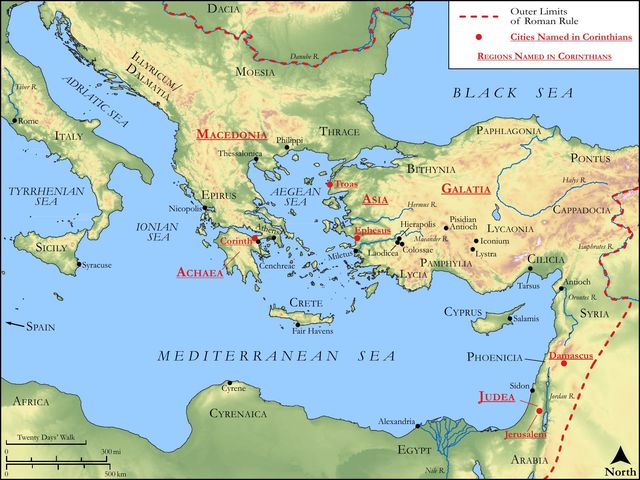
See on the biblical-era map

Study this verse
Public-domain commentary
Matthew Henry
From his Commentary on the Whole Bible. Henry comments on passages, not single verses — this entry covers 1 Corinthians 9:24–27. His two-level outline is real structure in the source text, so it is rendered as structure.
In these verses the apostle hints at the great encouragement he had to act in this manner. He had a glorious prize, an incorruptible crown, in view. Upon this head he compares himself to the racers and combatants in the Isthmian games, an allusion well known to the Corinthians, because they were celebrated in their neighbourhood: "Know you not that those who run in a race run all, but one obtaineth the prize? Co1 9:24. All run at your games, but only one gets the race and wins the crown." And here,
I.He excites them to their duty:
"So run that you may obtain. It is quite otherwise in the Christian race than in your races; only one wins the prize in them. You may all run so as to obtain. You have great encouragement, therefore, to persist constantly, and diligently, and vigorously, in your course. There is room for all to get the prize. You cannot fail if you run well. Yet there should be a noble emulation; you should endeavour to outdo one another. And it is a glorious contest who shall get first to heaven, or have the best rewards in that blessed world. I make it my endeavour to run; so do you, as you see me go before you." Note, It is the duty of Christians to follow their ministers closely in the chase of eternal glory, and the honour and duty of ministers to lead them in the way.
II.He directs them in their course, by setting more fully to view his own example, still carrying on the allusion.
1. Those that ran in their games were kept to a set diet: "Every man that strives for the mastery is temperate in all things, Co1 9:23. The fighters and wrestlers in your exercises are kept to strict diet and discipline; nay, they keep themselves to it. They do not indulge themselves, but restrain themselves from the food they eat and so from the liberties they use on other occasions. And should not Christians much more abridge themselves of their liberty, for so glorious an end as winning the race, and obtaining the prize set before them? They used a very spare diet, and course food, and denied themselves much, to prepare for their race and combat; so do I; so should you, after my example. It is hard if, for the heavenly crown, you cannot abstain from heathen sacrifices." 2. They were not only temperate, but inured themselves to hardships. Those who fought with one another in these exercises prepared themselves by beating the air, as the apostle calls it, or by throwing out their arms, and thereby inuring themselves, beforehand, to deal about their blows in close combat, or brandish them by way of flourish. There is no room for any such exercise in the Christian warfare. Christians are ever in close combat. There enemies make fierce and hearty opposition, and are ever at hand; and for this reason they must lay about them in earnest, and never drop the contest, nor flag and faint in it. They must fight, not as those that beat the air, but must strive against their enemies with all their might. One enemy the apostle here mentions, namely, the body; this must be kept under, beaten black and blue, as the combatants were in these Grecian games, and thereby brought into subjection. By the body we are to understand fleshly appetites and inclinations. These the apostle set himself to curb and conquer, and in this the Corinthians were bound to imitate him. Note, Those who would aright pursue the interests of their souls must beat down their bodies, and keep them under. They must combat hard with fleshly lusts, and not indulge a wanton appetite, and long for heathenish sacrifices, nor eat them, to please their flesh, at the hazard of their brethren's souls. The body must be made to serve the mind, not suffered to lord over it.
III.The apostle presses this advice on the Corinthians by proper arguments drawn from the same contenders.
1.They take pains, and undergo all those hardships, to obtain a corruptible crown (Co1 9:25), but we an incorruptible. Those who conquered in these games were crowned only with the withering leaves or boughs of trees, of olive, bays, or laurel. But Christians have an incorruptible crown in view, a crown of glory that never fadeth away, an inheritance incorruptible, reserved in heaven for them. And would they yet suffer themselves to be outdone by these racers or wrestlers? Can they use abstinence in diet, exert themselves in racing, expose their bodies to so much hardship in a combat, who have no more in view than the trifling huzzas of a giddy multitude, or a crown of leaves? And shall not Christians, who hope for the approbation of the sovereign Judge, and a crown of glory from his hands, stretch forward in the heavenly race, and exert themselves in beating down their fleshly inclinations, and the strong-holds of sin?
2.The racers in these games run at uncertainty. All run, but one receives the prize, Co1 9:24. Every racer, therefore, is at a great uncertainty whether he shall win it or no. But the Christian racer is at no such uncertainty. Every one may run here so as to obtain; but then he must run within the lines, he must keep to the path of duty prescribed, which, some think, is the meaning of running not as uncertainly, Co1 9:26. He who keeps within the limits prescribed, and keeps on in his race, will never miss his crown, though others may get theirs before him. And would the Grecian racers keep within their bounds, and exert themselves to the very last, when one only could win, and all must be uncertain which that one would be? And shall not Christians be much more exact and vigorous when all are sure of a crown when they come to the end of their race?
3.He sets before himself and them the danger of yielding to fleshly inclinations, and pampering the body and its lusts and appetites: I keep my body under, lest that by any means, when I have preached to others, I myself should be a cast-away (Co1 9:27), rejected, disapproved, adokimos, one to whom the brabeutēs - the judge or umpire of the race, will not decree the crown. The allusion to the games runs through the whole sentence. Note, A preacher of salvation may yet miss it. He may show others the way to heaven, and never get thither himself. To prevent this, Paul took so much pains in subduing and keeping under bodily inclinations, lest by any means he himself, who had preached to others, should yet miss the crown, be disapproved and rejected by his sovereign Judge. A holy fear of himself was necessary to preserve the fidelity of an apostle; and how much more necessary is it to our preservation? Note, Holy fear of ourselves, and not presumptuous confidence, is the best security against apostasy from God, and final rejection by him.
Historical interpretation
Two Centuries of Reception
10 surviving comments on this verse. Each one is dated, so this reads as a timeline rather than a list.
Select a marker to jump to its quote. Markers stagger vertically where authors wrote within a few decades of each other.
But I so run, not as uncertainty; I fight, not as One beating the air; but I make my body livid, and bring it into subjection, lest by any means, when preaching to others, I may myself be rendered a castaway."
Your master, Jesus Christ, has anointed you with his Spirit and has brought you to this training ground. He determined long before the day of the contest to take you from a softer way of life to a harsher regimen, that your strength may increase. Athletes are set apart for more rigid training to apply themselves to the building up of their physical strength. They are kept from lavish living, from more tempting dishes, from more pleasurable drinks. They are urged on, they are subjected to tortuous toils, they are worn out. The more strenuously they have exerted themselves, the greater is their hope of victory.
And to return to the praise of martyrdom, there is a word of the blessed Paul, who says; "Know ye not that they who run in a race strive many, but one receiveth the prize? But do ye so run, that all of you may obtain." Moreover also elsewhere, that be may exhort us to martyrdom, he has called us fellow-heirs with Christ; nay, that he might omit nothing, he says, "If ye are dead with Christ, why, as if living in the world, do ye make distinctions? " Because, dearest brethren, we who bear the rewards of resurrection, who seek for the day of judgment, who, in fine, are trusting that we shall reign with Christ, ought to be dead to the world. For you can neither desire martyrdom till you have first hated the world, nor attain to God's reward unless you have loved Christ. And he who loves Christ does not love the world. For Christ was given up by the world, even as the world also was given up by Christ; as it is written, "The world is crucified unto me, and I unto the world." The world has been an object of affection to none whom the Lord has not previously condemned; nor could he enjoy eternal salvation who has gloried in the life of the world. That is the very voice of Christ, who says: "He that loveth his life in this world, shall lose it in the world to come; but he that hateth his life in this world, shall find it in the world to come." Moreover, also, the Apostle Paul says: "Be ye imitators of me, as I also am of Christ." And the same elsewhere says: "I wish that all of you, if it were possible, should be imitators of me."
That we must press on and persevere in faith and virtue, and in completion of heavenly and spiritual grace, that we may attain to the palm and the crown. In the book of Chronicles: "The Lord is with you so long as ye also are with Him; but if ye forsake Him, He will forsake you." In Ezekiel also: "The righteousness of the righteous shall not deliver him in what day soever he may transgress." Moreover, in the Gospel the Lord speaks, and says: "He that shall endure to the end, the same shall be saved." And again: "If ye shall abide in my word, ye shall be my disciples indeed; and ye shall know the truth, and the truth shall make you free." Moreover, forewarning us that we ought always to be ready, and to stand firmly equipped and armed, He adds, and says: "Let your loins be girded about, and your lamps burning, and ye yourselves like unto men that wait for their lord when he shall return from the wedding, that when he cometh and knocketh they may open unto him. Blessed are those servants whom their lord, when he cometh, shall find watching." Also the blessed Apostle Paul, that our faith may advance and grow, and attain to the highest point, exhorts us, saying: "Know ye not, that they which run in a race run all indeed, yet one receiveth the prize? So run, that ye may obtain. And they, indeed, that they may receive a corruptible crown; but ye an incorruptible." And again: "No man that warreth for God binds himself to anxieties of this world, that he may be able to please Him to whom he hath approved himself. Moreover, also, if a man should contend, he will not be crowned unless he have fought lawfully." And again: "Now I beseech you, brethren, by the mercy of God, that ye constitute your bodies a living sacrifice, holy, acceptable unto God; and be not conformed to this world, but be ye transformed in the renewing of your spirit, that ye may prove what is the will of God, good, and acceptable, and perfect." And again: "We are children of God: but if children, then heirs; heirs indeed of God, but joint-heirs with Christ, if we suffer together, that we may also be glorified together." And in the Apocalypse the same exhortation of divine preaching speaks, saying, "Hold fast that which thou hast, lest another take thy crown; " which example of perseverance and persistence is pointed out in Exodus, when Moses, for the overthrow of Ama-lek, who bore the type of the devil, raised up his open hands in the sign and sacrament of the cross, and could not conquer his adversary unless when he had stedfastly persevered in the sign with hands continually lifted up. "And it came to pass," says he, "when Moses raised up his hands, Israel prevailed; but when he let down his hands, Amalek grew mighty. And they took a stone and placed it under him, and he sate thereon. And Aaron and Hur held up his hands on the one side and on the other side, and Moses' hands were made steady even to the going down of the sun. Anti Jesus routed Amalek and all his people. And the Lord said unto Moses, Write this, and let it be a memorial in a book, and tell it in the ears of Jesus; because in destroying I will destroy the remembrance of Amalek from under heaven."
A voice filled with the Holy Spirit broke forth from the martyr's mouth when the most blessed Mappalicus said to the proconsul in the midst of his torments, "You shall see a contest to-morrow." And that which he said with the testimony of virtue and faith, the Lord fulfilled. A heavenly contest was exhibited, and the servant of God was crowned ill the struggle of the promised fight. This is the contest which the prophet Isaiah of old predicted, saying, "It shall be no light contest for you with men, since God appoints the struggle." And in order to show what this struggle would be, he added the words, "Behold, a virgin shall conceive and bear a son, and ye shall call His name Emmanuel." This is the struggle of our faith in which we engage, in which we conquer, in which we are crowned. This is the struggle which the blessed Apostle Paul has shown to us, in which it behoves us to run and to attain the crown of glory. "Do ye not know," says he, "that they which run in a race, run all indeed, but one receiveth the prize? So run that ye may obtain." "Now they do it that they may receive a corruptible crown, but we an incorruptible." Moreover, setting forth his own struggle, and declaring that he himself should soon be a sacrifice for the Lord's sake, he says, "I am now ready to be offered, and the time of my assumption is at hand. I have fought a good fight, I have finished my course, I have kept the faith: henceforth there is laid up for me a crown of righteousness, which the Lord, the righteous judge, shall give me at that day; and not to me only, but unto all them also that love His appearing." This fight, therefore, predicted of old by the prophets, begun by the Lord, waged by the apostles, Mappalicus promised again to the proconsul in his own name and that of his colleagues.
That it is of small account to be baptized and to receive the Eucharist, unless one profit by it both in deeds and works. In the first Epistle of Paul to the Corinthians: "Know ye not, that they which run in a race run indeed all, although one receiveth the prize? So run, that ye may obtain. And those indeed that they may receive a corruptible crown, but we an incorruptible." In the Gospel according to Matthew: "Every tree that bringeth not forth good fruit shall be cut down, and cast into the fire." Also in the same place: "Many shall say unto me in that day, Lord, Lord, have we not prophesied in Thy name, and in Thy name have cast out devils, and in Thy name have done great works? And then shall I say to them, I never knew you; depart from me, ye who work iniquity." Also in the same place: "Let your light shine before men, that they may see your good works, and glorify your Father which is in heaven." Also Paul to the Philippians: "Shine as lights in the world."
As far as you extend your efforts in behalf of piety, so far will the greatness of your soul extend through efforts and toils toward what the Lord urges us.
So then, my brothers, let us strive, knowing that the contest is close at hand and that many make voyages for corruptible contests, but not all are crowned—only those who have labored much and striven well.
Having pointed out the manifold usefulness of condescension and that this is the highest perfectness, and that he himself having risen higher than all towards perfection, or rather having gone beyond it by declining to receive, descended lower than all again; and having made known to us the times for each of these, both for the perfectness and for the condescension; he touches them more sharply in what follows, covertly intimating that this which was done by them and which was counted a mark of perfectness, is a kind of superfluous and useless labor. And he saith it not thus out clearly, lest they should become insolent; but the methods of proof employed by him makes this evident.
And having said that they sin against Christ and destroy the brethren, and are nothing profited by this perfect knowledge, except charity be added; he again proceeds to a common example, and saith, "Know ye not that they which run in a race run all, but one receiveth the prize?" Now this he saith, not as though here also one only out of many would be saved; far from it; but to set forth the exceeding diligence which it is our duty to use. For as there, though many descend into the course not many are crowned, but this befalls one only; and it is not enough to descend into the contest, nor to anoint one's self and wrestle: so likewise here it is not sufficient to believe, and to contend in any way; but unless we have so run as unto the end to show ourselves unblameable, and to come near the prize, it will profit us nothing. For even though thou consider thyself to be perfect according to knowledge, thou hast not yet attained the whole; which hinting at, he said, "so run, that ye may obtain." They had not then yet, as it seems, attained. And having said thus, he teaches them also the manner.
It is not from the one who wills nor from the one that runs but from God who has mercy that we obtain what we hope for and reach what we desire. Esau was unwilling and did not run. Had he been willing and had he run, he would have obtained the help of God who by calling him would have given him the power both to will and to run.
Continue studying 1 Corinthians 9:24 across the web’s major study libraries — every link below opens this exact verse, chapter, or book on the destination site.
Read & Compare
 BibleGatewayThis verse in more than 200 translations and 70 languages.
 Bible.comThe YouVersion reader — hundreds of translations, reading plans, and highlights.
 ESV.orgCrossway's official English Standard Version reader.
 NET BibleThe NET translation with 60,000+ translators' notes on every rendering decision.
 STEP BibleTyndale House's free study tool — original text, vocabulary, and scholarly resources.
 BibliaLogos Bible Software's free web reader.
 USCCBThe New American Bible (Revised Edition) with the U.S. bishops' study notes.
Commentaries
 BibleHub CommentariesDozens of classic commentaries on this verse, gathered on one page.
 StudyLightMore than 100 commentary sets — the largest collection on the web.
 BibleRefPlain-English commentary on what this verse means, verse by verse.
 Enduring WordDavid Guzik's free commentary on this chapter, widely used by Bible teachers.
 Bible Study ToolsVerse commentary alongside Greek and Hebrew study aids.
Original Language & Research
- BibleHub InterlinearThe verse word by word — original language, transliteration, and English.
- BibleHub LexiconEvery word's original-language definition and Strong's entry.
 Blue Letter BibleDeep-study tools — Strong's numbers, concordance, and word studies.
 CNTR CollationThe earliest Greek manuscripts of this verse, collated letter by letter.
Sermons, Hymns & Audio


TrulyRandomVerse is not affiliated with these sites and doesn’t control their content. They’re linked because they’re genuinely useful.
Summary
In 1 Corinthians 9:24, the Apostle Paul employs a powerful and relatable athletic metaphor to impress upon the Corinthian believers, and all subsequent generations of Christians, the profound seriousness, intentionality, and disciplined effort required for the Christian life. He challenges them to approach their spiritual journey not with casual participation, but with the focused determination of a runner striving for a singular, ultimate prize, urging them to "run" in such a way that they genuinely "obtain" the imperishable reward of faith.
Context
ShowHideLiterary Context
This verse is situated within a broader discussion in 1 Corinthians 9 where Paul defends his apostolic rights and, more importantly, explains his willingness to forgo those rights for the sake of the gospel. He has just articulated his principle of "becoming all things to all people" (1 Corinthians 9:22) so that he "might by all means save some" (1 Corinthians 9:22). The athletic metaphor in 1 Corinthians 9:24-27 serves as a vivid illustration of the discipline and self-control he exercises in his own life, contrasting his self-denial with the pursuit of an eternal prize. It transitions from his personal example of sacrifice to a general exhortation for all believers to live with similar purpose and discipline.
Historical & Cultural Context
Ancient Corinth was a city renowned for its Isthmian Games, second only to the Olympic Games in prestige, held every two years in the nearby Isthmus of Corinth. Paul's audience would have been intimately familiar with the rigorous training, strict rules, and intense competition involved in these athletic contests. Athletes underwent significant self-denial, strict diets, and disciplined regimens for months, even years, leading up to the events. The ultimate prize for the victor was a perishable wreath, typically made of wild celery or pine, which quickly withered. Paul masterfully leverages this well-understood cultural phenomenon to draw a stark contrast between the temporary nature of earthly accolades and the enduring value of the spiritual prize, making his exhortation immediately relevant and impactful to the Corinthian church.
Key Themes
ShowHide1 Corinthians 9:24 contributes significantly to several key themes within 1 Corinthians and Paul's broader theology. It underscores the theme of Spiritual Discipline and Effort, emphasizing that the Christian life is not a passive journey but requires active, intentional, and disciplined engagement, mirroring the athlete's rigorous training (1 Corinthians 9:25). It highlights the Singular Focus on the Goal, urging believers to pursue the "prize" with unwavering determination, avoiding distractions and spiritual complacency, much like Paul's own focused pursuit of the gospel (1 Corinthians 9:23). Crucially, it introduces the theme of the Imperishable Prize, contrasting the fleeting glory of the Isthmian Games' wreaths with the eternal, incorruptible reward awaiting faithful believers (1 Corinthians 9:25). This elevates the significance of the spiritual race far beyond any earthly competition.
Exposition and Analysis
ShowHideKey Word Analysis
ShowHideThis verb signifies "to run or walk hastily," often implying a sense of urgency and vigorous effort. In the context of a race, it denotes the full exertion of an athlete. Paul uses this word to convey that the Christian life is not a leisurely stroll but a demanding, purposeful endeavor requiring sustained energy and commitment, much like a competitive runner giving their all.
Derived from a word meaning "an umpire," this term refers specifically to the award given to the victor in public games. It is the tangible recognition of success, the object for which the athlete strives. Here, it represents the ultimate, eternal reward for faithful perseverance in the Christian life, contrasting sharply with the perishable crowns of earthly contests.
This word means "to take eagerly," "to seize," "to grasp fully," or "to apprehend." It implies not just reaching the finish line, but actively securing and possessing the reward. Paul's use of this verb emphasizes that the goal is not mere participation or passive hope, but a determined and successful capture of the promised prize, underscoring the necessity of intentional effort to truly secure the eternal reward.
Verse Breakdown
ShowHide"Know ye not that they which run in a race run all, but one receiveth the prize?"
Paul begins with a rhetorical question, assuming the Corinthians' familiarity with the Isthmian Games. He states the obvious reality of an athletic contest: many participate, but only one achieves the ultimate victory and receives the coveted prize. This sets up the analogy, highlighting the competitive and exclusive nature of winning in the earthly realm.
"So run, that ye may obtain."
This is Paul's direct and forceful exhortation. Building on the established reality of the race, he commands believers to apply the same level of intensity, discipline, and singular focus to their spiritual lives. The imperative "run" (τρέχετε - trechete) is a present active imperative, urging continuous, active striving. The purpose clause "that ye may obtain" (ἵνα καταλάβητε - hina katalabēte) clearly articulates the desired outcome: not just to participate, but to successfully seize the eternal prize. This transforms the earthly athletic pursuit into a powerful spiritual mandate for purposeful living.
Literary Devices
ShowHidePaul masterfully employs several literary devices in 1 Corinthians 9:24. The most prominent is Metaphor, where the Christian life is vividly portrayed as an athletic race. This metaphor allows Paul to convey complex spiritual truths through a familiar, concrete image, emphasizing concepts like discipline, effort, perseverance, and a clear objective. The phrase "Know ye not..." introduces a Rhetorical Question, designed not to elicit information but to engage the audience and affirm their shared understanding of the Isthmian Games, thereby strengthening the impact of the subsequent exhortation. Finally, the concluding command, "So run, that ye may obtain," serves as a powerful Exhortation or imperative, directly challenging the believers to apply the principles of athletic training and competitive spirit to their spiritual walk, urging them towards intentional and successful pursuit of their eternal reward.
Theological and Thematic Connections
ShowHide1 Corinthians 9:24 profoundly underscores the New Testament emphasis on perseverance, discipline, and the eschatological hope that motivates the Christian life. It teaches that while salvation is a gift of grace, the Christian walk is an active, demanding journey requiring intentional effort and self-control, echoing the call to "work out your own salvation with fear and trembling" (Philippians 2:12). The "prize" is not a reward for earning salvation, but the full realization of glorification and eternal life with Christ, a crown of righteousness given to those who faithfully endure. This verse aligns with the broader biblical narrative of life as a pilgrimage or journey, where the destination and the reward are paramount, urging believers to live with an eternal perspective that shapes their daily choices and commitments.
Reflection and Application
ShowHide1 Corinthians 9:24 serves as a timeless and urgent call to intentionality and discipline in the Christian life. It compels us to move beyond passive participation to active, purposeful engagement with our faith. Just as an athlete trains relentlessly, denying themselves momentary pleasures for a future prize, believers are called to cultivate spiritual habits—prayer, Bible study, fellowship, service, and self-control—that strengthen them for the spiritual race. This verse challenges us to honestly assess our focus: Are we running to merely finish, or are we running to obtain the prize? It reminds us that distractions, complacency, and worldly pursuits can hinder our progress, urging us to fix our eyes on the imperishable reward that awaits us in Christ. The Christian life is a marathon, not a sprint, demanding endurance through trials, temptations, and the daily grind, always keeping the ultimate, eternal goal in sight.
Questions for Reflection
ShowHideFAQ
ShowHideDoes Paul's analogy imply that only a select few Christians will "win" or be saved?
ShowHideNo, Paul's analogy in 1 Corinthians 9:24 does not suggest that only one Christian will be saved or receive a prize in heaven. The "one" who receives the prize in an earthly race highlights the singular focus and intense effort required to win. In the spiritual race, the "prize" is available to all who run faithfully and persevere. The point is not that only one person is saved, but that every believer must run with the same intensity and purpose as if they were the only one competing for the prize. The "prize" for believers is the full realization of their salvation, the "crown of righteousness" (2 Timothy 4:8), and eternal life with Christ, which is offered to all who endure to the end (Matthew 10:22).
Christ-Centered Fulfillment
ShowHideWhile 1 Corinthians 9:24 exhorts believers to run with discipline and purpose, its ultimate fulfillment and motivation are found in Christ. The "prize" we seek is not earned merit, but the glorious inheritance and full communion with God made possible by Christ's finished work on the cross. He is the ultimate example of one who "ran the race" perfectly, enduring the cross "for the joy that was set before him" (Hebrews 12:2). Our ability to "obtain" the prize is rooted in His victory, not our own strength. The discipline Paul speaks of is a response to the grace we have received, a sanctification process empowered by the Holy Spirit, enabling us to live in a manner worthy of the calling we have in Christ Jesus (Ephesians 4:1). Ultimately, the "prize" is Christ Himself—knowing Him, being found in Him, and sharing in His resurrection power (Philippians 3:8-11), culminating in eternal life and glorification with Him.