


1 Thessalonians 3:5
Bible text: King James Version (1769 Blayney text) · Public domain
Bible text: King James Version with Strong's numbers · Public domain
Bible text: Berean Standard Bible · Public domain
Bible text: American Standard Version (1901) · Public domain
Bible text: World English Bible, Messianic edition · Public domain
Bible text: Geneva Bible (1599) · Public domain
Bible text: Young's Literal Translation · Public domain
- διὰdiaBecause ofG1223PREPPreposition
- τοῦτοtoutothisG3778D-ASNDemonstrative pronoun Accusative Singular Neuter
- κἀγὼkagōI myself alsoG2532P-1NS + G2532=CONJ
- μηκέτιmēketino longerG3371ADV-NAdverb or adverb and particle combined Negative
- στέγωνstegōnenduringG4722V-PAP-NSMVerb Present Active Participle Nominative Singular Masculine
- ἔπεμψαepempsaI sentG3992V-AAI-1SVerb Aorist Active Indicative 1st Singular
- εἰςeisin orderG1519PREPPreposition
- τὸto<the>G3588T-ASNDefinite article Accusative Singular Neuter
- γνῶναιgnōnaito knowG1097V-2AANVerb 2nd Aorist Active Infinitive
- τὴνtēntheG3588T-ASFDefinite article Accusative Singular Feminine
- πίστινpistinfaithG4102N-ASFNoun Accusative Singular Feminine
- ὑμῶνhumōnof youG4771P-2GPPersonal pronoun Genitive 2nd Plural
- μήmēlestG3361PRT-NNegative Particle Negative
- πωςpōsperhapsG4458PRTParticle or Disjunctive
- ἐπείρασενepeirasentemptedG3985V-AAI-3SVerb Aorist Active Indicative 3rd Singular
- ὑμᾶςhumasyouG4771P-2APPersonal pronoun Accusative 2nd Plural
- ὁhothe [one]G3588T-NSMDefinite article Nominative Singular Masculine
- πειράζωνpeirazōntemptingG3985V-PAP-NSMVerb Present Active Participle Nominative Singular Masculine
- καὶkaiandG2532CONJConjunction
- εἰςeisinG1519PREPPreposition
- κενὸνkenonvainG2756A-ASNAdjective Accusative Singular Neuter
- γένηταιgenētaimay beG1096V-2ADS-3SVerb 2nd Aorist Middle Deponent Subjunctive 3rd Singular
- ὁhotheG3588T-NSMDefinite article Nominative Singular Masculine
- κόποςkoposlaborG2873N-NSMNoun Nominative Singular Masculine
- ἡμῶνhēmōnof usG3165P-1GPPersonal pronoun Genitive 1st Plural
English is a literal word-by-word gloss of the Greek, not the KJV's wording. Why?
This is the original text the KJV's translators worked from — each Greek word with its own literal English meaning in this verse, prepared by scholars at Tyndale House, Cambridge. The KJV translates whole sentences, not word by word, so its wording differs: one Greek word can become several English words, and the KJV may choose “charity” where the gloss reads “love”. Both are faithful — they answer different questions. For the KJV's own rendering, switch to the KJV text.
Details
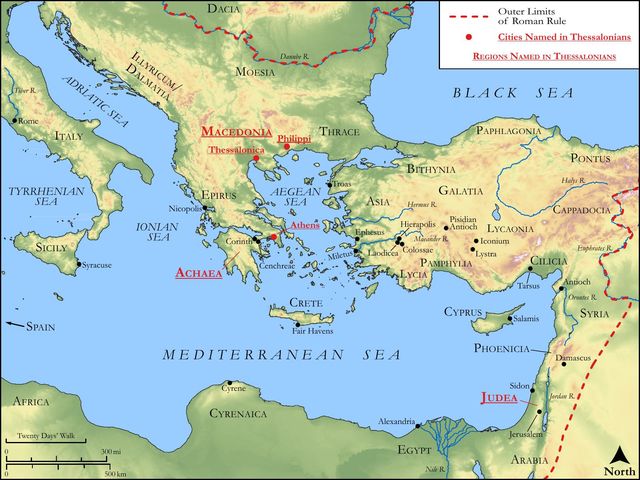
See on the biblical-era maps

Study this verse
Public-domain commentary
Matthew Henry
From his Commentary on the Whole Bible. Henry comments on passages, not single verses — this entry covers 1 Thessalonians 3:1–5. His four-level outline is real structure in the source text, so it is rendered as structure.
In these words the apostle gives an account of his sending Timothy to the Thessalonians. Though he was hindered from going to them himself, yet his love was such that he could not forbear sending Timothy to them. Though Timothy was very useful to him, and he could not well spare him, yet Paul was content, for their good, to be left alone at Athens. Note, Those ministers do not duly value the establishment and welfare of their people who cannot deny themselves in many things for that end. Observe,
I.The character he gives of Timothy (Th1 3:2):
We sent Timotheus, our brother. Elsewhere he calls him his son; here he calls him brother. Timothy was Paul's junior in age, his inferior in gifts and graces, and of a lower rank in the ministry: for Paul was an apostle, and Timothy but an evangelist; yet Paul calls him brother. This was an instance of the apostle's humility, and showed his desire to put honour upon Timothy and to recommend him to the esteem of the churches. He calls him also a minister of God. Note, Ministers of the gospel of Christ are ministers of God, to promote the kingdom of God among men. He calls him also his fellow-labourer in the gospel of Christ. Note, Ministers of the gospel must look upon themselves as labourers in the Lord's vineyard; they have an honourable office and hard work, yet a good work. This is a true saying, If any man desire the office of a bishop, he desires a good work, Ti1 3:1. And ministers should look upon one another, and strengthen one another's hands, not strive and contend one with another (which will hinder their work), but strive together to carry on the great work they are engaged in, namely, to preach and publish the gospel of Christ, and to persuade people to embrace and entertain it and live suitably thereto.
II.The end and design why Paul sent Timothy:
To establish you and to comfort you concerning your faith, Th1 3:2. Paul had converted them to the Christian faith, and now he was desirous that they might be confirmed and comforted, that they might confirmed in the choice they had made of the Christian religion, and comforted in the profession and practice of it. Note, The more we are comforted, the more we shall be confirmed, because, when we find pleasure in the ways of God, we shall thereby be engaged to continue and persevere therein. The apostle's design was to establish and comfort the Thessalonians concerning their faith, - concerning the object of their faith, namely, the truths of the gospel, and particularly that Jesus Christ was the Saviour of the world, and so wise and good, so powerful and faithful, that they might rely upon him, - concerning the recompence of faith, which was more than sufficient to balance all their losses and reward all their labours.
III.The motive inducing Paul to send Timothy for this end, namely, a godly fear or jealousy, lest they should be moved from the faith of Christ, Th1 3:3. He was desirous that no man, no one among them, should be moved or shaken in mind, that they should not apostatize or waver in the faith. And yet,
1.He apprehended there was danger, and feared the consequence.
(1.)There was danger,
[1.]By reason of affliction and persecution for the sake of the gospel, Th1 3:3. These Thessalonians could not but perceive what afflictions the apostles and preachers of the gospel met with, and this might possibly stumble them; and also those who made profession of the gospel were persecuted, and without doubt these Thessalonians themselves were afflicted.
[2.]By reason of the tempter's subtlety and malice. The apostle was afraid lest by any means the tempter had tempted them, Th1 3:5. The devil is a subtle and unwearied tempter, who seeks an opportunity to beguile and destroy us, and takes all advantages against us, both in a time of prosperity and adversity; and he has often been successful in his attacks upon persons under afflictions. He has often prejudiced the minds of men against religion on account of the sufferings its professors are exposed to. We have reason therefore to be jealous over ourselves and others, lest we be ensnared by him.
(2.)The consequence the apostle feared was lest his labour should be in vain. And thus it would have been, if the tempter had tempted them, and prevailed against them, to move them from the faith. They would have lost what they had wrought, and the apostle would have lost what he laboured for. Note, It is the devil's design to hinder the good fruit and effect of the preaching of the gospel. If he cannot hinder ministers from labouring in the word and doctrine, he will, if he be able, hinder them of the success of their labours. Note also, Faithful ministers are much concerned about the success of their labours. No one would willingly labour in vain; and ministers are loth to spend their strength, and pains, and time, for nought.
2.To prevent this danger, with its bad consequence, the apostle tells them what care he took in sending Timothy,
(1.)To put them in mind of what he had told them before concerning suffering tribulation (Th1 3:4), he says (Th1 3:3), We are appointed thereunto, that is, unto afflictions. So is the will and purpose of God that through many afflictions we must enter into his kingdom. Their troubles and persecutions did not come by chance, not merely from the wrath and malice of the enemies of religion, but by the appointment of God. The event only came to pass according as God had determined, and they knew he had told them before it would be; so that they should not think it strange, and, being fore-warned, they should be fore-armed. Note, The apostles were so far from flattering people with an expectation of worldly prosperity in religion that, on the contrary, they told them plainly they must count upon trouble in the flesh. And herein they followed the example of their great Master, the author or our faith. Besides, it might prove a confirmation of their faith, when they perceived that it only happened to them as was predicted before.
(2.)To know their faith, that so he might inform the apostles whether they remained stedfast under all their sufferings, whether their faith failed or not, because, if their faith did not fail, they would be able to stand their ground against the tempter and all his temptations: their faith would be a shield, to defend them against all the fiery darts of the wicked, Eph 6:16.
Historical interpretation
Historical reception
1 surviving comment on this verse from the historical church.
"For this cause I also, when I could no longer forbear, sent that I might know your faith, lest by any means the tempter had tempted you, and our labor should be in vain."
A Question lies before us to-day, which is much disputed, and which is gathered from many sources. But what is this question? "For this cause," he says, "when I could no longer forbear, I sent Timothy that I might know your faith." What sayest thou? He, who knew so many things, who heard unutterable words, who ascended even to the third heaven, doth not he know, even when he is in Athens? And yet the distance is not great, nor has he been long parted from them. For he says, "Being bereaved of you for a short season." He does not know the affairs of the Thessalonians, but is compelled to send Timothy to know their faith, "lest," he says, "the tempter had tempted you, and our labors should be in vain."
What then is one to say? That the Saints knew not all things. And this one might learn from many instances, both of the early ones, and of those who came after them. And this comes to pass out of great care on God's part. How, and in what way? For the sake both of the Saints themselves, and of those who believe in them. For as He permits that there should be persecutions, so He permits that they should also be ignorant of many things, that they may be kept humble.
What means, "Lest by any means the tempter had tempted you"? Dost thou see that to be shaken in afflictions proceeds from the devil, and from his seduction? For when he cannot shake us ourselves, he takes another way, and shakes the weaker sort through our means.
"And our labor," he says, "should be in vain." Wherefore! for even if they were turned aside, it was not through thy fault, not through thy negligence. But nevertheless, though this were the case, I think, from my great love of the brethren, that my labor had been rendered vain.
"Lest by any means the tempter had tempted you." But he tempts, not knowing whether he shall overthrow. Does he then, even though he knows not, yet assail us, and do we, who know that we shall completely overcome him, not watch? Let us all hear, how Paul labored. He does not say work, but "labor"; he does not say, and you be lost, but "our labor." So that even if anything had happened, it would be happening with some reason. But that it did not happen was a great wonder. These things indeed we expected, he says, but the contrary happened. For not only did we receive from you no addition to our affliction but even consolation.
Continue studying 1 Thessalonians 3:5 across the web’s major study libraries — every link below opens this exact verse, chapter, or book on the destination site.
Read & Compare
 BibleGatewayThis verse in more than 200 translations and 70 languages.
 Bible.comThe YouVersion reader — hundreds of translations, reading plans, and highlights.
 ESV.orgCrossway's official English Standard Version reader.
 NET BibleThe NET translation with 60,000+ translators' notes on every rendering decision.
 STEP BibleTyndale House's free study tool — original text, vocabulary, and scholarly resources.
 BibliaLogos Bible Software's free web reader.
 USCCBThe New American Bible (Revised Edition) with the U.S. bishops' study notes.
Commentaries
 BibleHub CommentariesDozens of classic commentaries on this verse, gathered on one page.
 StudyLightMore than 100 commentary sets — the largest collection on the web.
 BibleRefPlain-English commentary on what this verse means, verse by verse.
 Enduring WordDavid Guzik's free commentary on this chapter, widely used by Bible teachers.
 Bible Study ToolsVerse commentary alongside Greek and Hebrew study aids.
Original Language & Research
- BibleHub InterlinearThe verse word by word — original language, transliteration, and English.
- BibleHub LexiconEvery word's original-language definition and Strong's entry.
 Blue Letter BibleDeep-study tools — Strong's numbers, concordance, and word studies.
 CNTR CollationThe earliest Greek manuscripts of this verse, collated letter by letter.
Sermons, Hymns & Audio


TrulyRandomVerse is not affiliated with these sites and doesn’t control their content. They’re linked because they’re genuinely useful.
Summary
In 1 Thessalonians 3:5, the Apostle Paul articulates the profound pastoral anxiety that compelled him to dispatch Timothy to the nascent church in Thessalonica. Having been abruptly separated from them due to persecution, Paul's overwhelming concern was for the steadfastness of their faith. He feared that the intense trials they faced might have led them astray, allowing "the tempter" to undermine their newfound conviction and thereby render his strenuous apostolic "labour" among them utterly fruitless. This verse encapsulates Paul's deep spiritual burden and his proactive measures to safeguard the spiritual well-being of the believers.
Context
ShowHideLiterary Context
This verse serves as the culmination of Paul's explanation for sending Timothy, a decision driven by his intense longing and inability to bear the separation from the Thessalonian believers (1 Thessalonians 2:17-20). Having established the church and then been forced to leave, Paul, Silas, and Timothy found themselves in Athens (as noted in 1 Thessalonians 3:1). Paul's deep concern for the spiritual maturity and endurance of these relatively new converts led him to send Timothy back to them, specifically "to establish you, and to comfort you concerning your faith" (1 Thessalonians 3:2). Verse 5 explicitly states the underlying fear that necessitated this mission: the potential for their faith to collapse under duress, thereby nullifying the gospel work. The subsequent verses (e.g., 1 Thessalonians 3:6-10) then reveal Timothy's return with good news, alleviating Paul's anxiety.
Historical & Cultural Context
The church in Thessalonica was founded during Paul's second missionary journey, as recounted in Acts 17:1-9. Paul's ministry there was remarkably brief, lasting perhaps only a few weeks, yet it yielded significant conversions. However, this success was met with immediate and severe opposition from both Jewish and Gentile factions, forcing Paul and his companions to flee. The new believers were left to navigate a hostile environment without their apostolic mentors. This context of intense, ongoing persecution (1 Thessalonians 1:6 and 1 Thessalonians 2:14) made Paul's concern for their spiritual endurance particularly acute. The cultural backdrop included a widespread belief in spiritual forces, making the concept of "the tempter" resonate with the audience, who would understand Satan as a real and active adversary.
Key Themes
ShowHideThis verse powerfully highlights several core themes woven throughout Paul's letter. Firstly, it underscores Paul's profound pastoral concern and genuine affection for the Thessalonian believers, demonstrating the heart of a spiritual father deeply invested in the spiritual health of his children. His willingness to forgo his own comfort and send his trusted companion, Timothy, speaks volumes about his commitment to their steadfastness (2 Corinthians 11:28). Secondly, the verse explicitly addresses the reality of spiritual warfare and temptation. Paul acknowledges an active, malevolent force—"the tempter"—that seeks to undermine faith, especially during times of trial. This theme is crucial for understanding the challenges faced by early Christians and believers today. Thirdly, it emphasizes the centrality of enduring faith. For Paul, faith is not merely an initial decision but a dynamic, living trust that must withstand external pressures and internal doubts. Its preservation is paramount for a thriving Christian life and for the validation of apostolic ministry. Finally, the phrase "our labour be in vain" highlights the vulnerability and profound investment of apostolic ministry, where the success of the gospel hinges on the perseverance of those who receive it.
Exposition and Analysis
ShowHideKey Word Analysis
ShowHideDerived from a word meaning "to roof over," this term figuratively means "to cover with silence" or "to endure patiently." In this context, Paul's phrase "when I could no longer forbear" (G4722 stegō with G3371 mēkéti) signifies his inability to continue enduring the intense anxiety and uncertainty about the Thessalonians' spiritual state. He could no longer passively bear the suspense; his pastoral concern compelled him to act.
This word (G3985 peirázō) refers to one who tests, tries, or entices. When used as a noun, "the tempter" specifically designates Satan, the devil. It highlights his characteristic role as the adversary who seeks to scrutinize, entice, and lead people into sin or away from God. Paul's use of this specific title underscores his belief in a personal, malevolent spiritual force actively working against the faith of believers.
This term (G2873 kópos) denotes intense toil, weariness, or pain. It refers to the strenuous effort, hardship, and suffering that Paul and his companions endured in their missionary work—preaching, teaching, establishing churches, and facing persecution. Paul's fear that this "labour" might "be in vain" emphasizes the profound investment of his entire being into the spiritual lives of the Thessalonians.
Verse Breakdown
ShowHide"For this cause, when I could no longer forbear"
Paul begins by stating the compelling reason for his action. His emotional and spiritual burden regarding the Thessalonians had reached an unbearable point. He could no longer passively endure the uncertainty and anxiety about their spiritual condition, especially given the severe persecution they were facing. This phrase conveys the depth of his pastoral love and distress.
"I sent to know your faith"
This clause reveals Paul's proactive and decisive response to his anxiety. He dispatched Timothy, his trusted co-worker, with a specific mission: to ascertain the true state of their faith. The Greek word for "know" (G1097 ginṓskō) implies not just intellectual understanding, but a deep, experiential knowledge of their spiritual steadfastness and perseverance amidst trials.
"lest by some means the tempter have tempted you"
Here, Paul articulates his precise fear. He was concerned that the severe pressures and persecutions they faced might have been exploited by "the tempter" (Satan). The repetition of the root word peirázō (tempter/tempted) emphasizes the direct, insidious nature of this spiritual attack. The tempter's goal is to test their faith to the point of collapse or apostasy.
"and our labour be in vain"
This final phrase expresses the devastating consequence Paul feared most. If the Thessalonians' faith failed, all the strenuous effort, suffering, and spiritual investment Paul and his team had poured into establishing and nurturing that church would be rendered "empty" (G2756 kenós), useless, or without purpose. It highlights the profound spiritual stakes involved in gospel ministry and the enemy's desire to nullify God's work.
Literary Devices
ShowHidePaul's expression in 1 Thessalonians 3:5 is rich with literary techniques that amplify his message. The use of Pathos is evident in Paul's deeply emotional confession, "when I could no longer forbear," which powerfully conveys his profound anxiety and paternal concern for the Thessalonians. This personal vulnerability draws the readers into his pastoral heart. Furthermore, Paul employs Personification by explicitly naming "the tempter" as an active, malevolent agent. This gives a concrete face to the spiritual opposition, making the threat tangible and emphasizing the reality of spiritual warfare. The phrase "our labour be in vain" functions as a powerful Metaphor, portraying his ministry as an arduous investment, the fruit of which could be lost. This also sets up an implicit Antithesis between the intense effort expended ("labour") and the potential for it to yield no lasting result ("in vain"), highlighting the spiritual battle for the souls of believers and the ultimate purpose of gospel ministry.
Theological and Thematic Connections
ShowHidePaul's anxiety and proactive measures in 1 Thessalonians 3:5 underscore fundamental theological truths about the Christian life. It reveals the reality of spiritual warfare, where believers are engaged in a constant struggle against unseen forces, personified by "the tempter." This is not merely a psychological battle but a direct assault on faith, particularly potent during times of external pressure and persecution. The verse also highlights the critical importance of perseverance in faith, emphasizing that genuine faith is not only initiated by God but also sustained through trials, often with the support of the believing community and faithful pastoral oversight. Paul's concern for his "labour" not being "in vain" speaks to the divine economy of ministry, where human effort, empowered by the Spirit, contributes to God's eternal purposes, and its fruit is precious and vulnerable. Ultimately, this passage points to God's faithfulness in preserving His people, even as they face temptation, often through the instrumentality of His servants.
Reflection and Application
ShowHidePaul's deeply personal confession in 1 Thessalonians 3:5 offers timeless lessons for believers and leaders today. It serves as a powerful reminder that the Christian journey is not without its adversaries. We must cultivate a sober awareness that "the tempter" is a real and active spiritual force, constantly seeking opportunities, especially during our moments of vulnerability, trial, or isolation, to sow doubt, incite sin, or cause us to abandon our faith. This awareness should prompt us to vigilance, prayer, and reliance on God's strength. Furthermore, Paul's actions exemplify the profound value of genuine pastoral care and mutual accountability within the body of Christ. Just as Paul dispatched Timothy, we are called to actively check in on one another, offering encouragement, support, and spiritual strengthening, particularly to those who are new in faith or enduring significant hardship. Our faith is not meant to be a solitary endeavor but is often nurtured and sustained within the context of caring community, ensuring that the "labour" of evangelism and discipleship is not rendered "in vain."
Questions for Reflection
ShowHideFAQ
ShowHideWhy was Paul so concerned about the Thessalonians' faith?
ShowHidePaul's concern stemmed from several factors. Firstly, the Thessalonian church was relatively new, founded during a brief but intense period of ministry, meaning the believers were likely still immature in their faith and lacked extensive teaching. Secondly, Paul's ministry there was cut short by severe persecution, forcing him to leave abruptly. This left the new converts to face ongoing, intense trials (as mentioned in 1 Thessalonians 1:6 and 1 Thessalonians 2:14) without his direct presence and guidance. Paul feared that this combination of immaturity and intense pressure might cause them to falter, abandon their faith, or succumb to the schemes of the tempter.
Who is "the tempter" mentioned in this verse?
ShowHide"The tempter" (Greek: ho peirazōn) is a specific designation for Satan, the devil. This term emphasizes his primary role as one who tests, tries, and entices people to sin or to abandon their faith. He is the adversary of God and His people, actively seeking to undermine faith and nullify the work of God's kingdom. This same title is notably used in the account of Jesus' temptation in the wilderness.
What does it mean for "our labour be in vain"?
ShowHideFor Paul, "our labour" refers to the immense effort, toil, suffering, and spiritual investment he and his co-workers (Silas and Timothy) poured into establishing and nurturing the Thessalonian church. This included preaching the gospel, teaching, discipling, and enduring persecution for their sake. To have this "labour be in vain" (Greek: kenós) means that all their strenuous efforts would be rendered "empty," useless, or without purpose. If the Thessalonians' faith did not endure, it would signify that the enemy had succeeded in nullifying the fruit of their ministry, making their sacrifices and pains seem meaningless in terms of eternal impact.
Christ-Centered Fulfillment
ShowHidePaul's intense pastoral concern for the Thessalonians, fearing that "the tempter" might undermine their faith and render his "labour" in vain, finds its ultimate answer and fulfillment in the person and work of Jesus Christ. Christ himself faced the direct onslaught of "the tempter" in the wilderness, enduring and overcoming every temptation without sin (Matthew 4:1-11). This makes Him our sympathetic High Priest, one who can deeply relate to our struggles, "for we do not have a high priest who is unable to sympathize with our weaknesses, but one who in every respect has been tempted as we are, yet without sin" (Hebrews 4:15). Furthermore, Jesus is the Good Shepherd who lays down His life for His sheep (John 10:11) and promises that "no one will snatch them out of my hand" (John 10:28). Paul's anxiety, though real and human, is ultimately assuaged by the sovereign power of Christ, who intercedes for His own (Romans 8:34) and ensures that the faith of His elect will endure to the end. Therefore, while human "labour" in ministry is vital, its ultimate fruitfulness is guaranteed not by human strength or perfect perseverance, but by the unfailing work of Christ, who ensures that "your labor in the Lord is not in vain" (1 Corinthians 15:58).