


1 Thessalonians 3:6
Bible text: King James Version (1769 Blayney text) · Public domain
Bible text: King James Version with Strong's numbers · Public domain
Bible text: Berean Standard Bible · Public domain
Bible text: American Standard Version (1901) · Public domain
Bible text: World English Bible, Messianic edition · Public domain
Bible text: Geneva Bible (1599) · Public domain
Bible text: Young's Literal Translation · Public domain
- ἄρτιartiPresentlyG737ADVAdverb
- δὲdehoweverG1161CONJConjunction
- ἐλθόντοςelthontoswhen was comingG2064V-2AAP-GSMVerb 2nd Aorist Active Participle Genitive Singular Masculine
- ΤιμοθέουTimotheouTimothyG5095N-GSM-PNoun Genitive Singular Masculine Individual
- πρὸςprostoG4314PREPPreposition
- ἡμᾶςhēmasusG3165P-1APPersonal pronoun Accusative 1st Plural
- ἀφ᾽aph᾽fromG575PREPPreposition
- ὑμῶνhumōnyouG4771P-2GPPersonal pronoun Genitive 2nd Plural
- καὶkaiandG2532CONJConjunction
- εὐαγγελισαμένουeuangelisamenouhaving evangelisedG2097V-AMP-GSMVerb Aorist Middle Participle Genitive Singular Masculine
- ἡμῖνhēminto usG3165P-1DPPersonal pronoun Dative 1st Plural
- τὴνtēnof theG3588T-ASFDefinite article Accusative Singular Feminine
- πίστινpistinfaithG4102N-ASFNoun Accusative Singular Feminine
- καὶkaiandG2532CONJConjunction
- τὴνtēntheG3588T-ASFDefinite article Accusative Singular Feminine
- ἀγάπηνagapēnloveG26N-ASFNoun Accusative Singular Feminine
- ὑμῶνhumōnof youG4771P-2GPPersonal pronoun Genitive 2nd Plural
- καὶkaiandG2532CONJConjunction
- ὅτιhotithatG3754CONJConjunction
- ἔχετεecheteyou haveG2192V-PAI-2PVerb Present Active Indicative 2nd Plural
- μνείανmneiana remembranceG3417N-ASFNoun Accusative Singular Feminine
- ἡμῶνhēmōnof usG3165P-1GPPersonal pronoun Genitive 1st Plural
- ἀγαθὴνagathēngoodG18A-ASFAdjective Accusative Singular Feminine
- πάντοτεpantotealwaysG3842ADVAdverb
- ἐπιποθοῦντεςepipothounteslongingG1971V-PAP-NPMVerb Present Active Participle Nominative Plural Masculine
- ἡμᾶςhēmasusG3165P-1APPersonal pronoun Accusative 1st Plural
- ἰδεῖνideinto seeG1492V-2AANVerb 2nd Aorist Active Infinitive
- καθάπερkathaperjust asG2509CONJConjunction
- καὶkaialsoG2532CONJConjunction
- ἡμεῖςhēmeiswe ourselvesG3165P-1NPPersonal pronoun Nominative 1st Plural
- ὑμᾶςhumasyouG4771P-2APPersonal pronoun Accusative 2nd Plural
English is a literal word-by-word gloss of the Greek, not the KJV's wording. Why?
This is the original text the KJV's translators worked from — each Greek word with its own literal English meaning in this verse, prepared by scholars at Tyndale House, Cambridge. The KJV translates whole sentences, not word by word, so its wording differs: one Greek word can become several English words, and the KJV may choose “charity” where the gloss reads “love”. Both are faithful — they answer different questions. For the KJV's own rendering, switch to the KJV text.
Details
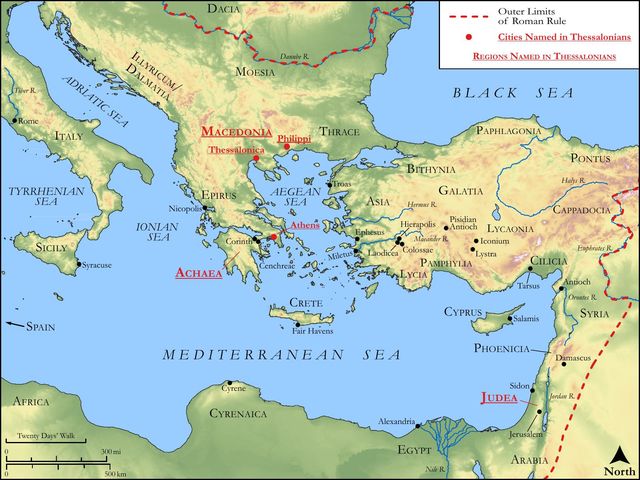
See on the biblical-era maps

Study this verse
Public-domain commentary
Matthew Henry
From his Commentary on the Whole Bible. Henry comments on passages, not single verses — this entry covers 1 Thessalonians 3:6–10. His three-level outline is real structure in the source text, so it is rendered as structure.
Here we have Paul's great satisfaction upon the return of Timothy with good tidings from the Thessalonians, in which we may observe,
I.The good report Timothy made concerning them, Th1 3:6.
Without question, he was a willing messenger of these good tidings. Concerning their faith, that is, concerning their stedfastness in the faith, that they were not shaken in mind, nor turned aside form the profession of the gospel. Their love also continued; their love to the gospel, and the ministers of the gospel. For they had a good and a kind remembrance of the apostles, and that constantly, or always. The names of the apostles were very dear to them, and the thoughts of them, and what they themselves had received from them, were very precious, insomuch that they desired greatly to see them again, and receive some spiritual gift from them; and there was no love lost, for the apostle was as desirous to see them. It is happy where there is such mutual love between minister and people. This tends to promote religion, and the success of the gospel. The world hates them, and therefore they should love one another.
II.The great comfort and satisfaction the apostle had in this good report concerning them (Th1 3:7, Th1 3:8):
Therefore, brethren, we were comforted in all our affliction and distress. The apostle thought this good news of them was sufficient to balance all the troubles he met with. It was easy to him to bear affliction, or persecution, or fightings from without, when he found the good success of his ministry and the constancy of the converts he had made to Christianity; and his distress of mind on account of his fears within, lest he had laboured in vain, was now in a good measure over, when he understood their faith and the perseverance of it. This put new life and spirit into the apostle and made him vigorous and active in the work of the Lord. Thus he was not only comforted, but greatly rejoiced also: Now we live, if you stand fast in the Lord, Th1 3:8. It would have been a killing thing to the apostles if the professors of religion had been unsteady, or proved apostates; whereas nothing was more encouraging than their constancy.
III.The effects of this were thankfulness and prayer to God on their behalf. Observe,
1.How thankful the apostle was, Th1 3:9. He was full of joy, and full of praise and thanksgiving. When we are most cheerful we should be most thankful. What we rejoice in we should give thanks for. This is to rejoice before our God, to spiritualize our joy. Paul speaks as if he could not tell how to express his thankfulness to God, or his joy and rejoicing for their sakes. But he was careful God should not lose the glory of the comfort he received in the welfare of his friends. His heart was enlarged with love to them and with thanksgiving to God. He was willing to express the one and the other as well as he could. As to thankfulness to God, this especially is very imperfect in the present state; but, when we come to heaven, we shall do this work better than now we can.
2.He prayed for them night and day (Th1 3:10), evening and morning, or very frequently, in the midst of the business of the day or slumber of the night lifting up his heart to God in prayer. Thus we should pray always. And Paul's prayer was fervent prayer. He prayed exceedingly, and was earnest in his supplication. Note, When we are most thankful we should always give ourselves to prayer; and those we give thanks for have yet need to be prayed for. Those whom we most rejoice in, and who are our greatest comforts, must be our constant care, while in this world of temptation and imperfection. There was something still lacking in their faith; Paul desired that this might be perfected, and to see their face in order thereunto. Note,
(1.)The best of men have something wanting in their faith, if not as to the matter of it, there being some mysteries or doctrines not sufficiently known or believed by them, yet as to the clearness and certainty of their faith, there being some remaining darkness and doubtings, or at least as to the effects and operations of it, these being not so conspicuous and perfect as they should be. And,
(2.)The ministry of the word and ordinances is helpful, and to be desired and used for the perfecting of that which is lacking in our faith.
Historical interpretation
Historical reception
1 surviving comment on this verse from the historical church.
"But when Timothy came even now unto us from you, and brought us glad tidings of your faith and love, and that ye have good remembrance of us always, longing to see us, even as we also to see you."
"Brought us glad tidings," he says. Do you see the excessive joy of Paul? he does not say, brought us word, but "brought us glad tidings." So great a good did he think their steadfastness and love. For it was necessary, the one remaining firm, that the other also must be steadfast. And he rejoiced in their love, because it was a sign of their faith. "And that ye have," he says, "good remembrance of us always, longing to see us, even as we also to see you." That is, with praises. Not when we were present, nor when we were working miracles, but even now, when we are far off, and are scourged, and are suffering numberless evils, "ye have good remembrance of us." Hear how disciples are admired, who have good remembrance of their teachers, how they are called blessed. Let us imitate these. For we benefit ourselves, not those who are loved by us. "Longing to see us," he says, "as we also to see you." And this too cheered them; for to him who loves, to perceive that the beloved person knows that he is beloved, is a great comfort and consolation.
Continue studying 1 Thessalonians 3:6 across the web’s major study libraries — every link below opens this exact verse, chapter, or book on the destination site.
Read & Compare
 BibleGatewayThis verse in more than 200 translations and 70 languages.
 Bible.comThe YouVersion reader — hundreds of translations, reading plans, and highlights.
 ESV.orgCrossway's official English Standard Version reader.
 NET BibleThe NET translation with 60,000+ translators' notes on every rendering decision.
 STEP BibleTyndale House's free study tool — original text, vocabulary, and scholarly resources.
 BibliaLogos Bible Software's free web reader.
 USCCBThe New American Bible (Revised Edition) with the U.S. bishops' study notes.
Commentaries
 BibleHub CommentariesDozens of classic commentaries on this verse, gathered on one page.
 StudyLightMore than 100 commentary sets — the largest collection on the web.
 BibleRefPlain-English commentary on what this verse means, verse by verse.
 Enduring WordDavid Guzik's free commentary on this chapter, widely used by Bible teachers.
 Bible Study ToolsVerse commentary alongside Greek and Hebrew study aids.
Original Language & Research
- BibleHub InterlinearThe verse word by word — original language, transliteration, and English.
- BibleHub LexiconEvery word's original-language definition and Strong's entry.
 Blue Letter BibleDeep-study tools — Strong's numbers, concordance, and word studies.
 CNTR CollationThe earliest Greek manuscripts of this verse, collated letter by letter.
Sermons, Hymns & Audio


TrulyRandomVerse is not affiliated with these sites and doesn’t control their content. They’re linked because they’re genuinely useful.
Summary
First Thessalonians 3:6 marks a pivotal moment of profound relief and joy for the Apostle Paul. After a period of anxious separation and deep concern for the spiritual well-being of the Thessalonian believers, Paul's trusted co-worker, Timothy, returns with a highly anticipated report. The news is overwhelmingly positive: the Thessalonians are steadfast in their faith, abounding in love, and hold a warm, constant remembrance of Paul and his companions, eagerly desiring to reunite with them, a longing that is fully reciprocated by Paul.
Context
ShowHideLiterary Context
This verse serves as the joyful culmination of Paul's expressed anxiety in the preceding verses. In 1 Thessalonians 3:1-5, Paul describes his inability to endure the separation and his decision to send Timothy to strengthen and encourage the Thessalonians, fearing that the persecutions they faced might have shaken their faith. The news Timothy brings in 1 Thessalonians 3:6 directly alleviates these fears, setting the stage for Paul's subsequent outpouring of gratitude and prayer in 1 Thessalonians 3:7-10. The entire chapter underscores the deep pastoral bond between Paul and the fledgling church, highlighting the importance of mutual encouragement and the profound impact of spiritual reports on Paul's emotional and spiritual state.
Historical & Cultural Context
Paul, Silvanus, and Timothy had established the church in Thessalonica during Paul's second missionary journey, as recounted in Acts 17:1-9. Their ministry was abruptly cut short by violent opposition from Jewish leaders, forcing Paul and his companions to flee. This sudden departure left Paul deeply concerned about the new converts, who were left to face significant persecution in a pagan city without their spiritual mentors. The Roman province of Macedonia, where Thessalonica was located, was known for its strong civic pride and emperor worship, making the nascent Christian community's adherence to "another king, Jesus" (as accused in Acts 17:7) a source of social and political tension. Timothy's mission from Athens (mentioned in 1 Thessalonians 3:1) was therefore critical, not just for spiritual encouragement but also to ascertain the church's resilience amidst a hostile environment.
Key Themes
ShowHideThe verse powerfully contributes to several overarching themes within 1 Thessalonians. Firstly, it exemplifies Pastoral Care and Affection, showcasing Paul's profound love and concern for his spiritual children, which transcends mere duty and reflects a genuine parental bond (compare 1 Thessalonians 2:7-8). Secondly, it highlights the Resilience of Faith Amidst Persecution, as the Thessalonians' steadfastness despite trials brought immense relief and joy to Paul, validating their genuine conversion and the power of the Gospel. Thirdly, the emphasis on "faith and charity" (love) underscores the Foundational Virtues of Christian Life, presenting them as the twin pillars upon which spiritual maturity and endurance are built. Finally, the mutual desire for reunion underscores the theme of Christian Fellowship and Community, emphasizing the importance of personal presence and relational bonds within the body of Christ, a longing for fellowship that Paul expresses throughout his letters, as seen in Romans 1:11-12.
Exposition and Analysis
ShowHideKey Word Analysis
ShowHideThis verb, often translated as "to preach the gospel" or "to evangelize," literally means "to announce good news." While it typically refers to the good news of salvation through Christ, here it is employed in a broader sense to describe the joyous, positive report Timothy brought concerning the Thessalonians' spiritual state. It emphasizes the profoundly encouraging nature of the news for Paul.
Derived from a root meaning "to persuade," pistis denotes conviction, trust, and reliance. In this context, it refers to the Thessalonians' unwavering trust in God and Christ, their adherence to Christian truth, and their faithfulness in living out their beliefs despite the severe persecution they faced. It signifies their steadfastness and loyalty to the Gospel.
This term represents the distinctive, unconditional, self-sacrificial love characteristic of God and commanded of believers. Unlike other Greek words for love, agápē is not primarily an emotion but a volitional act of selfless devotion and benevolent concern for others. Timothy's report confirmed that this divine love was actively present and evident among the Thessalonians, both in their relationships with one another and with Paul.
Verse Breakdown
ShowHide"But now when Timotheus came from you unto us"
This clause marks a crucial turning point, signaling the end of Paul's anxious waiting and the arrival of the much-anticipated messenger. Timothy's return signifies the completion of his mission to Thessalonica and his rejoining Paul, likely in Corinth.
"and brought us good tidings of your faith and charity"
This is the core of the good news. Timothy's report centered on two fundamental virtues: the Thessalonians' unwavering "faith" (their fidelity to Christ despite persecution) and their active "charity" or agápē (their selfless love for God, one another, and Paul). This confirmed their spiritual health and maturity.
"and that ye have good remembrance of us always"
This detail reveals the enduring affection and loyalty the Thessalonians held for Paul and his co-workers. Despite the forced separation and the passage of time, their memory of Paul was positive and constant, indicating a deep, lasting bond.
"desiring greatly to see us, as we also [to see] you"
This final phrase highlights the beautiful reciprocity of affection and longing for fellowship between the apostle and the church. The Thessalonians' strong desire to see Paul mirrored his own intense yearning for them, emphasizing the relational depth of their spiritual connection.
Literary Devices
ShowHideThe verse employs several literary devices that enhance its emotional and theological impact. Epistolary Structure is evident as Paul transitions from expressing his anxiety to detailing the report that alleviates it, a common feature in his letters where personal updates frame theological instruction. The use of Emotive Language is clear in phrases like "good tidings" and "desiring greatly," conveying Paul's profound relief and joy. The term "good tidings" (euangelízō) itself, typically reserved for the Gospel, here functions as a Metaphor for the immensely positive and salvific impact of the news on Paul's spirit, elevating the significance of the Thessalonians' spiritual state. Furthermore, the final clause demonstrates Reciprocity and Parallelism ("desiring greatly to see us, as we also [to see] you"), underscoring the mutual affection and longing for fellowship between Paul and the Thessalonians, reinforcing the familial bond he often uses to describe his relationship with the churches he founded.
Theological and Thematic Connections
ShowHideThe good report concerning the Thessalonians' faith and charity resonates deeply with core Christian theology. It affirms that genuine conversion and spiritual growth are evidenced by these two virtues, which are inseparable and foundational to the Christian life. Faith is the means by which we apprehend God's grace and truth, while charity (agápē) is the supreme expression of that faith lived out in relationship with God and others. This verse showcases the pastoral heart of Paul, who finds his greatest joy not in personal comfort or success, but in the spiritual flourishing of those he has discipled. His relief underscores the divine value placed on the perseverance of believers in truth and love, especially in the face of adversity. This mutual longing for fellowship also points to the communal nature of the church, where believers are bound together by shared faith and love, desiring to be present with one another for mutual encouragement and edification.
Reflection and Application
ShowHideFirst Thessalonians 3:6 offers a powerful reminder of the profound interconnectedness within the body of Christ. Paul's exuberant joy upon hearing of the Thessalonians' steadfast faith and abounding love serves as a model for how believers should celebrate and be encouraged by one another's spiritual growth. In a world often characterized by isolation and negative news, this verse calls us to actively seek out and share stories of faithfulness, perseverance, and love within our communities, recognizing that such reports can be a powerful source of spiritual uplift. It also challenges us to examine our own lives: are our faith and love growing, even amidst trials? Do we genuinely desire fellowship with other believers, and do we seek to encourage our spiritual leaders with evidence of our spiritual vitality? This passage underscores that the true measure of a vibrant Christian life lies not merely in intellectual assent, but in the tangible expressions of trust in God and selfless love for others.
Questions for Reflection
ShowHideFAQ
ShowHideWhy was Paul so concerned about the Thessalonians, leading him to send Timothy?
ShowHidePaul had a deep, parental love for the Thessalonian believers, whom he had discipled during his second missionary journey. However, his ministry there was cut short by intense persecution, forcing him to leave the new converts abruptly (as described in Acts 17:1-10). He was concerned that the severe trials and afflictions they faced might cause them to waver in their newfound faith. His anxiety is clearly expressed in 1 Thessalonians 3:1-5, where he states he "could no longer forbear" and sent Timothy to "establish you, and to comfort you concerning your faith." The good report brought by Timothy in 1 Thessalonians 3:6 directly addresses and alleviates these profound pastoral anxieties.
What is the significance of "faith and charity" in this verse?
ShowHide"Faith" (Greek: pistis) and "charity" (Greek: agápē, often translated as "love") are presented here as the two foundational virtues of Christian life, serving as evidence of the Thessalonians' genuine spiritual health and maturity. Their "faith" signifies their unwavering trust and conviction in God and Christ, even amidst severe persecution, demonstrating their steadfastness. Their "charity" or agápē refers to their distinctive, self-sacrificial, and unconditional love for God, for one another, and for Paul. These two virtues are consistently linked throughout Paul's epistles as essential marks of true discipleship and spiritual growth (e.g., Galatians 5:6 and 1 Corinthians 13:13). Timothy's report confirmed that the Thessalonians were not only holding firm to their beliefs but also actively living out the love that defines Christ's followers.
Christ-Centered Fulfillment
ShowHideFirst Thessalonians 3:6, while detailing a personal report, profoundly reflects the Christ-centered nature of the Christian life. The "faith" of the Thessalonians is ultimately faith in Christ, the one who is "the author and finisher of our faith" (Hebrews 12:2). Their steadfastness amidst persecution echoes Christ's own endurance of suffering for the joy set before Him (Hebrews 12:2). Furthermore, their "charity" (agápē) is a direct outflow of the love of God poured into their hearts through the Holy Spirit (Romans 5:5). This divine love is supremely demonstrated in Christ's sacrificial death on the cross (John 15:13), and believers are called to love one another as He has loved them (John 13:34). Paul's joy in their spiritual flourishing mirrors the joy of Christ over His redeemed, and the mutual longing for fellowship foreshadows the ultimate, unbroken fellowship believers will share with Christ and one another in His eternal kingdom (Revelation 21:3-4). Thus, the Thessalonians' faith and love are not merely human achievements but fruits of Christ's work in them, bringing glory to God and comfort to His servants, pointing to the transformative power of the Gospel centered on Jesus Christ.