


1 Samuel 7:7
Bible text: King James Version (1769 Blayney text) · Public domain
Bible text: King James Version with Strong's numbers · Public domain
Bible text: Berean Standard Bible · Public domain
Bible text: American Standard Version (1901) · Public domain
Bible text: World English Bible, Messianic edition · Public domain
Bible text: Geneva Bible (1599) · Public domain
Bible text: Young's Literal Translation · Public domain
- וַיִּשְׁמְעוּvai·yish·me·'Uand they heardH8085Conj-w ¦ V-Qal-ConsecImperf-3mpVerb Qal Consecutive Imperfect 3rd Plural Masculineוַandיִּשְׁמְעוּthey heard
- פְלִשְׁתִּיםfe·lish·Tim[the] PhilistinesH6430N-mpNoun Gentilic Plural Masculine Absolute
- כִּיkithatH3588PrtParticle Conditional
- הִתְקַבְּצוּhit·ka·be·Tzuthey had gathered togetherH6908V-Hithpael-Perf-3cpVerb Hithpael Perfect 3rd Plural common gender
- בְנֵיve·nei[the] people ofH1121N-mpcNoun Plural Masculine Construct
- יִשְׂרָאֵלYis·ra·'ElIsraelH3478N-properNoun Proper Location
- הַמִּצְפָּתָהha·mitz·Pa·tah<the> Mizpah towardsH4709Art ¦ N-proper ¦ SfxNoun Proper Locationהַ<the>מִּצְפָּתָMizpahהtowards
- וַיַּעֲלוּvai·ya·'a·Luand they went upH5927Conj-w ¦ V-Qal-ConsecImperf-3mpVerb Qal Consecutive Imperfect 3rd Plural Masculineוַandיַּעֲלוּthey went up
- סַרְנֵיsar·nei[the] rulers ofH5633N-mpcNoun Plural Masculine Construct
- פְלִשְׁתִּיםfe·lish·Tim[the] PhilistinesH6430N-mpNoun Gentilic Plural Masculine Absolute
- אֶל'elagainstH413PrepPreposition
- יִשְׂרָאֵלYis·ra·'ElIsraelH3478N-properNoun Proper Location
- וַיִּשְׁמְעוּvai·yish·me·'Uand they heardH8085Conj-w ¦ V-Qal-ConsecImperf-3mpVerb Qal Consecutive Imperfect 3rd Plural Masculineוַandיִּשְׁמְעוּthey heard
- בְּנֵיbe·Nei[the] people ofH1121N-mpcNoun Plural Masculine Construct
- יִשְׂרָאֵלYis·ra·'ElIsraelH3478N-properNoun Proper Location
- וַיִּרְאוּvai·yir·'Uand they were afraidH3372Conj-w ¦ V-Qal-ConsecImperf-3mpVerb Qal Consecutive Imperfect 3rd Plural Masculineוַandיִּרְאוּthey were afraid
- מִפְּנֵיmi·pe·Neiof <the face of>H6440Prep-m ¦ N-mpcNoun Plural Masculine Constructמִofפְּנֵי<the face of>
- פְלִשְׁתִּיםfe·lish·Tim[the] PhilistinesH6430N-mpNoun Gentilic Plural Masculine Absolute
English is a literal word-by-word gloss of the Hebrew, not the KJV's wording. Why?
This is the original text the KJV's translators worked from — each Hebrew word with its own literal English meaning in this verse, prepared by scholars at Tyndale House, Cambridge. The KJV translates whole sentences, not word by word, so its wording differs: one Hebrew word can become several English words, and the KJV may choose “the LORD” where the gloss reads “Yahweh”. Both are faithful — they answer different questions. For the KJV's own rendering, switch to the KJV text.
Details
See on the biblical-era maps
Study this verse
Public-domain commentary
Matthew Henry
From his Commentary on the Whole Bible. Henry comments on passages, not single verses — this entry covers 1 Samuel 7:7–12. His two-level outline is real structure in the source text, so it is rendered as structure.
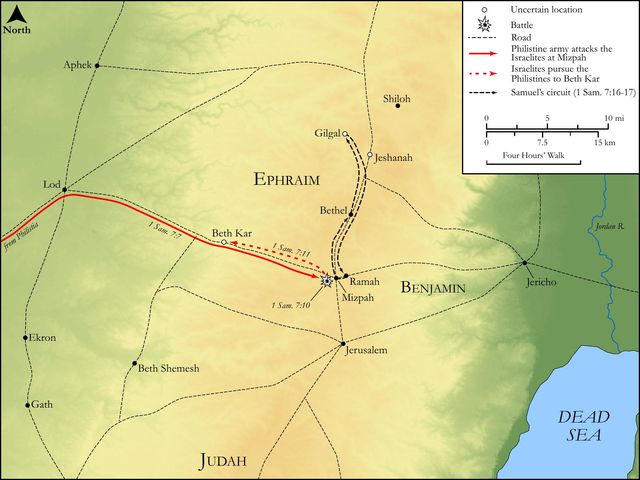
Here, I. The Philistines invade Israel (Sa1 7:7), taking umbrage from that general meeting for repentance and prayer as if it had been a rendezvous for war, and, if so, they thought it prudent to keep the war out of their own country. They had no just cause for this suspicion; but those that seek to do mischief to others will be forward to imagine that others design mischief to them. Now see here, 1. How evil sometimes seems to come out of good. The religious meeting of the Israelites at Mizpeh brought trouble upon them from the Philistines, which perhaps tempted them to wish they had staid at home and to blame Samuel for calling them together. But we may be in God's way and yet meet with distress; nay, when sinners begin to repent and reform, they must expect that Satan will muster all his force against them, and set his instruments on work to the utmost to oppose and discourage them. But, 2. How good is, at length, brought out of that evil. Israel could never be threatened more seasonably than at this time, when they were repenting and praying, nor could they have been better prepared to receive the enemy; nor could the Philistines have acted more impolitely for themselves than to make war upon Israel at this time, when they were making their peace with God. But God permitted them to do it, that he might have an opportunity immediately of crowning his people's reformation with tokens of his favour, and of confirming the words of his messenger, who had assured them that if they repented God would deliver them out of the hand of the Philistines. Thus he makes man's wrath to praise him, and serves the purposes of his grace to his people even by the malicious designs of their enemies against them, Mic 4:11, Mic 4:12.
II.Israel cleaves closely to Samuel, as their best friend, under God, in this distress; though he was no military man, nor ever celebrated as a mighty man of valour, yet, being afraid of the Philistines, for whom they thought themselves an unequal match, they engaged Samuel's prayers for them: Cease not to cry unto the Lord our God for us, Sa1 7:8. They were here unarmed, unprepared for war, come together to fast and pray, not to fight; prayers and tears therefore being all the weapons many of them are now furnished with, to these they have recourse. And, knowing Samuel to have a great interest in heaven, they earnestly beg of him to improve it for them. They had reason to expect it, because he had promised to pray for them (Sa1 7:5), had promised them deliverance from the Philistines (Sa1 7:3), and they had been observant of him in all that which he had spoken to them from the Lord. Thus those who sincerely submit to Christ, as their lawgiver and judge, need not doubt of their interest in his intercession. They were very solicitous that Samuel should not cease to pray for them: what military preparations were to be made they would undertake them, but let him continue instant in prayer, perhaps remembering that when Moses did but let down his hand ever so little Amalek prevailed. O what a comfort is it to all believers that our great intercessor above never ceases, is never silent, for he always appears in the presence of God for us!
III.Samuel intercedes with God for them, and does it by sacrifice, Sa1 7:9.
He took a sucking lamb, and offered it for a burnt-offering, a whole burnt-offering, to the Lord, and, while the sacrifice was in burning, with the smoke of it his prayers ascended up to heaven for Israel. Observe,
1.He made intercession with a sacrifice. Christ intercedes in the virtue of his satisfaction, and in all our prayers we must have an eye to his great oblation, depending upon that for audience and acceptance. Samuel's sacrifice without his prayer would have been an empty shadow, his prayer without the sacrifice would not have been so prevalent, but both together teach us what great things we may expect from God in answer to those prayers which are made with faith in Christ's sacrifice.
2.It was a burnt-offering, which was offered purely for the glory of God, so intimating that the great plea he relied on in his prayer was taken from the honour of God. "Lord, help thy people now for thy name's sake." When we endeavour to give glory to God we may hope he will, in answer to our prayers, work for his own glory.
3.It was but one sucking lamb that he offered; for it is the integrity and intention of the heart that God looks at, more than the bulk or number of the offerings. This one lamb (typifying the Lamb of God) was more acceptable than thousands of rams or bullocks would have been without faith and prayer. Samuel was no priest, but he was a Levite and a prophet; the case was extraordinary, and what he did was by special direction, and therefore was accepted of God. And justly was this reproach put upon the priests because they had corrupted themselves.
IV.God gave a gracious answer to Samuel's prayer (Sa1 7:9):
The Lord heard him. He was himself a Samuel, asked of God, and many a Samuel, many a mercy in answer to prayer, God gave him. Sons of prayer should be famous for praying, as Samuel was among those that call upon his name, Psa 99:6. The answer was a real answer: the Philistines were discomfited (Sa1 7:10, Sa1 7:11), totally routed, and that in such a manner as highly magnified the prayer of Samuel, the power of God, and the valour of Israel.
1.The prayer of Samuel was honoured; for at the very time when he was offering up his sacrifice, and his prayer with it, the battle began, and turned immediately against the Philistines. Thus while he was yet speaking God heard, and answered in thunder, Isa 65:24. God showed that it was Samuel's prayer and sacrifice that he had respect to, and hereby let Israel know that as in a former engagement with the Philistines he had justly chastised their presumptuous confidence in the presence of the ark, on the shoulders of two profane priests, so now he graciously accepted their humble dependence upon the prayer of faith from the mouth and heart of a pious prophet.
2.The power of God was greatly honoured; for he took the work into his own hand, and discomfited them, not with great hail-stones, which would kill them (as Jos 10:11), but with a great thunder, which frightened them and put them into such terror and consternation that they fainted away, and became a very easy prey to the sword of Israel, before whom, being thus confounded, they were smitten. Josephus adds that the earth quaked under them when first they made the onset and in many places opened and swallowed them up, and that, besides the terror of the thunder, their faces and hands were burnt with lightning, which obliged them to shift for themselves by flight. And, being thus driven to their heels by the immediate hand of God (whom they feared not so much as they had feared his ark, Sa1 4:7), then,
3.Honour was put upon the hosts of Israel; they were made use of for the completing of the victory, and had the pleasure of triumphing over their oppressors: They pursued the Philistines, and smote them. How soon did they find the benefit of their repentance, and reformation, and return to God! Now that they have thus engaged him for them none of their enemies can stand before them.
V.Samuel erected a thankful memorial of this victory, to the glory of God and for the encouragement of Israel, Sa1 7:12.
He set up an Eben-ezer, the stone of help. If ever the people's hard hearts should lose the impressions of this providence, this stone would either revive the remembrance of it, and make them thankful, or remain a standing witness against them for their unthankfulness.
1.The place where this memorial was set up was the same where, twenty years before, the Israelites were smitten before the Philistines, for that was beside Eben-ezer, Sa1 4:1. The sin which procured that defeat formerly being pardoned upon their repentance, the pardon was sealed by this glorious victory in the very same place where they then suffered loss; see Hos 1:10.
2.Samuel himself took care to set up this monument. He had been instrumental by prayer to obtain the mercy, and therefore he thought himself in a special manner obliged to make this grateful acknowledgement of it.
3.The reason he gives for the name is, Hitherto the Lord hath helped us, in which he speaks thankfully of what was past, giving the glory of the victory to God only, who had added this to all his former favours; and yet he speaks somewhat doubtfully for the future: "Hitherto things have done well, but what God may yet do with us we know not, that we refer to him; but let us praise him for what he has done." Note, The beginnings of mercy and deliverance are to be acknowledged by us with thankfulness so far as they go, though they be not completely finished, nay, though the issue seem uncertain. Having obtained help from God, I continue hitherto, says blessed Paul, Act 26:22.
Historical interpretation
Historical reception
2 surviving comments on this verse. Each one is dated, so this reads as a timeline rather than a list.
And the Philistines heard that the children of Israel had gathered in Mizpah, etc. The enemies of the truth heard that, with the Lord preaching the Gospel of the Kingdom, all the people gladly listened to Him; and unclean spirits, specifically the princes of the impious (wherefore they are also called the rulers of darkness by the Apostle [Ephesians VI]), rose up against the state of the Church, or rather, against each of the faithful, to be attacked with wicked snares. Concerning their wicked uprising, we have previously discussed while expounding the name Baalim.
When the children of Israel heard this, they were afraid, etc. The disciples of Christ, fearing the face of the persecuting Jews, watched and prayed, as He commanded, that they would not enter into temptation; and, suddenly struck by the storm of temptations, they said: Lord, save us, we are perishing. They are also remembered to have prayed frequently in afflictions after His ascension (Matt. VIII). This same practice offers us also, who are tempted, a very beneficial safeguard, that our soul may be delivered from the fear of the enemy.
Continue studying 1 Samuel 7:7 across the web’s major study libraries — every link below opens this exact verse, chapter, or book on the destination site.
Read & Compare
 BibleGatewayThis verse in more than 200 translations and 70 languages.
 Bible.comThe YouVersion reader — hundreds of translations, reading plans, and highlights.
 ESV.orgCrossway's official English Standard Version reader.
 NET BibleThe NET translation with 60,000+ translators' notes on every rendering decision.
 STEP BibleTyndale House's free study tool — original text, vocabulary, and scholarly resources.
 BibliaLogos Bible Software's free web reader.
 USCCBThe New American Bible (Revised Edition) with the U.S. bishops' study notes.
Commentaries
 BibleHub CommentariesDozens of classic commentaries on this verse, gathered on one page.
 StudyLightMore than 100 commentary sets — the largest collection on the web.
 BibleRefPlain-English commentary on what this verse means, verse by verse.
 Enduring WordDavid Guzik's free commentary on this chapter, widely used by Bible teachers.
 Bible Study ToolsVerse commentary alongside Greek and Hebrew study aids.
Original Language & Research
- BibleHub InterlinearThe verse word by word — original language, transliteration, and English.
- BibleHub LexiconEvery word's original-language definition and Strong's entry.
 Blue Letter BibleDeep-study tools — Strong's numbers, concordance, and word studies.
 SefariaThe Hebrew text with Rashi and centuries of Jewish commentary.
Sermons, Hymns & Audio


TrulyRandomVerse is not affiliated with these sites and doesn’t control their content. They’re linked because they’re genuinely useful.
Summary
This verse marks a pivotal moment in Israel's history, immediately following their national repentance and spiritual renewal at Mizpeh under Samuel's leadership. It starkly reveals the swift and aggressive response of their long-standing adversaries, the Philistines, who perceived Israel's spiritual assembly as a direct military threat, prompting their unified mobilization. The passage concludes by vividly portraying Israel's immediate and profound fear in the face of this formidable opposition, setting the stage for a dramatic divine intervention.
Context
ShowHideLiterary Context
The preceding verses in 1 Samuel 7 meticulously detail Israel's twenty-year period of severe Philistine oppression, a direct consequence of their widespread idolatry and abandonment of God, as highlighted in 1 Samuel 7:2. Samuel, now established as a prophet and judge, issued a fervent call for national repentance, urging the Israelites to discard their foreign gods and commit themselves exclusively to the worship of the Lord (1 Samuel 7:3). In a powerful display of obedience and contrition, the nation gathered at Mizpeh, a significant assembly point, where they engaged in a solemn ritual of fasting, confessing their sins, and pouring out water before the Lord, symbolizing their heartfelt repentance and renewed covenant allegiance (1 Samuel 7:6). Verse 1 Samuel 7:7 directly follows this spiritual revival, presenting the immediate, and seemingly paradoxical, consequence of their turning back to God: an imminent military confrontation.
Historical & Cultural Context
The era of the Judges and the nascent monarchy was defined by incessant conflict between Israel and its powerful neighbors, most notably the Philistines. These "Sea Peoples," who had settled along the fertile southwestern coast of Canaan, held a distinct technological and military advantage, possessing superior iron weaponry and a highly organized military structure, in contrast to Israel's bronze-age technology. Mizpeh, strategically located in the tribal territory of Benjamin, served as a prominent high place and a traditional gathering site for Israelite assemblies, as evidenced in critical moments like Judges 20:1. From the Philistine perspective, a large-scale Israelite gathering, regardless of its stated spiritual purpose, would have been unequivocally interpreted as a direct challenge to their regional hegemony and a potential precursor to military mobilization. This perception necessitated a swift, preemptive strike to reassert their dominance and suppress any nascent Israelite resistance.
Key Themes
ShowHideThis verse significantly contributes to several profound themes woven throughout 1 Samuel. Firstly, it illuminates the provocation of repentance, demonstrating that Israel's sincere turning to God did not immediately usher in peace but rather ignited fierce opposition from their enemies. This illustrates a recurring biblical principle: genuine spiritual progress and alignment with God's will often provoke resistance from forces hostile to His kingdom, as seen in the New Testament's understanding of spiritual warfare in Ephesians 6:12. Secondly, the verse powerfully underscores human fear in the face of overwhelming threat. Despite their recent profound spiritual commitment and national renewal, the news of the Philistine advance struck deep, visceral fear into the hearts of the Israelites. This reaction reveals their inherent human vulnerability and their desperate need for divine intervention, echoing similar moments of fear and reliance on God throughout Israel's history, such as their terror at the Red Sea in Exodus 14:10. Finally, it reinforces the ongoing conflict between Israel and the Philistines, a persistent struggle that forms a crucial backdrop for much of the narrative in both Judges and 1 Samuel, symbolizing the continuous spiritual and physical challenges Israel faced in securing their promised land and living faithfully under God's covenant.
Exposition and Analysis
ShowHideKey Word Analysis
ShowHideThis primitive root means "to grasp, i.e. collect; assemble (selves), gather (bring) (together, selves together, up), heap, resort, [idiom] surely, take up." In this context, it describes the deliberate and formal convocation of the Israelites at Mizpeh. The Philistines' interpretation of this "gathering" as a military threat underscores the strategic significance of Mizpeh and the perceived challenge to their established authority, regardless of Israel's spiritual intent.
A primitive root meaning "to ascend, intransitively (be high) or actively (mount); used in a great variety of senses, primary and secondary, literal and figurative; arise (up), (cause to) ascend up, at once, break (the day) (up), bring (up), (cause to) burn, carry up, cast up, [phrase] shew, climb (up), (cause to, make to) come (up), cut off, dawn, depart, exalt, excel, fall, fetch up, get up, (make to) go (away, up); grow (over) increase, lay, leap, levy, lift (self) up, light, (make) up, [idiom] mention, mount up, offer, make to pay, [phrase] perfect, prefer, put (on), raise, recover, restore, (make to) rise (up), scale, set (up), shoot forth (up), (begin to) spring (up), stir up, take away (up), work." While broadly meaning "to ascend," in military contexts, as here, it signifies an aggressive advance, an attack, or a campaign. The Philistine lords "going up" against Israel indicates a decisive, aggressive military movement, signaling their intent to confront and subdue the Israelite assembly.
A primitive root meaning "to fear; morally, to revere; caus. to frighten; affright, be (make) afraid, dread(-ful), (put in) fear(-ful, -fully, -ing), (be had in) reverence(-end), [idiom] see, terrible (act, -ness, thing)." Here, it unequivocally describes the visceral, immediate human reaction of the Israelites to the news of the formidable Philistine military mobilization. It highlights their vulnerability and the very real, imminent danger they perceived, distinct from the reverential fear of God.
Verse Breakdown
ShowHide"And when the Philistines heard that the children of Israel were gathered together to Mizpeh"
This initial clause establishes the crucial intelligence received by the Philistines and their subsequent interpretation of Israel's assembly. The news of a large Israelite gathering at Mizpeh, a location known for both strategic and religious significance, was likely perceived by the Philistine overlords as an act of rebellion or a preparation for war, rather than a purely spiritual revival. This perception immediately triggered their military response, demonstrating their vigilance and determination to maintain regional control.
"the lords of the Philistines went up against Israel."
This segment describes the Philistines' decisive and aggressive counter-action. The "lords" (Hebrew: seranim) were the powerful rulers of the five principal Philistine city-states (Gaza, Ashkelon, Ashdod, Ekron, Gath), indicating a unified and formidable military response. Their "going up" signifies a direct, offensive military advance towards Mizpeh, with the clear intention of crushing any potential Israelite uprising and reasserting their long-held dominance over the region.
"And when the children of Israel heard [it], they were afraid of the Philistines."
This final clause powerfully reveals Israel's immediate emotional and psychological state. Despite their recent spiritual awakening, national repentance, and renewed covenant commitment to the Lord, the news of the Philistine advance evoked a profound sense of fear and dread. This visceral human reaction underscores their military weakness, their painful past experience of Philistine oppression, and their deep-seated awareness of the Philistines' superior power, setting the stage for their desperate plea to Samuel in the verses that follow.
Literary Devices
ShowHideThe verse effectively employs Irony and Contrast. The primary Irony lies in the unexpected outcome of Israel's national repentance: their turning to God, intended to bring peace and blessing, instead provokes an immediate and formidable military threat. This highlights the profound reality that spiritual commitment can often intensify, rather than alleviate, external opposition from forces hostile to God's kingdom. Furthermore, the verse masterfully uses Contrast by juxtaposing Israel's recent spiritual renewal and bold declaration of faith with their sudden descent into paralyzing fear. This stark contrast emphasizes the ongoing struggle between inherent human weakness and the need for divine power, setting the stage for God's miraculous intervention in the subsequent narrative. The Philistines' aggressive reaction also serves as a form of Foreshadowing, hinting at the dramatic and unexpected deliverance God is about to perform, which will unequivocally demonstrate His sovereignty over Israel's enemies.
Theological and Thematic Connections
ShowHideThis verse profoundly illustrates the theological principle that genuine spiritual awakening and commitment to God can often precede intense opposition. Israel's repentance, a crucial step towards aligning with God's will, was met not with immediate peace or ease but with the aggressive mobilization of their most formidable enemy. This highlights the pervasive reality of spiritual warfare, where turning from sin to God can provoke a direct counter-attack from forces hostile to God's kingdom. Furthermore, Israel's fear, despite their recent spiritual high, underscores the persistent human tendency towards anxiety and doubt when faced with overwhelming physical threats, serving as a poignant reminder of our inherent weakness and desperate need for divine intervention. It meticulously sets the stage for God to demonstrate His power, not through Israel's military might, but through their humility, dependence, and desperate cry for His help.
Reflection and Application
ShowHideThe experience of the Israelites in 1 Samuel 7:7 offers a timeless and profound lesson for believers navigating their spiritual journey today. Just as Israel's turning to God provoked the Philistines, our sincere commitment to Christ, our repentance from sin, and our earnest pursuit of righteousness can often stir up unexpected and formidable opposition. This opposition may manifest in various forms: external challenges, relational conflicts, professional setbacks, or intense internal spiritual battles. This verse serves as a crucial reminder that spiritual growth does not guarantee an easy or conflict-free path; rather, it often intensifies the conflict with the "prince of this world" and his schemes. However, Israel's fear, while a natural human reaction, was not their final response. It became the catalyst for a deeper, more desperate cry to God, ultimately leading to miraculous deliverance. For us, too, our moments of fear and vulnerability, when confronted by life's "Philistines," should not lead to retreat or despair but to a more profound and unwavering dependence on God. It is precisely in our weakness that His strength is perfected, and our cries for help invite His powerful and timely intervention.
Questions for Reflection
ShowHideFAQ
ShowHideWhy did the Philistines attack immediately after Israel's repentance?
ShowHideThe Philistines, as the dominant regional power, likely did not interpret Israel's gathering at Mizpeh as a purely spiritual or religious event. Mizpeh was a strategically important location and a well-known traditional site for Israelite national assemblies, which often had military or political implications (e.g., Judges 20:1). Given their long-standing oppression of Israel and their history of swiftly suppressing any signs of Israelite resurgence or independence, the Philistine lords would have perceived such a large, organized assembly as a direct challenge to their authority and a potential military mobilization. Their immediate attack was a calculated, preemptive strike designed to maintain their control and prevent any organized Israelite resistance from gaining momentum.
What does Israel's fear reveal about their spiritual state at this moment?
ShowHideIsrael's fear, despite their recent national repentance and renewed covenant with God, reveals the lingering effects of their prolonged oppression and their inherent human vulnerability. While they had spiritually turned back to God and cleansed themselves of idolatry, their immediate, visceral reaction to the formidable Philistine threat demonstrates that their faith was still maturing and that they had not yet fully grasped the extent of God's power to deliver them from physical danger. It highlights the significant gap between spiritual intention and practical trust in the face of overwhelming external threats, setting the stage for God to powerfully demonstrate His faithfulness and build their confidence, as He miraculously does in 1 Samuel 7:10-11.
Christ-Centered Fulfillment
ShowHideThe narrative of 1 Samuel 7:7, with Israel's palpable fear in the face of a formidable enemy, finds its ultimate Christ-centered fulfillment in the person and redemptive work of Jesus Christ. Israel's desperate need for a deliverer from the Philistines profoundly foreshadows humanity's deeper, more pervasive need for deliverance from the spiritual enemies that truly oppress us: sin, death, and the dominion of Satan. While Israel's fear led them to cry out to Samuel, who interceded on their behalf and facilitated a temporary reprieve, our ultimate and eternal hope rests in Jesus, the true and greater Prophet, Priest, and King. He is the one who confronts and decisively defeats the ultimate "Philistine"—Satan and the forces of evil—not through a physical battle, but through His sacrificial death on the cross and His glorious resurrection, thereby triumphing over all principalities and powers (Colossians 2:15). Where Israel was afraid and vulnerable, Christ demonstrated perfect trust and obedience to His Father, even in the face of unimaginable suffering and the cross itself (Hebrews 5:7-8). Through His finished work, believers are now empowered to overcome fear, knowing with absolute certainty that "greater is he that is in you, than he that is in the world" (1 John 4:4). The deliverance at Mizpeh, a temporary and localized victory, points forward to the eternal and universal victory secured by the Lamb of God who takes away the sin of the world, who offers true peace, lasting freedom from all spiritual oppression, and an inheritance that will never perish (John 14:27).