


1 Samuel 7:2
Bible text: King James Version (1769 Blayney text) · Public domain
Bible text: King James Version with Strong's numbers · Public domain
Bible text: Berean Standard Bible · Public domain
Bible text: American Standard Version (1901) · Public domain
Bible text: World English Bible, Messianic edition · Public domain
Bible text: Geneva Bible (1599) · Public domain
Bible text: Young's Literal Translation · Public domain
- וַיְהִיvay·Hiand it wasH1961Conj-w ¦ V-Qal-ConsecImperf-3msVerb Qal Consecutive Imperfect 3rd Singular Masculineוַandיְהִיit was
- מִיּוֹםmi·Yomfrom [the] dayH3117Prep-m ¦ N-mscNoun Singular Masculine Constructמִfromיּוֹם[the] day
- שֶׁבֶתShe·vetdweltH3427V-Qal-InfVerb Qal Infinitive Construct
- הָאָרוֹןha·'a·rOnthe arkH727Art ¦ N-msNoun Singular Masculine Absoluteהָtheאָרוֹןark
- בְּקִרְיַתbe·kir·Yatat KiriathH7157Prep-b ¦ N-properNoun Proper LocationבְּatקִרְיַתKiriath
- יְעָרִיםye·'a·RimJearimH7157N-properNoun Proper Location
- וַיִּרְבּוּvai·yir·Buand they increasedH7235Conj-w ¦ V-Qal-ConsecImperf-3mpVerb Qal Consecutive Imperfect 3rd Plural Masculineוַandיִּרְבּוּthey increased
- הַיָּמִיםhai·ya·Mimthe daysH3117Art ¦ N-mpNoun Plural Masculine Absoluteהַtheיָּמִיםdays
- וַיִּהְיוּvai·yih·Yuand they wereH1961Conj-w ¦ V-Qal-ConsecImperf-3mpVerb Qal Consecutive Imperfect 3rd Plural Masculineוַandיִּהְיוּthey were
- עֶשְׂרִים'es·RimtwentyH6242N-mpNoun Plural Masculine Absolute
- שָׁנָהsha·Nahyear[s]H8141N-fsNoun Singular Feminine Absolute
- וַיִּנָּהוּvai·yi·na·Huand they mournedH5091Conj-w ¦ V-Niphal-ConsecImperf-3mpVerb Niphal Consecutive Imperfect 3rd Plural Masculineוַandיִּנָּהוּthey mourned
- כָּלkolallH3605N-mscNoun Singular Masculine Construct
- בֵּיתbeit[the] house ofH1004N-mscNoun Singular Masculine Construct
- יִשְׂרָאֵלYis·ra·'ElIsraelH3478N-properNoun Proper Location
- אַחֲרֵי'a·cha·ReiafterH310Adj-mpcAdjective Numerical Plural Masculine Construct
- יְהוָהYah·wehYahwehH3068N-properNoun Proper Title
English is a literal word-by-word gloss of the Hebrew, not the KJV's wording. Why?
This is the original text the KJV's translators worked from — each Hebrew word with its own literal English meaning in this verse, prepared by scholars at Tyndale House, Cambridge. The KJV translates whole sentences, not word by word, so its wording differs: one Hebrew word can become several English words, and the KJV may choose “the LORD” where the gloss reads “Yahweh”. Both are faithful — they answer different questions. For the KJV's own rendering, switch to the KJV text.
Details
See on the biblical-era maps
Study this verse
Public-domain commentary
Matthew Henry
From his Commentary on the Whole Bible. Henry comments on passages, not single verses — this entry covers 1 Samuel 7:1–2. His four-level outline is real structure in the source text, so it is rendered as structure.
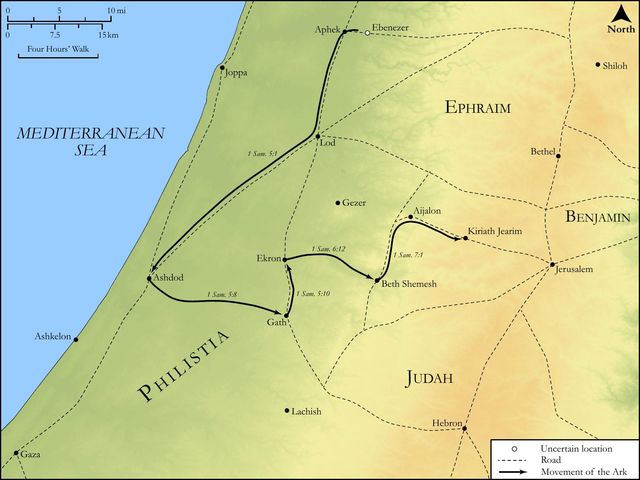
Here we must attend the ark to Kirjath-jearim, and then leave it there, to hear not a word more of it except once (Sa1 14:18), till David fetched it thence, about forty years after, Ch1 13:6.
I.We are very willing to attend it thither, for the men of Beth-shemesh have by their own folly made that a burden which might have been a blessing; and gladly would we see it among those to whom it will be a savour of life unto life, for in every place where it has been of late it has been a savour of death unto death. Now,
1.The men of Kirjath-jearim cheerfully bring it among them, Sa1 7:1. They came, at the first word, and fetched up the ark of the Lord. Their neighbours the Beth-shemites, were not more glad to get rid of it than they were to receive it, knowing very well that what slaughter the ark had made at Beth-shemesh was not an act of arbitrary power, but of necessary justice, and those that suffered by it must blame themselves, not the ark; we may depend upon the word which God hath said (Jer 25:6), Provoke me not, and I will do you no hurt. Note, The judgments of God on those who profane his ordinances should not make us afraid of the ordinances, but of profaning them and making an ill use of them.
2.They carefully provided for its decent entertainment among them, as a welcome guest, with true affection, and, as an honourable guest, with respect and reverence.
(1.)They provided a proper place to receive it. They had no public building to adorn with it, but they lodged it in the house of Abinadab, which stood upon the highest ground, and, probably, was the best house in their city; or perhaps the master of it was the most eminent man they had for piety, and best affected to the ark. The men of Beth-shemesh left it exposed upon a stone in the open field, and, though it was a city of priests, none of them received it into his house; but the men of Kirjath-jearim, though common Israelites, gave it house-room, and no doubt the best-furnished room in the house to which it was brought. Note,
[1.]God will find out a resting-place for his ark; if some thrust it from them, yet the hearts of others shall be inclined to receive it.
[2.]It is no new thing for God's ark to be thrust into a private house. Christ and his apostles preached from house to house when they could not have public places at command.
[3.]Sometimes priests are shamed and out-done in religion by common Israelites.
(2.)They provided a proper person to attend it: They sanctified Eleazar his son to keep it; not the father, either because he was aged and infirm, or because he had the affairs of his house and family to attend, from which they would not take him off. But the son, who, it is probable, was a very pious devout young man, and zealously affected towards the best things. His business was to keep the ark, not only from being seized by malicious Philistines, but from being touched or looked into by too curious Israelites. He was to keep the room clean and decent in which the ark was, that, though it was in an obscure place, it might no look like a neglected thing, which no man looked after. It does not appear that this Eleazar was of the tribe of Levi, much less of the house of Aaron, nor was it needful that he should, for here was no altar either for sacrifice or incense, only we may suppose that some devout Israelites would come and pray before the ark, and those that did so he was there ready to attend and assist. For this purpose they sanctified him, that is, by his own consent, they obliged him to make this his business, and to give a constant attendance to it; they set him apart for it in the name of all their citizens. This was irregular, but was excusable because of the present distress. When the ark has but recently come out of captivity we cannot expect it to be on a sudden in its usual solemnity, but must take things as they are, and make the best of them.
II.Yet we are very loth to leave it here, wishing it well at Shiloh again, but that is made desolate (Jer 7:14), or at least wishing it at Nob, or Gibeon, or wherever the tabernacle and the altars are; but, it seems, it must lie by the way for want of some public-spirited men to bring it to its proper place.
1.The time of its continuance here was long, very long, above forty years it lay in these fields of the wood, a remote, obscure, private place, unfrequented and almost unregarded (Sa1 7:2): The time that the ark abode in Kirjath-jearim was long, even till David fetched it thence. It was very strange that all the time that Samuel governed the ark was never brought to its place in the holy of holies, an evidence of the decay of holy zeal among them. God suffered it to be so, to punish them for their neglect of the ark when it was in its place and to show that the great stress which the institution laid upon the ark was but typical of Christ, and those good things to come which cannot be moved, Heb 9:23; Heb 12:27. It was a just reproach to the priests that one not of their order was sanctified to keep the ark.
2.Twenty years of this time had passed before the house of Israel was sensible of the want of the ark. The Septuagint read it somewhat more clearly than we do; and it was twenty years, and (that is, when) the whole house of Israel looked up again after the Lord. So long the ark remained in obscurity, and the Israelites were not sensible of the inconvenience, nor ever made any enquiry after it, what has become of it; though, while it was absent from the tabernacle, the token of God's special presence was wanting, nor could they keep the day of atonement as it should be kept. They were content with the altars without the ark; so easily can formal professors rest satisfied in a round of external performances, without any tokens of God's presence or acceptance. But at length they bethought themselves, and began to lament after the lord, stirred up to it, it is probable, by the preaching of Samuel, with which an extraordinary working of the Spirit of God set in. A general disposition to repentance and reformation now appears throughout all Israel, and they begin to look unto him whom they had slighted, and to mourn, Zac 12:10. Dr. Lightfoot thinks this was a matter and time as remarkable as almost any we read of in scripture; and that the great conversion, Acts 2 and 3, is the only parallel to it. Note,
(1.)Those that know how to value God's ordinances cannot but reckon it a very lamentable thing to want them.
(2.)True repentance and conversion begin in lamenting after the Lord; we must be sensible that by sin we have provoked him to withdraw and are undone if we continue in a state of distance from him, and be restless till we have recovered his favour and obtained his gracious returns. It was better with the Israelites when they wanted the ark, and were lamenting after it, than when they had the ark, and were prying into it, or priding themselves in it. Better see people longing in the scarcity of the means of grace than loathing in the abundance of them.
Historical interpretation
Historical reception
4 surviving comments on this verse. Each one is dated, so this reads as a timeline rather than a list.
Select a marker to jump to its quote. Markers stagger vertically where authors wrote within a few decades of each other.
Because we relate the perfection of the ark to the perfection of the contemplative life, the ark of God remained in Kiriath-jearim, since the learned minds of those who contemplate achieve with delight the gift of their very learning, namely, the brightness of above revealed to them. For twenty years the ark of God remained there, for the elect souls are transported to the pinnacle of innermost exaltation. Thus, they have the number ten, which stands for the perfection of knowledge, but then the number twenty for the delight in things above. For the multiplication of days can be related to the increase of spiritual virtues. Since this is the reason why the days were multiplied and it was expressly stated and asserted that it was the twentieth year: the more richly the elect minds of those who contemplate grazed on the thoughts above, the more fully they would be adorned with the glories of the spiritual virtues.Now what does it mean when it is said that all Israel “lay at rest after the Lord in the twentieth year,” except that the height of the perfection of the elect does not consist in the might of a good work but in the virtue of contemplation? To rest after the Lord is to cling to the imitation of our Redeemer with invincible love. And, if someone contemplates those inexpressible joys of our citizenship above but does not learn to love mightily—for often he can be diverted to love of the world—he by no means rests for the Lord. Thus, when the ark remained in Kiriath-jearim and the days were prolonged, all of Israel rested after the Lord. Surely, while the knowledge of the mind of the elect was raised up into the experience of divine delight, and while the lights of the spiritual virtues gathered beneath the light of restored glory, Israel was able to hold on all the more tenaciously to the imitation of our Lord, to the degree that they, illuminated by the immense lights of virtue, were not able to perceive those shadows by which they were divided from the light. Thus Israel is said to be well off as they rested after the Lord, for they saw God. The higher the contemplative individual was carried into divine matters, the further they departed from human affairs. They held those mightily in check and so by no means could they be conquered.
And it came to pass, from the day the ark remained in Kiriath-jearim, etc. Here, observe the difference between active and contemplative perfection. Behold, the ark of the Lord, which could scarcely remain even one day in the field of Joshua the Bethshemite when it arrived; and not only could it not ascend to Gabaa, that is, the high place of Bethshemesh, but it could not even clearly enter its very gates. However, reaching Kiriath-jearim and being brought to its hill, it remained there for almost twenty years, with days of virtues multiplied until the year was complete, because the contemplation of heavenly life can scarcely be tasted for even a moment by the holy ones living in the flesh. For the body, which is corrupted, weighs down the soul, and the earthly habitation depresses the mind that thinks of many things (Wisdom IX). On the other hand, active life can be celebrated with much longer duration and in the companionship of cooperating brethren, so much so that the Decalogue in it, doubled by the grace of the Gospel, or certainly perfected by the body and mind, is shown to be fulfilled almost as if it were the twentieth year of the ark remaining with them, proven by the merits of good deeds.
And the whole house of Israel rested after the Lord. It symbolically designates the final happiness of Judah converted at the end, to which the entire previous passage particularly refers, although it can generally be applied to the whole church. Also, according to the letter, some think that the period of twenty years in which the ark rested in Cariathiarim indicates both the manner and the status of the time when Samuel governed Israel. For it is not to be supposed, as some chronographers are mistakenly troubled, that the twenty years during which the ark remained there extends to the eighth year of David's reign, when it was transported to Jerusalem by him. For we read below, in the beginning of Saul's reign, that it was in Gabaa of Benjamin, with the Scripture saying: "And Saul said to Achia: Bring the ark of God. For the ark of God was there on that day with the sons of Israel" (1 Samuel 14). Therefore, we must understand, although Scripture is silent about it, that it was brought back from Gabaa of Benjamin to Gabaa, that is, the hill of Cariathiarim, from where it was transferred to Jerusalem during David's reign. Do not believe that the ark of the Lord was moved through various places without the significance of mystery, so that now it visits the Lord of the Solomites, now it enters the city of woods, now it appears as a helper among the camps, now it returns to the city of woods, and having left Shiloh, rejected the tabernacle of Shiloh (Psalm 78), finally ascending the mountain of Zion, which He loved; nor does it fail to be brought back and forth even then between the camps. Moreover, Uriah, speaking with David during the Ammonite war, indicated that it was under tents (1 Chronicles 17). And this continued until the time of the dedication of the house of God, wherein it received a permanent dwelling in the Holy of Holies. Know that these things are not done in vain, but in the type of the Church, which in its manifold but most peaceful diversity of its members now enjoys the sweetest light of the theoretical life, tasting and seeing that the Lord is good, now penetrates the dense active devotion, though nourished by a lesser burning or light of the mind, yet not less fruitful in good works; now it arms the spiritual militia of virtues against the dangers of the opposing world; nor does it desert its fruitful way of life suitable for resisting adversaries, but diligently takes care lest, after recognizing the mysteries of spiritual life, it seeks the literal observance of the law, like the tabernacle of Shiloh, by a perverse choice; now in those who have already departed from the body and escaped the labors of the changing world, it ascends to the vision of eternal peace. However, even through those reigning in the seat of heaven, it does not cease to fight by praying for its members still struggling against the enemy on earth, until with the brilliance of the resurrection's glory, which is its blessed dedication, it is lifted as the triumphant one over death into the heavenly Holy of Holies eternally.
"From the day the ark of the Lord remained in Cariathiarim, the days were multiplied, etc." [1 Samuel 7:2] What is said, that from the day the ark remained in Cariathiarim, the days were multiplied, indeed it was already the twentieth year, and all the house of Israel rested after the Lord, should not be understood as if the twenty years in which the ark stayed in Cariathiarim until the eighth year of David’s reign, when the gathering crowd of the people brought it to Jerusalem, ought to be counted. For it is found later that in Saul's times, it was taken out from this city and brought into the camp, while he fought against the Philistines. Thus it is written: And Saul said to Achia: Bring the ark of the Lord, for the ark of God was there on that day with the children of Israel. And because it is certain that David brought it to Jerusalem, having taken it from the house of Abinadab, into which it is said to have been brought, it remains to understand that in the days of Saul, it was brought back from the camp and into the aforementioned city, from which it was brought again to Jerusalem, during David’s reign. Therefore, the meaning of the aforementioned passage is that from the time the ark stayed in Cariathiarim, it was the twentieth year (Book of Antiquities VI, chap. 13), when it happened to be transferred from there during Saul’s times because of the war. Or certainly it was the twentieth year, when all the house of Israel still rested after the Lord, having cast away idols, serving Him alone. What it did during the entire time of Samuel’s leadership, which, as testified by Josephus, was completed in twelve years; and in the first period of Saul’s reign, which, according to the same historian, lasted for twenty years, no one curious about sacred history is ignorant of. For afterwards, when the spirit of the Lord had departed from Saul, and an evil spirit troubled him, especially in pursuing the innocent and just David, it was necessary that a part of his military or populace participated in his wrongdoing.
Continue studying 1 Samuel 7:2 across the web’s major study libraries — every link below opens this exact verse, chapter, or book on the destination site.
Read & Compare
 BibleGatewayThis verse in more than 200 translations and 70 languages.
 Bible.comThe YouVersion reader — hundreds of translations, reading plans, and highlights.
 ESV.orgCrossway's official English Standard Version reader.
 NET BibleThe NET translation with 60,000+ translators' notes on every rendering decision.
 STEP BibleTyndale House's free study tool — original text, vocabulary, and scholarly resources.
 BibliaLogos Bible Software's free web reader.
 USCCBThe New American Bible (Revised Edition) with the U.S. bishops' study notes.
Commentaries
 BibleHub CommentariesDozens of classic commentaries on this verse, gathered on one page.
 StudyLightMore than 100 commentary sets — the largest collection on the web.
 BibleRefPlain-English commentary on what this verse means, verse by verse.
 Enduring WordDavid Guzik's free commentary on this chapter, widely used by Bible teachers.
 Bible Study ToolsVerse commentary alongside Greek and Hebrew study aids.
Original Language & Research
- BibleHub InterlinearThe verse word by word — original language, transliteration, and English.
- BibleHub LexiconEvery word's original-language definition and Strong's entry.
 Blue Letter BibleDeep-study tools — Strong's numbers, concordance, and word studies.
 SefariaThe Hebrew text with Rashi and centuries of Jewish commentary.
Sermons, Hymns & Audio


TrulyRandomVerse is not affiliated with these sites and doesn’t control their content. They’re linked because they’re genuinely useful.
Summary
First Samuel 7:2 marks a profound twenty-year epoch in Israel's history, during which the sacred Ark of the Covenant remained sequestered in the obscure town of Kirjathjearim. This protracted period, far from a central sanctuary, symbolized a deep national spiritual void and distress, a direct consequence of Israel's earlier disobedience and devastating defeat. The verse culminates in a pivotal collective awakening, as "all the house of Israel lamented after the LORD," signifying a profound sorrow for their spiritual distance and a heartfelt, desperate yearning for God's restored presence, favor, and deliverance. This widespread lament serves as a critical turning point, setting the stage for genuine national repentance and the subsequent spiritual revival under the prophetic leadership of Samuel.
Context
ShowHideLiterary Context
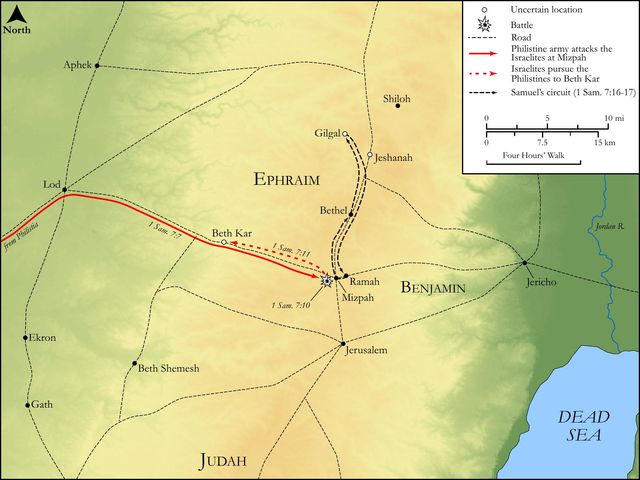
This verse serves as a crucial temporal and emotional bridge in the narrative of 1 Samuel. It follows the traumatic events detailed from 1 Samuel 4 through 1 Samuel 6. The preceding chapters recount Israel's devastating defeat by the Philistines, the capture of the Ark of the Covenant, and the subsequent divine plagues inflicted upon the Philistines as they possessed the Ark. Upon its return to Israelite territory, the Ark was sent to Beth-shemesh, where the people's irreverent curiosity led to a severe divine judgment, prompting its relocation to Kirjathjearim, as explicitly stated in 1 Samuel 6:21. 1 Samuel 7:2 then introduces a significant twenty-year gap, highlighting a period of spiritual stagnation and national distress before the emergence of Samuel as a national leader, prophet, and judge. This verse underscores the dire need for divine intervention and human responsiveness, preparing the reader for Samuel's call to repentance and the subsequent victory over the Philistines in 1 Samuel 7:7-11.
Historical & Cultural Context
The era depicted in 1 Samuel falls within the tumultuous period of the Judges, characterized by a cyclical pattern of apostasy, oppression, and intermittent deliverance. Israel lacked strong, centralized leadership, and the Philistines, a powerful and technologically advanced seafaring people, posed a constant military threat, dominating the coastal plains and encroaching upon Israelite highlands. The Ark of the Covenant, the most sacred object in Israelite worship, symbolized God's manifest presence among His people and served as the throne of His invisible presence (Exodus 25:22). Its capture and prolonged absence from a central sanctuary (like Shiloh, which was likely destroyed around this time, as hinted in Jeremiah 7:12-14) signified a profound spiritual crisis and a perceived withdrawal of God's favor. Kirjathjearim, meaning "City of Forests," was a Gibeonite town, not a primary cultic center or a Levitical city, further emphasizing the Ark's overlooked and neglected status during these two decades. The national lament, therefore, was not merely an emotional outburst but a deeply significant act of corporate repentance and a desperate plea for divine intervention in a time of deep national distress and spiritual estrangement.
Key Themes
ShowHide1 Samuel 7:2 encapsulates several critical theological and narrative themes. Firstly, it powerfully illustrates the consequences of national sin and the perceived absence of God's manifest presence. The Ark's prolonged, static dwelling in a non-cultic location symbolized a spiritual void and a tangible distance between God and His people, a stark contrast to the divine indwelling promised in Exodus 25:8. This period of distress was a direct result of Israel's unfaithfulness and spiritual negligence. Secondly, the phrase "lamented after the LORD" signifies a profound national lament and genuine repentance. This collective sorrow and deep longing for God's favor and presence marked a critical turning point, indicating a widespread spiritual awakening and a desire to return to their covenant relationship with God. It represents a movement towards genuine repentance after a long period of spiritual apathy and Philistine oppression. Thirdly, the verse highlights the enduring hope for restoration through repentance. Even after significant spiritual failures and prolonged divine discipline, God's patience endures, and there is always hope for restoration through sincere repentance and seeking His face, as promised in passages like Deuteronomy 30:1-3.
Exposition and Analysis
ShowHideKey Word Analysis
ShowHideThis primitive root means "to sit down (specifically as judge. in ambush, in quiet); by implication, to dwell, to remain; causatively, to settle, to marry." Here, its use emphasizes the static, prolonged nature of the Ark's presence in Kirjathjearim. It was not a temporary stop on a journey to a proper sanctuary but a long, unsettling stay, highlighting the spiritual stagnation and the lack of a central, God-ordained place for the Ark during this period. The Ark, symbolizing God's active presence, was ironically "sitting" or "remaining" in a relatively obscure, non-cultic location, reflecting the spiritual inertia of the nation.
This primitive root means "to groan, i.e. bewail; hence (through the idea of crying aloud), to assemble (as if on proclamation)." This word carries a strong sense of deep mourning, wailing, or expressing profound sorrow, often associated with grieving for the dead or expressing intense regret. Here, it is used not for a person, but for Israel's spiritual state and their separation from God. This is more than mere sadness; it implies a profound spiritual hunger, a recognition of their sin, and a desperate yearning for the restoration of God's favor and presence. It signifies a turning point from apathy to active spiritual seeking.
This word means "a house (in the greatest variation of applications, especially family, etc.)." In the phrase "all the house of Israel," it functions as a collective noun, referring to the entire nation, the descendants of Jacob, emphasizing the widespread and unified nature of the spiritual awakening and lament that occurred. It signifies a corporate, rather than merely individual, turning towards the Lord.
Verse Breakdown
ShowHide"And it came to pass, while the ark abode in Kirjathjearim,"
This clause establishes the setting and the central object of the narrative. The Ark, the most sacred symbol of God's presence and covenant with Israel, is in an unusual and prolonged state of being "at rest" or "dwelling" in Kirjathjearim. This is not its intended place (a central tabernacle or temple), signifying a period of spiritual displacement and disarray for the nation. The word "abode" (Hebrew: yâshab) underscores this static, unsettling reality.
"that the time was long; for it was twenty years:"
This phrase explicitly states the duration of the Ark's stay, emphasizing the extraordinary length of this period. Twenty years is a significant span, indicating a generation's worth of spiritual stagnation, national distress, and Philistine oppression. It highlights God's patience but also the depth of Israel's spiritual apathy and the consequences of their unfaithfulness, which led to this prolonged state of divine "absence" and national suffering.
"and all the house of Israel lamented after the LORD."
This is the climactic and most significant part of the verse. "All the house of Israel" signifies a widespread, collective spiritual awakening, encompassing the entire nation, not just a select few. Their "lamenting after the LORD" (Hebrew: nāhāh aḥarê YHWH) is a profound act of corporate repentance and yearning. It indicates a deep sorrow over their spiritual condition, their past sins, and their perceived separation from God. This lament is not merely an passive expression of grief but an active, desperate cry for His presence, forgiveness, and restoration, setting the stage for the spiritual revival and national deliverance that follows.
Literary Devices
ShowHide1 Samuel 7:2 masterfully employs several literary devices to convey its profound message. Symbolism is central, with the Ark of the Covenant serving as the primary symbol of God's presence and covenant fidelity. Its prolonged, static dwelling in Kirjathjearim symbolizes the spiritual stagnation and perceived distance between God and His people, a direct consequence of their sin and neglect. The Narrative Pause represented by the "twenty years" creates a palpable sense of prolonged tension and anticipation, highlighting the depth of Israel's distress and the urgent need for divine intervention. This extended period also functions as a form of Foreshadowing, preparing the reader for the significant spiritual revival and national deliverance that Samuel will soon orchestrate. The phrase "all the house of Israel lamented after the LORD" uses Synecdoche (where "house of Israel" stands for the entire nation) and Hyperbole (to emphasize the widespread nature of the lament, even if not every single individual was literally lamenting), underscoring the collective and profound nature of their spiritual awakening. The Juxtaposition of the long, stagnant period with the sudden, widespread lament emphasizes the dramatic shift in the nation's spiritual posture, from apathy and suffering to active yearning for God.
Theological and Thematic Connections
ShowHideThe lament of Israel in 1 Samuel 7:2 is a powerful theological statement about corporate repentance, divine discipline, and God's sovereign patience. For twenty years, the nation endured the consequences of their spiritual compromise and the oppressive Philistine yoke, a period marked by the symbolic absence of God's central presence. Yet, this prolonged distress ultimately led to a collective turning, a deep and widespread sorrow that transcended mere regret, becoming a genuine longing for God's restoration. This lament demonstrates that even in the midst of profound spiritual decline and divine discipline, God remains faithful to His covenant, patiently waiting for His people to turn back to Him. It underscores the biblical principle that genuine repentance, marked by heartfelt sorrow for sin and a fervent desire for God's presence, is the necessary precursor to divine intervention and national revival. This turning point reveals God's gracious disposition to hear the cries of His people when they humble themselves and seek His face, illustrating that divine discipline is often a means to draw His people back into right relationship.
Reflection and Application
ShowHideThe twenty-year period of the Ark's dwelling in Kirjathjearim and Israel's subsequent lament in 1 Samuel 7:2 offers profound and enduring lessons for contemporary believers and communities. Just as Israel experienced a tangible sense of God's absence and the painful consequences of their spiritual drift, individuals and churches today can find themselves in seasons of spiritual dryness, apathy, or perceived distance from God. This verse serves as a powerful call to honest self-examination, urging us to assess our spiritual condition and acknowledge when we have strayed from our vibrant covenant relationship with the Lord. The "lamenting after the LORD" is not a passive sadness but an active, heartfelt yearning for God's presence, favor, and transformative power, a turning from complacency to fervent seeking. It reminds us that genuine repentance, marked by sorrow for sin and a deep longing for God, is the essential pathway to spiritual renewal, both personally and corporately. Moreover, the long duration of the Ark's stay highlights God's profound patience and the often-slow, yet purposeful, process of spiritual transformation. Even in prolonged seasons of waiting, distress, or perceived divine silence, God is actively at work, preparing hearts and orchestrating circumstances to draw His people back to Himself, making us ready for His gracious intervention and revival.
Questions for Reflection
ShowHideFAQ
ShowHideWhy did the Ark stay in Kirjathjearim for so long?
ShowHideThe Ark's prolonged stay in Kirjathjearim was a consequence of several intertwined factors. After the tragedy at Beth-shemesh (1 Samuel 6:19-21), where many Israelites died due to irreverence, the people were terrified and unwilling to keep the Ark in their own territory. Kirjathjearim, a Gibeonite town, offered a temporary, safe, albeit non-cultic, resting place. More broadly, this period reflects the profound spiritual and political disarray of Israel during the time of the Judges. There was no central sanctuary (Shiloh, where the Ark had previously resided, was likely destroyed), no strong, unified leadership capable of properly relocating it, and a general spiritual apathy that prevented the nation from addressing the Ark's placement. The twenty years represent a period of divine patience and a consequence of Israel's unfaithfulness, during which they lived under Philistine oppression and without the full, manifest presence of God in their midst.
What does "lamented after the LORD" truly mean in this context?
ShowHide"Lamented after the LORD" (Hebrew: nāhāh aḥarê YHWH) signifies far more than simple sadness or regret; it denotes a profound spiritual transformation. The verb nāhāh implies a deep, mournful wailing, often associated with grieving or intense sorrow. When directed "after the LORD," it indicates a profound spiritual longing and a turning towards God. It suggests a national awakening to their spiritual decline, their past sins, and the painful consequences of their separation from God. This lament was a collective expression of repentance, a heartfelt cry for God's restored favor, presence, and deliverance from their oppressors. It marks a pivotal moment where Israel, as a whole, recognized their desperate need for God and actively sought to renew their covenant relationship with Him, paving the way for the spiritual revival under Samuel's leadership in 1 Samuel 7:3-6.
Was this 20-year period a punishment from God?
ShowHideWhile the twenty-year period was certainly a consequence of Israel's disobedience and spiritual apathy, it is more accurately understood as a period of divine discipline and preparation rather than solely punitive. God allowed the Philistine oppression and the Ark's displacement to persist, which served to highlight Israel's sin and their desperate need for Him. This extended period of distress fostered a deep spiritual hunger, culminating in the national lament mentioned in 1 Samuel 7:2. God's patience during these two decades allowed time for hearts to be prepared for genuine repentance and for Samuel to emerge as the faithful leader who would call the nation back to the Lord. It demonstrates that even in difficult seasons, God is at work, drawing His people to Himself and preparing them for renewal and restoration, ultimately for their good and His glory.
Christ-Centered Fulfillment
ShowHideThe prolonged spiritual void and the national lament described in 1 Samuel 7:2 find their ultimate fulfillment and resolution in the person and work of Jesus Christ. The Ark of the Covenant, whose absence from a central sanctuary symbolized God's perceived distance from His people and the consequences of their sin, was a profound foreshadowing of God's ultimate and perfect dwelling among humanity. While the Ark was a temporary, physical representation of God's presence, Jesus is the very Emmanuel, "God with us", the true and ultimate tabernacle in whom the fullness of God dwells bodily (Colossians 2:9). Israel's deep lament, their yearning "after the LORD" for His restored presence and favor, reflects the universal human longing for reconciliation with God, a longing that sin has profoundly broken. This profound spiritual separation is fully bridged by Christ's atoning sacrifice on the cross, where He became the Lamb of God who takes away the sin of the world, thereby opening the way for humanity to draw near to God once more with confidence (Hebrews 10:19-22). Through Jesus, the New Covenant is established, where God's Spirit now dwells not in a physical ark, but intimately within the hearts of all believers (1 Corinthians 6:19), fulfilling the deepest longing for an abiding, personal presence of God that Israel could only glimpse. He is the true and perfect High Priest, the ultimate Mediator, who perfectly reconciles us to the Father, bringing an end to the spiritual lament and ushering in an era of abiding peace, communion, and eternal life.