


1 Samuel 14:18
Bible text: King James Version (1769 Blayney text) · Public domain
Bible text: Berean Standard Bible · Public domain
Bible text: American Standard Version (1901) · Public domain
Bible text: World English Bible, Messianic edition · Public domain
Bible text: Geneva Bible (1599) · Public domain
Bible text: Young's Literal Translation · Public domain
- וַיֹּאמֶרvai·Yo·merand he saidH559Conj-w ¦ V-Qal-ConsecImperf-3msVerb Qal Consecutive Imperfect 3rd Singular Masculineוַandיֹּאמֶרhe said
- שָׁאוּלsha·'UlSaulH7586N-proper-mNoun Proper Masculine
- לַאֲחִיָּהla·'a·chi·Yahto AhijahH281Prep-l ¦ N-proper-mNoun Proper MasculineלַtoאֲחִיָּהAhijah
- הַגִּישָׁהha·Gi·shahbring near !H5066V-Hiphil-Imp-2ms ¦ SfxVerb Hiphil Imperative 2nd Singular Masculineהַגִּישָׁbring nearה!
- אֲרוֹן'a·Ron[the] ark ofH727N-mscNoun Singular Masculine Construct
- הָאֱלֹהִיםha·'E·lo·Him<the> GodH430Art ¦ N-mpNoun Plural Masculine Absoluteהָ<the>אֱלֹהִיםGod
- כִּיkiforH3588PrtParticle Conditional
- הָיָהha·Yahit wasH1961V-Qal-Perf-3msVerb Qal Perfect 3rd Singular Masculine
- אֲרוֹן'a·Ron[the] ark ofH727N-mscNoun Singular Masculine Construct
- הָאֱלֹהִיםha·'E·lo·Him<the> GodH430Art ¦ N-mpNoun Plural Masculine Absoluteהָ<the>אֱלֹהִיםGod
- בַּיּוֹםbai·Yomon the dayH3117Prep-b ¦ N-msNoun Singular Masculine Absoluteבַּon theיּוֹםday
- הַהוּאha·Hu'<the> thatH1931Art ¦ Pro-3msPronoun Personal 3rd Singular Masculineהַ<the>הוּאthat
- וּבְנֵיu·ve·Neiand [the] people ofH1121Conj-w ¦ N-mpcNoun Plural Masculine Constructוּandבְנֵי[the] people of
- יִשְׂרָאֵלYis·ra·'ElIsraelH3478N-properNoun Proper Location
English is a literal word-by-word gloss of the Hebrew, not the KJV's wording. Why?
This is the original text the KJV's translators worked from — each Hebrew word with its own literal English meaning in this verse, prepared by scholars at Tyndale House, Cambridge. The KJV translates whole sentences, not word by word, so its wording differs: one Hebrew word can become several English words, and the KJV may choose “the LORD” where the gloss reads “Yahweh”. Both are faithful — they answer different questions. For the KJV's own rendering, switch to the KJV text.
Details
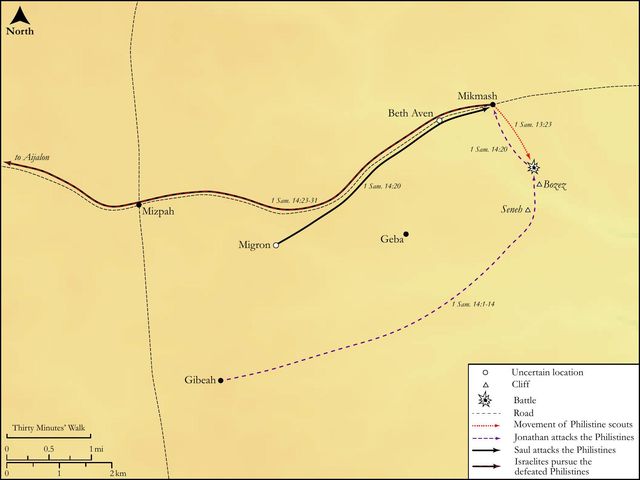
See on the biblical-era map
Study this verse
Public-domain commentary
Matthew Henry
From his Commentary on the Whole Bible. Henry comments on passages, not single verses — this entry covers 1 Samuel 14:16–23. His three-level outline is real structure in the source text, so it is rendered as structure.
We have here the prosecution and improvement of the wonderful advantages which Jonathan and his armour-bearer gained against the Philistines.
I.The Philistines were, by the power of God, set against one another.
They melted away like snow before the sun, and went on beating down one another (Sa1 14:16), for (Sa1 14:20) every man's sword was against his fellow. When they fled for fear, instead of turning back upon those that chased them, they reckoned those only their enemies that stood in their way, and treated them accordingly. The Philistines were very secure, because all the swords and spears were in their hands. Israel had none except what Saul and Jonathan had. But now God showed them the folly of that confidence, by making their own swords and spears the instruments of their own destruction, and more fatal in their own hands than if they had been in the hands of Israel. See the like done, Jdg 7:22; Ch2 20:23.
II.The Israelites were hereby animated against them.
1.Notice was soon taken of it by the watchmen of Saul, those that stood sentinel at Gibeah, Sa1 14:16. They were aware that the host of the enemy was in great confusion, and that a great slaughter was made among them, and yet, upon search, they found none of their own forces absent, but only Jonathan and his servant (Sa1 14:17), which no doubt greatly animated them, and assured them that it could be no other than the Lord's doing, when there was no more of man's doing than what those two could do against a great host.
2.Saul began to enquire of God, but soon desisted. His spirit had not come down so far as to allow him to consult Samuel, though, it is probable, he was near him; for we read (Sa1 13:15) that he had come to Gibeah of Benjamin; but he called for the ark (Sa1 14:18), desiring to know whether it would be safe for him to attack the Philistines, upon the disorder they perceived them to be in. Many will consult God about their safety that would never consult him about their duty. But, perceiving by his scouts that the noise in the enemy's camp increased, he commanded the priest that officiated to break off abruptly: "Withdraw thy hand (Sa1 14:19), consult no more, wait no longer for an answer." He was very unwise indeed if (as some think) he forbade him to lift up his hands in prayer; for when Joshua was actually engaged with Amalek Moses continued still to lift up his hands. It is rather a prohibition to his enquiring of the Lord, either,
(1.)Because now he thought he did not need an answer, the case was plain enough. And yet the more evident it was that God did all the more reason he had to enquire whether he would give him leave to do any thing. Or,
(2.)Because now he would not stay for it; he was in such haste to fight a falling enemy that he would not stay to make and end of his devotions, nor hear what answer God would give him. A little thing will divert a vain and carnal mind from religious exercises. He that believeth will not make haste, such haste as this, nor reckon any business so urgent as not to allow time to take God along with him.
3.He, and all the little force he had, made a vigorous attack upon the enemy; and all the people were cried together (so the word is, Sa1 14:20), for want of the silver trumpets wherewith God appointed them to sound an alarm in the day of battle, Num 10:9. They summoned them together by shouting, and their number was not so great but that they might soon be got together. And now they seem bold and brave when the work is done to their hands. Our Lord Jesus had conquered our spiritual enemies, routed and dispersed them, so that we are cowards indeed if we will not stand to our arms when it is only to pursue the victory and to divide the spoil.
4.Every Hebrew, even those from whom one would least have expected it, now turned his hand against the Philistines.
(1.)Those that had deserted and gone over to the enemy, and were among them, now fought against them, Sa1 14:21. Some think, they were such as had been taken prisoners by them, and now they were goads in their sides. It rather seems that they went in to them voluntarily, but, now that they saw them falling, recovered the hearts of Israelites, and did valiantly for their country.
(2.)Those that had fled their colours, and hid themselves in the mountains, returned to their posts, and joined in with the pursuers (Sa1 14:22), hoping by their great zeal and officiousness, now that the danger was over and the victory sure, to atone for their former cowardice. It was not much to their praise to appear now, but it would have been more their reproach if they had not appeared. Those that are remiss and faint-hearted indeed that will not act in the cause of God when they see it victorious, as well as righteous. Thus all hands were at work against the Philistines, and every Israelite slew as many as he could, without sword or spear; yet it is said (Sa1 14:23), it was the Lord that saved Israel that day. He did it by them, for without him they could do nothing. Salvation is of the Lord.
Historical interpretation
Twelve Centuries of Reception
2 surviving comments on this verse. Each one is dated, so this reads as a timeline rather than a list.
Select a marker to jump to its quote. Markers stagger vertically where authors wrote within a few decades of each other.
And Saul said to Ahijah, "Bring the ark of God here." Ahijah, also called his brother or his relative, is thus named. Therefore, the good leaders of the Church say, all the faithful daily waging war against the powers of the air, say to their brothers endowed with the reading of sacred Scripture and with greater exercise of virtues, daily offering themselves to God through the royal priesthood as a living sacrifice: they say, I say, to such who still see themselves agitated by temptations or behold the Church generally troubled by heresies, that, having revealed the mysteries of divine words, they should elucidate more manifest testimonies, by which they ought to use against the fabricators of heresies, by which they can overcome other struggles of temptations, with clear reasoning. But it often happens that the enemies of the Church (I mean the heretics or pagans) have so many and such great conflicts and battles of words or doctrines among themselves, that it is better that they be refuted by their own dispensation outwardly, than by the assertion of spiritual pages, proving that what they teach is false and what they do is impure: and it must be done as the leaders of the heavenly army, just as it is described that Saul did, who, when tumult arose in the camp of the Philistines and it increased more and more, no longer consulted God through the priest, but himself, with the hand of the soldiers taken up, hastens to pursue and urge to flight the enemies he had found to be discordant among themselves. However, Ahijah the priest, the keeper of the ark of the Lord, can also fittingly represent the very authors of sacred Scripture; who, whenever piously requested, bring forth the ark of the divine oracle they keep: they also bring forth examples of good works they performed; which was symbolized above, where the same Ahijah is said to have carried the ephod. Nor is it without reason that it is mentioned that he was the son of Ahitub, the brother of Ichabod, the son of Phinehas, who had been born from Eli, the priest of the Lord, in Shiloh. Ahitub indeed means "good brother." For many of the authors of the sacred letters also traced their lineage from priests: and being instructed by good brothers, as Scripture itself attests, also had some brothers who were not good: and today's readers of the same, equally instructed by good ones, yet cannot lack the company of the wicked, whom Ichabod, both by birth and by name, signifies as inglorious.
The one perfectly divine thing, the one glimpse of God's paradise given on earth, is to fight a losing battle - and not lose it.
Continue studying 1 Samuel 14:18 across the web’s major study libraries — every link below opens this exact verse, chapter, or book on the destination site.
Read & Compare
 BibleGatewayThis verse in more than 200 translations and 70 languages.
 Bible.comThe YouVersion reader — hundreds of translations, reading plans, and highlights.
 ESV.orgCrossway's official English Standard Version reader.
 NET BibleThe NET translation with 60,000+ translators' notes on every rendering decision.
 STEP BibleTyndale House's free study tool — original text, vocabulary, and scholarly resources.
 BibliaLogos Bible Software's free web reader.
 USCCBThe New American Bible (Revised Edition) with the U.S. bishops' study notes.
Commentaries
 BibleHub CommentariesDozens of classic commentaries on this verse, gathered on one page.
 StudyLightMore than 100 commentary sets — the largest collection on the web.
 BibleRefPlain-English commentary on what this verse means, verse by verse.
 Enduring WordDavid Guzik's free commentary on this chapter, widely used by Bible teachers.
 Bible Study ToolsVerse commentary alongside Greek and Hebrew study aids.
Original Language & Research
- BibleHub InterlinearThe verse word by word — original language, transliteration, and English.
- BibleHub LexiconEvery word's original-language definition and Strong's entry.
 Blue Letter BibleDeep-study tools — Strong's numbers, concordance, and word studies.
 SefariaThe Hebrew text with Rashi and centuries of Jewish commentary.
Sermons, Hymns & Audio


TrulyRandomVerse is not affiliated with these sites and doesn’t control their content. They’re linked because they’re genuinely useful.
Summary
1 Samuel 14:18 captures a critical juncture in King Saul's reign, as he urgently commands the high priest Ahiah to bring the Ark of God amidst a chaotic battle against the Philistines. This action underscores Saul's immediate need for divine guidance and intervention, reflecting the Ark's profound theological significance as the tangible symbol of God's covenantal presence and authority among His people. While outwardly demonstrating a reliance on the Lord, this moment subtly foreshadows the complexities and inconsistencies of Saul's leadership, setting the stage for his subsequent impulsive decisions.
Context
ShowHideLiterary Context
This verse is intricately woven into the dramatic and fast-paced narrative of 1 Samuel 14. The chapter begins with Jonathan, Saul's son, initiating a daring, unauthorized attack on a Philistine garrison, which miraculously causes widespread panic and confusion among the enemy. As the Philistines begin to rout themselves, Saul and his army discover the commotion and prepare to join the pursuit. However, before launching a full-scale offensive, Saul feels compelled to consult the Lord, recognizing the critical need for divine approval and strategic direction in such a pivotal military situation. His command to Ahiah to "Bring hither the ark of God" is an attempt to perform this inquiry, positioning the verse as a crucial transition point from the initial skirmish to a potential full-scale battle. It highlights Saul's initial, albeit often inconsistent, reliance on divine counsel. The narrative immediately following this verse, specifically 1 Samuel 14:19, reveals Saul's impatience, as he interrupts the consultation, demonstrating a wavering commitment to truly waiting on God's full revelation.
Historical & Cultural Context
In ancient Israel, the Ark of the Covenant was the preeminent sacred object, representing the very throne and active presence of Yahweh among His people. It was central to their worship, national identity, and military campaigns, often carried into battle as a symbol of God's leading and power, as seen in passages like Numbers 10:35-36. The high priest, in this instance Ahiah (identified in 1 Samuel 14:3 as a descendant of Eli and brother of Ahimelech), served as the primary mediator through whom God's will was sought. This was typically accomplished by consulting the Urim and Thummim, sacred lots kept within the priestly ephod, often in close proximity to the Ark. The Philistines, a powerful and technologically superior maritime people, posed an existential threat to Israel's nascent monarchy. Saul's reign was largely defined by this ongoing conflict, and his actions, including this attempt to consult the Ark, reflect the desperate military realities and the cultural expectation that divine intervention was absolutely crucial for victory against such formidable foes.
Key Themes
ShowHideThe primary themes converging in 1 Samuel 14:18 include the Significance of the Ark as the tangible symbol of God's active presence and covenant fidelity, serving as a focal point for divine revelation and guidance. Another prominent theme is Seeking Divine Counsel, as Saul's command underscores the Israelite understanding that major decisions, especially those involving national security and warfare, required God's explicit approval. This act, however, also subtly introduces the theme of Saul's Flawed Leadership and Impatience, as his subsequent actions in 1 Samuel 14:19 reveal a king more concerned with immediate tactical advantage than with patient, complete obedience to God's revealed will. The verse also touches on God's Immanent Presence among His people, as the Ark's physical location "with the children of Israel" signifies that God was accessible and ready to engage with His covenant community, even amidst their struggles and the clamor of battle.
Exposition and Analysis
ShowHideKey Word Analysis
ShowHideFrom a passive participle meaning "asked." Saul, the first king of Israel, was chosen by God but later rejected due to his disobedience. In this verse, his command to bring the Ark reveals his awareness of the need for divine consultation, even if his subsequent actions betray a lack of genuine submission.
From a root meaning "brother (i.e. worshipper) of Jah." Ahiah was the high priest at this time, a descendant of Eli's house. As high priest, he was the designated mediator between God and Israel, responsible for inquiring of the Lord, often through the Urim and Thummim, which were associated with the Ark or the priestly ephod. Saul's command to him highlights the proper channel for seeking divine guidance in Israel.
Meaning "a box; ark, chest, coffin." In this context, it refers specifically to the Ark of the Covenant, the sacred chest constructed according to divine specifications (Exodus 25:10-22). More than a mere container, it was considered the earthly throne of Yahweh, the place where His presence uniquely resided, particularly above the mercy seat between the cherubim. Its presence among the Israelites signified God's covenant fidelity, His power, and His readiness to lead and protect His people. It was the central cultic object, representing the very heart of Israel's relationship with God.
Verse Breakdown
ShowHide"And Saul said unto Ahiah, Bring hither the ark of God."
This clause reveals King Saul's direct and urgent command to the high priest. In a moment of intense battle and strategic decision-making, Saul seeks to consult God, recognizing the Ark as the traditional means through which divine will was revealed. His instruction to "bring hither" (Hebrew, nâgash, meaning "to draw near" or "to present") suggests an immediate desire for consultation, likely through the Urim and Thummim, to discern whether to pursue the Philistines or what specific strategy to employ. It signifies an outward acknowledgment of God's authority and sovereignty in military affairs, even if this acknowledgment was superficial or pragmatic.
"For the ark of God was at that time with the children of Israel."
This explanatory clause provides crucial context, confirming that the Ark was physically present with the Israelite army or encampment at that specific moment. This detail is significant because the Ark was not always with the army; it had been captured by the Philistines earlier (1 Samuel 4) and later resided in various locations (e.g., Kiriath-Jearim, cf. 1 Samuel 7:1-2). Its current presence "with the children of Israel" (Hebrew, bên Yisrâʼêl, meaning "sons of Israel") implies its availability for divine consultation, reinforcing the idea that God was immanently present and accessible to His covenant people in their time of need, ready to intervene on their behalf. The phrase "at that time" (Hebrew, yôwm, meaning "a day" or "a space of time") emphasizes the immediate context of the ongoing battle.
Literary Devices
ShowHideThe verse primarily employs Symbolism, where the "ark of God" is not merely a physical object but a potent representation of God's very presence, power, and covenant relationship with Israel. Its command to be brought forth underscores its symbolic weight as the locus of divine authority and guidance. There is also a subtle layer of Irony present, as Saul, who often acts impulsively and disobediently throughout his reign (e.g., his unlawful sacrifice in 1 Samuel 13:8-14), here outwardly seeks proper divine consultation. This highlights the tension between his superficial adherence to religious protocol and his deeper struggles with genuine submission to God's will. His subsequent impatience in 1 Samuel 14:19 quickly exposes this irony, foreshadowing his eventual rejection as king due to his persistent disobedience.
Theological and Thematic Connections
ShowHide1 Samuel 14:18 powerfully articulates the ancient Israelite conviction that God was not a distant deity but an active, immanent presence among His people, particularly symbolized by the Ark of the Covenant. This verse highlights the profound theological truth that God desires to guide His people, especially in moments of crisis and decision. Saul's command, while perhaps tinged with impatience and a desire for immediate tactical advantage, reflects a fundamental understanding that true victory and direction come from the Lord. The Ark's presence served as a constant reminder of God's covenant promises, His power to deliver, and His readiness to communicate His will, emphasizing that Israel's strength lay not in its military might but in its faithful reliance on Yahweh. This reliance was meant to be one of patient trust and obedience, a lesson Saul consistently struggled to learn.
Reflection and Application
ShowHideWhile we no longer have a physical Ark of the Covenant, the principle embedded in 1 Samuel 14:18—the urgent need to seek God's presence and guidance in critical moments—remains profoundly relevant for believers today. Just as Saul recognized the necessity of divine counsel before battle, we are called to prioritize seeking the Lord's wisdom in all our decisions, whether personal, familial, or professional. This seeking is not a mere ritual or a last resort, but a genuine expression of dependence on the Living God, accessed through fervent prayer, diligent study of His inspired Word, and attentive listening to the Holy Spirit's promptings. The verse also serves as a cautionary tale: true seeking of God involves patient submission to His timing and methods, rather than attempting to manipulate spiritual practices for our own ends or rushing ahead of His will, as Saul often did. Our ultimate victory, peace, and true direction come from God's active presence and power, not from our own strategies, strength, or impulsive actions. We are invited to trust Him fully, even when the path is unclear or the battle rages.
Questions for Reflection
ShowHideFAQ
ShowHideWhy did Saul specifically ask for the Ark of God to be brought?
ShowHideSaul asked for the Ark of God to be brought primarily because it was the preeminent symbol of God's presence and the traditional means by which divine counsel was sought in Israel. In times of war or national crisis, the Ark was often present, and the high priest would consult the Lord on behalf of the people or the king, typically using the Urim and Thummim (sacred lots) in conjunction with the Ark. Saul's request was an attempt to inquire of the Lord for strategic guidance on whether to pursue the Philistines and how to secure victory, reflecting the Israelite belief that God's direct intervention was crucial for success in battle (Numbers 27:21). His urgency in the face of a chaotic battle prompted him to seek this traditional form of divine consultation.
What does it mean that "the ark of God was at that time with the children of Israel"?
ShowHideThis phrase means that the Ark of the Covenant was physically present with the Israelite army or encampment at that specific moment. This detail is significant because the Ark did not always accompany the army, especially after its capture by the Philistines in 1 Samuel 4 and its subsequent return to Kiriath-Jearim (1 Samuel 7:1-2). Its presence indicated God's immanent availability and readiness to engage with His people. It underscored the theological reality that God was not distant but actively present among His covenant community, ready to hear their pleas and provide direction, reinforcing the covenant relationship He had with the children of Israel. This availability made Saul's request for consultation a practical possibility in the heat of battle.
Christ-Centered Fulfillment
ShowHideWhile the Ark of the Covenant served as the physical symbol of God's presence among His people in the Old Testament, its ultimate and perfect fulfillment is found in Jesus Christ. Jesus is the true and living Ark, the perfect embodiment of God's presence, for in Him "all the fullness of God dwells bodily" (Colossians 2:9). Just as the Ark was the place where God met with His people and revealed His will (Exodus 25:22), Jesus is the ultimate Mediator between God and humanity (1 Timothy 2:5). Saul's desire to consult the Ark for divine guidance foreshadows humanity's deep and universal need for God's direction, a need fully and eternally met in Christ, who is the "way, the truth, and the life" (John 14:6). Through His perfect sacrifice on the cross, Christ, our eternal High Priest, has opened a new and living way to the very presence of God, making the physical Ark and its rituals obsolete (Hebrews 9:11-12). Now, God's presence is not confined to a chest or a temple, but dwells within believers through the Holy Spirit, whom Christ sent to guide us into all truth and empower us for life and service (John 14:16-17). Thus, in Christ, we experience a far more intimate, personal, and abiding presence of God than the Ark could ever symbolize, a presence that transforms us from within.