


1 Samuel 30:7
- וַיֹּאמֶרvai·Yo·merand he saidH559Conj-w ¦ V-Qal-ConsecImperf-3msVerb Qal Consecutive Imperfect 3rd Singular Masculineוַandיֹּאמֶרhe said
- דָּוִדda·VidDavidH1732N-proper-mNoun Proper Masculine
- אֶל'eltoH413PrepPreposition
- אֶבְיָתָר'ev·ya·TarAbiatharH54N-proper-mNoun Proper Masculine
- הַכֹּהֵןha·ko·Henthe priestH3548Art ¦ N-msNoun Singular Masculine Absoluteהַtheכֹּהֵןpriest
- בֶּןben[the] son ofH1121N-mscNoun Singular Masculine Construct
- אֲחִימֶלֶךְ'a·chi·Me·lekhAhimelechH288N-proper-mNoun Proper Masculine
- הַגִּישָׁהha·gi·shahbring near !H5066V-Hiphil-Imp-2ms ¦ SfxVerb Hiphil Imperative 2nd Singular Masculineהַגִּישָׁbring nearה!
- נָּאna'pleaseH4994PrtParticle Interjection
- לִיlito <the> mePrep-l ¦ 1csSuffix Personal 1st Singular common genderלִto <the>יme
- הָאֵפֹדha·'e·Fodthe ephodH646Art ¦ N-msNoun Singular Masculine Absoluteהָtheאֵפֹדephod
- וַיַּגֵּשׁvai·ya·Geshand he brought nearH5066Conj-w ¦ V-Hiphil-ConsecImperf-3msVerb Hiphil Consecutive Imperfect 3rd Singular Masculineוַandיַּגֵּשׁhe brought near
- אֶבְיָתָר'ev·ya·TarAbiatharH54N-proper-mNoun Proper Masculine
- אֶת'et<obj.>H853DirObjMParticle Object Indicator
- הָאֵפֹדha·'e·Fodthe ephodH646Art ¦ N-msNoun Singular Masculine Absoluteהָtheאֵפֹדephod
- אֶל'eltoH413PrepPreposition
- דָּוִדda·VidDavidH1732N-proper-mNoun Proper Masculine
English is a literal word-by-word gloss of the Hebrew, not the KJV's wording. Why?
This is the original text the KJV's translators worked from — each Hebrew word with its own literal English meaning in this verse, prepared by scholars at Tyndale House, Cambridge. The KJV translates whole sentences, not word by word, so its wording differs: one Hebrew word can become several English words, and the KJV may choose “the LORD” where the gloss reads “Yahweh”. Both are faithful — they answer different questions. For the KJV's own rendering, switch to the KJV text.
Details
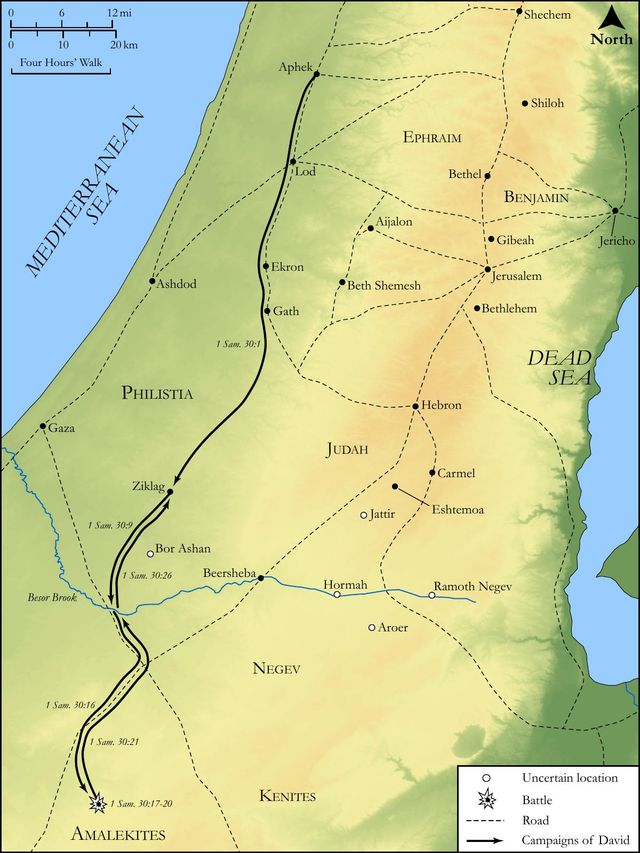
See on the biblical-era map
Study this verse
Public-domain commentary
Matthew Henry
From his Commentary on the Whole Bible. Henry comments on passages, not single verses — this entry covers 1 Samuel 30:7–20. His three-level outline is real structure in the source text, so it is rendered as structure.
Solomon observes that the righteous is delivered out of trouble and the wicked cometh in his stead, that the just falleth seven times a-day and riseth again; so it was with David. Many were his troubles, but the Lord delivered him out of them all, and particularly out of this of which we have here an account.
I.He enquired of the Lord both concerning his duty - Shall I pursue after this troop? and concerning the event - Shall I overtake them? Sa1 30:8. It was a great advantage to David that he had the high priest with him and the breast-plate of judgment, which, as a public person, he might consult in all his affairs, Num 27:21. We cannot think that he left Abiathar and the ephod at Ziklag, for then he and it would have been carried away by the Amalekites, unless we may suppose them hidden by a special providence, that they might be ready for David to consult at his return. If we conclude that David had his priest and ephod with him in the camp of the Philistines, it was certainly a great neglect in him that he did not enquire of the Lord by them concerning his engagement to Achish. Perhaps he was ashamed to own his religion so far among the uncircumcised; but now he begins to apprehend that this trouble is brought upon him to correct him for that oversight, and therefore the first thing he does is to call for the ephod. It is well if we get this good by our afflictions, to be reminded by them of neglected duties, and particularly to be quickened by them to enquire of the Lord. See Ch1 15:13. David had no room to doubt but that his war against these Amalekites was just, and he had an inclination strong enough to set upon them when it was for the recovery of that which was dearest to him in this world; and yet he would not go about it without asking counsel of God, thereby owning his dependence upon God and submission to him. If we thus, in all our ways, acknowledge God, we may expect that he will direct our steps, as he did David's here, answering him above what he asked, with an assurance that he should recover all.
II.He went himself in person, and took with him all the force he had, in pursuit of the Amalekites, Sa1 30:9, Sa1 30:10.
See how quickly, how easily, how effectually the mutiny among the soldiers was quelled by his patience and faith. When they spoke of stoning him (Sa1 30:6), if he had spoken of hanging them, or had ordered that the ringleaders of the faction should immediately have their heads struck off, though it would have been just, yet it might have been of pernicious consequence to his interest in this critical juncture; and, while he and his men were contending, the Amalekites would have clearly carried off their spoil. But when he, as a deaf man, heard not, smothered his resentments, and encouraged himself in the Lord his God, the tumult of the people was stilled by his gentleness and the power of God on their hearts; and, being thus mildly treated, they are now as ready to follow his foot as they were but a little before to fly in his face. Meekness is the security of any government. All his men were willing to go along with him in pursuit of the Amalekites, and he needed them all; but he was forced to drop a third part of them by the way; 200 out of 600 were so fatigued with their long march, and so sunk under the load of their grief, that they could not pass the brook Besor, but staid behind there. This was,
1.A great trial of David's faith, whether he could go on, in a dependence upon the word of God, when so many of his men failed him. When we are disappointed and discouraged in our expectations from second causes, then to go on with cheerfulness, confiding in the divine power, this is giving glory to God, by believing against hope, in hope.
2.A great instance of David's tenderness to his men, that he would by no means urge them beyond their strength, though the case itself was so very urgent. The Son of David thus considers the frame of his followers, who are not all alike strong and vigorous in their spiritual pursuits and conflicts; but, where we are weak, there he is kind; nay, more there he is strong, Co2 12:9, Co2 12:10.
III.Providence threw one in their way that gave them intelligence of the enemy's motions, and guided theirs; a poor Egyptian lad, scarcely alive, is made instrumental of a great deal of good to David. God chooses the foolish things of the world, with them to confound the wise. Observe,
1.His master's cruelty to him. He had got out of him all the service he could, and when the lad fell sick, probably being over-toiled with his work, he barbarously left him to perish in the field, when he was in no such haste but he might have put him into some of the carriages, and brought him home, or, at least, have left him wherewithal to support himself. That master has the spirit of an Amalekite, not of an Israelite, that can thus use a servant worse than one would use a beast. The tender mercies of the wicked are cruel. This Amalekite thought he should now have servants enough of the Israelite-captives, and therefore cared not what became of his Egyptian slave, but could willingly let him die in a ditch for want of necessaries, while he himself was eating and drinking, Sa1 30:16. Justly did Providence make this poor servant, that was thus basely abused, instrumental towards the destruction of a whole army of Amalekites and his master among the rest; for God hears the cry of oppressed servants.
2.David's compassion to him. Though he had reason to think he was one of those that had helped to destroy Ziklag, yet, finding him in distress, he generously relieved him, not only with bread and water (Sa1 30:11), but with figs and raisins, Sa1 30:12. Though the Israelites were in haste, and had no great plenty for themselves, yet they would not forbear to deliver one that was drawn unto death, nor say, Behold, we knew it not, Pro 24:11, Pro 24:12. Those are unworthy the name of Israelites who shut up the bowels of their compassion from persons in distress. It was also prudently done to relieve this Egyptian; for, though despicable, he was capable of doing them service: so it proved, though they were not certain of this when they relieved him. It is a good reason why we should neither do an injury nor deny a kindness to any man that we know not but, some time or other, it may be in his power to return either a kindness or an injury.
3.The intelligence David received from this poor Egyptian when he had come to himself. He gave him an account concerning his party.
(1.)What they had done (Sa1 30:14): We made an invasion, etc. The countries which David had pretended to Achish to have made an incursion upon (Sa1 27:10) they really had invaded and laid waste. What was then false now proved too true.
(2.)Whither they had gone, Sa1 30:15. This he promised David to inform him of upon condition he would spare his life and protect him from his master, who, if he could hear of him again (he thought), would add cruelty to cruelty. Such an opinion this poor Egyptian had of the obligation of an oath that he desired no greater security for his life than this: Swear unto me by God, not by the gods of Egypt or Amalek, but by the one supreme God.
IV.David, being directed to the place where they lay, securely celebrating their triumphs, fell upon them, and, as he used to pray, saw his desire upon his enemies.
1.The spoilers were cut off. The Amalekites, finding the booty was rich, and having got with it (as they thought) out of the reach of danger, were making themselves very merry with it, Sa1 30:16. All thoughts of war were laid aside, nor were they in any haste to house their prey, but spread themselves abroad on the earth in the most careless manner that could be, and there they were found eating, and drinking, and dancing, probably in honour of their idol-gods, to whom they gave the praise of their success. In this posture David surprised them, which made the conquest of them, and the blow he gave them, the more easy to him and the more dismal to them. Then are sinners nearest to ruin when they cry, Peace and safety, and put the evil day far from them. Nor does any thing give our spiritual enemies more advantage against us than sensuality and the indulgence of the flesh. Eating, and drinking, and dancing, have been the soft and pleasant way in which many have gone down to the congregation of the dead. Finding them thus off their guard, and from their arms (many of them, it may be, drunk, and unable to make any resistance), he put them all to the sword, and only 400 escaped, Sa1 30:17. Thus is the triumphing of the wicked short, and wrath comes on them, as on Belshazzar, when they are in the midst of their jollity.
2.The spoil was recovered and brought off, and nothing was lost, but a great deal gotten.
(1.)They retrieved all their own (Sa1 30:18, Sa1 30:19): David rescued his two wives; this is mentioned particularly, because this pleased David more than all the rest of his achievements. Providence had so ordered it that the Amalekites carefully preserved all that they had taken, concluding that they kept it for themselves, though really they preserved it for the right owners, so that there was nothing lacking to them; so it proved, when they concluded all was gone: so much better is God oftentimes to us than our own fears. Our Lord Jesus was indeed the Son of David and the Son of Abraham, in this resembling them both (Abraham, Gen 14:16, and David here), that he took the prey from the mighty, and led captivity captive. But this was not all.
(2.)They took all that belonged to the Amalekites besides (Sa1 30:20): Flocks and herds, either such as were taken from the Philistines and others, which David had the disposal of by the law of war; or perhaps he made a sally into the enemy's country, and fetched off these flocks and herds thence, as interest for his own. This drove was put in the van of the triumph, with this proclamation, "This is David's spoil. This we may thank him for." Those who lately spoke of stoning him now caressed him and cried him up, because they got by him more than they had then lost. Thus are the world and its sentiments governed by interest.
Historical interpretation
Historical reception
1 surviving comment on this verse from the historical church.
And Abiathar applied the ephod to David, etc. Those things which His saints do by the inspiration of the Lord, He Himself is said to do according to the manner of the Scriptures, since He aids them to do it; just as it is also said of the Holy Spirit, who has power and operation together with the Father and the Son: For He intercedes for us with groanings that cannot be uttered, because He makes those whom He has filled to groan and to pray to the Lord for their salvation. Therefore David, having applied the priestly stole to himself, consults the Lord whether he ought to pursue the robbers; while the pastors of the Church, enlightened inwardly by the grace of their Creator, through the reading of the Holy Scripture, with which teachers must always be clothed in the ministry of the word, seek the counsel of the divine will as to how they should act towards erring ones. The Lord responds that the robbers must be pursued by David, and that the plunder should be recovered from them, just as in the same reading He has taught that heretics must be pursued by the teachers of the Church through debate, overcome by overpowering them, and the plunder should be recovered from them by calling back to the Church those souls previously seduced by their deceit.
Continue studying 1 Samuel 30:7 across the web’s major study libraries — every link below opens this exact verse, chapter, or book on the destination site.
Read & Compare
 BibleGatewayThis verse in more than 200 translations and 70 languages.
 Bible.comThe YouVersion reader — hundreds of translations, reading plans, and highlights.
 ESV.orgCrossway's official English Standard Version reader.
 NET BibleThe NET translation with 60,000+ translators' notes on every rendering decision.
 STEP BibleTyndale House's free study tool — original text, vocabulary, and scholarly resources.
 BibliaLogos Bible Software's free web reader.
 USCCBThe New American Bible (Revised Edition) with the U.S. bishops' study notes.
Commentaries
 BibleHub CommentariesDozens of classic commentaries on this verse, gathered on one page.
 StudyLightMore than 100 commentary sets — the largest collection on the web.
 BibleRefPlain-English commentary on what this verse means, verse by verse.
 Enduring WordDavid Guzik's free commentary on this chapter, widely used by Bible teachers.
 Bible Study ToolsVerse commentary alongside Greek and Hebrew study aids.
Original Language & Research
- BibleHub InterlinearThe verse word by word — original language, transliteration, and English.
- BibleHub LexiconEvery word's original-language definition and Strong's entry.
 Blue Letter BibleDeep-study tools — Strong's numbers, concordance, and word studies.
 SefariaThe Hebrew text with Rashi and centuries of Jewish commentary.
Sermons, Hymns & Audio


TrulyRandomVerse is not affiliated with these sites and doesn’t control their content. They’re linked because they’re genuinely useful.
Summary
In the aftermath of the devastating Amalekite raid on Ziklag, which left David and his men heartbroken and their families captive, 1 Samuel 30:7 captures David's decisive and faithful response. Amidst the profound despair of his followers, who even contemplated stoning him, David, having "encouraged himself in the Lord his God," immediately turns to the legitimate priestly authority, Abiathar, to seek divine counsel. This pivotal moment illustrates David's unwavering dependence on God's guidance, even in the direst of circumstances, by requesting the ephod, the sacred garment used for discerning the Lord's will, thereby setting the stage for God's clear directive and David's subsequent victory.
Context
ShowHideLiterary Context
This verse is a crucial turning point within the narrative of David's life, specifically following his return to Ziklag after being dismissed by the Philistine lords from their campaign against Israel. The preceding verses vividly portray the utter devastation: 1 Samuel 30:1-3 describe the Amalekite raid, the burning of Ziklag, and the capture of all the women and children. The profound emotional toll is highlighted in 1 Samuel 30:4, where David and his men wept until they had no strength left. The crisis escalates further in 1 Samuel 30:6, revealing the men's bitter resentment and their talk of stoning David. It is precisely in this crucible of despair, leadership challenge, and potential mutiny that David "encouraged himself in the Lord his God." Verse 7, therefore, marks David's immediate, Spirit-empowered action, transitioning from personal spiritual renewal to seeking explicit divine direction, which directly precedes the Lord's clear instruction in 1 Samuel 30:8.
Historical & Cultural Context
David and his loyal followers were residing in Ziklag, a Philistine border town granted to David by King Achish of Gath, placing them in a precarious geopolitical situation. The Amalekites, a long-standing, nomadic, and predatory enemy of Israel (dating back to Exodus 17:8-16), had a history of opportunistic raids. Notably, King Saul had previously failed to fully execute God's judgment against them, leading to his rejection as king (1 Samuel 15). The presence of Abiathar, the priest, is historically significant. He was the sole survivor of Saul's horrific massacre of the priests at Nob (1 Samuel 22:18-19) and had fled to David, bringing the ephod with him (1 Samuel 22:20-23). The ephod, often used in conjunction with the Urim and Thummim, was the divinely appointed means for seeking direct guidance from God in ancient Israel, particularly for matters of national importance, military strategy, or judicial decisions. Its use here underscores the established religious practices of the time and David's adherence to them.
Key Themes
ShowHideThis verse powerfully encapsulates several foundational themes woven throughout the book of 1 Samuel and David's unfolding story. Firstly, it exemplifies Divine Guidance in Crisis, showcasing David's consistent pattern of seeking God's will before taking action, even when faced with overwhelming personal and leadership challenges. This stands in stark contrast to King Saul's later failures to consult God, which ultimately led to his downfall (1 Samuel 28:6). Secondly, it highlights the Legitimate Role of the Priesthood as the established means for divine communication in the Old Covenant, particularly through the ephod. Abiathar's presence with David, having escaped Saul's purge, signifies a transfer of legitimate spiritual authority from Saul's compromised reign to David, God's chosen king. Lastly, the verse underscores Faith and Dependence on God in the face of adversity. Despite the profound grief, the threat of mutiny from his own men, and the seemingly insurmountable odds, David's immediate turn to God demonstrates a deep-seated trust that God would provide direction and a way forward, reinforcing his character as a man "after God's own heart" (1 Samuel 13:14).
Exposition and Analysis
ShowHideKey Word Analysis
ShowHideFrom the same root as dôd, meaning "loving," David is the youngest son of Jesse, chosen by God to be king over Israel. In this context, the name emphasizes the man who, despite immense pressure and personal loss, demonstrates a profound love and dependence on God, seeking His counsel above all else. His action here solidifies his identity as a man uniquely devoted to the Lord's will.
Contracted from 'âb (father) and yâthar (to be abundant, preeminent), meaning "father of abundance" or "liberal." Abiathar was the son of Ahimelech, the high priest whom Saul had tragically murdered at Nob (1 Samuel 22:18-19). As the sole survivor of that massacre, Abiathar had fled to David, bringing the ephod with him (1 Samuel 22:20-23). His presence with David was crucial, as he represented the legitimate priestly line and the means by which David could inquire of the Lord. His loyalty to David and his role as the keeper of the ephod underscore his vital importance in David's spiritual and military leadership.
Probably of foreign derivation, this term refers to a sacred garment, specifically the high priest's shoulder-piece or a sleeveless tunic/apron. Its significance lay not merely in its appearance but in its function as an instrument for discerning God's will. It contained the breastplate, which in turn held the Urim and Thummim, objects used for casting lots or receiving yes/no answers from God on matters of national importance or critical decisions. By asking Abiathar to bring the ephod, David was initiating a formal inquiry of the Lord, seeking a direct, divine oracle concerning the pursuit of the Amalekites. Its presence symbolized God's accessibility and willingness to guide His people through His appointed means.
Verse Breakdown
ShowHide"And David said to Abiathar the priest, Ahimelech's son"
This opening clause establishes David's proactive leadership and his immediate turn to the legitimate spiritual authority available to him. By specifically identifying Abiathar as "Ahimelech's son," the text emphasizes his legitimate lineage and his unique position as the surviving priest who carried the ephod, thereby validating the means by which David sought divine counsel. It highlights David's recognition of proper protocol for divine inquiry, contrasting with Saul's disregard for such channels.
"I pray thee, bring me hither the ephod"
This is David's direct command, born out of a desperate situation but rooted in a deep-seated faith. The phrase "I pray thee" (or "please") indicates a respectful request, yet it carries the weight of a leader seeking a vital tool for divine communication. David understands that the ephod is the necessary instrument for discerning God's will in this crisis, signifying his dependence on God's direction rather than relying on his own strategic judgment or the emotional outcry of his men. It demonstrates a leader prioritizing divine wisdom over human counsel or despair.
"And Abiathar brought thither the ephod to David"
This concluding clause depicts Abiathar's immediate and obedient response. The prompt action signifies the readiness of the priestly office to serve the Lord's anointed and to facilitate communication with God. The physical act of bringing the ephod symbolizes the availability of divine guidance to those who earnestly seek it through the established means, setting the stage for the direct inquiry and God's subsequent answer. It underscores the cooperation between the king-elect and the legitimate priesthood.
Literary Devices
ShowHideThe verse employs several literary devices to convey its profound message. Juxtaposition is powerfully evident as David's calm, faith-filled request for divine guidance stands in stark contrast to the preceding scene of his men's inconsolable weeping and their talk of stoning him. This highlights David's spiritual fortitude and his role as a true leader who anchors himself in God amidst chaos, rather than being swayed by the volatile emotions of his followers. The Symbolism of the ephod is paramount; it is not merely a garment but a potent symbol of God's presence, His accessibility, and His willingness to communicate His will to His people. Its presence signifies the legitimate means of seeking divine oracle in the Old Covenant, representing divine authority and the channel for revelation. Furthermore, the verse subtly employs Foreshadowing, as David's consistent pattern of inquiring of the Lord through the ephod (e.g., 1 Samuel 23:2) establishes him as a king who consistently seeks God's heart, contrasting sharply with Saul's later abandonment of such practices, thus hinting at David's future success and Saul's ultimate failure.
Theological and Thematic Connections
ShowHide1 Samuel 30:7 serves as a powerful theological statement about the necessity and availability of divine guidance in times of profound crisis. David's immediate turn to God, despite immense personal grief and the threat of mutiny, underscores a foundational biblical principle: true leadership, especially in the face of overwhelming adversity, is characterized by absolute dependence on God's wisdom and direction. This act reinforces the Old Testament understanding that God is not silent but actively engages with His people, providing clarity and a path forward when sought through His appointed channels. It highlights God's faithfulness to His covenant people and His desire to lead them, even when human circumstances seem utterly hopeless, demonstrating that even in the darkest valleys, God's voice can be heard and His will discerned.
Reflection and Application
ShowHideDavid's response in 1 Samuel 30:7 offers a timeless and profoundly relevant model for believers facing their own "Ziklag moments" – times of overwhelming loss, uncertainty, betrayal, or the crushing weight of leadership. Instead of succumbing to despair, impulsive reactions, or the pressure of disheartened companions, David first "encouraged himself in the Lord" and then immediately sought God's specific direction through the available means. For us today, while the physical ephod is no longer the means, the underlying principle remains: our first and most crucial step in any crisis should be to turn to God. This involves earnest prayer, diligent consultation of His written Word (which is "a lamp to our feet and a light to our path"), and attentive listening to the guidance of the Holy Spirit. It challenges us to cultivate a habit of proactive dependence on God, not as a last resort, but as our primary and most reliable source of wisdom, strength, and hope, trusting that He will illuminate our path even when circumstances are darkest and human solutions seem nonexistent.
Questions for Reflection
ShowHideFAQ
ShowHideWhat was the ephod and how was it used?
ShowHideThe ephod was a sacred garment, typically worn by the high priest in ancient Israel. It was more than just an item of clothing; it served as a primary means through which God's will could be discerned. Often associated with the Urim and Thummim, two objects placed within its breastplate, the ephod was used to obtain divine answers, usually in the form of a "yes" or "no," or to reveal God's specific direction on important matters, particularly those affecting the nation or its leadership. Numbers 27:21 describes its use by the priest Eleazar to inquire of the Lord for Joshua and the congregation.
Why was Abiathar so important to David?
ShowHideAbiathar was crucial to David for several reasons. Firstly, he was the son of Ahimelech, the high priest whom King Saul had tragically massacred at Nob, making Abiathar the sole survivor of the legitimate priestly line. Secondly, when he fled to David, he brought the ephod with him 1 Samuel 22:20-23, which was essential for David to inquire of the Lord directly. This meant Abiathar was the legitimate conduit for seeking divine counsel, providing spiritual validation and guidance for David's actions, which was particularly significant given Saul's own spiritual decline and abandonment of God's counsel.
Did David always seek God's counsel?
ShowHideWhile David is consistently portrayed as a man who sought God's counsel, especially in critical military and leadership decisions (as seen repeatedly in 1 Samuel, e.g., 1 Samuel 23:2 and 2 Samuel 5:19), the Bible also records instances where he failed to do so. Notable examples include his sin with Bathsheba and the subsequent murder of Uriah 2 Samuel 11 and his unauthorized census 2 Samuel 24. These instances highlight that even a man "after God's own heart" could falter, yet his general pattern was one of seeking divine guidance, which marked him as distinct from Saul.
Christ-Centered Fulfillment
ShowHideThe Old Testament practice of seeking God's will through the ephod and the high priest, as exemplified by David and Abiathar in 1 Samuel 30:7, finds its ultimate and perfect fulfillment in Jesus Christ. The ephod served as a temporary, symbolic means of access to God's counsel, mediated by a human priest. However, Christ, as our Great High Priest, has forever abolished the need for such intermediaries, having offered Himself as the perfect and final sacrifice for sins Hebrews 9:11-14. He is not merely a conduit but the very embodiment of God's wisdom and will, through whom we have direct and unhindered access to the Father. The tearing of the temple veil at Christ's crucifixion Matthew 27:51 symbolizes the opening of this new and living way into God's presence. Now, through faith in Jesus, we can "draw near with confidence to the throne of grace, so that we may receive mercy and find grace to help in time of need" Hebrews 4:16. Jesus ever lives to intercede for us Hebrews 7:25, and the Holy Spirit, whom He sent, serves as our divine guide, teaching us all things and leading us into all truth John 14:26; John 16:13. Thus, the "ephod" for the New Covenant believer is the indwelling Christ, His living Word Psalm 119:105; 2 Timothy 3:16-17, and the guiding presence of the Holy Spirit, providing a far more intimate, complete, and personal revelation of God's will than any Old Testament instrument could offer.