


2 Samuel 5:19
- וַיִּשְׁאַלvai·yish·'Aland he enquiredH7592Conj-w ¦ V-Qal-ConsecImperf-3msVerb Qal Consecutive Imperfect 3rd Singular Masculineוַandיִּשְׁאַלhe enquired
- דָּוִדda·VidDavidH1732N-proper-mNoun Proper Masculine
- בַּיהוָהba·Yah·wehby YahwehH3068Prep-b ¦ N-properNoun Proper TitleבַּbyיהוָהYahweh
- לֵאמֹרle·Mor<to> sayingH559Prep-l ¦ V-Qal-InfVerb Qal Infinitive Constructלֵ<to>אמֹרsaying
- הַאֶעֱלֶהha·'e·'e·Leh¿ will I go upH5927Interrog ¦ V-Qal-Imperf-1csVerb Qal Imperfect 1st Singular common genderהַ¿אֶעֱלֶהwill I go up
- אֶל'elagainstH413PrepPreposition
- פְּלִשְׁתִּיםpe·lish·Tim[the] PhilistinesH6430N-mpNoun Gentilic Plural Masculine Absolute
- הֲתִתְּנֵםha·ti·te·Nem¿ will you give themH5414Interrog ¦ V-Qal-Imperf-2ms ¦ 3mpVerb Qal Imperfect 2nd Singular Masculineהֲ¿תִתְּנֵwill you giveםthem
- בְּיָדִיbe·ya·Diin my handH3027Prep-b ¦ N-csc ¦ 1csNoun Singular common gender Constructבְּinיָדִhandיmy
- וַיֹּאמֶרvai·Yo·merand he saidH559Conj-w ¦ V-Qal-ConsecImperf-3msVerb Qal Consecutive Imperfect 3rd Singular Masculineוַandיֹּאמֶרhe said
- יְהוָהYah·wehYahwehH3068N-properNoun Proper Title
- אֶל'eltoH413PrepPreposition
- דָּוִדda·VidDavidH1732N-proper-mNoun Proper Masculine
- עֲלֵה'a·Lehgo upH5927V-Qal-Imp-2msVerb Qal Imperative 2nd Singular Masculine
- כִּיkiforH3588PrtParticle Conditional
- נָתֹןna·Toncertainly <to give>H5414V-Qal-InfAbsVerb Qal Infinitive Absolute
- אֶתֵּן'e·TenI will giveH5414V-Qal-Imperf-1csVerb Qal Imperfect 1st Singular common gender
- אֶת'et<obj.>H853DirObjMParticle Object Indicator
- הַפְּלִשְׁתִּיםha·pe·lish·Timthe PhilistinesH6430Art ¦ N-mpNoun Gentilic Plural Masculine AbsoluteהַtheפְּלִשְׁתִּיםPhilistines
- בְּיָדֶךָbe·ya·De·khain your handH3027Prep-b ¦ N-csc ¦ 2msNoun Singular common gender Constructבְּinיָדֶhandךָyour
English is a literal word-by-word gloss of the Hebrew, not the KJV's wording. Why?
This is the original text the KJV's translators worked from — each Hebrew word with its own literal English meaning in this verse, prepared by scholars at Tyndale House, Cambridge. The KJV translates whole sentences, not word by word, so its wording differs: one Hebrew word can become several English words, and the KJV may choose “the LORD” where the gloss reads “Yahweh”. Both are faithful — they answer different questions. For the KJV's own rendering, switch to the KJV text.
Details
See on the biblical-era maps

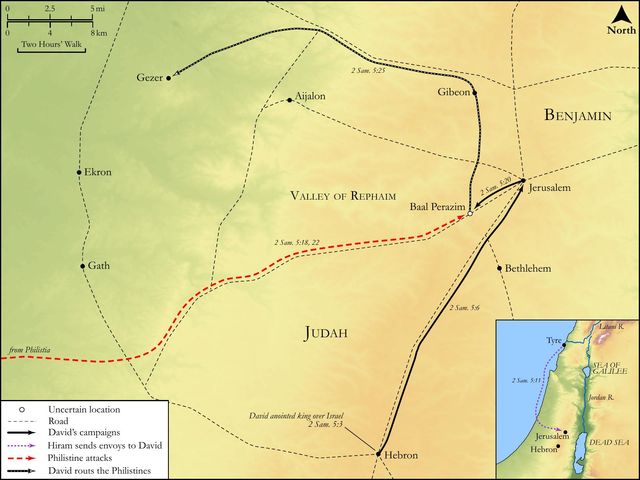
Study this verse
Public-domain commentary
Matthew Henry
From his Commentary on the Whole Bible. Henry comments on passages, not single verses — this entry covers 2 Samuel 5:17–25. His three-level outline is real structure in the source text, so it is rendered as structure.
The particular service for which David was raised up was to save Israel out of the hand of the Philistines, Sa2 3:18. This therefore divine Providence, in the first place, gives him an opportunity of accomplishing. Two great victories obtained over the Philistines we have here an account of, by which David not only balanced the disgrace and retrieved the loss Israel had sustained in the battle wherein Saul was slain, but went far towards the total subduing of those vexatious neighbours, the last remains of the devoted nations.
I.In both these actions the Philistines were the aggressors, stirred first towards their own destruction, and pulled it on their own heads.
1.In the former they came up to seek David (Sa2 5:17), because they heard that he was anointed king over Israel. He that under Saul had slain his ten thousands, what would he do when he himself came to be king! They therefore thought it was time to look about them, and try to crush his government in its infancy, before it was well settled. Their success against Saul, some years ago, perhaps encouraged them to make this attack upon David; but they considered not that David had that presence of God with him which Saul had forfeited and lost. The kingdom of the Messiah, as soon as ever it was set up in the world, was thus vigorously attacked by the powers of darkness, who, with the combined force both of Jews and Gentiles, made head against it. The heathen raged, and the kings of the earth set themselves to oppose it; but all in vain, Psa 2:1, etc. The destruction will turn, as this did, upon Satan's own kingdom. They took counsel together, but were broken in pieces, Isa 8:9, Isa 8:10.
2.In the latter they came up yet again, hoping to recover what they had lost in the former engagement, and their hearts being hardened to their destruction, Sa2 5:22.
3.In both they spread themselves in the valley of Rephaim, which lay very near Jerusalem. That city they hoped to make themselves masters of before David had completed the fortifications of it. Jerusalem, from its infancy, has been aimed at, and struck at, with a particular enmity. Their spreading themselves intimates that they were very numerous and that they made a very formidable appearance. We read of the church's enemies going up on the breadth of the earth (Rev 20:9), but the further they spread themselves the fairer mark they are to God's arrows.
II.In both, David, though forward enough to go forth against them (for as soon as he heard it he went down to the hold, to secure some important and advantageous post, Sa2 5:17), yet entered not upon action till he had enquired of the Lord by the breast-plate of judgment, Sa2 5:19, and again, Sa2 5:23. His enquiry was twofold: - 1. Concerning his duty: "Shall I go up? Shall I have a commission from heaven to engage them?" One would think he needed not doubt this; what was he made king for, but to fight the battles of the Lord and Israel? But a good man loves to see God going before him in every step he takes. "Shall I go up now?" It is to be done, but is it to be done at this time? In all thy ways acknowledge him. And besides, though the Philistines were public enemies, yet some of them had been his particular friends. Achish had been kind to him in his distress, and had protected him. "Now," says David, "ought not I, in remembrance of that, rather to make peace with them than to make war with them?" "No," says God, "they are Israel's enemies, and are doomed to destruction, and therefore scruple not, but go up." 2. Concerning his success. His conscience asked the former question, Shall I go up? His prudence asked this, Wilt thou deliver them into my hand? Hereby he owns his dependence on God for victory, that he could not conquer them unless God delivered them into his hand, and refers his cause to the good pleasure of God: Wilt thou do it? Yea, says God, I will doubtless do it. If God send us, he will bear us out and stand by us. The assurance God has given us of victory over our spiritual enemies, that he will tread Satan under our feet shortly, should animate us in our spiritual conflicts. We do not fight at uncertainty. David had now a great army at command and in good heart, yet he relied more on God's promise than his own force.
III.In the former of these engagements David routed the army of the Philistines by dint of sword (Sa2 5:20): He smote them; and when he had done,
1.He gave his God the glory; he said, "The Lord has broken forth upon my enemies before me. I could not have done it if he had not done it before me; he opened the breach like the breach of waters in a dam, which when once opened grows wider and wider." The principal part of the work was God's doing; nay, he did all; what David did was not worth speaking of; and therefore, Not unto us, but unto the Lord, give glory. He hoped likewise that this breach, like that of waters, was as the opening of the sluice, to let in a final desolation upon them; and, to perpetuate the remembrance of it, he called the place Baal-perazim, the master of the breaches, because, God having broken in upon their forces, he soon had the mastery of them. Let posterity take notice of it to God's honour.
2.He put their gods to shame. They brought the images of their gods into the field as their protectors, in imitation of the Israelites bringing the ark into their camp; but, being put to flight, they could not stay to carry off their images, for they were a burden to the weary beasts (Isa 46:1), and therefore they left them to fall with the rest of their baggage into the hands of the conqueror. Their images failed them, and gave them no assistance, and therefore they left their images to shift for themselves. God can make men weary of those things that they have been most fond of, and compel them to desert what they dote upon, and cast even the idols of silver and gold to the moles and the bats, Isa 2:20, Isa 2:21. David and his men converted to their own use the rest of the plunder, but the images they burnt, as God had appointed (Deu 7:5): "You shall burn their graven images with fire, in token of your detestation of idolatry, and lest they should be a snare." Bishop Patrick well observes here that when the ark fell into the Philistines' hands it consumed them, but, when these images fell into the hands of Israel, they could not save themselves from being consumed.
IV.In the latter of these engagements God gave David some sensible tokens of his presence with him, bade him not fall upon them directly, as he had done before, but fetch a compass behind them, Sa2 5:23.
1.God appoints him to draw back, as Israel stood still to see the salvation of the Lord.
2.He promised him to charge the enemy himself, by an invisible host of angels, Sa2 5:24. "Thou shalt hear the sound of a going, like the march of an army in the air, upon the tops of the mulberry trees." Angels tread light, and he that can walk upon the clouds can, when he pleases, walk on the tops of trees, or (as bishop Patrick understands it) at the head of the mulberry-trees, that is, of the wood, or hedge-row of those trees. "And, by that sign, thou shalt know that the Lord goes out before thee; though thou see him not, yet thou shalt hear him, and faith shall come and be confirmed by hearing. He goes forth to smite the host of the Philistines." When David had himself smitten them (Sa2 5:20), he ascribed it to God: The Lord has broken forth upon my enemies, to reward him for which thankful acknowledgment the next time God did it himself alone, without putting him to any toil or peril. Those that own God in what he has done for them will find him doing more. But observe, Though God promised to go before him and smite the Philistines, yet David, when he heard the sound of the going must bestir himself and be ready to pursue the victory. Note, God's grace must quicken our endeavours. If God work in us both to will and to do, it does not follow that we must sit still, as those that have nothing to do, but we must therefore, work out our own salvation with all possible care and diligence, Phi 2:12, Phi 2:13. The sound of the going was,
(1.)A signal to David when to move; it is comfortable going out when God goes before us. And,
(2.)Perhaps it was an alarm to the enemy, and put them into confusion. Hearing the march of an army against their front, they retreated with precipitation, and fell into David's army which lay behind them in their rear. Of those whom God fights against it is said (Lev 26:36), The sound of a shaken leaf shall chase them.
(3.)The success of this is briefly set down, Sa2 5:25. David observed his orders, waited till God moved, and stirred them, but not till then. Thus he was trained up in a dependence on God and his providence. God performed his promise, went before him, and routed all the enemies' force, and David failed not to improve his advantages; he smote the Philistines, even to the borders of their own country. When the kingdom of the Messiah was to be set up, the apostles that were to beat down the devil's kingdom must not attempt any thing till they received the promise of the Spirit, who came with a sound from heaven as of a rushing mighty wind (Act 2:2), which was typified by this sound of the going on the tops of the mulberry trees; and, when they heard that, they must bestir themselves, and did so; they went forth conquering and to conquer.
Historical interpretation
Historical reception
1 surviving comment on this verse from the historical church.
After that [the killing of Goliath] he never entered on a war without seeking counsel of the Lord. Thus he was victorious in all wars, and even to his last years [he] was ready to fight. And when war arose with the Philistines, he joined battle with their fierce troops, being desirous of winning renown, while careless of his own safety. But this is not the only kind of fortitude which is worthy of note. We consider their fortitude glorious, who, with greatness of mind, “through faith stopped the mouth of lions, quenched the violence of fire, escaped the edge of the sword, out of weakness were made strong,” They did not gain a victory in common with many, surrounded by comrades and aided by the legions, but [they] won their triumph alone over their treacherous foes by the mere courage of their own souls.
Continue studying 2 Samuel 5:19 across the web’s major study libraries — every link below opens this exact verse, chapter, or book on the destination site.
Read & Compare
 BibleGatewayThis verse in more than 200 translations and 70 languages.
 Bible.comThe YouVersion reader — hundreds of translations, reading plans, and highlights.
 ESV.orgCrossway's official English Standard Version reader.
 NET BibleThe NET translation with 60,000+ translators' notes on every rendering decision.
 STEP BibleTyndale House's free study tool — original text, vocabulary, and scholarly resources.
 BibliaLogos Bible Software's free web reader.
 USCCBThe New American Bible (Revised Edition) with the U.S. bishops' study notes.
Commentaries
 BibleHub CommentariesDozens of classic commentaries on this verse, gathered on one page.
 StudyLightMore than 100 commentary sets — the largest collection on the web.
 BibleRefPlain-English commentary on what this verse means, verse by verse.
 Enduring WordDavid Guzik's free commentary on this chapter, widely used by Bible teachers.
 Bible Study ToolsVerse commentary alongside Greek and Hebrew study aids.
Original Language & Research
- BibleHub InterlinearThe verse word by word — original language, transliteration, and English.
- BibleHub LexiconEvery word's original-language definition and Strong's entry.
 Blue Letter BibleDeep-study tools — Strong's numbers, concordance, and word studies.
 SefariaThe Hebrew text with Rashi and centuries of Jewish commentary.
Sermons, Hymns & Audio


TrulyRandomVerse is not affiliated with these sites and doesn’t control their content. They’re linked because they’re genuinely useful.
Summary
Following his anointing as king over all Israel and the strategic capture of Jerusalem as his capital, David faced an immediate and formidable military challenge from the Philistines. Demonstrating profound humility and unwavering dependence on God, David sought the Lord's specific counsel before engaging in battle, inquiring whether he should advance and if victory would be assured. The Lord responded with an unequivocal command to proceed, coupled with a certain promise of delivering the Philistines into David's hand, thereby affirming divine sovereignty over warfare and God's active commitment to His chosen king and people.
Context
ShowHideLiterary Context
This verse is situated at a pivotal moment in David's reign, marking the transition from his kingship over Judah to his full anointing as king over all twelve tribes of Israel in Hebron, as detailed in 2 Samuel 5:1-5. Immediately following this unification, David undertakes the strategic capture of Jerusalem from the Jebusites (2 Samuel 5:6-9), establishing it as his capital and the future spiritual heart of the nation. This consolidation of power and the emergence of a strong, unified Israel under David's leadership inevitably provoked the Philistines, Israel's long-standing adversaries. The preceding verses (2 Samuel 5:17-18) describe the Philistines' mobilization in the Valley of Rephaim, setting the immediate narrative stage for David's critical inquiry in this verse. This military confrontation serves as the first major test of David's reign as king of a united Israel, highlighting his reliance on divine guidance from the outset.
Historical & Cultural Context
The Philistines were a powerful, technologically advanced "Sea Peoples" who had settled on the southwestern coast of Canaan around the 12th century BC. Their superior iron technology and military organization, including chariots, often gave them a significant advantage over the Israelite forces, as evidenced throughout the periods of the Judges and early monarchy. They posed a constant threat to Israelite sovereignty and territorial integrity. The Valley of Rephaim, located southwest of Jerusalem, was a fertile plain and a frequent battleground, strategically important due to its proximity to David's newly established capital. In the ancient Near East, it was common for kings to consult their deities before major military campaigns, often through divination or omens. However, David's consistent and specific inquiry of Yahweh, the one true God, through established priestly means (e.g., the ephod), distinguished him from pagan rulers and underscored his unique covenant relationship with the Lord, emphasizing a personal and direct seeking of divine will rather than mere ritualistic appeasement.
Key Themes
ShowHideThis verse powerfully illustrates several central themes woven throughout the book of 2 Samuel and the broader Old Testament narrative. Foremost among these is Divine Guidance and Dependence. Despite his military prowess, recent successes, and divine anointing, David consistently models a profound reliance on God for direction in all matters, especially warfare. This echoes his earlier pattern of seeking the Lord, such as before rescuing Keilah from the Philistines in 1 Samuel 23:2. Another crucial theme is God's Faithfulness and Promise of Victory. The Lord's immediate and unequivocal response, "Go up: for I will doubtless deliver the Philistines into thine hand," underscores God's active sovereignty over history and His unwavering commitment to fulfill His promises to His chosen king and people. This divine assurance highlights that ultimate victory belongs to the Lord, not to human strength or strategic brilliance alone, a principle seen throughout Israel's history, as affirmed in Deuteronomy 20:4. Finally, David's actions exemplify Prudent and Pious Leadership, combining strategic awareness with deep spiritual reverence, setting a model for all who lead God's people.
Exposition and Analysis
ShowHideKey Word Analysis
ShowHideThis verb (H7592) signifies a formal, deliberate, and often reverent seeking of information or counsel, particularly from a divine source. In David's context, it implies seeking guidance through established priestly means, such as the Urim and Thummim (e.g., 1 Samuel 23:9-10). It is not a casual question but a serious appeal for direct divine instruction, demonstrating David's submission to God's ultimate authority as the true King of Israel and his recognition that military success depended entirely on God's favor and direction.
This primitive root (H5414) means "to give," "to place," or "to put into one's hand." In a military context, as here, it signifies granting victory, putting the enemy under the control of the victor. The repetition of this word in David's question ("wilt thou deliver them into mine hand?") and the Lord's emphatic response ("I will doubtless deliver the Philistines into thine hand") highlights the divine prerogative in granting victory. It emphasizes that the outcome of the battle is not dependent on David's strength or strategy, but solely on God's sovereign act of giving the enemy into David's power.
This primitive word (H3027) refers to the open hand, often indicating power, means, or dominion. When God promises to "deliver" the Philistines "into thine hand," it signifies granting complete authority and control over the enemy. It is a powerful metaphor for decisive victory and subjugation, emphasizing that the Philistines would be utterly defeated and placed under David's dominion, not by his own might but by God's enabling power.
Verse Breakdown
ShowHide"And David enquired of the LORD, saying,"
This opening clause immediately establishes David's posture of humility and dependence. Despite his recent anointing as king over all Israel and the capture of Jerusalem, David does not act presumptuously or rely on his own military acumen. His first action upon facing a major threat is to seek divine counsel, demonstrating his unwavering commitment to the Lord's leadership above his own strategic insights.
"Shall I go up to the Philistines? wilt thou deliver them into mine hand?"
These are David's two precise questions. "Go up" (עָלָה, alah) often implies ascending to battle or to a higher strategic position, reflecting David's need for specific divine authorization before initiating military action against a formidable foe. The second question reveals David's primary concern: not just whether to fight, but whether God would guarantee victory. It underscores his understanding that true success in battle comes from God's sovereign act of "delivering" the enemy into his power, rather than from human strength or military tactics alone.
"And the LORD said unto David, Go up:"
The Lord's response is swift, direct, and unambiguous. The command "Go up" provides the specific authorization David sought, confirming that the timing and strategy are perfectly aligned with God's will. This immediate divine affirmation validates David's inquiry and demonstrates God's attentiveness and readiness to guide His servant.
"for I will doubtless deliver the Philistines into thine hand."
This concluding declaration from the Lord provides the absolute assurance of victory. The phrase "doubtless deliver" (כִּי נָתֹן אֶתֵּן, ki naton etten - a Hebrew infinitive absolute construction) emphasizes the certainty and inevitability of the divine promise. It is a powerful affirmation that God Himself will ensure the Philistines' defeat and their subjugation to David, reinforcing His covenant faithfulness and active involvement in the affairs of His people. The victory is not merely possible; it is divinely guaranteed.
Literary Devices
ShowHideThe verse is rich in Dialogue, presenting a direct exchange between David and the Lord, which highlights the personal and intimate nature of their relationship and God's accessibility to His chosen king. This dialogue functions as a clear Question and Answer structure, where David's humble inquiry is met with God's authoritative and certain response, underscoring divine sovereignty and human dependence. The use of Repetition in the word "deliver" ("wilt thou deliver... I will doubtless deliver") serves to emphasize the central theme of God's power to grant victory and to confirm the absolute certainty of His promise. The Lord's response also employs Divine Assurance or Divine Promise, utilizing a strong Hebrew grammatical construction (the infinitive absolute, naton etten) to convey an undeniable and inevitable outcome, reinforcing the reliability of God's word and His active, decisive participation in the unfolding history of Israel.
Theological and Thematic Connections
ShowHideThis pivotal interaction between David and the Lord profoundly illustrates the theological principle of divine sovereignty and human dependence. David, though a powerful king, consistently models a posture of humility and reliance on God for every significant decision, particularly in matters of warfare and national security. This demonstrates that true leadership, especially in God's covenant people, is not about self-sufficiency or human ingenuity, but about discerning and submitting to God's will. God's immediate and unequivocal response reveals His active engagement in the affairs of His people, His faithfulness to His covenant promises, and His ultimate control over the outcomes of history. Victory is not earned by human strength but granted by divine favor, contingent upon obedience and faith. This passage serves as a powerful reminder that God is not merely an observer but an active participant, orchestrating events according to His perfect plan and empowering His servants to accomplish His purposes.
Reflection and Application
ShowHideDavid's example in 2 Samuel 5:19 offers timeless and profound lessons for believers navigating the challenges and decisions of contemporary life. In a world that often champions self-reliance, strategic planning, and immediate action, David's humility in seeking God's counsel before engaging a formidable enemy stands as a powerful counter-cultural model. It reminds us that true wisdom begins with acknowledging God's sovereignty over all circumstances, whether personal, professional, or spiritual. Just as David refused to move without divine authorization, we are called to cultivate a habit of prayerful dependence, laying our plans, fears, and aspirations before the Lord. When God provides a clear direction or promise, as He did for David, we are then empowered to proceed with unwavering confidence, knowing that His word is reliable and His power is sufficient to accomplish His purposes, even when the odds seem stacked against us. This verse encourages us to shift our focus from our own limited resources and anxieties to the infinite power and perfect wisdom of our Heavenly Father, fostering a life of active faith, obedient trust, and confident reliance on His unfailing guidance.
Questions for Reflection
ShowHideFAQ
ShowHideWhy did David need to inquire of the Lord if he was already king and had God's favor?
ShowHideDavid's kingship and God's favor did not negate the need for ongoing, specific divine guidance. While David was God's chosen king, he was still a human leader operating within a covenant relationship. His inquiries demonstrated his humility, his recognition of God's ultimate sovereignty over Israel, and his understanding that military success and national security depended entirely on God's active involvement and blessing. It was a consistent pattern of his pious leadership, showing that even those in positions of power must remain dependent on the Lord for every step, rather than presuming upon God's general favor. This practice ensured that David's actions were aligned with God's specific will for each situation, preventing him from relying on his own wisdom or strength alone and reinforcing the principle that "unless the LORD builds the house, its builders labor in vain" (Psalm 127:1).
How did David typically "enquire of the LORD" in such situations?
ShowHideDavid typically inquired of the Lord through established priestly means, most notably through the use of the ephod, which contained the Urim and Thummim. This is explicitly seen in passages like 1 Samuel 23:9-10 and 1 Samuel 30:7-8. The priest, wearing the ephod, would present David's questions to the Lord, and a divine response would be given, often in a "yes" or "no" format, or through clear instruction. While the exact mechanism of the Urim and Thummim is not fully understood, it served as a legitimate and recognized means of receiving direct divine counsel during that period. David's consistent use of this method underscored his commitment to seeking God's explicit direction in all matters of national importance, rather than relying on personal intuition or human strategy alone.
What is the significance of the Philistines gathering in the Valley of Rephaim?
ShowHideThe Valley of Rephaim, located southwest of Jerusalem, was a strategically important and fertile plain that served as a common battleground between Israel and the Philistines. Its proximity to Jerusalem, which David had just captured and established as his capital, made it a critical point of contention. The Philistines gathering there signaled a direct and immediate threat to David's newly consolidated kingdom and his central seat of power. For the Philistines, this was an attempt to reassert their dominance and prevent the rise of a strong, unified Israelite monarchy under David, whom they perceived as a significant challenge to their regional power. For David, it was the first major military test of his reign as king over all Israel, making the divine guidance he sought even more crucial. Their presence in this key valley indicated a direct challenge to David's authority and Israel's newfound unity.
Christ-Centered Fulfillment
ShowHideDavid's humble inquiry and God's certain promise of victory in 2 Samuel 5:19 powerfully foreshadow the ultimate King, Jesus Christ, and His definitive triumph. David, as an earthly king, was utterly dependent on God for every victory, serving as a type of the perfect King who would come. Jesus, the true Son of David, perfectly embodied this dependence, always doing the will of His Father, as He declared in John 5:19. He did not need to "enquire" in the same way, for He was one with the Father and perfectly knew the Father's will, yet His life was characterized by perfect obedience and reliance, culminating in His submission to the cross. The "deliverance" promised to David finds its ultimate fulfillment in Christ's victory over the true enemies of humanity: sin, death, and the devil. Through His crucifixion and resurrection, Jesus "doubtless delivered" all who believe in Him from the power of darkness, as Colossians 1:13 proclaims, transferring us into the kingdom of His beloved Son. David's military victory was temporal; Christ's victory is eternal, establishing a kingdom that will never end (Luke 1:33). Believers today, united with Christ, participate in His victory, empowered to overcome spiritual battles not by their own strength, but by the assured triumph of the Lamb of God who takes away the sin of the world who has already conquered the world (John 16:33).