


2 Samuel 5:25
Bible text: King James Version (1769 Blayney text) · Public domain
Bible text: Berean Standard Bible · Public domain
Bible text: American Standard Version (1901) · Public domain
Bible text: World English Bible, Messianic edition · Public domain
Bible text: Geneva Bible (1599) · Public domain
Bible text: Young's Literal Translation · Public domain
- וַיַּעַשׂvai·Ya·'asand he didH6213Conj-w ¦ V-Qal-ConsecImperf-3msVerb Qal Consecutive Imperfect 3rd Singular Masculineוַandיַּעַשׂhe did
- דָּוִדda·VidDavidH1732N-proper-mNoun Proper Masculine
- כֵּןKensoH3651AdvAdverb
- כַּאֲשֶׁרka·'a·Sherjust asH834Prep-k ¦ RelParticle Relativeכַּjustאֲשֶׁרas
- צִוָּהוּtzi·Va·huhe had commanded himH6680V-Piel-Perf-3ms ¦ 3msVerb Piel Perfect 3rd Singular Masculineצִוָּhe had commandedהוּhim
- יְהוָהYah·wehYahwehH3068N-properNoun Proper Title
- וַיַּךְvai·yaKhand he struck downH5221Conj-w ¦ V-Hiphil-ConsecImperf-3msVerb Hiphil Consecutive Imperfect 3rd Singular Masculineוַandיַּךְhe struck down
- אֶת'et<obj.>H853DirObjMParticle Object Indicator
- פְּלִשְׁתִּיםpe·lish·Tim[the] PhilistinesH6430N-mpNoun Gentilic Plural Masculine Absolute
- מִגֶּבַעmi·Ge·va'from GebaH1387Prep-m ¦ N-properNoun Proper LocationמִfromגֶּבַעGeba
- עַד'aduntilH5704PrepPreposition
- בֹּאֲךָbo·'a·Khacoming youH935V-Qal-Inf ¦ 2msVerb Qal Infinitive Constructבֹּאֲcomingךָyou
- גָזֶרGa·zerGezerH1507N-properNoun Proper Location
English is a literal word-by-word gloss of the Hebrew, not the KJV's wording. Why?
This is the original text the KJV's translators worked from — each Hebrew word with its own literal English meaning in this verse, prepared by scholars at Tyndale House, Cambridge. The KJV translates whole sentences, not word by word, so its wording differs: one Hebrew word can become several English words, and the KJV may choose “the LORD” where the gloss reads “Yahweh”. Both are faithful — they answer different questions. For the KJV's own rendering, switch to the KJV text.
Details
See on the biblical-era maps
Study this verse
Public-domain commentary
Matthew Henry
From his Commentary on the Whole Bible. Henry comments on passages, not single verses — this entry covers 2 Samuel 5:17–25. His three-level outline is real structure in the source text, so it is rendered as structure.
The particular service for which David was raised up was to save Israel out of the hand of the Philistines, Sa2 3:18. This therefore divine Providence, in the first place, gives him an opportunity of accomplishing. Two great victories obtained over the Philistines we have here an account of, by which David not only balanced the disgrace and retrieved the loss Israel had sustained in the battle wherein Saul was slain, but went far towards the total subduing of those vexatious neighbours, the last remains of the devoted nations.
I.In both these actions the Philistines were the aggressors, stirred first towards their own destruction, and pulled it on their own heads.
1.In the former they came up to seek David (Sa2 5:17), because they heard that he was anointed king over Israel. He that under Saul had slain his ten thousands, what would he do when he himself came to be king! They therefore thought it was time to look about them, and try to crush his government in its infancy, before it was well settled. Their success against Saul, some years ago, perhaps encouraged them to make this attack upon David; but they considered not that David had that presence of God with him which Saul had forfeited and lost. The kingdom of the Messiah, as soon as ever it was set up in the world, was thus vigorously attacked by the powers of darkness, who, with the combined force both of Jews and Gentiles, made head against it. The heathen raged, and the kings of the earth set themselves to oppose it; but all in vain, Psa 2:1, etc. The destruction will turn, as this did, upon Satan's own kingdom. They took counsel together, but were broken in pieces, Isa 8:9, Isa 8:10.
2.In the latter they came up yet again, hoping to recover what they had lost in the former engagement, and their hearts being hardened to their destruction, Sa2 5:22.
3.In both they spread themselves in the valley of Rephaim, which lay very near Jerusalem. That city they hoped to make themselves masters of before David had completed the fortifications of it. Jerusalem, from its infancy, has been aimed at, and struck at, with a particular enmity. Their spreading themselves intimates that they were very numerous and that they made a very formidable appearance. We read of the church's enemies going up on the breadth of the earth (Rev 20:9), but the further they spread themselves the fairer mark they are to God's arrows.
II.In both, David, though forward enough to go forth against them (for as soon as he heard it he went down to the hold, to secure some important and advantageous post, Sa2 5:17), yet entered not upon action till he had enquired of the Lord by the breast-plate of judgment, Sa2 5:19, and again, Sa2 5:23. His enquiry was twofold: - 1. Concerning his duty: "Shall I go up? Shall I have a commission from heaven to engage them?" One would think he needed not doubt this; what was he made king for, but to fight the battles of the Lord and Israel? But a good man loves to see God going before him in every step he takes. "Shall I go up now?" It is to be done, but is it to be done at this time? In all thy ways acknowledge him. And besides, though the Philistines were public enemies, yet some of them had been his particular friends. Achish had been kind to him in his distress, and had protected him. "Now," says David, "ought not I, in remembrance of that, rather to make peace with them than to make war with them?" "No," says God, "they are Israel's enemies, and are doomed to destruction, and therefore scruple not, but go up." 2. Concerning his success. His conscience asked the former question, Shall I go up? His prudence asked this, Wilt thou deliver them into my hand? Hereby he owns his dependence on God for victory, that he could not conquer them unless God delivered them into his hand, and refers his cause to the good pleasure of God: Wilt thou do it? Yea, says God, I will doubtless do it. If God send us, he will bear us out and stand by us. The assurance God has given us of victory over our spiritual enemies, that he will tread Satan under our feet shortly, should animate us in our spiritual conflicts. We do not fight at uncertainty. David had now a great army at command and in good heart, yet he relied more on God's promise than his own force.
III.In the former of these engagements David routed the army of the Philistines by dint of sword (Sa2 5:20): He smote them; and when he had done,
1.He gave his God the glory; he said, "The Lord has broken forth upon my enemies before me. I could not have done it if he had not done it before me; he opened the breach like the breach of waters in a dam, which when once opened grows wider and wider." The principal part of the work was God's doing; nay, he did all; what David did was not worth speaking of; and therefore, Not unto us, but unto the Lord, give glory. He hoped likewise that this breach, like that of waters, was as the opening of the sluice, to let in a final desolation upon them; and, to perpetuate the remembrance of it, he called the place Baal-perazim, the master of the breaches, because, God having broken in upon their forces, he soon had the mastery of them. Let posterity take notice of it to God's honour.
2.He put their gods to shame. They brought the images of their gods into the field as their protectors, in imitation of the Israelites bringing the ark into their camp; but, being put to flight, they could not stay to carry off their images, for they were a burden to the weary beasts (Isa 46:1), and therefore they left them to fall with the rest of their baggage into the hands of the conqueror. Their images failed them, and gave them no assistance, and therefore they left their images to shift for themselves. God can make men weary of those things that they have been most fond of, and compel them to desert what they dote upon, and cast even the idols of silver and gold to the moles and the bats, Isa 2:20, Isa 2:21. David and his men converted to their own use the rest of the plunder, but the images they burnt, as God had appointed (Deu 7:5): "You shall burn their graven images with fire, in token of your detestation of idolatry, and lest they should be a snare." Bishop Patrick well observes here that when the ark fell into the Philistines' hands it consumed them, but, when these images fell into the hands of Israel, they could not save themselves from being consumed.
IV.In the latter of these engagements God gave David some sensible tokens of his presence with him, bade him not fall upon them directly, as he had done before, but fetch a compass behind them, Sa2 5:23.
1.God appoints him to draw back, as Israel stood still to see the salvation of the Lord.
2.He promised him to charge the enemy himself, by an invisible host of angels, Sa2 5:24. "Thou shalt hear the sound of a going, like the march of an army in the air, upon the tops of the mulberry trees." Angels tread light, and he that can walk upon the clouds can, when he pleases, walk on the tops of trees, or (as bishop Patrick understands it) at the head of the mulberry-trees, that is, of the wood, or hedge-row of those trees. "And, by that sign, thou shalt know that the Lord goes out before thee; though thou see him not, yet thou shalt hear him, and faith shall come and be confirmed by hearing. He goes forth to smite the host of the Philistines." When David had himself smitten them (Sa2 5:20), he ascribed it to God: The Lord has broken forth upon my enemies, to reward him for which thankful acknowledgment the next time God did it himself alone, without putting him to any toil or peril. Those that own God in what he has done for them will find him doing more. But observe, Though God promised to go before him and smite the Philistines, yet David, when he heard the sound of the going must bestir himself and be ready to pursue the victory. Note, God's grace must quicken our endeavours. If God work in us both to will and to do, it does not follow that we must sit still, as those that have nothing to do, but we must therefore, work out our own salvation with all possible care and diligence, Phi 2:12, Phi 2:13. The sound of the going was,
(1.)A signal to David when to move; it is comfortable going out when God goes before us. And,
(2.)Perhaps it was an alarm to the enemy, and put them into confusion. Hearing the march of an army against their front, they retreated with precipitation, and fell into David's army which lay behind them in their rear. Of those whom God fights against it is said (Lev 26:36), The sound of a shaken leaf shall chase them.
(3.)The success of this is briefly set down, Sa2 5:25. David observed his orders, waited till God moved, and stirred them, but not till then. Thus he was trained up in a dependence on God and his providence. God performed his promise, went before him, and routed all the enemies' force, and David failed not to improve his advantages; he smote the Philistines, even to the borders of their own country. When the kingdom of the Messiah was to be set up, the apostles that were to beat down the devil's kingdom must not attempt any thing till they received the promise of the Spirit, who came with a sound from heaven as of a rushing mighty wind (Act 2:2), which was typified by this sound of the going on the tops of the mulberry trees; and, when they heard that, they must bestir themselves, and did so; they went forth conquering and to conquer.
Continue studying 2 Samuel 5:25 across the web’s major study libraries — every link below opens this exact verse, chapter, or book on the destination site.
Read & Compare
 BibleGatewayThis verse in more than 200 translations and 70 languages.
 Bible.comThe YouVersion reader — hundreds of translations, reading plans, and highlights.
 ESV.orgCrossway's official English Standard Version reader.
 NET BibleThe NET translation with 60,000+ translators' notes on every rendering decision.
 STEP BibleTyndale House's free study tool — original text, vocabulary, and scholarly resources.
 BibliaLogos Bible Software's free web reader.
 USCCBThe New American Bible (Revised Edition) with the U.S. bishops' study notes.
Commentaries
 BibleHub CommentariesDozens of classic commentaries on this verse, gathered on one page.
 StudyLightMore than 100 commentary sets — the largest collection on the web.
 BibleRefPlain-English commentary on what this verse means, verse by verse.
 Enduring WordDavid Guzik's free commentary on this chapter, widely used by Bible teachers.
 Bible Study ToolsVerse commentary alongside Greek and Hebrew study aids.
Original Language & Research
- BibleHub InterlinearThe verse word by word — original language, transliteration, and English.
- BibleHub LexiconEvery word's original-language definition and Strong's entry.
 Blue Letter BibleDeep-study tools — Strong's numbers, concordance, and word studies.
 SefariaThe Hebrew text with Rashi and centuries of Jewish commentary.
Sermons, Hymns & Audio


TrulyRandomVerse is not affiliated with these sites and doesn’t control their content. They’re linked because they’re genuinely useful.
Summary
Second Samuel 5:25 encapsulates a pivotal moment in David's nascent kingship over all Israel, showcasing the direct correlation between his unwavering obedience to God's specific battle instructions and the comprehensive, divinely-granted victory over the Philistines. This verse highlights not only David's exemplary faith and reliance on the Lord but also God's active involvement in securing His people's triumph, decisively breaking the Philistine stronghold across a significant geographical expanse.
Context
ShowHideLiterary Context
This verse concludes a crucial narrative segment in 2 Samuel 5, which chronicles David's anointing as king over all Israel in Hebron, his strategic capture of Jerusalem from the Jebusites to establish it as the capital, and his subsequent two decisive victories over the Philistines. The Philistines, recognizing David's consolidation of power as a direct threat, launched an offensive. David, unlike his predecessor Saul, consistently sought the Lord's counsel before engaging in battle. The first Philistine encounter, detailed in 2 Samuel 5:17-21, resulted in a victory at Baal-perazim. However, the Philistines regrouped and attacked again. In the lead-up to 2 Samuel 5:25, God gave David a highly specific and unconventional command in 2 Samuel 5:23-24: to circle around and attack only when he heard "the sound of marching in the tops of the mulberry trees," a clear sign of divine movement. 2 Samuel 5:25 directly affirms David's immediate and complete obedience to this unique divine strategy, leading to the crushing defeat of the Philistine forces.
Historical & Cultural Context
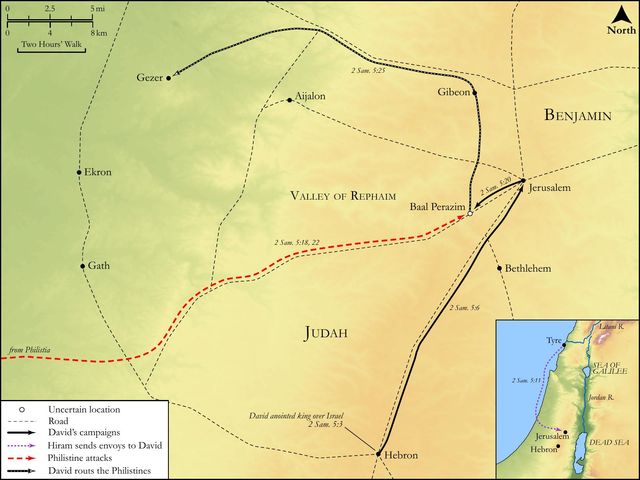
The Philistines were a formidable, technologically superior (possessing iron weaponry, unlike Israel) people who had long dominated the coastal plains and exerted significant pressure on Israelite territories. Their presence represented a constant existential threat to Israel's nascent monarchy. David's ascent to the throne and his capture of Jerusalem (a strategically vital, defensible city) marked a critical turning point, challenging Philistine hegemony. Culturally, seeking divine counsel before battle was a common practice among the nations, but the specific nature of God's command to David—waiting for a supernatural sign—underscored a unique covenantal relationship between Yahweh and His chosen king. The geographical markers "Geba" and "Gazer" (or Gezer) are crucial. Geba was a town in the territory of Benjamin, relatively close to Jerusalem, while Gezer was a significant Canaanite city on the western border of Ephraim, strategically located on a major trade route between the coastal plain and the Judean hills. Its capture or control signified a deep penetration into Philistine-influenced territory, indicating a comprehensive and far-reaching victory that secured Israel's western flank and significantly curtailed Philistine power.
Key Themes
ShowHideThis verse powerfully reinforces several overarching themes within the book of Samuel and David's reign. Firstly, it underscores the theme of obedience as a prerequisite for divine blessing and victory. David's success is explicitly attributed to his immediate and faithful execution of God's precise, even unconventional, instructions, as seen in the phrase "And David did so, as the LORD had commanded him." This contrasts sharply with Saul's repeated failures in obedience. Secondly, the narrative highlights divine sovereignty and active intervention in human affairs. God not only promises victory but also provides the specific strategy and the miraculous sign of His presence (the sound in the mulberry trees in 2 Samuel 5:24). This demonstrates that the battle belongs to the Lord, and human effort is effective only when aligned with His will. Finally, the geographical sweep "from Geba until thou come to Gazer" emphasizes the completeness and decisiveness of God's deliverance. This was not a partial skirmish but a thorough routing of the enemy, signifying a significant shift in regional power dynamics and the establishment of David's kingdom with divine backing, fulfilling the promise of a secure land for Israel (e.g., Genesis 15:18).
Exposition and Analysis
ShowHideKey Word Analysis
ShowHideThis verb (H6213), often translated as "to do," "to make," or "to perform," carries significant weight here. It implies not merely passive compliance but active, diligent, and complete execution of the command. David's "doing so" indicates a swift and thorough implementation of God's strategic instructions, demonstrating his trust and commitment. It is the practical outworking of his faith.
This verb (H6680) signifies a direct, authoritative instruction or order, often from a superior to a subordinate, or from God to humanity. The use of "the LORD had commanded him" emphasizes the divine origin and authoritative nature of the instruction given to David. It highlights that David's actions were not based on his own military genius or tactical assessment, but on a specific, revealed divine will, making the ensuing victory a direct result of God's plan and power.
Verse Breakdown
ShowHide"And David did so, as the LORD had commanded him;"
This opening clause is the linchpin of the verse, establishing the direct causal link between David's obedience and the subsequent victory. It underscores David's posture of humility and dependence on God, setting him apart as a king "after God's own heart." His immediate and faithful execution of the Lord's specific, unconventional command (to wait for the sound in the mulberry trees and then attack) is presented as the prerequisite for divine intervention and success. This phrase emphasizes that the victory was not a result of David's military prowess alone, but a direct consequence of his submission to divine strategy.
"and smote the Philistines"
This phrase describes the action taken by David's forces, empowered by God. The verb "smote" (Hebrew: nakah, H5221) implies a decisive, often violent, striking down or defeating. It conveys the completeness and severity of the blow dealt to the Philistines. This was not a mere skirmish but a crushing defeat, signifying a significant shift in power dynamics and the breaking of Philistine dominance over Israel. The Philistines, who had long been a thorn in Israel's side, are now decisively routed.
"from Geba until thou come to Gazer."
This geographical merism delineates the extensive scope and completeness of the victory. "Geba" (H1387) was a town in Benjamin, relatively close to Jerusalem, while "Gazer" (H1507, Gezer) was a strategically important Canaanite city on the Philistine border, located on a major ancient trade route. The phrase "from Geba until Gazer" signifies a wide-ranging pursuit and destruction of the Philistine forces across a significant portion of their territory. It implies a thorough cleansing of the land from the enemy's presence, marking a comprehensive and decisive blow that established David's authority and secured Israel's borders against their perennial adversaries.
Literary Devices
ShowHideThe verse employs several significant literary devices. The phrase "And David did so, as the LORD had commanded him" functions as a clear causal statement, directly linking David's obedience to the subsequent outcome, thereby emphasizing the theological principle of divine blessing through submission. The geographical markers "from Geba until thou come to Gazer" constitute a merism, a rhetorical device where two contrasting or opposing parts are used to represent a whole. Here, it signifies the entire breadth and completeness of the victory, from one end of the Philistine-influenced territory to another, implying a thorough and comprehensive routing. Furthermore, the narrative leading up to this verse, with God's specific and unusual instruction to wait for the "sound of marching in the tops of the mulberry trees" (2 Samuel 5:24), highlights divine intervention and a form of theophany (God's manifestation), underscoring that the victory was not merely David's military achievement but a supernatural act of God on behalf of His obedient king.
Theological and Thematic Connections
ShowHideThis passage profoundly illustrates the theological principle that divine blessing and victory are contingent upon human obedience and reliance on God's sovereign plan. David's success was not merely a result of his military skill, but a direct consequence of his humble submission to the Lord's unconventional strategy. This narrative reinforces the truth that God is the ultimate strategist and warrior for His people, actively fighting their battles when they align with His will. The comprehensive nature of the victory, spanning from Geba to Gazer, serves as a powerful testament to God's ability to deliver His people completely and decisively from their enemies, establishing His kingdom and securing His promises.
Reflection and Application
ShowHideThe narrative of David's victory in 2 Samuel 5:25 offers profound and timeless lessons for believers today. It calls us to cultivate a posture of radical dependence on God, seeking His guidance not merely as an option but as a prerequisite for true success in all areas of life. Just as David waited for God's specific command and the supernatural sign, we are invited to listen for the Lord's voice, trusting that His ways are higher than our own, even when they seem unconventional or counter-intuitive. This passage reminds us that our "battles"—whether spiritual, relational, professional, or personal—are ultimately God's to fight, and our role is one of faithful obedience. When we align our wills with His, we can confidently expect His active intervention and the comprehensive victory that only He can provide, liberating us from the strongholds that seek to hinder our progress in His kingdom.
Questions for Reflection
ShowHideFAQ
ShowHideWhat was the significance of the "sound of marching in the tops of the mulberry trees" mentioned in the preceding verse?
ShowHideThe "sound of marching in the tops of the mulberry trees" (2 Samuel 5:24) was a miraculous and audible sign from God to David. It signified that the Lord Himself was moving out ahead of David's army to strike the Philistine camp. This was a divine signal, a supernatural manifestation of God's presence and active intervention in the battle. It was meant to assure David that the victory would be God's, not merely a result of human military strategy or strength, and it served as the precise timing for David to launch his attack, ensuring divine orchestration of the victory.
Why was David's obedience so crucial in this battle, especially given his military prowess?
ShowHideDavid's obedience was crucial because it demonstrated his absolute reliance on God as the true commander of Israel's armies, rather than on his own considerable military skill or experience. While David was a gifted warrior, the narrative emphasizes that the victory was granted by the Lord. By waiting for God's specific and unusual command, David acknowledged God's sovereignty and wisdom above his own. This act of obedience was not merely a tactical maneuver; it was a profound act of faith that unlocked divine power and ensured a comprehensive victory that would otherwise have been impossible. It set a precedent for David's reign, showcasing that his leadership was God-centered, distinguishing him from King Saul, who often acted presumptuously or disobediently (e.g., 1 Samuel 13:8-14).
Christ-Centered Fulfillment
ShowHideWhile 2 Samuel 5:25 describes a historical victory achieved through David's obedience, it powerfully foreshadows the ultimate and decisive victory secured by Jesus Christ through His perfect obedience. David's "doing so, as the LORD had commanded him" finds its supreme fulfillment in the Son of God, who perfectly submitted to the Father's will, even to the point of death on a cross (Philippians 2:8). Just as God fought for David, Christ, the greater David, engaged in the ultimate spiritual battle against sin, death, and the powers of darkness. His death and resurrection represent the definitive "smoting" of our spiritual enemies, delivering a comprehensive defeat "from Geba until Gazer" – a victory that extends to the uttermost parts of the earth and into every corner of human existence (Colossians 2:15). Through Christ's perfect obedience and decisive triumph, believers are now able to share in His victory, being freed from the dominion of sin and death (Romans 6:22). The "sound of marching" that signaled God's movement before David now finds its echo in the triumphant advance of the gospel, empowered by the Spirit, bringing the kingdom of God to every nation and tribe (Matthew 28:18-20).