


2 Samuel 6:1
- וַיֹּסֶףvai·Yo·sefand he gatheredH622Conj-w ¦ V-Qal-ConsecImperf-3msVerb Qal Consecutive Imperfect 3rd Singular Masculineוַandיֹּסֶףhe gathered
- עוֹדodagainH5750Adj-msAdjective Numerical Singular Masculine Absolute
- דָּוִדda·VidDavidH1732N-proper-mNoun Proper Masculine
- אֶת'et<obj.>H853DirObjMParticle Object Indicator
- כָּלkoleveryH3605N-mscNoun Singular Masculine Construct
- בָּחוּרba·Churchosen [man]H977V-Qal-PassPrtcpl-msVerb Qal Participle Passive Singular Masculine Absolute
- בְּיִשְׂרָאֵלbe·Yis·ra·'Elin IsraelH3478Prep-b ¦ N-properNoun Proper LocationבְּinיִשְׂרָאֵלIsrael
- שְׁלֹשִׁיםshe·lo·ShimthirtyH7970N-mpNoun Plural Masculine Absolute
- אָלֶף'A·lefthousandH505N-csNoun Singular common gender Absolute
English is a literal word-by-word gloss of the Hebrew, not the KJV's wording. Why?
This is the original text the KJV's translators worked from — each Hebrew word with its own literal English meaning in this verse, prepared by scholars at Tyndale House, Cambridge. The KJV translates whole sentences, not word by word, so its wording differs: one Hebrew word can become several English words, and the KJV may choose “the LORD” where the gloss reads “Yahweh”. Both are faithful — they answer different questions. For the KJV's own rendering, switch to the KJV text.
Details
See on the biblical-era map
Study this verse
Public-domain commentary
Matthew Henry
From his Commentary on the Whole Bible. Henry comments on passages, not single verses — this entry covers 2 Samuel 6:1–5. His two-level outline is real structure in the source text, so it is rendered as structure.
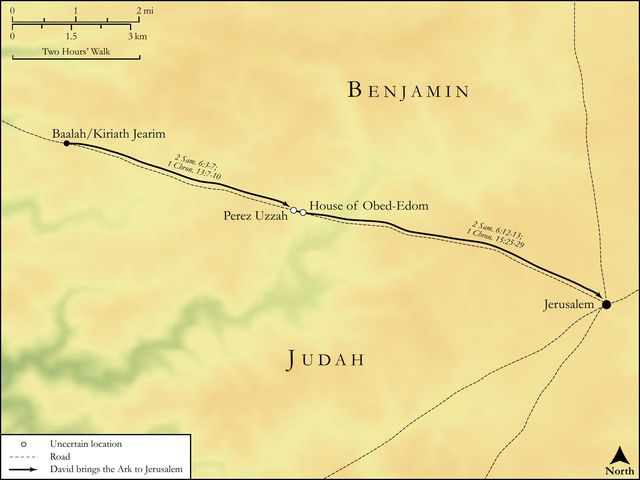
We have not heard a word of the ark since it was lodged in Kirjath-jearim, immediately after its return out of its captivity among the Philistines (Sa1 7:1, Sa1 7:2), except that, once, Saul called for it, Sa1 14:18. That which in former days had made so great a figure is now thrown aside, as a neglected thing, for many years. And, if now the ark was for so many years in a house, let it not seem strange that we find the church so long in the wilderness, Rev 12:14. Perpetual visibility is no mark of the true church. God is graciously present with the souls of his people even when they want the external tokens of his presence. But now that David is settled in the throne the honour of the ark begins to revive, and Israel's care of it to flourish again, wherein also, no doubt, the good people among them had been careful, but they lacked opportunity. See Phi 4:10.
I.Here is honourable mention made of the ark.
Because it had not been spoken of a great while, now that it is spoken of observe how it is described (Sa2 6:2): it is the ark of God whose name is called by the name of the Lord of hosts that dwelleth between the cherubim, or at which the name, even the name of the Lord of hosts, was called upon, or upon which the name of the Lord of hosts was called, or because of which the name is proclaimed, the name of the Lord of hosts (that is, God was greatly magnified in the miracles done before the ark), or the ark of God, who is called the name (Lev 24:11, Lev 24:16), the name of the Lord of hosts, sitting on the cherubim upon it. Let us learn hence,
1.To think and speak highly of God. He is the name above every name, the Lord of hosts, that has all the creatures in heaven and earth at his command, and receives homage from them all, and yet is pleased to dwell between the cherubim, over the propitiatory or mercy-seat, graciously manifesting himself to his people, reconciled in a Mediator, and ready to do them good.
2.To think and speak honourably of holy ordinances, which are to us, as the ark was to Israel, the tokens of God's presence (Mat 28:2), and the means of our communion with him, Psa 27:4. It is the honour of the ark that it is the ark of God; he is jealous for it, is magnified in it, his name is called upon it. The divine institution puts a beauty and grandeur upon holy ordinances, which otherwise have no form nor comeliness. Christ is our ark. In and by him God manifests his favour and communicates his grace to us, and accepts our adoration and addresses.
II.Here is an honourable attendance given to the ark upon the removal of it.
Now, at length, it is enquired after, David made the motion (Ch1 13:1-3), and the heads of the congregation agreed to it, Sa2 6:4. All the chosen men of Israel are called together to grace the solemnity, to pay their respect to the ark, and to testify their joy in its restoration. The nobility and gentry, elders and officers, came to the number of 30,000 (Sa2 6:1), and the generality of the common people besides (Ch1 13:5); for, some think, it was done at one of the three great festivals. This would make a noble cavalcade, and would help to inspire the young people of the nation, who perhaps had scarcely heard of the ark, with a great veneration for it, for this was certainly a treasure of inestimable value which the king himself and all the great men waited upon, and were a guard to.
III.Here are great expressions of joy upon the removal of the ark, Sa2 6:5.
David himself, and all that were with him that were musically inclined, made use of such instruments as they had to excite and express their rejoicing upon this occasion. It might well put them into a transport of joy to see the ark rise out of obscurity and move towards a public station. It is better to have the ark in a house than not at all, better in a house than a captive in Dagon's temple; but it is very desirable to have it in a tent pitched on purpose for it, where the resort to it may be more free and open. As secret worship is better the more secret it is, so public worship is better the more public it is; and we have reason to rejoice when restraints are taken off, and the ark of God finds welcome in the city of David, and has not only the protection and support, but the countenance and encouragement, of the civil powers; for joy of this they played before the Lord. Note, Public joy must always be as before the Lord, with an eye to him and terminating in him, and must not degenerate into that which is carnal and sensual. Dr. Lightfoot supposes that, upon this occasion, David penned the 68th Psalm, because it begins with that ancient prayer of Moses at the removing of the ark, Let God arise, and let his enemies be scattered; and notice is taken there (v. 25) of the singers and players on instruments that attended, and (v. 27) of the princes of several of the tribes; and perhaps those words in the last verse, O God, thou art terrible out of thy holy places, were added upon occasion of the death of Uzzah.
IV.Here is an error that they were guilty of in this matter, that they carried the ark in a cart or carriage, whereas the priests should have carried it upon their shoulders, Sa2 6:3. The Kohathites that had the charge of the ark had no wagons assigned them, because their service was to bear it upon their shoulders, Num 7:9. The ark was no such heavy burden but that they might, among them, have carried it as far as Mount Sion upon their shoulders, they needed not to put it in a cart like a common thing. It was no excuse for them that the Philistines had done so and were not punished for it; they knew no better, nor had they any priests or Levites with them to undertake the carrying of it; better carry it in a cart than that any of Dagon's priests should carry it. Philistines may cart the ark with impunity; but, if Israelites do so, they do it at their peril. And it mended the matter very little that it was a new cart; old or new, it was not what God had appointed. I wonder how so wise and good a man as David was, that conversed so much with the law of God, came to be guilty of such an oversight. We will charitably hope that it was because he was so extremely intent upon the substance of the service that he forgot to take care of this circumstance.
Continue studying 2 Samuel 6:1 across the web’s major study libraries — every link below opens this exact verse, chapter, or book on the destination site.
Read & Compare
 BibleGatewayThis verse in more than 200 translations and 70 languages.
 Bible.comThe YouVersion reader — hundreds of translations, reading plans, and highlights.
 ESV.orgCrossway's official English Standard Version reader.
 NET BibleThe NET translation with 60,000+ translators' notes on every rendering decision.
 STEP BibleTyndale House's free study tool — original text, vocabulary, and scholarly resources.
 BibliaLogos Bible Software's free web reader.
 USCCBThe New American Bible (Revised Edition) with the U.S. bishops' study notes.
Commentaries
 BibleHub CommentariesDozens of classic commentaries on this verse, gathered on one page.
 StudyLightMore than 100 commentary sets — the largest collection on the web.
 BibleRefPlain-English commentary on what this verse means, verse by verse.
 Enduring WordDavid Guzik's free commentary on this chapter, widely used by Bible teachers.
 Bible Study ToolsVerse commentary alongside Greek and Hebrew study aids.
Original Language & Research
- BibleHub InterlinearThe verse word by word — original language, transliteration, and English.
- BibleHub LexiconEvery word's original-language definition and Strong's entry.
 Blue Letter BibleDeep-study tools — Strong's numbers, concordance, and word studies.
 SefariaThe Hebrew text with Rashi and centuries of Jewish commentary.
Sermons, Hymns & Audio


TrulyRandomVerse is not affiliated with these sites and doesn’t control their content. They’re linked because they’re genuinely useful.
Summary
Second Samuel 6:1 marks the commencement of King David's pivotal, though initially flawed, endeavor to relocate the Ark of the Covenant to Jerusalem. This verse powerfully illustrates David's proactive leadership and the immense national scale of the undertaking, as he mobilizes "thirty thousand" of Israel's "chosen men" for this sacred procession. It underscores the Ark's supreme importance as the tangible symbol of God's presence and covenant with Israel, signaling David's strategic vision to centralize both political and spiritual authority within his newly established capital.
Context
ShowHideLiterary Context
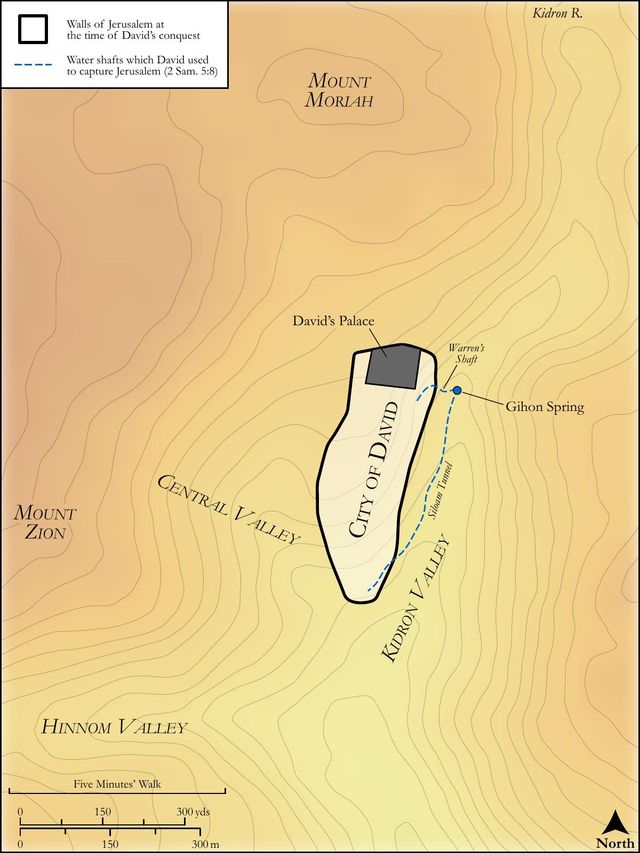
This verse immediately follows a period of significant consolidation and triumph for David's reign. Having been anointed king over all Israel in 2 Samuel 5:1-5, David then strategically captures Jerusalem from the Jebusites, establishing it as his capital and the seat of his burgeoning kingdom, as detailed in 2 Samuel 5:6-9. His authority is further solidified by decisive victories over the Philistines, securing his borders and demonstrating divine favor (2 Samuel 5:17-25). With political and military stability achieved, David now turns his attention to the spiritual heart of the nation. The Ark of the Covenant, which had been residing at Kirjath-jearim for several decades since its return from Philistine captivity (1 Samuel 7:1-2), represents the next logical focus for a king seeking to truly unite Israel under God. This verse, therefore, sets the stage for the dramatic and ultimately tragic events surrounding Uzzah's death, and the eventual, more properly executed transfer of the Ark later in the chapter and in 1 Chronicles 15.
Historical & Cultural Context
The Ark of the Covenant was unequivocally the most sacred object in ancient Israel, serving as the physical representation of Yahweh's presence among His people. It functioned as the divine throne, the repository of the Ten Commandments, and the central symbol of the Mosaic covenant (Exodus 25:10-22). For decades, it had been separated from the tabernacle and the central worship life of Israel, first captured by the Philistines (1 Samuel 4:11) and subsequently residing in various private homes, notably that of Abinadab. David's initiative to bring the Ark to Jerusalem was far more than a mere religious act; it was a profound political and theological statement. By centralizing the Ark in his capital, he aimed to solidify Jerusalem's status as the spiritual and political heart of the unified kingdom, legitimizing his rule as God's chosen king and fulfilling a long-held desire for God's dwelling place to be among His people. The mobilization of "chosen men" for such a task reflects the ancient Near Eastern practice of assembling elite forces for significant national or religious undertakings, highlighting the solemnity and perceived importance of the event.
Key Themes
ShowHideThis verse introduces several crucial themes that resonate throughout the book of 2 Samuel and the broader biblical narrative. Firstly, it highlights David's Unifying Leadership and Vision. Having secured the kingdom politically and militarily, David demonstrates his commitment to spiritual leadership, aiming to centralize worship and God's presence, thereby unifying the disparate tribes under a common spiritual banner. This reflects his desire for a kingdom truly ordered by God's will, as seen throughout 2 Samuel. Secondly, the sheer scale of the gathering underscores the Profound Significance of the Ark of the Covenant. It was not merely an artifact but the embodiment of God's covenant presence, and its relocation was a national priority, reflecting Israel's identity as God's chosen people and their relationship with Yahweh, as established in Exodus. Thirdly, the verse subtly introduces the theme of Divine Holiness and Human Responsibility. While David's intentions are noble, the subsequent narrative (2 Samuel 6:6-7) reveals the critical importance of approaching God's holiness according to His prescribed ways, a lesson that Israel, and indeed all believers, must continually learn. This grand assembly, therefore, is a testament to David's piety, his strategic genius, and the enduring centrality of God's presence in the life of His people.
Exposition and Analysis
ShowHideKey Word Analysis
ShowHideThis word, derived from H3254, means "to add or augment," often used adverbially to signify a continuation or repetition of action. In this context, it suggests David's persistent and active leadership, following his recent military victories and the establishment of his capital. It implies that gathering such a large force was another deliberate and significant undertaking in a series of strategic moves to solidify his reign and centralize the nation's life around God. It sets a tone of renewed effort and purpose.
This primitive root means "to gather for any purpose," including to assemble or bring together. It denotes a formal convocation or assembly, often for a specific, important purpose. It is not a casual meeting but a deliberate act of mobilization, underscoring David's authority and the organized, national scale of the endeavor. The use of this word emphasizes the solemnity and collective nature of bringing the Ark, highlighting that this was a unified effort of the entire nation under its king.
This word, from H977, means "to try" and, by implication, "to select." When applied to "men," it refers to select, strong, and capable individuals, typically in the prime of life, often associated with military service or special, significant assignments. It indicates that David did not merely gather a random crowd, but a carefully selected, elite force. This choice of personnel underscores the immense importance and perceived difficulty or danger of handling the sacred Ark, reflecting a deep reverence and a desire for the most competent individuals to be involved in such a hallowed task.
Verse Breakdown
ShowHide"¶ Again, David gathered together"
This opening phrase immediately establishes David's proactive and decisive leadership. The word "Again" implies a continuity of his energetic reign, following his recent successes in consolidating power and defeating enemies. It highlights his personal initiative in orchestrating this momentous national event, demonstrating his vision for a kingdom centered on God's presence. The act of "gathering together" signifies a deliberate, organized mobilization under his direct command.
"all the chosen men of Israel"
This clause emphasizes the comprehensive and national scope of the undertaking. The phrase "chosen men" (Hebrew: bâchar') refers to select, capable individuals, often those fit for military service or special assignments. This signifies that the assembly was not a random collection of people but a carefully selected, elite group, underscoring the perceived solemnity, importance, and perhaps the dangerous holiness associated with transporting the Ark of the Covenant. It reflects the nation's collective commitment to this sacred task, with the best of Israel being called upon.
"thirty thousand"
This large, round number conveys the massive scale of the assembly. While it could be a literal count, it also functions as a rhetorical device to emphasize the grandeur, national involvement, and the immense resources David was willing to commit to this sacred endeavor. It paints a picture of a grand, public spectacle, designed to impress upon all Israel the significance of bringing God's presence into the heart of the kingdom, showcasing the unified strength and dedication of the people under their king.
Literary Devices
ShowHideThe verse effectively employs several literary devices to convey its meaning and significance. Emphasis is achieved through the opening word "Again," highlighting David's persistent and active leadership in this new phase of his reign, building upon his previous accomplishments. The sheer magnitude of "thirty thousand" "chosen men" serves as Hyperbole or a symbolic representation of a vast, national effort, rather than necessarily a precise census. This exaggeration underscores the monumental importance David ascribed to the Ark's relocation and the collective will of the nation. Furthermore, the meticulous preparation and the vast number of select individuals involved subtly employ Foreshadowing. While intended to show reverence and strength, this grand assembly and the focus on human strength and numbers subtly hint at the challenges and the critical need for divine instruction that will become tragically apparent in the subsequent verses (e.g., Uzzah's death in 2 Samuel 6:6-7), where human methods prove insufficient for handling divine holiness. The verse also uses Synecdoche, where "chosen men of Israel" represents the collective will and participation of the entire nation in this pivotal event, signifying that this was a national undertaking, not merely a personal project of David.
Theological and Thematic Connections
ShowHideThe gathering of "thirty thousand chosen men" to bring the Ark of the Covenant to Jerusalem is a profound theological statement about the centrality of God's presence in the life of His people and the aspirations of a godly king. David's meticulous preparation and the national scale of the endeavor reflect a deep understanding of the Ark's significance as the tangible symbol of God's covenant and His dwelling among Israel. It speaks to the human desire to honor God and to bring His manifest presence into the heart of their national life. However, it also subtly introduces the tension between human zeal and divine holiness, foreshadowing the need for strict adherence to God's commands in approaching His sacred presence. This event is a testament to David's vision for a kingdom truly centered on Yahweh, a vision that would shape Israel's identity for generations and serve as a model for future kings.
Reflection and Application
ShowHideDavid's initiative to gather "thirty thousand chosen men" for the sacred task of bringing the Ark to Jerusalem offers a powerful example of intentionality, reverence, and collective effort in seeking God's presence. It reminds us that significant spiritual undertakings require careful preparation, dedicated resources, and a unified commitment. For believers today, this translates into a call to prioritize God's presence in our individual lives, our families, and our communities. Are we as intentional and dedicated in seeking God's centrality as David was? Do we commit our "chosen" (our best) resources—our time, talent, and treasure—to endeavors that honor Him and advance His kingdom? This verse challenges us to consider the scale of our commitment to spiritual pursuits and to ensure that our efforts are not merely grand gestures but are rooted in a genuine desire to draw near to God, always with reverence and according to His revealed will, understanding that God's holiness demands our humble obedience.
Questions for Reflection
ShowHideFAQ
ShowHideWhy was the Ark so important to David?
ShowHideThe Ark of the Covenant was supremely important to David because it represented the tangible presence of God among His people, the very throne of Yahweh on earth. It contained the tablets of the Law, symbolizing God's covenant with Israel, as detailed in Exodus 25. For David, bringing the Ark to Jerusalem was not just a religious act but a crucial step in legitimizing his reign, unifying the disparate tribes under a common spiritual center, and establishing Jerusalem as the undisputed religious and political capital of a kingdom truly devoted to God. It was a visible sign of God's blessing and a source of national identity and strength, essential for his vision of a unified Israel.
What does "chosen men" signify here?
ShowHideThe phrase "chosen men" (Hebrew: bâchar') refers to select, capable, and often young and strong men, typically those fit for military service or special, significant assignments. It signifies that David was not merely gathering a random crowd but a carefully selected, elite force. This choice of personnel underscores the immense importance and solemnity of the task of handling the sacred Ark, reflecting a deep reverence and a desire for the most competent individuals to be involved in such a hallowed undertaking. It highlights the national significance and the perceived need for strength and purity in this sacred endeavor.
Why "thirty thousand"? Was it a literal count?
ShowHideWhile it is possible that "thirty thousand" was a literal count, it is also a large, round number often used in biblical narratives to convey immense scale and national involvement rather than a precise census. This number emphasizes the grandeur and importance David attached to the event. It suggests a massive, public spectacle designed to impress upon all Israel the significance of bringing God's presence into the heart of the kingdom, showcasing the collective commitment and resources dedicated to this pivotal moment. It serves to underscore the profound national significance of the Ark's relocation and David's leadership in this monumental task.
Christ-Centered Fulfillment
ShowHideDavid's passionate desire to bring the Ark of the Covenant, the tangible symbol of God's presence, into Jerusalem, his capital, finds its ultimate fulfillment in Jesus Christ. The Ark, representing God dwelling among His people, powerfully foreshadows the incarnation, where the very Word of God became flesh and "dwelt among us" (John 1:14). Just as David gathered the chosen men of Israel to bring God's presence to a physical city, God Himself, in Christ, came to dwell not in a box of wood and gold, but in a human body, bringing His divine presence directly into humanity. In Jesus, "all the fullness of the Deity lives in bodily form" (Colossians 2:9), making Him the ultimate tabernacle and temple. The journey of the Ark to Jerusalem, intended to centralize worship, points to Christ's journey to Jerusalem, where He offered the ultimate sacrifice on the cross, establishing a new covenant that makes true, intimate access to God possible for all who believe (Hebrews 10:19-22). Through Christ's atoning work, the need for a physical Ark is transcended, as believers themselves become temples of the Holy Spirit (1 Corinthians 6:19-20), and God's presence is no longer confined to a box or a building, but dwells within His people. This grand procession of the Ark, therefore, is a powerful Old Testament image pointing to the greater reality of God's dwelling with humanity in the person of Jesus Christ, and ultimately, in the New Jerusalem where God's "dwelling place is now among the people, and he will dwell with them" (Revelation 21:3).