


2 Samuel 6:4
Bible text: King James Version (1769 Blayney text) · Public domain
Bible text: Berean Standard Bible · Public domain
Bible text: American Standard Version (1901) · Public domain
Bible text: World English Bible, Messianic edition · Public domain
Bible text: Geneva Bible (1599) · Public domain
Bible text: Young's Literal Translation · Public domain
- וַיִּשָּׂאֻהוּvai·yi·sa·'U·huand they carried itH5375Conj-w ¦ V-Qal-ConsecImperf-3mp ¦ 3msVerb Qal Consecutive Imperfect 3rd Plural Masculineוַandיִּשָּׂאֻthey carriedהוּit
- מִבֵּיתmi·Beitfrom [the] house ofH1004Prep-m ¦ N-mscNoun Singular Masculine Constructמִfromבֵּית[the] house of
- אֲבִינָדָב'a·vi·na·DavAbinadabH41N-proper-mNoun Proper Masculine
- אֲשֶׁר'a·SherwhichH834RelParticle Relative
- בַּגִּבְעָהba·giv·'Ah[was] on the hillH1389Prep-b ¦ N-fsNoun Singular Feminine Absoluteבַּ[was] on theגִּבְעָהhill
- עִם'imwithH5973PrepPreposition
- אֲרוֹן'a·Ron[the] ark ofH727N-mscNoun Singular Masculine Construct
- הָאֱלֹהִיםha·'E·lo·Him<the> GodH430Art ¦ N-mpNoun Plural Masculine Absoluteהָ<the>אֱלֹהִיםGod
- וְאַחְיוֹve·'ach·Yoand AhioH283Conj-w ¦ N-proper-mNoun Proper MasculineוְandאַחְיוֹAhio
- הֹלֵךְho·Lekh[was] walkingH1980V-Qal-Prtcpl-msVerb Qal Participle Singular Masculine Absolute
- לִפְנֵיlif·Nei<to> beforeH6440Prep-l ¦ N-mpcNoun Plural Masculine Constructלִ<to>פְנֵיbefore
- הָאָרוֹןha·'a·Ronthe arkH727Art ¦ N-msNoun Singular Masculine Absoluteהָtheאָרוֹןark
English is a literal word-by-word gloss of the Hebrew, not the KJV's wording. Why?
This is the original text the KJV's translators worked from — each Hebrew word with its own literal English meaning in this verse, prepared by scholars at Tyndale House, Cambridge. The KJV translates whole sentences, not word by word, so its wording differs: one Hebrew word can become several English words, and the KJV may choose “the LORD” where the gloss reads “Yahweh”. Both are faithful — they answer different questions. For the KJV's own rendering, switch to the KJV text.
Details
See on the biblical-era maps
Study this verse
Public-domain commentary
Matthew Henry
From his Commentary on the Whole Bible. Henry comments on passages, not single verses — this entry covers 2 Samuel 6:1–5. His two-level outline is real structure in the source text, so it is rendered as structure.
We have not heard a word of the ark since it was lodged in Kirjath-jearim, immediately after its return out of its captivity among the Philistines (Sa1 7:1, Sa1 7:2), except that, once, Saul called for it, Sa1 14:18. That which in former days had made so great a figure is now thrown aside, as a neglected thing, for many years. And, if now the ark was for so many years in a house, let it not seem strange that we find the church so long in the wilderness, Rev 12:14. Perpetual visibility is no mark of the true church. God is graciously present with the souls of his people even when they want the external tokens of his presence. But now that David is settled in the throne the honour of the ark begins to revive, and Israel's care of it to flourish again, wherein also, no doubt, the good people among them had been careful, but they lacked opportunity. See Phi 4:10.
I.Here is honourable mention made of the ark.
Because it had not been spoken of a great while, now that it is spoken of observe how it is described (Sa2 6:2): it is the ark of God whose name is called by the name of the Lord of hosts that dwelleth between the cherubim, or at which the name, even the name of the Lord of hosts, was called upon, or upon which the name of the Lord of hosts was called, or because of which the name is proclaimed, the name of the Lord of hosts (that is, God was greatly magnified in the miracles done before the ark), or the ark of God, who is called the name (Lev 24:11, Lev 24:16), the name of the Lord of hosts, sitting on the cherubim upon it. Let us learn hence,
1.To think and speak highly of God. He is the name above every name, the Lord of hosts, that has all the creatures in heaven and earth at his command, and receives homage from them all, and yet is pleased to dwell between the cherubim, over the propitiatory or mercy-seat, graciously manifesting himself to his people, reconciled in a Mediator, and ready to do them good.
2.To think and speak honourably of holy ordinances, which are to us, as the ark was to Israel, the tokens of God's presence (Mat 28:2), and the means of our communion with him, Psa 27:4. It is the honour of the ark that it is the ark of God; he is jealous for it, is magnified in it, his name is called upon it. The divine institution puts a beauty and grandeur upon holy ordinances, which otherwise have no form nor comeliness. Christ is our ark. In and by him God manifests his favour and communicates his grace to us, and accepts our adoration and addresses.
II.Here is an honourable attendance given to the ark upon the removal of it.
Now, at length, it is enquired after, David made the motion (Ch1 13:1-3), and the heads of the congregation agreed to it, Sa2 6:4. All the chosen men of Israel are called together to grace the solemnity, to pay their respect to the ark, and to testify their joy in its restoration. The nobility and gentry, elders and officers, came to the number of 30,000 (Sa2 6:1), and the generality of the common people besides (Ch1 13:5); for, some think, it was done at one of the three great festivals. This would make a noble cavalcade, and would help to inspire the young people of the nation, who perhaps had scarcely heard of the ark, with a great veneration for it, for this was certainly a treasure of inestimable value which the king himself and all the great men waited upon, and were a guard to.
III.Here are great expressions of joy upon the removal of the ark, Sa2 6:5.
David himself, and all that were with him that were musically inclined, made use of such instruments as they had to excite and express their rejoicing upon this occasion. It might well put them into a transport of joy to see the ark rise out of obscurity and move towards a public station. It is better to have the ark in a house than not at all, better in a house than a captive in Dagon's temple; but it is very desirable to have it in a tent pitched on purpose for it, where the resort to it may be more free and open. As secret worship is better the more secret it is, so public worship is better the more public it is; and we have reason to rejoice when restraints are taken off, and the ark of God finds welcome in the city of David, and has not only the protection and support, but the countenance and encouragement, of the civil powers; for joy of this they played before the Lord. Note, Public joy must always be as before the Lord, with an eye to him and terminating in him, and must not degenerate into that which is carnal and sensual. Dr. Lightfoot supposes that, upon this occasion, David penned the 68th Psalm, because it begins with that ancient prayer of Moses at the removing of the ark, Let God arise, and let his enemies be scattered; and notice is taken there (v. 25) of the singers and players on instruments that attended, and (v. 27) of the princes of several of the tribes; and perhaps those words in the last verse, O God, thou art terrible out of thy holy places, were added upon occasion of the death of Uzzah.
IV.Here is an error that they were guilty of in this matter, that they carried the ark in a cart or carriage, whereas the priests should have carried it upon their shoulders, Sa2 6:3. The Kohathites that had the charge of the ark had no wagons assigned them, because their service was to bear it upon their shoulders, Num 7:9. The ark was no such heavy burden but that they might, among them, have carried it as far as Mount Sion upon their shoulders, they needed not to put it in a cart like a common thing. It was no excuse for them that the Philistines had done so and were not punished for it; they knew no better, nor had they any priests or Levites with them to undertake the carrying of it; better carry it in a cart than that any of Dagon's priests should carry it. Philistines may cart the ark with impunity; but, if Israelites do so, they do it at their peril. And it mended the matter very little that it was a new cart; old or new, it was not what God had appointed. I wonder how so wise and good a man as David was, that conversed so much with the law of God, came to be guilty of such an oversight. We will charitably hope that it was because he was so extremely intent upon the substance of the service that he forgot to take care of this circumstance.
Historical interpretation
Historical reception
1 surviving comment on this verse from the historical church.
“Again I say to you, if two of you agree on earth about anything they ask, it will be done for them.” Strictly speaking, the word symphony is used by musicians for the voices of harmony. For among musical tones, some harmonize with each other and others do not. But the Gospel is also familiar with this term as applied to music where it says, “He heard music [symphōnias] and dancing.” For it was fitting that, at the harmony that resulted between the father and his son who had been lost but was now found through his repentance, a symphony should be heard on the occasion of the rejoicing of the house.… Akin to this kind of symphony is what is written in the second book of Kings [Samuel] when the brothers of Aminadab “went before the ark, and David and the sons of Israel were playing before the face of the Lord on well-tuned instruments and in power and in songs.” For the “well-tuned instruments in power and in song” have in them that harmony of tones which is of such power that if only two people bring before the Father in heaven any request with that symphony which is found in divine and spiritual music, the Father grants it to them—which is most remarkable.
Continue studying 2 Samuel 6:4 across the web’s major study libraries — every link below opens this exact verse, chapter, or book on the destination site.
Read & Compare
 BibleGatewayThis verse in more than 200 translations and 70 languages.
 Bible.comThe YouVersion reader — hundreds of translations, reading plans, and highlights.
 ESV.orgCrossway's official English Standard Version reader.
 NET BibleThe NET translation with 60,000+ translators' notes on every rendering decision.
 STEP BibleTyndale House's free study tool — original text, vocabulary, and scholarly resources.
 BibliaLogos Bible Software's free web reader.
 USCCBThe New American Bible (Revised Edition) with the U.S. bishops' study notes.
Commentaries
 BibleHub CommentariesDozens of classic commentaries on this verse, gathered on one page.
 StudyLightMore than 100 commentary sets — the largest collection on the web.
 BibleRefPlain-English commentary on what this verse means, verse by verse.
 Enduring WordDavid Guzik's free commentary on this chapter, widely used by Bible teachers.
 Bible Study ToolsVerse commentary alongside Greek and Hebrew study aids.
Original Language & Research
- BibleHub InterlinearThe verse word by word — original language, transliteration, and English.
- BibleHub LexiconEvery word's original-language definition and Strong's entry.
 Blue Letter BibleDeep-study tools — Strong's numbers, concordance, and word studies.
 SefariaThe Hebrew text with Rashi and centuries of Jewish commentary.
Sermons, Hymns & Audio


TrulyRandomVerse is not affiliated with these sites and doesn’t control their content. They’re linked because they’re genuinely useful.
Summary
Second Samuel 6:4 details the initial movement of the Ark of the Covenant from the house of Abinadab in Gibeah, marking King David's pivotal, yet ultimately flawed, attempt to bring this sacred symbol of God's presence to Jerusalem. This seemingly straightforward act of transport immediately sets the stage for a dramatic and tragic event, subtly hinting at the underlying tension between human zeal and divine command that will unfold as the narrative progresses, underscoring the profound holiness of God.
Context
ShowHideLiterary Context
This verse serves as a crucial link in the narrative describing David's first, ill-fated endeavor to relocate the Ark of the Covenant. It immediately follows 2 Samuel 6:3, which introduces the new cart and oxen used for the Ark's transport, a detail that subtly signals a deviation from prescribed Mosaic law. The verse directly precedes the tragic account of Uzzah's death in 2 Samuel 6:6-7, where he is struck down for touching the Ark. The narrative thread meticulously contrasts David's fervent, well-intentioned initiative and the national celebration with the swift divine judgment, thereby highlighting the critical importance of adhering to God's specific instructions regarding sacred things. This passage functions as a theological pivot, emphasizing that even righteous goals must be pursued in accordance with divine will.
Historical & Cultural Context
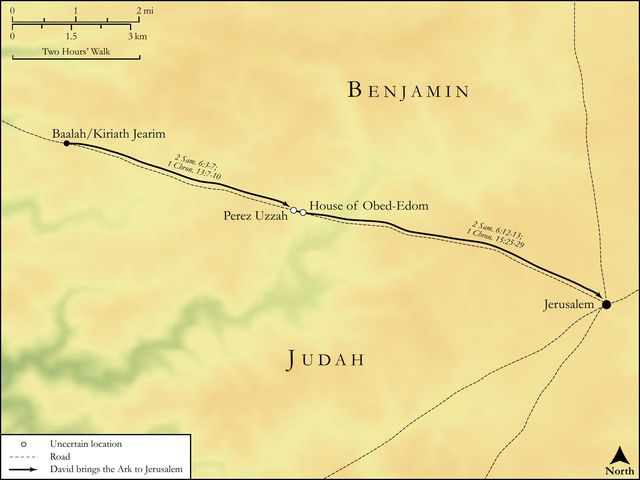
For approximately two decades, the Ark of the Covenant had resided in the house of Abinadab in Kirjath-jearim, also referred to as Gibeah (as noted in 1 Samuel 7:1-2), following its tumultuous return from the Philistines. During this period, the Ark's central role in Israelite worship and national identity, so prominent during the wilderness wanderings and the time of the Judges, had largely been neglected. David, having recently established Jerusalem as his capital and successfully unified the kingdom, sought to consolidate both the political and spiritual life of the nation by bringing the Ark into the city. This act was intended to centralize worship, signify God's presence at the heart of the kingdom, and reinforce the covenant relationship between God and Israel, echoing the detailed instructions for the Ark's construction and significance found in Exodus 25:10-22.
Key Themes
ShowHideThis verse subtly introduces several profound themes that resonate throughout the broader narrative of 2 Samuel 6. Firstly, it underscores the Desire for God's Presence, as David's zealous initiative reflects a genuine longing for God to be central to the nation's life, despite the flawed methodology. Secondly, it immediately foreshadows the theme of Improper Handling of Sacred Things. The chosen method of transport—on a new cart rather than being carried by the prescribed Levitical means—signals a critical deviation from divine command, setting the stage for the tragic consequences that follow. This oversight, whether born of ignorance or presumption, demonstrates a lack of careful adherence to God's law regarding holy objects, a principle clearly articulated in Numbers 4:15. Lastly, the involvement of Abinadab's sons, Uzzah and Ahio, highlights the theme of Human Responsibility and Reverence in approaching God's holiness. Their long-standing care for the Ark, while commendable in its duration, ultimately proved insufficient without strict obedience to divine protocol.
Exposition and Analysis
ShowHideKey Word Analysis
ShowHideDerived from H5375, this verb signifies "to lift," "bear," or "carry." In this context, it emphasizes the active role of human agents in physically moving the Ark from its resting place. The choice of this verb highlights the human initiative and effort involved in this pivotal moment, underscoring that the Ark's relocation was an intentional act driven by David and his people.
This phrase combines H727 ("a box, ark, chest") with H430 ("God," specifically the supreme God). It identifies the object as the most sacred artifact in Israel, representing not merely a ceremonial container but the tangible symbol of God's dwelling presence, His throne, and the very covenant He had established with His people. The use of "God" (ʼĕlôhîym) here explicitly emphasizes its divine ownership and inherent, absolute holiness, elevating the significance of the entire procession.
Meaning "brotherly," this name signifies his familial relationship, specifically to Uzzah, who is mentioned in the preceding verse. The name itself is descriptive, highlighting the close bond and shared responsibility between the two brothers in this critical task. His role of "going before the ark" (H1980 hâlak "to walk"; H6440 pânîym "face, before") suggests a leading or guiding position, likely clearing the path or directing the oxen, underscoring his direct involvement in the Ark's transport.
Verse Breakdown
ShowHide"And they brought it out of the house of Abinadab which [was] at Gibeah"
This clause establishes the precise starting point of the Ark's journey. "They" refers broadly to David and the assembled Israelites, along with Abinadab's sons, Uzzah and Ahio, who were directly responsible for the Ark. The "house of Abinadab" in Gibeah (also known as Kirjath-jearim) had been the Ark's residence for two decades, a period marked by relative obscurity and neglect. This act of bringing it out signifies a deliberate re-engagement with God's visible presence by the nation under David's leadership, aiming to restore its central role in Israelite worship and national life.
"accompanying the ark of God"
This phrase describes the large retinue that surrounded the Ark. The Hebrew implies a sense of attendance or being "with" the Ark, suggesting a procession of honor, reverence, and national celebration. This detail underscores the public and communal nature of this event, involving a significant portion of the Israelite leadership and populace. It emphasizes the collective desire to honor God and bring His presence into the capital, highlighting the fervent, albeit misguided, atmosphere surrounding the Ark's movement.
"and Ahio went before the ark"
This specific detail highlights the role of Ahio, one of Abinadab's sons. His position "before the ark" suggests he was leading the procession, likely directing the oxen pulling the cart. This detail, seemingly minor, sets up a subtle contrast with Uzzah's position "beside the ark" (mentioned in 2 Samuel 6:3), and together, their roles emphasize the direct and personal involvement of Abinadab's family in the Ark's transport, a responsibility they had borne for many years.
Literary Devices
ShowHideThe verse employs several subtle literary devices that enrich its meaning and foreshadow future events. Foreshadowing is prominent, as the seemingly innocuous detail of transporting the Ark on a new cart, rather than by the divinely prescribed Levitical method, subtly hints at the impending disaster. The very act of "bringing it out" sets in motion a chain of events that will culminate in divine judgment, creating a sense of dramatic irony for the discerning reader. There is also a strong element of Symbolism in the Ark itself, which represents God's holy presence, His covenant, and His sovereign throne. The movement of this sacred object is not merely a logistical task but a deeply symbolic act intended to unify the nation under God's authority. Finally, a degree of Irony is present, as David's fervent, well-intentioned desire to honor God and bring His presence to Jerusalem is tragically undermined by a failure to adhere to the very divine commands that define how God's holiness is to be approached. The celebratory atmosphere described in the surrounding verses stands in stark contrast to the tragic outcome, highlighting the tension between human zeal and divine law.
Theological and Thematic Connections
ShowHideThis verse, though brief, is pregnant with theological significance, primarily serving as the opening act in a narrative that profoundly illustrates the nature of God's holiness and the absolute necessity of approaching Him on His own terms. The Ark, representing God's very presence and His covenant throne, was not to be treated as a common object, even with the best intentions. The method of its transport—on a new cart rather than carried by Kohathite Levites as explicitly prescribed in the Mosaic Law—reveals a dangerous presumption or ignorance regarding divine mandates. This disregard for specific instructions, however well-meaning, underscores a critical theological principle: God's holiness demands reverence, obedience, and adherence to His revealed will, not human innovation, convenience, or even sincere zeal divorced from divine command. The subsequent judgment on Uzzah (2 Samuel 6:6-7) serves as a stark reminder that God's character is unchangeable, and His commands are not arbitrary, but are rooted in His absolute purity, majesty, and unapproachable glory.
Reflection and Application
ShowHideSecond Samuel 6:4, as the prelude to a profound and sobering lesson, reminds us that genuine devotion to God must be meticulously coupled with careful obedience to His revealed will. David's desire to bring the Ark to Jerusalem was commendable, reflecting a heart that longed for God's central presence and a unified nation under divine authority. However, the method chosen, though seemingly efficient and perhaps even respectful in a human sense, directly contravened God's explicit instructions for handling the Ark. This serves as a timeless warning: good intentions alone are insufficient in serving a holy God. Our zeal must be tempered by careful study of Scripture and humble submission to its precepts. For believers today, while we no longer deal with a physical Ark, the underlying principle remains: we are called to approach God, worship Him, and engage in His work not according to our own wisdom, cultural norms, or convenience, but according to His established ways. This requires a diligent pursuit of understanding His Word and a reverent obedience that acknowledges His supreme authority and holiness, ensuring that our service is not only fervent but also faithful and pleasing to Him.
Questions for Reflection
ShowHideFAQ
ShowHideWhy was the Ark of the Covenant at Abinadab's house for so long?
ShowHideThe Ark had been at Abinadab's house in Kirjath-jearim (also called Gibeah in this context) for approximately twenty years, as mentioned in 1 Samuel 7:1-2. This period followed its tumultuous return from the Philistines, who had captured it but then suffered severe plagues and returned it to Israelite territory. When it arrived at Beth-shemesh, some of the people irreverently looked into it, resulting in a severe judgment (1 Samuel 6:19-21). Fearing the Ark's power and holiness, the people of Beth-shemesh asked the inhabitants of Kirjath-jearim to take it. Abinadab's family, specifically his son Eleazar, was consecrated to guard it. During the reign of Saul, the Ark remained largely neglected and outside the central worship life of Israel, reflecting a period of spiritual decline. It was only with David's reign and his fervent desire to centralize worship in Jerusalem that the Ark's proper place was re-evaluated and its return initiated.
Christ-Centered Fulfillment
ShowHideThe movement of the Ark of the Covenant, representing God's dwelling presence among His people and the locus of His glory, finds its ultimate and perfect fulfillment in the person and work of Jesus Christ. Just as King David sought to bring God's presence into the heart of Israel's capital, so God, in His ultimate act of redemption, brought His very presence to dwell among humanity in the person of Jesus, Emmanuel, which means "God with us" (Matthew 1:23). The Ark, a physical symbol of God's throne and the place where His glory resided, perfectly foreshadowed Christ, who is the true and perfect embodiment of God's glory and presence, the Word made flesh dwelling among us (John 1:14). Furthermore, the strict regulations for approaching the Ark, which highlighted the unapproachable holiness of God and the absolute necessity of proper mediation, are fully met and surpassed in Christ. He is the ultimate High Priest (Hebrews 4:14-16) and the perfect, once-for-all sacrifice, through whom believers now have direct and confident access to God's presence, not through a physical object or ritual, but through faith in His atoning work and His shed blood (Hebrews 10:19-22). The deep desire for God's presence, evident in David's actions, is fully realized in the New Covenant, where God dwells not in a box or a temple made with hands, but by His Holy Spirit within believers, making them living temples of the Holy Spirit (1 Corinthians 6:19).