


1 Chronicles 13:14
Bible text: King James Version (1769 Blayney text) · Public domain
Bible text: King James Version with Strong's numbers · Public domain
Bible text: Berean Standard Bible · Public domain
Bible text: American Standard Version (1901) · Public domain
Bible text: World English Bible, Messianic edition · Public domain
Bible text: Geneva Bible (1599) · Public domain
Bible text: Young's Literal Translation · Public domain
- וַיֵּשֶׁבvai·ye·Shevand it remainedH3427Conj-w ¦ V-Qal-ConsecImperf-3msVerb Qal Consecutive Imperfect 3rd Singular Masculineוַandיֵּשֶׁבit remained
- אֲרוֹן'a·Ron[the] ark ofH727N-mscNoun Singular Masculine Construct
- הָאֱלֹהִיםha·'E·lo·Him<the> GodH430Art ¦ N-mpNoun Plural Masculine Absoluteהָ<the>אֱלֹהִיםGod
- עִם'imwithH5973PrepPreposition
- בֵּיתbeit[the] household ofH1004N-mscNoun Singular Masculine Construct
- עֹבֵד'o·VedObed-H5654N-proper-mNoun Proper Masculine
- אֱדֹם'e·DomEdomH5654N-proper-mNoun Proper Masculine
- בְּבֵיתוֹbe·vei·Toin his houseH1004Prep-b ¦ N-msc ¦ 3msNoun Singular Masculine Constructבְּinבֵיתhouseוֹhis
- שְׁלֹשָׁהshe·lo·ShahthreeH7969N-csNoun Singular common gender Absolute
- חֳדָשִׁיםcho·da·ShimmonthsH2320N-mpNoun Plural Masculine Absolute
- וַיְבָרֶךְvay·Va·rekhand he blessedH1288Conj-w ¦ V-Piel-ConsecImperf-3msVerb Piel Consecutive Imperfect 3rd Singular Masculineוַandיְבָרֶךְhe blessed
- יְהוָהYah·wehYahwehH3068N-properNoun Proper Title
- אֶת'et<obj.>H853DirObjMParticle Object Indicator
- בֵּיתbeit[the] household ofH1004N-mscNoun Singular Masculine Construct
- עֹבֵד'oedObed-H5654N-proper-mNoun Proper Masculine
- אֱדֹם'e·DomEdomH5654N-proper-mNoun Proper Masculine
- וְאֶתve·'Etand <obj.>H853Conj-w ¦ DirObjMParticle Object Indicatorוְandאֶת<obj.>
- כָּלkolallH3605N-msNoun Singular Masculine Absolute
- אֲשֶׁר'a·SherthatH834RelParticle Relative
- לוֹlo[belonged] to himPrep-l ¦ 3msSuffix Personal 3rd Singular Masculineל[belonged] toוֹhim
English is a literal word-by-word gloss of the Hebrew, not the KJV's wording. Why?
This is the original text the KJV's translators worked from — each Hebrew word with its own literal English meaning in this verse, prepared by scholars at Tyndale House, Cambridge. The KJV translates whole sentences, not word by word, so its wording differs: one Hebrew word can become several English words, and the KJV may choose “the LORD” where the gloss reads “Yahweh”. Both are faithful — they answer different questions. For the KJV's own rendering, switch to the KJV text.
Details
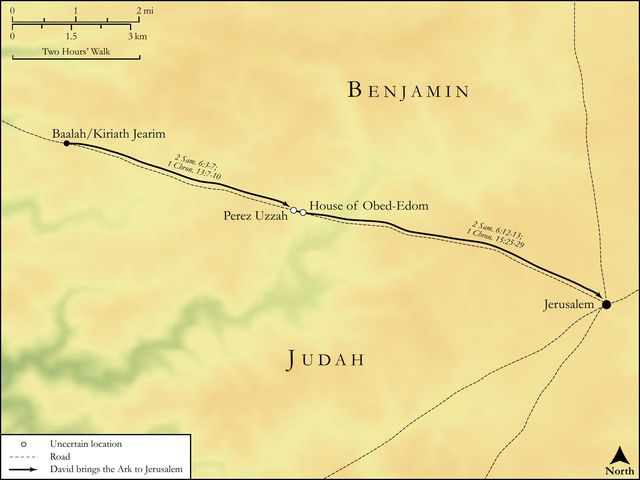
See on the biblical-era map
Study this verse
Public-domain commentary
Matthew Henry
From his Commentary on the Whole Bible. Henry comments on passages, not single verses — this entry covers 1 Chronicles 13:9–14.
This breach upon Uzza, which caused all the joy to cease, we had an account of, Sa2 6:6, etc. 1. Let the sin of Uzza warn us all to take heed of presumption, rashness, and irreverence, in dealing about holy things (Ch1 13:9), and not to think that a good intention will justify a bad action. In our communion with God we must carefully watch over our own hearts, lest familiarity breed contempt, and we think God is in any way beholden to us. 2. Let the punishment of Uzza convince us that the God with whom we have to do is a jealous God. His death, like that of Nadab and Abihu, proclaims aloud that God will be sanctified in those that come nigh unto him (Lev 10:3), and that the nearer any are to him the more displeased he is with their presumptions. Let us not dare to trifle with God in our approaches to him; and yet let us, through Christ, come boldly to the throne of grace; for we are under the dispensation of liberty and grace, not of bondage and terror. 3. Let the damp this gave to the joy of Israel be a memorandum to us always to rejoice with trembling, and to serve the Lord with fear, even when we serve him with gladness. 4. Let David's displeasure upon this occasion caution us to take heed to our spirits when we are under divine rebukes, lest, instead of submitting to God, we quarrel with him. If God be angry with us, shall we dare to be angry with him? 5. Let the stop thus put to the solemnity caution us not to be driven off from our duty by those providences which are only intended to drive us from our sins. David should have gone on with the work notwithstanding the breach made upon Uzza; so might the breach have been made up. 6. Let the blessing which the ark brought with it to the house of Obed-edom encourage us to welcome God's ordinances into our houses, as those that believe the ark is a guest that nobody shall lose by; not let it be less precious to us for its being to some a stone of stumbling and a rock of offence. If the gospel be to some a savour of death unto death, as the ark was to Uzza, yet let us receive it in the love of it and it will be to us a saviour of life unto life.
Continue studying 1 Chronicles 13:14 across the web’s major study libraries — every link below opens this exact verse, chapter, or book on the destination site.
Read & Compare
 BibleGatewayThis verse in more than 200 translations and 70 languages.
 Bible.comThe YouVersion reader — hundreds of translations, reading plans, and highlights.
 ESV.orgCrossway's official English Standard Version reader.
 NET BibleThe NET translation with 60,000+ translators' notes on every rendering decision.
 STEP BibleTyndale House's free study tool — original text, vocabulary, and scholarly resources.
 BibliaLogos Bible Software's free web reader.
 USCCBThe New American Bible (Revised Edition) with the U.S. bishops' study notes.
Commentaries
 BibleHub CommentariesDozens of classic commentaries on this verse, gathered on one page.
 StudyLightMore than 100 commentary sets — the largest collection on the web.
 BibleRefPlain-English commentary on what this verse means, verse by verse.
 Enduring WordDavid Guzik's free commentary on this chapter, widely used by Bible teachers.
 Bible Study ToolsVerse commentary alongside Greek and Hebrew study aids.
Original Language & Research
- BibleHub InterlinearThe verse word by word — original language, transliteration, and English.
- BibleHub LexiconEvery word's original-language definition and Strong's entry.
 Blue Letter BibleDeep-study tools — Strong's numbers, concordance, and word studies.
 SefariaThe Hebrew text with Rashi and centuries of Jewish commentary.
Sermons, Hymns & Audio


TrulyRandomVerse is not affiliated with these sites and doesn’t control their content. They’re linked because they’re genuinely useful.
Summary
1 Chronicles 13:14 chronicles a pivotal moment in King David's attempt to relocate the Ark of the Covenant to Jerusalem. Following the tragic, divinely-ordained death of Uzzah for improperly touching the sacred Ark, David, overwhelmed by fear and reverence, diverted its journey to the home of Obed-Edom the Gittite. This verse beautifully records the immediate and profound divine favor bestowed upon Obed-Edom's household over the three months the Ark resided there, powerfully demonstrating God's readiness to bless those who approach His holy presence with appropriate reverence, obedience, and honor.
Context
ShowHideLiterary Context
This verse is strategically placed within the narrative of King David's initial, flawed endeavor to transport the Ark of the Covenant from Kiriath-Jearim to Jerusalem. The preceding verses vividly recount David's grand procession and the catastrophic error of Uzzah, who, in a moment of perceived crisis, reached out to steady the Ark when the oxen stumbled, resulting in his immediate death by divine judgment, as detailed in 1 Chronicles 13:9-10. This shocking event instilled profound fear and apprehension in David, leading him to abandon the original plan and divert the Ark to the nearby house of Obed-Edom, as described in 1 Chronicles 13:11-13. Verse 14 then serves as a crucial narrative interlude, presenting a stark and compelling contrast between Uzzah's tragic fate and Obed-Edom's remarkable blessing. This powerful juxtaposition not only highlights the consequences of irreverence versus reverence but also sets the theological and narrative stage for David's subsequent, successful, and properly executed transport of the Ark to Jerusalem in 1 Chronicles 15.
Historical & Cultural Context
The Ark of the Covenant held unparalleled significance in ancient Israel, serving as the tangible symbol of God's dwelling presence among His people and His earthly throne. Its proper handling was meticulously prescribed within the Mosaic Law, specifically mandating that it be carried by Levites of the Kohathite clan on poles through rings, with direct physical contact strictly forbidden, as outlined in Numbers 4:15. David's initial decision to transport the Ark on a new cart, while perhaps well-intentioned, regrettably mirrored the Philistine method observed in 1 Samuel 6:7 and flagrantly disregarded the established divine protocol. Uzzah's death was therefore not an arbitrary act but a severe, albeit tragic, demonstration of God's absolute holiness and the non-negotiable necessity of strict obedience to His commands concerning sacred things. Obed-Edom, likely a Levite from Gath-Rimmon (a designated Levitical city, see Joshua 21:24-25), or potentially a devout proselyte, exemplified the proper reverence, hospitality, and adherence to protocol required for God's holy presence, which directly led to the remarkable and widely observed blessing described in this verse.
Key Themes
ShowHideThe passage powerfully underscores several foundational theological themes. Firstly, the absolute holiness of God and the sacredness of His presence are paramount. Uzzah's death serves as an enduring, sobering reminder that God's presence is not to be treated casually, approached presumptuously, or managed according to human convenience, but rather with the utmost reverence, awe, and strict adherence to His revealed will. Secondly, the narrative highlights the profound theme of blessing through reverence and obedience. In stark contrast to Uzzah's judgment, Obed-Edom's household experienced tangible, abundant, and comprehensive blessing, vividly illustrating that while God's holiness demands respect, He also pours out lavish favor upon those who approach Him with a humble, obedient, and reverent heart. This divine favor was so evident and widely reported that it eventually spurred David to undertake a second, successful attempt to bring the Ark to Jerusalem, this time meticulously following the prescribed Levitical methods, as recorded in 1 Chronicles 15:25. Finally, the passage subtly speaks to divine sovereignty and grace, as God's blessing on Obed-Edom was a clear demonstration of His willingness to bless those who host His presence with honor, even in a situation initially born out of human error and fear, transforming a moment of crisis into a testimony of His goodness.
Exposition and Analysis
ShowHideKey Word Analysis
ShowHideA primitive root meaning "to sit down; by implication, to dwell, to remain." In this context, it signifies the Ark's settled presence, indicating a period of dwelling rather than mere transient storage. The word implies a stable, enduring stay, allowing sufficient time for the divine blessing to manifest and be observed by all.
Meaning "a house (in the greatest variation of applications, especially family, etc.)." This term is crucial as it refers not merely to Obed-Edom's physical dwelling but comprehensively to his entire household, encompassing his family, dependents, and all his possessions. The blessing was holistic, extending to every aspect of his domestic and economic life.
A primitive root meaning "to kneel; by implication to bless God (as an act of adoration), and (vice-versa) man (as a benefit)." Here, it denotes an active, positive intervention by the LORD to bring about prosperity, favor, abundance, protection, and overall well-being. It signifies a tangible, observable outpouring of divine goodness, demonstrating God's delight in those who honor His presence.
Verse Breakdown
ShowHide"And the ark of God remained with the family of Obededom in his house three months."
This clause establishes the temporary, yet significant, dwelling place of the Ark after David's fearful decision to divert its journey. The specification of "three months" is a crucial temporal detail, indicating a sufficient period for the divine blessing to become undeniably evident and widely known, serving as a powerful sign or testimony to all. The phrase "family of Obededom in his house" emphasizes that the blessing was not merely personal to Obed-Edom but extended comprehensively to his entire household, including all its members and possessions, underscoring the holistic and pervasive nature of God's favor.
"And the LORD blessed the house of Obededom, and all that he had."
This is the climactic and most significant statement of the verse, directly attributing the prosperity, well-being, and flourishing of Obed-Edom and his entire household to the active and benevolent hand of Yahweh (the LORD). The repetition of "the house of Obededom" reinforces the comprehensive scope of the blessing. The emphatic addition "and all that he had" further specifies that this divine favor encompassed every conceivable aspect of his life—his family, his material possessions, his livestock, and perhaps even his health, peace, and spiritual well-being. This profound blessing stands in stark, intentional contrast to the judgment meted out to Uzzah, powerfully highlighting the principle that reverent and obedient posture towards God's holiness leads directly to divine favor and abundant life.
Literary Devices
ShowHideThe passage effectively employs Contrast as its primary literary device. The tragic, immediate death of Uzzah, who died for his irreverent touch of the Ark, is placed in stark opposition to the abundant, tangible blessing bestowed upon Obed-Edom's household, which hosted the Ark with reverence and proper care. This powerful juxtaposition serves to illustrate the dual nature of God's holiness: it brings swift judgment upon disobedience but lavish blessing upon those who honor it. Furthermore, Symbolism is central to the narrative, as the Ark of the Covenant itself symbolizes God's tangible, active presence among His people. Its presence in Obed-Edom's house, and the subsequent flourishing, serves as a potent symbol of the life-giving, prosperity-bringing nature of God's presence when properly revered and welcomed. The narrative also contains an element of Irony, as David's fear and apprehension, which led him to divert the Ark, inadvertently resulted in a public, undeniable demonstration of God's blessing, which ultimately served to encourage David to correct his methods and successfully bring the Ark to Jerusalem.
Theological and Thematic Connections
ShowHideThe account of Obed-Edom profoundly illustrates the timeless principle that God's presence, though inherently holy and demanding of reverence, is simultaneously the ultimate source of immeasurable blessing and life. The Ark, serving as the preeminent symbol of the very throne and dwelling place of God among His people, brought tangible prosperity and comprehensive well-being to Obed-Edom's household, not because of any inherent magical quality in the object itself, but solely because of the Person it represented—the living God. This narrative teaches us that a proper, reverent, and obedient posture towards God's holiness and His revealed will invites His favor, goodness, and transforming power into our lives and homes. It underscores that true, lasting blessing flows from being in a right, submissive relationship with God and actively honoring His presence in our midst, transforming a situation initially born of human error and fear into a powerful testimony of divine grace and unwavering faithfulness.
Reflection and Application
ShowHideThe story of Obed-Edom offers timeless and profound lessons for believers today. While the physical Ark of the Covenant no longer exists, the foundational truth of God's active, indwelling presence remains central to our Christian faith. For Christians, the Holy Spirit indwells us, making our very bodies temples of God, as affirmed in 1 Corinthians 6:19. This passage encourages us not only to acknowledge God's awesome holiness but to actively cultivate an environment, both personally and within our homes, where His presence is welcomed, honored, and obeyed. Just as Obed-Edom experienced tangible and comprehensive blessing, we can trust that God delights in pouring out His goodness upon those who approach Him with reverence, humility, and a sincere desire to live according to His will. This blessing may manifest in diverse forms—profound peace, overflowing joy, spiritual growth, divine wisdom, timely provision, or favor in relationships—all serving as tangible demonstrations of His enduring goodness and faithfulness to those who honor Him.
Questions for Reflection
ShowHideFAQ
ShowHideWho was Obed-Edom, and why was he chosen to host the Ark?
ShowHideObed-Edom is identified as "the Gittite," which most likely indicates he was from Gath-Rimmon, a Levitical city in the territory of Dan, as mentioned in Joshua 21:24-25. This strong geographical and tribal connection suggests he was indeed a Levite, specifically a Kohathite, the very clan responsible for the sacred duty of carrying the Ark. If so, he would have possessed an inherent understanding of the meticulous sacred protocols surrounding the Ark, unlike David's initial, ill-advised method of transport. His choice was likely due to his proximity to the aborted journey route and his presumed Levitical lineage, making him a fitting, albeit temporary, custodian of the Ark. His name, ironically, means "servant of Edom" or "servant of man," but his actions undeniably proved him a faithful servant of the LORD.
Why did God bless Obed-Edom so abundantly for only three months?
ShowHideThe three months were a divinely appointed and sufficient period for the blessing to be clearly evident, undeniably tangible, and widely known throughout Israel, serving as a powerful public demonstration of God's favor. This relatively short duration highlights the immediacy, potency, and undeniable nature of God's blessing when His presence is honored and His commands are respected. The blessing was not a reward for a prolonged period of service but a direct, immediate consequence of Obed-Edom's reverent reception, hospitable care, and proper handling of the Ark, contrasting sharply with Uzzah's irreverence. It was a divine sign, intended to show David and all Israel that God's presence, when approached rightly and with obedience, brings abundant life and profound blessing, not just judgment. This evident blessing ultimately served as the catalyst that encouraged David to correct his methods and properly transport the Ark to Jerusalem, as recorded in 1 Chronicles 15:25.
Christ-Centered Fulfillment
ShowHideThe narrative of the Ark's presence bringing profound blessing to Obed-Edom's house finds its ultimate and most glorious fulfillment in the person and work of Jesus Christ. The Ark of the Covenant was the preeminent symbol of God's dwelling presence among His people, a temporary and veiled representation of His glory and throne. In Christ, God's presence is no longer confined to a physical box or a temple, but is fully and perfectly incarnated in a person. Jesus is the true "Ark of God," the very embodiment of "God with us," Emmanuel, as prophesied and fulfilled in Matthew 1:23. He is the one in whom "all the fullness of the Deity lives in bodily form," as declared in Colossians 2:9. Just as the Ark brought tangible blessing to Obed-Edom's house, so too does the presence of Christ bring ultimate and eternal blessing, not merely material prosperity, but eternal life, complete reconciliation with God, and spiritual abundance to all who receive Him. Through His perfect sacrifice on the cross, Jesus has opened a new and living way for us to draw near to God's holy presence with confidence, not fear, for we now approach the throne of grace through Him, as encouraged in Hebrews 4:16. We, as believers, are now the temple of the Holy Spirit, indwelt by God Himself, as taught in 1 Corinthians 6:19, experiencing the immeasurable blessings of His presence as we walk in fellowship with the One who is greater than the temple, as Jesus Himself proclaimed in Matthew 12:6. The blessing on Obed-Edom's house was a beautiful, historical foreshadowing of the immeasurable spiritual blessings poured out upon all who welcome Christ into the "house" of their lives.