


Genesis 39:5
- וַיְהִיvay·Hiand it wasH1961Conj-w ¦ V-Qal-ConsecImperf-3msVerb Qal Consecutive Imperfect 3rd Singular Masculineוַandיְהִיit was
- מֵאָזme·'Azfrom thenH227Prep-m ¦ AdvAdverbמֵfromאָזthen
- הִפְקִידhif·Kidhe appointedH6485V-Hiphil-Perf-3msVerb Hiphil Perfect 3rd Singular Masculine
- אֹתוֹ'o·To<obj.> himH853DirObjM ¦ 3msParticle Object Indicatorאֹת<obj.>וֹhim
- בְּבֵיתוֹbe·vei·Toin his householdH1004Prep-b ¦ N-msc ¦ 3msNoun Singular Masculine Constructבְּinבֵיתhouseholdוֹhis
- וְעַלve·'Aland overH5921Conj-w ¦ PrepPrepositionוְandעַלover
- כָּלkolallH3605N-msNoun Singular Masculine Absolute
- אֲשֶׁר'a·SherthatH834RelParticle Relative
- יֶשׁyeshthereH3426Adj-csAdjective Numerical Singular common gender Absolute
- לוֹlo[belonged] to <the> himPrep-l ¦ 3msSuffix Personal 3rd Singular Masculineל[belonged] to <the>וֹhim
- וַיְבָרֶךְvay·Va·rekhand he blessedH1288Conj-w ¦ V-Piel-ConsecImperf-3msVerb Piel Consecutive Imperfect 3rd Singular Masculineוַandיְבָרֶךְhe blessed
- יְהוָהYah·wehYahwehH3068N-properNoun Proper Title
- אֶת'et<obj.>H853DirObjMParticle Object Indicator
- בֵּיתbeit[the] household ofH1004N-mscNoun Singular Masculine Construct
- הַמִּצְרִיha·mitz·Rithe EgyptianH4713Art ¦ N-msNoun Gentilic Singular Masculine AbsoluteהַtheמִּצְרִיEgyptian
- בִּגְלַלbig·Lalon account ofH1558Prep-b ¦ N-mscNoun Singular Masculine Constructבִּonגְלַלaccount of
- יוֹסֵףyo·SefJosephH3130N-proper-mNoun Proper Masculine
- וַיְהִיvay·Hiand it wasH1961Conj-w ¦ V-Qal-ConsecImperf-3msVerb Qal Consecutive Imperfect 3rd Singular Masculineוַandיְהִיit was
- בִּרְכַּתbir·Kat[the] blessing ofH1293N-fscNoun Singular Feminine Construct
- יְהוָהYah·wehYahwehH3068N-properNoun Proper Title
- בְּכָלbe·kholon allH3605Prep-b ¦ N-msNoun Singular Masculine Absoluteבְּonכָלall
- אֲשֶׁר'a·SherthatH834RelParticle Relative
- יֶשׁyeshthereH3426Adj-csAdjective Numerical Singular common gender Absolute
- לוֹlo[belonged] to <the> himPrep-l ¦ 3msSuffix Personal 3rd Singular Masculineל[belonged] to <the>וֹhim
- בַּבַּיִתba·Ba·yitin the houseH1004Prep-b ¦ N-msNoun Singular Masculine Absoluteבַּin theבַּיִתhouse
- וּבַשָּׂדֶהu·va·sa·Dehand in the fieldH7704Conj-w ¦ Prep-b ¦ N-msNoun Singular Masculine Absoluteוּandבַin theשָּׂדֶהfield
English is a literal word-by-word gloss of the Hebrew, not the KJV's wording. Why?
This is the original text the KJV's translators worked from — each Hebrew word with its own literal English meaning in this verse, prepared by scholars at Tyndale House, Cambridge. The KJV translates whole sentences, not word by word, so its wording differs: one Hebrew word can become several English words, and the KJV may choose “the LORD” where the gloss reads “Yahweh”. Both are faithful — they answer different questions. For the KJV's own rendering, switch to the KJV text.
Details
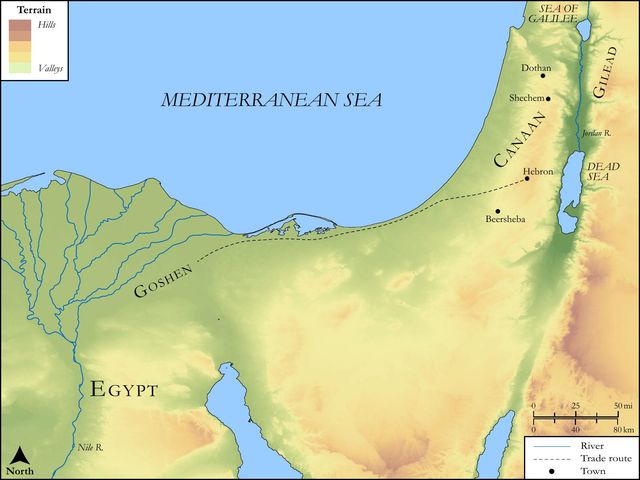
See on the biblical-era map


Study this verse
Public-domain commentary
Matthew Henry
From his Commentary on the Whole Bible. Henry comments on passages, not single verses — this entry covers Genesis 39:1–6. His three-level outline is real structure in the source text, so it is rendered as structure.
Here is, I. Joseph bought (Gen 39:1), and he that bought him, whatever he gave for him, had a good bargain of him; it was better than the merchandise of silver. The Jews have a proverb, "If the world did not know the worth of good men, they would hedge them about with pearls." He was sold to an officer of Pharaoh, with whom he might get acquainted with public persons and public business, and so be fitted for the preferment for which he was designed. Note, 1. What God intends men for he will be sure, some way or other, to qualify them for. 2. Providence is to be acknowledged in the disposal even of poor servants and in their settlements, and therein may perhaps be working towards something great and important.
II.Joseph blessed, wonderfully blessed, even in the house of his servitude.
1.God prospered him, Gen 39:2, Gen 39:3. Perhaps the affairs of Potiphar's family had remarkably gone backward before; but, upon Joseph's coming into it, a discernible turn was given to them, and the face and posture of them altered on a sudden. Though, at first, we may suppose that his hand was put to the meanest services, even in those appeared his ingenuity and industry; a particular blessing of Heaven attended him, which, as he rose in his employment, became more and more discernible. Note,
(1.)Those that have wisdom and grace have that which cannot be taken away from them, whatever else they are robbed of. Joseph's brethren had stripped him of his coat of many colours, but they could not strip him of his virtue and prudence.
(2.)Those that can separate us from all our friends, yet cannot deprive us of the gracious presence of our God. When Joseph had none of all his relations with him, he had his God with him, even in the house of the Egyptian. Joseph was separated from his brethren, but not from his God; banished from his father's house, but the Lord was with him, and this comforted him.
(3.)It is God's presence with us that makes all we do prosperous. Those that would prosper must therefore make God their friend; and those that do prosper must therefore give God the praise.
2.His master preferred him, by degrees made him steward of his household, Gen 39:4. Note,
(1.)Industry and honesty are the surest and safest way both of rising and thriving: Seest thou a man prudent, and faithful, and diligent in his business? He shall stand before kings at length, and not always before mean men.
(2.)It is the wisdom of those that are in any sort of authority to countenance and employ those with whom it appears that the presence of God is, Psa 101:6. Potiphar knew what he did when he put all into the hands of Joseph; for he knew it would prosper better there than in his own hand.
(3.)He that is faithful in a few things stand fair for being made ruler over many things, Mat 25:21. Christ goes by this rule with his servants.
(4.)It is a great ease to a master to have those employed under him that are trusty. Potiphar was so well satisfied with Joseph's conduct that he knew not aught he had, save the bread which he did eat, Gen 39:6. The servant had all the care and trouble of the estate; the master had only the enjoyment of it: an example not to be imitated by any master, unless he could be sure that he had one in all respects like Joseph for a servant.
3.God favoured his master for his sake (Gen 39:5): He blessed the Egyptian's house, though he was an Egyptian, a stranger to the true God, for Joseph's sake; and he himself, like Laban, soon learned it by experience, Gen 30:27. Note,
(1.)Good men are the blessings of the places where they live; even good servants may be so, though mean, and lightly esteemed.
(2.)The prosperity of the wicked is, one way or other, for the sake of the godly. Here was a wicked family blessed for the sake of one good servant in it.
Continue studying Genesis 39:5 across the web’s major study libraries — every link below opens this exact verse, chapter, or book on the destination site.
Read & Compare
 BibleGatewayThis verse in more than 200 translations and 70 languages.
 Bible.comThe YouVersion reader — hundreds of translations, reading plans, and highlights.
 ESV.orgCrossway's official English Standard Version reader.
 NET BibleThe NET translation with 60,000+ translators' notes on every rendering decision.
 STEP BibleTyndale House's free study tool — original text, vocabulary, and scholarly resources.
 BibliaLogos Bible Software's free web reader.
 USCCBThe New American Bible (Revised Edition) with the U.S. bishops' study notes.
Commentaries
 BibleHub CommentariesDozens of classic commentaries on this verse, gathered on one page.
 StudyLightMore than 100 commentary sets — the largest collection on the web.
 BibleRefPlain-English commentary on what this verse means, verse by verse.
 Enduring WordDavid Guzik's free commentary on this chapter, widely used by Bible teachers.
 Bible Study ToolsVerse commentary alongside Greek and Hebrew study aids.
Original Language & Research
- BibleHub InterlinearThe verse word by word — original language, transliteration, and English.
- BibleHub LexiconEvery word's original-language definition and Strong's entry.
 Blue Letter BibleDeep-study tools — Strong's numbers, concordance, and word studies.
 SefariaThe Hebrew text with Rashi and centuries of Jewish commentary.
Sermons, Hymns & Audio


TrulyRandomVerse is not affiliated with these sites and doesn’t control their content. They’re linked because they’re genuinely useful.
Summary
Genesis 39:5 reveals the profound divine favor bestowed upon the household of Potiphar, an Egyptian official, directly as a result of Joseph's presence and diligent stewardship. This verse powerfully illustrates God's active and benevolent involvement in the lives of His faithful servants, demonstrating how His blessing can extend far beyond the individual, bringing tangible prosperity and well-being to those connected to them, even in unexpected and seemingly adverse circumstances.
Context
ShowHideLiterary Context
This verse is situated within the narrative of Joseph's early life in Egypt, following his traumatic sale into slavery by his jealous brothers and his subsequent arrival in Potiphar's house. The preceding verses, Genesis 39:2-4, establish that "the LORD was with Joseph," leading to his immediate prosperity and favor in Potiphar's eyes. Potiphar, recognizing Joseph's exceptional abilities and the divine hand upon him, quickly elevated Joseph to the position of overseer, entrusting him with the management of his entire estate. Verse 5 then serves as the climactic declaration of the tangible outcome of Joseph's appointment: a comprehensive divine blessing that permeated every aspect of Potiphar's household and possessions. This sets the stage for the subsequent challenges Joseph faces, highlighting that God's favor is not always synonymous with ease, but rather with His enduring presence and purpose.
Historical & Cultural Context
Joseph's arrival in Egypt places him in a highly advanced and organized society. Potiphar, as an "officer of Pharaoh" and "captain of the guard," held a position of significant authority and influence, likely overseeing the royal bodyguard or even a part of the palace administration. Such a high-ranking official would have possessed a substantial estate, including a large household of servants and extensive agricultural lands. The concept of a chief steward or overseer was common in ancient Near Eastern households, where a trusted slave or servant would be given immense responsibility for managing the master's affairs. The Egyptians were polytheistic, worshipping a pantheon of gods, making the explicit mention of "the LORD" (Yahweh), the God of Israel, blessing an Egyptian household particularly striking. This underscores the theological point that Yahweh's sovereignty extends beyond national boundaries and religious affiliations, demonstrating His power even among those who do not acknowledge Him.
Key Themes
ShowHideGenesis 39:5 contributes significantly to several overarching themes in the book of Genesis and the broader biblical narrative. Foremost among these is God's Sovereign Providence, illustrating His meticulous and active involvement in guiding the lives of His chosen people, even through hardship and exile. Joseph's journey, from the pit to Potiphar's house and ultimately to a position of power in Egypt, is a testament to God's unwavering plan, as seen in Genesis 50:20. Another key theme is Divine Blessing and Favor, where God's presence with an individual (as stated in Genesis 39:2-3) directly translates into prosperity and success, not just for the individual but also for those associated with them. This foreshadows the broader Abrahamic covenant promise that through Abraham's descendants, "all the families of the earth would be blessed," as declared in Genesis 12:3. Finally, the theme of Faithfulness and Integrity is evident in Joseph's character; his diligent and trustworthy stewardship, even as a slave, is the human conduit through which God's blessing flows, highlighting that God honors and uses those who remain faithful in all circumstances.
Exposition and Analysis
ShowHideKey Word Analysis
ShowHideA primitive root meaning "to visit (with friendly or hostile intent); by analogy, to oversee, muster, charge, care for, miss, deposit, etc." In this context, it signifies being appointed to a position of authority and responsibility, specifically to manage and supervise. Joseph was given full charge, indicating a high degree of trust and the transfer of administrative control over Potiphar's entire estate.
"the self-Existent or Eternal; Jehovah, Jewish national name of God." This is the covenant name of God, Yahweh, emphasizing His personal, relational, and unchanging nature. The use of this specific name underscores that the blessing was not a generic stroke of luck or the work of an Egyptian deity, but the direct and intentional act of the one true God, the God of Abraham, Isaac, and Jacob.
A primitive root meaning "to kneel; by implication to bless God (as an act of adoration), and (vice-versa) man (as a benefit); also (by euphemism) to curse (God or the king, as treason)." Here, it denotes divine favor, prosperity, and abundance bestowed upon Potiphar's household. The blessing (H1293, Bᵉrâkâh') implies a profound sense of well-being, increase, and success that originates directly from God, encompassing material, domestic, and agricultural flourishing.
Meaning "a circumstance (as rolled around); only used adverbially, on account of." This word establishes a direct causal link. The blessing was not due to Potiphar's own merit or religious standing, but solely "on account of" Joseph's presence and his relationship with the LORD. It highlights Joseph's role as a conduit of divine favor.
Verse Breakdown
ShowHide"And it came to pass from the time that he had made him overseer in his house, and over all that he had"
This clause establishes the precise moment and scope of the divine intervention. The blessing commenced immediately upon Joseph's elevation to chief steward, demonstrating God's prompt and direct response to Joseph's faithfulness and Potiphar's recognition of it. "All that he had" signifies the comprehensive nature of Joseph's authority and, consequently, the comprehensive scope of the blessing.
"that the LORD blessed the Egyptian's house for Joseph's sake"
This is the core declaration of the verse. It explicitly names "the LORD" (Yahweh) as the agent of the blessing, emphasizing divine agency over coincidence or human effort. The recipient is "the Egyptian's house," highlighting that God's blessing transcends ethnic and religious boundaries. Crucially, the blessing is "for Joseph's sake," establishing a clear causal link between Joseph's presence and the prosperity of Potiphar's household. This underscores God's commitment to His covenant people and His willingness to extend favor through them.
"and the blessing of the LORD was upon all that he had in the house, and in the field."
This final clause reiterates and expands upon the comprehensive nature of the blessing. "The blessing of the LORD" (a specific noun, Bᵉrâkâh' from H1293) emphasizes the tangible and pervasive nature of this divine favor. It extended to "all that he had," encompassing every aspect of Potiphar's possessions and endeavors, from domestic affairs ("in the house") to agricultural output and livestock ("and in the field"). This paints a picture of holistic and abundant prosperity directly attributable to God's hand.
Literary Devices
ShowHideThe passage primarily employs Causality and Hyperbole to emphasize the profound impact of Joseph's presence. The repeated phrase "for Joseph's sake" and the direct attribution of the blessing to "the LORD" clearly establish a cause-and-effect relationship, leaving no doubt that the prosperity was divinely orchestrated and directly linked to Joseph. The description of the blessing extending to "all that he had in the house, and in the field" utilizes Hyperbole to convey the comprehensive and overwhelming nature of the divine favor. It suggests an abundance that touched every corner of Potiphar's life, implying a prosperity that was complete and undeniable. Furthermore, the narrative uses Foreshadowing, as Joseph's ability to bring blessing to a pagan household anticipates his later role in preserving not only his own family but also the entire land of Egypt and surrounding nations from famine, effectively making him a channel of God's universal providence.
Theological and Thematic Connections
ShowHideGenesis 39:5 powerfully illustrates God's sovereign providence and His commitment to His covenant people, even when they are in seemingly hopeless circumstances. It reveals that God's plan for Joseph, and through him, for the nation of Israel, continued to unfold despite the challenges of slavery and exile. A profound theological principle demonstrated here is the concept of "blessing by association," where God's favor extends beyond an individual to those around them because of their connection to a righteous person. Potiphar, an Egyptian and a pagan, benefited immensely from Joseph's presence, not due to his own merit, but solely because of God's relationship with Joseph. This foreshadows the broader redemptive plan, where God's blessings flow through His chosen instruments to impact the wider world. It also underscores that God honors faithfulness and diligent stewardship, using His faithful servants as conduits for His grace and power.
Reflection and Application
ShowHideGenesis 39:5 offers timeless and profound lessons for believers today, reminding us that our faithfulness to God, even in challenging, obscure, or seemingly insignificant circumstances, can have far-reaching and transformative effects. Joseph's integrity, diligence, and unwavering trust in God, even as a slave, made him a channel of divine blessing. This encourages us to consider our own lives: are we living in such a way that God's presence in us brings blessing to our families, our workplaces, our communities, and even to those who do not yet know Him? We are called to embody Christ's character in all spheres of life, recognizing that God can use us as conduits of His grace, favor, and redemptive purposes, demonstrating His power and goodness through our lives in unexpected and impactful ways. Our faithful stewardship, whether in positions of prominence or obscurity, can literally transform the environments we inhabit, making us agents of God's comprehensive blessing.
Questions for Reflection
ShowHideFAQ
ShowHideWhy did the LORD bless Potiphar's house 'for Joseph's sake'?
ShowHideThe phrase "for Joseph's sake" (Hebrew: בִּגְלַל יוֹסֵף, biglal Yoseph) highlights God's covenant faithfulness and His special relationship with Joseph, who was a descendant of Abraham and part of God's chosen lineage. God's blessing on Potiphar's house was not an endorsement of Potiphar or his pagan beliefs, nor was it a reward for Potiphar's actions. Instead, it was a direct consequence of Joseph's presence as a righteous servant of the LORD. This demonstrates God's commitment to prospering His chosen ones and, through them, revealing His power and goodness to others, even those outside the covenant community. It also served God's larger providential plan to elevate Joseph's status and prepare him for his future role as a deliverer for his family and for Egypt, as seen later in Genesis 41:37-43. This principle of blessing by association is a recurring theme in Scripture, illustrating how God uses His people to impact the world around them.
Christ-Centered Fulfillment
ShowHideJoseph, in his role as a faithful steward and a conduit of divine blessing, serves as a profound type of Christ. Just as Potiphar's house was blessed "for Joseph's sake," so too is all of creation, and especially the Church, blessed "for Christ's sake." Jesus Christ is the true and perfect Steward, entrusted with all authority in heaven and on earth by the Father, as declared in Matthew 28:18. Through His perfect obedience, sacrificial death on the cross, and glorious resurrection, He has become the ultimate channel through whom God's abundant grace, eternal life, and comprehensive favor flow to all who believe. He is the ultimate "righteous individual" whose presence brings blessing not only to a single household but to the entire world, fulfilling the Abrahamic promise that in Him, "all the nations of the earth will be blessed" (Galatians 3:8). All spiritual blessings in the heavenly places are ours "in Christ" (Ephesians 1:3), signifying that our prosperity, peace, and eternal well-being are entirely dependent on our union with Him, the source of all blessing.