


2 Samuel 6:12
Bible text: King James Version (1769 Blayney text) · Public domain
Bible text: King James Version with Strong's numbers · Public domain
Bible text: Berean Standard Bible · Public domain
Bible text: American Standard Version (1901) · Public domain
Bible text: World English Bible, Messianic edition · Public domain
Bible text: Geneva Bible (1599) · Public domain
Bible text: Young's Literal Translation · Public domain
- וַיֻּגַּדvai·yu·Gadand it was toldH5046Conj-w ¦ V-Hophal-ConsecImperf-3msVerb Hophal Consecutive Imperfect 3rd Singular Masculineוַandיֻּגַּדit was told
- לַמֶּלֶךְla·Me·lekhto the kingH4428Prep-l ¦ N-msNoun Singular Masculine Absoluteלַto theמֶּלֶךְking
- דָּוִדda·VidDavidH1732N-proper-mNoun Proper Masculine
- לֵאמֹרle·Mor<to> sayingH559Prep-l ¦ V-Qal-InfVerb Qal Infinitive Constructלֵ<to>אמֹרsaying
- בֵּרַךְbe·Rakhhe has blessedH1288V-Piel-Perf-3msVerb Piel Perfect 3rd Singular Masculine
- יְהוָהYah·wehYahwehH3068N-properNoun Proper Title
- אֶת'et<obj.>H853DirObjMParticle Object Indicator
- בֵּיתbeit[the] household ofH1004N-mscNoun Singular Masculine Construct
- עֹבֵד'o·VedObed-H5654N-proper-mNoun Proper Masculine
- אֱדֹם'e·DomEdomH5654N-proper-mNoun Proper Masculine
- וְאֶתve·'Etand <obj.>H853Conj-w ¦ DirObjMParticle Object Indicatorוְandאֶת<obj.>
- כָּלkolallH3605N-msNoun Singular Masculine Absolute
- אֲשֶׁר'a·SherthatH834RelParticle Relative
- לוֹlo[belongs] to <the> himPrep-l ¦ 3msSuffix Personal 3rd Singular Masculineל[belongs] to <the>וֹhim
- בַּעֲבוּרba·'a·Vurfor sake ofH5668Prep-b ¦ N-mscNoun Singular Masculine Constructבַּforעֲבוּרsake of
- אֲרוֹן'a·Ron[the] ark ofH727N-mscNoun Singular Masculine Construct
- הָאֱלֹהִיםha·'E·lo·Him<the> GodH430Art ¦ N-mpNoun Plural Masculine Absoluteהָ<the>אֱלֹהִיםGod
- וַיֵּלֶךְvai·Ye·lekhand he wentH1980Conj-w ¦ V-Qal-ConsecImperf-3msVerb Qal Consecutive Imperfect 3rd Singular Masculineוַandיֵּלֶךְhe went
- דָּוִדda·VidDavidH1732N-proper-mNoun Proper Masculine
- וַיַּעַלvai·ya·'Aland he brought upH5927Conj-w ¦ V-Hiphil-ConsecImperf-3msVerb Hiphil Consecutive Imperfect 3rd Singular Masculineוַandיַּעַלhe brought up
- אֶת'et<obj.>H853DirObjMParticle Object Indicator
- אֲרוֹן'a·Ron[the] ark ofH727N-mscNoun Singular Masculine Construct
- הָאֱלֹהִיםha·'E·lo·Him<the> GodH430Art ¦ N-mpNoun Plural Masculine Absoluteהָ<the>אֱלֹהִיםGod
- מִבֵּיתmi·Beitfrom [the] house ofH1004Prep-m ¦ N-mscNoun Singular Masculine Constructמִfromבֵּית[the] house of
- עֹבֵד'o·VedObed-H5654N-proper-mNoun Proper Masculine
- אֱדֹם'e·DomEdomH5654N-proper-mNoun Proper Masculine
- עִיר'ir[the] city ofH5892N-fscNoun Singular Feminine Construct
- דָּוִדda·VidDavidH1732N-proper-mNoun Proper Masculine
- בְּשִׂמְחָהbe·sim·Chahwith rejoicingH8057Prep-b ¦ N-fsNoun Singular Feminine Absoluteבְּwithשִׂמְחָהrejoicing
English is a literal word-by-word gloss of the Hebrew, not the KJV's wording. Why?
This is the original text the KJV's translators worked from — each Hebrew word with its own literal English meaning in this verse, prepared by scholars at Tyndale House, Cambridge. The KJV translates whole sentences, not word by word, so its wording differs: one Hebrew word can become several English words, and the KJV may choose “the LORD” where the gloss reads “Yahweh”. Both are faithful — they answer different questions. For the KJV's own rendering, switch to the KJV text.
Details
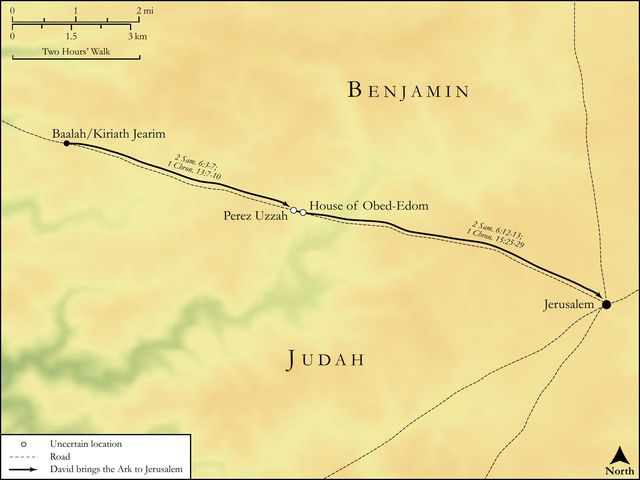
See on the biblical-era maps

Study this verse
Public-domain commentary
Matthew Henry
From his Commentary on the Whole Bible. Henry comments on passages, not single verses — this entry covers 2 Samuel 6:12–19. His four-level outline is real structure in the source text, so it is rendered as structure.
We have here the second attempt to bring the ark home to the city of David; and this succeeded, though the former miscarried.
I.It should seem the blessing with which the house of Obed-edom was blessed for the ark's sake was a great inducement to David to bring it forward; for when that was told him (Sa2 6:12) he hastened to fetch it to him. For,
1.It was an evidence that God was reconciled to them, and his anger was turned away. As David could read God's frowns upon them all in Uzzah's stroke, so he could read God's favour to them all in Obed-edom's prosperity; and, if God be at peace with them, they can cheerfully go on with their design.
2.It was an evidence that the ark was not such a burdensome stone as it was taken to be, but, on the contrary, happy was the man that had it near him. Christ is indeed a stone of stumbling, and a rock of offence, to those that are disobedient; but to those who believe he is a corner-stone, elect, precious, Pe1 2:6-8. When David heard that Obed-edom had such joy of the ark, then he would have it in his own city. Note, The experience others have had of the gains of godliness should encourage us to be religious. Is the ark a blessing to others' houses? let us bid it welcome to ours; we may have it, and the blessing of it, without fetching it from our neighbours.
II.Let us see how David managed the matter now.
1.He rectified the former error. He did not put the ark in a cart now, but ordered those whose business it was to carry it on their shoulders. This is implied here (Sa2 6:13) and expressed Ch1 15:15. Then we make a good use of the judgments of God on ourselves and others when we are awakened by them to reform and amend whatever has been amiss.
2.At their first setting out he offered sacrifices to God (Sa2 6:13) by way of atonement for their former errors and in a thankful acknowledgment of the blessings bestowed on the house of Obed-edom. Then we are likely to speed in our enterprises when we begin with God and give diligence to make our peace with him, When we attend upon God in holy ordinances our eye must be to the great sacrifice, to which we owe it that we are taken into covenant and communion with God, Psa 50:5.
3.He himself attended the solemnity with the highest expressions of joy that could be (Sa2 6:14): He danced before the Lord with all his might; he leaped for joy, as one transported with the occasion, and the more because of the disappointment he met with the last time. It is a pleasure to a good man to see his errors rectified and himself in the way of his duty. His dancing, I suppose, was not artificial, by any certain rule or measure, nor do we find that any danced with him; but it was a natural expression of his great joy and exultation of mind. He did it with all his might; so we should perform all our religious services, as those that are intent upon them and desire to do them in the best manner. All our might is little enough to be employed in holy duties: the work deserves it all. On this occasion David laid aside his imperial purple, and put on a plain linen ephod, which was light and convenient for dancing, and was used in religious exercises by those who were no priests, for Samuel wore one, Sa1 2:18. That great prince thought it no disparagement to him to appear in the habit of a minister to the ark.
4.All the people triumphed in this advancement of the ark (Sa2 6:15): They brought it up into the royal city with shouting, and with sound of trumpet, so expressing their own joy in loud acclamations, and giving notice to all about them to rejoice with them. The public and free administration of ordinances, not only under the protection, but under the smiles, of the civil powers, is just matter of rejoicing to any people. 5. the ark was safely brought to, and honourably deposited in, the place prepared for it, Sa2 6:17. They set it in the midst of the tabernacle, or tent, which David had pitched for it; not the tabernacle which Moses reared, for that was at Gibeon (Ch2 1:13), and, we may suppose, being made of cloth, in so many hundred years it had gone to decay and was not fit to be removed; but this was a tent set up on purpose to receive the ark. He would not bring it into a private house, no, not his own, lest it should seem to be too much engrossed, and people's resort to it, to pray before it, should be less free; yet he would not build a house for it, lest that should supersede the building of a more stately temple in due time, and therefore, for the present, he placed it within curtains, under a canopy, in imitation of Moses's tabernacle. As soon as ever it was lodged, he offered burnt-offerings and peace-offerings, in thankfulness to God that the business was now done without any more errors or breaches, and in supplication to God for the continuance of his favour. Note, All our joys must be sanctified both with praises and prayers; for with such sacrifices God is well pleased. New, it should seem, he penned the 132nd Psa 6:1-10. The people were then dismissed with great satisfaction. He sent them away,
(1.)With a gracious prayer: He blessed them in the name of the Lord of hosts (v. 18), having not only a particular interest in heaven as a prophet, but an authority over them as a prince; for the less is blessed of the better, Heb 7:7. He prayed to God to bless them, and particularly to reward them for the honour and respect they had now shown to his ark, assuring them they should be no losers by their journey, but the blessing of God upon their affairs at home would more than bear their charges. He testified his desire for their welfare by this prayer for them, and let them know they had a king that loved them.
(2.)With a generous treat; for so it was, rather than a distribution of alms. The great men, it is probable, he entertained at his own house, but to the multitude of Israel, men and women (and children, says Josephus), he dealt to every one a cake of bread (a spice-cake, so some), a good piece of flesh - a handsome decent piece (so some) - a part of the peace-offerings (so Josephus), that they might feast with him upon the sacrifice, and a flagon, or bottle, of wine, Sa2 6:19. Probably he ordered this provision to be made for them at their respective quarters, and this he did,
[1.]In token of his joy and gratitude to God. When the heart is enlarged in cheerfulness the hand should be opened in liberality. The feast of Purim was observed with sending portions one to another, Est 9:22. As those to whom God is merciful ought to show mercy in forgiving, so those to whom God is bountiful ought to exercise bounty in giving.
[2.]To recommend himself to the people, and confirm his interest in them; for every one is a friend to him that giveth gifts. Those that cared not for his prayers would love him for his generosity; and this would encourage them to attend him another time if he saw cause to call them together.
Historical interpretation
Historical reception
1 surviving comment on this verse from the historical church.
Choirs: Or companies of musicians.
Continue studying 2 Samuel 6:12 across the web’s major study libraries — every link below opens this exact verse, chapter, or book on the destination site.
Read & Compare
 BibleGatewayThis verse in more than 200 translations and 70 languages.
 Bible.comThe YouVersion reader — hundreds of translations, reading plans, and highlights.
 ESV.orgCrossway's official English Standard Version reader.
 NET BibleThe NET translation with 60,000+ translators' notes on every rendering decision.
 STEP BibleTyndale House's free study tool — original text, vocabulary, and scholarly resources.
 BibliaLogos Bible Software's free web reader.
 USCCBThe New American Bible (Revised Edition) with the U.S. bishops' study notes.
Commentaries
 BibleHub CommentariesDozens of classic commentaries on this verse, gathered on one page.
 StudyLightMore than 100 commentary sets — the largest collection on the web.
 BibleRefPlain-English commentary on what this verse means, verse by verse.
 Enduring WordDavid Guzik's free commentary on this chapter, widely used by Bible teachers.
 Bible Study ToolsVerse commentary alongside Greek and Hebrew study aids.
Original Language & Research
- BibleHub InterlinearThe verse word by word — original language, transliteration, and English.
- BibleHub LexiconEvery word's original-language definition and Strong's entry.
 Blue Letter BibleDeep-study tools — Strong's numbers, concordance, and word studies.
 SefariaThe Hebrew text with Rashi and centuries of Jewish commentary.
Sermons, Hymns & Audio


TrulyRandomVerse is not affiliated with these sites and doesn’t control their content. They’re linked because they’re genuinely useful.
Summary
Second Samuel 6:12 marks a pivotal turning point in David's quest to bring the Ark of the Covenant to Jerusalem, revealing that the Lord had abundantly blessed the household of Obed-Edom during the three months the Ark resided there. This divine favor, a stark contrast to the previous tragedy involving Uzzah, prompted David to renew his efforts, now approaching the sacred task with a newfound understanding of reverence and a spirit of gladness, recognizing God's power to bless those who honor His presence according to His prescribed ways.
Context
ShowHideLiterary Context
This verse immediately follows a period of profound apprehension and fear for King David. In the preceding verses of 2 Samuel 6, David had attempted to transport the Ark of the Covenant on a new cart, a method contrary to the Mosaic Law's explicit instructions for its carriage by Levites using poles (Numbers 4:15). When the oxen stumbled, Uzzah, a non-Levite, reached out to steady the Ark and was struck dead by God (2 Samuel 6:6-7). This tragic event, highlighting God's absolute holiness and the necessity of obedience to His commands, filled David with fear and anger, causing him to abandon the Ark at the house of Obed-Edom the Gittite (2 Samuel 6:10-11). Verse 12 then serves as the crucial bridge, demonstrating God's blessing on Obed-Edom's household as a divine signal that the Ark, when treated with reverence, was a source of blessing, not just judgment, thus motivating David to complete the task correctly and with a transformed perspective.
Historical & Cultural Context
The Ark of the Covenant was the most sacred object in ancient Israel, representing God's throne and His very presence among His people. Its proper handling was meticulously detailed in the Mosaic Law, particularly for the Kohathite clan of the Levites, who were uniquely authorized to carry it (Numbers 3:30-31). David's initial attempt to transport it on a cart, common for pagan deities, revealed a lack of adherence to these specific divine protocols. The "City of David" refers to Jerusalem, which David had recently captured and established as his capital. Bringing the Ark there was not merely a logistical move but a profound theological and political act, signifying Jerusalem's status as the spiritual and national center of Israel. Obed-Edom, identified as a "Gittite," was likely a Levite from Gath-Rimmon, a Levitical city in Dan, making him a legitimate custodian for the Ark, capable of understanding and adhering to the proper procedures. His role underscores the importance of proper priestly and Levitical service in ancient Israelite worship.
Key Themes
ShowHideThis verse powerfully underscores several key themes central to the narrative of 2 Samuel. Firstly, it highlights the holiness and power of God's presence, symbolized by the Ark. While God's holiness demands reverence and obedience, it also brings profound blessing when honored correctly, as seen in Obed-Edom's prosperity. Secondly, it illustrates the theme of learning from past mistakes and the importance of obedience to divine commands. David's initial failure and Uzzah's death served as a stark lesson, prompting David to re-evaluate his approach and proceed with the Ark's transfer in a manner consistent with God's will. Finally, the "gladness" with which David now approaches the task introduces the theme of joy in God's presence, contrasting with the earlier fear and anger. This joy anticipates the exuberant celebration that would accompany the Ark's successful entry into Jerusalem, a reflection of the delight found in drawing near to God in the right way, as echoed in Psalm 16:11.
Exposition and Analysis
ShowHideKey Word Analysis
ShowHideThis verb (H1288) signifies a divine act of empowerment and favor that results in tangible well-being, prosperity, fruitfulness, and abundance. It is not merely good fortune but a specific, active bestowal of God's goodness. In the context of Obed-Edom, the blessing was so evident and widespread ("all that pertaineth unto him") that it became public knowledge, signaling God's approval and transforming the perception of the Ark from a source of danger to a conduit of divine favor when handled appropriately. The use of the perfect tense indicates a completed action with ongoing results, emphasizing the enduring nature of God's favor upon Obed-Edom's household.
This noun (H8057) denotes deep joy, delight, and often accompanies festive occasions, celebrations, or acts of worship and thanksgiving. It contrasts sharply with David's previous emotional state of "fear" and "anger" after Uzzah's death. David's renewed approach is characterized by this profound joy, indicating a shift from a ritualistic or fearful obligation to a heartfelt, celebratory recognition of God's benevolent presence and power to bless. It sets the tone for the great celebration that follows in the subsequent verses, highlighting a transformed relationship with the divine presence.
Meaning "worker of Edom" (H5654), or potentially "servant of the Lord" (a less common interpretation of "Edom" as a variant of "Adon," Lord). While his precise lineage is debated, his designation as a "Gittite" (likely from Gath-Rimmon, a Levitical city) and the fact that the Ark was entrusted to him strongly suggest he was a Levite, specifically a Kohathite. This would mean he was knowledgeable about the proper procedures for handling the Ark, and his obedience to these divine instructions was instrumental in his household receiving God's blessing, serving as a living testament to the efficacy of obedience.
Verse Breakdown
ShowHide"And it was told king David, saying"
This phrase emphasizes the critical role of communication in David's decision-making. The news reaching David was not mere rumor but a confirmed report of God's tangible blessing, which served as a divine sign and catalyst for his renewed action. It highlights God's indirect communication through observable events, demonstrating His providential guidance in the affairs of His people and their leaders.
"The LORD hath blessed the house of Obededom, and all that [pertaineth] unto him, because of the ark of God"
This is the core message conveyed to David. The blessing was comprehensive, extending to Obed-Edom's entire household and possessions, demonstrating God's overflowing favor. Crucially, the blessing is explicitly attributed to the "ark of God," signifying that God's presence, when honored according to His terms, is the source of life and prosperity, not merely judgment. This direct connection between the Ark's presence and the blessing served to alleviate David's fear and confirm God's desire to bless His people.
"So David went and brought up the ark of God from the house of Obededom into the city of David with gladness"
This clause describes David's decisive and corrected action. The phrase "So David went" indicates a direct and immediate response to the news, signifying a renewed resolve. His decision to "bring up" the Ark to Jerusalem ("the city of David") signals his renewed commitment to establishing Jerusalem as the spiritual capital. The addition of "with gladness" is profoundly significant, marking a complete shift from his previous fear and anger to a spirit of joy and celebration, indicating that he had learned the lesson of proper reverence and understood the benevolent nature of God's presence when approached according to His will.
Literary Devices
ShowHideThe verse powerfully employs Contrast as its primary literary device. The stark difference between the tragic death of Uzzah in the immediate preceding verses and the abundant blessing on Obed-Edom's household is central to the narrative's impact. This contrast highlights the dual nature of God's holiness: it is dangerous when disrespected but profoundly beneficial when honored. There is also an element of Irony in that the very object that brought judgment and fear now brings such evident blessing, forcing David (and the reader) to re-evaluate the conditions under which God's presence operates. Furthermore, the Ark itself serves as a potent Symbolism of God's presence, His covenant, and His throne, making the events surrounding its movement deeply theological. David's shift from fear to "gladness" also Foreshadows the great celebration and worship that will ensue upon the Ark's arrival in Jerusalem, setting a tone of joyous reverence for the rest of the chapter.
Theological and Thematic Connections
ShowHideThis passage profoundly illustrates the dual nature of God's holiness: it is both awe-inspiring and potentially dangerous for those who approach it irreverently, yet it is also the ultimate source of blessing and life for those who approach with obedience and reverence. The Ark, representing God's very presence, is not a neutral object; it demands respect for divine protocol. Obed-Edom's household flourished not because of any inherent magic in the Ark, but because they honored God's presence in a way that Uzzah did not. This demonstrates that God's desire is to bless His people, but He requires that they come to Him on His terms. This principle resonates throughout Scripture, emphasizing that true blessing comes from walking in God's ways and acknowledging His sovereignty, transforming fear into joy when His presence is rightly honored.
Reflection and Application
ShowHide2 Samuel 6:12 offers a profound lesson for believers today: our approach to God matters. Just as Obed-Edom experienced tangible blessing by honoring God's presence according to His ways, so too does God pour out His favor on those who walk in obedience and reverence. This passage challenges us to examine our own hearts and practices: Do we approach God casually, or with the deep respect His holiness demands? Are we willing to learn from our mistakes and adjust our lives to align with His revealed will? David's shift from fear to gladness, prompted by the evidence of God's blessing, reminds us that true joy in our relationship with God comes not from avoiding Him, but from embracing His presence on His terms. When we honor God, He delights in blessing us, transforming our fear into celebratory joy and demonstrating that His presence is a source of life and abundance for those who reverence Him.
Questions for Reflection
ShowHideFAQ
ShowHideWhy was Obed-Edom's household blessed, while Uzzah was struck down?
ShowHideThe key difference lies in obedience to God's specific commands regarding the Ark of the Covenant. God had explicitly commanded that the Ark was to be carried by the Kohathite Levites using poles, and no one was to touch it directly (Numbers 4:15). David's initial attempt to transport the Ark on a new cart was a deviation from this divine instruction. When Uzzah reached out to steady the Ark, he violated this sacred command, resulting in his death as a demonstration of God's absolute holiness and the seriousness of His laws. Obed-Edom, likely a Levite from Gath-Rimmon, understood and adhered to the proper protocols for the Ark's care during its three-month stay. His reverence and obedience to God's prescribed ways resulted in the Lord abundantly blessing his household, demonstrating that God's presence brings favor and prosperity when His holiness is honored.
What is the significance of David bringing the Ark "with gladness" this time?
ShowHideThe "gladness" (Hebrew: simchâh) signifies a profound shift in David's emotional and spiritual state. After Uzzah's death, David was filled with "fear" and "anger" (2 Samuel 6:8-9), indicating a misunderstanding or apprehension of God's holiness. The news of Obed-Edom's blessing, however, revealed that God's presence, when approached correctly, was a source of life and favor, not just judgment. This revelation transformed David's fear into joy. His "gladness" reflects a renewed understanding of God's character, a spirit of repentance for past errors, and a joyful anticipation of God's benevolent presence in Jerusalem. It sets the stage for the exuberant worship and celebration that follows in 2 Samuel 6:14-15.
Christ-Centered Fulfillment
ShowHideThe Ark of the Covenant, representing the very presence of God among His people, finds its ultimate and perfect fulfillment in Jesus Christ. Just as the Ark was the dwelling place of God's glory and the place where atonement was made, so too is Christ the true embodiment of God with us, "Immanuel" (Matthew 1:23). The blessing experienced by Obed-Edom's household because of the Ark's presence foreshadows the immeasurable spiritual blessings that flow to those who welcome Christ into their lives and homes. Unlike the Old Covenant Ark, which demanded strict adherence to ritual and could bring judgment when mishandled, Christ, through His perfect obedience and sacrificial death, has opened a new and living way for us to draw near to God with confidence and "gladness" (Hebrews 10:19-22). He is the true Lamb of God, whose sacrifice not only covers our sins but also ushers us into the very presence of God, transforming fear into profound joy and ushering in an abundance of spiritual blessings for all who believe (Ephesians 1:3). In Christ, the dwelling of God is no longer confined to a box but is present in the person of God's Son, bringing eternal life and an unceasing flow of grace, ensuring that God's presence is now a source of unmitigated blessing for all who approach Him through the Son.