


1 Chronicles 16:3
- וַיְחַלֵּקvay·cha·Lekand he distributedH2505Conj-w ¦ V-Piel-ConsecImperf-3msVerb Piel Consecutive Imperfect 3rd Singular Masculineוַandיְחַלֵּקhe distributed
- לְכָלle·kholto everyH3605Prep-l ¦ N-mscNoun Singular Masculine Constructלְtoכָלevery
- אִישׁ'ish<the> person ofH376N-mscNoun Singular Masculine Construct
- יִשְׂרָאֵלYis·ra·'ElIsraelH3478N-properNoun Proper Location
- מֵאִישׁme·'Ishfrom manH376Prep-m ¦ N-msNoun Singular Masculine Absoluteמֵfromאִישׁman
- וְעַדve·'adand untoH5704Conj-w ¦ PrepPrepositionוְandעַדunto
- אִשָּׁה'i·ShahwomanH802N-fsNoun Singular Feminine Absolute
- לְאִישׁle·'Ishto everyoneH376Prep-l ¦ N-msNoun Singular Masculine Absoluteלְtoאִישׁeveryone
- כִּכַּרki·kara round loaf ofH3603N-fscNoun Singular Feminine Construct
- לֶחֶםLe·chembreadH3899N-msNoun Singular Masculine Absolute
- וְאֶשְׁפָּרve·'esh·Parand a date-cakeH829Conj-w ¦ N-msNoun Singular Masculine Absoluteוְandאֶשְׁפָּרa date-cake
- וַאֲשִׁישָׁהva·'a·shi·Shahand a raisin-cakeH809Conj-w ¦ N-fsNoun Singular Feminine Absoluteוַandאֲשִׁישָׁהa raisin-cake
English is a literal word-by-word gloss of the Hebrew, not the KJV's wording. Why?
This is the original text the KJV's translators worked from — each Hebrew word with its own literal English meaning in this verse, prepared by scholars at Tyndale House, Cambridge. The KJV translates whole sentences, not word by word, so its wording differs: one Hebrew word can become several English words, and the KJV may choose “the LORD” where the gloss reads “Yahweh”. Both are faithful — they answer different questions. For the KJV's own rendering, switch to the KJV text.
Details
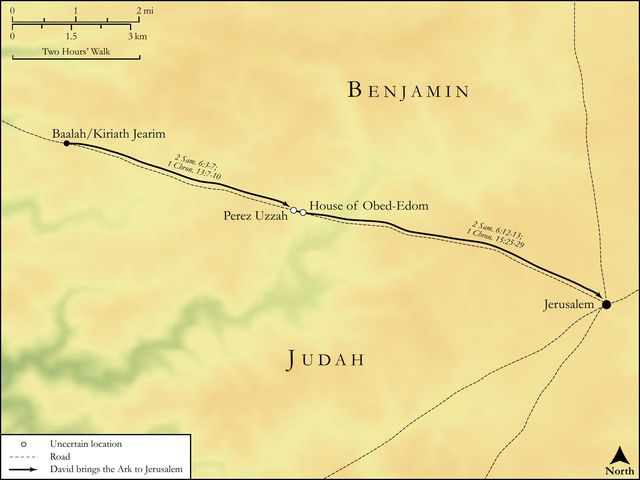
See on the biblical-era map
Study this verse
Public-domain commentary
Matthew Henry
From his Commentary on the Whole Bible. Henry comments on passages, not single verses — this entry covers 1 Chronicles 16:1–6. His two-level outline is real structure in the source text, so it is rendered as structure.
It was a glorious day when the ark of God was safely lodged in the tent David had pitched for it. That good man had his heart much upon it, could not sleep contentedly till it was done, Psa 132:4, Psa 132:5.
I.The circumstances of the ark were now,
1.Better than what they had been. It had been obscure in a country town, in the fields of the wood; now it was removed to a public place, to the royal city, where all might resort to it. It had been neglected, as a despised broken vessel; now it was attended with veneration, and God was enquired of by it. It had borrowed a room in a private house, which it enjoyed by courtesy; now it had a habitation of its own entirely to itself, was set in the midst of it, and not crowded into a corner. Note, Though God's word and ordinances may be clouded and eclipsed for a time, they shall at length shine out of obscurity. Yet,
2.They were much short of what was intended in the next reign, when the temple was to be built. This was but a tent, a poor mean dwelling; yet this was the tabernacle, the temple which David in his psalms often speaks of with so much affection. David, who pitched a tent for the ark and continued steadfast to it, did far better than Solomon, who built a temple for it and yet in his latter end turned his back upon it. The church's poorest times were its purest.
II.Now David was easy in his mind, the ark was fixed, and fixed near him. Now see how he takes care,
1.That God shall have the glory of it. Two ways he gives him honour upon this occasion: - (1.) By sacrifices (Ch1 16:1), burnt-offerings in adoration of his perfections, peace-offerings in acknowledgment of his favours. (2.) By songs: he appointed Levites to record this story in a song for the benefit of others, or to celebrate it themselves by thanking and praising the God of Israel, Ch1 16:4. All our rejoicings must express themselves in thanksgivings to him from whom all our comforts are received.
2.That the people shall have the joy of it. They shall fare the better for this day's solemnity; for he gives them all what is worth coming for, not only a royal treat in honour of the day (Ch1 16:3), in which David showed himself generous to his subjects, as he had found God gracious to him (those whose hearts are enlarged with holy joy should show it by being open-handed); but (which is far better) he gives them also a blessing in the name of the Lord, as a father, as a prophet, Ch1 16:2. He prayed to God for them, and commended them to his grace. In the name of the Word of the Lord (so the Targum), the essential eternal Word, who is Jehovah, and through whom all blessings come to us.
Continue studying 1 Chronicles 16:3 across the web’s major study libraries — every link below opens this exact verse, chapter, or book on the destination site.
Read & Compare
 BibleGatewayThis verse in more than 200 translations and 70 languages.
 Bible.comThe YouVersion reader — hundreds of translations, reading plans, and highlights.
 ESV.orgCrossway's official English Standard Version reader.
 NET BibleThe NET translation with 60,000+ translators' notes on every rendering decision.
 STEP BibleTyndale House's free study tool — original text, vocabulary, and scholarly resources.
 BibliaLogos Bible Software's free web reader.
 USCCBThe New American Bible (Revised Edition) with the U.S. bishops' study notes.
Commentaries
 BibleHub CommentariesDozens of classic commentaries on this verse, gathered on one page.
 StudyLightMore than 100 commentary sets — the largest collection on the web.
 BibleRefPlain-English commentary on what this verse means, verse by verse.
 Enduring WordDavid Guzik's free commentary on this chapter, widely used by Bible teachers.
 Bible Study ToolsVerse commentary alongside Greek and Hebrew study aids.
Original Language & Research
- BibleHub InterlinearThe verse word by word — original language, transliteration, and English.
- BibleHub LexiconEvery word's original-language definition and Strong's entry.
 Blue Letter BibleDeep-study tools — Strong's numbers, concordance, and word studies.
 SefariaThe Hebrew text with Rashi and centuries of Jewish commentary.
Sermons, Hymns & Audio


TrulyRandomVerse is not affiliated with these sites and doesn’t control their content. They’re linked because they’re genuinely useful.
Summary
1 Chronicles 16:3 vividly portrays King David's profound generosity and inclusive provision for every Israelite, both man and woman, immediately following the triumphant and sacred event of bringing the Ark of the Covenant into Jerusalem. This widespread distribution of bread, a choice portion of meat, and a sweet cake served as the celebratory culmination of a national act of worship, underscoring God's abundant blessings, David's exemplary pastoral care for his people, and the communal joy that permeated the nation with the establishment of God's tangible presence in the capital city.
Context
ShowHideLiterary Context
This verse is strategically placed as the immediate aftermath of the grand and pivotal relocation of the Ark of the Covenant to Jerusalem, a momentous event detailed in 1 Chronicles 16:1-2. The preceding narrative describes extensive burnt offerings and peace offerings made before the Lord, signifying dedication, atonement, and reconciliation. David's subsequent blessing of the people in the name of the Lord, as recorded in 1 Chronicles 16:2, sets the spiritual and emotional stage for his tangible act of material provision. The distribution of food and sweet cakes serves as a concrete manifestation of the covenant blessings and the peace God had established with His people, marking the joyous conclusion of a profound national worship experience and the dawn of a new era with the Ark centrally located in Jerusalem. This act of royal generosity further reinforces David's role as a benevolent and God-ordained king who mirrors the divine character of provision.
Historical & Cultural Context
The bringing of the Ark to Jerusalem was far more than a logistical move; it was a monumental theological and political event, signifying the establishment of God's dwelling place in the capital and solidifying Jerusalem's status as the spiritual and political heart of Israel. In ancient Near Eastern cultures, large-scale feasting and the distribution of food were customary and significant elements of major celebrations, religious festivals, and covenant renewals. Such acts often symbolized prosperity, peace, and the king's beneficence and legitimacy. Peace offerings, specifically, were unique sacrifices where a portion of the sacrificed animal was returned to the worshipper to be consumed in a communal meal, symbolizing fellowship with God and with one another. David's actions in 1 Chronicles 16:3 align perfectly with this cultural practice, transforming a sacred religious ceremony into a nationwide feast. By ensuring that every individual, regardless of social standing, could partake in the joy and abundance, David fostered unity among the diverse tribes under his leadership and God's overarching covenant.
Key Themes
ShowHideThe widespread distribution of provisions in this verse powerfully illustrates several key themes prevalent throughout the book of Chronicles. Firstly, it highlights Divine Provision and Abundance, mirroring God's unwavering faithfulness in sustaining His people, a theme deeply rooted in Israel's history, from the manna in the wilderness to the promise of a land flowing with milk and honey. Secondly, it emphasizes Celebration and Joy in Worship, demonstrating that worship is not merely a ritualistic obligation but a holistic experience involving profound communal rejoicing and thanksgiving for God's manifest presence and blessings. Thirdly, the explicit mention of "every one of Israel, both man and woman" underscores Universal reach and Unity, showcasing David's desire for all members of the covenant community to share equally in the blessings and joy, thereby fostering a deep sense of national solidarity under God's righteous rule. This act of generosity also powerfully reflects David's Pastoral Kingship, portraying him as a compassionate shepherd who diligently cares for the physical as well as spiritual well-being of his flock, a motif central to understanding his reign and echoing the ideal shepherd described in Psalm 23.
Exposition and Analysis
ShowHideKey Word Analysis
ShowHideThis verb (H2505) signifies "to divide," "to apportion," or "to distribute." It implies a deliberate, orderly, and systematic act of sharing, ensuring that each individual receives an equitable and designated portion. In this context, it emphasizes David's intentional and organized generosity, not a haphazard giving, but a structured distribution to every single person, signifying the thoroughness of his care and the universality of the blessing being extended to the entire community.
This phrase (H829) refers to a substantial, choice, or measured portion of meat, most likely derived from the peace offerings that had just been sacrificed before the Lord. The term ʼeshpâr suggests a generous and desirable cut, not merely scraps, indicating a feast of quality and abundance. Its inclusion reinforces the celebratory atmosphere and the richness of God's provision being shared among His people, reflecting the bounty of the sacrifice.
While the KJV translates this as "flagon [of wine]," scholarly consensus, based on other biblical occurrences (H809), indicates ʼăshîyshâh refers to a "raisin cake" or "sweet cake." These cakes were often pressed from dried fruits, particularly raisins, and were commonly associated with festive occasions, offerings, and expressions of love or comfort. This suggests a dense, sweet, and delightful food item rather than a liquid, emphasizing the provision of substantial, celebratory, and pleasurable nourishment, adding to the festive nature of the distribution.
Verse Breakdown
ShowHide"And he dealt to every one of Israel, both man and woman"
This opening clause immediately establishes the universal and profoundly inclusive nature of David's generosity. The phrase "every one of Israel" emphasizes that no one within the covenant community was excluded, and the specific mention of "both man and woman" further underscores the comprehensive scope of the distribution, ensuring that the entire populace, irrespective of gender, age, or social standing, participated in the blessing and celebration. This demonstrates David's commitment to the well-being, unity, and shared joy of his entire kingdom.
"to every one a loaf of bread"
The provision of "a loaf of bread" signifies the basic, essential sustenance provided to each individual. Bread was the fundamental staple food in ancient Israel, representing daily provision, life itself, and the most fundamental necessity. Its inclusion ensures that the foundational needs of every person were met, symbolizing God's faithfulness in providing for His people's daily sustenance, even amidst grand and extraordinary celebrations.
"and a good piece of flesh"
This phrase indicates the provision of a substantial and choice portion of meat. As elucidated in the Key Word Analysis, this was likely derived from the peace offerings, which symbolized fellowship with God and communal feasting. The designation "good piece" emphasizes the quality and generosity of the provision, elevating a simple meal into a celebratory feast, reflecting the abundance of God's blessings and the richness of the covenant relationship.
"and a flagon [of wine]"
As accurately understood through the Key Word Analysis, this refers to "a raisin cake" or "sweet cake." The inclusion of this sweet delicacy further underscores the festive and celebratory nature of the occasion. It represents a special treat, a symbol of joy, delight, and abundance beyond mere sustenance, contributing to the overall sense of thanksgiving and profound pleasure associated with God's manifest presence and favor among His people.
Literary Devices
ShowHideThe verse employs several impactful literary devices to convey its meaning and emotional resonance. Repetition is prominently featured in the phrase "to every one," which appears twice, powerfully emphasizing the comprehensive and universal nature of David's distribution, ensuring that absolutely no one was overlooked. This repetition underscores the king's meticulous care and the universal reach of the national celebration. Symbolism is also deeply at play, as the bread, meat, and sweet cake are not merely mundane food items but potent symbols of divine provision, covenant fellowship (derived from the peace offerings), and the profound joy and sweetness of God's tangible presence among His people. The very act of sharing these provisions becomes a tangible metonymy for the peace, unity, and abundance that God had graciously bestowed upon Israel through the Ark's arrival and David's faithful leadership. Furthermore, the sheer scale of the distribution, implied by the phrase "every one of Israel," suggests a form of hyperbole employed to convey the immense generosity and the truly national scope of the rejoicing and blessing.
Theological and Thematic Connections
ShowHide1 Chronicles 16:3 beautifully illustrates the profound theological principle that spiritual blessings and the establishment of God's presence often manifest in tangible, material provision and overflowing communal joy. David's act of widespread generosity, flowing directly from a moment of profound worship and the sacred establishment of God's dwelling place, mirrors God's own character as the ultimate provider who delights in blessing His people abundantly. This passage reminds us that true worship is holistic, encompassing both fervent spiritual devotion and practical, compassionate care for one another, fostering a community where all are valued, seen, and nourished. The emphasis on universal provision powerfully foreshadows the inclusive nature of God's kingdom, where all who come in faith are welcomed to partake in the divine feast of grace and salvation.
Reflection and Application
ShowHideThis verse offers a powerful and enduring model for leadership, community, and personal discipleship within the faith. David's extraordinary generosity, flowing from a heart overflowing with worship and gratitude for God's manifest presence, teaches us the profound importance of sharing our blessings—both material and spiritual—with those around us. It serves as a compelling call to deal generously with all, as David dealt "to every one of Israel, both man and woman", thereby reflecting the boundless love and abundant provision of God Himself. In a world too often marked by scarcity, division, and exclusion, the vivid image of David ensuring "every one of Israel, both man and woman" received a share challenges believers to actively seek out and meet the needs of others, fostering genuine fellowship and demonstrating the tangible reality of God's kingdom on earth. Our celebrations of God's goodness and our experience of His presence should naturally overflow into acts of kindness, radical generosity, and selfless service, making His transformative presence known through our sacrificial care for one another.
Questions for Reflection
ShowHideFAQ
ShowHideWhy was David so exceptionally generous in his provision for the people?
ShowHideDavid's generosity was a multifaceted expression, stemming from both profound spiritual devotion and astute, pastoral leadership. Spiritually, it was an authentic outpouring of thanksgiving and overwhelming joy for God's faithfulness in allowing the Ark, the sacred symbol of God's very presence, to be brought triumphantly to Jerusalem. This act of widespread provision was a tangible, communal expression of worship, mirroring God's own character as the ultimate, benevolent provider. From a leadership perspective, it served to unify the diverse tribes of the nation, solidifying Jerusalem's newly established status as the spiritual, political, and cultural capital of Israel. By ensuring that "every one of Israel, both man and woman" received a share, David fostered an unparalleled sense of communal participation, peace, and shared blessing, reinforcing his role as a benevolent and divinely appointed king who deeply cared for all his subjects. This act transformed a sacred religious ceremony into a joyous national celebration, creating a lasting positive impression and strengthening the bonds of loyalty and affection between the king and his people, much like the shared covenant meals seen elsewhere in Israel's history (e.g., Exodus 24:11).
What is the precise significance of the "flagon [of wine]" mentioned in the KJV translation of this verse?
ShowHideThe KJV translation of "flagon [of wine]" for the Hebrew word ʾăshîyshāh (H809) is widely considered a mistranslation by modern biblical scholarship. Based on other definitive biblical contexts (e.g., Song of Solomon 2:5 and Hosea 3:1), ʾăshîyshāh is more accurately translated as a "raisin cake" or "sweet cake." These were dense, sweet cakes, often made from pressed dried fruits, particularly raisins. Their significance lies in their strong association with festive occasions, celebrations, and sometimes cultic offerings, symbolizing delight and abundance. Therefore, David was providing not merely essential sustenance (bread and meat) but also a special, delightful treat, a luxury item that further emphasized the joyous, abundant, and celebratory nature of the occasion. This correction highlights the critical importance of academic rigor in biblical interpretation and significantly enriches our understanding of the profoundly festive atmosphere surrounding the Ark's arrival in Jerusalem.
Christ-Centered Fulfillment
ShowHide1 Chronicles 16:3, with its vivid depiction of King David's generous and inclusive provision for all Israel, serves as a beautiful and profound foreshadowing of the ultimate and infinitely more abundant provision offered by Jesus Christ. David, as an earthly king and shepherd, provides physical sustenance for a temporary, earthly celebration, but Christ, the true and eternal Son of David, offers spiritual and eternal sustenance for all who believe. He declares Himself the Bread of Life, promising that those who come to Him will never hunger and those who believe in Him will never thirst. Just as the peace offerings in the Old Testament provided meat for communal feasting, symbolizing fellowship with God, Christ's ultimate and perfect sacrifice on the cross establishes a new and everlasting covenant, inviting all humanity to partake in the feast of His body and blood, signifying deep reconciliation, intimate fellowship, and eternal life with God. The universal reach of David's distribution to "every one of Israel, both man and woman," finds its perfect and glorious fulfillment in Christ, who breaks down all barriers of gender, social status, ethnicity, or nationality, welcoming all who believe into His boundless kingdom. He is the ultimate host, preparing a heavenly banquet where His redeemed people will feast eternally on His boundless grace, unending love, and glorious presence, a provision that far surpasses any earthly bread, meat, or sweet cake.