


1 Chronicles 16:2
Bible text: King James Version (1769 Blayney text) · Public domain
Bible text: Berean Standard Bible · Public domain
Bible text: American Standard Version (1901) · Public domain
Bible text: World English Bible, Messianic edition · Public domain
Bible text: Geneva Bible (1599) · Public domain
Bible text: Young's Literal Translation · Public domain
- וַיְכַלvay·Khaland he finishedH3615Conj-w ¦ V-Piel-ConsecImperf-3msVerb Piel Consecutive Imperfect 3rd Singular Masculineוַandיְכַלhe finished
- דָּוִידda·VidDavidH1732N-proper-mNoun Proper Masculine
- מֵהַעֲלוֹתme·ha·'a·Lotfrom offering upH5927Prep-m ¦ V-Hiphil-InfVerb Hiphil Infinitive Constructמֵfromהַעֲלוֹתoffering up
- הָעֹלָהha·'o·Lahthe burnt offeringH5930Art ¦ N-fsNoun Singular Feminine Absoluteהָtheעֹלָהburnt offering
- וְהַשְּׁלָמִיםve·ha·she·la·Mimand the peace offeringsH8002Conj-w ¦ Art ¦ N-mpNoun Plural Masculine Absoluteוְandהַtheשְּׁלָמִיםpeace offerings
- וַיְבָרֶךְvay·Va·rekhand he blessedH1288Conj-w ¦ V-Piel-ConsecImperf-3msVerb Piel Consecutive Imperfect 3rd Singular Masculineוַandיְבָרֶךְhe blessed
- אֶת'et<obj.>H853DirObjMParticle Object Indicator
- הָעָםha·'Amthe peopleH5971Art ¦ N-msNoun Singular Masculine Absoluteהָtheעָםpeople
- בְּשֵׁםbe·Shemin [the] name ofH8034Prep-b ¦ N-mscNoun Singular Masculine Constructבְּinשֵׁם[the] name of
- יְהוָהYah·wehYahwehH3068N-properNoun Proper Title
English is a literal word-by-word gloss of the Hebrew, not the KJV's wording. Why?
This is the original text the KJV's translators worked from — each Hebrew word with its own literal English meaning in this verse, prepared by scholars at Tyndale House, Cambridge. The KJV translates whole sentences, not word by word, so its wording differs: one Hebrew word can become several English words, and the KJV may choose “the LORD” where the gloss reads “Yahweh”. Both are faithful — they answer different questions. For the KJV's own rendering, switch to the KJV text.
Details
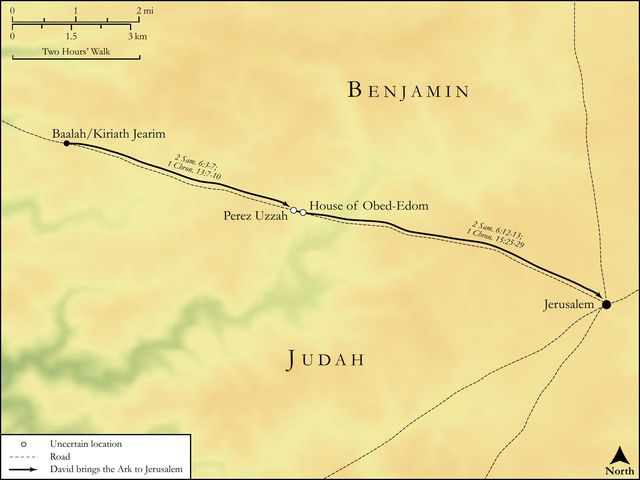
See on the biblical-era map
Study this verse
Public-domain commentary
Matthew Henry
From his Commentary on the Whole Bible. Henry comments on passages, not single verses — this entry covers 1 Chronicles 16:1–6. His two-level outline is real structure in the source text, so it is rendered as structure.
It was a glorious day when the ark of God was safely lodged in the tent David had pitched for it. That good man had his heart much upon it, could not sleep contentedly till it was done, Psa 132:4, Psa 132:5.
I.The circumstances of the ark were now,
1.Better than what they had been. It had been obscure in a country town, in the fields of the wood; now it was removed to a public place, to the royal city, where all might resort to it. It had been neglected, as a despised broken vessel; now it was attended with veneration, and God was enquired of by it. It had borrowed a room in a private house, which it enjoyed by courtesy; now it had a habitation of its own entirely to itself, was set in the midst of it, and not crowded into a corner. Note, Though God's word and ordinances may be clouded and eclipsed for a time, they shall at length shine out of obscurity. Yet,
2.They were much short of what was intended in the next reign, when the temple was to be built. This was but a tent, a poor mean dwelling; yet this was the tabernacle, the temple which David in his psalms often speaks of with so much affection. David, who pitched a tent for the ark and continued steadfast to it, did far better than Solomon, who built a temple for it and yet in his latter end turned his back upon it. The church's poorest times were its purest.
II.Now David was easy in his mind, the ark was fixed, and fixed near him. Now see how he takes care,
1.That God shall have the glory of it. Two ways he gives him honour upon this occasion: - (1.) By sacrifices (Ch1 16:1), burnt-offerings in adoration of his perfections, peace-offerings in acknowledgment of his favours. (2.) By songs: he appointed Levites to record this story in a song for the benefit of others, or to celebrate it themselves by thanking and praising the God of Israel, Ch1 16:4. All our rejoicings must express themselves in thanksgivings to him from whom all our comforts are received.
2.That the people shall have the joy of it. They shall fare the better for this day's solemnity; for he gives them all what is worth coming for, not only a royal treat in honour of the day (Ch1 16:3), in which David showed himself generous to his subjects, as he had found God gracious to him (those whose hearts are enlarged with holy joy should show it by being open-handed); but (which is far better) he gives them also a blessing in the name of the Lord, as a father, as a prophet, Ch1 16:2. He prayed to God for them, and commended them to his grace. In the name of the Word of the Lord (so the Targum), the essential eternal Word, who is Jehovah, and through whom all blessings come to us.
Continue studying 1 Chronicles 16:2 across the web’s major study libraries — every link below opens this exact verse, chapter, or book on the destination site.
Read & Compare
 BibleGatewayThis verse in more than 200 translations and 70 languages.
 Bible.comThe YouVersion reader — hundreds of translations, reading plans, and highlights.
 ESV.orgCrossway's official English Standard Version reader.
 NET BibleThe NET translation with 60,000+ translators' notes on every rendering decision.
 STEP BibleTyndale House's free study tool — original text, vocabulary, and scholarly resources.
 BibliaLogos Bible Software's free web reader.
 USCCBThe New American Bible (Revised Edition) with the U.S. bishops' study notes.
Commentaries
 BibleHub CommentariesDozens of classic commentaries on this verse, gathered on one page.
 StudyLightMore than 100 commentary sets — the largest collection on the web.
 BibleRefPlain-English commentary on what this verse means, verse by verse.
 Enduring WordDavid Guzik's free commentary on this chapter, widely used by Bible teachers.
 Bible Study ToolsVerse commentary alongside Greek and Hebrew study aids.
Original Language & Research
- BibleHub InterlinearThe verse word by word — original language, transliteration, and English.
- BibleHub LexiconEvery word's original-language definition and Strong's entry.
 Blue Letter BibleDeep-study tools — Strong's numbers, concordance, and word studies.
 SefariaThe Hebrew text with Rashi and centuries of Jewish commentary.
Sermons, Hymns & Audio


TrulyRandomVerse is not affiliated with these sites and doesn’t control their content. They’re linked because they’re genuinely useful.
Summary
Following the momentous and celebratory procession of the Ark of the Covenant into Jerusalem, King David concluded the elaborate ritual of worship and sacrifice. After offering numerous burnt offerings, signifying complete dedication, and peace offerings, symbolizing fellowship and communion, David, acting as the divinely appointed leader, turned to the assembled multitude and personally pronounced a blessing upon them, invoking the very name and authority of the LORD. This act underscored the culmination of a significant spiritual event, establishing Jerusalem as the spiritual heart of Israel under God's favor and setting a foundational precedent for the nation's worship.
Context
ShowHideLiterary Context
This verse serves as the immediate culmination of the narrative in 1 Chronicles 16:1, which details David's successful relocation of the Ark of God into the tent he had specifically prepared for it in Jerusalem, followed by the presentation of burnt and peace offerings before God. The broader context of 1 Chronicles 16 then unfolds with David's magnificent psalm of thanksgiving and praise, followed by the establishment of regular worship practices before the Ark, orchestrated by David. The Chronicler's overarching emphasis throughout this section is on proper worship, the centrality of the Ark (and thus God's tangible presence), and David's pivotal role in organizing and leading the spiritual life of the nation. The blessing pronounced in 1 Chronicles 16:2 functions as the official, divinely sanctioned conclusion to the Ark's relocation and the initial dedication ceremonies, setting the theological and practical stage for the ongoing worship described thereafter. While paralleled in 2 Samuel 6, the Chronicler provides additional details and a more pronounced theological emphasis on worship, the Davidic covenant, and the proper order of God's kingdom.
Historical & Cultural Context
The bringing of the Ark to Jerusalem was a profoundly significant historical and religious event for ancient Israel. For many years prior, the Ark had been in various locations, including Kirjath-jearim, after its capture by the Philistines and subsequent return. David's strategic relocation of the Ark to Jerusalem was not merely a political move; it elevated the city from solely a political capital to the undisputed spiritual center of the united kingdom, signifying God's active presence dwelling among His people. The types of sacrifices offered were culturally significant: burnt offerings (Hebrew, ʻôlâh [H5930]) were entirely consumed by fire on the altar, symbolizing complete consecration and atonement, while peace offerings (Hebrew, shelem [H8002]) involved a portion given to God, a portion to the priests, and the remainder eaten by the worshiper, signifying fellowship, reconciliation, and thanksgiving. For a king like David to pronounce a blessing was not uncommon; kings of Israel and of the nations often held cultic responsibilities, as Solomon later stood and blessed all the congregation of Israel. However, David's blessing "in the name of the LORD" uniquely emphasized that his authority was not inherent but derived directly from Yahweh (Hebrew, Yᵉhôvâh [H3068]), the covenant God of Israel, reinforcing the unique relationship between God, the king, and the nation. This act solidified David's role as not just a military and political leader, but also a spiritual shepherd of his people, mediating divine favor.
Key Themes
ShowHide1 Chronicles 16:2 encapsulates several profound themes central to the Chronicler's narrative and Israelite theology. Firstly, Worship and Sacrifice are paramount, as the entire event revolves around the proper approach to God through prescribed rituals. The offerings signify devotion, atonement, and communion, setting the pattern for Israel's relationship with God. Secondly, Davidic Leadership and Divine Authority are highlighted. David, though not a priest, acts in a priestly capacity by offering sacrifices and pronouncing a blessing. This underscores his unique role as God's chosen king, mediating divine favor to his people, a theme that resonates throughout the books of 1 Samuel, 2 Samuel, 1 Kings, and 2 Kings. His authority to bless comes directly "in the name of the LORD," emphasizing that true blessing originates from God. Finally, the theme of Divine Blessing and Covenant Faithfulness is profoundly evident. The blessing is a declaration of God's favor and a reaffirmation of His covenant promises to Israel, ensuring prosperity, peace, and well-being for His people as they remain faithful to Him. This act mirrors the Aaronic blessing in Numbers 6:24-26, demonstrating God's consistent desire to bless His people.
Exposition and Analysis
ShowHideKey Word Analysis
ShowHideThis primitive root signifies to cease, be finished, or complete. In this context, it emphasizes the thoroughness and conclusion of David's sacrificial offerings. It implies that the prescribed rituals were fully performed, leaving nothing undone, thereby ensuring their acceptance by God and setting the stage for the subsequent divine blessing. The completion of these acts of worship is presented as a prerequisite for the impartation of God's favor.
This verb carries a rich semantic range, often implying kneeling. When a superior, such as God or His divinely appointed representative like David, blesses an inferior (the people), it means to impart favor, bestow good things, and declare divine favor, prosperity, and well-being. It is an active, authoritative declaration that invokes God's power to bring about the promised good. David is not merely wishing them well; he is, by divine appointment, a conduit through whom God's favor is declared and channeled to the congregation.
This phrase is profoundly crucial for understanding the authority and efficacy of David's blessing. It signifies that David was acting not by his own inherent power or personal authority, but as God's representative, with God's full authorization and power backing his words. To act "in the name of" someone implies acting on their behalf, with their character, power, and authority. Therefore, the blessing was divinely sanctioned, legitimate, and potent, carrying the weight of God's own word and promise. It ensured that the blessing was truly from God, not from David, and that its effects would be real and lasting.
Verse Breakdown
ShowHide"And when David had made an end of offering the burnt offerings and the peace offerings"
This initial clause underscores the completion and proper execution of the sacrificial ritual. The "burnt offerings" (Hebrew, ʻôlâh), symbolizing total dedication and atonement, and the "peace offerings" (Hebrew, shelem), representing fellowship, reconciliation, and thanksgiving, were foundational elements of Israelite worship. The completion of these specific sacrifices signifies that the people had properly approached God, their sins had been covered, and communion had been established. This act of worship was a necessary prerequisite before the blessing could be pronounced, indicating that God's favor is often contingent on proper reverence and obedience.
"he blessed the people"
This highlights David's direct action as the king and spiritual leader. Having meticulously overseen the ceremonial sacrifices, he now assumes the authoritative role of mediator of divine favor. This was a public, authoritative declaration of God's goodness upon the entire assembled multitude, signifying the covenant relationship between God and Israel, with David serving as the chosen instrument. It was a moment of profound spiritual significance, affirming the people's standing before God and the king's role in their spiritual well-being.
"in the name of the LORD"
This critical phrase qualifies the nature and source of the blessing, emphasizing its divine origin and power. It underscores that David's authority to bless was not inherent in himself but was entirely derived from Yahweh (Hebrew, Yᵉhôvâh). His words were not merely human pronouncements but carried divine weight because they were spoken under the direct authorization and power of God. This ensured the blessing's legitimacy and efficacy, making it a powerful declaration of God's intended favor and prosperity for His covenant people, rooted in His character and promises.
Literary Devices
ShowHideThe verse employs several literary devices to convey its profound theological message. Narrative Progression is evident as it marks the culmination of the Ark's relocation and the associated sacrificial rituals, moving seamlessly from action to divine declaration. Symbolism is central, with the "burnt offerings" symbolizing complete surrender and atonement, and the "peace offerings" representing restored fellowship and communion, both prerequisites for receiving divine favor. The Ark itself, though not explicitly mentioned in this verse, is the ultimate Symbol of God's presence, around which the entire event revolves. David's act of blessing "in the name of the LORD" is a powerful example of Metonymy, where "the name of the LORD" stands for the very authority, character, power, and presence of God Himself. This phrase also highlights Divine Authority, emphasizing that the blessing's power and legitimacy originate solely from God, not from David's personal power. Furthermore, the scene establishes David's Royal Theology, portraying him not just as a political ruler but as a divinely appointed spiritual leader who mediates between God and His people, a role that profoundly foreshadows the ultimate King-Priest.
Theological and Thematic Connections
ShowHideThe act of David blessing the people "in the name of the LORD" is deeply rooted in the biblical understanding of divine blessing and covenant. It reflects God's consistent desire to pour out His goodness upon His people, a theme that begins with the creation account, continues through the patriarchs, the nation of Israel, and ultimately finds its zenith in Christ. This blessing was not a mere wish but an authoritative declaration, carrying the weight of God's own word and promise. It signified God's favor, protection, and prosperity upon a people who had just engaged in profound worship and dedication. It also highlights the mediatorial role, where a chosen leader acts as a conduit for God's grace, a pattern seen throughout salvation history from Moses to the prophets and, preeminently, in Jesus Christ.
Reflection and Application
ShowHideDavid's act of blessing the people after a period of intense worship and sacrifice offers profound insights for believers today. It reminds us that true blessing flows fundamentally from God, often in response to our sincere dedication and communion with Him. Just as the Ark symbolized God's tangible presence among Israel, believers today are indwelt by the Holy Spirit, making us temples of the living God. Our worship, whether personal or corporate, should always lead us to a deeper experience of God's favor and grace, transforming us from within. Furthermore, this verse underscores the importance of spiritual leadership that seeks to impart God's blessing upon the congregation, not from personal charisma or human authority, but from a humble reliance on God's divine authorization and power. It challenges us to consider how we, as individuals and as a community, can be channels of God's blessing to those around us, speaking words of life, encouragement, and truth that reflect His character and promises. The ultimate goal of our worship is not merely to perform rituals, but to draw near to God and receive the outpouring of His goodness, enabling us to live lives that honor Him and authentically bless others in His name.
Questions for Reflection
ShowHideFAQ
ShowHideWhy was David, a king and not a priest, able to bless the people in this manner?
ShowHideDavid's ability to bless the people, despite not being a Levite or Aaronic priest, highlights his unique divinely appointed role as king. In ancient Israel, the king often held a significant spiritual function, acting as God's representative and mediator for the nation. This was part of the broader concept of "royal theology," where the king was seen as God's anointed, responsible for the spiritual well-being of his people. While the priests had specific cultic duties related to sacrifices and the tabernacle, the king could also perform certain religious acts, especially those related to national worship and covenant reaffirmation, as seen in David's actions here and Solomon's prayer of dedication in 1 Kings 8. David's blessing "in the name of the LORD" explicitly states that his authority was delegated by God, making the blessing legitimate and effective, not based on his priestly lineage but on his royal anointing and God's direct commission. This foreshadows the ultimate King-Priest, Jesus Christ, who perfectly embodies both roles.
Christ-Centered Fulfillment
ShowHide1 Chronicles 16:2, with David blessing the people "in the name of the LORD" after completing the sacrifices, powerfully foreshadows the person and work of Jesus Christ. David, as king, acts in a mediatorial capacity, bringing the Ark (symbolizing God's presence) to His people and then imparting divine favor. Jesus, the ultimate Davidic King, is the true and greater mediator who not only brings God's presence to humanity but is God's presence, Emmanuel, "God with us" (Matthew 1:23). Unlike David, who offered animal sacrifices that had to be repeated, Jesus offered Himself as the perfect, once-for-all sacrifice, fulfilling all burnt and peace offerings through His death on the cross (Hebrews 9:26 and Hebrews 10:10). Having completed this ultimate act of atonement and reconciliation, Jesus, our High Priest and King, blesses His people not merely with earthly prosperity but with every spiritual blessing in the heavenly places (Ephesians 1:3). His final act before ascension was to bless His disciples (Luke 24:50-51), a tangible sign of the ongoing divine favor, peace, and eternal life He bestows upon all who believe. Thus, David's blessing in the name of the LORD finds its ultimate and eternal fulfillment in Christ, through whom all true and lasting blessings flow, establishing a new covenant of grace (Jeremiah 31:31-34).