


1 Chronicles 16:1
- וַיָּבִיאוּvai·ya·Vi·'uand they broughtH935Conj-w ¦ V-Hiphil-ConsecImperf-3mpVerb Hiphil Consecutive Imperfect 3rd Plural Masculineוַandיָּבִיאוּthey brought
- אֶת'et<obj.>H853DirObjMParticle Object Indicator
- אֲרוֹן'a·Ron[the] ark ofH727N-mscNoun Singular Masculine Construct
- הָאֱלֹהִיםha·'E·lo·Him<the> GodH430Art ¦ N-mpNoun Plural Masculine Absoluteהָ<the>אֱלֹהִיםGod
- וַיַּצִּיגוּvai·ya·Tzi·guand they setH3322Conj-w ¦ V-Hiphil-ConsecImperf-3mpVerb Hiphil Consecutive Imperfect 3rd Plural Masculineוַandיַּצִּיגוּthey set
- אֹתוֹ'o·To<obj.> itH853DirObjM ¦ 3msParticle Object Indicatorאֹת<obj.>וֹit
- בְּתוֹךְbe·Tokhin [the] midst ofH8432Prep-b ¦ N-mscNoun Singular Masculine Constructבְּinתוֹךְ[the] midst of
- הָאֹהֶלha·'O·helthe tentH168Art ¦ N-msNoun Singular Masculine Absoluteהָtheאֹהֶלtent
- אֲשֶׁר'a·SherwhichH834RelParticle Relative
- נָטָהna·tahhe had pitchedH5186V-Qal-Perf-3msVerb Qal Perfect 3rd Singular Masculine
- לוֹlofor itPrep-l ¦ 3msSuffix Personal 3rd Singular Masculineלforוֹit
- דָּוִידda·VidDavidH1732N-proper-mNoun Proper Masculine
- וַיַּקְרִיבוּvai·yak·Ri·vuand they brought nearH7126Conj-w ¦ V-Hiphil-ConsecImperf-3mpVerb Hiphil Consecutive Imperfect 3rd Plural Masculineוַandיַּקְרִיבוּthey brought near
- עֹלוֹתo·Lotburnt offeringsH5930N-fpNoun Plural Feminine Absolute
- וּשְׁלָמִיםu·she·la·Mimand peace offeringsH8002Conj-w ¦ N-mpNoun Plural Masculine Absoluteוּandשְׁלָמִיםpeace offerings
- לִפְנֵיlif·Nei<to> beforeH6440Prep-l ¦ N-mpcNoun Plural Masculine Constructלִ<to>פְנֵיbefore
- הָאֱלֹהִיםha·'E·lo·Him<the> GodH430Art ¦ N-mpNoun Plural Masculine Absoluteהָ<the>אֱלֹהִיםGod
English is a literal word-by-word gloss of the Hebrew, not the KJV's wording. Why?
This is the original text the KJV's translators worked from — each Hebrew word with its own literal English meaning in this verse, prepared by scholars at Tyndale House, Cambridge. The KJV translates whole sentences, not word by word, so its wording differs: one Hebrew word can become several English words, and the KJV may choose “the LORD” where the gloss reads “Yahweh”. Both are faithful — they answer different questions. For the KJV's own rendering, switch to the KJV text.
Details
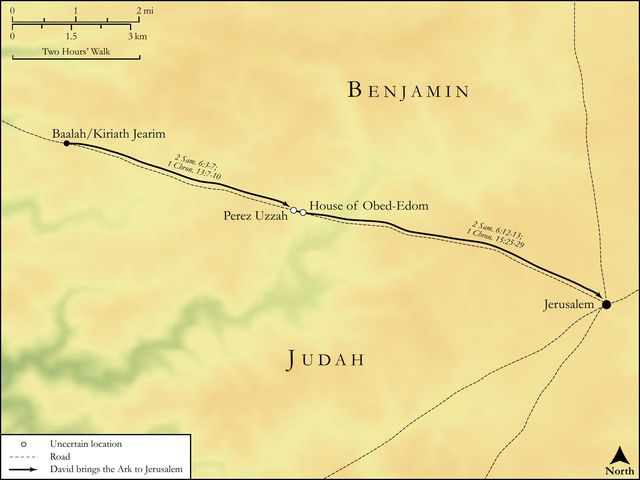
See on the biblical-era map
Study this verse
Public-domain commentary
Matthew Henry
From his Commentary on the Whole Bible. Henry comments on passages, not single verses — this entry covers 1 Chronicles 16:1–6. His two-level outline is real structure in the source text, so it is rendered as structure.
It was a glorious day when the ark of God was safely lodged in the tent David had pitched for it. That good man had his heart much upon it, could not sleep contentedly till it was done, Psa 132:4, Psa 132:5.
I.The circumstances of the ark were now,
1.Better than what they had been. It had been obscure in a country town, in the fields of the wood; now it was removed to a public place, to the royal city, where all might resort to it. It had been neglected, as a despised broken vessel; now it was attended with veneration, and God was enquired of by it. It had borrowed a room in a private house, which it enjoyed by courtesy; now it had a habitation of its own entirely to itself, was set in the midst of it, and not crowded into a corner. Note, Though God's word and ordinances may be clouded and eclipsed for a time, they shall at length shine out of obscurity. Yet,
2.They were much short of what was intended in the next reign, when the temple was to be built. This was but a tent, a poor mean dwelling; yet this was the tabernacle, the temple which David in his psalms often speaks of with so much affection. David, who pitched a tent for the ark and continued steadfast to it, did far better than Solomon, who built a temple for it and yet in his latter end turned his back upon it. The church's poorest times were its purest.
II.Now David was easy in his mind, the ark was fixed, and fixed near him. Now see how he takes care,
1.That God shall have the glory of it. Two ways he gives him honour upon this occasion: - (1.) By sacrifices (Ch1 16:1), burnt-offerings in adoration of his perfections, peace-offerings in acknowledgment of his favours. (2.) By songs: he appointed Levites to record this story in a song for the benefit of others, or to celebrate it themselves by thanking and praising the God of Israel, Ch1 16:4. All our rejoicings must express themselves in thanksgivings to him from whom all our comforts are received.
2.That the people shall have the joy of it. They shall fare the better for this day's solemnity; for he gives them all what is worth coming for, not only a royal treat in honour of the day (Ch1 16:3), in which David showed himself generous to his subjects, as he had found God gracious to him (those whose hearts are enlarged with holy joy should show it by being open-handed); but (which is far better) he gives them also a blessing in the name of the Lord, as a father, as a prophet, Ch1 16:2. He prayed to God for them, and commended them to his grace. In the name of the Word of the Lord (so the Targum), the essential eternal Word, who is Jehovah, and through whom all blessings come to us.
Continue studying 1 Chronicles 16:1 across the web’s major study libraries — every link below opens this exact verse, chapter, or book on the destination site.
Read & Compare
 BibleGatewayThis verse in more than 200 translations and 70 languages.
 Bible.comThe YouVersion reader — hundreds of translations, reading plans, and highlights.
 ESV.orgCrossway's official English Standard Version reader.
 NET BibleThe NET translation with 60,000+ translators' notes on every rendering decision.
 STEP BibleTyndale House's free study tool — original text, vocabulary, and scholarly resources.
 BibliaLogos Bible Software's free web reader.
 USCCBThe New American Bible (Revised Edition) with the U.S. bishops' study notes.
Commentaries
 BibleHub CommentariesDozens of classic commentaries on this verse, gathered on one page.
 StudyLightMore than 100 commentary sets — the largest collection on the web.
 BibleRefPlain-English commentary on what this verse means, verse by verse.
 Enduring WordDavid Guzik's free commentary on this chapter, widely used by Bible teachers.
 Bible Study ToolsVerse commentary alongside Greek and Hebrew study aids.
Original Language & Research
- BibleHub InterlinearThe verse word by word — original language, transliteration, and English.
- BibleHub LexiconEvery word's original-language definition and Strong's entry.
 Blue Letter BibleDeep-study tools — Strong's numbers, concordance, and word studies.
 SefariaThe Hebrew text with Rashi and centuries of Jewish commentary.
Sermons, Hymns & Audio


TrulyRandomVerse is not affiliated with these sites and doesn’t control their content. They’re linked because they’re genuinely useful.
Summary
1 Chronicles 16:1 chronicles the momentous occasion of the Ark of God's successful and reverent relocation to Jerusalem by King David. This act was far more than a logistical transfer; it was a profound spiritual declaration, establishing Jerusalem as the spiritual heart of the nation and signifying the restoration of proper worship and God's central place in the kingdom. The immediate offering of burnt sacrifices and peace offerings underscored the nation's desire for atonement, complete dedication, and renewed fellowship with the Almighty, marking a new era of spiritual vitality under David's leadership.
Context
ShowHideLiterary Context
This verse serves as the triumphant climax to a significant narrative arc concerning the Ark of God within the book of Chronicles. It follows the detailed account in 1 Chronicles 15 of David's meticulous preparations and the Levites' consecrated efforts to transport the Ark correctly, learning from the previous disastrous attempt recorded in 1 Chronicles 13. Having successfully brought the Ark into the city with great celebration, 1 Chronicles 16:1 describes its placement in the specially prepared tent and the immediate commencement of sacrificial worship. The subsequent verses in 1 Chronicles 16 detail David's blessings upon the people, the distribution of food, and the establishment of a permanent Levitical ministry of praise and worship before the Ark, culminating in David's magnificent psalm of thanksgiving. This verse, therefore, is the foundational act upon which the subsequent liturgical and spiritual life of David's reign in Jerusalem would be built.
Historical & Cultural Context
The Ark of the Covenant was the most sacred artifact in ancient Israel, symbolizing God's tangible presence among His people, His covenant faithfulness, and His divine authority. It contained the tablets of the Law, Aaron's rod, and a pot of manna, representing God's revelation, provision, and judgment. For decades prior to David's reign, the Ark had been largely neglected and displaced, first captured by the Philistines (1 Samuel 4), then residing in various locations outside the main centers of Israelite life (1 Samuel 7:1-2 and 2 Samuel 6:3). David's determined effort to bring the Ark to Jerusalem was a deliberate move to centralize worship and re-establish God's rightful place at the heart of the nation, contrasting sharply with the spiritual apathy of Saul's reign. The "tent" David pitched was a temporary structure, distinct from the Mosaic Tabernacle, signaling his immediate priority to honor God even before his son Solomon would build the permanent Temple. The "burnt sacrifices" (ʿôlôt) and "peace offerings" (šəlāmîm) were fundamental components of Israelite worship, signifying complete dedication and atonement, and fellowship and thanksgiving, respectively.
Key Themes
ShowHideThe successful relocation of the Ark and the subsequent worship in 1 Chronicles 16:1 underscores several major theological and narrative themes. Foremost is the Centrality of God's Presence, as the Ark symbolized the very dwelling of Yahweh among His people. David's reign is consistently characterized by a passionate desire to honor God and ensure His presence is acknowledged as the ultimate authority. This event also highlights the theme of Restoration of Proper Worship, rectifying decades of neglect and initiating a period of renewed, biblically-prescribed worship in Israel. The meticulous care taken in bringing the Ark, in contrast to the earlier failure, emphasizes the importance of Obedience and Reverence in approaching God, a lesson learned from the tragic death of Uzzah (1 Chronicles 13:9-10). Finally, the offerings of "burnt sacrifices and peace offerings" underscore the themes of Atonement, Dedication, and Fellowship, demonstrating the Israelites' desire for reconciliation and communion with God through prescribed means. This act solidifies David's role as a king deeply committed to the spiritual well-being of his nation and the honor of God's name, a key characteristic of the Davidic Kingship as portrayed in Chronicles.
Exposition and Analysis
ShowHideKey Word Analysis
ShowHideMeaning "a box; ark, chest, coffin." In this context, it refers specifically to the Ark of the Covenant, the most sacred object in Israel. It symbolized God's manifest presence, His throne, and the very heart of His covenant with His people. Its placement in Jerusalem signified the re-establishment of God's central dwelling place among His people, bringing spiritual order and divine blessing to the capital.
Meaning "a tent (as clearly conspicuous from a distance); covering, (dwelling) (place), home, tabernacle, tent." This specific "tent that David had pitched for it" was a temporary, purpose-built structure in Jerusalem, distinct from the ancient Mosaic Tabernacle which was then at Gibeon (1 Chronicles 16:39). David's immediate construction of this tent highlights his zeal and priority to provide a dedicated, honorable dwelling place for the Ark, signaling his deep personal commitment to God's presence in the nation's capital even before the permanent Temple could be built.
A primitive root meaning "to approach (causatively, bring near) for whatever purpose; (cause to) approach, (cause to) bring (forth, near), (cause to) come (near, nigh), (cause to) draw near (nigh), go (near), be at hand, join, be near, offer, present, produce, make ready, stand, take." This verb emphasizes the deliberate and intentional act of bringing the sacrifices near to God, signifying an act of worship and communion. It highlights the active participation of the people and priests in presenting their devotion and seeking reconciliation before the Lord.
Verse Breakdown
ShowHide"So they brought the ark of God,"
The "they" refers to the Levites, specifically appointed and consecrated for this task, as detailed in 1 Chronicles 15:2-15. This emphasizes the importance of proper, divinely ordained procedure for handling sacred things, a lesson learned from the tragic error of Uzzah. The bringing of the Ark signifies the physical manifestation of God's presence being established in the new capital, Jerusalem.
"and set it in the midst of the tent that David had pitched for it:"
This clause highlights David's proactive and reverent initiative. The Ark was placed in a central, prominent position, symbolizing God's centrality to the nation's life and governance. David's personal investment in preparing this temporary dwelling underscores his deep devotion and commitment to honoring God above all else, even before the grand Temple envisioned for Solomon. The phrase "in the midst" (Hebrew, tâvek') emphasizes the Ark's central and preeminent position.
"and they offered burnt sacrifices and peace offerings before God."
The immediate offering of these sacrifices signifies the restoration of proper worship and the nation's desire for reconciliation and communion with God. The burnt offerings (Hebrew, ʿōlâh') represented complete dedication and atonement for sin, while the peace offerings (Hebrew, shelem') symbolized thanksgiving and fellowship. This act of worship was not merely ritualistic but a profound expression of the people's and David's renewed covenant relationship with Yahweh, marking the beginning of a new era of spiritual vitality in Israel. The phrase "before God" (Hebrew, pânîym') emphasizes the direct, reverent presentation of these offerings in God's immediate presence.
Literary Devices
ShowHideThe verse employs several significant literary devices. Symbolism is paramount, with the Ark itself serving as the most potent symbol of God's presence, covenant, and authority. Its placement in Jerusalem symbolizes the establishment of God's rule at the heart of the kingdom. The "tent" David pitched is symbolic of his personal devotion and the temporary, yet consecrated, nature of worship before the ultimate Temple would be built. The "burnt sacrifices and peace offerings" are symbolic acts representing atonement, dedication, thanksgiving, and fellowship with God. The narrative also uses Climax, as this verse represents the culmination of David's concerted efforts to bring the Ark to Jerusalem, a long-awaited and highly significant event following the earlier failed attempt. There is an implicit Contrast between the neglect of the Ark during Saul's reign and David's zealous pursuit of its proper placement, highlighting David's righteous kingship. Finally, the entire event can be seen as Foreshadowing the ultimate dwelling of God among His people, not in a tent or temple, but in the person of Jesus Christ.
Theological and Thematic Connections
ShowHideThe successful relocation of the Ark and the immediate offering of sacrifices in 1 Chronicles 16:1 carries profound theological weight, emphasizing God's desire for intimate presence with His people and the necessity of proper, reverent worship. This event underscores the covenant relationship between Yahweh and Israel, where God's dwelling among them was contingent on their obedience and faithfulness. David's actions highlight the ideal of a king who prioritizes God's honor above all, setting a precedent for national worship and demonstrating that true prosperity and stability derive from divine favor. The sacrifices offered signify the ongoing need for atonement and the joy of fellowship with a holy God, laying the groundwork for a robust liturgical life centered on God's dwelling place. This act of bringing God's presence to the capital foreshadows the ultimate fulfillment of God dwelling among humanity, first in the incarnation of Christ, and finally in the new heavens and new earth.
Reflection and Application
ShowHideThe triumphant arrival of the Ark in Jerusalem and the immediate acts of worship in 1 Chronicles 16:1 offer timeless lessons for believers today. Just as David prioritized God's presence and made a special place for the Ark, we are called to prioritize God's Spirit and His Word in our lives, homes, and communities. This means intentionally creating space for worship, prayer, and engagement with Scripture, ensuring that God is not relegated to the periphery but is truly at the "midst" of our existence. The offering of burnt and peace sacrifices reminds us of the need for complete dedication to God (burnt offerings) and the joy of fellowship and thanksgiving (peace offerings). It encourages us to approach God with reverence, acknowledging His holiness, and with gratitude for His grace. Furthermore, recognizing David's learning from his past error with Uzzah, we are reminded of the importance of obedience to God's revealed will in our worship and service, ensuring our devotion is both heartfelt and biblically sound. This verse inspires us to cultivate a life characterized by intentional worship, deep reverence, and a constant awareness of God's indwelling presence.
Questions for Reflection
ShowHideFAQ
ShowHideWhat was the significance of the "tent that David had pitched for it," and how did it differ from the Tabernacle?
ShowHideThe "tent that David had pitched for it" was a new, temporary structure specifically erected by King David in Jerusalem to house the Ark of the Covenant. Its significance lay in David's immediate desire to provide a dedicated and honorable dwelling place for God's presence in the new capital, even before the permanent Temple could be built by his son Solomon. This tent was distinct from the Mosaic Tabernacle (also known as the Tent of Meeting), which was still in existence at Gibeon at this time (1 Chronicles 16:39). While the Mosaic Tabernacle was a portable sanctuary built according to specific divine blueprints given to Moses, David's tent was a simpler, temporary structure. Its purpose was to centralize the Ark and facilitate immediate worship in Jerusalem, marking a new phase in Israel's spiritual life under David's reign.
Why were both "burnt sacrifices" and "peace offerings" offered immediately upon the Ark's arrival?
ShowHideThe offering of both burnt sacrifices (Hebrew, ʿōlôt') and peace offerings (Hebrew, šəlāmîm') immediately upon the Ark's arrival was highly significant, representing the dual nature of Israelite worship and their relationship with God. Burnt sacrifices symbolized complete dedication and atonement. They were entirely consumed on the altar, signifying a total surrender to God and a plea for forgiveness, acknowledging God's holiness and the people's sinfulness. Peace offerings, on the other hand, were offerings of thanksgiving, fellowship, or to fulfill a vow. They fostered communion, as portions were given to God, to the priests, and consumed by the worshipers in a communal meal. By offering both, David and the people expressed both their humble desire for atonement and their joyful gratitude and renewed fellowship with God, marking the occasion with both solemn reverence and celebratory communion. This demonstrated a comprehensive approach to worship, encompassing both propitiation and praise.
Christ-Centered Fulfillment
ShowHideThe events of 1 Chronicles 16:1, centered on the Ark of God and the sacrifices, find their ultimate and glorious fulfillment in Jesus Christ. The Ark, symbolizing God's presence dwelling among His people, powerfully foreshadows the incarnation of Christ, who is Immanuel, "God with us". While the Ark was confined to a tent, a temporary dwelling, Christ is the very Word made flesh, who "dwelt among us", the true and perfect tabernacle where God's glory resides in human form. The "burnt sacrifices" and "peace offerings" offered before the Ark, though vital for Old Covenant worship, were imperfect and temporary, requiring constant repetition. They pointed forward to the once-for-all sacrifice of Jesus Christ on the cross, which perfectly atones for sin and establishes eternal peace between God and humanity. David's zeal to bring God's presence to the heart of the nation and establish proper worship anticipates Christ's mission to reconcile humanity to God and establish a new covenant where true worship is offered in Spirit and in truth. Thus, the physical relocation of the Ark and the ancient rituals serve as a profound shadow, illuminated and fulfilled by the person and work of Jesus, who is our ultimate access to God's presence, our perfect sacrifice, and the source of our eternal peace.