


1 Chronicles 15:29
Bible text: King James Version (1769 Blayney text) · Public domain
Bible text: King James Version with Strong's numbers · Public domain
Bible text: Berean Standard Bible · Public domain
Bible text: American Standard Version (1901) · Public domain
Bible text: World English Bible, Messianic edition · Public domain
Bible text: Geneva Bible (1599) · Public domain
Bible text: Young's Literal Translation · Public domain
- וַיְהִיvay·Hiand it wasH1961Conj-w ¦ V-Qal-ConsecImperf-3msVerb Qal Consecutive Imperfect 3rd Singular Masculineוַandיְהִיit was
- אֲרוֹן'a·rOn[the] ark ofH727N-mscNoun Singular Masculine Construct
- בְּרִיתbe·Rit[the] covenant ofH1285N-fscNoun Singular Feminine Construct
- יְהוָהYah·wehYahwehH3068N-properNoun Proper Title
- בָּאba'[was] comingH935V-Qal-Perf-3msVerb Qal Perfect 3rd Singular Masculine
- עַד'adtoH5704PrepPreposition
- עִיר'ir[the] city ofH5892N-fscNoun Singular Feminine Construct
- דָּוִידda·VidDavidH1732N-proper-mNoun Proper Masculine
- וּמִיכַלu·mi·Khaland MichalH4324Conj-w ¦ N-proper-fNoun Proper FeminineוּandמִיכַלMichal
- בַּתbat[the] daughter ofH1323N-fscNoun Singular Feminine Construct
- שָׁאוּלsha·'UlSaulH7586N-proper-mNoun Proper Masculine
- נִשְׁקְפָהnish·ke·Fahshe looked downH8259V-Niphal-Perf-3fsVerb Niphal Perfect 3rd Singular Feminine
- בְּעַדbe·'AdthroughH1157Adj-cscAdjective Numerical Singular common gender Construct
- הַחַלּוֹןha·cha·Lonthe windowH2474Art ¦ N-msNoun Singular Masculine Absoluteהַtheחַלּוֹןwindow
- וַתֵּרֶאva·Te·re'and she sawH7200Conj-w ¦ V-Qal-ConsecImperf-3fsVerb Qal Consecutive Imperfect 3rd Singular Feminineוַandתֵּרֶאshe saw
- אֶת'et<obj.>H853DirObjMParticle Object Indicator
- הַמֶּלֶךְha·Me·lekhthe kingH4428Art ¦ N-msNoun Singular Masculine Absoluteהַtheמֶּלֶךְking
- דָּוִידda·VidDavidH1732N-proper-mNoun Proper Masculine
- מְרַקֵּדme·ra·KeddancingH7540V-Piel-Prtcpl-msVerb Piel Participle Singular Masculine Absolute
- וּמְשַׂחֵקu·me·sa·Chekand making merryH7832Conj-w ¦ V-Piel-Prtcpl-msVerb Piel Participle Singular Masculine Absoluteוּandמְשַׂחֵקmaking merry
- וַתִּבֶזva·Ti·vezand she despisedH959Conj-w ¦ V-Qal-ConsecImperf-3fsVerb Qal Consecutive Imperfect 3rd Singular Feminineוַandתִּבֶזshe despised
- לוֹlo<to> himPrep-l ¦ 3msSuffix Personal 3rd Singular Masculineל<to>וֹhim
- בְּלִבָּהּbe·li·Bahin her heartH3820Prep-b ¦ N-msc ¦ 3fsNoun Singular Masculine Constructבְּinלִבָּheartהּher
English is a literal word-by-word gloss of the Hebrew, not the KJV's wording. Why?
This is the original text the KJV's translators worked from — each Hebrew word with its own literal English meaning in this verse, prepared by scholars at Tyndale House, Cambridge. The KJV translates whole sentences, not word by word, so its wording differs: one Hebrew word can become several English words, and the KJV may choose “the LORD” where the gloss reads “Yahweh”. Both are faithful — they answer different questions. For the KJV's own rendering, switch to the KJV text.
Details
See on the biblical-era map
Study this verse
Public-domain commentary
Matthew Henry
From his Commentary on the Whole Bible. Henry comments on passages, not single verses — this entry covers 1 Chronicles 15:25–29. His two-level outline is real structure in the source text, so it is rendered as structure.
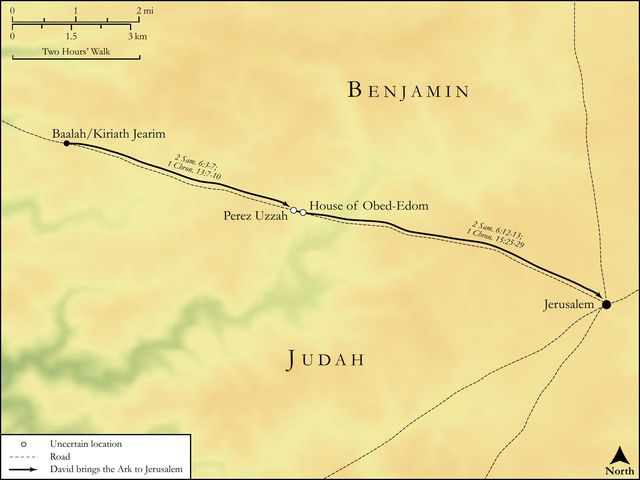
All things being got ready for the carrying of the ark to the city of David, and its reception there, we have here an account of the solemnity of this conveyance thither from the house of Obed-edom.
I.God helped the Levites that carried it.
The ark was no very great burden, that those who carried it needed any extraordinary help. But,
1.It is good to take notice of the assistance of the divine providence even in those things that fall within the compass of our natural powers: if God did not help us, we could not stir a step.
2.In all our religious exercises we must particularly derive help from heaven. See Act 26:22. All our sufficiency for holy duties is from God.
3.The Levites, remembering the breach upon Uzza, were probably ready to tremble when they took up the ark; but God helped them, that is, he encouraged them to it, silenced their fears, and strengthened their faith.
4.God helped them to do it decently and well, and without making any mistake. If we perform any religious duties so as to escape a breach, and come off with our lives, we must own it is God that helps us; for, if left to ourselves, we should be guilty of some fatal miscarriages. God's ministers that bear the vessels of the Lord have special need of divine help in their ministrations, that God in them may be glorified and his church edified. And, if God help the Levites, the people have the benefit of it.
II.When they experienced the tokens of God's presence with them they offered sacrifices of praise to him, Ch1 15:26.
This also he helped them to do. They offered these bullocks and rams perhaps by way of atonement for the former error, that it might not now be remembered against them, as well as by way of acknowledgment for the help now received.
III.There were great expressions of rejoicing used:
the sacred music was played, David danced, the singers sang, and the common people shouted, Ch1 15:27, Ch1 15:28. This we had before, Sa2 6:14, Sa2 6:15. Learn hence,
1.That we serve a good master, who delights to have his servants sing at their work.
2.That times of public reformation are, and should be, times of public rejoicing. Those are unworthy of the ark that are not glad of it.
3.It is not any disparagement to the greatest of men to show themselves zealous in the acts of devotion. Michal indeed despised David (Ch1 15:29); but her despising him did not make him at all despicable; he did not regard it himself, nor did any that were wise and good (and why should we covet the esteem of any but such?) think the worse of him.
Continue studying 1 Chronicles 15:29 across the web’s major study libraries — every link below opens this exact verse, chapter, or book on the destination site.
Read & Compare
 BibleGatewayThis verse in more than 200 translations and 70 languages.
 Bible.comThe YouVersion reader — hundreds of translations, reading plans, and highlights.
 ESV.orgCrossway's official English Standard Version reader.
 NET BibleThe NET translation with 60,000+ translators' notes on every rendering decision.
 STEP BibleTyndale House's free study tool — original text, vocabulary, and scholarly resources.
 BibliaLogos Bible Software's free web reader.
 USCCBThe New American Bible (Revised Edition) with the U.S. bishops' study notes.
Commentaries
 BibleHub CommentariesDozens of classic commentaries on this verse, gathered on one page.
 StudyLightMore than 100 commentary sets — the largest collection on the web.
 BibleRefPlain-English commentary on what this verse means, verse by verse.
 Enduring WordDavid Guzik's free commentary on this chapter, widely used by Bible teachers.
 Bible Study ToolsVerse commentary alongside Greek and Hebrew study aids.
Original Language & Research
- BibleHub InterlinearThe verse word by word — original language, transliteration, and English.
- BibleHub LexiconEvery word's original-language definition and Strong's entry.
 Blue Letter BibleDeep-study tools — Strong's numbers, concordance, and word studies.
 SefariaThe Hebrew text with Rashi and centuries of Jewish commentary.
Sermons, Hymns & Audio


TrulyRandomVerse is not affiliated with these sites and doesn’t control their content. They’re linked because they’re genuinely useful.
Summary
1 Chronicles 15:29 vividly portrays the triumphant arrival of the Ark of the Covenant in Jerusalem, the City of David, yet it culminates in a stark contrast between King David's uninhibited, joyful worship and his wife Michal's profound contempt. As David passionately celebrated the Ark's return with exuberant dancing and playing, Michal, observing from a window, responded with deep-seated disdain, exposing a fundamental divergence in their understanding of true devotion, royal decorum, and the very nature of worship before God. This moment serves as a poignant illustration of the heart's posture in the presence of the divine.
Context
ShowHideLiterary Context
This verse serves as the climactic conclusion to the detailed narrative of David's successful second attempt to bring the Ark of the Covenant to Jerusalem. It immediately follows the meticulous preparations and the joyous, divinely-ordained procession described throughout 1 Chronicles 15. This account stands in stark contrast to the tragic failure of the first attempt in 1 Chronicles 13, where Uzzah's death underscored the necessity of strict adherence to God's prescribed method for handling the sacred Ark. The entire chapter builds to this moment of exuberant celebration, with David leading the people in worship, offering sacrifices, and donning a linen ephod, a priestly garment, which underscored his humility and dedication. Michal's reaction in this verse abruptly punctuates the pervasive joy, setting the stage for the significant marital conflict and its consequences, which are more fully elaborated in the parallel account found in 2 Samuel 6:20-23. The subsequent chapter, 1 Chronicles 16, records David's psalm of thanksgiving and the establishment of regular worship before the Ark, solidifying Jerusalem as the spiritual and political heart of the kingdom.
Historical & Cultural Context
The Ark of the Covenant was the preeminent symbol of God's presence, His throne, and His covenant relationship with Israel, serving as the physical representation of the divine dwelling among His people (Exodus 25:22). Its arrival in Jerusalem was not merely a political act of centralizing the nation's capital but a profound theological statement, signifying God's choice of Jerusalem and David's dynasty. Among the kings of that day, an aura of dignified solemnity and regal decorum was typically expected, especially in public. David's "dancing and playing" involved vigorous, uninhibited movements, described elsewhere as "dancing before the LORD with all his might" (2 Samuel 6:14), an ecstatic expression of worship that transcended conventional royal protocol. Michal, as the daughter of King Saul, likely embodied a more traditional and perhaps rigid view of kingship and public appearance, possibly influenced by her father's pride and preoccupation with outward status. Her perspective was rooted in human dignity and social propriety, clashing sharply with David's radical humility and passionate, God-centered devotion.
Key Themes
ShowHideThis verse powerfully encapsulates several profound themes. The central theme is the Heart of Worship, vividly contrasting David's unreserved, humble, and joyful devotion with Michal's disdainful, prideful, and externally focused perspective. David's willingness to "strip away" his royal dignity to honor God highlights the theme of Humility vs. Pride, demonstrating that authentic reverence for God often necessitates setting aside human status, self-consciousness, and worldly expectations. Michal's scorn reveals a preoccupation with human appearances and social propriety over spiritual fervor, illustrating the danger of Judging Sincere Faith based on superficial standards or personal biases. Furthermore, the passage touches on the theme of Authenticity in Faith, challenging believers to discern whether their worship stems from a genuine, unreserved love for God or is merely a performative act. The conflict between David and Michal also subtly introduces the theme of Spiritual Fruitfulness, as Michal's subsequent barrenness, mentioned in the parallel account (2 Samuel 6:23), is often interpreted as a symbolic consequence of her spiritual unfruitfulness and contempt for God's anointed king and his form of worship. The passage thus underscores that God looks at the heart, not merely outward appearance (1 Samuel 16:7).
Exposition and Analysis
ShowHideKey Word Analysis
ShowHideThis word (H7540) describes a vigorous, uninhibited, and often ecstatic physical expression, typically of joy or religious fervor. It implies a full-bodied, energetic movement, such as leaping, whirling, or stamping. In David's context, it underscores the intensity and unreserved nature of his worship before the Lord, demonstrating a complete surrender to the moment of divine celebration, without concern for royal dignity or public perception. It is an act of total engagement, physically manifesting his inner delight.
This term (H7832) refers to joyful celebration, revelry, or sport. While it can sometimes imply mockery, in this context, it signifies an exuberant, perhaps even playful, expression of delight and adoration. Coupled with "dancing," it paints a vivid picture of David's worship as spontaneous, overflowing, and joyous, fully engaging his body and spirit in praise, reflecting a heart unburdened by self-consciousness.
This powerful term (H959) conveys a strong sense of contempt, scorn, or looking down upon someone with utter disdain. It signifies an inward feeling of devaluation, a deep-seated lack of respect or appreciation. Michal's bâzâh was not merely a disagreement with David's method of worship but a profound internal rejection and demeaning of his person and actions, revealing a heart fundamentally out of alignment with the spirit of worship and the joyous reception of God's presence.
Verse Breakdown
ShowHide"And it came to pass, [as] the ark of the covenant of the LORD came to the city of David"
This opening clause meticulously sets the scene, marking the culmination of a long-anticipated and divinely ordained event. The Ark, the most sacred object in Israel, symbolizing God's tangible presence and His covenant relationship with His people, is finally being brought to Jerusalem, David's newly established capital. This act signifies the spiritual and political unification of the nation under God's chosen king, establishing Jerusalem as the central place of worship and governance.
"that Michal the daughter of Saul looking out at a window"
This identifies the observer and her specific vantage point. Michal, uniquely identified as "the daughter of Saul" rather than simply "David's wife," is positioned as an outsider, observing the vibrant procession from a distance and through a barrier (the window). Her lineage to the former king, Saul, is significant, potentially linking her perspective to the prideful, human-centered kingship of her father, which stood in stark contrast to David's God-centered approach. The "window" symbolically suggests her detachment, her inability or unwillingness to participate in the communal joy and spiritual fervor.
"saw king David dancing and playing"
This describes David's actions, which are the direct catalyst for Michal's reaction. David, the anointed king, is depicted engaging in uninhibited, joyful, and perhaps, by human standards, undignified worship. His actions are not a mere performance but an authentic, deeply felt expression of devotion, fully immersed in the celebration of God's presence without regard for his royal status or public image. The dual description of "dancing and playing" emphasizes the exuberance and totality of his worship.
"and she despised him in her heart"
This climactic phrase reveals the profound, internal nature of Michal's reaction. Her contempt was not merely a fleeting thought or an outward criticism, but a deep-seated, internal disdain. The phrase "in her heart" indicates a fundamental misalignment of her spirit with David's, and by extension, with the spirit of unreserved worship before the Lord. This internal scorn foreshadows the later marital strife and Michal's eventual barrenness, symbolizing a spiritual unfruitfulness stemming from her judgmental and prideful heart.
Literary Devices
ShowHideThe passage employs several potent Literary Devices to convey its profound message. Foremost is Contrast, which is central to the verse's meaning. It starkly juxtaposes David's uninhibited, joyful, and humble worship with Michal's detached, scornful, and prideful observation. This contrast highlights two fundamentally different approaches to God and kingship: one rooted in genuine devotion and humility, the other in human dignity and external appearances. Foreshadowing is also evident, as Michal's internal contempt here anticipates the direct confrontation and bitter exchange recorded in 2 Samuel 6:20-23, which ultimately leads to her barrenness. Her barrenness, in turn, functions as Symbolism, representing a spiritual unfruitfulness or a divine judgment on her contempt for God's anointed and the spirit of true worship. The "window" from which Michal observes can also be seen as a Symbol of her detachment and inability to participate in the spiritual joy, creating a barrier between her and the vibrant communal worship, emphasizing her isolation from the divine celebration.
Theological and Thematic Connections
ShowHide1 Chronicles 15:29 serves as a profound theological statement on the nature of authentic worship and the heart's posture before God. It underscores that true worship is not about maintaining human dignity or adhering to social expectations, but about unreserved, humble devotion to the Lord, even if it appears undignified or unconventional in the eyes of others. David's actions exemplify a heart fully surrendered to God's glory, prioritizing divine honor above personal reputation or public image. Michal's reaction, conversely, warns against the dangers of pride, judgmentalism, and a focus on external appearances that can quench the spirit of genuine praise. Her contempt reveals a spiritual disconnect, highlighting the biblical truth that God looks not at outward display but at the heart's condition (1 Samuel 16:7). The passage thus challenges believers to examine their own hearts in worship, cultivating a spirit of freedom, humility, and unreserved joy in God's presence, rather than allowing human standards or critical spirits to hinder their devotion or judge the sincere expressions of others.
Reflection and Application
ShowHideThis ancient narrative speaks powerfully to the contemporary believer, urging us to introspect on the authenticity and freedom of our worship. David's uninhibited dancing before the Ark, despite his royal status, challenges us to consider whether our expressions of faith are truly for God's glory or if they are constrained by self-consciousness, fear of judgment, or adherence to human expectations. Are we willing to set aside our pride and perceived dignity to fully engage with God in worship, embracing whatever form genuine devotion takes, whether it's quiet reverence or exuberant praise? Conversely, Michal's scorn serves as a sobering caution against the judgmental spirit that can arise when we prioritize external decorum or personal preferences over the sincere, Spirit-led expressions of others. We are called to cultivate a heart that celebrates God's presence in all its manifestations, rather than despising what might seem "undignified" to human eyes. Ultimately, this passage calls us to a worship that is heartfelt, humble, and wholly devoted to God, free from the shackles of human opinion and cultural norms, recognizing that true honor comes from honoring God above all else.
Questions for Reflection
ShowHideFAQ
ShowHideWhy was Michal's reaction so strong and negative?
ShowHideMichal's strong and negative reaction stemmed from a profound clash of perspectives regarding kingship, dignity, and the nature of worship. As the daughter of King Saul, she likely inherited or was shaped by her father's emphasis on outward appearance and royal decorum. Saul, remember, was chosen for his impressive stature (1 Samuel 9:2), and his reign was often characterized by a preoccupation with public image and maintaining a kingly facade. Michal perceived David's uninhibited dancing, stripping himself of royal robes to wear a simple linen ephod, as undignified and shameful for a king. She explicitly articulated this in the parallel account, accusing David of debasing himself before his servants' handmaids (2 Samuel 6:20). Her contempt was rooted in a human-centric view of kingship and propriety, failing to grasp David's God-centered humility and his understanding that true honor came from humbling oneself before the Lord of the Covenant, not from upholding human standards of dignity. Her heart was focused on worldly status rather than spiritual fervor.
What is the significance of Michal's barrenness in 2 Samuel 6:23?
ShowHideMichal's barrenness, as recorded in 2 Samuel 6:23, is highly significant within the biblical narrative. While the text does not explicitly state it as a direct divine punishment, it is widely interpreted by scholars as a symbolic consequence of her contempt for David's worship and, by extension, for God's chosen king and the spirit of unreserved devotion. In biblical narratives, barrenness often symbolizes a lack of fruitfulness, a cessation of blessing, or a spiritual unfruitfulness. In Michal's case, her inability to bear children for David, the king through whom God promised an enduring dynasty (2 Samuel 7:12-16), underscores her spiritual alienation and the severing of her connection to the vibrant, life-giving flow of God's covenant purposes. Her pride and scorn led to a spiritual and physical unfruitfulness, standing in stark contrast to the abundant blessing and life associated with David's humble and passionate worship.
Christ-Centered Fulfillment
ShowHide1 Chronicles 15:29, with its vivid portrayal of David's uninhibited worship and Michal's contempt, profoundly foreshadows the nature of worship and spiritual reception in the New Covenant, culminating in Christ. David, as the king who humbles himself to dance before the Lord, prefigures Jesus, the ultimate King who "emptied himself, by taking the form of a servant" (Philippians 2:5-8), to accomplish salvation for humanity. His radical humility and passionate devotion to God serve as a prototype for the worship that Christ inaugurates: worship "in spirit and truth," where external appearances and human traditions are superseded by a genuine, heartfelt, and unreserved connection with God (John 4:23-24). Michal's scorn, rooted in a concern for outward dignity and societal norms, mirrors the rejection of Jesus by those who were bound by religious traditions and external righteousness, unable to recognize the divine glory veiled in humility (Matthew 23:27-28). Just as Michal despised David for his "undignified" worship, many religious leaders despised Christ for associating with sinners and challenging their established norms, failing to see the "Lamb of God, who takes away the sin of the world!" (John 1:29). The passage thus calls believers to embrace the freedom and humility of New Covenant worship, recognizing that true honor comes from surrendering all to Christ, who himself became "despised and rejected by mankind" (Isaiah 53:3) for our sake, so that we might worship God without reservation or concern for human opinion.