


1 Chronicles 15:28
- וְכָלve·kholand allH3605Conj-w ¦ N-mscNoun Singular Masculine Constructוְandכָלall
- יִשְׂרָאֵלYis·ra·'ElIsraelH3478N-properNoun Proper Location
- מַעֲלִיםma·'a·Lim[was] bringing upH5927V-Hiphil-Prtcpl-mpVerb Hiphil Participle Plural Masculine Absolute
- אֶת'et<obj.>H853DirObjMParticle Object Indicator
- אֲרוֹן'a·Ron[the] ark ofH727N-mscNoun Singular Masculine Construct
- בְּרִיתbe·rit[the] covenant ofH1285N-fscNoun Singular Feminine Construct
- יְהוָהYah·wehYahwehH3068N-properNoun Proper Title
- בִּתְרוּעָהbit·ru·'Ahwith a shoutH8643Prep-b ¦ N-fsNoun Singular Feminine Absoluteבִּwithתְרוּעָהa shout
- וּבְקוֹלu·ve·Koland with [the] sound ofH6963Conj-w ¦ Prep-b ¦ N-mscNoun Singular Masculine Constructוּandבְwithקוֹל[the] sound of
- שׁוֹפָרsho·Fara ram's hornH7782N-msNoun Singular Masculine Absolute
- וּבַחֲצֹצְרוֹתu·va·cha·tzo·tze·Rotand with trumpetsH2689Conj-w ¦ Prep-b ¦ N-fpNoun Plural Feminine Absoluteוּandבַwithחֲצֹצְרוֹתtrumpets
- וּבִמְצִלְתָּיִםu·vim·tzil·Ta·yimand with cymbalsH4700Conj-w ¦ Prep-b ¦ N-fdNoun Dual Feminine Absoluteוּandבִwithמְצִלְתָּיִםcymbals
- מַשְׁמִעִיםmash·mi·'Imsounding aloudH8085V-Hiphil-Prtcpl-mpVerb Hiphil Participle Plural Masculine Absolute
- בִּנְבָלִיםbin·va·Limwith lyresH5035Prep-b ¦ N-mpNoun Plural Masculine Absoluteבִּwithנְבָלִיםlyres
- וְכִנֹּרוֹתve·khi·no·Rotand harpsH3658Conj-w ¦ N-fpNoun Plural Feminine Absoluteוְandכִנֹּרוֹתharps
English is a literal word-by-word gloss of the Hebrew, not the KJV's wording. Why?
This is the original text the KJV's translators worked from — each Hebrew word with its own literal English meaning in this verse, prepared by scholars at Tyndale House, Cambridge. The KJV translates whole sentences, not word by word, so its wording differs: one Hebrew word can become several English words, and the KJV may choose “the LORD” where the gloss reads “Yahweh”. Both are faithful — they answer different questions. For the KJV's own rendering, switch to the KJV text.
Details
See on the biblical-era map
Study this verse
Public-domain commentary
Matthew Henry
From his Commentary on the Whole Bible. Henry comments on passages, not single verses — this entry covers 1 Chronicles 15:25–29. His two-level outline is real structure in the source text, so it is rendered as structure.
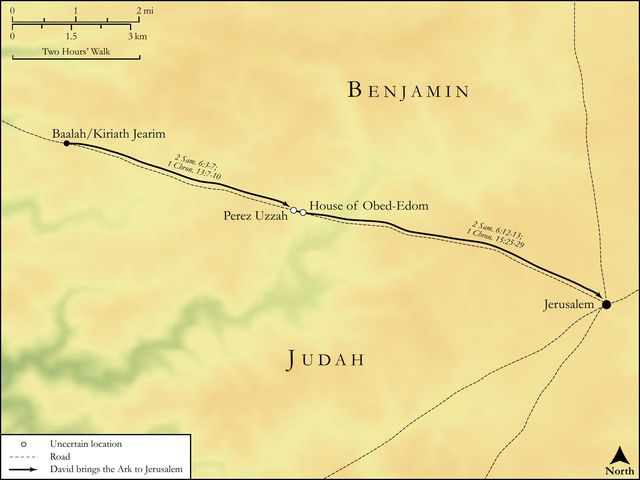
All things being got ready for the carrying of the ark to the city of David, and its reception there, we have here an account of the solemnity of this conveyance thither from the house of Obed-edom.
I.God helped the Levites that carried it.
The ark was no very great burden, that those who carried it needed any extraordinary help. But,
1.It is good to take notice of the assistance of the divine providence even in those things that fall within the compass of our natural powers: if God did not help us, we could not stir a step.
2.In all our religious exercises we must particularly derive help from heaven. See Act 26:22. All our sufficiency for holy duties is from God.
3.The Levites, remembering the breach upon Uzza, were probably ready to tremble when they took up the ark; but God helped them, that is, he encouraged them to it, silenced their fears, and strengthened their faith.
4.God helped them to do it decently and well, and without making any mistake. If we perform any religious duties so as to escape a breach, and come off with our lives, we must own it is God that helps us; for, if left to ourselves, we should be guilty of some fatal miscarriages. God's ministers that bear the vessels of the Lord have special need of divine help in their ministrations, that God in them may be glorified and his church edified. And, if God help the Levites, the people have the benefit of it.
II.When they experienced the tokens of God's presence with them they offered sacrifices of praise to him, Ch1 15:26.
This also he helped them to do. They offered these bullocks and rams perhaps by way of atonement for the former error, that it might not now be remembered against them, as well as by way of acknowledgment for the help now received.
III.There were great expressions of rejoicing used:
the sacred music was played, David danced, the singers sang, and the common people shouted, Ch1 15:27, Ch1 15:28. This we had before, Sa2 6:14, Sa2 6:15. Learn hence,
1.That we serve a good master, who delights to have his servants sing at their work.
2.That times of public reformation are, and should be, times of public rejoicing. Those are unworthy of the ark that are not glad of it.
3.It is not any disparagement to the greatest of men to show themselves zealous in the acts of devotion. Michal indeed despised David (Ch1 15:29); but her despising him did not make him at all despicable; he did not regard it himself, nor did any that were wise and good (and why should we covet the esteem of any but such?) think the worse of him.
Continue studying 1 Chronicles 15:28 across the web’s major study libraries — every link below opens this exact verse, chapter, or book on the destination site.
Read & Compare
 BibleGatewayThis verse in more than 200 translations and 70 languages.
 Bible.comThe YouVersion reader — hundreds of translations, reading plans, and highlights.
 ESV.orgCrossway's official English Standard Version reader.
 NET BibleThe NET translation with 60,000+ translators' notes on every rendering decision.
 STEP BibleTyndale House's free study tool — original text, vocabulary, and scholarly resources.
 BibliaLogos Bible Software's free web reader.
 USCCBThe New American Bible (Revised Edition) with the U.S. bishops' study notes.
Commentaries
 BibleHub CommentariesDozens of classic commentaries on this verse, gathered on one page.
 StudyLightMore than 100 commentary sets — the largest collection on the web.
 BibleRefPlain-English commentary on what this verse means, verse by verse.
 Enduring WordDavid Guzik's free commentary on this chapter, widely used by Bible teachers.
 Bible Study ToolsVerse commentary alongside Greek and Hebrew study aids.
Original Language & Research
- BibleHub InterlinearThe verse word by word — original language, transliteration, and English.
- BibleHub LexiconEvery word's original-language definition and Strong's entry.
 Blue Letter BibleDeep-study tools — Strong's numbers, concordance, and word studies.
 SefariaThe Hebrew text with Rashi and centuries of Jewish commentary.
Sermons, Hymns & Audio


TrulyRandomVerse is not affiliated with these sites and doesn’t control their content. They’re linked because they’re genuinely useful.
Summary
1 Chronicles 15:28 vividly portrays the triumphant and meticulously orchestrated procession of the Ark of the Covenant into Jerusalem. This pivotal event, following a previous tragic failure, saw King David and all Israel meticulously adhere to divine commands, culminating in an outpouring of national joy, exuberant worship, and unified celebration. The scene is marked by a cacophony of shouting, the majestic sound of cornets and trumpets, the rhythmic clash of cymbals, and the melodic strains of psalteries and harps, signifying the central establishment of God's holy presence among His people in the capital city.
Context
ShowHideLiterary Context
This verse serves as the triumphant climax of a significant narrative arc in 1 Chronicles 15, detailing David's renewed and successful effort to bring the Ark of the Covenant to Jerusalem. It stands in stark contrast to the disastrous first attempt in 1 Chronicles 13, where Uzzah died for touching the Ark because it was transported improperly on a new cart rather than carried by the Levites as prescribed by Mosaic law (Numbers 4:15). Chapter 15 meticulously details David's diligent preparation: he consults with the Levites and priests, sanctifies them, and ensures the Ark is carried on poles by the appointed Kohathite Levites (1 Chronicles 15:2). This meticulous obedience to God's instructions transforms a previous tragedy into a joyous, divinely sanctioned triumph, setting the stage for the Ark's permanent dwelling in Jerusalem and foreshadowing the eventual building of the Temple.
Historical & Cultural Context
The Ark of the Covenant, constructed according to God's precise instructions in Exodus 25:10-22, was the most sacred object in ancient Israel, symbolizing God's presence, His covenant with Israel, and His throne. Its journey from Kiriath-Jearim (where it had been residing at the house of Obed-Edom since its return from Philistine capture) to Jerusalem was a monumental event. David's decision to bring the Ark to Jerusalem was not merely a logistical move but a profound theological and political statement, signifying Jerusalem as the spiritual and political heart of the nation, where God's presence would reside. The widespread use of diverse musical instruments and collective shouting reflects the vibrant and expressive nature of ancient Israelite worship, where sound, movement, and communal participation were integral to expressing devotion and celebrating divine acts, often marking significant national or religious occasions.
Key Themes
ShowHideThe verse powerfully illustrates several key themes central to the book of Chronicles and broader biblical theology. Firstly, it highlights the paramount importance of obedience to God's commands, particularly concerning worship and sacred things. The stark contrast with the events of 1 Chronicles 13 underscores that God desires not just devotion, but devotion rendered in the way He prescribes, leading to blessing rather than judgment. Secondly, it showcases joyful and expressive worship, demonstrating that worship can and should be a vibrant, communal, and uninhibited expression of praise and gratitude. The cacophony of instruments and shouting signifies a wholehearted national celebration of God's presence. Thirdly, the phrase "all Israel" emphasizes communal unity in worship and national life, portraying a unified people celebrating their covenant God. Finally, the entire event underscores the significance of God's presence among His people, with the Ark serving as its tangible symbol, establishing Jerusalem as the central place of worship and foreshadowing the future Temple, a theme that resonates throughout the Old Testament narratives, from the Tabernacle to Solomon's Temple.
Exposition and Analysis
ShowHideKey Word Analysis
ShowHideThis word denotes a clamor or acclamation, specifically a shout of joy or triumph, or the clangor of trumpets as an alarm. In this context, it conveys an unbridled, national outpouring of celebratory emotion, signifying exultation and praise. It is often associated with moments of divine intervention, victory, or profound worship, such as the fall of Jericho (Joshua 6:5) or a call to joyful worship (Psalm 100:1).
This term refers to a compact or league, often made by "cutting" (referencing ancient covenant-making rituals involving animal sacrifice). Here, it specifically refers to God's covenant with Israel, a foundational relationship based on divine promises and human obedience. The "Ark of the Covenant" thus represents the tangible symbol of this sacred agreement, embodying God's faithfulness and His unique relationship with His chosen people. Its movement signifies the re-establishment of this central relationship in the heart of the nation.
This is the personal, self-existent, and eternal name of God, often rendered as "Jehovah" or "Yahweh." The presence of this divine name emphasizes that the Ark is not merely a national artifact but the sacred dwelling place of the sovereign God of Israel. The entire procession is therefore an act of worship directed towards the one true God, acknowledging His supreme authority and His active presence among His people.
Verse Breakdown
ShowHide"Thus all Israel brought up the ark of the covenant of the LORD"
This opening phrase underscores the collective, unified action of the entire nation, led by King David, in a sacred undertaking. The phrase "ark of the covenant of the LORD" highlights the supreme object of their reverence and the divine authority behind the procession, signifying that this was not merely a political act but a deeply spiritual one, now conducted according to God's specific instructions. The verb "brought up" (H5927, ʻâlâh) implies an ascent, fitting for Jerusalem's elevated position and the elevation of God's presence.
"with shouting"
This describes the vocal expression of the people's intense joy and triumph. It was not a silent, somber procession but a loud, exultant declaration of praise and celebration for God's presence, signifying unbridled enthusiasm and communal participation.
"and with sound of the cornet, and with trumpets, and with cymbals, making a noise with psalteries and harps"
This detailed enumeration of musical instruments paints a vivid auditory picture of the scene. It signifies a full, orchestrated celebration, employing a wide range of sounds—from the piercing blasts of the shôwphâr (H7782, cornet) and chătsôtsᵉrâh (H2689, trumpets) used for signaling and solemn occasions, to the percussive clash of mᵉtsêleth (H4700, cymbals), and the melodic strains of nebel (H5035, psalteries/lyres) and kinnôwr (H3658, harps), typically used for accompaniment and praise. Their combined sound created a powerful, celebratory atmosphere, a "noise" (H8085, shâmaʻ, implying a sound that is heard and acknowledged) of worship and adoration.
Literary Devices
ShowHideThe verse employs several powerful literary devices to convey its message. Imagery is central, painting a vivid sensory picture of the procession, particularly through the auditory details of "shouting" and the cacophony of various musical instruments. This creates a strong sense of the overwhelming joy and energy of the event, allowing the reader to almost hear the celebration. Enumeration is used effectively in the listing of instruments (cornet, trumpets, cymbals, psalteries, harps), which not only provides specific detail but also emphasizes the comprehensive and diverse nature of the musical worship, indicating a full-scale national celebration. Furthermore, the verse stands in implicit Contrast to the previous, ill-fated attempt to move the Ark in 1 Chronicles 13, highlighting the success and blessing that result from obedience to God's prescribed ways. Finally, the Symbolism of the Ark itself is paramount, representing God's very presence and covenant faithfulness, making its triumphant entry a moment of profound spiritual significance for the nation.
Theological and Thematic Connections
ShowHide1 Chronicles 15:28 stands as a powerful testament to the nature of true worship and the significance of God's presence among His people. It demonstrates that worship, when conducted in obedience to God's revealed will, is not a somber duty but a joyous, expressive, and communal celebration. The emphasis on "all Israel" underscores the corporate dimension of faith, where the entire community participates in acknowledging God's sovereignty and celebrating His dwelling among them. This event also prefigures the ultimate dwelling of God with humanity, a theme that runs throughout biblical history, culminating in the person of Christ and the new heavens and new earth. The meticulous care taken to follow divine instructions for the Ark's transport highlights the holiness of God and the reverence due to Him, reminding us that while our worship should be heartfelt, it must also be offered in a manner that honors His character and commands, ensuring that our devotion is both passionate and proper.
Reflection and Application
ShowHideThe scene in 1 Chronicles 15:28 offers profound insights for contemporary believers regarding the nature of worship and the pursuit of God's presence. It calls us to cultivate a worship that is not only reverent but also unreservedly joyful and expressive, engaging our whole being—voices, instruments, and hearts—in praise. Just as "all Israel" participated, this verse encourages corporate worship, reminding us of the unique power and encouragement found when believers gather in unity to celebrate God's faithfulness. Moreover, the success of this procession, contrasted with the previous failure, serves as a timeless reminder that while passion is vital, it must be coupled with obedience to God's revealed will. Our devotion is most pleasing to God when it aligns with His character and commands, fostering an environment where His presence can truly be experienced and celebrated without hindrance. We are invited to bring our whole selves, with exuberant joy and faithful adherence, into the presence of our holy God.
Questions for Reflection
ShowHideFAQ
ShowHideWhat was the significance of the Ark of the Covenant for ancient Israel?
ShowHideThe Ark of the Covenant was the most sacred object to ancient Israel, symbolizing God's tangible presence among His people. It represented His throne, His covenant relationship with Israel, and His divine authority. It contained the tablets of the Law, a pot of manna, and Aaron's rod, serving as a constant reminder of God's provision, law, and miraculous power. Its presence signified God's dwelling with them, guiding them, and fighting for them, making it the central focus of their worship and national identity.
Why was there such a strong emphasis on music and shouting during this procession?
ShowHideThe emphasis on music and shouting in 1 Chronicles 15:28 reflects the deeply expressive and communal nature of ancient Israelite worship. The "shouting" (teru'ah) was a cry of triumph and joy, often associated with divine intervention or great celebration. The diverse array of instruments—cornets, trumpets, cymbals, psalteries, and harps—created a full, rich sound that amplified the national rejoicing. This was not merely entertainment but a profound act of worship, a physical and audible outpouring of gratitude, adoration, and exultation for God's presence and faithfulness, demonstrating wholehearted engagement in the sacred moment.
How did this successful attempt to move the Ark differ from the previous, failed attempt in 1 Chronicles 13?
ShowHideThe key difference lay in obedience to God's specific instructions. In 1 Chronicles 13, David attempted to move the Ark on a new cart, a method not prescribed by God, leading to Uzzah's death when he touched the Ark. This was a violation of the Law given in Numbers 4:15, which mandated that the Ark be carried on poles by the Kohathite Levites. In 1 Chronicles 15, David learned from this tragedy. He meticulously ensured that the Levites were consecrated and carried the Ark on their shoulders, as commanded. This adherence to divine protocol transformed a previous disaster into a blessed and triumphant celebration, demonstrating that God's ways are paramount for receiving His blessing.
Christ-Centered Fulfillment
ShowHideThe triumphant procession of the Ark of the Covenant into Jerusalem, as described in 1 Chronicles 15:28, finds its ultimate fulfillment in the person and work of Jesus Christ. The Ark symbolized God's presence dwelling among His people, a profound longing that finds its perfect realization in Christ, who is Immanuel, "God with us". He is the true tabernacle, the living embodiment of God's presence, as John 1:14 declares, "The Word became flesh and made his dwelling among us." Just as the Ark's entry into Jerusalem established a central place for God's presence, Christ's incarnation and His establishing of the New Covenant through His sacrifice and resurrection usher in a new era where God's presence is not confined to a physical object or temple, but dwells within believers through the Holy Spirit (1 Corinthians 6:19). The joyous celebration surrounding the Ark's arrival foreshadows the even greater joy and worship that erupts from the hearts of those who encounter the living God in Christ, who has truly brought God's presence to humanity, making reconciliation and intimate fellowship possible for all who believe (Colossians 1:19-20). He is our ultimate access to God, our High Priest who has entered the true heavenly sanctuary, making a way for us to draw near with confidence to the throne of grace (Hebrews 9:11-12).