


1 Chronicles 15:27
Bible text: King James Version (1769 Blayney text) · Public domain
Bible text: King James Version with Strong's numbers · Public domain
Bible text: Berean Standard Bible · Public domain
Bible text: American Standard Version (1901) · Public domain
Bible text: World English Bible, Messianic edition · Public domain
Bible text: Geneva Bible (1599) · Public domain
Bible text: Young's Literal Translation · Public domain
- וְדָוִידve·da·Vidand DavidH1732Conj-w ¦ N-proper-mNoun Proper MasculineוְandדָוִידDavid
- מְכֻרְבָּלme·khur·Bal[was] wrappedH3736V-Pual-PassPrtcpl-msVerb Pual Participle Passive Singular Masculine Absolute
- בִּמְעִילbim·'Ilin a robe ofH4598Prep-b ¦ N-mscNoun Singular Masculine Constructבִּinמְעִילa robe of
- בּוּץButzfine linenH948N-msNoun Singular Masculine Absolute
- וְכָלve·kholand allH3605Conj-w ¦ N-mscNoun Singular Masculine Constructוְandכָלall
- הַלְוִיִּםhal·vi·Yimthe LevitesH3881Art ¦ N-mpNoun Gentilic Plural Masculine AbsoluteהַtheלְוִיִּםLevites
- הַנֹּשְׂאִיםha·no·se·'Imwho were carryingH5375Art ¦ V-Qal-Prtcpl-mpVerb Qal Participle Plural Masculine Absoluteהַwhoנֹּשְׂאִיםwere carrying
- אֶת'et<obj.>H853DirObjMParticle Object Indicator
- הָאָרוֹןha·'a·Ronthe arkH727Art ¦ N-msNoun Singular Masculine Absoluteהָtheאָרוֹןark
- וְהַמְשֹׁרְרִיםve·ham·Sho·re·Rimand the singersH7891Conj-w ¦ Art ¦ V-Piel-Prtcpl-mpVerb Piel Participle Plural Masculine Absoluteוְandהַtheמְשֹׁרְרִיםsingers
- וּכְנַנְיָהu·khe·nan·Yahand KenaniahH3663Conj-w ¦ N-proper-mNoun Proper MasculineוּandכְנַנְיָהKenaniah
- הַשַּׂרha·Sarthe leaderH8269Art ¦ N-mscNoun Singular Masculine Constructהַtheשַּׂרleader
- הַמַּשָּׂאha·ma·Sa'the lifting upH4853Art ¦ N-msNoun Singular Masculine Absoluteהַtheמַּשָּׂאlifting up
- הַמְשֹׁרְרִיםham·sho·re·Rimthe singersH7891Art ¦ V-Piel-Prtcpl-mpVerb Piel Participle Plural Masculine Absoluteהַtheמְשֹׁרְרִיםsingers
- וְעַלve·'aland [was] onH5921Conj-w ¦ PrepPrepositionוְandעַל[was] on
- דָּוִידda·VidDavidH1732N-proper-mNoun Proper Masculine
- אֵפוֹד'e·Fodan ephod ofH646N-mscNoun Singular Masculine Construct
- בָּדBadlinenH906N-msNoun Singular Masculine Absolute
English is a literal word-by-word gloss of the Hebrew, not the KJV's wording. Why?
This is the original text the KJV's translators worked from — each Hebrew word with its own literal English meaning in this verse, prepared by scholars at Tyndale House, Cambridge. The KJV translates whole sentences, not word by word, so its wording differs: one Hebrew word can become several English words, and the KJV may choose “the LORD” where the gloss reads “Yahweh”. Both are faithful — they answer different questions. For the KJV's own rendering, switch to the KJV text.
Details
See on the biblical-era map
Study this verse
Public-domain commentary
Matthew Henry
From his Commentary on the Whole Bible. Henry comments on passages, not single verses — this entry covers 1 Chronicles 15:25–29. His two-level outline is real structure in the source text, so it is rendered as structure.
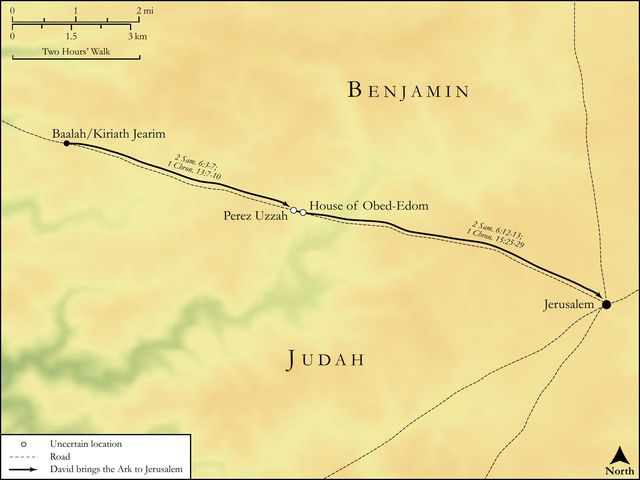
All things being got ready for the carrying of the ark to the city of David, and its reception there, we have here an account of the solemnity of this conveyance thither from the house of Obed-edom.
I.God helped the Levites that carried it.
The ark was no very great burden, that those who carried it needed any extraordinary help. But,
1.It is good to take notice of the assistance of the divine providence even in those things that fall within the compass of our natural powers: if God did not help us, we could not stir a step.
2.In all our religious exercises we must particularly derive help from heaven. See Act 26:22. All our sufficiency for holy duties is from God.
3.The Levites, remembering the breach upon Uzza, were probably ready to tremble when they took up the ark; but God helped them, that is, he encouraged them to it, silenced their fears, and strengthened their faith.
4.God helped them to do it decently and well, and without making any mistake. If we perform any religious duties so as to escape a breach, and come off with our lives, we must own it is God that helps us; for, if left to ourselves, we should be guilty of some fatal miscarriages. God's ministers that bear the vessels of the Lord have special need of divine help in their ministrations, that God in them may be glorified and his church edified. And, if God help the Levites, the people have the benefit of it.
II.When they experienced the tokens of God's presence with them they offered sacrifices of praise to him, Ch1 15:26.
This also he helped them to do. They offered these bullocks and rams perhaps by way of atonement for the former error, that it might not now be remembered against them, as well as by way of acknowledgment for the help now received.
III.There were great expressions of rejoicing used:
the sacred music was played, David danced, the singers sang, and the common people shouted, Ch1 15:27, Ch1 15:28. This we had before, Sa2 6:14, Sa2 6:15. Learn hence,
1.That we serve a good master, who delights to have his servants sing at their work.
2.That times of public reformation are, and should be, times of public rejoicing. Those are unworthy of the ark that are not glad of it.
3.It is not any disparagement to the greatest of men to show themselves zealous in the acts of devotion. Michal indeed despised David (Ch1 15:29); but her despising him did not make him at all despicable; he did not regard it himself, nor did any that were wise and good (and why should we covet the esteem of any but such?) think the worse of him.
Continue studying 1 Chronicles 15:27 across the web’s major study libraries — every link below opens this exact verse, chapter, or book on the destination site.
Read & Compare
 BibleGatewayThis verse in more than 200 translations and 70 languages.
 Bible.comThe YouVersion reader — hundreds of translations, reading plans, and highlights.
 ESV.orgCrossway's official English Standard Version reader.
 NET BibleThe NET translation with 60,000+ translators' notes on every rendering decision.
 STEP BibleTyndale House's free study tool — original text, vocabulary, and scholarly resources.
 BibliaLogos Bible Software's free web reader.
 USCCBThe New American Bible (Revised Edition) with the U.S. bishops' study notes.
Commentaries
 BibleHub CommentariesDozens of classic commentaries on this verse, gathered on one page.
 StudyLightMore than 100 commentary sets — the largest collection on the web.
 BibleRefPlain-English commentary on what this verse means, verse by verse.
 Enduring WordDavid Guzik's free commentary on this chapter, widely used by Bible teachers.
 Bible Study ToolsVerse commentary alongside Greek and Hebrew study aids.
Original Language & Research
- BibleHub InterlinearThe verse word by word — original language, transliteration, and English.
- BibleHub LexiconEvery word's original-language definition and Strong's entry.
 Blue Letter BibleDeep-study tools — Strong's numbers, concordance, and word studies.
 SefariaThe Hebrew text with Rashi and centuries of Jewish commentary.
Sermons, Hymns & Audio


TrulyRandomVerse is not affiliated with these sites and doesn’t control their content. They’re linked because they’re genuinely useful.
Summary
1 Chronicles 15:27 provides a meticulous description of the attire worn by King David, the Levites who carried the Ark of the Covenant, the singers, and Chenaniah, the master of the song, during the Ark's solemn and joyous procession to Jerusalem. This detail highlights David's profound humility and reverence, as he, despite his royal status, donned a simple robe of fine linen and a linen ephod, mirroring the garments of those actively involved in the sacred service. The shared attire underscores the unified devotion and ritual purity deemed essential for approaching God's holy presence, emphasizing that proper worship transcends earthly hierarchy and demands a consecrated heart.
Context
ShowHideLiterary Context
This verse is strategically placed within the narrative of 1 Chronicles 15, which recounts King David's second, successful endeavor to bring the Ark of the Covenant to Jerusalem. The Chronicler meticulously details this event, especially in light of the disastrous first attempt recorded in 1 Chronicles 13, where Uzzah's death underscored the severe consequences of disregarding divine protocol. Learning from this tragedy, David ensures that this second attempt adheres strictly to God's instructions. Chapter 1 Chronicles 15 opens with David's preparations, including building a place for the Ark and summoning the Levites to sanctify themselves and carry the Ark "according to the word of the Lord" (1 Chronicles 15:15). Verses 1 Chronicles 15:16-24 detail the careful appointment of musicians and gatekeepers, emphasizing the organized and celebratory nature of the procession. Verse 1 Chronicles 15:27 specifically focuses on the attire worn by the key participants, setting the stage for the triumphant entry into Jerusalem described in 1 Chronicles 15:28 and the subsequent worship and sacrifices in 1 Chronicles 16.
Historical & Cultural Context
The Ark of the Covenant was the most sacred artifact in ancient Israel, serving as the tangible representation of God's throne and His dwelling presence among His people, as explicitly outlined in Exodus 25:22. Its proper handling was strictly governed by Mosaic Law, which underscored the profound holiness of God and the absolute necessity of ritual purity. Only consecrated Levites from the family of Kohath were authorized to transport it, and then only by means of poles, never by direct touch. The tragic incident involving Uzzah in 1 Chronicles 13 served as a stark reminder of the severe consequences of disregarding these divine protocols. Fine linen (Hebrew: bûwts), a material renowned for its purity and pristine white appearance, was intimately associated with sanctity and priestly service in the Old Testament. It was frequently used for the tabernacle curtains and the garments of the priests, as mandated in Exodus 28:5. The ephod, while famously an elaborate and ornate garment for the High Priest, could also refer to a simpler linen vestment worn by priests or individuals engaged in sacred service, as exemplified by Samuel ministering in a linen ephod in 1 Samuel 2:18. David's deliberate choice to wear such attire, rather than his customary royal robes, constituted a profound cultural statement of humility, identification with the sacred office, and an acknowledgment of God's supreme authority over his own kingship.
Key Themes
ShowHideThis verse profoundly contributes to several overarching themes within the book of Chronicles and the broader biblical narrative. Firstly, it powerfully illustrates Humility in Leadership, demonstrating that even a powerful monarch like David recognized his subordinate position before the Almighty. By divesting himself of royal garments in favor of simple linen, he intentionally identified with the Levites and musicians, thereby emphasizing that authentic leadership in God's presence necessitates a servant-hearted posture of worship. Secondly, the passage underscores Reverence and Proper Worship. David's meticulous attention to his attire, which adhered to the divine protocols for purity and sanctity, reflects a deep and abiding reverence for God's holiness and a steadfast commitment to honoring Him in the divinely prescribed manner, standing in stark contrast to the previous failure. Thirdly, the theme of Purity and Holiness is central. Fine linen universally symbolized ritual purity, underscoring the absolute necessity of a holy approach to the Ark, which embodied God's very presence. This emphasizes that approaching God demands not merely outward actions but also inward consecration. Finally, the shared attire among the king, the Levites, and the musicians powerfully symbolizes Unity in Worship. It portrays a collective and unified act of devotion, where all participants, irrespective of their societal standing, were united in their sacred duty and shared reverence for God. This communal act of worship highlights the importance of all God's people coming together in humble adoration.
Exposition and Analysis
ShowHideKey Word Analysis
ShowHideFrom the root meaning "to gird or clothe," this word signifies the act of adorning oneself with garments. In this context, it highlights David's deliberate action of putting on specific attire, emphasizing his active participation and preparation for the sacred procession, rather than merely being present as an observer.
This term refers to a high-quality, pure white fabric, often associated with bleaching to achieve its pristine whiteness. It denotes a material of purity and sanctity, frequently used for sacred purposes. Its mention here underscores the ritual cleanliness and holiness required for all participants, especially David, in approaching the Ark of the Covenant, which symbolized God's holy presence.
This word describes a type of garment, often a girdle or shoulder-piece, specifically known as the ephod worn by priests, including the High Priest. While the High Priest's ephod was elaborate, David's "linen ephod" indicates a simpler form. Its presence signifies a garment of service and worship, identifying the wearer with sacred duties rather than royal status. David's choice to wear this garment demonstrates his humility and active role in the religious ceremony.
Verse Breakdown
ShowHide"And David [was] clothed with a robe of fine linen"
This opening clause immediately establishes King David's personal attire for the sacred event. His deliberate choice of a "robe of fine linen," a garment associated with purity and priestly service rather than royal splendor, profoundly signifies his humility and his desire to approach God not as a monarch, but as a devoted worshiper. It sets the reverent tone for the entire procession, prioritizing spiritual humility over earthly status.
"and all the Levites that bare the ark, and the singers, and Chenaniah the master of the song with the singers"
This part of the verse meticulously details that the same humble, pure attire was worn by all key participants in the procession. This shared dress among the Ark-bearers, the musicians, and their designated leader, Chenaniah, conveys a powerful message of unity and equality in sacred service. It underscores that before God, all participants, regardless of their specific role or societal standing, were united in their shared devotion and commitment to proper, consecrated worship.
"David also [had] upon him an ephod of linen"
This final clause reinforces and further specifies David's attire, highlighting the "ephod of linen." This detail emphasizes his active and personal participation in the sacred duties. The ephod, a garment traditionally associated with priestly service, solidified his identification with the Levites and his role as a worshiper, rather than merely an observer or a king presiding over a ceremony. It underscores his uninhibited and personal devotion, a characteristic famously displayed in his dancing before the Lord (2 Samuel 6:14).
Literary Devices
ShowHideThe passage employs several literary devices to convey its profound theological message. Symbolism is paramount, with "fine linen" and the "linen ephod" serving as potent symbols of purity, holiness, and humility. The pure white linen visually represents the ritual cleanliness and moral uprightness required for approaching the holy God, while the simple ephod symbolizes David's humble identification with the Levites and his role as a servant-worshiper, rather than a king in royal regalia. The Repetition of "linen" (robe of fine linen, ephod of linen) serves to emphasize the material's significance and the consistent standard of purity applied to all participants, especially David. Furthermore, there is an implicit Juxtaposition between David's usual royal attire and the humble garments he chose for this sacred occasion. This contrast highlights his deliberate act of self-abasement and reverence before God, making his humility even more striking. The detailed enumeration of those wearing the linen (David, Levites, singers, Chenaniah) also creates a sense of Unity and collective participation in a sacred, divinely ordered event, reinforcing the communal nature of worship.
Theological and Thematic Connections
ShowHideThe careful description of attire in 1 Chronicles 15:27 offers profound theological insights into the nature of worship and leadership before a holy God. It teaches that true reverence involves not only external actions but also an internal posture of humility and purity. David, as king, models a leadership that understands its place under divine authority, choosing to identify with those serving God rather than asserting his earthly power. This act foreshadows the New Testament understanding of humility as a core virtue for all believers, especially leaders, and emphasizes that God values a contrite and obedient heart over outward show. The communal wearing of linen underscores the unity of purpose in worship, where all are equal in their need for God's grace and their commitment to His service. This passage, therefore, serves as a timeless reminder that approaching God demands intentionality, purity of heart, and a humble recognition of His supreme holiness.
Reflection and Application
ShowHideDavid's intentional choice to wear a simple linen ephod and robe, identifying with the Levites and musicians, offers a powerful paradigm for contemporary believers and leaders. It challenges the notion that status or worldly position grants special privilege in the presence of God. Instead, it calls us to cultivate a profound humility, recognizing that our highest honor is to be a servant and worshiper of the Lord. This passage encourages us to approach worship, both individually and corporately, with intentionality and reverence, considering what attitudes and preparations truly honor God. Just as David learned from past mistakes to meticulously follow God's instructions, we are reminded of the importance of aligning our lives and worship practices with biblical truth. Furthermore, the shared attire symbolizes the unity that should characterize the body of Christ. In our diverse roles within the church, we are called to be united in purpose and devotion, recognizing that our common identity in Christ transcends all earthly distinctions. Our worship should not be a performance but a sincere, humble offering from a pure heart, reflecting our deep reverence for God's holiness and our joy in His presence.
Questions for Reflection
ShowHideFAQ
ShowHideWhy did David wear a "linen ephod" and not his royal robes?
ShowHideDavid's choice to wear a "linen ephod" and a robe of fine linen instead of his royal garments was a deliberate and profound act of humility and reverence. Royal robes would have signified his kingly authority and status. By contrast, the linen ephod was a simple garment typically worn by priests and those engaged in sacred service, like the Levites and Samuel (1 Samuel 2:18). This choice allowed David to identify himself not as a king presiding over a ceremony, but as a participant, a worshiper, and a servant alongside those bearing the Ark. It demonstrated his understanding that before God's holy presence, earthly status was secondary to spiritual humility and obedience to divine protocol, especially after the previous disastrous attempt to move the Ark (1 Chronicles 13).
What was the significance of "fine linen" in this context?
ShowHide"Fine linen" (Hebrew: bûwts) held significant symbolic meaning in ancient Israel. It was a material associated with purity, holiness, and priestly service. It was used extensively in the construction of the Tabernacle and for the garments of the priests, as detailed in Exodus 28:5. Its pure white color symbolized ritual cleanliness and moral uprightness. For David and all those involved in the sacred procession of the Ark, wearing fine linen underscored the necessity of purity and reverence when approaching the Ark, which represented the very presence of God. It was a visual declaration of their consecrated state and their commitment to honoring God according to His prescribed ways.
Christ-Centered Fulfillment
ShowHide1 Chronicles 15:27, with its profound emphasis on David's humble attire and the purity required for approaching God's holy presence, powerfully foreshadows the person and redemptive work of Jesus Christ. David, a king, lays aside his royal splendor to identify with those serving God, embodying a king-priest figure who leads in worship. This act points directly to Jesus, the true King of Kings, who, though eternally divine, "did not count equality with God a thing to be grasped, but emptied himself, by taking the form of a servant, being born in the likeness of men" (Philippians 2:6-7). Christ, our Great High Priest, did not come in earthly pomp but in profound humility, clothed in the "fine linen" of perfect righteousness and sinlessness, offering Himself as the ultimate, spotless sacrifice. The Ark, representing God's dwelling among His people, finds its ultimate and complete fulfillment in Christ, for in Him "the Word became flesh and dwelt among us, and we have seen his glory" (John 1:14). The meticulous preparation and the absolute necessity of purity to approach the Ark point to the profound reality that access to God's presence is now only possible through Christ's perfect sacrifice and His imputed righteousness. He is the new and living way, the sole means by which we can draw near to the Father in holiness and truth (John 14:6 and Hebrews 10:19-22). Thus, David's humble linen garments anticipate the divine humility and perfect purity of the Lamb of God, through whom all believers are clothed in righteousness and granted unhindered access to God's holy presence.