


2 Samuel 6:14
Bible text: King James Version (1769 Blayney text) · Public domain
Bible text: Berean Standard Bible · Public domain
Bible text: American Standard Version (1901) · Public domain
Bible text: World English Bible, Messianic edition · Public domain
Bible text: Geneva Bible (1599) · Public domain
Bible text: Young's Literal Translation · Public domain
- וְדָוִדve·da·Vidand DavidH1732Conj-w ¦ N-proper-mNoun Proper MasculineוְandדָוִדDavid
- מְכַרְכֵּרme·khar·Ker[was] dancingH3769V-Piel-Prtcpl-msVerb Piel Participle Singular Masculine Absolute
- בְּכָלbe·kholwith allH3605Prep-b ¦ N-mscNoun Singular Masculine Constructבְּwithכָלall
- עֹז'ozstrengthH5797N-msNoun Singular Masculine Absolute
- לִפְנֵיlif·Nei<to> beforeH6440Prep-l ¦ N-mpcNoun Plural Masculine Constructלִ<to>פְנֵיbefore
- יְהוָהYah·wehYahwehH3068N-properNoun Proper Title
- וְדָוִדve·da·Vidand DavidH1732Conj-w ¦ N-proper-mNoun Proper MasculineוְandדָוִדDavid
- חָגוּרcha·Gur[was] girdedH2296V-Qal-PassPrtcpl-msVerb Qal Participle Passive Singular Masculine Absolute
- אֵפוֹד'e·Fodan ephod ofH646N-mscNoun Singular Masculine Construct
- בָּדBadlinenH906N-msNoun Singular Masculine Absolute
English is a literal word-by-word gloss of the Hebrew, not the KJV's wording. Why?
This is the original text the KJV's translators worked from — each Hebrew word with its own literal English meaning in this verse, prepared by scholars at Tyndale House, Cambridge. The KJV translates whole sentences, not word by word, so its wording differs: one Hebrew word can become several English words, and the KJV may choose “the LORD” where the gloss reads “Yahweh”. Both are faithful — they answer different questions. For the KJV's own rendering, switch to the KJV text.
Details
See on the biblical-era maps
Study this verse
Public-domain commentary
Matthew Henry
From his Commentary on the Whole Bible. Henry comments on passages, not single verses — this entry covers 2 Samuel 6:12–19. His four-level outline is real structure in the source text, so it is rendered as structure.
We have here the second attempt to bring the ark home to the city of David; and this succeeded, though the former miscarried.
I.It should seem the blessing with which the house of Obed-edom was blessed for the ark's sake was a great inducement to David to bring it forward; for when that was told him (Sa2 6:12) he hastened to fetch it to him. For,
1.It was an evidence that God was reconciled to them, and his anger was turned away. As David could read God's frowns upon them all in Uzzah's stroke, so he could read God's favour to them all in Obed-edom's prosperity; and, if God be at peace with them, they can cheerfully go on with their design.
2.It was an evidence that the ark was not such a burdensome stone as it was taken to be, but, on the contrary, happy was the man that had it near him. Christ is indeed a stone of stumbling, and a rock of offence, to those that are disobedient; but to those who believe he is a corner-stone, elect, precious, Pe1 2:6-8. When David heard that Obed-edom had such joy of the ark, then he would have it in his own city. Note, The experience others have had of the gains of godliness should encourage us to be religious. Is the ark a blessing to others' houses? let us bid it welcome to ours; we may have it, and the blessing of it, without fetching it from our neighbours.
II.Let us see how David managed the matter now.
1.He rectified the former error. He did not put the ark in a cart now, but ordered those whose business it was to carry it on their shoulders. This is implied here (Sa2 6:13) and expressed Ch1 15:15. Then we make a good use of the judgments of God on ourselves and others when we are awakened by them to reform and amend whatever has been amiss.
2.At their first setting out he offered sacrifices to God (Sa2 6:13) by way of atonement for their former errors and in a thankful acknowledgment of the blessings bestowed on the house of Obed-edom. Then we are likely to speed in our enterprises when we begin with God and give diligence to make our peace with him, When we attend upon God in holy ordinances our eye must be to the great sacrifice, to which we owe it that we are taken into covenant and communion with God, Psa 50:5.
3.He himself attended the solemnity with the highest expressions of joy that could be (Sa2 6:14): He danced before the Lord with all his might; he leaped for joy, as one transported with the occasion, and the more because of the disappointment he met with the last time. It is a pleasure to a good man to see his errors rectified and himself in the way of his duty. His dancing, I suppose, was not artificial, by any certain rule or measure, nor do we find that any danced with him; but it was a natural expression of his great joy and exultation of mind. He did it with all his might; so we should perform all our religious services, as those that are intent upon them and desire to do them in the best manner. All our might is little enough to be employed in holy duties: the work deserves it all. On this occasion David laid aside his imperial purple, and put on a plain linen ephod, which was light and convenient for dancing, and was used in religious exercises by those who were no priests, for Samuel wore one, Sa1 2:18. That great prince thought it no disparagement to him to appear in the habit of a minister to the ark.
4.All the people triumphed in this advancement of the ark (Sa2 6:15): They brought it up into the royal city with shouting, and with sound of trumpet, so expressing their own joy in loud acclamations, and giving notice to all about them to rejoice with them. The public and free administration of ordinances, not only under the protection, but under the smiles, of the civil powers, is just matter of rejoicing to any people. 5. the ark was safely brought to, and honourably deposited in, the place prepared for it, Sa2 6:17. They set it in the midst of the tabernacle, or tent, which David had pitched for it; not the tabernacle which Moses reared, for that was at Gibeon (Ch2 1:13), and, we may suppose, being made of cloth, in so many hundred years it had gone to decay and was not fit to be removed; but this was a tent set up on purpose to receive the ark. He would not bring it into a private house, no, not his own, lest it should seem to be too much engrossed, and people's resort to it, to pray before it, should be less free; yet he would not build a house for it, lest that should supersede the building of a more stately temple in due time, and therefore, for the present, he placed it within curtains, under a canopy, in imitation of Moses's tabernacle. As soon as ever it was lodged, he offered burnt-offerings and peace-offerings, in thankfulness to God that the business was now done without any more errors or breaches, and in supplication to God for the continuance of his favour. Note, All our joys must be sanctified both with praises and prayers; for with such sacrifices God is well pleased. New, it should seem, he penned the 132nd Psa 6:1-10. The people were then dismissed with great satisfaction. He sent them away,
(1.)With a gracious prayer: He blessed them in the name of the Lord of hosts (v. 18), having not only a particular interest in heaven as a prophet, but an authority over them as a prince; for the less is blessed of the better, Heb 7:7. He prayed to God to bless them, and particularly to reward them for the honour and respect they had now shown to his ark, assuring them they should be no losers by their journey, but the blessing of God upon their affairs at home would more than bear their charges. He testified his desire for their welfare by this prayer for them, and let them know they had a king that loved them.
(2.)With a generous treat; for so it was, rather than a distribution of alms. The great men, it is probable, he entertained at his own house, but to the multitude of Israel, men and women (and children, says Josephus), he dealt to every one a cake of bread (a spice-cake, so some), a good piece of flesh - a handsome decent piece (so some) - a part of the peace-offerings (so Josephus), that they might feast with him upon the sacrifice, and a flagon, or bottle, of wine, Sa2 6:19. Probably he ordered this provision to be made for them at their respective quarters, and this he did,
[1.]In token of his joy and gratitude to God. When the heart is enlarged in cheerfulness the hand should be opened in liberality. The feast of Purim was observed with sending portions one to another, Est 9:22. As those to whom God is merciful ought to show mercy in forgiving, so those to whom God is bountiful ought to exercise bounty in giving.
[2.]To recommend himself to the people, and confirm his interest in them; for every one is a friend to him that giveth gifts. Those that cared not for his prayers would love him for his generosity; and this would encourage them to attend him another time if he saw cause to call them together.
Historical interpretation
Three Centuries of Reception
3 surviving comments on this verse. Each one is dated, so this reads as a timeline rather than a list.
Select a marker to jump to its quote. Markers stagger vertically where authors wrote within a few decades of each other.
And that David danced before the Lord does in no way encourage faithful Christians to take seats in the theater. He did not distort his body in obscene movements and dance out the drama of Grecian libido.… Therefore, no approval whatever is given for spectators of illicit things.
For our vows are celebrated when the church is united to Christ, as John says: “The one who has the bride is the bridegroom.” Because of this marriage, therefore, it behooves us to dance, for David, at once king and prophet, is also said to have danced before the ark of the covenant with much singing. In high rejoicing he broke into dancing, for in the Spirit he foresaw Mary, born of his own line, brought into Christ’s chamber, and so he says, “And he, like a bridegroom, will come forth from his chamber.” Thus he sang more than the other prophetic authors because, gladder than the rest of them, by these joys he united those coming after him in marriage. And, by inviting us to his own vows in a more charming way than usual, having danced with such joy in front of the ark before his marriage, he taught us what we ought to do at those other vows. The prophet David danced, then. But what would we say that the ark was if not holy Mary, since the ark carried within it the tables of the covenant, while Mary bore the master of the same covenant? The one bore the law within itself and the other the gospel, but the ark gleamed within and without with the radiance of gold, while holy Mary shone within and without with the splendor of virginity; the one was adorned with earthly gold, the other with heavenly.
But because secret pride of heart is reproved by this which Elihu says, “All who seem to themselves to be wise will not dare to contemplate him,” it seems good to observe what great gifts of virtues David had obtained, and in all these with how firm a humility he maintained himself. For whom would it not puff up to break the mouths of lions, to rend asunder the arms of bears, to be chosen, when his elder brothers had been despised, to be anointed to the government of the kingdom when the kings had been rejected, to slay with a single stone Goliath who was dreaded by all, to bring back, after the destruction of the aliens, the numerous foreskins proposed by the king, to receive at last the promised kingdom, and to possess the whole people of Israel without any contradiction? And yet, when he brings back the ark of God to Jerusalem, he dances before the ark, mingled with the people, as though forgetful that he had been preferred to them all. And because, as is believed, it had been the custom of the common people to dance before the ark, the king wheels round in the dance, in service to God. Behold how he whom the Lord preferred specially above all despises himself beneath the Lord, both by equaling himself to the least and by displaying abject behavior. The power of his kingdom is not recalled to his memory. He does not fear to be of low stature in the eyes of his people by dancing. He does not remember, before the ark of him who had given him honor, that he had been preferred in honor above the rest. Before God he acted with the most extreme lowliness, in order to strengthen by his humility the bold deeds he had performed in the sight of people. What others think of his doings, I do not know; I am more surprised at David dancing than fighting. For by fighting he subdued his enemies; but by dancing before the Lord he overcame himself. And when Michal, the daughter of Saul, still mad with pride at her royal descent, despised him when humbled, saying, “How glorious was the king of Israel today, uncovering himself before the handmaids of his servants, and made himself naked, as though one of the buffoons were naked,” she immediately heard, “As the Lord lives, I will play before the Lord, who has chosen me rather than your father.” And a little later he says, “And I will play and I will become more lowly than I have been, and I will be humble in my own eyes,” as if he had said, I seek to become lowly before people because I seek to keep myself noble before the Lord through my humility.
Continue studying 2 Samuel 6:14 across the web’s major study libraries — every link below opens this exact verse, chapter, or book on the destination site.
Read & Compare
 BibleGatewayThis verse in more than 200 translations and 70 languages.
 Bible.comThe YouVersion reader — hundreds of translations, reading plans, and highlights.
 ESV.orgCrossway's official English Standard Version reader.
 NET BibleThe NET translation with 60,000+ translators' notes on every rendering decision.
 STEP BibleTyndale House's free study tool — original text, vocabulary, and scholarly resources.
 BibliaLogos Bible Software's free web reader.
 USCCBThe New American Bible (Revised Edition) with the U.S. bishops' study notes.
Commentaries
 BibleHub CommentariesDozens of classic commentaries on this verse, gathered on one page.
 StudyLightMore than 100 commentary sets — the largest collection on the web.
 BibleRefPlain-English commentary on what this verse means, verse by verse.
 Enduring WordDavid Guzik's free commentary on this chapter, widely used by Bible teachers.
 Bible Study ToolsVerse commentary alongside Greek and Hebrew study aids.
Original Language & Research
- BibleHub InterlinearThe verse word by word — original language, transliteration, and English.
- BibleHub LexiconEvery word's original-language definition and Strong's entry.
 Blue Letter BibleDeep-study tools — Strong's numbers, concordance, and word studies.
 SefariaThe Hebrew text with Rashi and centuries of Jewish commentary.
Sermons, Hymns & Audio


TrulyRandomVerse is not affiliated with these sites and doesn’t control their content. They’re linked because they’re genuinely useful.
Summary
2 Samuel 6:14 vividly portrays King David's uninhibited and wholehearted devotion as the Ark of the Covenant was triumphantly brought into Jerusalem. This pivotal verse captures David's passionate worship, expressed through vigorous, unrestrained dance and humble attire, signifying his complete surrender and profound joy in the tangible presence of the Lord among His people. It stands as a powerful testament to authentic worship that transcends social status, personal dignity, and conventional expectations, prioritizing devotion to God above all else.
Context
ShowHideLiterary Context
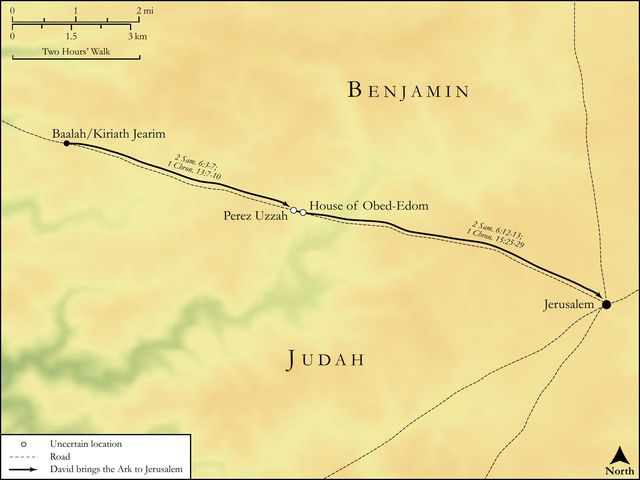
This verse is strategically placed within the narrative detailing the highly significant relocation of the Ark of the Covenant to Jerusalem, a defining moment in David's reign that solidified Jerusalem as both the political and spiritual capital of Israel. The immediate preceding verses recount the successful, second attempt to transport the Ark, a stark contrast to the tragic first attempt where Uzzah died for touching it 2 Samuel 6:6-7. Having learned from this devastating error, David ensured the Ark was transported correctly by the Levites, accompanied by sacrifices and immense national rejoicing, which set the stage for his exuberant and deeply personal expression of worship. The narrative continues directly into 2 Samuel 6:16, where David's wife, Michal, observes his dancing with disdain, leading to a significant and revealing confrontation that highlights the profound contrast between David's uninhibited devotion and Michal's concern for kingly decorum and public image.
Historical & Cultural Context
The Ark of the Covenant represented the most sacred object in ancient Israel, serving as the physical symbol of God's dwelling presence, His covenant relationship with Israel, and His divine authority as their true King. Its relocation from Kiriath-jearim to Jerusalem was far more than a logistical move; it was a profound theological and political act, establishing Jerusalem as the spiritual heart of the united monarchy under David. Kings among the nations typically cultivated an image of dignified power and aloofness, maintaining strict protocols of royal conduct. David's unreserved dancing, particularly while wearing a simple linen ephod, was an unconventional and potentially scandalous act for a king. However, it profoundly aligned with Israel's unique covenant relationship with Yahweh, where even the king was ultimately a servant of God, called to love the Lord with all his heart, soul, and might, as explicitly commanded in Deuteronomy 6:5. This act demonstrated David's understanding that his kingship was subordinate to his role as a worshiper of the Almighty.
Key Themes
ShowHideDavid's actions in this verse powerfully articulate several foundational themes. First, Wholehearted Worship: His dancing "with all his might" signifies an unrestrained, passionate, and uninhibited expression of worship, prioritizing genuine devotion and spiritual fervor over kingly dignity or social expectations. This contrasts sharply with Michal's subsequent reaction, underscoring the authenticity and depth of David's worship. Second, Humility and Servanthood: By choosing to wear a "linen ephod," a simple garment typically worn by priests or those ministering in the tabernacle, such as young Samuel, David symbolically laid aside his royal robes and kingly status. This act demonstrated profound humility, identifying himself as a worshiper and servant before God, rather than a monarch on display, emphasizing that all are equal in their posture before the divine. Third, Joy in God's Presence: The entire celebration surrounding the Ark's return was an outpouring of national and personal joy over the tangible symbol of God's dwelling among His people, highlighting that true worship is often characterized by exuberant celebration and profound delight in the Lord. This joy is a natural response to God's faithfulness and presence.
Exposition and Analysis
ShowHideKey Word Analysis
ShowHideThe Hebrew verb H3769 (kârar) means "to whirl" or "to spin," directly implying a vigorous and uninhibited form of dancing. This term conveys an energetic, perhaps even ecstatic, physical movement that goes far beyond a mere ceremonial step. In the context of David's worship, it suggests a complete abandonment to the joy and reverence of the moment, indicating an intense and unrestrained physical expression of praise before the Lord.
The Hebrew H3068 (Yᵉhôvâh) is the self-Existent or Eternal God, the Jewish national name of God, often rendered as Jehovah or the Lord. This specific name emphasizes God's covenant relationship with Israel and His unchanging, eternal nature. David's dance was not a general religious act but a specific, personal, and public act of worship directed toward Yahweh, the sovereign God of Israel, acknowledging His unique identity and supreme authority.
The Hebrew H5797 (ʻôz) denotes strength in various applications, including force, security, majesty, and praise. When David danced "with all his might," it signifies the totality and vigor of his effort. It was not a half-hearted or perfunctory movement, but an outpouring of his entire being—spirit, soul, and physical strength—in worship, reflecting the command to love God with all one's strength. This word highlights the intensity and wholeheartedness of his devotion.
The Hebrew H2296 (châgar) is a primitive root meaning "to gird on," as a belt or armor. In this context, it describes the act of David putting on or securing the linen ephod. This verb implies a deliberate action of dressing himself in this specific garment, emphasizing his intentional choice to wear attire that signified humility and service rather than royal pomp.
The Hebrew H906 (bad) refers to flaxen thread or yarn, and by extension, a linen garment. This specifies the material of the ephod, emphasizing its simplicity and plainness. Linen was associated with purity and was typically worn by priests, distinguishing it from the ornate, royal garments.
The Hebrew H646 (ʼêphôwd) refers to a girdle or shoulder-piece. While the high priest wore an elaborate ephod Exodus 28:6-14, the "linen ephod" (ephod bad) worn by David was a simpler, less ornate garment, typically worn by priests or those ministering in a religious capacity. David's choice of this garment underscored his humility and his desire to stand before God not as a king, but as a devoted worshiper and servant, identifying with the common people and the Levitical ministers.
Verse Breakdown
ShowHide"And David danced before the LORD with all [his] might"
This clause describes the central action of the verse, highlighting David's personal and active participation in the celebration. "David danced" emphasizes the king's physical, uninhibited expression of joy and worship. The phrase "before the LORD" is crucial, signifying that his dance was an act of worship directed specifically towards God, acknowledging His supreme authority and presence, which was tangibly symbolized by the Ark of the Covenant. The intensifier "with all [his] might" (בְּכָל־עֹז, bekhol-oz) conveys the totality and vigor of his effort, indicating that his worship was not a half-hearted or perfunctory movement, but an outpouring of his entire being—spirit, soul, and body—in complete devotion, reflecting the command to love God with all one's strength.
"and David [was] girded with a linen ephod"
This second clause provides crucial detail about David's attire during his dance, offering profound symbolic insight into his posture of worship. "Girded" indicates that the ephod was wrapped around him, likely a short, tunic-like garment that allowed for freedom of movement and was suitable for physical exertion. The "linen ephod" highlights its simplicity and lack of royal adornment, distinguishing it from the ornate robes of kingship. This choice of clothing is profoundly symbolic, demonstrating David's humility and his willingness to divest himself of kingly pomp and status in the presence of God, identifying instead with the common people and the Levitical servants who ministered before the Ark. It signifies that before God, his royal status was secondary to his role as a humble worshiper.
Literary Devices
ShowHideThe verse employs several powerful Literary Devices to convey its profound message. The phrase "with all his might" functions as Hyperbole or Intensification, emphasizing the extreme, unreserved, and total nature of David's worship. It suggests a devotion that consumed his entire being, indicating an all-encompassing passion. Symbolism is central to the verse: the Ark of the Covenant itself symbolizes God's tangible, covenantal presence among His people, while David's vigorous dance symbolizes uninhibited joy, passionate devotion, and complete surrender to God. The "linen ephod" is also highly symbolic, representing humility, servanthood, and a deliberate shedding of kingly status in favor of a priestly or ministerial posture before the Divine. Furthermore, there is an implicit Contrast established, which becomes explicit in the subsequent verses 2 Samuel 6:16, between David's unbridled, humble worship and Michal's aristocratic disdain for his actions, highlighting differing perspectives on reverence, decorum, and the true nature of worship.
Theological and Thematic Connections
ShowHide2 Samuel 6:14 offers a profound theological statement on the nature of true worship, emphasizing that it is an internal posture of the heart that finds external, often uninhibited, expression, transcending social conventions or personal dignity. David's uninhibited dance and humble attire illustrate that genuine worship is not about maintaining appearances or status, but about wholehearted devotion and joyful surrender to God's presence. It challenges believers to consider the authenticity and intensity of their own worship, reminding us that God values a sincere heart and passionate spirit over outward show or rigid formality. This passage underscores that worship can be both deeply reverent and exuberantly celebratory, profoundly personal yet publicly expressed, and always directed towards the Lord with all one's being, reflecting the comprehensive love commanded by God.
Reflection and Application
ShowHideDavid's dance before the Lord serves as a powerful and enduring model for worship that is authentic, uninhibited, and deeply personal. In a world often preoccupied with external appearances, self-consciousness, and social conventions, this verse challenges us to examine the sincerity and freedom of our own devotion. Are we willing to lay aside our personal dignity, our fear of others' opinions, or our self-consciousness to fully express our love and joy before God? David, the powerful king, chose to humble himself, prioritizing his relationship with the Lord above all else, even at the risk of appearing undignified in the eyes of his peers. This invites us to consider what "might" we might be holding back from God—whether it's our time, our talents, our resources, or our emotional and physical expressions of praise. True worship flows from a heart completely surrendered to God, eager to celebrate His presence and goodness without reservation, recognizing that our highest calling is to honor Him with every fiber of our being.
Questions for Reflection
ShowHideFAQ
ShowHideWas David's dance appropriate for a king, considering his royal status?
ShowHideFrom a conventional, worldly perspective, David's dance might have seemed undignified or even scandalous for a king. Kings among the nations typically maintained a rigid decorum to project power and authority, often distancing themselves from the common people. However, from a biblical and theological perspective, David's actions were profoundly appropriate and pleasing to God. He understood that his ultimate authority and dignity came from God, and therefore, his highest calling was to humble himself and worship the Lord with all his being. His choice to wear a simple linen ephod instead of royal robes further underscored this humility, demonstrating that before God, all are servants and worshipers, regardless of earthly status. This act highlighted David's heart of devotion, which God valued more than outward kingly pomp, aligning with the principle that God looks at the heart, not outward appearance 1 Samuel 16:7. David's worship was an act of profound spiritual integrity.
Christ-Centered Fulfillment
ShowHideDavid's passionate, uninhibited dance before the Ark of the Covenant, clothed in a humble linen ephod, powerfully foreshadows the ultimate King-Priest, Jesus Christ. The Ark symbolized God's dwelling presence among His people, a presence that found its ultimate and complete fulfillment in the person of Jesus, who is God incarnate, dwelling among us and in whom all the fullness of the Deity lives in bodily form. David, a king, humbled himself to wear the garment of a servant or priest, reflecting the profound humility of Christ, who, being in very nature God, did not consider equality with God something to be used to his own advantage; rather, he made himself nothing by taking the very nature of a servant, even to the point of death on a cross. David's exuberant joy in God's presence points to the boundless joy and freedom found in the New Covenant established by Christ, where believers can now approach God with confidence through Jesus. Just as David brought the Ark to Jerusalem, establishing a central place of worship, Christ's sacrificial work and resurrection inaugurated a new era where true worshipers will worship the Father in the Spirit and in truth, no longer confined to a physical temple or a specific location but drawing near to God through the ultimate High Priest, Jesus, who has entered the true tabernacle, not made with human hands, but into heaven itself. David's worship, though powerful, was a shadow of the perfect, wholehearted devotion embodied and enabled by Christ.