


2 Samuel 6:13
- וַיְהִיvay·Hiand it wasH1961Conj-w ¦ V-Qal-ConsecImperf-3msVerb Qal Consecutive Imperfect 3rd Singular Masculineוַandיְהִיit was
- כִּיkithatH3588PrtParticle Conditional
- צָעֲדוּtza·'a·Duthey had steppedH6805V-Qal-Perf-3cpVerb Qal Perfect 3rd Plural common gender
- נֹשְׂאֵיno·se·'Ei[the] bearers ofH5375V-Qal-Prtcpl-mpVerb Qal Participle Plural Masculine Construct
- אֲרוֹן'a·ron[the] ark ofH727N-mscNoun Singular Masculine Construct
- יְהוָהYah·wehYahwehH3068N-properNoun Proper Title
- שִׁשָּׁהshi·ShahsixH8337N-csNoun Singular common gender Absolute
- צְעָדִיםtze·'a·DimstepsH6806N-mpNoun Plural Masculine Absolute
- וַיִּזְבַּחvai·yiz·Bachand he sacrificedH2076Conj-w ¦ V-Qal-ConsecImperf-3msVerb Qal Consecutive Imperfect 3rd Singular Masculineוַandיִּזְבַּחhe sacrificed
- שׁוֹרShoran oxH7794N-msNoun Singular Masculine Absolute
- וּמְרִיאu·me·Ri'and a fatlingH4806Conj-w ¦ N-msNoun Singular Masculine Absoluteוּandמְרִיאa fatling
English is a literal word-by-word gloss of the Hebrew, not the KJV's wording. Why?
This is the original text the KJV's translators worked from — each Hebrew word with its own literal English meaning in this verse, prepared by scholars at Tyndale House, Cambridge. The KJV translates whole sentences, not word by word, so its wording differs: one Hebrew word can become several English words, and the KJV may choose “the LORD” where the gloss reads “Yahweh”. Both are faithful — they answer different questions. For the KJV's own rendering, switch to the KJV text.
Details
See on the biblical-era map
Study this verse
Public-domain commentary
Matthew Henry
From his Commentary on the Whole Bible. Henry comments on passages, not single verses — this entry covers 2 Samuel 6:12–19. His four-level outline is real structure in the source text, so it is rendered as structure.
We have here the second attempt to bring the ark home to the city of David; and this succeeded, though the former miscarried.
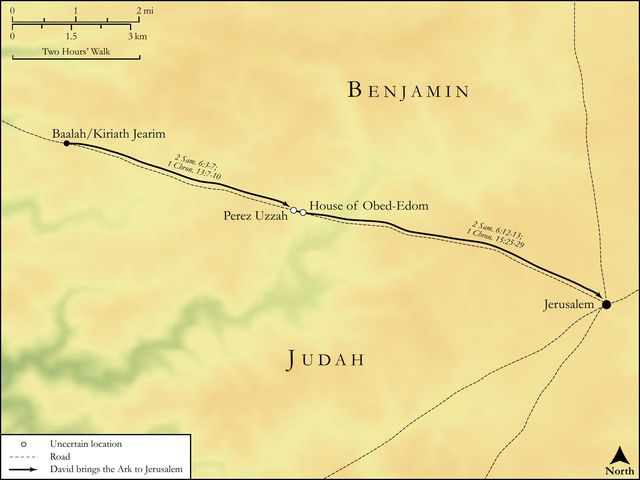
I.It should seem the blessing with which the house of Obed-edom was blessed for the ark's sake was a great inducement to David to bring it forward; for when that was told him (Sa2 6:12) he hastened to fetch it to him. For,
1.It was an evidence that God was reconciled to them, and his anger was turned away. As David could read God's frowns upon them all in Uzzah's stroke, so he could read God's favour to them all in Obed-edom's prosperity; and, if God be at peace with them, they can cheerfully go on with their design.
2.It was an evidence that the ark was not such a burdensome stone as it was taken to be, but, on the contrary, happy was the man that had it near him. Christ is indeed a stone of stumbling, and a rock of offence, to those that are disobedient; but to those who believe he is a corner-stone, elect, precious, Pe1 2:6-8. When David heard that Obed-edom had such joy of the ark, then he would have it in his own city. Note, The experience others have had of the gains of godliness should encourage us to be religious. Is the ark a blessing to others' houses? let us bid it welcome to ours; we may have it, and the blessing of it, without fetching it from our neighbours.
II.Let us see how David managed the matter now.
1.He rectified the former error. He did not put the ark in a cart now, but ordered those whose business it was to carry it on their shoulders. This is implied here (Sa2 6:13) and expressed Ch1 15:15. Then we make a good use of the judgments of God on ourselves and others when we are awakened by them to reform and amend whatever has been amiss.
2.At their first setting out he offered sacrifices to God (Sa2 6:13) by way of atonement for their former errors and in a thankful acknowledgment of the blessings bestowed on the house of Obed-edom. Then we are likely to speed in our enterprises when we begin with God and give diligence to make our peace with him, When we attend upon God in holy ordinances our eye must be to the great sacrifice, to which we owe it that we are taken into covenant and communion with God, Psa 50:5.
3.He himself attended the solemnity with the highest expressions of joy that could be (Sa2 6:14): He danced before the Lord with all his might; he leaped for joy, as one transported with the occasion, and the more because of the disappointment he met with the last time. It is a pleasure to a good man to see his errors rectified and himself in the way of his duty. His dancing, I suppose, was not artificial, by any certain rule or measure, nor do we find that any danced with him; but it was a natural expression of his great joy and exultation of mind. He did it with all his might; so we should perform all our religious services, as those that are intent upon them and desire to do them in the best manner. All our might is little enough to be employed in holy duties: the work deserves it all. On this occasion David laid aside his imperial purple, and put on a plain linen ephod, which was light and convenient for dancing, and was used in religious exercises by those who were no priests, for Samuel wore one, Sa1 2:18. That great prince thought it no disparagement to him to appear in the habit of a minister to the ark.
4.All the people triumphed in this advancement of the ark (Sa2 6:15): They brought it up into the royal city with shouting, and with sound of trumpet, so expressing their own joy in loud acclamations, and giving notice to all about them to rejoice with them. The public and free administration of ordinances, not only under the protection, but under the smiles, of the civil powers, is just matter of rejoicing to any people. 5. the ark was safely brought to, and honourably deposited in, the place prepared for it, Sa2 6:17. They set it in the midst of the tabernacle, or tent, which David had pitched for it; not the tabernacle which Moses reared, for that was at Gibeon (Ch2 1:13), and, we may suppose, being made of cloth, in so many hundred years it had gone to decay and was not fit to be removed; but this was a tent set up on purpose to receive the ark. He would not bring it into a private house, no, not his own, lest it should seem to be too much engrossed, and people's resort to it, to pray before it, should be less free; yet he would not build a house for it, lest that should supersede the building of a more stately temple in due time, and therefore, for the present, he placed it within curtains, under a canopy, in imitation of Moses's tabernacle. As soon as ever it was lodged, he offered burnt-offerings and peace-offerings, in thankfulness to God that the business was now done without any more errors or breaches, and in supplication to God for the continuance of his favour. Note, All our joys must be sanctified both with praises and prayers; for with such sacrifices God is well pleased. New, it should seem, he penned the 132nd Psa 6:1-10. The people were then dismissed with great satisfaction. He sent them away,
(1.)With a gracious prayer: He blessed them in the name of the Lord of hosts (v. 18), having not only a particular interest in heaven as a prophet, but an authority over them as a prince; for the less is blessed of the better, Heb 7:7. He prayed to God to bless them, and particularly to reward them for the honour and respect they had now shown to his ark, assuring them they should be no losers by their journey, but the blessing of God upon their affairs at home would more than bear their charges. He testified his desire for their welfare by this prayer for them, and let them know they had a king that loved them.
(2.)With a generous treat; for so it was, rather than a distribution of alms. The great men, it is probable, he entertained at his own house, but to the multitude of Israel, men and women (and children, says Josephus), he dealt to every one a cake of bread (a spice-cake, so some), a good piece of flesh - a handsome decent piece (so some) - a part of the peace-offerings (so Josephus), that they might feast with him upon the sacrifice, and a flagon, or bottle, of wine, Sa2 6:19. Probably he ordered this provision to be made for them at their respective quarters, and this he did,
[1.]In token of his joy and gratitude to God. When the heart is enlarged in cheerfulness the hand should be opened in liberality. The feast of Purim was observed with sending portions one to another, Est 9:22. As those to whom God is merciful ought to show mercy in forgiving, so those to whom God is bountiful ought to exercise bounty in giving.
[2.]To recommend himself to the people, and confirm his interest in them; for every one is a friend to him that giveth gifts. Those that cared not for his prayers would love him for his generosity; and this would encourage them to attend him another time if he saw cause to call them together.
Continue studying 2 Samuel 6:13 across the web’s major study libraries — every link below opens this exact verse, chapter, or book on the destination site.
Read & Compare
 BibleGatewayThis verse in more than 200 translations and 70 languages.
 Bible.comThe YouVersion reader — hundreds of translations, reading plans, and highlights.
 ESV.orgCrossway's official English Standard Version reader.
 NET BibleThe NET translation with 60,000+ translators' notes on every rendering decision.
 STEP BibleTyndale House's free study tool — original text, vocabulary, and scholarly resources.
 BibliaLogos Bible Software's free web reader.
 USCCBThe New American Bible (Revised Edition) with the U.S. bishops' study notes.
Commentaries
 BibleHub CommentariesDozens of classic commentaries on this verse, gathered on one page.
 StudyLightMore than 100 commentary sets — the largest collection on the web.
 BibleRefPlain-English commentary on what this verse means, verse by verse.
 Enduring WordDavid Guzik's free commentary on this chapter, widely used by Bible teachers.
 Bible Study ToolsVerse commentary alongside Greek and Hebrew study aids.
Original Language & Research
- BibleHub InterlinearThe verse word by word — original language, transliteration, and English.
- BibleHub LexiconEvery word's original-language definition and Strong's entry.
 Blue Letter BibleDeep-study tools — Strong's numbers, concordance, and word studies.
 SefariaThe Hebrew text with Rashi and centuries of Jewish commentary.
Sermons, Hymns & Audio


TrulyRandomVerse is not affiliated with these sites and doesn’t control their content. They’re linked because they’re genuinely useful.
Summary
Second Samuel 6:13 marks a pivotal moment in King David's rectified attempt to bring the Ark of the Lord to Jerusalem, following the tragic failure of his first endeavor. This verse vividly portrays a profound shift in David's approach, demonstrating meticulous reverence and immediate, costly sacrifice. It illustrates a king's humble obedience to God's prescribed methods for handling His sacred presence, marking each successful step with an offering of thanksgiving and atonement, thereby underscoring the absolute holiness of God and the seriousness of approaching Him on His terms.
Context
ShowHideLiterary Context
This verse is strategically placed within the broader narrative of David's reign, specifically his efforts to consolidate the kingdom and establish Jerusalem as its spiritual and political heart. The immediate preceding verses recount the disastrous initial attempt to move the Ark, resulting in Uzzah's death for touching it (2 Samuel 6:6-8). This tragedy led David to abandon the procession and leave the Ark at the house of Obed-Edom for three months (2 Samuel 6:9-11). The subsequent report of God's blessing upon Obed-Edom's household because of the Ark's presence spurred David to undertake a second, more cautious and reverent attempt. Verse 13 signals the commencement of this corrected process, where David and the Israelites exhibit a heightened awareness of God's holiness and a commitment to adhering to divine instructions for the Ark's transportation, particularly that it be carried on the shoulders of the Levites with poles, as mandated by the Law (Numbers 4:15). The immediate and repeated sacrifices after only six paces underscore the profound transition from presumption to meticulous reverence and obedience.
Historical & Cultural Context
The Ark of the Covenant was the most sacred artifact in ancient Israel, serving as the tangible representation of God's throne and His dwelling presence among His people, particularly above the mercy seat (Exodus 25:22). Its proper handling was strictly governed by Mosaic Law, and any deviation carried severe consequences, as tragically demonstrated by Uzzah. David, as the newly established king, sought to centralize the worship of Yahweh in Jerusalem, and the relocation of the Ark was a crucial, symbolic act in establishing the city as the nation's spiritual capital. The practice of offering animal sacrifices was integral to Israelite worship, fulfilling various functions such as atonement, thanksgiving, and communion with God. The offering of "oxen and fatlings" signifies a valuable and costly sacrifice, reflecting the immense significance and devotion attached to this sacred procession. The public nature of both the procession and the sacrifices would have served as a powerful declaration of national piety and a re-establishment of proper worship protocols after the previous, ill-fated attempt.
Key Themes
ShowHideThe events surrounding the Ark's transfer, particularly as highlighted in this verse, powerfully illustrate several foundational theological themes. First, Reverence and Obedience are paramount; David's initial failure stemmed from neglecting God's precise instructions for handling the Ark, whereas his subsequent success was predicated on meticulous adherence to them, demonstrating unequivocally that God must be approached on His terms. Second, God's Holiness and Sovereignty are powerfully underscored by the severity of Uzzah's death and the subsequent, palpable carefulness exhibited by David and the people. The Ark's presence served as a constant, tangible reminder of God's unapproachable glory and His absolute authority over His covenant people. Third, Atonement and Thanksgiving are vividly expressed through the repeated sacrifices. These offerings likely functioned as both a plea for forgiveness for past errors and a continuous expression of gratitude for God's grace and the successful, safe journey of His divine presence. Finally, the entire event, culminating in the Ark's triumphant arrival in Jerusalem and David's exuberant worship (2 Samuel 6:14-15), highlights themes of Worship and Celebration, showcasing David's unwavering commitment to prioritizing God in the nation's life and fostering a spirit of national unity centered on divine presence.
Exposition and Analysis
ShowHideKey Word Analysis
ShowHideThis word, יְהֹוָה (Yᵉhôvâh), is the covenant name of God, often rendered as "Jehovah" or "Yahweh." It signifies the self-existent, eternal, and unchanging God who is faithful to His covenant promises. In the context of the Ark of the LORD, it emphasizes that the Ark is not merely a religious artifact but the sacred symbol of the presence of the sovereign, living God of Israel. The meticulous care taken in moving the Ark, and the sacrifices offered, are directed toward this holy and awesome God, whose character demands reverence and whose commands must be strictly obeyed.
The Hebrew verb נָשָׂא (nâsâʼ) carries a broad range of meanings, including "to lift," "to carry," or "to bear." In this context, it specifically refers to the act of carrying the Ark. The significance lies in how it was carried. The Law prescribed that the Ark be carried on poles by the Levites, not transported on a cart (as in the first attempt). The successful "bearing" of the Ark for six paces without incident indicated God's favor and acceptance of the corrected method, prompting David's immediate sacrificial response. This word highlights the physical act of carrying, but implicitly points to the proper, prescribed method of handling the sacred.
The verb זָבַח (zâbach) is a general term for slaughtering an animal for sacrifice. This act was central to Israelite worship, encompassing various types of offerings like burnt offerings (for atonement and devotion) and peace offerings (for thanksgiving and communion). The immediacy of the sacrifice after only six paces suggests a continuous, reverent acknowledgment of God's favor and a plea for continued blessing and protection. It indicates that David understood the need for ongoing purification, thanksgiving, and dependence on God's grace for every step of this sacred undertaking.
The term מְרִיא (mᵉrîyʼ) refers to stall-fed or fatted animals, typically considered the choicest and most desirable for sacrifice. These were animals specifically prepared and fattened to be the very best offering. The inclusion of "fatlings" alongside oxen underscores the costly, generous, and unreserved nature of David's offerings. It demonstrates his profound desire to give God nothing but the highest quality and to spare no expense in expressing his devotion, seeking divine favor, and acknowledging the immense holiness of the Ark's presence.
Verse Breakdown
ShowHide"And it was [so], that when they that bare the ark of the LORD had gone six paces"
This clause emphasizes the meticulous and cautious approach adopted in this second attempt to transport the Ark. The specific mention of "six paces" signifies an incredibly short distance, indicating that David was not waiting for the entire journey to be completed before offering sacrifices. Instead, he was acknowledging God's favor and seeking His continued blessing at the very outset and, implicitly, at regular intervals thereafter. This immediate response to successful movement contrasts sharply with the previous presumption and underscores a newfound humility and dependence on God's grace for every step of the sacred endeavor. It suggests a process of continuous, step-by-step validation of God's presence and approval.
"he sacrificed oxen and fatlings"
This phrase describes David's immediate and lavish response to the successful movement of the Ark. The offering of "oxen and fatlings" signifies a costly and significant sacrifice, involving multiple valuable animals. This act served multiple purposes: it was a profound expression of thanksgiving for God's favor in allowing the Ark to move safely; it was likely an act of atonement, acknowledging past errors and seeking forgiveness for any inadvertent sin; and it was a public demonstration of profound reverence and devotion. The plural "oxen and fatlings" suggests the scale and seriousness of the offerings, reflecting David's earnest desire to honor God appropriately and secure His continued blessing for the procession, indicating a commitment to worship that spared no expense.
Literary Devices
ShowHideThe passage employs several literary devices to convey its profound theological and narrative message. Narrative Contrast is strikingly evident, setting the meticulous, sacrificial second attempt to move the Ark against the disastrous, presumptuous first attempt. This contrast starkly highlights the crucial lesson learned by David and the nation regarding the proper, reverent approach to God's holiness. The Symbolism of the Ark itself is central, representing God's very dwelling place and throne, thereby emphasizing the immense gravity and sacredness of its handling. The repeated, costly sacrifices of "oxen and fatlings" serve as powerful Symbolism for genuine devotion, atonement, and profound thanksgiving, signifying a radical shift from human convenience and presumption to a posture of humble obedience to divine terms. Furthermore, the precise mention of "six paces" creates a sense of Hyperbole or extreme meticulousness, underscoring the depth of David's newfound reverence and profound fear of the Lord. This specific detail emphasizes the immediate and continuous nature of his sacrificial worship, transforming it into a potent narrative element that communicates the king's humility, obedience, and unwavering commitment to honoring God at every step.
Theological and Thematic Connections
ShowHideThis verse powerfully underscores the critical theological principle that God's holiness demands a specific, reverent approach, one dictated by His revealed will rather than by human convenience, innovation, or presumption. David's costly and immediate sacrifices after only six paces demonstrate a profound understanding that access to God's presence is an immense privilege, not an inherent right, and must be sought exclusively on His terms. This act of worship, punctuated by continuous offerings, reflects a posture of deep humility, absolute dependence, and an earnest desire to maintain fellowship with the Holy God. It teaches that genuine worship involves both unwavering obedience to divine commands and a willing generosity to give sacrificially, acknowledging God's supreme worthiness and seeking His continuous blessing and favor.
Reflection and Application
ShowHideSecond Samuel 6:13 serves as a profound and enduring reminder for believers today regarding the essential nature of our approach to God. Just as King David learned through a painful lesson that God's holy presence is not to be trifled with, we too are called to approach Him with profound reverence, awe, and unwavering obedience, never casually or presumptuously. Our worship, our service, and indeed our entire lives should be meticulously aligned with His revealed will, not merely with our own good intentions, convenience, or preferred methods. The "six paces" and immediate, costly sacrifices teach us the vital importance of continuous, step-by-step obedience and heartfelt thanksgiving in our spiritual pilgrimage. Every small victory, every moment of God's grace, every successful endeavor should prompt us to humbly acknowledge His goodness and to offer Him our very best. Genuine worship often involves a significant cost—whether of our time, our financial resources, our personal comfort, or the surrender of our own will—and must always be accompanied by a spirit of deep humility and profound gratitude for God's unfailing presence and abundant blessings in our lives. This passage challenges us to honestly examine our own hearts: do we approach God on our terms, or on His? Are we quick to offer Him thanks and seek His approval in all our endeavors, even in the smallest, seemingly insignificant steps?
Questions for Reflection
ShowHideFAQ
ShowHideWhy did David sacrifice after only "six paces"?
ShowHideThe act of sacrificing after only "six paces" signifies an extreme level of caution, profound reverence, and a dramatic shift in David's approach to God's holiness. After the tragic and devastating death of Uzzah (2 Samuel 6:7), David understood that God's presence was not to be treated lightly, presumptuously, or according to human convenience. The immediate sacrifices served multiple crucial purposes: they were a potent expression of thanksgiving for God's grace in allowing the Ark to move safely without further incident; they were likely an act of atonement for past errors and a heartfelt plea for continued divine favor and protection; and they demonstrated a continuous, step-by-step acknowledgment of God's absolute sovereignty over the entire procession. It was a public declaration that every single step of the journey was entirely dependent on God's blessing and was to be met with appropriate worship and profound humility. This meticulous and costly approach contrasts sharply with the earlier, less reverent and ultimately disastrous attempt.
What was the significance of sacrificing "oxen and fatlings"?
ShowHideThe sacrifice of "oxen and fatlings" was highly significant because these were exceptionally valuable, costly, and prime animals. Oxen (cattle) were large and represented substantial wealth and agricultural productivity, while "fatlings" were animals specifically fattened for slaughter, considered the choicest, healthiest, and best offerings available. By sacrificing such valuable animals, David demonstrated the immense depth of his devotion, the sincerity of his repentance for past errors, and his profound gratitude for God's presence and blessing. It underscored that David spared no expense in honoring God and that the return of the Ark to Jerusalem was an event of paramount national and spiritual importance, demanding the highest and most costly form of worship and sacrifice. This act emphasized the costly nature of true worship and the earnest desire to give God nothing but the very best, reflecting the magnitude of the moment and the reverence due to the Lord.
Christ-Centered Fulfillment
ShowHideThe narrative of David bringing the Ark, particularly the reverent and sacrificial approach detailed in 2 Samuel 6:13, profoundly foreshadows the ultimate fulfillment found in Jesus Christ. The Ark symbolized God's holy presence dwelling among His people, a presence that required meticulous adherence to the Law and costly, repeated sacrifices for access and atonement. In Christ, God's presence is no longer confined to a physical object or a temple, but is fully and perfectly embodied in the person of Jesus, who is truly Immanuel, "God with us". David's repeated sacrifices of "oxen and fatlings" point to the inherent insufficiency of animal offerings to truly and finally atone for sin, thereby powerfully foreshadowing the once-for-all perfect sacrifice of Christ. He is the ultimate Lamb of God who takes away the sin of the world, whose single, perfect offering eternally and completely atones for all who place their faith in Him. Furthermore, David's humble obedience and meticulous approach to God's commands find their ultimate and perfect expression in Jesus, who flawlessly fulfilled the Law and always did the will of His Father (John 8:29). Through Christ's finished work on the cross, believers now have bold and confident access to God's very presence, not through repeated animal sacrifices or strict adherence to physical rituals, but through faith in His perfect work, establishing a new and living way into the holiest place (Hebrews 10:19-20).