


2 Chronicles 1:13
- וַיָּבֹאvai·ya·Vo'and he wentH935Conj-w ¦ V-Qal-ConsecImperf-3msVerb Qal Consecutive Imperfect 3rd Singular Masculineוַandיָּבֹאhe went
- שְׁלֹמֹהshe·lo·MohSolomonH8010N-proper-mNoun Proper Masculine
- לַבָּמָהla·ba·Mahto the high placeH1116Prep-l ¦ N-fsNoun Singular Feminine Absoluteלַto theבָּמָהhigh place
- אֲשֶׁר'a·SherwhichH834RelParticle Relative
- בְּגִבְעוֹןbe·giv·'On[was] at GibeonH1391Prep-b ¦ N-properNoun Proper Locationבְּ[was] atגִבְעוֹןGibeon
- יְרוּשָׁלִַםye·Ru·sha·LimJerusalemH3389N-properNoun Proper Location
- מִלִּפְנֵיmi·lif·Neifrom to beforeH6440Prep-m ¦ Prep-l ¦ N-mpcNoun Plural Masculine Constructמִfromלִּtoפְנֵיbefore
- אֹהֶל'O·hel[the] tent ofH168N-mscNoun Singular Masculine Construct
- מוֹעֵדmo·'EdmeetingH4150N-msNoun Singular Masculine Absolute
- וַיִּמְלֹךְvai·yim·Lokhand he reignedH4427Conj-w ¦ V-Qal-ConsecImperf-3msVerb Qal Consecutive Imperfect 3rd Singular Masculineוַandיִּמְלֹךְhe reigned
- עַל'aloverH5921PrepPreposition
- יִשְׂרָאֵלYis·ra·'ElIsraelH3478N-properNoun Proper Location
English is a literal word-by-word gloss of the Hebrew, not the KJV's wording. Why?
This is the original text the KJV's translators worked from — each Hebrew word with its own literal English meaning in this verse, prepared by scholars at Tyndale House, Cambridge. The KJV translates whole sentences, not word by word, so its wording differs: one Hebrew word can become several English words, and the KJV may choose “the LORD” where the gloss reads “Yahweh”. Both are faithful — they answer different questions. For the KJV's own rendering, switch to the KJV text.
Details
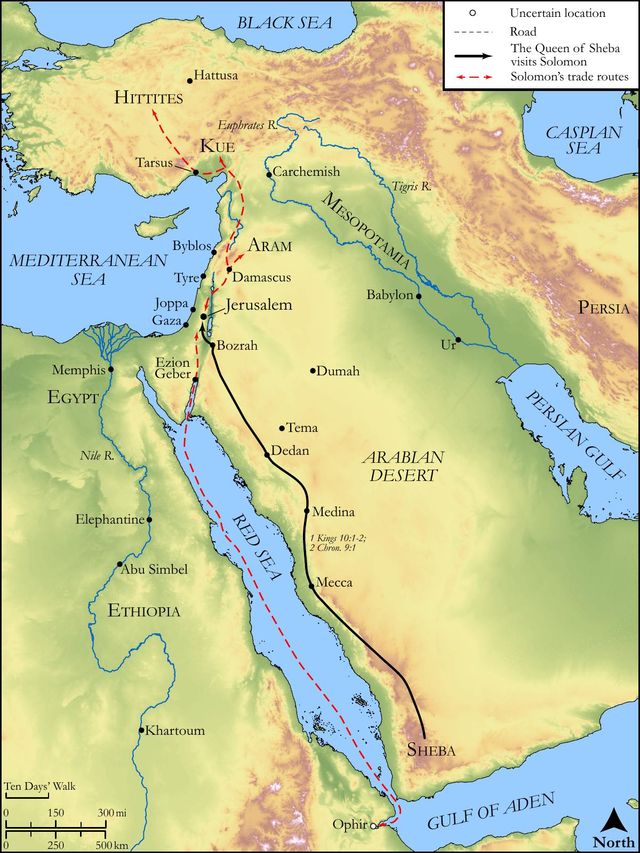
See on the biblical-era map
Study this verse
Public-domain commentary
Matthew Henry
From his Commentary on the Whole Bible. Henry comments on passages, not single verses — this entry covers 2 Chronicles 1:13–17.
Here is, 1. Solomon's entrance upon the government (Ch2 1:13): He came from before the tabernacle, and reigned over Israel. He would not do any acts of government till he had done his acts of devotion, would not take honour to himself till he had given honour to God - first the tabernacle, and then the throne. But, when he had obtained wisdom from God, he did not bury his talent, but as he received the gift ministered the same, did not give up himself to ease and pleasure, but minded business: he reigned over Israel. 2. The magnificence of his court (Ch2 1:14): He gathered chariots and horsemen. Shall we praise him for this? We praise him not; for the king was forbidden to multiply horses, Deu 17:16. I do not remember that ever we find his good father in a chariot or on horseback; a mule was the highest he mounted. We should endeavor to excel those that went before us in goodness rather than in grandeur. 3. The wealth and trade of his kingdom. He made silver and gold very cheap and common, Ch2 1:15. The increase of gold lowers the value of it; but the increase of grace advances its price; the more men have of that the more they value it. How much better therefore is it to get wisdom than gold! He opened also a trade with Egypt, whence he imported horses and linen-yarn, which he exported again to the kings of Syria, with great advantage no doubt, Ch2 1:16, Ch2 1:17. This we had before, Kg1 10:28, Kg1 10:29. It is the wisdom of princes to promote industry and encourage trade in their dominions. Perhaps Solomon took the hint of setting up the linen-manufacture, bringing linen-yarn out of Egypt, working it into cloth, and then sending that to other nations, from what his mother taught when she specified this as one of the characteristics of the virtuous woman, She maketh fine linen, and selleth it, and delivereth girdles of it to the merchant, Pro 31:24. In all labour there is profit.
Continue studying 2 Chronicles 1:13 across the web’s major study libraries — every link below opens this exact verse, chapter, or book on the destination site.
Read & Compare
 BibleGatewayThis verse in more than 200 translations and 70 languages.
 Bible.comThe YouVersion reader — hundreds of translations, reading plans, and highlights.
 ESV.orgCrossway's official English Standard Version reader.
 NET BibleThe NET translation with 60,000+ translators' notes on every rendering decision.
 STEP BibleTyndale House's free study tool — original text, vocabulary, and scholarly resources.
 BibliaLogos Bible Software's free web reader.
 USCCBThe New American Bible (Revised Edition) with the U.S. bishops' study notes.
Commentaries
 BibleHub CommentariesDozens of classic commentaries on this verse, gathered on one page.
 StudyLightMore than 100 commentary sets — the largest collection on the web.
 BibleRefPlain-English commentary on what this verse means, verse by verse.
 Enduring WordDavid Guzik's free commentary on this chapter, widely used by Bible teachers.
 Bible Study ToolsVerse commentary alongside Greek and Hebrew study aids.
Original Language & Research
- BibleHub InterlinearThe verse word by word — original language, transliteration, and English.
- BibleHub LexiconEvery word's original-language definition and Strong's entry.
 Blue Letter BibleDeep-study tools — Strong's numbers, concordance, and word studies.
 SefariaThe Hebrew text with Rashi and centuries of Jewish commentary.
Sermons, Hymns & Audio


TrulyRandomVerse is not affiliated with these sites and doesn’t control their content. They’re linked because they’re genuinely useful.
Summary
2 Chronicles 1:13 marks a pivotal moment in Solomon's early reign, detailing his significant return to Jerusalem from Gibeon. This journey signifies the practical and divinely sanctioned commencement of his kingship over Israel, following his profound encounter with God where he was granted wisdom and knowledge. This verse sets the stage for the application of God's enablement in his governance, establishing the theological foundation for his subsequent actions as monarch.
Context
ShowHideLiterary Context
This verse serves as a crucial narrative bridge, transitioning from Solomon's momentous spiritual encounter at Gibeon to the active exercise of his kingship in Jerusalem. Immediately preceding this, Solomon offered a thousand burnt offerings at the high place in Gibeon, demonstrating his devotion and seeking God's favor at the very outset of his rule. It was in this sacred setting that God appeared to him in a dream, as recorded in 2 Chronicles 1:7-12, a passage paralleled in 1 Kings 3:5-15. Instead of requesting personal gain, Solomon humbly asked for wisdom and knowledge to govern God's people justly. Having received this divine enablement, 2 Chronicles 1:13 details his physical and symbolic return to Jerusalem, the established political and spiritual capital, poised to apply the granted wisdom in his kingship. This movement underscores the Chronicler's emphasis on God's active involvement and blessing in Solomon's reign.
Historical & Cultural Context
Gibeon, located approximately six miles northwest of Jerusalem, was a prominent "high place" (Hebrew: bamah') and, crucially, a legitimate site for Israelite worship during this period. Its significance stemmed from the presence of the Tabernacle of Meeting, the portable sanctuary from the wilderness wanderings, which represented God's dwelling among His people. While later "high places" became associated with syncretistic worship and were condemned (e.g., 1 Kings 14:23), Gibeon's status as a legitimate worship center is affirmed by Solomon's actions. Jerusalem, in contrast, had been established by King David as the political and spiritual capital, where the Ark of the Covenant resided. Solomon's journey from Gibeon to Jerusalem therefore represents a shift from a temporary, albeit legitimate, center of worship to the destined permanent capital, where the Temple would soon be built. This movement also highlights the cultural understanding of kingship in ancient Israel, which was not merely hereditary but required divine anointing and enablement to be truly legitimate and effective.
Key Themes
ShowHideThis verse powerfully contributes to several overarching themes within 2 Chronicles and the broader biblical narrative. Firstly, it reinforces the Divine Legitimacy of Kingship, presenting Solomon's rule not merely as an inherited right but as a direct outcome of his humble seeking of God and the subsequent divine enablement. His authority is rooted in God's wisdom, as detailed in 2 Chronicles 1:7-12. Secondly, it signifies a crucial Transition of Authority and Worship, marking the shift from the legitimate, but temporary, worship center at Gibeon to Jerusalem, which would become the exclusive center of worship with the construction of the Temple. This transition is further elaborated through the preparations described in 2 Chronicles 2 and the building itself in 2 Chronicles 3:1. Finally, the verse implies the theme of Wisdom in Action, as Solomon returns from his divine encounter poised to apply the wisdom he received to the practical governance of his kingdom, fulfilling the very purpose for which he requested it.
Exposition and Analysis
ShowHideKey Word Analysis
ShowHideFrom an unused root meaning "to be high," this term refers to an elevated place, often used for worship. In the context of Gibeon, it denotes a legitimate, recognized site for Israelite sacrificial worship, distinguished by the presence of the Tabernacle. Its usage here highlights a period before the centralization of worship in Jerusalem, where such sites would later be condemned.
Literally "tent of meeting," this phrase denotes the portable sanctuary constructed according to God's instructions in the wilderness. It was the primary place where God met with His people, where sacrifices were offered, and where the divine presence resided before the Temple was built. Its presence at Gibeon lent the site its sacred authority and legitimacy for worship.
A primitive root meaning "to reign" or, inceptively, "to ascend the throne." In this context, it signifies the official and active commencement of Solomon's sovereign authority. Coupled with the preceding divine encounter, it emphasizes that his reign was not merely a political succession but a divinely appointed and empowered leadership over God's chosen people.
Verse Breakdown
ShowHide"Then Solomon came [from his journey] to the high place that [was] at Gibeon"
This clause describes Solomon's initial arrival at Gibeon, the site of his significant spiritual encounter. The parenthetical "[from his journey]" clarifies that he traveled to Gibeon with purpose—to offer sacrifices and seek God at this legitimate worship site, demonstrating his devotion at the outset of his reign.
"to Jerusalem"
This signifies the destination of Solomon's return journey. Jerusalem was the established capital of Israel, the seat of the Davidic dynasty, and the place where Solomon would physically establish and exercise his rule. This movement underscores the transition from a spiritual encounter to its practical implementation in governance.
"from before the tabernacle of the congregation"
This phrase specifies the exact point of departure from Gibeon. It emphasizes that Solomon's return to Jerusalem was directly from the presence of God, symbolized by the Tabernacle. This detail reinforces that his subsequent reign was not based on human ambition but on divine encounter and empowerment received at this sacred place.
"and reigned over Israel"
This concluding clause states the immediate consequence and culmination of Solomon's journey and divine encounter. It marks the formal and divinely sanctioned beginning of his kingship, indicating that he now actively assumed his role as the divinely appointed ruler of the nation, equipped with the wisdom he had sought and received.
Literary Devices
ShowHideThe verse employs several literary devices to convey its profound meaning and underscore its theological significance. Juxtaposition is evident in the movement from Gibeon to Jerusalem, contrasting the place of spiritual seeking and divine encounter with the place of earthly rule and practical application. This geographical shift is rich in symbolism, where Gibeon represents the source of divine wisdom and authority, and Jerusalem symbolizes the sphere of its implementation. The journey itself serves as a metaphor for the transition from a period of preparation and divine endowment to one of active leadership. Furthermore, the mention of the "tabernacle of the congregation" is a powerful symbol of God's abiding presence and the legitimacy of the worship at Gibeon, which in turn legitimizes Solomon's subsequent reign. The verse also functions as a narrative bridge, connecting Solomon's spiritual experience with the unfolding account of his kingship and the monumental task of building the Temple.
Theological and Thematic Connections
ShowHideSolomon's journey from Gibeon to Jerusalem, having received divine wisdom, illustrates a profound theological principle: true and effective leadership, particularly within God's covenant people, must be rooted in divine encounter and enablement rather than mere human inheritance or ambition. God's gracious response to Solomon's humble request for wisdom, rather than wealth or power, establishes a paradigm for all who are called to lead or serve. This passage underscores God's active involvement in establishing and empowering those He chooses for His purposes, emphasizing that the authority to "reign" ultimately flows from Him. It highlights the indispensable link between spiritual insight and practical governance, demonstrating that God's wisdom is not an abstract concept but a practical necessity for navigating the complexities of leadership and life.
Reflection and Application
ShowHideSolomon's journey from the "high place" of Gibeon to the capital city of Jerusalem offers a timeless model for believers today. It underscores the critical importance of intentionally seeking God's wisdom and presence before embarking on significant endeavors or assuming positions of responsibility. Just as Solomon's reign was divinely sanctioned and empowered by the wisdom he received, our effectiveness in our spheres of influence—whether in family, work, community, or ministry—is directly tied to our reliance on God's guidance. The "high place" represents our personal times of prayer, study, and worship, where we humble ourselves before God and seek His counsel. Our "Jerusalem" is the practical arena of our daily lives, where we are called to apply that divine wisdom and "reign" with integrity, discernment, and justice. This passage challenges us to prioritize spiritual preparation over immediate action, trusting that God will equip us for every good work as we commit our ways to Him.
Questions for Reflection
ShowHideFAQ
ShowHideWhy was the Tabernacle at Gibeon, and not already in Jerusalem?
ShowHideThe Tabernacle was a portable sanctuary that had moved to various locations after the wilderness wanderings (e.g., Shiloh, Nob). While King David had brought the Ark of the Covenant, the most sacred item, to Jerusalem and placed it in a tent there (2 Samuel 6:17), the full Tabernacle structure itself, with its altar of burnt offering, remained at Gibeon. This made Gibeon a legitimate, though temporary, center for large-scale sacrifices and worship, as noted in 1 Kings 3:4 and 2 Chronicles 1:3. It was only with the construction of Solomon's Temple in Jerusalem that the Ark and the remaining Tabernacle implements were brought together, centralizing worship in one permanent location.
What is the significance of Solomon "reigning over Israel" immediately after his encounter with God?
ShowHideThe immediate mention of Solomon "reigning over Israel" after his divine encounter at Gibeon is highly significant. It underscores that his kingship was not merely a hereditary succession but a divinely sanctioned and empowered rule. Having just received profound wisdom and knowledge directly from God (2 Chronicles 1:7-12), his return to Jerusalem and assumption of full authority signifies that his reign was blessed and enabled by the Almighty. This sequence establishes a theological foundation for his kingship, emphasizing that his ability to govern effectively stemmed from his spiritual communion with God, rather than solely from his own capabilities or political maneuvering. It marks the official, blessed commencement of his divinely-backed reign.
Christ-Centered Fulfillment
ShowHideSolomon's divinely-appointed, wisdom-enabled kingship serves as a profound foreshadowing of the ultimate King, Jesus Christ. While Solomon, though wise, was a fallible earthly monarch whose reign eventually saw division and decline, Jesus is the perfect and eternal King, whose wisdom is not merely a gift received but an inherent attribute of His divine nature (1 Corinthians 1:30). Solomon's journey from Gibeon, the place of divine encounter, to Jerusalem, the seat of his earthly reign, mirrors Christ's own journey from heavenly glory to His earthly ministry, culminating in His triumphant entry into Jerusalem and His ultimate enthronement as King of kings and Lord of lords (Philippians 2:9-11). Unlike Solomon's reign, which was limited to Israel, Christ's dominion extends over all creation (Ephesians 1:20-22). Believers, through Christ, are not only recipients of His wisdom (Colossians 2:3) but are also called to live under His perfect and righteous reign, eagerly anticipating the New Jerusalem where He will reign eternally (Revelation 21:1-4). Thus, Solomon's return to Jerusalem and the commencement of his divinely-backed rule points forward to the establishment of God's eternal kingdom through the perfect wisdom and authority of Jesus Christ.