


2 Chronicles 1:17
- וַיַּעֲלוּVai·ya·'a·luand they brought upH5927Conj-w ¦ V-Hiphil-ConsecImperf-3mpVerb Hiphil Consecutive Imperfect 3rd Plural Masculineוַandיַּעֲלוּthey brought up
- וַיּוֹצִיאוּvai·yo·Tzi·'uand they brought outH3318Conj-w ¦ V-Hiphil-ConsecImperf-3mpVerb Hiphil Consecutive Imperfect 3rd Plural Masculineוַandיּוֹצִיאוּthey brought out
- מִמִּצְרַיִםmi·mitz·Ra·yimfrom EgyptH4714Prep-m ¦ N-properNoun Proper LocationמִfromמִּצְרַיִםEgypt
- מֶרְכָּבָהmer·ka·Vaha chariotH4818N-fsNoun Singular Feminine Absolute
- בְּשֵׁשׁbe·Sheshfor sixH8337Prep-b ¦ N-cscNoun Singular common gender Constructבְּforשֵׁשׁsix
- מֵאוֹתme·'othundred<s>H3967N-fpNoun Plural Feminine Absolute
- כֶּסֶףKe·sefsilverH3701N-msNoun Singular Masculine Absolute
- וְסוּסve·Susand a horseH5483Conj-w ¦ N-msNoun Singular Masculine Absoluteוְandסוּסa horse
- בַּחֲמִשִּׁיםba·cha·mi·Shimfor fiftyH2572Prep-b ¦ N-mpNoun Plural Masculine Absoluteבַּforחֲמִשִּׁיםfifty
- וּמֵאָהu·me·'Ahand one hundredH3967Conj-w ¦ N-fsNoun Singular Feminine Absoluteוּandמֵאָהone hundred
- וְכֵןVe·khenand thusH3651Conj-w ¦ AdvAdverbוְandכֵןthus
- לְכָלle·kholto allH3605Prep-l ¦ N-mscNoun Singular Masculine Constructלְtoכָלall
- מַלְכֵיmal·Khei[the] kings ofH4428N-mpcNoun Plural Masculine Construct
- הַחִתִּיםha·chi·Timthe HittitesH2850Art ¦ N-mpNoun Gentilic Plural Masculine AbsoluteהַtheחִתִּיםHittites
- וּמַלְכֵיu·mal·Kheiand [the] kings ofH4428Conj-w ¦ N-mpcNoun Plural Masculine Constructוּandמַלְכֵי[the] kings of
- אֲרָם'a·RamAramH758N-properNoun Proper Location
- בְּיָדָםbe·ya·Damby their handH3027Prep-b ¦ N-csc ¦ 3mpNoun Singular common gender Constructבְּbyיָדָhandםtheir
- יוֹצִיאוּyo·Tzi·'uthey brought [them] outH3318V-Hiphil-Imperf-3mpVerb Hiphil Imperfect 3rd Plural Masculine
English is a literal word-by-word gloss of the Hebrew, not the KJV's wording. Why?
This is the original text the KJV's translators worked from — each Hebrew word with its own literal English meaning in this verse, prepared by scholars at Tyndale House, Cambridge. The KJV translates whole sentences, not word by word, so its wording differs: one Hebrew word can become several English words, and the KJV may choose “the LORD” where the gloss reads “Yahweh”. Both are faithful — they answer different questions. For the KJV's own rendering, switch to the KJV text.
Details
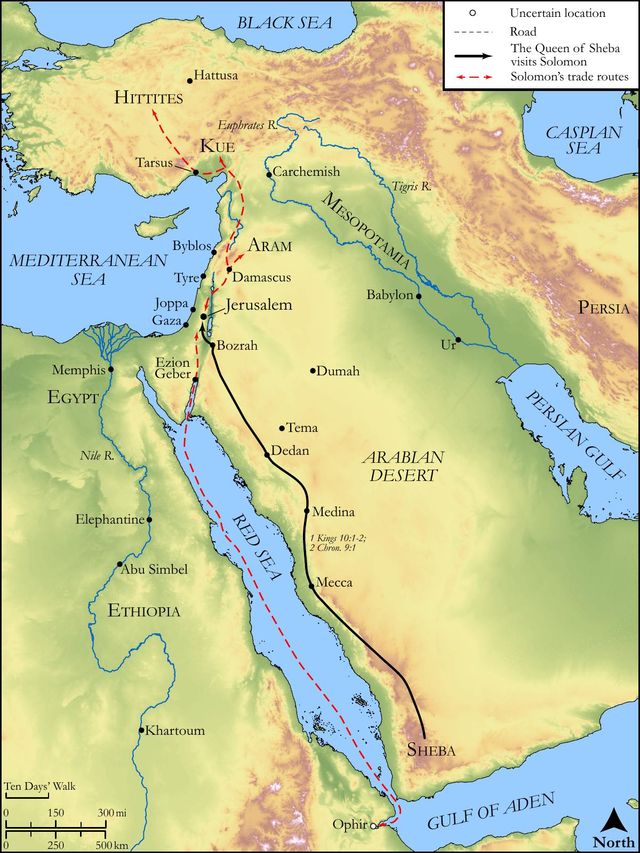
See on the biblical-era map
Study this verse
Public-domain commentary
Matthew Henry
From his Commentary on the Whole Bible. Henry comments on passages, not single verses — this entry covers 2 Chronicles 1:13–17.
Here is, 1. Solomon's entrance upon the government (Ch2 1:13): He came from before the tabernacle, and reigned over Israel. He would not do any acts of government till he had done his acts of devotion, would not take honour to himself till he had given honour to God - first the tabernacle, and then the throne. But, when he had obtained wisdom from God, he did not bury his talent, but as he received the gift ministered the same, did not give up himself to ease and pleasure, but minded business: he reigned over Israel. 2. The magnificence of his court (Ch2 1:14): He gathered chariots and horsemen. Shall we praise him for this? We praise him not; for the king was forbidden to multiply horses, Deu 17:16. I do not remember that ever we find his good father in a chariot or on horseback; a mule was the highest he mounted. We should endeavor to excel those that went before us in goodness rather than in grandeur. 3. The wealth and trade of his kingdom. He made silver and gold very cheap and common, Ch2 1:15. The increase of gold lowers the value of it; but the increase of grace advances its price; the more men have of that the more they value it. How much better therefore is it to get wisdom than gold! He opened also a trade with Egypt, whence he imported horses and linen-yarn, which he exported again to the kings of Syria, with great advantage no doubt, Ch2 1:16, Ch2 1:17. This we had before, Kg1 10:28, Kg1 10:29. It is the wisdom of princes to promote industry and encourage trade in their dominions. Perhaps Solomon took the hint of setting up the linen-manufacture, bringing linen-yarn out of Egypt, working it into cloth, and then sending that to other nations, from what his mother taught when she specified this as one of the characteristics of the virtuous woman, She maketh fine linen, and selleth it, and delivereth girdles of it to the merchant, Pro 31:24. In all labour there is profit.
Continue studying 2 Chronicles 1:17 across the web’s major study libraries — every link below opens this exact verse, chapter, or book on the destination site.
Read & Compare
 BibleGatewayThis verse in more than 200 translations and 70 languages.
 Bible.comThe YouVersion reader — hundreds of translations, reading plans, and highlights.
 ESV.orgCrossway's official English Standard Version reader.
 NET BibleThe NET translation with 60,000+ translators' notes on every rendering decision.
 STEP BibleTyndale House's free study tool — original text, vocabulary, and scholarly resources.
 BibliaLogos Bible Software's free web reader.
 USCCBThe New American Bible (Revised Edition) with the U.S. bishops' study notes.
Commentaries
 BibleHub CommentariesDozens of classic commentaries on this verse, gathered on one page.
 StudyLightMore than 100 commentary sets — the largest collection on the web.
 BibleRefPlain-English commentary on what this verse means, verse by verse.
 Enduring WordDavid Guzik's free commentary on this chapter, widely used by Bible teachers.
 Bible Study ToolsVerse commentary alongside Greek and Hebrew study aids.
Original Language & Research
- BibleHub InterlinearThe verse word by word — original language, transliteration, and English.
- BibleHub LexiconEvery word's original-language definition and Strong's entry.
 Blue Letter BibleDeep-study tools — Strong's numbers, concordance, and word studies.
 SefariaThe Hebrew text with Rashi and centuries of Jewish commentary.
Sermons, Hymns & Audio


TrulyRandomVerse is not affiliated with these sites and doesn’t control their content. They’re linked because they’re genuinely useful.
Summary
2 Chronicles 1:17 meticulously details King Solomon's sophisticated and highly profitable international trade in military assets, specifically the acquisition of chariots and horses from Egypt. This verse not only underscores his immense wealth and strategic economic power, fulfilling God's promise of riches, but also reveals his role as a central intermediary, supplying these high-value items to the kings of the Hittites and Syria. This activity solidified his regional influence and demonstrated the unprecedented scale of his kingdom's early glory, setting the stage for his grand building projects.
Context
ShowHideLiterary Context
This verse is strategically placed within the Chronicler's account of Solomon's early reign, immediately following God's magnificent promise to Solomon at Gibeon, where He granted him wisdom, wealth, and honor beyond measure (2 Chronicles 1:7-12). Verses 2 Chronicles 1:14-16 provide a sweeping summary of Solomon's military and economic might, highlighting his vast numbers of chariots and horsemen, and the unparalleled abundance of silver and gold in Jerusalem. Verse 2 Chronicles 1:17 then zooms in, offering precise, concrete details that substantiate these general claims. It illustrates the specific mechanism and costs involved in acquiring these crucial assets, serving as a tangible example of the economic prowess that underpinned the kingdom's splendor and enabled the subsequent detailed accounts of the temple construction and other monumental endeavors.
Historical & Cultural Context
In the ancient Near East, Egypt was unparalleled in its production of high-quality horses and advanced chariot technology, making it the premier source for these critical military components. Chariots were the dominant weapon system of the era, providing unparalleled speed, maneuverability, and shock value on the battlefield, and their possession signified a nation's military sophistication and economic might. The Hittites, referring here to the Neo-Hittite states in northern Syria and Anatolia (successors to the once-mighty Hittite Empire), and the various Aramean city-states known as "the kings of Syria," were significant regional powers with whom Israel often interacted, sometimes in conflict and sometimes through alliances or trade. Solomon's strategic position as an intermediary, supplying these formidable neighbors, highlights his dominant economic and political standing in the region. The mention of "shekels of silver" refers to a standard unit of weight and currency, underscoring the substantial financial investment required for these high-value transactions and the premium placed on these military commodities.
Key Themes
ShowHideThis verse powerfully illustrates several key themes central to the Chronicler's portrayal of Solomon's reign. Firstly, it showcases Unprecedented Wealth and Economic Power, directly demonstrating the fulfillment of God's promise to Solomon regarding his riches (2 Chronicles 1:12). The specific, high costs of chariots (600 shekels of silver) and horses (150 shekels) emphasize the vast resources at Solomon's disposal. Secondly, it highlights Strategic International Trade and Influence, as Solomon not only imported for his own formidable army but also served as a crucial supplier to other regional powers, positioning him as a central figure in the ancient Near Eastern economy and diplomacy. Thirdly, it speaks to Military Modernization and Strength, reflecting Solomon's commitment to building a powerful army capable of maintaining peace and projecting power across his vast kingdom. Finally, and subtly, it introduces a theme of Foreshadowing of Disobedience. While initially a sign of God's blessing and Solomon's glory, his aggressive accumulation of horses directly contravened the Mosaic Law's specific warning to future kings against multiplying horses for themselves (Deuteronomy 17:16). This subtle tension foreshadows the eventual spiritual decline and idolatry that would mar Solomon's later reign.
Exposition and Analysis
ShowHideKey Word Analysis
ShowHideThis verb (H5927), often translated as "to go up" or "to ascend," implies more than mere transportation; it suggests "bringing up" or "importing" from a lower elevation, such as the Nile Valley of Egypt, to the higher terrain of Judah. In this context, it emphasizes the deliberate and organized effort involved in acquiring and moving these valuable military assets across significant distances, highlighting the active nature of Solomon's extensive international trade network.
The term (H3701) refers to "silver" as a metal, and by implication, "money" or "price." The specific mention of "shekels of silver" underscores the immense monetary value of the chariots and horses. These precise figures (600 for a chariot, 150 for a horse) are not arbitrary; they impress upon the reader the extraordinary scale of Solomon's wealth and the strategic importance of these military assets, which commanded premium prices in the ancient world.
This primitive word (H3027), literally meaning "hand," is used in a vast array of applications, both literal and figurative. In the phrase "by their means" (bĕyādām, "by their hand"), it signifies agency, instrumentality, or control. It indicates that Solomon's agents or representatives were the active facilitators of these transactions, demonstrating his powerful influence and the sophisticated organizational structure of his trade operations in the ancient Near East.
Verse Breakdown
ShowHide"And they fetched up, and brought forth out of Egypt"
This initial clause establishes the origin of these highly valued military goods – Egypt, renowned for its superior horses and advanced chariot technology. The plural "they" refers to Solomon's well-organized network of agents, merchants, or trade representatives, indicating a deliberate and extensive commercial operation under his direct command. This highlights the systematic and strategic nature of Solomon's acquisition process.
"a chariot for six hundred [shekels] of silver, and an horse for an hundred and fifty"
This provides the precise, astonishing costs of these crucial military assets. The valuation of a chariot at four times the cost of a single horse (600 vs. 150 shekels) reflects its complex construction, advanced technology, and immense strategic importance on the battlefield. These specific figures are not merely economic details; they serve to emphasize the extraordinary wealth and vast resources at Solomon's disposal, enabling him to engage in such high-value transactions on a grand scale.
"and so brought they out [horses] for all the kings of the Hittites, and for the kings of Syria, by their means"
This final clause reveals Solomon's pivotal role as a regional arms dealer and power broker. He was not merely acquiring for his own formidable army; his agents also acted as intermediaries, supplying horses (and implicitly, chariots, as horses were essential for them) to neighboring kingdoms. The phrase "by their means" (literally "by their hand") further emphasizes that Solomon's agents facilitated and controlled these transactions. This demonstrates Solomon's immense economic influence and his strategic control over a vital commodity, positioning him as a dominant figure in the ancient Near Eastern political and economic landscape.
Literary Devices
ShowHideThe verse employs several literary techniques to convey its message effectively. The precise enumeration of prices ("six hundred [shekels] of silver," "an hundred and fifty") is a form of Economic Detail that lends a strong sense of verisimilitude and historical accuracy to the account, while simultaneously emphasizing the vastness of Solomon's wealth. The mention of "a chariot and an horse" can be seen as a form of Merism, where two distinct but related items are mentioned to represent a broader category—in this case, the entire military apparatus or the lucrative trade in high-value military assets. The statement "all the kings of the Hittites, and for the kings of Syria" may contain an element of Hyperbole or Generalization, used to convey the scope and extent of Solomon's influence and trade network, rather than a literal claim that every single king received horses. Finally, while celebrating Solomon's glory and the fulfillment of God's promises, the verse contains subtle Foreshadowing of future disobedience, as the very act of multiplying horses for military strength was explicitly warned against in the Mosaic Law, hinting at the seeds of Solomon's later spiritual decline and the eventual division of the kingdom.
Theological and Thematic Connections
ShowHide2 Chronicles 1:17, while seemingly a straightforward economic report, carries profound theological implications. It illustrates the tangible manifestation of God's promised blessing of wealth and honor to Solomon, showcasing a kingdom of unprecedented earthly splendor and strategic acumen. However, it also subtly introduces the inherent tension between divine provision and human responsibility. The accumulation of military power, while a legitimate aspect of national defense, could easily become a source of trust in human might rather than in God. This verse, therefore, serves as a theological pivot point, highlighting the potential for even divinely granted blessings to become a snare if they lead to self-reliance or a disregard for God's specific commands. The Chronicler, writing from a post-exilic perspective, would have understood the tragic trajectory of Solomon's reign, where such earthly glory ultimately gave way to spiritual compromise, idolatry, and national division, serving as a cautionary tale for future generations.
Reflection and Application
ShowHideSolomon's reign, as depicted in 2 Chronicles 1:17, presents a powerful paradox: a king blessed with unparalleled wisdom and wealth by God, yet whose very means of glory contained the seeds of future disobedience. This verse challenges us to examine the sources of our own security and influence. While God often blesses us with resources, talents, and opportunities, the temptation to rely on these "chariots and horses" (our wealth, status, abilities, or connections) instead of on God Himself is ever-present. Solomon's strategic trade was legitimate and initially a sign of God's favor, but the sheer scale and the eventual disregard for the Deuteronomic warning reveal how even good things can become idols or lead us astray when they displace our primary trust in the Almighty. We are called to be wise stewards of what God provides, using our resources for His glory and the good of others, rather than allowing them to foster self-sufficiency or lead us into practices that subtly contradict God's principles. Our ultimate security and strength must always be found in Him, not in our accumulated power or possessions.
Questions for Reflection
ShowHideFAQ
ShowHideWhy was it problematic for Solomon to multiply horses, given God blessed him with wealth?
ShowHideThe problem for Solomon was not the wealth itself, which was a direct fulfillment of God's promise (2 Chronicles 1:12). The issue lay in the specific command given to future kings of Israel in Deuteronomy 17:16, which explicitly warned against multiplying horses, wives, and silver/gold. This prohibition was intended to prevent kings from relying on foreign military alliances (like Egypt, a source of horses) and earthly might, from being led astray by foreign wives into idolatry, and from trusting in material wealth over God's provision. While Solomon's trade in horses initially showcased his God-given prosperity and strategic acumen, his eventual accumulation of vast numbers of horses and chariots, far beyond defensive needs, reflected a growing reliance on military strength and international connections rather than solely on the Lord for national security. This ultimately contributed to his spiritual decline and the kingdom's subsequent division.
What does "by their means" signify in this verse?
ShowHideThe phrase "by their means" (Hebrew: bĕyādām, literally "by their hand") signifies that Solomon's agents, merchants, or representatives were the intermediaries in these transactions. It indicates that these individuals facilitated the trade of horses from Egypt not only for Solomon's own use but also for the kings of the Hittites and Syria. This highlights the sophisticated nature of Solomon's trade network and his powerful position as a central economic broker in the ancient Near East. His agents were effectively acting as a regional distribution hub for these highly sought-after military assets, further underscoring Solomon's immense influence and control over vital trade routes and commodities.
Christ-Centered Fulfillment
ShowHideSolomon's earthly kingdom, with its unparalleled wealth, military might, and strategic international trade in chariots and horses, serves as a powerful, albeit imperfect, type of the ultimate, eternal kingdom of Christ. Solomon's glory was tangible and impressive, built on material assets and human wisdom, yet it ultimately proved temporary and flawed, leading to a divided kingdom due to his later unfaithfulness. In contrast, Jesus, the true and greater King (Matthew 12:42), establishes a kingdom not of this world (John 18:36), one built not on chariots and horses but on righteousness, peace, and joy in the Holy Spirit (Romans 14:17). While Solomon multiplied horses for military strength, Christ entered Jerusalem humbly on a donkey (Matthew 21:5), demonstrating that His power conquers not through earthly might but through sacrificial love and spiritual authority. The "weapons" of His kingdom are not carnal but spiritual, powerful to demolish strongholds (2 Corinthians 10:4). Believers are called to seek first His kingdom and His righteousness (Matthew 6:33), recognizing that true security and everlasting glory are found not in accumulating earthly "chariots and horses" but in absolute trust and reliance on Christ, who has triumphed over all spiritual powers through His cross (Colossians 2:15).