


2 Chronicles 1:16
- וּמוֹצָאu·mo·Tza'and [the] export ofH4161Conj-w ¦ N-mscNoun Singular Masculine Constructוּandמוֹצָא[the] export of
- הַסּוּסִיםha·su·Simthe horsesH5483Art ¦ N-mpNoun Plural Masculine Absoluteהַtheסּוּסִיםhorses
- אֲשֶׁר'a·SherwhichH834RelParticle Relative
- לִשְׁלֹמֹהlish·lo·Moh[belonged] to SolomonH8010Prep-l ¦ N-proper-mNoun Proper Masculineלִ[belonged] toשְׁלֹמֹהSolomon
- מִמִּצְרָיִםmi·mitz·Ra·yim[was] from EgyptH4714Prep-m ¦ N-properNoun Proper Locationמִ[was] fromמִּצְרָיִםEgypt
- וּמִקְוֵאu·mik·Ve'and from QueH4723Conj-w ¦ Prep-m ¦ N-properNoun Proper LocationוּandמִfromקְוֵאQue
- סֹחֲרֵיso·cha·Rei[the] traders ofH5503V-Qal-Prtcpl-mpVerb Qal Participle Plural Masculine Construct
- הַמֶּלֶךְha·Me·lekhthe kingH4428Art ¦ N-msNoun Singular Masculine Absoluteהַtheמֶּלֶךְking
- מִקְוֵאmik·Ve'from QueH4723Prep-m ¦ N-properNoun Proper LocationמִfromקְוֵאQue
- יִקְחוּyik·Chuthey took [them]H3947V-Qal-Imperf-3mpVerb Qal Imperfect 3rd Plural Masculine
- בִּמְחִירbim·Chirfor a priceH4242Prep-b ¦ N-msNoun Singular Masculine Absoluteבִּforמְחִירa price
English is a literal word-by-word gloss of the Hebrew, not the KJV's wording. Why?
This is the original text the KJV's translators worked from — each Hebrew word with its own literal English meaning in this verse, prepared by scholars at Tyndale House, Cambridge. The KJV translates whole sentences, not word by word, so its wording differs: one Hebrew word can become several English words, and the KJV may choose “the LORD” where the gloss reads “Yahweh”. Both are faithful — they answer different questions. For the KJV's own rendering, switch to the KJV text.
Details
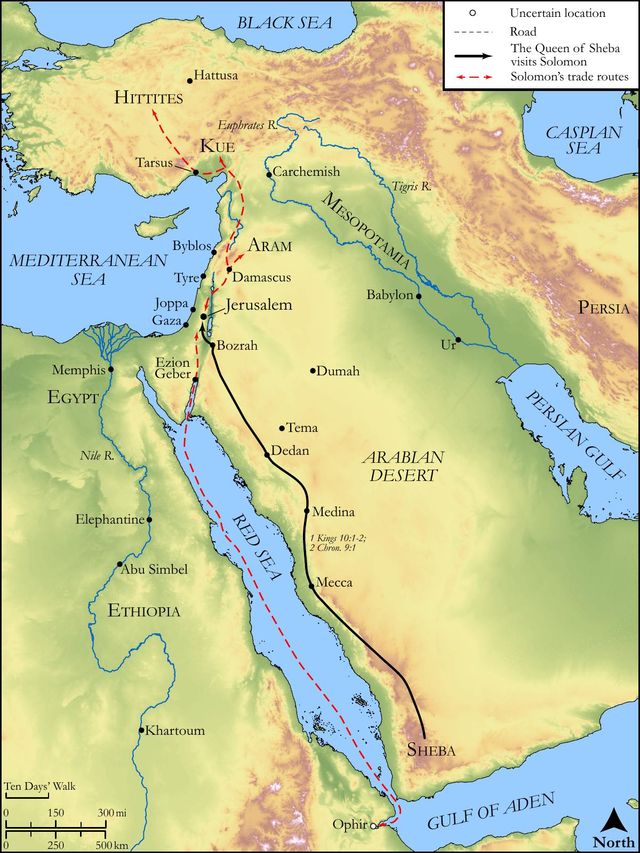
See on the biblical-era map
Study this verse
Public-domain commentary
Matthew Henry
From his Commentary on the Whole Bible. Henry comments on passages, not single verses — this entry covers 2 Chronicles 1:13–17.
Here is, 1. Solomon's entrance upon the government (Ch2 1:13): He came from before the tabernacle, and reigned over Israel. He would not do any acts of government till he had done his acts of devotion, would not take honour to himself till he had given honour to God - first the tabernacle, and then the throne. But, when he had obtained wisdom from God, he did not bury his talent, but as he received the gift ministered the same, did not give up himself to ease and pleasure, but minded business: he reigned over Israel. 2. The magnificence of his court (Ch2 1:14): He gathered chariots and horsemen. Shall we praise him for this? We praise him not; for the king was forbidden to multiply horses, Deu 17:16. I do not remember that ever we find his good father in a chariot or on horseback; a mule was the highest he mounted. We should endeavor to excel those that went before us in goodness rather than in grandeur. 3. The wealth and trade of his kingdom. He made silver and gold very cheap and common, Ch2 1:15. The increase of gold lowers the value of it; but the increase of grace advances its price; the more men have of that the more they value it. How much better therefore is it to get wisdom than gold! He opened also a trade with Egypt, whence he imported horses and linen-yarn, which he exported again to the kings of Syria, with great advantage no doubt, Ch2 1:16, Ch2 1:17. This we had before, Kg1 10:28, Kg1 10:29. It is the wisdom of princes to promote industry and encourage trade in their dominions. Perhaps Solomon took the hint of setting up the linen-manufacture, bringing linen-yarn out of Egypt, working it into cloth, and then sending that to other nations, from what his mother taught when she specified this as one of the characteristics of the virtuous woman, She maketh fine linen, and selleth it, and delivereth girdles of it to the merchant, Pro 31:24. In all labour there is profit.
Continue studying 2 Chronicles 1:16 across the web’s major study libraries — every link below opens this exact verse, chapter, or book on the destination site.
Read & Compare
 BibleGatewayThis verse in more than 200 translations and 70 languages.
 Bible.comThe YouVersion reader — hundreds of translations, reading plans, and highlights.
 ESV.orgCrossway's official English Standard Version reader.
 NET BibleThe NET translation with 60,000+ translators' notes on every rendering decision.
 STEP BibleTyndale House's free study tool — original text, vocabulary, and scholarly resources.
 BibliaLogos Bible Software's free web reader.
 USCCBThe New American Bible (Revised Edition) with the U.S. bishops' study notes.
Commentaries
 BibleHub CommentariesDozens of classic commentaries on this verse, gathered on one page.
 StudyLightMore than 100 commentary sets — the largest collection on the web.
 BibleRefPlain-English commentary on what this verse means, verse by verse.
 Enduring WordDavid Guzik's free commentary on this chapter, widely used by Bible teachers.
 Bible Study ToolsVerse commentary alongside Greek and Hebrew study aids.
Original Language & Research
- BibleHub InterlinearThe verse word by word — original language, transliteration, and English.
- BibleHub LexiconEvery word's original-language definition and Strong's entry.
 Blue Letter BibleDeep-study tools — Strong's numbers, concordance, and word studies.
 SefariaThe Hebrew text with Rashi and centuries of Jewish commentary.
Sermons, Hymns & Audio


TrulyRandomVerse is not affiliated with these sites and doesn’t control their content. They’re linked because they’re genuinely useful.
Summary
Second Chronicles 1:16 provides a succinct yet profound insight into the early reign of King Solomon, detailing his strategic acquisition of horses and linen yarn through trade with Egypt. Far from a mere economic report, this verse subtly introduces a critical tension: while Solomon has just received unparalleled divine wisdom and prosperity, his actions here hint at a potential deviation from Mosaic commands designed to prevent Israelite kings from relying on foreign power or worldly might instead of God alone. It thus lays the groundwork for understanding the complex trajectory of Solomon's reign, where immense blessing coexisted with the nascent seeds of future spiritual compromise.
CONTEXT
ShowHideExposition and Analysis
ShowHideKey Word Analysis
ShowHideIn the ancient world, horses, particularly warhorses, represented formidable military power, national strength, and prestige. Their acquisition from Egypt, a leading power in equestrian warfare, signifies Solomon's ambition to build a formidable military and project an image of imperial might. This action directly challenges the Deuteronomic prohibition, which aimed to prevent Israelite kings from relying on human military strength rather than divine protection and provision.
More than just a geographical location, Egypt held profound theological weight for Israel. It was the land of their bitter bondage, from which God miraculously delivered them through the Exodus. The command in Deuteronomy 17:16 specifically warned against returning to Egypt, particularly for horses, as it symbolized a reliance on worldly power, a potential return to idolatrous influences, and a fundamental undermining of the unique covenant relationship with Yahweh.
While the KJV translates this as "linen yarn," the Hebrew word miqveh is notably ambiguous. Its primary meanings include "something waited for," "confidence," or "a collection/gathering." In this specific context, it has been interpreted as "linen yarn" or "thread" (referring to fine Egyptian linen), a luxury commodity. However, some scholars, referencing its meaning as a "collection" or "drove," suggest it could also refer to a "string" or "company" of horses, or even the "cost" or "arrangement" for importing the horses. The Septuagint and Vulgate translate it as "collection" or "company," lending support to the idea of a contingent of horses. Nevertheless, the common interpretation of two distinct commodities (horses and linen yarn) remains widely accepted, highlighting the breadth and sophistication of Solomon's trade network.
Verse Breakdown
ShowHide"And Solomon had horses brought out of Egypt"
This initial clause immediately highlights Solomon's active and deliberate role in establishing this significant trade. The verb "brought out" (H4161, môwtsâʼ) implies a systematic and organized procurement, emphasizing the king's direct involvement in this international enterprise. The origin, "out of Egypt," is critically important, directly invoking the Deuteronomic prohibition against kings multiplying horses and returning to Egypt. This action, despite Solomon's divinely granted wisdom, marks a significant and early departure from God's ideal for Israelite kings, who were to trust in divine power, not military might derived from foreign sources.
"and linen yarn"
This phrase introduces another valuable commodity within Solomon's extensive trade network. Fine Egyptian linen was a highly prized luxury good, reflecting the immense opulence and wealth accumulating in Solomon's kingdom. While the acquisition of linen was not explicitly forbidden like the horses, its inclusion underscores the vast scale of his commercial enterprises and the material prosperity that characterized his reign.
"the king's merchants received the linen yarn at a price"
This final detail emphasizes the highly organized and commercial nature of Solomon's trade. It was not merely tribute or gifts, but a sophisticated system of exchange, managed by royal merchants who facilitated these international transactions. The phrase "at a price" (H4242, mᵉchîyr) confirms a direct commercial transaction, indicating that Solomon's kingdom was a major player in international commerce, capable of purchasing high-value goods on a large scale.
Literary Devices
ShowHideThe Chronicler employs several potent literary devices in 2 Chronicles 1:16 to convey a deeper theological message beyond a simple economic report. Foreshadowing is prominently featured, as this seemingly innocuous detail about trade subtly hints at Solomon's future spiritual compromises and eventual decline. His reliance on foreign alliances, and the multiplication of wealth and wives, were all explicitly warned against in Deuteronomy 17. There is a profound element of Irony at play, as Solomon, having just received unparalleled wisdom directly from God, immediately engages in an activity that directly contravenes a clear divine command. This highlights the enduring human tendency to prioritize perceived practical advantages and worldly prestige over divine instruction, even when blessed with extraordinary insight. Furthermore, the verse presents a powerful Juxtaposition between the glorious blessing of God (wisdom, riches, and honor, as detailed in the preceding verses) and the subtle, yet significant, act of disobedience. This sets up a theological tension that runs as an undercurrent throughout the entire narrative of Solomon's reign, prompting the reader to consider the true source of enduring strength and stability.
Theological and Thematic Connections
ShowHide2 Chronicles 1:16 serves as a powerful theological statement about the inherent tension between worldly success and divine obedience. While God blessed Solomon with incredible wisdom and unprecedented prosperity, the king's decision to multiply horses from Egypt reveals a subtle but significant shift in reliance—from God's provision and protection to human military strength and economic prowess. This act, though seemingly practical for national security and status, directly violated a divine command designed to keep Israel's kings dependent on Yahweh alone and to prevent them from reverting to the ways of the nations they had left behind. It underscores the profound danger that even great blessings can become a snare if they lead to self-reliance rather than continued trust in God. The Chronicler uses this detail to subtly critique the very success he celebrates, reminding his audience that true and lasting security comes not from horses and chariots, but from unwavering faith and radical obedience to God's covenant.
Reflection and Application
ShowHide2 Chronicles 1:16 offers a profound and enduring lesson for believers today: the subtle dangers of prosperity and the enduring importance of radical obedience. Solomon, gifted with unparalleled wisdom and wealth, began his reign by subtly compromising God's clear commands. This serves as a potent reminder that even when we are blessed and successful, the temptation to rely on our own resources, strategic planning, worldly advantages, or accumulated power can subtly lead us away from God's perfect will. Our "horses from Egypt" might manifest as an over-reliance on financial security, professional networks, political influence, personal intellect, or even technological advancements, rather than fully trusting in God's sovereign provision and guidance. This verse challenges us to critically examine our motivations and methods: are we seeking to build our "kingdoms" or achieve our goals through means that subtly contradict God's Word, or are we committed to radical obedience, even when it seems less "practical," "efficient," or "wise" by worldly standards? True strength, lasting success, and genuine security are found not in accumulating power or prestige, but in humbly adhering to God's unchanging standards, knowing that His commands are always for our ultimate good and protection.
Questions for Reflection
ShowHideFAQ
ShowHideWhy was it forbidden for kings to multiply horses or cause the people to return to Egypt?
ShowHideThe prohibition in Deuteronomy 17:16 was multi-faceted and deeply theological, designed to safeguard Israel's unique identity and relationship with God. First, it aimed to prevent Israelite kings from relying on military might (horses were instruments of war and a symbol of national power) rather than on God for their security and victory. God intended Israel to be a nation distinct from its neighbors, trusting in divine power, not in a large army or foreign alliances. Second, returning to Egypt, even for trade, carried the significant risk of re-exposure to the idolatry, oppressive practices, and worldly values from which God had miraculously delivered them. It symbolized a spiritual regression and a potential for the people to be led back into bondage, both literally and spiritually. The command underscored the principle that Israel's true strength and identity were rooted in their covenant relationship with Yahweh, not in worldly power or foreign entanglements.
Did Solomon know about this command, given his wisdom?
ShowHideYes, as king, Solomon would have been expected to know and uphold the Mosaic Law, which included the specific commands concerning kingship in Deuteronomy 17. The Chronicler consistently portrays Solomon as exceptionally wise, a gift directly from God (as seen in 2 Chronicles 1:7-12). Therefore, his actions in multiplying horses from Egypt were not born of ignorance but represented a deliberate choice to prioritize perceived practical advantages and worldly prestige over explicit divine instruction. This highlights a tragic aspect of Solomon's reign: despite his immense wisdom, he allowed pragmatic considerations and the allure of worldly power to subtly erode his obedience to God's foundational principles, setting a dangerous precedent for himself and future kings.
Christ-Centered Fulfillment
ShowHideSolomon's acquisition of horses from Egypt, a subtle act of disobedience despite his divinely granted wisdom and wealth, stands in stark contrast to the perfect kingship of Jesus Christ. Solomon sought to secure his kingdom through military might and economic power, relying on the very things God had warned against. In doing so, he foreshadowed the universal human tendency to build security and significance apart from God's prescribed ways. Jesus, the true and ultimate King, perfectly fulfills the ideal kingship that Solomon failed to embody. He did not come riding on a warhorse from a powerful nation, but humbly on a donkey into Jerusalem, a deliberate act signifying peace, humility, and spiritual authority, as recorded in Matthew 21:5. His kingdom is not of this world, nor is it advanced by worldly power, military might, or accumulated wealth, as He Himself declared in John 18:36. Instead, Christ's victory and reign are established through radical obedience, self-sacrifice, and complete reliance on God alone, culminating in His atoning death on the cross and glorious resurrection. Where Solomon compromised for earthly gain and prestige, Christ "emptied himself, by taking the form of a servant," and became "obedient to the point of death, even death on a cross" (Philippians 2:5-8). He is the King who perfectly trusts God, providing the ultimate model for true security and spiritual prosperity, not in chariots and horses, but in the name and power of the Lord.