


2 Chronicles 9:28
- וּמוֹצִיאִיםu·mo·tzi·'Imand [were] brought outH3318Conj-w ¦ V-Hiphil-Prtcpl-mpVerb Hiphil Participle Plural Masculine Absoluteוּandמוֹצִיאִים[were] brought out
- סוּסִיםsu·SimhorsesH5483N-mpNoun Plural Masculine Absolute
- מִמִּצְרַיִםmi·mitz·Ra·yimfrom EgyptH4714Prep-m ¦ N-properNoun Proper LocationמִfromמִּצְרַיִםEgypt
- לִשְׁלֹמֹהlish·lo·Mohfor SolomonH8010Prep-l ¦ N-proper-mNoun Proper MasculineלִforשְׁלֹמֹהSolomon
- וּמִכָּלu·mi·koland from allH3605Conj-w ¦ Prep-m ¦ N-mscNoun Singular Masculine Constructוּandמִfromכָּלall
- הָאֲרָצוֹתha·'a·ra·Tzotthe landsH776Art ¦ N-fpNoun Plural Feminine Absoluteהָtheאֲרָצוֹתlands
English is a literal word-by-word gloss of the Hebrew, not the KJV's wording. Why?
This is the original text the KJV's translators worked from — each Hebrew word with its own literal English meaning in this verse, prepared by scholars at Tyndale House, Cambridge. The KJV translates whole sentences, not word by word, so its wording differs: one Hebrew word can become several English words, and the KJV may choose “the LORD” where the gloss reads “Yahweh”. Both are faithful — they answer different questions. For the KJV's own rendering, switch to the KJV text.
Details
See on the biblical-era map
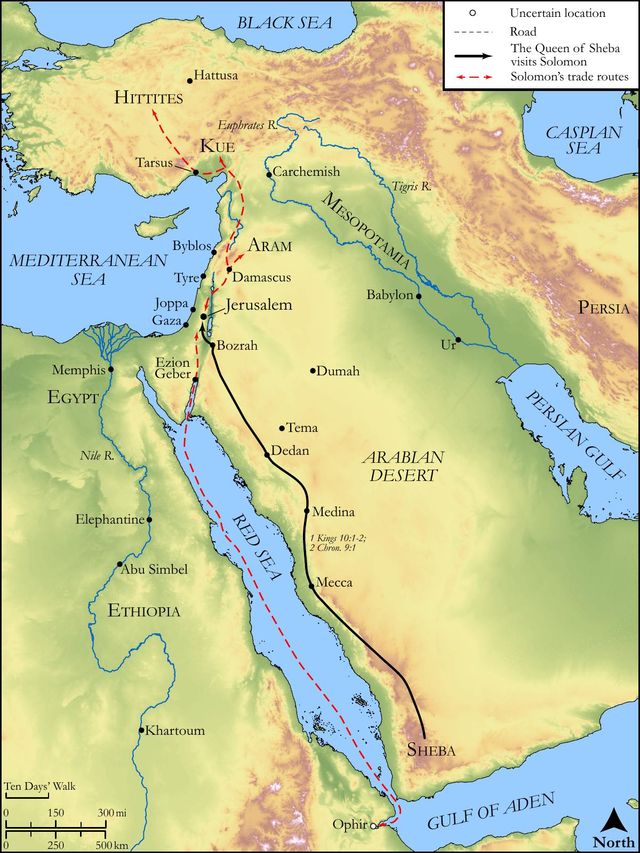
Study this verse
Public-domain commentary
Matthew Henry
From his Commentary on the Whole Bible. Henry comments on passages, not single verses — this entry covers 2 Chronicles 9:13–31. His two-level outline is real structure in the source text, so it is rendered as structure.
We have here Solomon in his throne, and Solomon in his grave; for the throne would not secure him from the grave. Mors sceptra ligonibus aequat - Death wrenches from the hand the sceptre as well as the spade.
I.Here is Solomon reigning in wealth and power, in ease and fulness, such as, for aught I know, could never since be paralleled by any king whatsoever. In cannot pretend to be critical in comparing the grandeur of Solomon with that of some of the great princes of the earth. But I may observe that the most illustrious of them were famed for their wars, whereas Solomon reigned forty years in profound peace. Some of those that might be thought to vie with Solomon affected retirement, kept people in awe by keeping them at a great distance; nobody must see them, or come near him, upon pain of death: but Solomon went much abroad, and appeared in public business. So that, all things considered, the promise was fulfilled, that God would give him riches, and wealth, and honour, such as no kings have had, or shall have, Ch2 1:12.
1.Never any prince appeared in public with great splendour than Solomon did, which to those that judge by the sight of the eye, as most people do, would very much recommend him. He had 200 targets and 300 shields, all of beaten gold, carried before him (Ch2 9:15, Ch2 9:16), and sat upon a most stately throne, Ch2 9:17-19. There was not the like in any kingdom. The lustre wherein he appeared was typical of the spiritual glory of the kingdom of the Messiah and but a faint representation of his throne, which is above every throne. Solomon's pomp was all artificial; and therefore our Saviour prefers the natural beauty of the lilies of the field before it. Mat 6:29, Solomon, in all his glory, was not arrayed like one of these.
2.Never any prince had greater plenty of gold and silver, though there were no gold or silver mines in his own kingdom. Either he made himself master of the mines in other countries, and, having a populous country, sent hands to dig out those rich metals, or, having a fruitful country, he exported the commodities of it and with them fetched home all this gold that is here spoken of, Ch2 9:13, Ch2 9:14-21.
3.Never any prince had such presents brought him by all his neighbours as Solomon had: All the kings of Arabia, and governors of the country, brought him gold and silver (Ch2 9:14), not as tribute which he extorted from them, but as freewill offerings to procure his favour, or in a way of exchange for some of the productions of his husbandry, corn or cattle. All the kings of the earth brought him presents, that is, all in those parts of the world (Ch2 9:24, Ch2 9:28), because they coveted his acquaintance and friendship. Herein he was a type of Christ, to whom, as soon as he was born, the wise men of the east brought presents, gold, frankincense, and myrrh (Mat 2:11), and to whom all that are about him must bring presents, Psa 76:11; Rom 12:1.
4.Never any prince was so renowned for wisdom, so courted, so consulted, so admired (Ch2 9:23): The kings of the earth (for it was too great a favour for common persons to pretend to) sought to hear his wisdom - his natural philosophy, or his skill in physic, or his state policy, or his rules of prudence for the conduct of human life, or perhaps the principles of his religion, and the reasons of it. The application which they then made to Solomon to hear his wisdom will aggravate, shame, and condemn, men's general contempt of Christ and his gospel. Though in them are hidden all the treasures of wisdom and knowledge, yet none of the princes of this world desire to know them, for they are foolishness to them, Co1 2:8, Co1 2:14.
II.Here is Solomon dying, stripped of his pomp, and leaving all his wealth and power, not to one concerning whom he knew not whether he would be a wise man or a fool (Ecc 2:19), but who he knew would be a fool. This was not only vanity but vexation of spirit, Ch2 9:29-31. It is very observable that no mention is here made of Solomon's departure from God in his latter days, not the least hint given of it,
1.Because the Holy Ghost would teach us not to take delight in repeating the faults and follies of others. If those that have been in reputation for wisdom and honour misbehave, though it may be of use to take notice of their misconduct for warning to ourselves and others, yet we must not be forward to mention it, once the speaking of it is enough; why should that unpleasing string be again struck upon? Why can we not do as the sacred historian here does, speak largely of that in others which is praise-worthy, without saying any thing of their blemishes, yea, though they have been gross and obvious? This is but doing as we would be done by.
2.Because, though he fell, yet he was not utterly cast down. His sin is not again recorded, because it was repented of, and pardoned, and became as if it had never been. Scripture-silence sometimes speaks. I am willing to believe that its silence here concerning the sin of Solomon is an intimation that none of the sins he committed were mentioned against him, Eze 33:16. When God pardons sin he casts it behind his back and remembers it no more.
Continue studying 2 Chronicles 9:28 across the web’s major study libraries — every link below opens this exact verse, chapter, or book on the destination site.
Read & Compare
 BibleGatewayThis verse in more than 200 translations and 70 languages.
 Bible.comThe YouVersion reader — hundreds of translations, reading plans, and highlights.
 ESV.orgCrossway's official English Standard Version reader.
 NET BibleThe NET translation with 60,000+ translators' notes on every rendering decision.
 STEP BibleTyndale House's free study tool — original text, vocabulary, and scholarly resources.
 BibliaLogos Bible Software's free web reader.
 USCCBThe New American Bible (Revised Edition) with the U.S. bishops' study notes.
Commentaries
 BibleHub CommentariesDozens of classic commentaries on this verse, gathered on one page.
 StudyLightMore than 100 commentary sets — the largest collection on the web.
 BibleRefPlain-English commentary on what this verse means, verse by verse.
 Enduring WordDavid Guzik's free commentary on this chapter, widely used by Bible teachers.
 Bible Study ToolsVerse commentary alongside Greek and Hebrew study aids.
Original Language & Research
- BibleHub InterlinearThe verse word by word — original language, transliteration, and English.
- BibleHub LexiconEvery word's original-language definition and Strong's entry.
 Blue Letter BibleDeep-study tools — Strong's numbers, concordance, and word studies.
 SefariaThe Hebrew text with Rashi and centuries of Jewish commentary.
Sermons, Hymns & Audio


TrulyRandomVerse is not affiliated with these sites and doesn’t control their content. They’re linked because they’re genuinely useful.
Summary
2 Chronicles 9:28 provides a succinct yet powerful testament to King Solomon's extraordinary wealth and expansive international influence, specifically detailing his extensive acquisition of horses. This verse, embedded within a broader chronicle of his golden age, highlights not only the sheer scale of his prosperity—underscored by the strategic importance and immense cost of horses in the ancient world—but also the global reach of his trade networks and diplomatic relations, with Egypt serving as a primary, though not exclusive, source for these vital assets. It vividly portrays a kingdom at the zenith of its power, reflecting both divine blessing and human enterprise.
Context
ShowHideLiterary Context
This verse is strategically placed at a pivotal point in the Chronicler's detailed account of Solomon's reign, immediately following the climactic visit of the Queen of Sheba, who herself attested to Solomon's unparalleled wisdom and opulence 2 Chronicles 9:1-12. The preceding verses, specifically 2 Chronicles 9:22-27, meticulously enumerate Solomon's immense riches, including vast quantities of gold, silver, ivory, and precious stones, alongside a description of his formidable administrative and military infrastructure. Verse 28 then hones in on his acquisition of horses and chariots, which were a critical component of ancient military power and a profound indicator of national strength and prosperity. This section collectively serves to underscore the profound fulfillment of God's promises of blessing to Solomon, while simultaneously, and subtly, foreshadowing potential pitfalls associated with excessive wealth, particularly when viewed through the lens of Mosaic law.
Historical & Cultural Context
In the ancient Near East, horses, especially those rigorously trained for chariot warfare, were the ultimate symbol of military might, national prestige, and immense wealth. Egypt, with its long-standing tradition of horse breeding and advanced chariot technology, was universally recognized as a premier source for high-quality equines. For a monarch like Solomon to procure horses "out of Egypt, and out of all lands" signified not only his extraordinary economic prowess but also his extensive diplomatic reach and strategic control over vital trade routes. This era witnessed the emergence of large, centralized empires, and the capacity to maintain a strong cavalry and chariot force was absolutely paramount for both national defense and the projection of power. Solomon's extensive horse trade, while undeniably demonstrating his kingdom's prosperity, also placed him in a complex and potentially problematic relationship with the Mosaic Law, which explicitly cautioned kings against multiplying horses, particularly from Egypt, to prevent a reliance on foreign military strength rather than on the divine protection of God Deuteronomy 17:16.
Key Themes
ShowHideThe acquisition of horses in 2 Chronicles 9 contributes significantly to several overarching themes woven throughout the book of Chronicles. Firstly, it powerfully illustrates Unparalleled Prosperity and Divine Blessing, showcasing the tangible fulfillment of God's promise to make Solomon exceedingly great and wealthy 2 Chronicles 1:12. Secondly, it highlights International Influence and Diplomatic Prowess, as Solomon's remarkable ability to trade for such vital resources across diverse borders unequivocally underscores his kingdom's preeminent standing among the nations. Thirdly, and perhaps most subtly yet profoundly, it introduces the theme of Potential Spiritual Compromise. While presented as a clear sign of blessing, the multiplication of horses, particularly those sourced from Egypt, directly echoes the specific prohibition articulated in Deuteronomy 17:16. This subtle tension between divinely granted blessing and the potential for human disobedience subtly hints at the very actions that would later contribute to Solomon's spiritual decline and the eventual tragic division of the united kingdom. This recurring motif of obedience and its consequences is a central thread in the Chronicler's narrative.
Exposition and Analysis
ShowHideKey Word Analysis
ShowHideFrom the primitive root H3318, meaning "to go (causatively, bring) out." In this context, it signifies the active process of transporting or importing. The use of "brought" implies a concerted effort by agents or traders to acquire and deliver these valuable animals to Solomon, underscoring the king's vast network and the systematic nature of his procurement.
A root meaning "to skip (properly, for joy)." This term refers to a horse, often in the context of its use in warfare or as a symbol of wealth and status. While the root is singular, the plural form in the verse ("horses") emphasizes the sheer quantity and scale of Solomon's acquisition, highlighting the immense military and economic power he commanded.
A root meaning "to be firm." This word refers to the earth at large, or more specifically, a country, field, or ground. In the phrase "out of all lands," the plural form signifies a vast, comprehensive geographical reach, indicating that Solomon's trade networks extended far beyond Egypt, encompassing numerous regions that supplied these highly sought-after animals, further emphasizing his unparalleled global standing.
Verse Breakdown
ShowHide"And they brought unto Solomon horses"
This opening clause immediately establishes the active and widespread procurement of horses for King Solomon. The indefinite "they brought" suggests a diverse and extensive network of traders, merchants, and perhaps even tribute-bearers from various nations, all converging to satisfy Solomon's immense demand. This highlights Solomon's central and powerful position as the ultimate recipient of immense wealth and crucial strategic resources.
"out of Egypt, and out of all lands."
This specifies the primary and secondary sources of these highly valued horses. Egypt is explicitly singled out due to its historical and well-established reputation as a major supplier of high-quality horses and advanced chariot technology in the ancient Near East. The subsequent phrase, "and out of all lands," significantly broadens the scope, indicating that Solomon's influence and trade extended far beyond the Nile Valley, encompassing a truly vast international network. This powerfully emphasizes the global nature of his economic power and the widespread recognition of his kingdom's preeminence.
Literary Devices
ShowHideThe Chronicler masterfully employs several literary devices in 2 Chronicles 9:28 to vividly convey Solomon's unparalleled grandeur and the scale of his kingdom. Hyperbole is clearly evident in the phrase "out of all lands," which, while not literally implying every single land on earth, powerfully communicates the extraordinary breadth and reach of Solomon's trade empire. This deliberate exaggeration serves to magnify his immense wealth and international prestige. The verse also utilizes Metonymy, where the specific mention of "horses" stands in for the broader concepts of military strength, national security, and economic power, as these animals were indispensable components of ancient armies and potent symbols of a nation's might. Furthermore, the sheer accumulation of such a vital and explicitly regulated resource can be interpreted as Symbolism, with the horses representing not just economic prosperity but also a potential over-reliance on human might and worldly resources, subtly foreshadowing the spiritual dangers and eventual compromises associated with such immense wealth, especially when viewed in light of the Mosaic Law's warnings.
Theological and Thematic Connections
ShowHideThis verse, while appearing to be a straightforward statement of fact, carries profound theological implications within the expansive biblical narrative. Solomon's extensive acquisition of horses, particularly those sourced from Egypt, directly echoes a specific and critical prohibition given to future kings of Israel within the Mosaic Law. Deuteronomy 17:16 explicitly warns kings against multiplying horses for themselves, "nor cause the people to return to Egypt, to the end that he should multiply horses." This divine command was meticulously designed to prevent Israel's kings from placing their reliance on military might or forming entangling foreign alliances, fostering instead an absolute and unwavering dependence on God alone for security, provision, and success. While 2 Chronicles consistently highlights Solomon's prosperity as a clear sign of divine blessing, his actions detailed here, when carefully viewed through the lens of Deuteronomy, subtly introduce a profound tension between divinely granted wealth and the potential for human disobedience. This tension foreshadows the spiritual compromises that would later plague his reign and ultimately contribute to the kingdom's tragic division. The Chronicler, writing for a post-exilic audience, frequently emphasizes the critical importance of obedience and its far-reaching consequences, and this seemingly minor detail would have resonated deeply with an audience intimately familiar with the Law and the historical trajectory of Israel's kings.
Reflection and Application
ShowHideSolomon's vast acquisition of horses, a potent symbol of immense wealth and military power in his era, serves as a powerful and enduring reminder of both God's boundless capacity to bless and humanity's persistent propensity to misuse those very blessings. While his initial prosperity was undeniably a sign of divine favor for his wisdom and faithfulness, the sheer scale of his accumulation, particularly of items explicitly warned against in the Law (such as horses from Egypt), subtly hints at a dangerous shift from humble reliance on God to a perilous dependence on worldly strength and material resources. For believers today, this narrative prompts deep and necessary introspection: where do we, in our own lives, place our ultimate trust? Is our sense of security primarily found in our financial portfolios, our professional achievements, our extensive social networks, or in the unfailing power, immutable promises, and sovereign provision of God? The story of Solomon reminds us that material abundance, while not inherently evil, can quickly become a dangerous snare if it subtly or overtly leads us away from humble and unwavering dependence on the Lord. Our divine call is to steward all resources—whether great or small, tangible or intangible—with profound wisdom, heartfelt gratitude, and a constant, vigilant awareness that true and lasting security, peace, and fulfillment are found only in seeking first God's kingdom and His righteousness, rather than in the relentless accumulation of worldly power or possessions.
Questions for Reflection
ShowHideFAQ
ShowHideWas Solomon's acquisition of horses from Egypt a violation of God's law?
ShowHideThis is a nuanced and complex question that invites careful consideration of biblical texts. Deuteronomy 17:16 explicitly warns future kings against multiplying horses for themselves, especially from Egypt, and against causing the people to return to Egypt to multiply horses. While 2 Chronicles 9:28 simply states the fact of Solomon's extensive horse trade, the parallel account in 1 Kings 10:28-29 details how Solomon's agents systematically brought horses and chariots out of Egypt at a set price, indicating a highly organized and large-scale operation. The Chronicler, writing for an audience keenly aware of Israel's history of obedience and disobedience, often highlights the consequences of adhering to or deviating from God's commands. While not explicitly condemning Solomon's horse trade in this specific verse, the inclusion of this detail, especially given the clear Deuteronomic warning, would have signaled to a discerning reader that Solomon was engaging in an activity that bordered on, or even crossed, a divinely established boundary. This action, alongside his multiplying of wives and silver (also explicitly warned against in Deuteronomy 17), contributed significantly to his later spiritual decline and the eventual tragic division of the kingdom, powerfully illustrating how even divinely blessed prosperity can lead to profound disobedience if not managed with humble and unwavering reliance on God.
Christ-Centered Fulfillment
ShowHideThe narrative of Solomon's unparalleled wealth, so vividly symbolized by his vast acquisition of horses, finds its ultimate and profound Christ-centered fulfillment not in the accumulation of earthly power or military might, but in the humble, yet infinitely more powerful, reign of Jesus Christ. Solomon's glory, though immense and globally recognized, was ultimately fleeting and tragically marred by his own disobedience and spiritual compromises, leading to the eventual division and decline of his kingdom. In stark and beautiful contrast, Jesus, the true and eternal King of Israel, did not come riding on warhorses or chariots imported from Egypt, but humbly on a donkey, precisely fulfilling the ancient prophecy of Zechariah 9:9. His kingdom is emphatically not of this world, nor is it built upon military strength, economic prowess, or political alliances, but rather upon divine love, sacrificial atonement, and spiritual power John 18:36. While Solomon's horses represented a reliance on human strength and worldly resources, Christ's supreme power is paradoxically demonstrated through weakness, self-giving, and the cross 2 Corinthians 12:9. He is the one who truly gathers "out of all lands" not horses for war, but redeemed people from every tribe, tongue, and nation, bringing them into His eternal, indestructible kingdom through His atoning work on the cross Revelation 7:9-10. Thus, the temporary and ultimately flawed glory of Solomon's horse-powered empire points forward to the everlasting, spiritual dominion of Christ, whose reign is characterized by profound humility, perfect righteousness, and an enduring peace that infinitely surpasses any earthly prosperity or military might.