


2 Chronicles 1:14
Bible text: King James Version (1769 Blayney text) · Public domain
Bible text: King James Version with Strong's numbers · Public domain
Bible text: Berean Standard Bible · Public domain
Bible text: American Standard Version (1901) · Public domain
Bible text: World English Bible, Messianic edition · Public domain
Bible text: Geneva Bible (1599) · Public domain
Bible text: Young's Literal Translation · Public domain
- וַיֶּאֱסֹףvai·ye·'e·Sofand he gatheredH622Conj-w ¦ V-Qal-ConsecImperf-3msVerb Qal Consecutive Imperfect 3rd Singular Masculineוַandיֶּאֱסֹףhe gathered
- שְׁלֹמֹהshe·lo·MohSolomonH8010N-proper-mNoun Proper Masculine
- רֶכֶבRe·khevchariot[s]H7393N-msNoun Singular Masculine Absolute
- וּפָרָשִׁיםu·fa·ra·Shimand warhorsesH6571Conj-w ¦ N-mpNoun Plural Masculine Absoluteוּandפָרָשִׁיםwarhorses
- וַיְהִיvay·hiand it belongedH1961Conj-w ¦ V-Qal-ConsecImperf-3msVerb Qal Consecutive Imperfect 3rd Singular Masculineוַandיְהִיit belonged
- לוֹloto himPrep-l ¦ 3msSuffix Personal 3rd Singular Masculineלtoוֹhim
- אֶלֶף'E·lefone thousandH505N-csNoun Singular common gender Absolute
- וְאַרְבַּעve·'ar·ba'and fourH702Conj-w ¦ N-cscNoun Singular common gender Constructוְandאַרְבַּעfour
- מֵאוֹתme·'Othundred<s>H3967N-fpNoun Plural Feminine Absolute
- רֶכֶבRe·khevchariot[s]H7393N-msNoun Singular Masculine Absolute
- וּשְׁנֵיםu·she·neimand two [plus]H8147Conj-w ¦ N-cdNoun Dual common gender Absoluteוּandשְׁנֵיםtwo [plus]
- עָשָׂר'a·SartenH6240N-csNoun Singular common gender Absolute
- אֶלֶף'E·lefthousandH505N-csNoun Singular common gender Absolute
- פָּרָשִׁיםpa·ra·ShimwarhorsesH6571N-mpNoun Plural Masculine Absolute
- וַיַּנִּיחֵםvai·ya·ni·Chemand he placed themH5117Conj-w ¦ V-Hiphil-ConsecImperf-3ms ¦ 3mpVerb Hiphil Consecutive Imperfect 3rd Singular Masculineוַandיַּנִּיחֵhe placedםthem
- בְּעָרֵיbe·'a·Reiin [the] cities ofH5892Prep-b ¦ N-mpcNoun Plural Masculine Constructבְּinעָרֵי[the] cities of
- הָרֶכֶבha·Re·khev<the> chariotryH7393Art ¦ N-msNoun Singular Masculine Absoluteהָ<the>רֶכֶבchariotry
- וְעִםve·'imand withH5973Conj-w ¦ PrepPrepositionוְandעִםwith
- הַמֶּלֶךְha·Me·lekhthe kingH4428Art ¦ N-msNoun Singular Masculine Absoluteהַtheמֶּלֶךְking
- בִּירוּשָׁלִָםbi·Ru·sha·Limin JerusalemH3389Prep-b ¦ N-properNoun Proper LocationבִּinירוּשָׁלִָםJerusalem
English is a literal word-by-word gloss of the Hebrew, not the KJV's wording. Why?
This is the original text the KJV's translators worked from — each Hebrew word with its own literal English meaning in this verse, prepared by scholars at Tyndale House, Cambridge. The KJV translates whole sentences, not word by word, so its wording differs: one Hebrew word can become several English words, and the KJV may choose “the LORD” where the gloss reads “Yahweh”. Both are faithful — they answer different questions. For the KJV's own rendering, switch to the KJV text.
Details
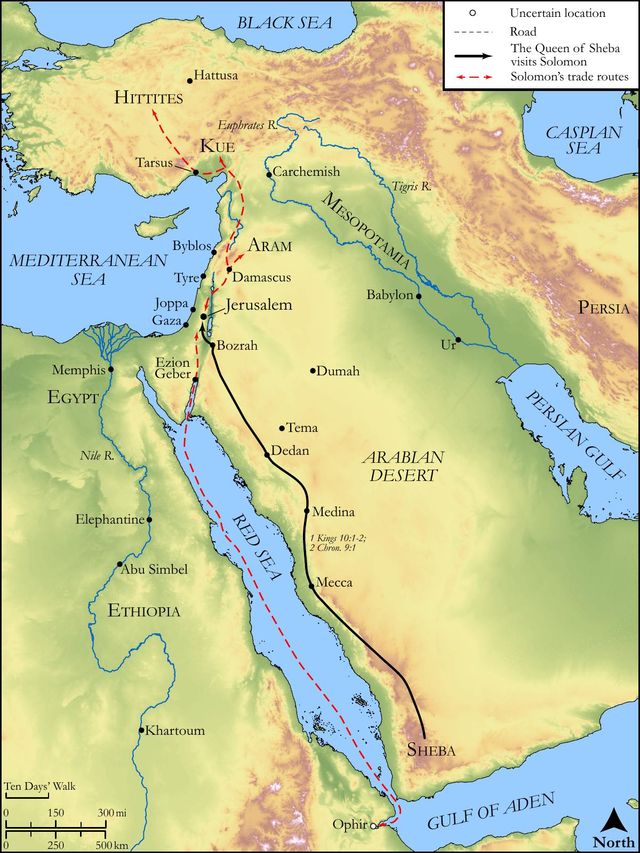
See on the biblical-era map
Study this verse
Public-domain commentary
Matthew Henry
From his Commentary on the Whole Bible. Henry comments on passages, not single verses — this entry covers 2 Chronicles 1:13–17.
Here is, 1. Solomon's entrance upon the government (Ch2 1:13): He came from before the tabernacle, and reigned over Israel. He would not do any acts of government till he had done his acts of devotion, would not take honour to himself till he had given honour to God - first the tabernacle, and then the throne. But, when he had obtained wisdom from God, he did not bury his talent, but as he received the gift ministered the same, did not give up himself to ease and pleasure, but minded business: he reigned over Israel. 2. The magnificence of his court (Ch2 1:14): He gathered chariots and horsemen. Shall we praise him for this? We praise him not; for the king was forbidden to multiply horses, Deu 17:16. I do not remember that ever we find his good father in a chariot or on horseback; a mule was the highest he mounted. We should endeavor to excel those that went before us in goodness rather than in grandeur. 3. The wealth and trade of his kingdom. He made silver and gold very cheap and common, Ch2 1:15. The increase of gold lowers the value of it; but the increase of grace advances its price; the more men have of that the more they value it. How much better therefore is it to get wisdom than gold! He opened also a trade with Egypt, whence he imported horses and linen-yarn, which he exported again to the kings of Syria, with great advantage no doubt, Ch2 1:16, Ch2 1:17. This we had before, Kg1 10:28, Kg1 10:29. It is the wisdom of princes to promote industry and encourage trade in their dominions. Perhaps Solomon took the hint of setting up the linen-manufacture, bringing linen-yarn out of Egypt, working it into cloth, and then sending that to other nations, from what his mother taught when she specified this as one of the characteristics of the virtuous woman, She maketh fine linen, and selleth it, and delivereth girdles of it to the merchant, Pro 31:24. In all labour there is profit.
Continue studying 2 Chronicles 1:14 across the web’s major study libraries — every link below opens this exact verse, chapter, or book on the destination site.
Read & Compare
 BibleGatewayThis verse in more than 200 translations and 70 languages.
 Bible.comThe YouVersion reader — hundreds of translations, reading plans, and highlights.
 ESV.orgCrossway's official English Standard Version reader.
 NET BibleThe NET translation with 60,000+ translators' notes on every rendering decision.
 STEP BibleTyndale House's free study tool — original text, vocabulary, and scholarly resources.
 BibliaLogos Bible Software's free web reader.
 USCCBThe New American Bible (Revised Edition) with the U.S. bishops' study notes.
Commentaries
 BibleHub CommentariesDozens of classic commentaries on this verse, gathered on one page.
 StudyLightMore than 100 commentary sets — the largest collection on the web.
 BibleRefPlain-English commentary on what this verse means, verse by verse.
 Enduring WordDavid Guzik's free commentary on this chapter, widely used by Bible teachers.
 Bible Study ToolsVerse commentary alongside Greek and Hebrew study aids.
Original Language & Research
- BibleHub InterlinearThe verse word by word — original language, transliteration, and English.
- BibleHub LexiconEvery word's original-language definition and Strong's entry.
 Blue Letter BibleDeep-study tools — Strong's numbers, concordance, and word studies.
 SefariaThe Hebrew text with Rashi and centuries of Jewish commentary.
Sermons, Hymns & Audio


TrulyRandomVerse is not affiliated with these sites and doesn’t control their content. They’re linked because they’re genuinely useful.
Summary
2 Chronicles 1:14 offers a vivid snapshot of King Solomon's burgeoning military and economic power early in his reign, detailing his extensive acquisition and strategic deployment of "a thousand and four hundred chariots, and twelve thousand horsemen." This verse not only underscores the unprecedented prosperity and security Israel enjoyed under Solomon, a direct fulfillment of God's promised blessings of wealth and honor, but also subtly introduces a significant theological tension regarding the king's reliance on earthly might rather than exclusive dependence on divine provision.
Context
ShowHideLiterary Context
This verse immediately follows the pivotal account of God's gracious appearance to Solomon at Gibeon. There, Solomon humbly requested wisdom to govern God's people, and in response, God not only granted his petition but also promised him unparalleled riches, honor, and a long life if he walked in obedience, as detailed in 2 Chronicles 1:7-12. The Chronicler presents the acquisition of this vast military force as the immediate, tangible evidence of God's faithfulness in fulfilling these promises of wealth and power. It serves as a narrative bridge, transitioning from the divine encounter to the practical manifestations of Solomon's glorious and prosperous reign, highlighting his administrative acumen and the kingdom's formidable strength. However, for the discerning reader, it also subtly foreshadows potential areas of spiritual compromise that would later characterize aspects of Solomon's rule.
Historical & Cultural Context
In Scripture, chariots represented the pinnacle of military technology and power, as in the "nine hundred chariots of iron" of Sisera's host. A nation possessing a large chariot force was considered a dominant regional power, reflecting immense economic strength and sophisticated military organization. Solomon's reign (c. 970-931 BC) was a period of unprecedented peace and prosperity for Israel, allowing for the establishment of extensive trade networks, particularly with Egypt, a primary source of horses and chariots. The mention of "chariot cities" (Hebrew: 'arei ha-rekhev) refers to a sophisticated military infrastructure where these valuable assets and their associated personnel were housed, trained, and maintained. These cities, often fortified and strategically located at key defensive points or trade routes (e.g., Megiddo, Gezer, Hazor, as indicated by archaeological evidence), underscore Solomon's foresight in national defense and his ability to project royal authority across his expanding kingdom.
Key Themes
ShowHide2 Chronicles 1:14 powerfully illustrates several central themes in the Chronicler's portrayal of Solomon's reign. Firstly, it highlights divine blessing and unprecedented prosperity, showcasing the extraordinary wealth and military might of the kingdom as a direct consequence of God's favor and fulfillment of His promises. Secondly, it emphasizes strategic governance and national defense, demonstrating Solomon's administrative genius in organizing and deploying resources for the security and stability of Israel. Thirdly, and most significantly for the Chronicler's theological agenda, it introduces a subtle but profound theological tension regarding the king's ultimate reliance. While the accumulation of such power is a sign of blessing, it stands in stark contrast to the Mosaic Law found in Deuteronomy 17:16, which explicitly warned future kings against multiplying horses for themselves, lest their hearts be turned away from the Lord and they rely on military strength rather than on God's divine protection. This act by Solomon, though part of his prosperity, subtly foreshadows a potential area of departure from divine instruction and a reliance on earthly power, a theme that becomes more pronounced later in his narrative.
Exposition and Analysis
ShowHideKey Word Analysis
ShowHideA primitive root meaning "to gather for any purpose; hence, to receive, take away, i.e. remove." In this context, the Hiphil form (implied by the KJV "gathered") indicates a deliberate and active collection, emphasizing Solomon's intentional policy of amassing these military assets. It signifies a systematic and organized effort on the king's part to consolidate power and resources.
From a root meaning "to ride," this term refers to a "vehicle" or, by implication, a "team" or "cavalry." Specifically, it denotes the war chariots, which were the most formidable offensive weapons of that age. Their presence in such vast numbers signifies not only immense military strength but also the substantial economic resources required for their acquisition, maintenance, and the training of their specialized crews.
A primitive root meaning "to deposit; by implication, to allow to stay; bestow, cast down, lay (down, up), leave (off), let alone (remain), pacify, place, put, set (down), suffer, withdraw, withhold." Here, it describes Solomon's strategic deployment of his forces. The verb highlights a deliberate, organized, and permanent arrangement, indicating a well-thought-out military infrastructure rather than a mere temporary collection.
Verse Breakdown
ShowHide"And Solomon gathered chariots and horsemen:"
This opening clause immediately establishes Solomon's active role in building up Israel's military might. The verb "gathered" (וַיֶּאֱסֹף, vayye'esof) denotes a purposeful and systematic collection, indicating that this was a deliberate policy of the king, not merely an incidental acquisition. It highlights his administrative capacity and his intent to consolidate military power.
"and he had a thousand and four hundred chariots, and twelve thousand horsemen,"
These precise figures underscore the unprecedented scale of Solomon's military establishment. Compared to the military forces of previous Israelite kings, this represents an enormous increase in military might, signaling the zenith of Israel's power and influence among the nations. This numerical specificity emphasizes the tangible fulfillment of God's promise of unparalleled wealth and honor, as also recounted in 1 Kings 10:26.
"which he placed in the chariot cities, and with the king at Jerusalem."
This final clause details the strategic deployment and distribution of these formidable forces. By placing them in "chariot cities" (fortified garrisons throughout the kingdom), Solomon ensured rapid response capabilities to threats across his realm and efficient logistical support for these valuable assets. Keeping a significant contingent "with the king at Jerusalem" ensured the immediate security of the capital and the king's person, reinforcing the centralized power and authority of the monarchy.
Literary Devices
ShowHide2 Chronicles 1:14 employs Numerical Specificity to convey the immense scale of Solomon's military power, lending an air of historical veracity and emphasizing the unprecedented nature of his reign. The precise figures of "a thousand and four hundred chariots, and twelve thousand horsemen" serve to impress upon the reader the extraordinary wealth and might of the kingdom under Solomon. Furthermore, the passage utilizes Symbolism, where chariots and horses serve as potent symbols of earthly power, wealth, and military dominance. This accumulation of power, while presented as a sign of God's blessing, also carries a subtle but significant Foreshadowing of potential spiritual pitfalls. In light of the Deuteronomic law for kings (Deuteronomy 17:16), Solomon's actions, though initially indicative of prosperity, hint at a future reliance on human strength and foreign alliances rather than exclusive trust in God. This tension becomes a crucial theme as the Chronicler's narrative progresses, ultimately contributing to the spiritual decline observed later in Solomon's life.
Theological and Thematic Connections
ShowHideThe account of Solomon's military build-up in 2 Chronicles 1:14 presents a complex theological paradox. On one hand, it is undeniably a tangible manifestation of God's promised blessings of wealth and honor, demonstrating the peak of Israel's national strength and prosperity under divine favor. On the other hand, it introduces a subtle but significant tension with the clear Mosaic Law, particularly Deuteronomy 17:16, which explicitly warned future kings against multiplying horses for themselves, lest their hearts be turned away from the Lord. This tension highlights a recurring and vital theme in biblical theology: the inherent danger of trusting in God's blessings (such as wealth, power, and security) rather than in God Himself, the ultimate Giver. While military strength can be a legitimate tool for national defense, an over-reliance on it, or its acquisition through means that compromise spiritual principles (like excessive foreign alliances), can lead to spiritual complacency and a departure from divine dependence. The Chronicler, in his theological history, consistently emphasizes the consequences of a king's obedience or disobedience to God's commands, thereby setting the stage for later narratives that detail Solomon's spiritual decline and the subsequent division of the kingdom.
Reflection and Application
ShowHideSolomon's amassing of chariots and horsemen serves as a profound and enduring reminder for believers today about the true source of security, strength, and ultimate provision. While God graciously blesses us with a myriad of resources—be they financial stability, intellectual talents, professional achievements, supportive relationships, or even good health—the inherent human temptation is to subtly, or even overtly, place our trust in these tangible assets rather than in the Giver of all good things. This verse challenges us to engage in honest self-examination: where does our ultimate security truly lie? Is it in our meticulously planned retirement funds, our impressive résumés, our extensive social networks, or our robust physical well-being? True and unshakable security is found only in a steadfast, unwavering reliance on God's unfailing provision, protection, and sovereign control. When we elevate our "chariots and horsemen"—our worldly means and accomplishments—to a place of ultimate trust, we risk subtly departing from God's commands and compromising the integrity of our spiritual walk. This passage encourages a posture of profound humility and radical dependence, ensuring that the blessings we receive from God lead us into deeper faith and worship, rather than fostering a spirit of self-sufficiency or misplaced confidence.
Questions for Reflection
ShowHideFAQ
ShowHideWhy did Solomon gather so many chariots if the law warned against it?
ShowHideThe tension between Solomon's actions in 2 Chronicles 1:14 and the Mosaic Law in Deuteronomy 17:16 is a significant theological point. While Deuteronomy explicitly warned Israelite kings against multiplying horses, Solomon's extensive acquisition of chariots and horsemen is presented by the Chronicler (and in parallel accounts in 1 Kings) as a direct fulfillment of God's promise of unparalleled riches and honor to him, as seen in 2 Chronicles 1:12. The core issue is not necessarily the possession of a military for national defense, but the spirit behind the accumulation and the source of the king's trust. The Deuteronomic warning aimed to prevent kings from relying on military might or foreign alliances (especially with Egypt, a primary source of horses) instead of on divine protection. Solomon's initial intent might have been for legitimate national defense and the projection of God-given power, but the sheer scale of his acquisition and his extensive trade with Egypt for these assets hinted at a potential over-reliance on human strength and worldly connections, which indeed foreshadowed later spiritual compromises and a turning away from God's exclusive command.
What were "chariot cities"?
ShowHide"Chariot cities" (Hebrew: 'arei ha-rekhev) were strategic garrisons or fortified cities specifically built, expanded, or designated by King Solomon to house his vast chariot forces, their horses, and the necessary personnel. These personnel included chariot drivers, archers, armorers, and maintenance crews. Archaeological findings at sites like Megiddo, Gezer, and Hazor have revealed large stables and administrative buildings consistent with such military depots. These cities were often located at key crossroads, along trade routes, or at strategic defensive points throughout the kingdom. Their purpose was multifaceted: to provide secure storage and training facilities for these valuable military assets, to ensure rapid deployment of forces to any part of the kingdom in response to threats, and to project royal authority and military presence across Israel's territories, thereby solidifying Solomon's control and influence.
Christ-Centered Fulfillment
ShowHideSolomon's reign, characterized by unparalleled wealth and military might symbolized by his vast array of chariots and horsemen, represents the pinnacle of Israel's earthly kingdom and its potential under a divinely blessed king. Yet, even this glorious era, built on human strength, resources, and strategic alliances, ultimately proved temporary and fell short of God's perfect, eternal design. In profound contrast, Jesus Christ, the true and eternal King, establishes a kingdom that is "not of this world" (John 18:36), one not built on earthly chariots and horsemen, but on spiritual power, sacrificial love, and divine authority. His triumphal entry into Jerusalem, humbly riding on a donkey (Matthew 21:5), powerfully contrasts with the displays of military might by earthly kings, signifying a kingdom founded on peace, humility, and servanthood. His ultimate victory over sin, death, and the powers of darkness was secured not by an army of "more than twelve legions of angels" (Matthew 26:53) but by His willing sacrifice on the cross, through which He "disarmed the powers and authorities, he made a public spectacle of them, triumphing over them by the cross" (Colossians 2:15). Believers are therefore called to trust not in worldly might or accumulated resources, but in the spiritual armor of God (Ephesians 6:10-18) and the unshakable nature of Christ's eternal kingdom (Hebrews 12:28). He is the one in whom all true security, lasting peace, and ultimate triumph are found, far surpassing any earthly display of power or fleeting prosperity.