


1 Kings 4:24
Bible text: King James Version (1769 Blayney text) · Public domain
Bible text: King James Version with Strong's numbers · Public domain
Bible text: Berean Standard Bible · Public domain
Bible text: American Standard Version (1901) · Public domain
Bible text: World English Bible, Messianic edition · Public domain
Bible text: Geneva Bible (1599) · Public domain
Bible text: Young's Literal Translation · Public domain
- כִּיkiforH3588PrtParticle Conditional
- הוּאhu'heH1931Pro-3msPronoun Personal 3rd Singular Masculine
- רֹדֶהro·Deh[was] rulingH7287V-Qal-Prtcpl-msVerb Qal Participle Singular Masculine Absolute
- בְּכָלbe·kholover allH3605Prep-b ¦ N-mscNoun Singular Masculine Constructבְּoverכָלall
- עֵבֶר'E·ver[the] other side ofH5676N-mscNoun Singular Masculine Construct
- הַנָּהָרha·na·Harthe RiverH5104Art ¦ N-properNoun Proper LocationהַtheנָּהָרRiver
- מִתִּפְסַחmi·tif·Sachfrom TiphsahH8607Prep-m ¦ N-properNoun Proper LocationמִfromתִּפְסַחTiphsah
- וְעַדve·'adand toH5704Conj-w ¦ PrepPrepositionוְandעַדto
- עַזָּה'a·ZahGazaH5804N-properNoun Proper Location
- בְּכָלbe·kholover allH3605Prep-b ¦ N-mscNoun Singular Masculine Constructבְּoverכָלall
- מַלְכֵיmal·Khei[the] kings ofH4428N-mpcNoun Plural Masculine Construct
- עֵבֶר'E·ver[the] other side ofH5676N-mscNoun Singular Masculine Construct
- הַנָּהָרha·na·Harthe RiverH5104Art ¦ N-properNoun Proper LocationהַtheנָּהָרRiver
- וְשָׁלוֹםve·sha·Lomand peaceH7965Conj-w ¦ N-msNoun Singular Masculine Absoluteוְandשָׁלוֹםpeace
- הָיָהHa·yahit belongedH1961V-Qal-Perf-3msVerb Qal Perfect 3rd Singular Masculine
- לוֹloto <the> himPrep-l ¦ 3msSuffix Personal 3rd Singular Masculineלto <the>וֹhim
- מִכָּלmi·kolfrom allH3605Prep-m ¦ N-mscNoun Singular Masculine Constructמִfromכָּלall
- עֲבָרָיו'a·va·Ravhis sidesH5676N-mpc ¦ 3msNoun Plural Masculine Constructעֲבָרָיsidesוhis
- מִסָּבִיבmi·sa·Vivfrom round aboutH5439Prep-m ¦ N-csNoun Singular common gender Absoluteמִfromסָּבִיבround about
English is a literal word-by-word gloss of the Hebrew, not the KJV's wording. Why?
This is the original text the KJV's translators worked from — each Hebrew word with its own literal English meaning in this verse, prepared by scholars at Tyndale House, Cambridge. The KJV translates whole sentences, not word by word, so its wording differs: one Hebrew word can become several English words, and the KJV may choose “the LORD” where the gloss reads “Yahweh”. Both are faithful — they answer different questions. For the KJV's own rendering, switch to the KJV text.
Details
See on the biblical-era maps
Study this verse
Public-domain commentary
Matthew Henry
From his Commentary on the Whole Bible. Henry comments on passages, not single verses — this entry covers 1 Kings 4:20–28. His three-level outline is real structure in the source text, so it is rendered as structure.
Such a kingdom, and such a court, surely never any prince had, as Solomon's are here described to be.
I.Such a kingdom.
Never did the crown of Israel shine so brightly as it did when Solomon wore it, never in his father's days, never in the days of any of his successors; nor was that kingdom ever so glorious a type of the kingdom of the Messiah as it was then. The account here given of it is such as fully answers the prophecies which we have concerning it in Ps. 72, which is a psalm for Solomon, but with reference to Christ.
1.The territories of his kingdom were large and its tributaries many; so it was foretold that he should have dominion from sea to sea, Psa 72:8-11. Solomon reigned not only over all Israel, who were his subjects by choice, but over all the neighbouring kingdoms, who were his subjects by constraint. All the princes from the river Euphrates, north-east to the border of Egypt south-west, not only added to his honour by doing him homage and holding their crowns from him, but added to his wealth by serving him, and bringing him presents, Kg1 4:21. David, by his successful wars, compelled them to this subjection, and Solomon, by his admirable wisdom, made it easy and reasonable; for it is fit that the fool should be servant to the wise in heart. If they gave him presents, he gave them instructions, and still taught the people knowledge, not only his own people, but those of other nations: and wisdom is better than gold. He had peace on all sides, Kg1 4:24. None of all the nations that were subject to him offered to shake off his yoke, or to give him any disturbance, but rather thought themselves happy in their dependence upon him. Herein his kingdom typified the Messiah's; for to him it is promised that he shall have the heathen for his inheritance and that princes shall worship him, Isa 49:6, Isa 49:7; Isa 53:12.
2.The subjects of his kingdom and its inhabitants, were many and cheerful.
(1.)They were numerous and country was exceedingly populous (Kg1 4:20): Judah and Israel were many, and that good land was sufficient to maintain them all. They were as the sand of the sea in multitude. Now was fulfilled the promise made to Abraham concerning the increase of his seed (Gen 22:17), as well as that concerning the extent of their dominion, Gen 15:18. This was their strength and beauty, the honour of their prince, the terror of their enemies, and an advancement of the wealth of the nation. If they grew so numerous that the place was any where too strait for them, they might remove with advantage into the countries that were subject to them. God's spiritual Israel are many, at least they will be so when they come all together, Rev 7:9.
(2.)They were easy, they dwelt safely, or with confidence and assurance (Kg1 4:25), not jealous of their king or of his officers, not disaffected either to him or one to another, nor under any apprehension or danger from enemies foreign or domestic. They were happy and knew it, safe and willing to think themselves so. They dwelt every man under his vine and fig-tree. Solomon invaded no man's property, took not to himself their vineyards and olive-yards, as sometimes was the manner of the king (Sa1 8:14), but what they had they could call their own: he protected every man in the possession and enjoyment of his property. Those that had vines and fig-trees ate the fruit of them themselves; and so great was the peace of the country that they might, if they pleased, dwell as safely under the shadow of them as within the walls of a city. Or, because it was usual to have vines by the sides of their houses (Psa 128:3), they are said to dwell under their vines.
(3.)They were cheerful in the use of their plenty, eating and drinking, and making merry, Kg1 4:20. Solomon did not only keep a good table himself, but enabled all his subjects, according to their rank, to do so too, and taught them that God gave them their abundance that they might use it soberly and pleasantly, not that they might hoard it up. There is nothing better than for a man to eat the labour of his hands (Ecc 2:24), and that with a merry heart, Ecc 9:7. His father, in the Psalms, had led his people into the comforts of communion with God, and now he led them into the comfortable use of the good things of this life. This pleasant posture of Israel's affairs extended, in place, from Dan to Beer-sheba - no part of the country was exposed nor upon any account uneasy; and it continued a long time, all the days of Solomon, without any material interruption. Go where you would, you might see all the marks of plenty, peace, and satisfaction. The spiritual peace, and joy, and holy security, of all the faithful subjects of the Lord Jesus were typified by this. The kingdom of God is not, as Solomon's was, meat and drink, but, what is infinitely better, righteousness, and peace, and joy in the Holy Ghost.
II.Such a court Solomon kept as can scarcely be paralleled.
We may guess at the vast number of his attendants, and the great resort there was to him, by the provision that was made daily for his table. Of bread there were so many measures of flour and meal as, it is computed, would richly serve 3000 men (Carellus computes above 4800 men), and the provision of flesh (Kg1 4:23) was rather more in proportion. What vast quantities were here of beef, mutton, and venison, and the choicest of all fatted things, as some read that which we translate fatted fowl! Ahasuerus, once in his reign, made a great feast, to show the riches of his kingdom, Est 1:3, Est 1:4. But it was much more the honour of Solomon that he kept a constant table and a very noble one, not of dainties or deceitful meats (he himself witnessed against them, Pro 23:3), but substantial food, for the entertainment of those who came to hear his wisdom. Thus Christ fed those whom he taught, 5000 at a time, more than ever Solomon's table would entertain at once: and all believers have in him a continual feast. Herein he far outdoes Solomon, that he feeds all his subjects, not with the bread that perishes, but with that which endures to eternal life. It added much both to the strength and glory of Solomon's kingdom that he had such abundance of horses, 40,000 for chariots and 12,000 for his troops, 1000 horse, perhaps, in every tribe, for the preserving of the public peace, Kg1 4:26. God had commanded that their king should not multiply horses (Deu 17:16), nor, according to the account here given, considering the extent and wealth of Solomon's kingdom, did he multiply horses in proportion to his neighbours; for we find even the Philistines bringing into the field 30,000 chariots (Sa1 13:5) and the Syrians at least 40,000 horse, Sa2 10:18. The same officers that provided for his house provided also for his stable, Kg1 4:27, Kg1 4:28. Every one knew his place, and work, and time; and so this great court was kept without confusion. Solomon, that had vast incomes, lived at a vast expense, and perhaps wrote that with application to himself, Ecc 5:11. When goods increase those are increased that eat them; and what good is there to the owners thereof, saving the beholding of them with their eyes, unless withal they have the satisfaction of doing good with them?
Continue studying 1 Kings 4:24 across the web’s major study libraries — every link below opens this exact verse, chapter, or book on the destination site.
Read & Compare
 BibleGatewayThis verse in more than 200 translations and 70 languages.
 Bible.comThe YouVersion reader — hundreds of translations, reading plans, and highlights.
 ESV.orgCrossway's official English Standard Version reader.
 NET BibleThe NET translation with 60,000+ translators' notes on every rendering decision.
 STEP BibleTyndale House's free study tool — original text, vocabulary, and scholarly resources.
 BibliaLogos Bible Software's free web reader.
 USCCBThe New American Bible (Revised Edition) with the U.S. bishops' study notes.
Commentaries
 BibleHub CommentariesDozens of classic commentaries on this verse, gathered on one page.
 StudyLightMore than 100 commentary sets — the largest collection on the web.
 BibleRefPlain-English commentary on what this verse means, verse by verse.
 Enduring WordDavid Guzik's free commentary on this chapter, widely used by Bible teachers.
 Bible Study ToolsVerse commentary alongside Greek and Hebrew study aids.
Original Language & Research
- BibleHub InterlinearThe verse word by word — original language, transliteration, and English.
- BibleHub LexiconEvery word's original-language definition and Strong's entry.
 Blue Letter BibleDeep-study tools — Strong's numbers, concordance, and word studies.
 SefariaThe Hebrew text with Rashi and centuries of Jewish commentary.
Sermons, Hymns & Audio


TrulyRandomVerse is not affiliated with these sites and doesn’t control their content. They’re linked because they’re genuinely useful.
Summary
1 Kings 4:24 vividly portrays the unparalleled zenith of King Solomon's reign, illustrating a period of immense territorial dominion and comprehensive peace for ancient Israel. This verse encapsulates the tangible fulfillment of divine promises regarding the land and the unprecedented tranquility that characterized his rule, marking a golden age of stability, prosperity, and flourishing that stood in stark contrast to the preceding era of constant conflict and tribal fragmentation.
Context
ShowHideLiterary Context
This verse is strategically placed within a larger section of 1 Kings (specifically 1 Kings 4:20-34) that meticulously details the administrative structure, economic prosperity, and extraordinary wisdom divinely bestowed upon King Solomon. It immediately follows the account of Solomon's profound prayer for wisdom and God's subsequent blessing of not only wisdom but also immense wealth and honor (1 Kings 3:4-15). The preceding verses in chapter 4 elaborate on the vast population under his rule and the immense daily provisions required for his court, thereby setting the grand stage for the description of his expansive and peaceful kingdom. This section collectively serves to highlight the unparalleled glory and stability of Solomon's reign before the narrative transitions to the monumental undertaking of building the Temple in 1 Kings 5.
Historical & Cultural Context
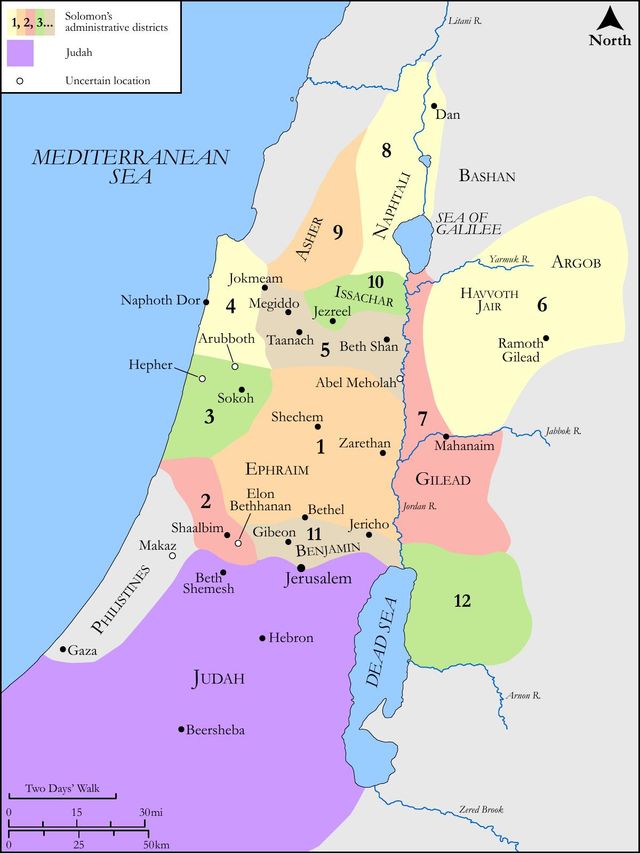
Solomon's reign, traditionally dated from c. 970-931 BC, occurred during a propitious geopolitical lull among the nations. Major powers like Egypt and Assyria were experiencing periods of internal weakness or preoccupation, which allowed Israel to ascend as a significant regional hegemon. The phrase "on this side the river" refers to the region west of the great Euphrates River, often known as "Trans-Euphrates" or "Aram-Naharaim." "Tiphsah" is widely identified with Thapsacus, a crucial city and crossing point on the Euphrates, while "Azzah" is Gaza, a prominent Philistine city located on the Mediterranean coast. This geographical span signifies Israel's control or dominion over a vital land bridge connecting the empires of Egypt, Mesopotamia, and Anatolia, effectively dominating major international trade routes. The "kings on this side the river" were likely smaller city-states or regional rulers who paid tribute, formed alliances, or otherwise acknowledged Solomon's paramount authority, indicating a period of significant political and economic hegemony for the unified kingdom of Israel.
Key Themes
ShowHideThe primary themes powerfully evinced in this verse and the surrounding narrative include Vast Dominion and Influence, which reflects a significant, albeit partial and temporary, fulfillment of the expansive land promises made by God to Abraham (Genesis 15:18) and subsequently reiterated in the Davidic covenant (2 Samuel 7:8-16). Another central and defining theme is Unprecedented Peace (Shalom). Unlike his father David, who was explicitly described as a "man of war" (1 Chronicles 22:8), Solomon's era was uniquely characterized by an almost complete absence of external threats and a profound internal stability. This divinely granted peace (shalom) was absolutely foundational for the massive construction projects, the flourishing economic prosperity, and the widespread development of wisdom and culture that defined his reign, embodying a period of rest and security promised to a faithful Israel. Finally, the verse powerfully underscores Divine Blessing and Fulfillment, portraying Solomon's peaceful and expansive kingdom as a direct and undeniable result of God's favor and unwavering faithfulness to His covenant promises.
Exposition and Analysis
ShowHideKey Word Analysis
ShowHideThis primitive root means "to tread down, i.e., subjugate; specifically, to crumble off; (come to, make to) have dominion, prevail against, reign, (bear, make to) rule." In the context of 1 Kings 4:24, it emphasizes the active and authoritative exercise of control and sovereignty by Solomon over the specified territories and their rulers, indicating a recognized political and military supremacy rather than mere influence.
This noun refers to "a stream (including the sea; expectation the Nile, Euphrates, etc.); figuratively, prosperity." When used in conjunction with "on this side," as it is here, it almost invariably refers to the Euphrates River, which served as the traditional northeastern boundary of the land promised to Israel. Its inclusion precisely defines the extreme and impressive reach of Solomon's influence.
This rich Hebrew term means "safe, i.e. (figuratively) well, happy, friendly; also (abstractly) welfare, i.e. health, prosperity, peace." Far more profound than merely the absence of conflict, shalom encompasses a holistic state of wholeness, completeness, well-being, prosperity, security, and harmony. Solomon's peace was a comprehensive state of flourishing, a profound and comprehensive blessing from God that facilitated internal development and external stability.
Verse Breakdown
ShowHide"For he had dominion over all [the region] on this side the river"
This initial clause establishes the vast geographical scope and authoritative nature of Solomon's rule. The phrase "on this side the river" specifically refers to the entire Levant region situated west of the Euphrates River, signifying that Israel, under Solomon, exerted significant political and economic control and influence over this crucial geopolitical corridor, extending its reach far beyond its immediate borders.
"from Tiphsah even to Azzah"
These specific geographical markers function as a merism, precisely defining the northern and southern limits of Solomon's sphere of influence. Tiphsah (Thapsacus) was a strategically important crossing point on the Euphrates, while Azzah (Gaza) was a major Philistine city located on the Mediterranean coast. This phrase comprehensively signifies the entire breadth of his dominion, from the far north to the far south, encompassing vital trade routes and strategically important territories.
"over all the kings on this side the river"
This phrase clarifies the precise nature of Solomon's dominion: it was not necessarily direct administrative control over every single square mile or city, but rather a recognized dominion over the various smaller kingdoms and city-states within the region. These kings likely paid tribute, formed alliances, or submitted to Solomon's overarching authority, significantly contributing to Israel's wealth, security, and regional prestige.
"and he had peace on all sides round about him"
This final clause highlights the most remarkable and divinely granted feature of Solomon's reign—a profound and comprehensive state of shalom. This peace was not merely the absence of warfare but a divinely bestowed period of rest, security, and prosperity that allowed Israel to flourish internally without the constant threat of external aggression, presenting a stark and welcome contrast to the perpetual warfare that characterized the reigns of Saul and David.
Literary Devices
ShowHideThe verse employs several potent literary devices to convey the unparalleled magnitude and blessed nature of Solomon's reign. Merism is prominently evident in the phrase "from Tiphsah even to Azzah," which ingeniously uses two extreme geographical points to represent the entire intervening territory, thereby emphasizing the vast and comprehensive nature of his dominion. The description of his rule "over all the kings on this side the river" may contain an element of hyperbole, a common rhetorical feature of Hebrew narrative, used to underscore the unparalleled extent of his influence and authority, even if not every single ruler was directly subjugated. There is also an implicit contrast with the preceding era of David's reign, which was perpetually marked by relentless warfare and conflict, highlighting Solomon's unique and divinely granted blessing of profound peace. Finally, the entire description serves as a powerful symbol of the ideal, God-blessed kingdom, where peace and prosperity are the direct and tangible results of divine favor, wisdom, and covenant faithfulness.
Theological and Thematic Connections
ShowHide1 Kings 4:24 stands as a powerful and tangible testament to God's unwavering faithfulness in fulfilling His covenant promises to both Abraham and David. Solomon's vast dominion and profound peace represent a concrete, albeit temporary and imperfect, realization of the divine vision for Israel as a blessed nation, secure in its promised land and respected by its neighbors. This period of shalom was not merely a political or military achievement but a profound divine gift, demonstrating God's deep desire for His people to live in a state of rest, security, and prosperity when they walk in obedience to His commands. It serves as a significant foreshadowing of a greater, more enduring peace and universal dominion that God ultimately intends for His eternal kingdom, perfectly realized in the person and reign of the Messiah.
Reflection and Application
ShowHideThe account of Solomon's peaceful and prosperous reign in 1 Kings 4:24 offers profound and enduring lessons for contemporary believers. It serves as a powerful reminder that true peace, shalom, is a comprehensive state of well-being that extends far beyond the mere absence of conflict, encompassing spiritual, social, emotional, and physical flourishing. This verse calls us to recognize peace as a divine blessing and a gift to be actively pursued and cultivated in our personal lives, families, churches, and communities, understanding that such an environment is uniquely conducive to spiritual growth, the acquisition of wisdom, and deeper communion with God. Furthermore, Solomon's reign stands as a powerful testament to God's unwavering faithfulness to His promises, even when circumstances seem challenging or impossible. Just as God brought about an era of unprecedented peace and dominion for ancient Israel, He continues to work in our lives today, faithfully fulfilling His word and demonstrating His steadfast love and covenant loyalty, encouraging us to trust in His sovereign plan.
Questions for Reflection
ShowHideFAQ
ShowHideWas Solomon's kingdom truly that large, encompassing "all the kings on this side the river"?
ShowHideThe biblical description of Solomon's dominion in 1 Kings 4:24, stretching "from Tiphsah even to Azzah" and ruling "over all the kings on this side the river," indeed depicts the largest extent of Israel's influence in its history. While it signifies a vast sphere of political and economic influence and acknowledged dominion, it does not necessarily imply direct administrative control over every single territory or city-state within that expansive geographical span. Rather, it indicates that surrounding kingdoms paid tribute, formed strategic alliances, or were otherwise subservient to Solomon's paramount authority, thereby establishing Israel as the dominant regional power. This remarkable period was a significant, albeit temporary, fulfillment of the land promises made to Abraham in Genesis 15:18, which spoke of dominion extending from the "river of Egypt to the great river, the River Euphrates."
How did Solomon achieve such widespread peace when his father David was a renowned warrior king?
ShowHideSolomon's unprecedented peace was a remarkable combination of divine blessing and astute, strategic leadership. Firstly, it was a direct fulfillment of God's promise to David that his son would be a "man of rest" (1 Chronicles 22:9). God explicitly granted Solomon extraordinary wisdom (1 Kings 3:12), which he applied not only in discerning judgment but also in shrewd diplomacy and efficient administration. Solomon strategically built up Israel's military strength and fortified key cities (1 Kings 9:15-19), effectively deterring potential aggressors. He also engaged in extensive international trade and formed crucial political alliances through strategic marriages, such as with the daughter of Pharaoh (1 Kings 3:1), which significantly stabilized the region. The preceding conquests of David had largely subdued Israel's immediate enemies, creating a power vacuum that Solomon was able to fill with his diplomatic prowess and economic might, thereby ushering in a period of unparalleled shalom.
Christ-Centered Fulfillment
ShowHideSolomon's reign, as magnificently described in 1 Kings 4:24, serves as a profound type and shadow of the ultimate, perfect, and eternal kingdom of Jesus Christ. While Solomon's dominion was vast and impressive, it was inherently earthly, temporary, and ultimately flawed, eventually succumbing to division and decline. In stark contrast, Jesus, the true "Prince of Peace" (Isaiah 9:6), establishes a kingdom that is eternal, universal, and righteous, extending "from sea to sea, and from the River to the ends of the earth" (Psalm 72:8). The geopolitical peace Solomon enjoyed was a temporal blessing, but Christ offers a spiritual and eternal shalom that transcends all earthly circumstances, a profound peace that the world cannot give or take away (John 14:27). Furthermore, Solomon's renowned wisdom, though divinely granted, pales in comparison to Christ, in whom "are hidden all the treasures of wisdom and knowledge" (Colossians 2:3). The ideal kingdom of peace and prosperity under Solomon points forward to the perfect, everlasting reign of Christ, who truly fulfills the Abrahamic and Davidic covenants, establishing a kingdom that will have no end (Luke 1:32-33). He is the true and ultimate King who brings perfect rest, complete wholeness, and eternal salvation to all who believe in Him.