


1 Kings 5:4
Bible text: King James Version (1769 Blayney text) · Public domain
Bible text: Berean Standard Bible · Public domain
Bible text: American Standard Version (1901) · Public domain
Bible text: World English Bible, Messianic edition · Public domain
Bible text: Geneva Bible (1599) · Public domain
Bible text: Young's Literal Translation · Public domain
- וְעַתָּהve·'a·Tahand nowH6258Conj-w ¦ AdvAdverbוְandעַתָּהnow
- הֵנִיחַhe·Ni·achhe has given restH5117V-Hiphil-Perf-3msVerb Hiphil Perfect 3rd Singular Masculine
- יְהוָהYah·wehYahwehH3068N-properNoun Proper Title
- אֱלֹהַי'e·lo·Haimy GodH430N-mpc ¦ 1csNoun Plural Masculine ConstructאֱלֹהַGodיmy
- לִיlito <the> mePrep-l ¦ 1csSuffix Personal 1st Singular common genderלִto <the>יme
- מִסָּבִיבmi·sa·Vivfrom round aboutH5439Prep-m ¦ N-csNoun Singular common gender Absoluteמִfromסָּבִיבround about
- אֵין'einthere notH369N-mscNoun Singular Masculine Construct
- שָׂטָןsa·Tan[is] an adversaryH7854N-msNoun Singular Masculine Absolute
- וְאֵיןve·'Einand there notH369Conj-w ¦ N-mscNoun Singular Masculine Constructוְandאֵיןthere not
- פֶּגַעPe·ga'[is] an occurrenceH6294N-msNoun Singular Masculine Absolute
- רָעRa'evilH7451Adj-msAdjective Singular Masculine Absolute
English is a literal word-by-word gloss of the Hebrew, not the KJV's wording. Why?
This is the original text the KJV's translators worked from — each Hebrew word with its own literal English meaning in this verse, prepared by scholars at Tyndale House, Cambridge. The KJV translates whole sentences, not word by word, so its wording differs: one Hebrew word can become several English words, and the KJV may choose “the LORD” where the gloss reads “Yahweh”. Both are faithful — they answer different questions. For the KJV's own rendering, switch to the KJV text.
Details
See on the biblical-era maps

Study this verse
Public-domain commentary
Matthew Henry
From his Commentary on the Whole Bible. Henry comments on passages, not single verses — this entry covers 1 Kings 5:1–9. His four-level outline is real structure in the source text, so it is rendered as structure.
We have here an account of the amicable correspondence between Solomon and Hiram. Tyre was a famous trading city, that lay close upon the sea, in the border of Israel; its inhabitants (as should seem) were none of the devoted nations, nor ever at enmity with Israel, and therefore David never offered to destroy them, but lived in friendship with them. It is here said of Hiram their king that he was ever a lover of David; and we have reason to think he was a worshipper of the true God, and had himself renounced, though he could not reform, the idolatry of his city. David's character will win the affections even of those that are without. Here is,
I.Hiram's embassy of compliment to Solomon, Kg1 5:1.
He sent, as is usual among princes, to condole with him on the death of David, and to renew his alliances with him upon his succession to the government. It is good keeping up friendship and communion with the families in which religion is uppermost.
II.Solomon's embassy of business to Hiram, sent, it is likely, by messengers of his own.
In wealth, honour, and power, Hiram was very much inferior to Solomon, yet Solomon had occasion to be beholden to him and begged his favour. Let us never look with disdain on those below us, because we know not how soon we may need them. Solomon, in his letter to Hiram, acquaints him,
1.With his design to build a temple to the honour of God. Some think that temples among the heathen took their first rise and copy from the tabernacle which Moses erected in the wilderness, and that there were none before that; however there were many houses built in honour of the false gods before this was built in honour of the God of Israel, so little is external splendour a mark of the true church. Solomon tells Hiram, who was himself no stranger to the affair,
(1.)That David's wars were an obstruction to him, that he could not build this temple, though he designed it, Kg1 5:3. They took up much of his time, and thoughts, and cares, were a constant expense to him and a constant employment of his subjects; so that he could not do it so well as it must be done, and therefore, it not being essential to religion, he must leave it to be done by his successor. See what need we have to pray that God will give peace in our time, because, in time or war, the building of the gospel temple commonly goes on slowly.
(2.)That peace gave him an opportunity to build it, and therefore he resolved to set about it immediately: God has given me rest both at home and abroad, and there is no adversary (Kg1 5:4), no Satan (so the word is), no instrument of Satan to oppose it, or to divert us from it. Satan does all he can to hinder temple work (Th1 2:18; Zac 3:1), but when he is bound (Rev 20:2) we should be busy. When there is no evil occurrent, then let us be vigorous and zealous in that which is good and get it forward. When the churches have rest let them be edified, Act 9:31. Days of peace and prosperity present us with a fair gale, which we must account for if we improve not. As God's providence excited Solomon to think of building the temple, by giving him wealth and leisure, so his promise encouraged him. God had told David that his son should build him a house, Kg1 5:5. He will take it as a pleasure to be thus employed, and will not lose the honour designed him by that promise. It may stir us up much to good undertakings to be assured of good success in them. Let God's promise quicken our endeavours.
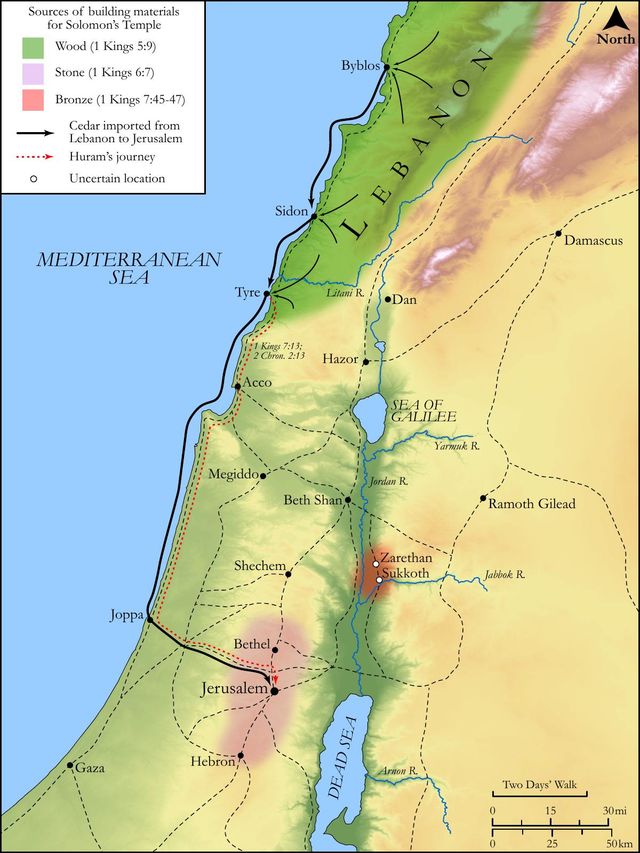
2.With his desire that Hiram would assist him herein. Lebanon was the place whence timber must be had, a noble forest in the north of Canaan, particularly expressed in the grant of that land to Israel - all Lebanon, Jos 13:5. So that Solomon was proprietor of all its productions. The cedars of Lebanon are spoken of as, in a special manner, the planting of the Lord (Psa 109:16), being designed for Israel's use and particularly for temple service. But Solomon owned that though the trees were his the Israelites had not skill to hew timber like the Sidonians, who were Hiram's subjects. Canaan was a land of wheat and barley (Deu 8:8), which employed Israel in the affairs of husbandry, so that they were not at all versed in manufactures: in them the Sidonians excelled. Israel, in the things of God, are a wise and understanding people; and yet, in curious arts, inferior to their neighbours. True piety is a much more valuable gift of heaven than the highest degree of ingenuity. Better be an Israelite skilful in the law than a Sidonian skilful to hew timber. But, the case being thus, Solomon courts Hiram to send him workmen, and promises (Kg1 5:6) both to assist them (my servants shall be with thy servants, to work under them), and to pay them (unto thee will I give hire for thy servants); for the labourer, even in church-work, though it be indeed its own wages, is worthy of his hire, The evangelical prophet, foretelling the glory of the church in the days of the Messiah, seems to allude to this story, Isa. 60, where he prophesies,
(1.)That the sons of strangers (such were the Tyrians and Sidonians) shall build up the wall of the gospel temple, Kg1 5:10. Ministers were raised up among the Gentiles for the edifying of the body of Christ.
(2.)That the glory of Lebanon shall be brought to it to beautify it, Kg1 5:13. All external endowments and advantages shall be made serviceable to the interests of Christ's kingdom.
3.Hiram's reception of, and return to, this message.
(1.)He received it with great satisfaction to himself: He rejoiced greatly (Kg1 5:7) that Solomon trod in his father's steps, and carried on his designs, and was likely to be so great a blessing to his kingdom. In this Hiram's generous spirit rejoiced, and not merely in the prospect he had of making an advantage to himself by Solomon's employing him. What he had the pleasure of he gave God the praise of: Blessed be the Lord, who has given to David (who was himself a wise man) a wise son to rule over this great people. See here, [1.] With what pleasure Hiram speaks of Solomon's wisdom and the extent of his dominion. Let us learn not to envy others either those secular advantages or those endowments of the mind wherein they excel us. What a great comfort it is to those that wish well to the Israel of God to see religion and wisdom kept up in families from one generation to another, especially in great families and those that have great influence on others! where it is so, God must have the glory of it. If to godly parents be given a godly seed (Mal 2:15), it is a token for good, and a happy indication that the entail of the blessing shall not be cut off.
(2.)He answered it with great satisfaction to Solomon, granting him what he desired, and showing himself very forward to assist him in this great and good work to which he was laying his hand. We have here his articles of agreement with Solomon concerning this affair, in which we may observe Hiram's prudence.
[1.]He deliberated upon the proposal, before he returned an answer (Kg1 5:8): I have considered the things. It is common for those that make bargains rashly afterwards to wish them unmade again. The virtuous woman considers a field and then buys it, Pro 31:16. Those do not lose time who take time to consider.
[2.]He descended to particulars in the articles, that there might be no misunderstanding afterwards, to occasion a quarrel. Solomon had spoken of hewing the trees (Kg1 5:6), and Hiram agrees to what he desired concerning that (Kg1 5:8); but nothing had been said concerning carriage, and this matter therefore must be settled. Land-carriage would be very troublesome and chargeable; he therefore undertakes to bring all the timber down from Lebanon by sea, a coasting voyage. Conveyance by water is a great convenience to trade, for which God is to have praise, who taught man that discretion. Observe what a definite bargain Hiram made. Solomon must appoint the place where the timber shall be delivered, and thither Hiram will undertake to bring it and be responsible for its safety. As the Sidonians excelled the Israelites in timber-work, so they did in sailing; for Tyre and Sidon were situate at the entry of the sea (Eze 27:3): they therefore were fittest to take care of the water-carriage. Tractant fabrilia fabri - Every artist has his trade assigned. And,
[3.]If Hiram undertake for the work, and do all Solomon's desire concerning the timber (Kg1 5:8), he justly expects that Solomon shall undertake for the wages: "Thou shalt accomplish my desire in giving food for my household (Kg1 5:9), not only for the workmen, but for my own family." If Tyre supply Israel with craftsmen, Israel will supply Tyre with corn, Eze 27:17. Thus, by the wise disposal of Providence, one country has need of another and is benefited by another, that there may be mutual correspondence and dependence, to the glory of God our common parent.
Historical interpretation
Historical reception
1 surviving comment on this verse from the historical church.
After this war one work remains for us,
O leaders, that which Solomon achieved,
The peaceful scion and the unarmed heir
Of a warlike realm, whose father’s weary hand
Was sullied by the ardent blood of kings.
The blood effaced, a temple is upraised
And golden altar, house sublime of Christ.
Jerusalem then by its temple crowned,
Received its God, now that the wandering ark
On the marble altar found repose.
In our camp let a sacred temple rise,
that God may in its sanctuary dwell.
What profits it to have repelled the hosts
Of earthborn vices, if the Son of man
From heaven descending, enter the body cleansed,
But unadorned and not a temple fair?
Thus far we have engaged in fierce conflict:
Now let white-vestured Peace perform its tasks,
And youth unarmed build up a sacred house.
Continue studying 1 Kings 5:4 across the web’s major study libraries — every link below opens this exact verse, chapter, or book on the destination site.
Read & Compare
 BibleGatewayThis verse in more than 200 translations and 70 languages.
 Bible.comThe YouVersion reader — hundreds of translations, reading plans, and highlights.
 ESV.orgCrossway's official English Standard Version reader.
 NET BibleThe NET translation with 60,000+ translators' notes on every rendering decision.
 STEP BibleTyndale House's free study tool — original text, vocabulary, and scholarly resources.
 BibliaLogos Bible Software's free web reader.
 USCCBThe New American Bible (Revised Edition) with the U.S. bishops' study notes.
Commentaries
 BibleHub CommentariesDozens of classic commentaries on this verse, gathered on one page.
 StudyLightMore than 100 commentary sets — the largest collection on the web.
 BibleRefPlain-English commentary on what this verse means, verse by verse.
 Enduring WordDavid Guzik's free commentary on this chapter, widely used by Bible teachers.
 Bible Study ToolsVerse commentary alongside Greek and Hebrew study aids.
Original Language & Research
- BibleHub InterlinearThe verse word by word — original language, transliteration, and English.
- BibleHub LexiconEvery word's original-language definition and Strong's entry.
 Blue Letter BibleDeep-study tools — Strong's numbers, concordance, and word studies.
 SefariaThe Hebrew text with Rashi and centuries of Jewish commentary.
Sermons, Hymns & Audio


TrulyRandomVerse is not affiliated with these sites and doesn’t control their content. They’re linked because they’re genuinely useful.
Summary
King Solomon, in a pivotal communication with Hiram of Tyre, declares a divinely orchestrated era of profound peace and stability throughout his kingdom. This unprecedented tranquility, characterized by the complete absence of external enemies and internal disturbances, is presented as God's direct and comprehensive provision, establishing the ideal conditions for the long-anticipated and monumental construction of the Temple in Jerusalem—a sacred task previously unattainable by his father, David, due to constant warfare.
Context
ShowHideLiterary Context
This verse is strategically placed within Solomon's diplomatic correspondence with Hiram, King of Tyre, as detailed in 1 Kings 5. Solomon is articulating the providential circumstances that now enable him to undertake the immense project of building the Temple for the Lord. He explicitly contrasts his current situation with that of his father, David, who was prevented from completing this task due to continuous military conflicts, as Solomon himself recounts in 1 Kings 5:3. This declaration of comprehensive peace serves as a crucial narrative bridge, providing the theological and practical justification for the grand architectural endeavor detailed in subsequent chapters, particularly from 1 Kings 6:1 onward.
Historical & Cultural Context
Solomon's reign, traditionally dated from approximately 970 to 931 BC, is widely regarded as a "golden age" for ancient Israel, characterized by unparalleled prosperity, wisdom, and, significantly, a period of relative peace. Unlike the preceding era of King David, which was defined by relentless military campaigns to consolidate Israel's territory and subdue its surrounding adversaries, Solomon inherited a kingdom that was largely pacified and secure. The strategic alliance forged with Tyre, a formidable maritime power, was instrumental in this stability, providing not only access to vital resources like timber and skilled labor but also reinforcing regional geopolitical equilibrium. In Israel, a monarch's capacity to maintain peace and ensure the security of his realm was understood as a clear manifestation of divine favor and effective governance, thereby facilitating large-scale public works and fostering economic flourishing. The theological concept of "rest" (Hebrew: נוּחַ, nuakh) held profound significance, often signifying God's faithfulness in fulfilling His covenant promises to bring His people into a secure inheritance, free from their enemies, a theme powerfully articulated in passages such as Joshua 21:44.
Key Themes
ShowHide1 Kings 5:4 profoundly contributes to several overarching themes within the book of Kings and the broader biblical narrative. Firstly, it underscores Divine Sovereignty and Providence, emphasizing that the peace Solomon enjoys is not merely a political achievement but a direct, active gift from "the LORD my God," demonstrating God's meticulous orchestration of circumstances. Secondly, it highlights the Fulfillment of Covenant Promises, particularly the Davidic Covenant, where God explicitly promised David a successor who would build a permanent house for His name (2 Samuel 7:13). This era of peace is presented as the indispensable condition for the realization of that sacred promise. Thirdly, the verse illustrates Peace as a Prerequisite for God's Work, showing how a period of national stability allows God's people to concentrate their resources, energy, and attention on sacred undertakings without external or internal distractions. Finally, it speaks to Israel's Prosperity and Security, portraying a kingdom free from both external threats and internal strife, a state of comprehensive well-being further elaborated upon in 1 Kings 4:25.
Exposition and Analysis
ShowHideKey Word Analysis
ShowHideThis word, derived from a primitive root meaning "to settle down," signifies far more than a mere cessation of hostilities. It denotes a profound state of tranquility, security, and settledness. In biblical theology, "rest" is frequently associated with God's completed work, such as the creation rest in Genesis 2:2, and the fulfillment of His promises, especially concerning the land of Israel being free from its enemies. Here, it implies a divinely granted period of comprehensive peace and stability that enables the nation to focus its energies on sacred endeavors, specifically the construction of the Temple.
From a root meaning "to oppose" or "to resist," this term, in this specific context, refers to any human or national opponent—whether military, political, or economic—that might threaten Israel's borders, challenge its authority, or disrupt its internal stability. It is not used here in the later theological sense of the demonic entity Satan, but rather denotes any external enemy or hostile power. Solomon's declaration signifies the absence of any active, significant threats challenging the security or sovereignty of his kingdom.
This noun, meaning "impact (casual)," "chance," or "misfortune," is used in conjunction with the Hebrew word for "evil" (raʻ H7451) to form the phrase "evil occurrent." Together, they refer to the absence of any harmful incident, calamity, internal rebellion, or disruptive misfortune that could hinder the kingdom's operations or, crucially, the Temple building project. This term speaks to comprehensive internal peace and well-being, complementing the external peace signified by the absence of an "adversary."
Verse Breakdown
ShowHide"But now the LORD my God hath given me rest on every side"
This opening clause immediately establishes the divine source of Solomon's unprecedented peace. The phrase "the LORD my God hath given me" directly attributes the tranquility not to Solomon's diplomatic acumen or military might, but to God's sovereign and active provision. "Rest on every side" emphatically conveys the comprehensive nature of this peace, signifying that all borders are secure and internal affairs are stable, marking a period of unparalleled security and tranquility for the nation. This divinely bestowed rest is presented as the indispensable prerequisite for the Temple's construction.
"[so that there is] neither adversary nor evil occurrent"
This explanatory clause elaborates on the practical manifestation of the "rest." "Adversary" specifically refers to external military or political enemies, while "evil occurrent" denotes internal misfortunes, calamities, or rebellions. The combined absence of both external threats and internal disturbances signifies a state of complete national security and well-being. This comprehensive peace allows Israel to dedicate its resources, labor, and collective focus entirely to the sacred task of building the house for the Lord's name without distraction, interruption, or diversion of resources.
Literary Devices
ShowHideThe verse effectively employs several literary devices to convey its profound message and underscore the unique nature of Solomon's reign. The phrase "rest on every side" coupled with "neither adversary nor evil occurrent" utilizes Hyperbole to emphasize the extraordinary and comprehensive nature of the peace granted to Solomon. This rhetorical exaggeration serves to underscore the divine favor and the ideal conditions divinely established for the Temple's construction, even if minor challenges might have existed or arisen later in his reign. The explicit attribution "the LORD my God hath given me rest" is a clear example of Divine Agency, highlighting God's direct, active, and sovereign involvement in orchestrating the circumstances necessary for His will to be accomplished. Furthermore, the verse functions as a narrative Foreshadowing, powerfully setting the stage for the detailed accounts of the Temple's construction that immediately follow, indicating that the time is now divinely appointed and prepared for this monumental sacred project. Implicitly, it also creates a stark Contrast with the preceding reign of King David, which was characterized by constant warfare, thereby accentuating the unique tranquility and divine blessing of Solomon's era.
Theological and Thematic Connections
ShowHideThe peace granted to Solomon in 1 Kings 5:4 is a profound theological statement about God's active involvement in human history and His unwavering faithfulness to His covenant promises. This divine "rest" is not merely a passive cessation of conflict but a proactive, sovereign provision by God to enable the fulfillment of His specific purposes—most notably, the building of His Temple. It powerfully demonstrates that God orchestrates circumstances, even the geopolitical landscape, to prepare the way for His people to carry out His divine will. This peace is presented as a profound blessing, a tangible sign of divine favor, and a strategic means to a greater end, showcasing how God provides the necessary conditions for significant spiritual undertakings. It echoes earlier promises of rest for Israel in the Promised Land and foreshadows a deeper, more enduring peace yet to come through the ultimate King.
Reflection and Application
ShowHideSolomon's experience in 1 Kings 5:4 offers timeless and profound insights for believers today. It calls us to cultivate a posture of recognition and appreciation for periods of peace, stability, and abundant provision in our own lives, understanding them not as mere coincidences or solely the result of our own efforts, but as direct, gracious gifts from God. These seasons of "rest on every side" are often God's strategic way of clearing the path, providing necessary resources, and creating the essential space for us to engage in significant spiritual work, pursue deep personal growth, or commit to acts of service that demand focused attention and dedicated effort. Just as the absence of adversaries and evil occurrents allowed ancient Israel to construct the physical Temple, our own spiritual and emotional peace can empower us to build up the "spiritual house" of our lives and ministries, as described in 1 Peter 2:5. This verse profoundly encourages us to trust implicitly in God's sovereignty over our circumstances, knowing that He is capable of bringing about peace even in the most chaotic times, and to remain acutely attentive to how He might be preparing us for His specific purposes during moments of tranquility.
Questions for Reflection
ShowHideFAQ
ShowHideWas Solomon's peace truly absolute throughout his entire reign, or is this verse a theological idealization?
ShowHideWhile 1 Kings 5:4 describes a period of unprecedented tranquility and the absence of major external and internal threats, it is primarily a theological statement emphasizing God's unique provision and the ideal conditions specifically for the Temple's construction. For the particular purpose of initiating and carrying out the Temple project, the kingdom indeed enjoyed remarkable stability. However, later in Solomon's long reign, the biblical narrative does record the rise of significant adversaries, such as Hadad the Edomite, Rezon of Damascus, and the internal rebellion led by Jeroboam. Therefore, while the verse highlights a divinely granted era of peace foundational for God's work, it should be understood as a description of the prevailing and divinely orchestrated conditions at the time of the Temple's inception, rather than a guarantee of perpetual, absolute calm for his entire reign.
What is the deeper significance of "the LORD my God hath given me rest"?
ShowHideThe emphatic declaration "the LORD my God hath given me rest" carries profound theological significance. It underscores the concept of divine agency and God's absolute sovereignty over human affairs and national circumstances. This profound peace was not merely a fortunate outcome of Solomon's diplomatic skill, military prowess, or strategic alliances, but a direct, supernatural blessing and provision from God Himself. It represents a tangible fulfillment of the covenant promises made to David, particularly the promise of a peaceful succession and a son who would build God's house (see 2 Samuel 7:11). This highlights a crucial biblical principle: God actively prepares the way for His work to be accomplished, providing the necessary conditions—even peace in a volatile world—for His people to fulfill His will and for His kingdom purposes to advance.
Christ-Centered Fulfillment
ShowHideSolomon's divinely granted peace, which enabled the construction of the magnificent physical Temple in Jerusalem, serves as a beautiful and profound foreshadowing of the ultimate and everlasting peace found exclusively in Jesus Christ, the greater Solomon. While Solomon's reign, despite its initial glory and prosperity, was ultimately temporary and imperfect, eventually giving way to division and conflict, Jesus brings a peace that the world cannot give and cannot take away (John 14:27). He is the true "Prince of Peace" (Isaiah 9:6), who, through His perfect life, atoning sacrifice on the cross, and triumphant resurrection, has decisively conquered the ultimate adversaries of humanity: sin, death, and Satan (Colossians 2:15). Through Him, we receive complete reconciliation with God, experiencing a spiritual "rest for our souls" (Matthew 11:28-29) and an inner peace that surpasses all human understanding, which guards our hearts and minds in Christ Jesus (Philippians 4:7). In Christ, the true and eternal Temple, the Church, is being built, not with human hands, but with living stones, founded upon the perfect peace, unity, and reconciliation He provides (Ephesians 2:19-22). He has definitively overcome the world and its "evil occurrents," offering His followers His profound peace even amidst tribulation and suffering (John 16:33).