


1 Kings 14:23
Bible text: King James Version (1769 Blayney text) · Public domain
Bible text: Berean Standard Bible · Public domain
Bible text: American Standard Version (1901) · Public domain
Bible text: World English Bible, Messianic edition · Public domain
Bible text: Geneva Bible (1599) · Public domain
Bible text: Young's Literal Translation · Public domain
- וַיִּבְנוּvai·yiv·Nuand they builtH1129Conj-w ¦ V-Qal-ConsecImperf-3mpVerb Qal Consecutive Imperfect 3rd Plural Masculineוַandיִּבְנוּthey built
- גַםgamalsoH1571AdvAdverb
- הֵמָּהHe·mahtheyH1992Pro-3mpPronoun Personal 3rd Plural Masculine
- לָהֶםla·Hemfor themselvesPrep-l ¦ 3mpSuffix Personal 3rd Plural Masculineלָforהֶםthemselves
- בָּמוֹתba·Mothigh placesH1116N-fpNoun Plural Feminine Absolute
- וּמַצֵּבוֹתu·ma·tze·Votand sacred pillarsH4676Conj-w ¦ N-fpNoun Plural Feminine Absoluteוּandמַצֵּבוֹתsacred pillars
- וַאֲשֵׁרִיםva·'a·she·Rimand Asherah polesH842Conj-w ¦ N-mpNoun Title Plural Masculine AbsoluteוַandאֲשֵׁרִיםAsherah poles
- עַל'alonH5921PrepPreposition
- כָּלkoleveryH3605N-mscNoun Singular Masculine Construct
- גִּבְעָהgiv·'AhhillH1389N-fsNoun Singular Feminine Absolute
- גְבֹהָהge·vo·HahhighH1364Adj-fsAdjective Singular Feminine Absolute
- וְתַחַתve·Ta·chatand underH8478Conj-w ¦ N-mscNoun Singular Masculine Constructוְandתַחַתunder
- כָּלkoleveryH3605N-mscNoun Singular Masculine Construct
- עֵץ'etztreeH6086N-msNoun Singular Masculine Absolute
- רַעֲנָןra·'a·NanluxuriantH7488Adj-msAdjective Singular Masculine Absolute
English is a literal word-by-word gloss of the Hebrew, not the KJV's wording. Why?
This is the original text the KJV's translators worked from — each Hebrew word with its own literal English meaning in this verse, prepared by scholars at Tyndale House, Cambridge. The KJV translates whole sentences, not word by word, so its wording differs: one Hebrew word can become several English words, and the KJV may choose “the LORD” where the gloss reads “Yahweh”. Both are faithful — they answer different questions. For the KJV's own rendering, switch to the KJV text.
Details
See on the biblical-era maps

Study this verse
Public-domain commentary
Matthew Henry
From his Commentary on the Whole Bible. Henry comments on passages, not single verses — this entry covers 1 Kings 14:21–31. His three-level outline is real structure in the source text, so it is rendered as structure.
Judah's story and Israel's are intermixed in this book. Jeroboam out-lived Rehoboam, four or five years, yet his history is despatched first, that the account of Rehoboam's reign may be laid together; and a sad account it is.
I.Here is no good said of the king. All the account we have of him here is,
1.That he was forty-one years old when he began to reign, by which reckoning he was born in the last year of David, and had his education, and the forming of his mind, in the best days of Solomon; yet he lived not up to these advantages. Solomon's defection at last did more to corrupt him than his wisdom and devotion had done to give him good principles.
2.That he reigned seventeen years in Jerusalem, the city where God put his name, where he had opportunity enough to know his duty, if he had but had a heart to do it.
3.That his mother was Naamah, an Ammonitess; this is twice mentioned, Kg1 14:21, Kg1 14:31. It was strange that David would marry his son Solomon to an Ammonitess (for it was done while he lived), but it is probable that Solomon was in love with her, because she was Naamah, a beauty (so it signifies), and his father was loth to cross him, but it proved to have a very bad influence upon posterity. Probably she was daughter to Shobi the Ammonite, who was kind to David (Sa2 17:27), and David was too willing to requite him by matching his son into his family. None can imagine how lasting and how fatal the consequences may be of being unequally yoked with unbelievers.
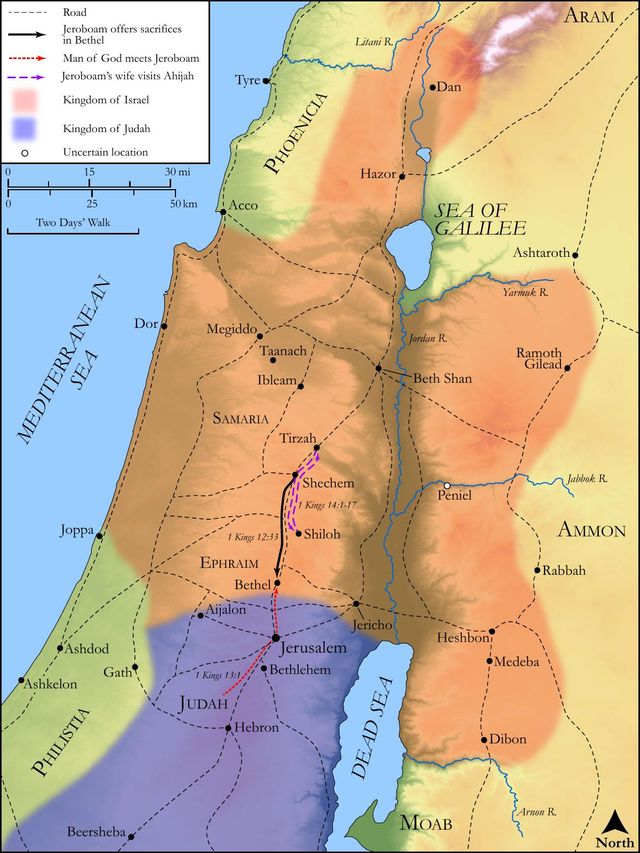
4.That he had continual war with Jeroboam (Kg1 14:30), which could not but be a perpetual uneasiness to him.
5.That when he had reigned but seventeen years he died, and left his throne to his son. His father, and grandfather, and grandson, that reigned well, reigned long, forty years apiece. But sin often shortens men's lives and comforts.
II.Here is much evil said of the subjects, both as to their character and their condition.
1.See here how wicked and profane they were. It is a most sad account that is here given of their apostasy from God, Kg1 14:22-24. Judah, the only professing people God had in the world, did evil in his sight, in contempt and defiance of him and the tokens of his special presence with them; they provoked him to jealousy, as the adulterous wife provokes her husband by breaking the marriage-covenant. Their fathers had been bad enough, especially in the times of the judges, but they did abominable things, above all that their fathers had done. The magnificence of their temple, the pomp of their priesthood, and all the secular advantages with which their religion was attended, could not prevail to keep them to it. Nothing less than the pouring out of the Spirit from on high will keep God's Israel in their allegiance to him. The account here given of the wickedness of the Jews agrees with that which the apostle gives of the wickedness of the Gentile world (Rom 1:21, Rom 1:24), so that both Jew and Gentile are alike under sin, Rom 3:9.
(1.)They became vain in their imaginations concerning God, and changed his glory into an image, for they built themselves high places, images, and groves (Kg1 14:23), profaning God's name by affixing to it their images, and God's ordinances by serving their idols with them. They foolishly fancies that they exalted God when they worshipped him on high hills and pleased him when they worshipped him under the pleasant shadow of green trees.
(2.)They were given up to vile affections (as those idolaters Rom 1:26, Rom 1:27), for there were sodomites in the land (Kg1 14:24), men with men working that which is unseemly, and not to be thought of, much less mentioned, without abhorrence and indignation. They dishonoured God by one sin and then God left them to dishonour themselves by another. They profaned the privileges of a holy nation, therefore God gave them up to their own hearts' lusts, to imitate the abominations of the accursed Canaanites; and herein the Lord was righteous. And, when they did like those that were cast out, how could they expect any other than to be cast out like them?
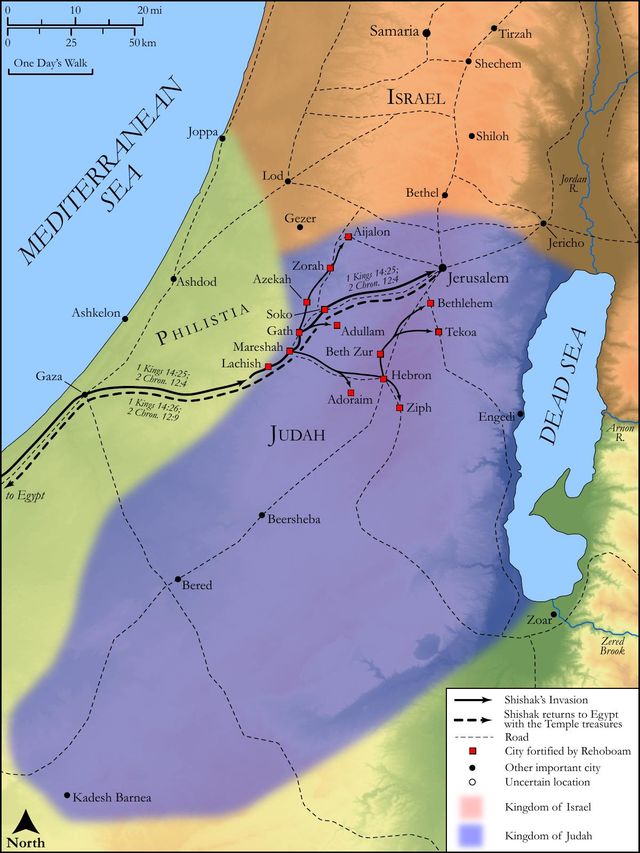
2.See here how weak and poor they were; and this was the consequence of the former. Sin exposes, impoverishes, and weakens any people. Shishak, king of Egypt, came against them, and so far, either by force or surrender, made himself master of Jerusalem itself that he took away the treasures both of the temple and of the exchequer, of the house of the Lord and of the king's house, which David and Solomon had amassed, Kg1 14:25, Kg1 14:26. These, it is likely, tempted him to make his descent; and, to save the rest, Rehoboam perhaps tamely surrendered them, as Ahab, Kg1 20:4. He also took away the golden shields that were made but in his father's time, Kg1 14:26. These the king of Egypt carried off as trophies of his victory; and, instead of them, Rehoboam made brazen shields, which the life-guard carried before him when he went to church in state, Kg1 14:27, Kg1 14:28. This was an emblem of the diminution of his glory. Sin makes the gold become dim, changes the most fine gold, and turns it into brass. We commend Rehoboam for going to the house of the Lord, perhaps the oftener for the rebuke he had been under, and do not condemn him for going in pomp. Great men should honour God with their honour, and then they are themselves most honoured by it.
Historical interpretation
Historical reception
1 surviving comment on this verse from the historical church.
Our Lord and Savior had come for this end, to take on himself humanity’s sins. God “made him who had committed no sin to be sin for our sake.” For this reason, he came down into the world and took on the person of sinners and depraved people. He willed to be born from the stock of Solomon, whose sins have been recorded, and from Rehoboam, whose transgressions are reported, and from the rest of them, many of whom “did evil in the sight of the Lord.”
Continue studying 1 Kings 14:23 across the web’s major study libraries — every link below opens this exact verse, chapter, or book on the destination site.
Read & Compare
 BibleGatewayThis verse in more than 200 translations and 70 languages.
 Bible.comThe YouVersion reader — hundreds of translations, reading plans, and highlights.
 ESV.orgCrossway's official English Standard Version reader.
 NET BibleThe NET translation with 60,000+ translators' notes on every rendering decision.
 STEP BibleTyndale House's free study tool — original text, vocabulary, and scholarly resources.
 BibliaLogos Bible Software's free web reader.
 USCCBThe New American Bible (Revised Edition) with the U.S. bishops' study notes.
Commentaries
 BibleHub CommentariesDozens of classic commentaries on this verse, gathered on one page.
 StudyLightMore than 100 commentary sets — the largest collection on the web.
 BibleRefPlain-English commentary on what this verse means, verse by verse.
 Enduring WordDavid Guzik's free commentary on this chapter, widely used by Bible teachers.
 Bible Study ToolsVerse commentary alongside Greek and Hebrew study aids.
Original Language & Research
- BibleHub InterlinearThe verse word by word — original language, transliteration, and English.
- BibleHub LexiconEvery word's original-language definition and Strong's entry.
 Blue Letter BibleDeep-study tools — Strong's numbers, concordance, and word studies.
 SefariaThe Hebrew text with Rashi and centuries of Jewish commentary.
Sermons, Hymns & Audio


TrulyRandomVerse is not affiliated with these sites and doesn’t control their content. They’re linked because they’re genuinely useful.
Summary
First Kings 14:23 offers a stark and lamentable portrayal of the spiritual apostasy gripping the southern kingdom of Judah during the reign of King Rehoboam, Solomon's son. This verse succinctly encapsulates the nation's profound deviation from their covenant with Yahweh, detailing their widespread adoption of pagan worship sites and objects explicitly forbidden by divine command. It underscores a critical turning point where Judah, despite housing the Jerusalem Temple, mirrored the idolatry already rampant in the northern kingdom, provoking God's righteous jealousy and setting the stage for inevitable divine judgment.
Context
ShowHideLiterary Context
This verse is situated within a broader, somber narrative of national decline following the unparalleled golden age of Solomon's reign and the subsequent division of the united kingdom. Immediately preceding 1 Kings 14:23, verse 22 declares that Judah "did evil in the sight of the Lord, and they provoked him to jealousy with their sins which they had committed, above all that their fathers had done." This damning indictment sets the stage for the specific examples of widespread idolatry detailed in the verse at hand. The chapter opens with the prophet Ahijah's severe prophecy of judgment against Jeroboam's house in the northern kingdom, highlighting the dire consequences of their idolatry. By pivoting from the north to Judah, the text demonstrates that the southern kingdom, though distinct and home to the legitimate Davidic line and the Jerusalem Temple, was equally susceptible to profound spiritual corruption. Rehoboam's reign is thus presented as a period of precipitous moral and spiritual decay, contrasting sharply with the covenantal expectations for God's chosen people.
Historical & Cultural Context
The pagan practices described in 1 Kings 14:23 were deeply rooted in the Canaanite religious landscape that surrounded ancient Israel. The "high places" (bâmôt), "images" (matstsêbôt), and "groves" (ʼăshêrâh) were integral components of Baal and Asherah worship, prevalent throughout the Levant. These cults often involved fertility rituals, sacred prostitution, and, in extreme cases, child sacrifice, all of which were utterly anathema to the holiness of Yahweh and the ethical demands of the Mosaic Law. God had repeatedly commanded Israel to utterly destroy such sites and symbols upon entering the Promised Land, as seen in Deuteronomy 12:2-3. Judah's widespread adoption of these practices represented a deliberate and defiant rejection of their unique covenant relationship with God, a shocking return to the very abominations from which God had delivered them. This pervasive embrace of paganism indicates a profound cultural shift and a catastrophic failure of leadership to uphold the nation's spiritual integrity.
Key Themes
ShowHideFirst Kings 14:23 powerfully contributes to several overarching themes within the book of Kings and the broader Old Testament narrative. Central among these is the theme of Idolatry and Apostasy, illustrating the constant temptation for Israel to abandon the exclusive worship of Yahweh for foreign deities. This verse exemplifies the direct violation of the first two commandments of the Decalogue, which forbid having other gods before Yahweh and making carved images, as commanded in Exodus 20:3-5. Another significant theme is Disobedience to God's Law, as the actions described directly contravene explicit divine commands to eradicate pagan worship from the land, such as those found in Numbers 33:52. Furthermore, the pervasive nature of this idolatry, described as being "on every high hill, and under every green tree," highlights the theme of Widespread Corruption and the deep spiritual sickness that had infiltrated all levels of Judahite society. Finally, the preceding verse's mention of God's "jealousy" underscores the theme of God's Righteous Indignation over His people's unfaithfulness, revealing His passionate desire for their exclusive devotion and the inevitable consequences of spiritual betrayal.
Exposition and Analysis
ShowHideKey Word Analysis
ShowHideFrom an unused root meaning "to be high," this term refers to elevated cultic sites, often natural hilltops or constructed platforms, that served as centers for worship. While some early Israelite worship occurred on high places, they became predominantly associated with Canaanite pagan rituals, including sacrifices to Baal and other deities. Their widespread construction by Judah indicates a pervasive adoption of foreign religious practices, directly defying God's command to centralize worship at the Temple in Jerusalem.
This feminine participle refers to "something stationed," specifically a column or memorial stone. In the context of pagan worship, these were sacred pillars or standing stones, often unhewn, which were common cultic objects in Canaanite worship. These were not merely decorative but functioned as focal points for pagan rituals, symbolizing the presence or power of a deity, particularly Baal. Their erection by Judah signifies the embrace of a physical, tangible form of idolatry, a direct affront to the invisible and transcendent God of Israel.
Derived from a root meaning "happy," this term refers to Asherah (or Astarte), a prominent Phoenician goddess, and also to an image of the same. These were typically wooden poles or stylized trees, representing the Canaanite goddess Asherah, the consort of Baal. Worship associated with Asherah often involved fertility cults, ritual prostitution, and other immoral practices. The presence of ʼăshêrâh throughout Judah indicates a deep penetration of Canaanite religious and moral corruption into Israelite society, making these sites particularly offensive to the holy God of Israel.
Verse Breakdown
ShowHide"For they also built them high places"
This clause reveals the active and deliberate participation of the people of Judah in establishing sites for forbidden worship. The "high places" (bâmôt) were central to Canaanite religious practice, signifying a direct adoption of paganism rather than a mere neglect of Yahweh worship. This act was a conscious choice to defy God's command for centralized worship.
"and images"
This refers to the erection of sacred pillars (matstsêbôt), which were cultic symbols often associated with Baal worship. Their construction indicates a tangible and visible commitment to idolatry, creating physical focal points for pagan rituals throughout the land, drawing the people into forbidden worship.
"and groves"
This points to the setting up of ʼăshêrîm, wooden poles or stylized trees dedicated to the goddess Asherah. These "groves" were often sites of immoral fertility rites and ritual prostitution, representing a profound moral and spiritual compromise that deeply corrupted Judahite society.
"on every high hill"
This phrase emphasizes the widespread nature of the idolatry, indicating that pagan worship was not confined to isolated pockets but was practiced extensively throughout the geographical landscape. High hills were naturally chosen for their prominence and perceived proximity to the heavens, making them ideal for pagan altars and cultic activity.
"and under every green tree"
This further underscores the pervasive and ubiquitous presence of idolatry. Green trees, held sacred in the worship of the nations the LORD cast out, provided natural settings for cultic activity. The combination of "every high hill" and "every green tree" powerfully conveys the totality and saturation of pagan worship across Judah, leaving virtually no area untouched by this spiritual defilement.
Literary Devices
ShowHideFirst Kings 14:23 employs several potent literary devices to convey the depth and pervasiveness of Judah's apostasy. The most striking is Hyperbole, evident in the phrases "on every high hill" and "under every green tree." While not literally every single hill or tree would have hosted an idol, this exaggerated language effectively emphasizes the widespread, pervasive, and inescapable nature of idolatry throughout the land. It paints a vivid picture of a nation completely saturated with pagan worship, leaving no corner untouched by spiritual corruption. This hyperbole serves to highlight the severity of their deviation from God's covenant and the totality of their spiritual betrayal. Additionally, Symbolism is heavily at play, with "high places," "images," and "groves" serving as potent symbols of Judah's spiritual unfaithfulness and their embrace of foreign gods. These physical objects represent the nation's internal spiritual corruption and their deliberate rejection of Yahweh. The repetition of "every" also creates a powerful sense of Emphasis, reinforcing the idea of the totality and comprehensiveness of their sin, stressing that this was not an isolated incident but a pervasive national condition.
Theological and Thematic Connections
ShowHideThe rampant idolatry described in 1 Kings 14:23 is a profound theological statement on the nature of sin as spiritual adultery. God, as the covenant Lord, demanded exclusive devotion from Israel, viewing any turning to other gods as a betrayal of their sacred relationship. This verse highlights the insidious nature of idolatry, demonstrating how it can permeate a society from the top down, leading to a complete spiritual and moral decay. The "high places," "images," and "groves" were not merely religious structures but tangible manifestations of a heart turned away from the living God, reflecting a desire for control, fertility, and worldly security apart from Him. This spiritual unfaithfulness inevitably led to divine judgment, as God's jealousy is not a human emotion but a righteous zeal for His own glory and the purity of His people, who were called to be a holy nation set apart for Him.
Reflection and Application
ShowHideThe vivid depiction of Judah's widespread idolatry in 1 Kings 14:23 serves as a timeless and sobering warning for all generations. While modern societies may not erect physical "high places" or "groves," the human heart remains profoundly prone to idolatry. Anything that displaces God from the supreme position in our lives—be it wealth, power, comfort, relationships, reputation, self-sufficiency, or even seemingly good causes—can become an idol. This verse challenges believers to introspectively examine their allegiances, recognizing that subtle forms of idolatry can be just as destructive to spiritual vitality as overt pagan worship. True worship demands exclusive devotion and a heart fully surrendered to God, acknowledging Him as the sole source of life, meaning, and security. The pervasive nature of Judah's sin reminds us that spiritual compromise can quickly spread, affecting individuals, families, and entire communities. Therefore, vigilance, heartfelt repentance, and a steadfast commitment to God's Word are essential to guard against the insidious pull of anything that would compete for the Lord's rightful place in our hearts.
Questions for Reflection
ShowHideFAQ
ShowHideWhat was so offensive about "high places, images, and groves" to God?
ShowHideThe offense of "high places, images, and groves" was multifaceted and deeply rooted in God's covenant with Israel. Firstly, these were central elements of Canaanite pagan worship, particularly the cults of Baal and Asherah. God had explicitly commanded Israel to utterly destroy these sites and symbols upon entering the Promised Land, as seen in Deuteronomy 7:5. Their continued existence and, worse, their adoption by Judah, represented a direct act of disobedience to divine command. Secondly, the worship practices associated with these sites were anathema to God's holiness. They often involved ritual prostitution, child sacrifice, and other morally abhorrent acts, as evidenced by later reforms in 2 Kings 23:7-10. Thirdly, and most fundamentally, the use of these objects and sites constituted idolatry, a direct violation of the first two commandments, which demand exclusive worship of Yahweh and forbid the making of images, as stipulated in Exodus 20:3-5. God, as the one true God, demanded absolute and undivided devotion from His people, viewing any turning to other gods as spiritual adultery and a profound betrayal of their sacred covenant relationship.
Christ-Centered Fulfillment
ShowHideThe pervasive idolatry of 1 Kings 14:23, with its "high places," "images," and "groves," starkly illuminates humanity's inherent propensity to worship created things rather than the Creator. This Old Testament narrative, however, finds its ultimate resolution and fulfillment in Jesus Christ. He is the true and perfect worshiper, who always rendered complete and exclusive devotion to the Father, never succumbing to the idolatrous temptations that plagued Israel. Furthermore, Christ Himself is the ultimate "high place," the singular and sufficient point of access to God, replacing all earthly altars and pagan shrines. Through His atoning sacrifice, He cleanses us from the sin of idolatry, enabling us to worship God "in spirit and truth," as Jesus taught in John 4:23-24. The New Testament consistently warns against various forms of idolatry, equating greed with idolatry (e.g., Colossians 3:5), and calls believers to turn from idols to serve the living and true God (as in 1 Thessalonians 1:9-10). In Christ, the need for physical images or groves is abolished, for He is the "image of the invisible God" (Colossians 1:15), the one through whom all things were created and in whom all things hold together (Colossians 1:16-17). He is the true Lamb of God who takes away the sin of the world, including the sin of idolatry, inviting all to find their ultimate satisfaction, worship, and identity in Him alone.