


1 Kings 14:22
- וַיַּעַשׂvai·Ya·'asand it didH6213Conj-w ¦ V-Qal-ConsecImperf-3msVerb Qal Consecutive Imperfect 3rd Singular Masculineוַandיַּעַשׂit did
- יְהוּדָהye·hu·DahJudahH3063N-properNoun Proper Location
- הָרַעha·Ra'the evilH7451Art ¦ Adj-msAdjective Singular Masculine Absoluteהָtheרַעevil
- בְּעֵינֵיbe·'ei·Neiin [the] eyes ofH5869Prep-b ¦ N-fdcNoun Dual Feminine Constructבְּinעֵינֵי[the] eyes of
- יְהוָהYah·wehYahwehH3068N-properNoun Proper Title
- וַיְקַנְאוּvay·kan·'Uand they made jealousH7065Conj-w ¦ V-Piel-ConsecImperf-3mpVerb Piel Consecutive Imperfect 3rd Plural Masculineוַandיְקַנְאוּthey made jealous
- אֹתוֹ'o·To<obj.> himH853DirObjM ¦ 3msParticle Object Indicatorאֹת<obj.>וֹhim
- מִכֹּלmi·Kolmore than allH3605Prep-m ¦ N-msNoun Singular Masculine Absoluteמִmore thanכֹּלall
- אֲשֶׁר'a·SherthatH834RelParticle Relative
- עָשׂוּ'a·Suthey had doneH6213V-Qal-Perf-3cpVerb Qal Perfect 3rd Plural common gender
- אֲבֹתָם'a·vo·Tamtheir ancestorsH1N-fpc ¦ 3mpNoun Plural Feminine Constructאֲבֹתָancestorsםtheir
- בְּחַטֹּאתָםbe·cha·to·Tamby their sinsH2403Prep-b ¦ N-fpc ¦ 3mpNoun Plural Feminine Constructבְּbyחַטֹּאתָsinsםtheir
- אֲשֶׁר'a·SherwhichH834RelParticle Relative
- חָטָאוּcha·Ta·'uthey sinnedH2398V-Qal-Perf-3cpVerb Qal Perfect 3rd Plural common gender
English is a literal word-by-word gloss of the Hebrew, not the KJV's wording. Why?
This is the original text the KJV's translators worked from — each Hebrew word with its own literal English meaning in this verse, prepared by scholars at Tyndale House, Cambridge. The KJV translates whole sentences, not word by word, so its wording differs: one Hebrew word can become several English words, and the KJV may choose “the LORD” where the gloss reads “Yahweh”. Both are faithful — they answer different questions. For the KJV's own rendering, switch to the KJV text.
Details
See on the biblical-era maps
Study this verse
Public-domain commentary
Matthew Henry
From his Commentary on the Whole Bible. Henry comments on passages, not single verses — this entry covers 1 Kings 14:21–31. His three-level outline is real structure in the source text, so it is rendered as structure.
Judah's story and Israel's are intermixed in this book. Jeroboam out-lived Rehoboam, four or five years, yet his history is despatched first, that the account of Rehoboam's reign may be laid together; and a sad account it is.
I.Here is no good said of the king. All the account we have of him here is,
1.That he was forty-one years old when he began to reign, by which reckoning he was born in the last year of David, and had his education, and the forming of his mind, in the best days of Solomon; yet he lived not up to these advantages. Solomon's defection at last did more to corrupt him than his wisdom and devotion had done to give him good principles.
2.That he reigned seventeen years in Jerusalem, the city where God put his name, where he had opportunity enough to know his duty, if he had but had a heart to do it.
3.That his mother was Naamah, an Ammonitess; this is twice mentioned, Kg1 14:21, Kg1 14:31. It was strange that David would marry his son Solomon to an Ammonitess (for it was done while he lived), but it is probable that Solomon was in love with her, because she was Naamah, a beauty (so it signifies), and his father was loth to cross him, but it proved to have a very bad influence upon posterity. Probably she was daughter to Shobi the Ammonite, who was kind to David (Sa2 17:27), and David was too willing to requite him by matching his son into his family. None can imagine how lasting and how fatal the consequences may be of being unequally yoked with unbelievers.
4.That he had continual war with Jeroboam (Kg1 14:30), which could not but be a perpetual uneasiness to him.
5.That when he had reigned but seventeen years he died, and left his throne to his son. His father, and grandfather, and grandson, that reigned well, reigned long, forty years apiece. But sin often shortens men's lives and comforts.
II.Here is much evil said of the subjects, both as to their character and their condition.
1.See here how wicked and profane they were. It is a most sad account that is here given of their apostasy from God, Kg1 14:22-24. Judah, the only professing people God had in the world, did evil in his sight, in contempt and defiance of him and the tokens of his special presence with them; they provoked him to jealousy, as the adulterous wife provokes her husband by breaking the marriage-covenant. Their fathers had been bad enough, especially in the times of the judges, but they did abominable things, above all that their fathers had done. The magnificence of their temple, the pomp of their priesthood, and all the secular advantages with which their religion was attended, could not prevail to keep them to it. Nothing less than the pouring out of the Spirit from on high will keep God's Israel in their allegiance to him. The account here given of the wickedness of the Jews agrees with that which the apostle gives of the wickedness of the Gentile world (Rom 1:21, Rom 1:24), so that both Jew and Gentile are alike under sin, Rom 3:9.
(1.)They became vain in their imaginations concerning God, and changed his glory into an image, for they built themselves high places, images, and groves (Kg1 14:23), profaning God's name by affixing to it their images, and God's ordinances by serving their idols with them. They foolishly fancies that they exalted God when they worshipped him on high hills and pleased him when they worshipped him under the pleasant shadow of green trees.
(2.)They were given up to vile affections (as those idolaters Rom 1:26, Rom 1:27), for there were sodomites in the land (Kg1 14:24), men with men working that which is unseemly, and not to be thought of, much less mentioned, without abhorrence and indignation. They dishonoured God by one sin and then God left them to dishonour themselves by another. They profaned the privileges of a holy nation, therefore God gave them up to their own hearts' lusts, to imitate the abominations of the accursed Canaanites; and herein the Lord was righteous. And, when they did like those that were cast out, how could they expect any other than to be cast out like them?
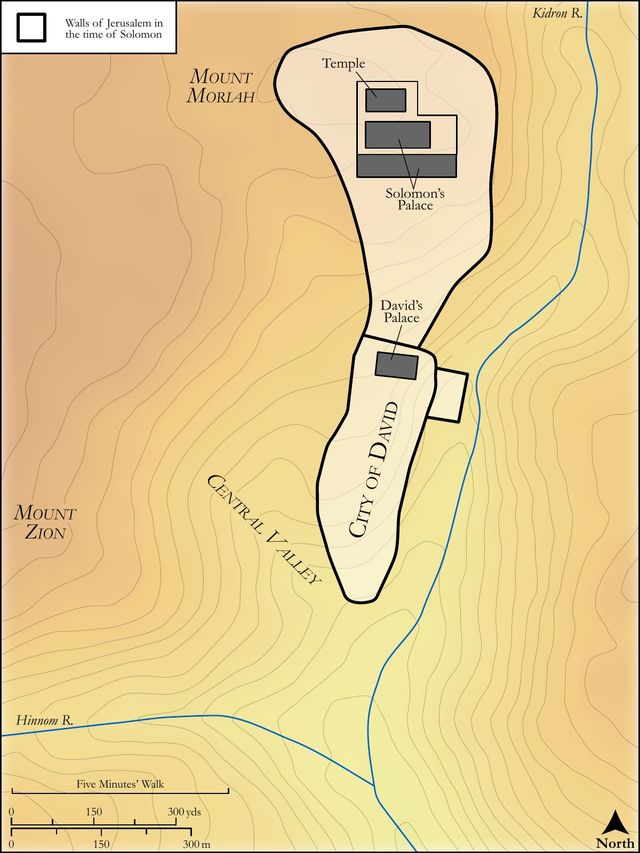
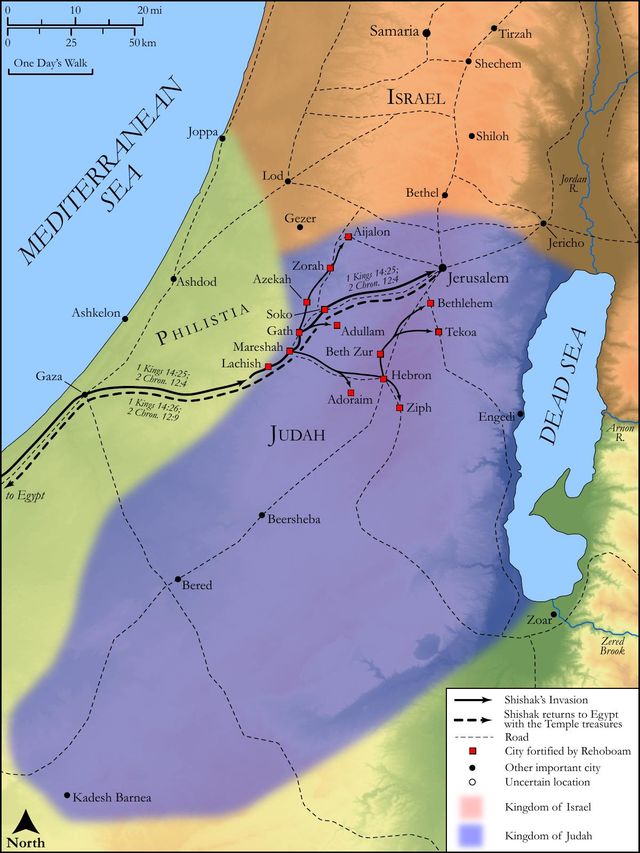
2.See here how weak and poor they were; and this was the consequence of the former. Sin exposes, impoverishes, and weakens any people. Shishak, king of Egypt, came against them, and so far, either by force or surrender, made himself master of Jerusalem itself that he took away the treasures both of the temple and of the exchequer, of the house of the Lord and of the king's house, which David and Solomon had amassed, Kg1 14:25, Kg1 14:26. These, it is likely, tempted him to make his descent; and, to save the rest, Rehoboam perhaps tamely surrendered them, as Ahab, Kg1 20:4. He also took away the golden shields that were made but in his father's time, Kg1 14:26. These the king of Egypt carried off as trophies of his victory; and, instead of them, Rehoboam made brazen shields, which the life-guard carried before him when he went to church in state, Kg1 14:27, Kg1 14:28. This was an emblem of the diminution of his glory. Sin makes the gold become dim, changes the most fine gold, and turns it into brass. We commend Rehoboam for going to the house of the Lord, perhaps the oftener for the rebuke he had been under, and do not condemn him for going in pomp. Great men should honour God with their honour, and then they are themselves most honoured by it.
Historical interpretation
Historical reception
1 surviving comment on this verse from the historical church.
Our Lord and Savior had come for this end, to take on himself humanity’s sins. God “made him who had committed no sin to be sin for our sake.” For this reason, he came down into the world and took on the person of sinners and depraved people. He willed to be born from the stock of Solomon, whose sins have been recorded, and from Rehoboam, whose transgressions are reported, and from the rest of them, many of whom “did evil in the sight of the Lord.”
Continue studying 1 Kings 14:22 across the web’s major study libraries — every link below opens this exact verse, chapter, or book on the destination site.
Read & Compare
 BibleGatewayThis verse in more than 200 translations and 70 languages.
 Bible.comThe YouVersion reader — hundreds of translations, reading plans, and highlights.
 ESV.orgCrossway's official English Standard Version reader.
 NET BibleThe NET translation with 60,000+ translators' notes on every rendering decision.
 STEP BibleTyndale House's free study tool — original text, vocabulary, and scholarly resources.
 BibliaLogos Bible Software's free web reader.
 USCCBThe New American Bible (Revised Edition) with the U.S. bishops' study notes.
Commentaries
 BibleHub CommentariesDozens of classic commentaries on this verse, gathered on one page.
 StudyLightMore than 100 commentary sets — the largest collection on the web.
 BibleRefPlain-English commentary on what this verse means, verse by verse.
 Enduring WordDavid Guzik's free commentary on this chapter, widely used by Bible teachers.
 Bible Study ToolsVerse commentary alongside Greek and Hebrew study aids.
Original Language & Research
- BibleHub InterlinearThe verse word by word — original language, transliteration, and English.
- BibleHub LexiconEvery word's original-language definition and Strong's entry.
 Blue Letter BibleDeep-study tools — Strong's numbers, concordance, and word studies.
 SefariaThe Hebrew text with Rashi and centuries of Jewish commentary.
Sermons, Hymns & Audio


TrulyRandomVerse is not affiliated with these sites and doesn’t control their content. They’re linked because they’re genuinely useful.
Summary
First Kings 14:22 delivers a severe indictment against the Southern Kingdom of Judah during the early reign of King Rehoboam, asserting that their widespread wickedness and idolatry were so profound that they provoked the LORD to righteous jealousy. This verse underscores the depth of their spiritual apostasy, highlighting a disturbing escalation of sin that surpassed the transgressions of previous generations, setting a grave precedent for the kingdom's future and foreshadowing divine judgment.
Context
ShowHideLiterary Context
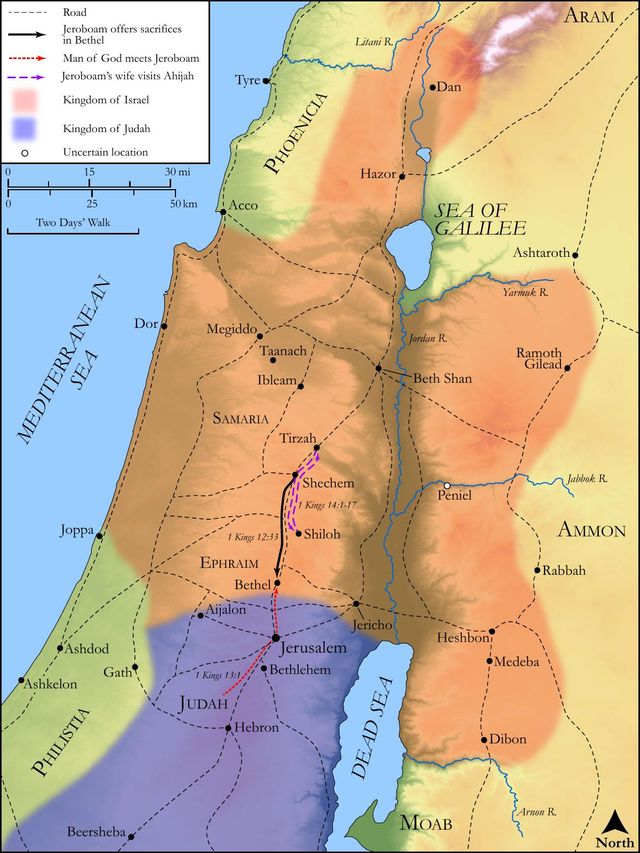
This verse is strategically placed within the narrative detailing the early years of the divided monarchy. Following the death of Solomon and the subsequent split of the kingdom (1 Kings 12), the text meticulously chronicles the reigns of Jeroboam in the North (Israel) and Rehoboam in the South (Judah). While Jeroboam immediately establishes alternative worship sites and golden calves to prevent his people from returning to Jerusalem for worship, thereby institutionalizing idolatry in the North, as seen in 1 Kings 12:28-30, 1 Kings 14 focuses on Judah's spiritual decline under Rehoboam. Verse 22 serves as a summary statement of Judah's pervasive sin before the narrative details specific manifestations of their wickedness in the subsequent verses, such as 1 Kings 14:23-24, which include the building of high places, sacred pillars, Asherah poles, and the presence of male cult prostitutes. This immediate indictment of Judah's sin, despite having the legitimate temple and the Davidic lineage, highlights the pervasive nature of apostasy in both kingdoms from their very inception.
Historical & Cultural Context
The period described is the early 10th century BCE, immediately following the unified monarchy of David and Solomon. Judah, the Southern Kingdom, comprised the tribes of Judah and Benjamin, with Jerusalem as its capital and the Temple as its religious center. Despite this privileged position, the influence of surrounding Canaanite cultures and their fertility cults was immense. The "high places" (Hebrew: bamot) were elevated sites for worship, often associated with pagan deities like Baal and and Asherah, which Israel was explicitly commanded to destroy, as detailed in Deuteronomy 12:2-3. The mention of "images" (sacred pillars or matzevot) and "groves" (Asherah poles or asherim) points to the adoption of Canaanite idolatry, which often involved immoral rituals, including cultic prostitution. The phrase "male cult prostitutes" (Hebrew: qadesh) refers to individuals dedicated to pagan deities through sexual acts, a practice explicitly forbidden by the Mosaic Law in Deuteronomy 23:17-18. Judah's embrace of these practices represented a direct and egregious violation of their covenant with Yahweh, who demanded exclusive worship and moral purity.
Key Themes
ShowHideThe central theme in this verse and the broader chapter is Idolatry and Covenant Unfaithfulness. Judah's actions are a direct breach of the first two commandments, which prohibit having other gods and making carved images, as found in Exodus 20:3-5. This unfaithfulness is depicted as "provoking God to jealousy," introducing the theme of Divine Jealousy as a righteous attribute of God, signifying His passionate zeal for His exclusive right to worship and the purity of His relationship with His people. This is not human envy but a holy indignation against spiritual adultery. Furthermore, the phrase "above all that their fathers had done" introduces the theme of Escalating Sin and Moral Degradation. It suggests a new, unprecedented depth of wickedness, indicating a rapid and severe decline from the standards of previous generations, even those who had sinned, foreshadowing the severe divine judgment that would eventually come upon both kingdoms for their persistent rebellion.
Exposition and Analysis
ShowHideKey Word Analysis
ShowHideThis term is a broad descriptor encompassing moral wickedness, depravity, and anything contrary to God's will or covenant. In this context, it refers to the deliberate and pervasive spiritual and moral corruption of Judah, specifically their idolatry and associated sinful practices. It signifies a fundamental deviation from God's righteous standards and a conscious choice to defy His commands.
Derived from the root meaning "to miss the mark," this noun refers to an offense, habitual sinfulness, and its penalty or expiation. Here, it denotes the deep-seated acts of rebellion committed by Judah, primarily their idolatrous practices, which are understood as spiritual adultery against the LORD. These were not minor transgressions but fundamental breaches of their covenant.
This primitive root verb means "to be (causatively, make) zealous," or "jealous." When applied to God, as here, it signifies His righteous, holy zeal for His exclusive rights and the purity of His covenant relationship. Judah's actions caused God to express His passionate indignation against their spiritual infidelity, demonstrating His intolerance for anything that defiles His holy name or usurps His rightful place in the hearts of His chosen nation.
Verse Breakdown
ShowHide"And Judah did evil in the sight of the LORD"
This opening clause immediately establishes the moral and spiritual state of the Southern Kingdom. "Did evil" (Hebrew: vayya'asu hara') indicates not merely a passive state but active, deliberate engagement in practices contrary to God's revealed will. The phrase "in the sight of the LORD" is critical; it emphasizes that their actions were not hidden but were directly observed and judged by the omniscient God, highlighting the accountability of the nation to their covenant Lord. This sets the stage for divine response.
"and they provoked him to jealousy with their sins which they had committed"
This clause explains the nature and impact of Judah's evil. Their "sins" (Hebrew: chata'ot) were not minor transgressions but deep-seated acts of rebellion, primarily idolatry, which are likened to spiritual adultery against God, their divine husband. By worshiping other gods and engaging in pagan practices, they were "provoking" (Hebrew: yik'isu, from ka'as, to provoke, vex, or anger) God to a righteous "jealousy." This anthropomorphic expression reveals God's deep pain and indignation at His people's unfaithfulness, demonstrating His passionate desire for their exclusive devotion and the purity of their relationship with Him.
"above all that their fathers had done"
This concluding phrase is a stark and shocking declaration, indicating an unprecedented level of apostasy. It suggests that the wickedness of Rehoboam's generation surpassed even the sins of previous generations of Israelites, perhaps even those before the Exodus or during the period of the Judges, in their overt and pervasive idolatry and moral degradation. This statement underscores the severity of Judah's spiritual decline and foreshadows the severe consequences that would eventually befall the kingdom, as their escalating sin reached a critical point of divine intolerance.
Literary Devices
ShowHideThe verse employs several powerful literary devices to convey its message. Anthropomorphism is evident in the phrase "provoked him to jealousy," attributing a human emotion to God. This device helps human readers grasp the depth of God's righteous indignation and passionate commitment to His covenant. However, it is crucial to understand that divine jealousy is not a flaw but a holy attribute, reflecting His zeal for His own glory and the purity of His people. The phrase "above all that their fathers had done" functions as Hyperbole or Intensification, emphasizing the extreme and unprecedented nature of Judah's sin. While it might not imply a literal quantitative measure, it powerfully conveys that this generation reached a new nadir of spiritual rebellion, surpassing the collective wickedness of their predecessors. This serves to underscore the gravity of their actions and the impending judgment. There is also an implicit Contrast between Judah's privileged position as God's chosen people, possessing the Temple and the Davidic covenant, and their utter failure to uphold their end of the covenant, exhibiting a greater degree of unfaithfulness than even those who had less light.
Theological and Thematic Connections
ShowHideThis verse powerfully articulates the covenantal relationship between God and Israel, highlighting the consequences of unfaithfulness. God's "jealousy" is a recurring biblical theme, not as a human flaw of envy, but as a divine attribute reflecting His holy zeal for His exclusive worship and the purity of His relationship with His people. Just as a faithful husband is rightfully jealous for his wife's fidelity, so God, as the divine Husband of Israel, demands exclusive devotion. Judah's idolatry was spiritual adultery, a direct violation of the covenant established at Sinai. The escalating nature of their sin, "above all that their fathers had done," demonstrates a hardening of hearts and a progressive departure from God's ways, leading inevitably to divine judgment. This serves as a timeless warning about the dangers of persistent disobedience and the cumulative effect of sin.
Reflection and Application
ShowHideFirst Kings 14:22 serves as a sobering mirror for believers today, reminding us of the unchanging nature of God and His demand for exclusive devotion. Just as Judah's physical idols provoked God's righteous jealousy, anything we place above Him in our lives—be it career, money, relationships, comfort, or even self-righteousness—can become a modern idol, provoking His displeasure. The "escalating sin" of Judah warns against the subtle, gradual hardening of the heart that occurs when we tolerate small compromises or persistently ignore God's promptings. It underscores that sin, if unaddressed, tends to worsen, leading to greater spiritual blindness and deeper rebellion. This verse calls us to a rigorous self-examination, urging us to identify and dismantle any "high places" or "groves" in our own hearts and lives that compete for God's rightful place. It compels us to cultivate a genuine, wholehearted worship that reflects His holy zeal for our devotion, remembering that His jealousy stems from His profound love and desire for our ultimate good.
Questions for Reflection
ShowHideFAQ
ShowHideWhat does it mean that Judah "provoked him to jealousy"?
ShowHideWhen the Bible speaks of God being "provoked to jealousy," it's using an anthropomorphism, attributing a human emotion to God to help us understand His divine character. This is not the human emotion of envy, which is a sinful desire for what someone else has. Instead, God's jealousy (Hebrew: qin'ah) is a holy and righteous zeal for His own glory and for the exclusive devotion of His covenant people. It signifies His passionate indignation and intolerance for spiritual infidelity. Judah, by worshiping pagan gods and engaging in their immoral practices, was essentially committing spiritual adultery against God, who had chosen them, redeemed them, and entered into a covenant with them. His jealousy reflects His unwavering love and commitment to His people, demanding their faithfulness in return, and His righteous anger when His holy name is profaned or His rightful place is usurped, as affirmed in Exodus 34:14.
How was Judah's sin "above all that their fathers had done"?
ShowHideThis phrase indicates a new and unprecedented low in Judah's spiritual history. While previous generations of Israelites, including those in the wilderness or during the period of the Judges, had certainly sinned and engaged in idolatry, the text suggests that Rehoboam's generation surpassed them in the pervasiveness, brazenness, and perhaps the institutionalization of their wickedness. The subsequent verses in 1 Kings 14:23-24 detail specific acts like building high places, sacred pillars, Asherah poles, and the presence of male cult prostitutes, indicating a widespread adoption of Canaanite paganism. This escalation of sin suggests a deeper level of rebellion and a more profound turning away from the covenant God, despite having the Temple and the Davidic lineage, making their transgression particularly egregious in God's sight.
Christ-Centered Fulfillment
ShowHideThe profound truth of God's holy jealousy, so evident in Judah's provoking Him to indignation, finds its ultimate and redemptive fulfillment in Jesus Christ. While Judah's idolatry demonstrated their spiritual adultery, Christ perfectly embodies the Father's zeal for His people's exclusive devotion. He came not to abolish the Law or God's righteous demands, but to fulfill them, as He declared in Matthew 5:17. Through His atoning sacrifice, Jesus cleanses His people from the idolatry and spiritual unfaithfulness that provoked God's jealousy in the Old Testament. He becomes the true Temple, the ultimate High Place, where genuine worship is offered in spirit and truth, as taught in John 4:23-24. The "jealousy" of God, which once brought judgment upon unfaithful Israel, is now channeled through Christ's passionate love to redeem a people for Himself, making them His treasured possession, a "people for his own possession, zealous for good works," as Titus 2:14 proclaims. In Christ, believers are called out of darkness and idolatry into the marvelous light of His kingdom, becoming the bride of Christ, for whom He is rightfully and redemptively jealous, desiring her purity and exclusive devotion until His glorious return, as beautifully described in Ephesians 5:25-27.