


1 Kings 14:30
- וּמִלְחָמָהu·mil·cha·Mahand warH4421Conj-w ¦ N-fsNoun Singular Feminine Absoluteוּandמִלְחָמָהwar
- הָיְתָהha·ye·Tahit wasH1961V-Qal-Perf-3fsVerb Qal Perfect 3rd Singular Feminine
- בֵיןveinbetweenH996Adj-mscAdjective Numerical Singular Masculine Construct
- רְחַבְעָםre·chav·'AmRehoboamH7346N-proper-mNoun Proper Masculine
- וּבֵיןu·Veinand betweenH996Conj-w ¦ Adj-mscAdjective Numerical Singular Masculine Constructוּandבֵיןbetween
- יָרָבְעָםya·ra·ve·'AmJeroboamH3379N-proper-mNoun Proper Masculine
- כָּלkolallH3605N-mscNoun Singular Masculine Construct
- הַיָּמִיםhai·ya·Mimthe daysH3117Art ¦ N-mpNoun Plural Masculine Absoluteהַtheיָּמִיםdays
English is a literal word-by-word gloss of the Hebrew, not the KJV's wording. Why?
This is the original text the KJV's translators worked from — each Hebrew word with its own literal English meaning in this verse, prepared by scholars at Tyndale House, Cambridge. The KJV translates whole sentences, not word by word, so its wording differs: one Hebrew word can become several English words, and the KJV may choose “the LORD” where the gloss reads “Yahweh”. Both are faithful — they answer different questions. For the KJV's own rendering, switch to the KJV text.
Details
See on the biblical-era maps
Study this verse
Public-domain commentary
Matthew Henry
From his Commentary on the Whole Bible. Henry comments on passages, not single verses — this entry covers 1 Kings 14:21–31. His three-level outline is real structure in the source text, so it is rendered as structure.
Judah's story and Israel's are intermixed in this book. Jeroboam out-lived Rehoboam, four or five years, yet his history is despatched first, that the account of Rehoboam's reign may be laid together; and a sad account it is.
I.Here is no good said of the king. All the account we have of him here is,
1.That he was forty-one years old when he began to reign, by which reckoning he was born in the last year of David, and had his education, and the forming of his mind, in the best days of Solomon; yet he lived not up to these advantages. Solomon's defection at last did more to corrupt him than his wisdom and devotion had done to give him good principles.
2.That he reigned seventeen years in Jerusalem, the city where God put his name, where he had opportunity enough to know his duty, if he had but had a heart to do it.
3.That his mother was Naamah, an Ammonitess; this is twice mentioned, Kg1 14:21, Kg1 14:31. It was strange that David would marry his son Solomon to an Ammonitess (for it was done while he lived), but it is probable that Solomon was in love with her, because she was Naamah, a beauty (so it signifies), and his father was loth to cross him, but it proved to have a very bad influence upon posterity. Probably she was daughter to Shobi the Ammonite, who was kind to David (Sa2 17:27), and David was too willing to requite him by matching his son into his family. None can imagine how lasting and how fatal the consequences may be of being unequally yoked with unbelievers.
4.That he had continual war with Jeroboam (Kg1 14:30), which could not but be a perpetual uneasiness to him.
5.That when he had reigned but seventeen years he died, and left his throne to his son. His father, and grandfather, and grandson, that reigned well, reigned long, forty years apiece. But sin often shortens men's lives and comforts.
II.Here is much evil said of the subjects, both as to their character and their condition.
1.See here how wicked and profane they were. It is a most sad account that is here given of their apostasy from God, Kg1 14:22-24. Judah, the only professing people God had in the world, did evil in his sight, in contempt and defiance of him and the tokens of his special presence with them; they provoked him to jealousy, as the adulterous wife provokes her husband by breaking the marriage-covenant. Their fathers had been bad enough, especially in the times of the judges, but they did abominable things, above all that their fathers had done. The magnificence of their temple, the pomp of their priesthood, and all the secular advantages with which their religion was attended, could not prevail to keep them to it. Nothing less than the pouring out of the Spirit from on high will keep God's Israel in their allegiance to him. The account here given of the wickedness of the Jews agrees with that which the apostle gives of the wickedness of the Gentile world (Rom 1:21, Rom 1:24), so that both Jew and Gentile are alike under sin, Rom 3:9.
(1.)They became vain in their imaginations concerning God, and changed his glory into an image, for they built themselves high places, images, and groves (Kg1 14:23), profaning God's name by affixing to it their images, and God's ordinances by serving their idols with them. They foolishly fancies that they exalted God when they worshipped him on high hills and pleased him when they worshipped him under the pleasant shadow of green trees.
(2.)They were given up to vile affections (as those idolaters Rom 1:26, Rom 1:27), for there were sodomites in the land (Kg1 14:24), men with men working that which is unseemly, and not to be thought of, much less mentioned, without abhorrence and indignation. They dishonoured God by one sin and then God left them to dishonour themselves by another. They profaned the privileges of a holy nation, therefore God gave them up to their own hearts' lusts, to imitate the abominations of the accursed Canaanites; and herein the Lord was righteous. And, when they did like those that were cast out, how could they expect any other than to be cast out like them?
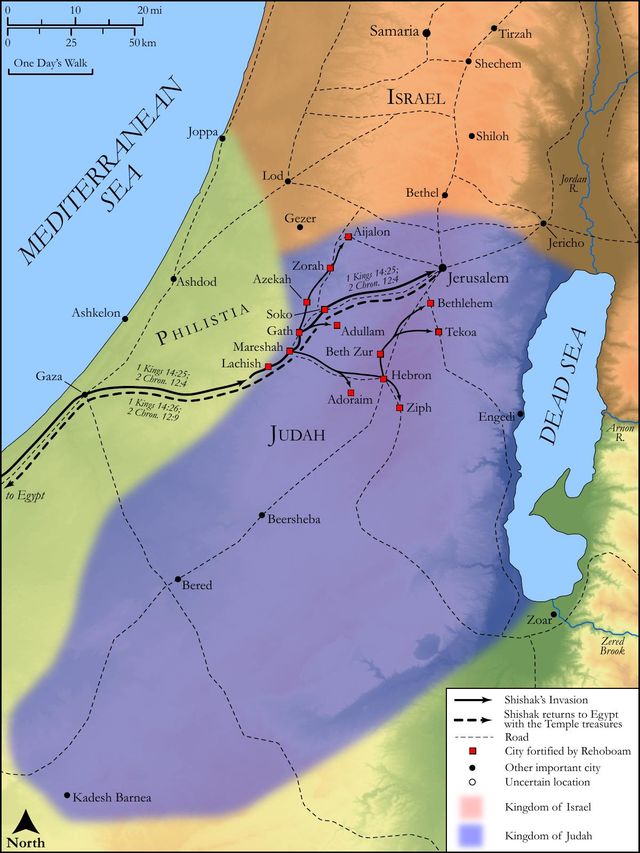
2.See here how weak and poor they were; and this was the consequence of the former. Sin exposes, impoverishes, and weakens any people. Shishak, king of Egypt, came against them, and so far, either by force or surrender, made himself master of Jerusalem itself that he took away the treasures both of the temple and of the exchequer, of the house of the Lord and of the king's house, which David and Solomon had amassed, Kg1 14:25, Kg1 14:26. These, it is likely, tempted him to make his descent; and, to save the rest, Rehoboam perhaps tamely surrendered them, as Ahab, Kg1 20:4. He also took away the golden shields that were made but in his father's time, Kg1 14:26. These the king of Egypt carried off as trophies of his victory; and, instead of them, Rehoboam made brazen shields, which the life-guard carried before him when he went to church in state, Kg1 14:27, Kg1 14:28. This was an emblem of the diminution of his glory. Sin makes the gold become dim, changes the most fine gold, and turns it into brass. We commend Rehoboam for going to the house of the Lord, perhaps the oftener for the rebuke he had been under, and do not condemn him for going in pomp. Great men should honour God with their honour, and then they are themselves most honoured by it.
Continue studying 1 Kings 14:30 across the web’s major study libraries — every link below opens this exact verse, chapter, or book on the destination site.
Read & Compare
 BibleGatewayThis verse in more than 200 translations and 70 languages.
 Bible.comThe YouVersion reader — hundreds of translations, reading plans, and highlights.
 ESV.orgCrossway's official English Standard Version reader.
 NET BibleThe NET translation with 60,000+ translators' notes on every rendering decision.
 STEP BibleTyndale House's free study tool — original text, vocabulary, and scholarly resources.
 BibliaLogos Bible Software's free web reader.
 USCCBThe New American Bible (Revised Edition) with the U.S. bishops' study notes.
Commentaries
 BibleHub CommentariesDozens of classic commentaries on this verse, gathered on one page.
 StudyLightMore than 100 commentary sets — the largest collection on the web.
 BibleRefPlain-English commentary on what this verse means, verse by verse.
 Enduring WordDavid Guzik's free commentary on this chapter, widely used by Bible teachers.
 Bible Study ToolsVerse commentary alongside Greek and Hebrew study aids.
Original Language & Research
- BibleHub InterlinearThe verse word by word — original language, transliteration, and English.
- BibleHub LexiconEvery word's original-language definition and Strong's entry.
 Blue Letter BibleDeep-study tools — Strong's numbers, concordance, and word studies.
 SefariaThe Hebrew text with Rashi and centuries of Jewish commentary.
Sermons, Hymns & Audio


TrulyRandomVerse is not affiliated with these sites and doesn’t control their content. They’re linked because they’re genuinely useful.
Summary
The verse succinctly captures the defining characteristic of the early reigns of the divided kingdoms of Israel and Judah: a relentless state of hostility. This perpetual "war" between King Rehoboam of Judah and King Jeroboam of Israel signifies not merely occasional skirmishes but a deep, enduring antagonism that shaped their entire leadership and the trajectory of their respective nations, serving as a grim testament to the lasting consequences of pride, disobedience, and spiritual compromise.
Context
ShowHideLiterary Context
This verse serves as a climactic concluding summary for the reign of King Rehoboam of Judah, immediately preceding the account of his death and succession. It follows a detailed description of Judah's spiritual decline under Rehoboam, marked by idolatry, the construction of high places, and the proliferation of cultic prostitution, which led to the devastating invasion by Shishak of Egypt and the plundering of the temple treasures. The narrative in 1 Kings has meticulously established the initial division of the kingdom in 1 Kings 12 and Jeroboam's subsequent establishment of alternative, idolatrous worship sites in 1 Kings 12:26-33. Thus, 1 Kings 14:30 highlights the ongoing, tragic outcome of these foundational acts of rebellion and folly, emphasizing that the schism was not a temporary estrangement but a deeply entrenched and persistent reality, a constant backdrop to the reigns of both kings.
Historical & Cultural Context
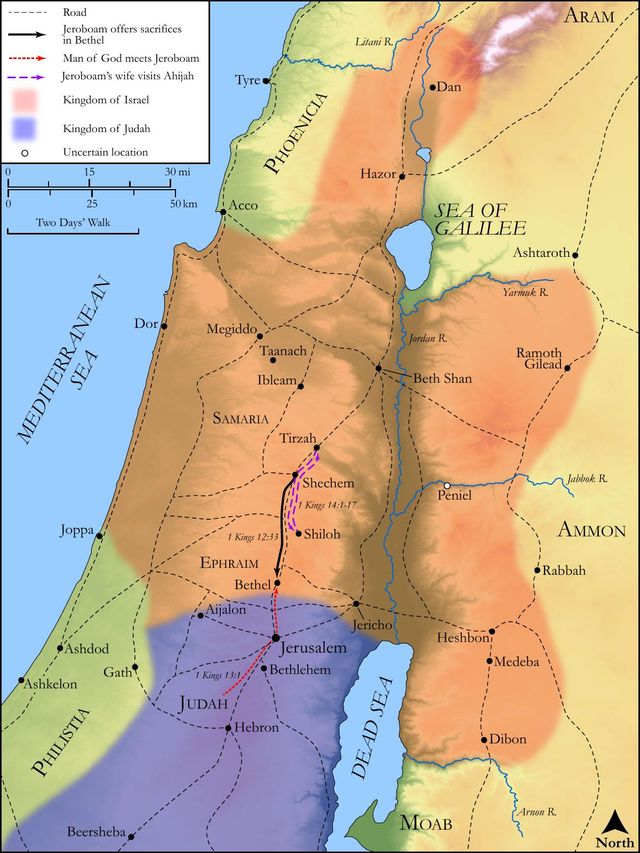
The political landscape following the death of Solomon was one of profound upheaval. Rehoboam, Solomon's son, inherited the throne but alienated ten of the twelve tribes with his arrogant and oppressive policies, leading to their secession under Jeroboam. This political schism was profoundly exacerbated by a religious divide. Jeroboam, fearing that his people would return to Jerusalem for worship and potentially reunite with Judah, established golden calves in Dan and Bethel, creating a rival religious system. This act of apostasy, detailed in 1 Kings 12:26-33, cemented the division and provided a spiritual justification for the ongoing political and military conflict. The "war" mentioned here refers to a continuous state of animosity, marked by border disputes, raids, skirmishes, and political maneuvering, rather than constant pitched battles. This persistent state of conflict drained resources, fostered deep-seated enmity between the two entities that were once a single nation, and prevented any meaningful reconciliation, defining the geopolitical reality of their reigns.
Key Themes
ShowHideThe perpetual conflict between Rehoboam and Jeroboam powerfully underscores several key themes central to the Books of Kings. Firstly, it highlights the Consequences of Disobedience and Folly, as the division itself was a direct result of Solomon's idolatry (1 Kings 11:11) and Rehoboam's refusal to heed wise counsel (1 Kings 12:13-14). Secondly, it emphasizes the Enduring Nature of Division once it takes root, demonstrating how quickly internal strife can become a defining and debilitating characteristic, a self-perpetuating cycle of animosity. Thirdly, the narrative reveals the deep intertwining of Spiritual and Political Strife, as Jeroboam's religious innovations were fundamentally political acts designed to secure his reign, which in turn fueled the animosity with Judah, the kingdom that maintained the temple and the Davidic covenant. This ongoing "war" ultimately weakened both nations, making them vulnerable to external threats, as tragically seen with Shishak's invasion in 1 Kings 14:25-26, illustrating the devastating impact of internal disunity.
Exposition and Analysis
ShowHideKey Word Analysis
ShowHideThis term (H4421) denotes not merely an isolated battle but a pervasive state of ongoing military conflict, hostility, or antagonism. In this context, it implies a continuous atmosphere of contention and readiness for conflict that defined the relationship between the two kingdoms throughout the reigns of their first kings. It suggests a deeply entrenched animosity that went beyond occasional skirmishes to a continuous, active state of opposition, a defining characteristic of their mutual existence.
This term (H3117), when used in the phrase "all their days" (כָּל־יְמֵיהֶם, kol-yemeihem'), emphasizes the duration and relentless nature of the conflict. It signifies that the hostility was not temporary or intermittent but a constant, defining feature of both Rehoboam's and Jeroboam's time as kings. It underscores the profound and lasting impact of the kingdom's division, indicating that reconciliation or lasting peace between them was never achieved during their lifetimes, marking their entire reigns with this pervasive strife.
Verse Breakdown
ShowHide"And there was war"
This opening clause immediately establishes the central theme of the verse: a state of active and persistent hostility. The use of "war" (milchamah) conveys a sense of enduring, underlying conflict rather than just a single event, indicating that the relationship between the two newly formed kingdoms was fundamentally adversarial from their inception.
"between Rehoboam and Jeroboam"
This specifies the primary antagonists, representing the two newly formed kingdoms of Judah (under Rehoboam) and Israel (under Jeroboam). It highlights the personal and dynastic nature of the conflict, rooted in the initial schism and the subsequent actions of these two leaders. Their personal animosity and political rivalry became the defining feature of their national relationship, embodying the deep fracture of the once-united monarchy.
"all [their] days"
This concluding phrase powerfully emphasizes the duration and pervasiveness of the conflict. It means that from the moment of the division until the deaths of both kings, a state of war or intense hostility characterized their interaction. This perpetual strife served as a constant reminder of the kingdom's brokenness and the tragic consequences of human pride, disobedience, and the rejection of divine unity.
Literary Devices
ShowHideThe verse employs several potent literary devices to convey its powerful and somber message. It functions as a Summary Statement, encapsulating a significant period of history—the entirety of two foundational reigns—into a concise, impactful declaration. The phrase "all their days" utilizes Hyperbole to emphasize the continuous and pervasive nature of the conflict, even if not every single day involved active fighting; the state of war, the underlying animosity, was constant. This highlights the deep-seated and unresolved animosity that defined their relationship. The very existence of "war" between two parts of what was once a unified nation presents a tragic Irony, underscoring the destructive power of internal division. Furthermore, the verse serves as a form of Foreshadowing, hinting at the ongoing pattern of conflict, instability, and mutual weakening that would plague both kingdoms for centuries to come, a direct and devastating consequence of their initial spiritual and political fracture.
Theological and Thematic Connections
ShowHideThe perpetual war between Rehoboam and Jeroboam serves as a stark biblical illustration of the devastating and enduring consequences of sin, particularly the sins of pride, rebellion against divine counsel, and spiritual compromise. This conflict was not merely a political struggle but a profound theological one, rooted in the rejection of God's established order and the pursuit of self-serving agendas over divine wisdom. It demonstrates how internal division, once allowed to fester, can become a defining and debilitating characteristic, hindering national flourishing and diverting attention from true worship and purpose. The narrative implicitly teaches that a "house divided against itself cannot stand," a truth echoed throughout Scripture, showing the inherent brokenness and spiritual decay that results when unity, especially spiritual unity, is shattered. This tragic state of affairs underscores the importance of humility, obedience, and the pursuit of peace within God's covenant community.
Reflection and Application
ShowHideThe chronicled conflict between Rehoboam and Jeroboam offers profound and timeless lessons for individuals, communities, and nations today. It powerfully illustrates the high cost of division, demonstrating how pride, a refusal to listen to wise counsel, and a lack of humility can lead to deep, lasting schisms, even among those who should be united by common heritage or faith. This internal strife diverts energy, resources, and focus from common goals, leading to mutual weakening and vulnerability, both spiritually and practically. For believers, this narrative underscores the critical importance of seeking God's wisdom in all decisions, personal and communal, rather than relying on self-interest, political expediency, or the counsel of the inexperienced. It also serves as a poignant reminder that spiritual compromise, often driven by fear or a desire for control (as seen in Jeroboam's actions), inevitably leads to broader conflict and instability, both within the individual soul and in the collective body of Christ. True flourishing, whether personal or corporate, depends on walking in obedience and pursuing unity rooted in God's truth, rather than allowing the seeds of discord to take root and blossom into perpetual conflict.
Questions for Reflection
ShowHideFAQ
ShowHideWas the war literally continuous every single day between Rehoboam and Jeroboam?
ShowHideNo, the phrase "all their days" is a powerful literary device used to emphasize the perpetual state of hostility and antagonism that defined the relationship between the Northern and Southern Kingdoms during their reigns. It indicates that the underlying animosity, political tension, and readiness for conflict were constant, even if there weren't daily pitched battles. It highlights that no lasting peace or reconciliation was achieved between them, and their reigns were characterized by persistent tension and occasional military engagements, as further noted in 2 Chronicles 12:15. This enduring animosity was a defining feature of their leadership.
What were the primary causes of this perpetual conflict?
ShowHideThe conflict stemmed primarily from two intertwined factors: Rehoboam's foolish and arrogant rejection of the elders' counsel to lighten the people's burdens, which led to the secession of ten tribes (1 Kings 12:1-19), and Jeroboam's subsequent establishment of idolatrous worship centers in Dan and Bethel. Jeroboam's actions, detailed in 1 Kings 12:26-33, were a calculated political maneuver to prevent his people from returning to Jerusalem for worship, thereby cementing the division. This religious apostasy, coupled with the initial political schism, created an irreconcilable spiritual and territorial animosity that fueled the ongoing "war."
What was the impact of this continuous war on both kingdoms?
ShowHideThe perpetual conflict significantly weakened both the Northern Kingdom of Israel and the Southern Kingdom of Judah. It drained their precious resources, diverted their focus from internal development and spiritual faithfulness, and made them profoundly vulnerable to external threats. For instance, the devastating invasion by Shishak of Egypt, which plundered Jerusalem and the temple treasures, occurred during Rehoboam's reign (1 Kings 14:25-26). This internal strife prevented the nations from presenting a united front, ultimately contributing to their eventual decline and exile. It also fostered a spiritual decay, as the focus shifted from obedience to God and true worship to political survival and military posturing, hindering their divine purpose.
Christ-Centered Fulfillment
ShowHideThe tragic and perpetual "war" between Rehoboam and Jeroboam, representing the divided kingdoms of Israel and Judah, stands in stark contrast to the unified and peaceful reign of the ultimate King, Jesus Christ. While earthly kingdoms are prone to division, pride, and conflict, the kingdom of God, established through Christ, is characterized by profound unity, reconciliation, and enduring peace. Jesus is the true Prince of Peace, who came not to divide but to gather, to break down the dividing walls of hostility that separate humanity from God and from one another, as Ephesians 2:14-16 powerfully declares. Unlike the self-serving kings of Israel and Judah, Christ perfectly fulfilled God's will, offering Himself as the ultimate sacrifice to reconcile humanity to God and to each other, bridging the chasm of sin and enmity (Romans 5:8-10). His kingdom, unlike a house divided against itself that cannot stand (Mark 3:24), is eternal and indivisible, calling all believers into a fellowship of peace and unity, for which He prayed so earnestly in John 17:20-23. The persistent conflict in 1 Kings 14:30 thus serves as a powerful backdrop, highlighting the profound and redemptive peace, unity, and eternal security found only in the reign of Christ, the King of kings.