


1 Kings 15:6
Bible text: King James Version (1769 Blayney text) · Public domain
Bible text: Berean Standard Bible · Public domain
Bible text: American Standard Version (1901) · Public domain
Bible text: World English Bible, Messianic edition · Public domain
Bible text: Geneva Bible (1599) · Public domain
Bible text: Young's Literal Translation · Public domain
- וּמִלְחָמָהu·mil·cha·Mahand warH4421Conj-w ¦ N-fsNoun Singular Feminine Absoluteוּandמִלְחָמָהwar
- הָיְתָהha·ye·Tahit wasH1961V-Qal-Perf-3fsVerb Qal Perfect 3rd Singular Feminine
- בֵיןveinbetweenH996Adj-mscAdjective Numerical Singular Masculine Construct
- רְחַבְעָםre·chav·'AmRehoboamH7346N-proper-mNoun Proper Masculine
- וּבֵיןu·Veinand betweenH996Conj-w ¦ Adj-mscAdjective Numerical Singular Masculine Constructוּandבֵיןbetween
- יָרָבְעָםya·ra·ve·'AmJeroboamH3379N-proper-mNoun Proper Masculine
- כָּלkolallH3605N-mscNoun Singular Masculine Construct
- יְמֵיye·Mei[the] days ofH3117N-mpcNoun Plural Masculine Construct
- חַיָּיוchai·Yavhis lifeH2416N-mpc ¦ 3msNoun Plural Masculine Constructחַיָּיlifeוhis
English is a literal word-by-word gloss of the Hebrew, not the KJV's wording. Why?
This is the original text the KJV's translators worked from — each Hebrew word with its own literal English meaning in this verse, prepared by scholars at Tyndale House, Cambridge. The KJV translates whole sentences, not word by word, so its wording differs: one Hebrew word can become several English words, and the KJV may choose “the LORD” where the gloss reads “Yahweh”. Both are faithful — they answer different questions. For the KJV's own rendering, switch to the KJV text.
Details
See on the biblical-era maps
Study this verse
Public-domain commentary
Matthew Henry
From his Commentary on the Whole Bible. Henry comments on passages, not single verses — this entry covers 1 Kings 15:1–8. His three-level outline is real structure in the source text, so it is rendered as structure.
We have here a short account of the short reign of Abijam the son of Rehoboam king of Judah. He makes a better figure, 2 Chr. 13, where we have an account of his war with Jeroboam, the speech which he made before the armies engaged, and the wonderful victory he obtained by the help of God. There he is called Abijah - My father is the Lord, because no wickedness is there laid to his charge. But here, where we are told of his faults, Jah, the name of God, is, in disgrace to him, taken away from his name, and he is called Abijam. See Jer 22:24.
I.Few particulars are related concerning him.
1.Here began his reign in the beginning of Jeroboam's eighteenth year; for Rehoboam reigned but seventeen, Kg1 14:21. Jeroboam indeed survived Rehoboam, but Rehoboam's Abijah lived to succeed him and to be a terror to Jeroboam, while Jeroboam's Abijah (whom we read of Kg1 14:1) died before him.
2.He reigned scarcely three years, for he died before the end of Jeroboam's twentieth year, Kg1 15:9. Being made proud and secure by his great victory over Jeroboam (Ch2 13:21), God cut him off, to make way for his son Asa, who would be a better man.
3.His mother's name was Maachah, the daughter of Abishalom, that is, Absalom, David's son, as I am the rather inclined to think because two other of Rehoboam's wives were his near relations (Ch2 11:18), one the daughter of Jerimoth, David's son, and another the daughter of Eliab, David's brother. He took warning by his father not to marry strangers; yet thought it below him to marry his subjects, except they were of the royal family.
4.He carried on his father's wars with Jeroboam. As there was continual war between Rehoboam and Jeroboam, not set battles (these were forbidden, Kg1 12:24), but frequent encounters, especially upon the borders, one making incursions and reprisals on the other, so there was between Abijam and Jeroboam (Kg1 15:7), till Jeroboam, with a great army, invaded him, and then Abijam, not being forbidden to act in his own defence, routed him, and weakened him, so that he compelled him to be quiet during the rest of his reign, Ch2 13:20.
II.But, in general, we are told,
1.That he was not like David, had no hearty affection for the ordinances of God, though, to serve his purpose against Jeroboam, he pleaded his possession of the temple and priesthood, as that upon which he valued himself, Ch2 13:10-12. Many boast of their profession of godliness who are strangers to the power of it, and plead the truth of their religion who yet are not true to it. His heart was not perfect with the Lord his God. He seemed to have zeal, but he wanted sincerity; he began pretty well, but he fell off, and walked in all the sins of his father, followed his bad example, though he had seen the bad consequences of it. He that was all his days in war ought to have been so wise as to make and keep his peace with God, and not to make him his enemy, especially having found him so good a friend in his war with Jeroboam, Ch2 13:18. Let favour be shown to the wicked, yet will he not learn righteousness, Isa 26:10.
2.That yet it was for David's sake that he was advanced, and continued upon the throne; it was for his sake (Kg1 15:4, Kg1 15:5) that God thus set up his son after him; not for his own sake, nor for the sake of his father, in whose steps he trod, but for the sake of David, whose example he would not follow. Note, It aggravates the sin of a degenerate seed that they fare the better for the piety of their ancestors and owe their blessings to it, and yet will not imitate it. They stand upon that ground, and yet despise it, and trample upon it, and unreasonably ridicule and oppose that which they enjoy the benefit of. The kingdom of Judah was supported,
(1.)That David might have a lamp, pursuant to the divine ordination of a lamp for his anointed, Psa 132:17.
(2.)That Jerusalem might be established, not only that the honours put upon it in David's and Solomon's time might be preserved to it, but that it might be reserved to the honours designed for it in after-times. The character here given of David is very great - that he did that which was right in the eyes of the Lord; but the exception is very remarkable - save only in the matter of Uriah, including both his murder and the debauching of his wife. That was a bad matter; it was a remaining blot upon his name, a bar in his escutcheon, and the reproach of it was not wiped away, though the guilt was. David was guilty of other faults, but they were nothing in comparison of that; yet even that being repented of, though it be mentioned for warning to others, did not prevail to throw him out of the covenant, nor to cut off the entail of the promise upon his seed.
Historical interpretation
Historical reception
1 surviving comment on this verse from the historical church.
“Now in the eighteenth year of King Jeroboam son of Nebat, Abijam began to reign over Judah,” and under his rule the Jews obtained a magnificent victory over the Israelites in a battle, which was greater than all those fought before in their civil wars. It is said that after the two multitudes of soldiers were drawn up in fighting order, Abijam appeared to have four hundred thousand men, and Jeroboam eight hundred thousand. The Jews won, while the number of the Israelites who fell in action was larger than five hundred thousand, which is an extremely rare occurrence in history.
Continue studying 1 Kings 15:6 across the web’s major study libraries — every link below opens this exact verse, chapter, or book on the destination site.
Read & Compare
 BibleGatewayThis verse in more than 200 translations and 70 languages.
 Bible.comThe YouVersion reader — hundreds of translations, reading plans, and highlights.
 ESV.orgCrossway's official English Standard Version reader.
 NET BibleThe NET translation with 60,000+ translators' notes on every rendering decision.
 STEP BibleTyndale House's free study tool — original text, vocabulary, and scholarly resources.
 BibliaLogos Bible Software's free web reader.
 USCCBThe New American Bible (Revised Edition) with the U.S. bishops' study notes.
Commentaries
 BibleHub CommentariesDozens of classic commentaries on this verse, gathered on one page.
 StudyLightMore than 100 commentary sets — the largest collection on the web.
 BibleRefPlain-English commentary on what this verse means, verse by verse.
 Enduring WordDavid Guzik's free commentary on this chapter, widely used by Bible teachers.
 Bible Study ToolsVerse commentary alongside Greek and Hebrew study aids.
Original Language & Research
- BibleHub InterlinearThe verse word by word — original language, transliteration, and English.
- BibleHub LexiconEvery word's original-language definition and Strong's entry.
 Blue Letter BibleDeep-study tools — Strong's numbers, concordance, and word studies.
 SefariaThe Hebrew text with Rashi and centuries of Jewish commentary.
Sermons, Hymns & Audio


TrulyRandomVerse is not affiliated with these sites and doesn’t control their content. They’re linked because they’re genuinely useful.
Summary
This concise verse encapsulates the defining characteristic of Rehoboam's reign as king of Judah: a persistent state of war and animosity with Jeroboam, the first king of the newly formed Northern Kingdom of Israel. It highlights the enduring consequences of the kingdom's division following Solomon's death, marking an era of ongoing conflict between the two brother nations that profoundly shaped the early history of the divided monarchy.
Context
ShowHideLiterary Context
This verse is situated within the book of 1 Kings, which meticulously chronicles the history of the Israelite monarchy from the reign of Solomon through the division of the kingdom and the subsequent reigns of the kings of both Judah and Israel. Specifically, this verse appears in the account of Abijam's reign (Rehoboam's son) but retrospectively summarizes the relationship between Rehoboam and Jeroboam, underscoring the foundational and enduring nature of their conflict. It serves as a concise statement of the political reality that immediately followed the kingdom's split, setting the stage for the ongoing strife that would characterize the relationship between the two entities for centuries.
Historical & Cultural Context
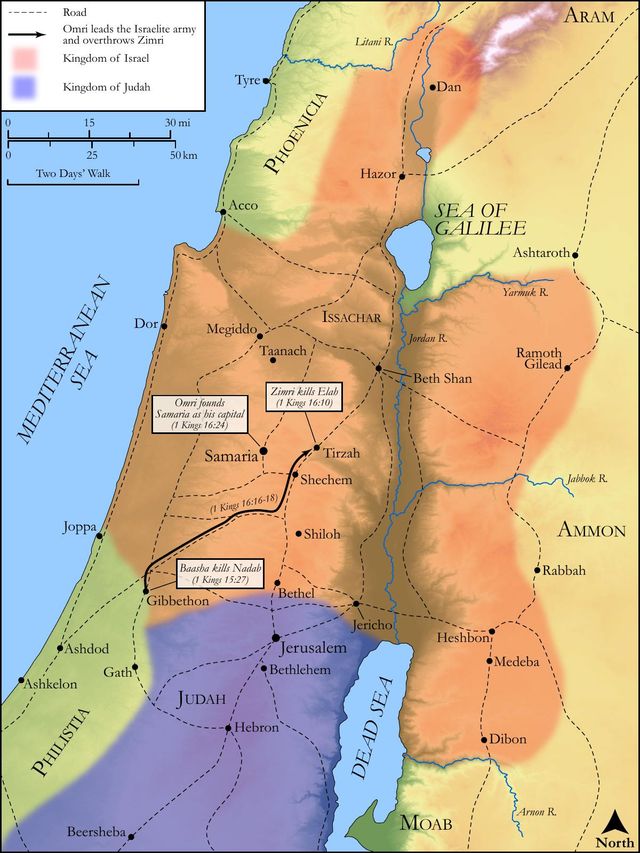
The historical backdrop to this verse is the tumultuous period immediately following the death of King Solomon around 931 BC. His son, Rehoboam, ascended the throne, but his harsh response to the people's plea for lighter burdens led to the rebellion of ten northern tribes, who subsequently crowned Jeroboam as their king (as detailed in 1 Kings 12). This event irrevocably split the united monarchy into the Southern Kingdom of Judah (ruled by Rehoboam) and the Northern Kingdom of Israel (ruled by Jeroboam). The "war" mentioned here refers not necessarily to a continuous, large-scale battle, but to a pervasive state of hostility, border skirmishes, and occasional military engagements that characterized the relationship between these two rival states. Among the nations, such persistent animosity between neighboring kingdoms was common, often fueled by territorial disputes, political ambition, and religious differences.
Key Themes
ShowHideThis verse powerfully highlights several key themes central to the book of Kings and the broader biblical narrative. Firstly, it underscores the Consequences of Disobedience and Division. The kingdom's division was a divine judgment against Solomon's idolatry (as prophesied in 1 Kings 11:11), and the subsequent perpetual warfare demonstrates the painful, long-term human cost of spiritual compromise and political folly. Secondly, it emphasizes Political Fragmentation and Spiritual Apostasy. Jeroboam's establishment of alternative worship centers at Bethel and Dan (recorded in 1 Kings 12:28-30) to prevent his people from returning to Jerusalem deepened the divide, transforming a political split into a profound spiritual schism that fueled ongoing animosity. Lastly, the verse implicitly touches on Divine Sovereignty and Human Responsibility. While God ordained the split, the persistent conflict was exacerbated by the pride and poor decisions of both kings, such as Rehoboam's harshness (seen in 1 Kings 12:14) and Jeroboam's idolatry, demonstrating how human choices can perpetuate and intensify divine judgment.
Exposition and Analysis
ShowHideKey Word Analysis
ShowHideThis term (H4421) denotes not merely a single battle or skirmish, but a state of ongoing conflict, hostility, or military engagement. Its use here indicates that the relationship between Rehoboam and Jeroboam was defined by a pervasive atmosphere of tension, confrontation, and a lack of true peace, rather than isolated events.
This phrase, combining the concepts of "days" (H3117) and "life" (H2416), emphasizes the comprehensive and enduring nature of the conflict. It signifies that the animosity and occasional warfare were not temporary occurrences but characterized and defined the entire reign of Rehoboam, making it a constant reality for the Southern Kingdom of Judah during his rule, lasting throughout the entirety of his existence as king.
Verse Breakdown
ShowHide"And there was war"
This opening clause immediately establishes the prevailing condition of the relationship between the two kingdoms. It's a declarative statement, setting the tone for the period and highlighting the absence of peace.
"between Rehoboam and Jeroboam"
This identifies the primary antagonists. Rehoboam, King of Judah (the Southern Kingdom), and Jeroboam, King of Israel (the Northern Kingdom), represent the two factions of the divided monarchy. Their personal rivalry symbolized the broader schism within God's people.
"all the days of his life"
This specifies the duration and pervasiveness of the conflict. The pronoun "his" refers to Rehoboam, indicating that this state of hostility was a defining and continuous feature throughout his entire reign as king of Judah.
Literary Devices
ShowHideThis verse employs several literary devices to convey its powerful message. Its most striking feature is its Conciseness, delivering a profound historical summary in a mere ten words in the KJV. This brevity lends it a declarative force, stating a stark reality without elaboration. It functions as a Summary Statement, encapsulating a complex period of ongoing animosity and conflict between the two nascent kingdoms, rather than detailing specific battles. This summary also serves as a subtle Foreshadowing, hinting at the long and often bloody history of strife that would characterize the relationship between Israel and Judah throughout much of the subsequent narrative in Kings. Furthermore, the theme of "war" or conflict between the kingdoms becomes a Recurring Motif in the book, establishing a pattern of disunity and strife that underscores the tragic consequences of the initial division.
Theological and Thematic Connections
ShowHideThis verse powerfully underscores the tragic consequences of disobedience and division within God's people. The unity of Israel, once a hallmark of the Davidic kingdom, was shattered by sin—specifically, Solomon's idolatry, Rehoboam's folly, and Jeroboam's apostasy. The perpetual "war" is a tangible manifestation of a broken covenant relationship and a divided heart, both individually and corporately. It serves as a somber reminder that sin's ripple effects extend far beyond the immediate act, leading to prolonged suffering, instability, and the weakening of what God intended to be a unified witness to the nations. The absence of peace between these brother nations highlights the profound spiritual and political cost of turning away from God's commands and pursuing self-interest, revealing how deeply human sin can fracture even divinely ordained structures.
Reflection and Application
ShowHideThe persistent conflict between Rehoboam and Jeroboam stands as a stark biblical warning against the destructive power of division, pride, and spiritual compromise. It challenges us to examine areas in our own lives, families, churches, and communities where unresolved conflict or deep-seated animosity might be hindering unity and flourishing. Just as the division weakened both kingdoms, so too does internal strife diminish our collective witness and effectiveness. The call to peace and reconciliation, even in the face of historical grievances, remains a profound spiritual imperative. We are invited to actively pursue harmony, recognizing that true strength comes not from dominance or self-assertion, but from unity rooted in shared faith, mutual respect, and a commitment to God's will. This verse serves as a powerful reminder that the choices we make today, particularly those related to unity and reconciliation, can have far-reaching and lasting consequences, echoing through generations and impacting the spiritual health of communities.
Questions for Reflection
ShowHideFAQ
ShowHideWas the war a continuous, large-scale battle throughout Rehoboam's life?
ShowHideThe term "war" (milchamah) in this context refers more to a persistent state of hostility, animosity, and occasional military skirmishes rather than a continuous, large-scale battle throughout Rehoboam's entire reign. While there were specific engagements and periods of heightened tension (e.g., 1 Kings 14:30), the verse primarily emphasizes the ongoing nature of the strained relationship and the absence of true peace between the two kingdoms. It signifies that the state of conflict was a defining characteristic of the era, rather than a series of isolated incidents.
Why did God allow this division and ongoing conflict?
ShowHideThe division of the kingdom was a direct consequence of King Solomon's idolatry and disobedience to God's covenant (as revealed in 1 Kings 11:11). God, in His sovereignty, used this judgment to fulfill His prophetic word. While God ordained the division, the ongoing conflict was fueled by the human pride, political ambition, and spiritual apostasy of both Rehoboam and Jeroboam. Rehoboam's refusal to listen to the people's pleas (seen in 1 Kings 12:14) and Jeroboam's establishment of idolatrous worship centers (described in 1 Kings 12:28-30) solidified the divide and ensured perpetual strife. God's sovereignty works through human choices, even sinful ones, to accomplish His ultimate purposes, often demonstrating the painful consequences of rebellion.
Christ-Centered Fulfillment
ShowHideThe perpetual "war" between Rehoboam and Jeroboam vividly illustrates the profound brokenness and division that sin introduces into human relationships, even among God's chosen people. This state of affairs stands in stark contrast to the perfect unity and peace offered in Christ. Jesus, the true King, came not to divide but to reconcile. He is the ultimate Peacemaker, who, by His sacrifice on the cross, broke down the dividing wall of hostility between God and humanity, and between different peoples, creating one new humanity (as taught in Ephesians 2:14-16). Unlike the earthly kings whose reigns were marked by strife and division, Christ's reign is characterized by the peace that surpasses all understanding (promised in Philippians 4:7) and a kingdom where righteousness and peace prevail (as described in Romans 14:17). He calls His followers to be agents of reconciliation, to live in harmony, and to pursue peace with all, reflecting the unity of the Spirit in the bond of peace (exhorted in Ephesians 4:3). The ultimate fulfillment of the longing for peace and unity, so conspicuously absent in the days of Rehoboam and Jeroboam, is found in the Kingdom of God established through Christ, where every knee will bow and every tongue confess His Lordship, bringing an end to all strife and division (as prophesied in Philippians 2:10-11).