


1 Kings 15:5
- אֲשֶׁר'a·SherthatH834RelParticle Relative
- עָשָׂה'a·Sahhe had doneH6213V-Qal-Perf-3msVerb Qal Perfect 3rd Singular Masculine
- דָוִדda·VidDavidH1732N-proper-mNoun Proper Masculine
- אֶת'et<obj.>H853DirObjMParticle Object Indicator
- הַיָּשָׁרhai·ya·Sharthe rightH3477Art ¦ Adj-msAdjective Singular Masculine Absoluteהַtheיָּשָׁרright
- בְּעֵינֵיbe·'ei·Neiin [the] eyes ofH5869Prep-b ¦ N-fdcNoun Dual Feminine Constructבְּinעֵינֵי[the] eyes of
- יְהוָהYah·wehYahwehH3068N-properNoun Proper Title
- וְלֹאve·lo'and notH3808Conj-w ¦ NegParticle Negativeוְandלֹאnot
- סָרsarhe had turned asideH5493V-Qal-Perf-3msVerb Qal Perfect 3rd Singular Masculine
- מִכֹּלmi·Kolfrom allH3605Prep-m ¦ N-msNoun Singular Masculine Absoluteמִfromכֹּלall
- אֲשֶׁר'a·SherthatH834RelParticle Relative
- צִוָּהוּtzi·Va·huhe had commanded himH6680V-Piel-Perf-3ms ¦ 3msVerb Piel Perfect 3rd Singular Masculineצִוָּhe had commandedהוּhim
- כֹּלkolallH3605N-mscNoun Singular Masculine Construct
- יְמֵיye·Mei[the] days ofH3117N-mpcNoun Plural Masculine Construct
- חַיָּיוchai·Yavhis lifeH2416N-mpc ¦ 3msNoun Plural Masculine Constructחַיָּיlifeוhis
- רַקrakonlyH7535AdvAdverb
- בִּדְבַרbid·Varin [the] matter ofH1697Prep-b ¦ N-mscNoun Singular Masculine Constructבִּinדְבַר[the] matter of
- אוּרִיָּה'u·ri·YahUriahH223N-proper-mNoun Proper Masculine
- הַחִתִּיha·chi·Tithe HittiteH2850Art ¦ N-msNoun Gentilic Singular Masculine AbsoluteהַtheחִתִּיHittite
English is a literal word-by-word gloss of the Hebrew, not the KJV's wording. Why?
This is the original text the KJV's translators worked from — each Hebrew word with its own literal English meaning in this verse, prepared by scholars at Tyndale House, Cambridge. The KJV translates whole sentences, not word by word, so its wording differs: one Hebrew word can become several English words, and the KJV may choose “the LORD” where the gloss reads “Yahweh”. Both are faithful — they answer different questions. For the KJV's own rendering, switch to the KJV text.
Details
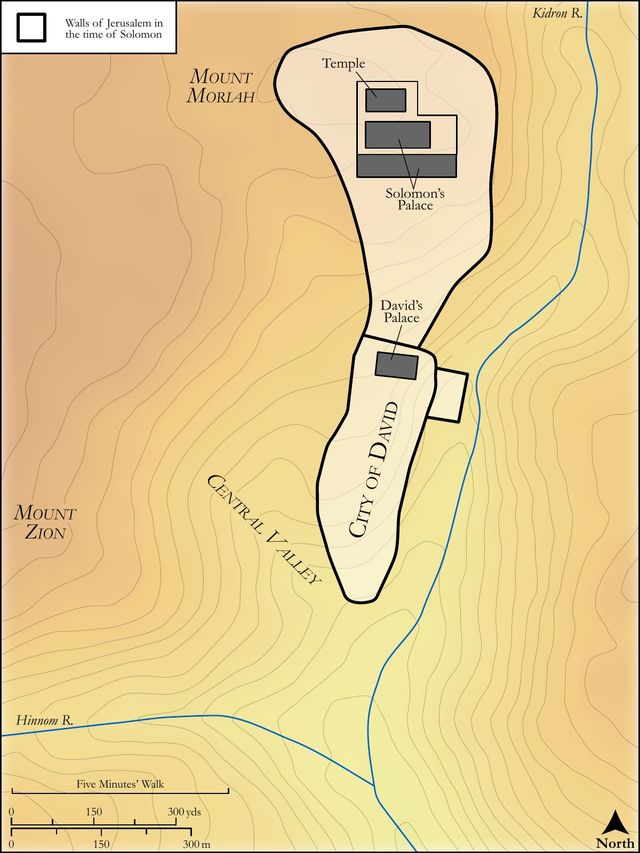
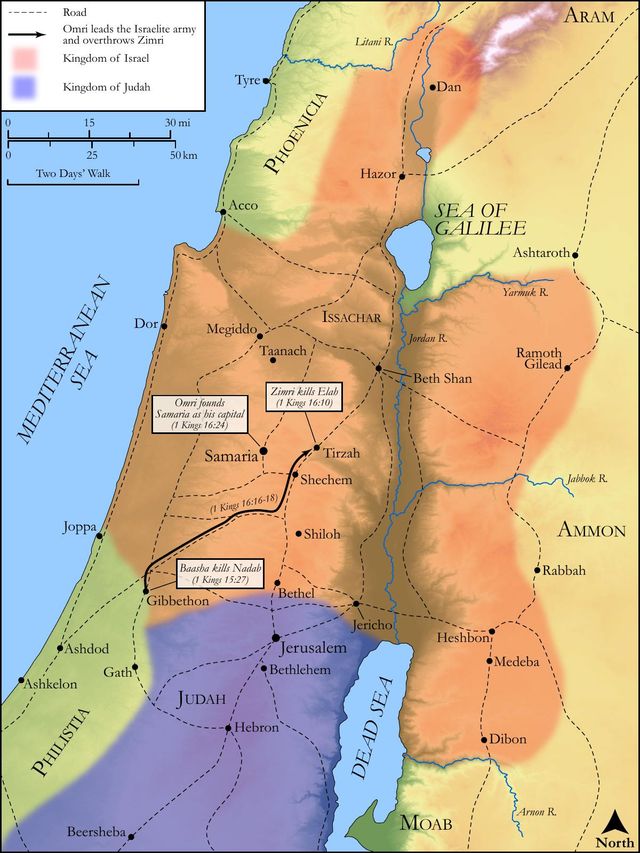
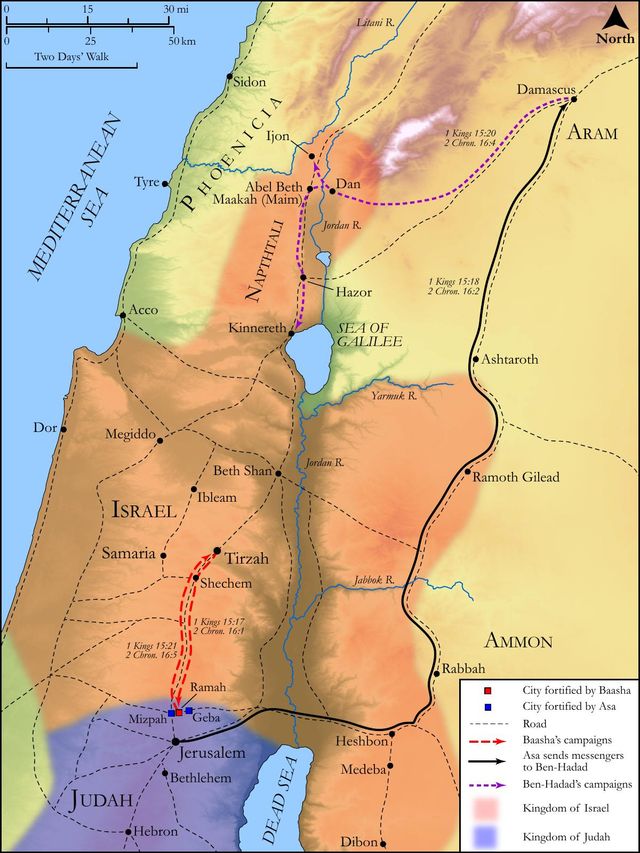
See on the biblical-era map
Study this verse
Public-domain commentary
Matthew Henry
From his Commentary on the Whole Bible. Henry comments on passages, not single verses — this entry covers 1 Kings 15:1–8. His three-level outline is real structure in the source text, so it is rendered as structure.
We have here a short account of the short reign of Abijam the son of Rehoboam king of Judah. He makes a better figure, 2 Chr. 13, where we have an account of his war with Jeroboam, the speech which he made before the armies engaged, and the wonderful victory he obtained by the help of God. There he is called Abijah - My father is the Lord, because no wickedness is there laid to his charge. But here, where we are told of his faults, Jah, the name of God, is, in disgrace to him, taken away from his name, and he is called Abijam. See Jer 22:24.
I.Few particulars are related concerning him.
1.Here began his reign in the beginning of Jeroboam's eighteenth year; for Rehoboam reigned but seventeen, Kg1 14:21. Jeroboam indeed survived Rehoboam, but Rehoboam's Abijah lived to succeed him and to be a terror to Jeroboam, while Jeroboam's Abijah (whom we read of Kg1 14:1) died before him.
2.He reigned scarcely three years, for he died before the end of Jeroboam's twentieth year, Kg1 15:9. Being made proud and secure by his great victory over Jeroboam (Ch2 13:21), God cut him off, to make way for his son Asa, who would be a better man.
3.His mother's name was Maachah, the daughter of Abishalom, that is, Absalom, David's son, as I am the rather inclined to think because two other of Rehoboam's wives were his near relations (Ch2 11:18), one the daughter of Jerimoth, David's son, and another the daughter of Eliab, David's brother. He took warning by his father not to marry strangers; yet thought it below him to marry his subjects, except they were of the royal family.
4.He carried on his father's wars with Jeroboam. As there was continual war between Rehoboam and Jeroboam, not set battles (these were forbidden, Kg1 12:24), but frequent encounters, especially upon the borders, one making incursions and reprisals on the other, so there was between Abijam and Jeroboam (Kg1 15:7), till Jeroboam, with a great army, invaded him, and then Abijam, not being forbidden to act in his own defence, routed him, and weakened him, so that he compelled him to be quiet during the rest of his reign, Ch2 13:20.
II.But, in general, we are told,
1.That he was not like David, had no hearty affection for the ordinances of God, though, to serve his purpose against Jeroboam, he pleaded his possession of the temple and priesthood, as that upon which he valued himself, Ch2 13:10-12. Many boast of their profession of godliness who are strangers to the power of it, and plead the truth of their religion who yet are not true to it. His heart was not perfect with the Lord his God. He seemed to have zeal, but he wanted sincerity; he began pretty well, but he fell off, and walked in all the sins of his father, followed his bad example, though he had seen the bad consequences of it. He that was all his days in war ought to have been so wise as to make and keep his peace with God, and not to make him his enemy, especially having found him so good a friend in his war with Jeroboam, Ch2 13:18. Let favour be shown to the wicked, yet will he not learn righteousness, Isa 26:10.
2.That yet it was for David's sake that he was advanced, and continued upon the throne; it was for his sake (Kg1 15:4, Kg1 15:5) that God thus set up his son after him; not for his own sake, nor for the sake of his father, in whose steps he trod, but for the sake of David, whose example he would not follow. Note, It aggravates the sin of a degenerate seed that they fare the better for the piety of their ancestors and owe their blessings to it, and yet will not imitate it. They stand upon that ground, and yet despise it, and trample upon it, and unreasonably ridicule and oppose that which they enjoy the benefit of. The kingdom of Judah was supported,
(1.)That David might have a lamp, pursuant to the divine ordination of a lamp for his anointed, Psa 132:17.
(2.)That Jerusalem might be established, not only that the honours put upon it in David's and Solomon's time might be preserved to it, but that it might be reserved to the honours designed for it in after-times. The character here given of David is very great - that he did that which was right in the eyes of the Lord; but the exception is very remarkable - save only in the matter of Uriah, including both his murder and the debauching of his wife. That was a bad matter; it was a remaining blot upon his name, a bar in his escutcheon, and the reproach of it was not wiped away, though the guilt was. David was guilty of other faults, but they were nothing in comparison of that; yet even that being repented of, though it be mentioned for warning to others, did not prevail to throw him out of the covenant, nor to cut off the entail of the promise upon his seed.
Historical interpretation
Historical reception
1 surviving comment on this verse from the historical church.
“Now in the eighteenth year of King Jeroboam son of Nebat, Abijam began to reign over Judah,” and under his rule the Jews obtained a magnificent victory over the Israelites in a battle, which was greater than all those fought before in their civil wars. It is said that after the two multitudes of soldiers were drawn up in fighting order, Abijam appeared to have four hundred thousand men, and Jeroboam eight hundred thousand. The Jews won, while the number of the Israelites who fell in action was larger than five hundred thousand, which is an extremely rare occurrence in history.
Continue studying 1 Kings 15:5 across the web’s major study libraries — every link below opens this exact verse, chapter, or book on the destination site.
Read & Compare
 BibleGatewayThis verse in more than 200 translations and 70 languages.
 Bible.comThe YouVersion reader — hundreds of translations, reading plans, and highlights.
 ESV.orgCrossway's official English Standard Version reader.
 NET BibleThe NET translation with 60,000+ translators' notes on every rendering decision.
 STEP BibleTyndale House's free study tool — original text, vocabulary, and scholarly resources.
 BibliaLogos Bible Software's free web reader.
 USCCBThe New American Bible (Revised Edition) with the U.S. bishops' study notes.
Commentaries
 BibleHub CommentariesDozens of classic commentaries on this verse, gathered on one page.
 StudyLightMore than 100 commentary sets — the largest collection on the web.
 BibleRefPlain-English commentary on what this verse means, verse by verse.
 Enduring WordDavid Guzik's free commentary on this chapter, widely used by Bible teachers.
 Bible Study ToolsVerse commentary alongside Greek and Hebrew study aids.
Original Language & Research
- BibleHub InterlinearThe verse word by word — original language, transliteration, and English.
- BibleHub LexiconEvery word's original-language definition and Strong's entry.
 Blue Letter BibleDeep-study tools — Strong's numbers, concordance, and word studies.
 SefariaThe Hebrew text with Rashi and centuries of Jewish commentary.
Sermons, Hymns & Audio


TrulyRandomVerse is not affiliated with these sites and doesn’t control their content. They’re linked because they’re genuinely useful.
Summary
1 Kings 15:5 provides a retrospective divine assessment of King David's reign, affirming his consistent and lifelong adherence to the LORD's commands as the standard for righteous kingship. This profound commendation, however, is immediately and starkly qualified by the singular, grievous exception of his actions concerning Uriah the Hittite, which encompassed adultery, deception, and murder. The verse thus serves as a crucial benchmark for evaluating subsequent monarchs of Judah, simultaneously highlighting God's unwavering standard of righteousness and acknowledging the profound and lasting impact of even a single, significant deviation from His will by an otherwise faithful servant.
Context
ShowHideLiterary Context
This verse is strategically placed within the narrative of King Asa's reign in Judah, specifically at the commencement of the evaluation of his kingship, which spans 1 Kings 15:1-24. The author of Kings consistently employs a standardized formula to assess each monarch, frequently comparing their conduct to the ideal standard established by David. By explicitly stating that Asa "did what was right in the eyes of the LORD, as his father David had done" (1 Kings 15:11), the text unequivocally establishes David as the benchmark for righteous rule. Verse 5, therefore, functions as a parenthetical explanation, clarifying why David is considered the quintessential standard, even while unflinchingly acknowledging his most infamous moral failure. It sharply contrasts David's general obedience with the widespread apostasy and idolatry of many other kings in both the northern kingdom of Israel and the southern kingdom of Judah, thereby emphasizing the unique and enduring nature of David's commitment to the covenant.
Historical & Cultural Context
King David's reign in the 10th century BCE was a transformative period, marked by the establishment of Jerusalem as the capital and the solidification of the united monarchy of Israel. His era saw significant military expansion, sophisticated administrative organization, and the momentous bringing of the Ark of the Covenant to Jerusalem, profoundly symbolizing God's active presence among His people. In the broader ancient Near Eastern context, a king's success was often measured by military prowess, territorial expansion, and material prosperity. However, within Israel, the ultimate measure of a king's reign was his fidelity to the covenant with Yahweh. The phrase "in the eyes of the LORD" signifies a divine, moral evaluation that transcends mere human political or military achievements. The incident with Uriah the Hittite, meticulously detailed in 2 Samuel 11, occurred during a time when kings were typically expected to lead their armies into battle, making David's presence in Jerusalem and his subsequent actions particularly egregious. Uriah's status as a loyal Hittite mercenary serving Israel further underscores the profound depth of David's betrayal and the moral gravity of his actions.
Key Themes
ShowHideThis verse powerfully encapsulates several pivotal themes prevalent throughout the books of Samuel and Kings. Firstly, it profoundly underscores the divine standard of kingship, where true righteousness is measured not by political success or military might, but by unwavering obedience to God's commands. Kings are unequivocally accountable to God, and their actions are perpetually "in the eyes of the LORD." Secondly, it highlights the enduring theme of the Davidic Covenant and Legacy. Despite his monumental failure, David remains the foundational figure for the Judean monarchy, the one through whom God promised an enduring dynasty (2 Samuel 7). His general obedience, as affirmed here, legitimizes his role as the ideal king, even as his sin serves as a potent cautionary tale for all who follow. Thirdly, the verse demonstrates the unflinching honesty of biblical narrative regarding human sin. Even the most revered and divinely chosen figures are presented with their profound flaws, emphasizing that no one is beyond moral failure, and God's judgment is consistently impartial. This radical honesty serves to magnify both God's justice and His sovereign grace.
Exposition and Analysis
ShowHideKey Word Analysis
ShowHideThis proper noun (H1732) refers to the beloved youngest son of Jesse, who became the second king of Israel. The name itself, derived from a root meaning "loving," encapsulates his character as a "man after God's own heart" despite his profound failures. Here, his name anchors the divine assessment of his reign, setting him as the paradigm for all subsequent kings.
The term (H3477) literally means "straight," "upright," or "just." In the context of human conduct, particularly kingship, it signifies moral integrity, adherence to God's covenant stipulations, and a life lived in alignment with divine will. It is a recurring evaluative term in Kings and Chronicles, indicating whether a king's reign was pleasing to God. David's life is here affirmed as largely "straight" and morally upright in God's sight.
This versatile Hebrew word (H1697) can mean "word," "thing," "affair," or "business." In this context, "the matter of Uriah the Hittite" concisely encapsulates the entire complex and grievous affair detailed in 2 Samuel 11. It refers to the specific incident and its associated actions—adultery, deception, and the orchestrated murder—which constituted David's singular, yet catastrophic, deviation from God's commands.
Verse Breakdown
ShowHide"Because David did [that which was] right in the eyes of the LORD"
This opening clause establishes the fundamental divine assessment of David's character and the overall trajectory of his reign. It signifies that David's actions, his underlying motives, and the general course of his life were pleasing and acceptable to God. The phrase "in the eyes of the LORD" powerfully emphasizes God's omniscient perspective and His role as the ultimate, impartial judge of all human conduct, particularly that of His chosen leaders.
"and turned not aside from any [thing] that he commanded him all the days of his life"
This clause further elaborates on the nature of David's righteousness, defining it as unwavering obedience and steadfast adherence to God's every command. The phrase "turned not aside" (לֹא־סָר, lo-sar, from H5493) implies a consistent dedication, a resolute refusal to deviate from the path God had laid out for His people. "All the days of his life" highlights the comprehensive and enduring nature of this commitment, presenting it as a lifelong pattern of faithfulness that set him apart.
"save only in the matter of Uriah the Hittite"
This crucial qualifying clause introduces the sole, yet profoundly significant, exception to David's otherwise exemplary record of obedience. The "matter of Uriah the Hittite" is a concise, yet loaded, allusion to the complex and grievous series of sins detailed in 2 Samuel 11, involving adultery with Bathsheba, calculated deception, and the orchestrated murder of her loyal husband, Uriah. This exception is far from trivial; it represents a grave breach of multiple divine commands (adultery, murder, coveting) and stands as a stark, indelible reminder that even the most devoted and divinely favored can fall catastrophically.
Literary Devices
ShowHideThe verse employs several powerful literary devices to convey its profound message. Contrast is central to its construction, setting David's general, lifelong obedience against the single, glaring exception of Uriah. This juxtaposition powerfully highlights the magnitude of that particular sin while simultaneously affirming David's overall faithfulness. The phrase "all the days of his life" functions as a form of hyperbole or generalization, emphasizing the pervasive nature of his obedience, which is then immediately qualified by the singular, devastating exception. This structural technique creates a subtle sense of irony: the king who largely walked uprightly and was deemed "right in the eyes of the LORD" committed one of the most heinous acts recorded in Scripture. Furthermore, the succinct reference to "the matter of Uriah the Hittite" is a potent form of allusion, relying on the reader's prior knowledge of the detailed, tragic narrative in 2 Samuel 11 and 2 Samuel 12 to convey the full weight and moral gravity of David's transgression without needing to recount it. This conciseness underscores the indelible stain of the sin on his otherwise commendable record.
Theological and Thematic Connections
ShowHide1 Kings 15:5 offers a profound theological statement on the nature of divine judgment and human accountability. It underscores that God's standard for righteousness is absolute and unwavering; even a celebrated, divinely chosen king like David is not exempt from the consequences of his sin. While acknowledging David's general faithfulness and his remarkable devotion, the verse adamantly refuses to whitewash his gravest transgression, demonstrating God's impartiality and the Bible's unwavering commitment to truth. This honest portrayal serves as a powerful reminder that human righteousness is always imperfect and that even one significant act of disobedience can have profound and lasting implications, both personally and corporately, for generations. Yet, the verse's overall commendation of David, despite this glaring flaw, also subtly points to the reality of divine grace and the possibility of genuine repentance, which allowed David to remain in God's favor and continue his role as king despite his sin. It highlights that God looks at the overall trajectory and heart of a person, even amidst profound failures.
Reflection and Application
ShowHideThis verse presents a remarkably balanced and profoundly realistic portrait of a biblical hero, offering timeless lessons for every believer. It affirms David's lifelong commitment to God's commands, setting him apart as a standard of faithfulness for future kings and for us. This reminds us that a life characterized by general obedience and a heart genuinely devoted to God are highly valued in His sight, forming the bedrock of a pleasing walk with Him. At the same time, it unflinchingly highlights his most significant moral failure—the complex and devastating sin involving adultery, deception, and murder related to Uriah. This serves as a sobering reminder that even those who are largely faithful, deeply committed to God, and divinely favored can stumble profoundly and catastrophically. No one is above the temptation to sin, and even one act of disobedience, particularly one of such magnitude, can have devastating, far-reaching consequences, impacting not only ourselves but also those around us, our families, our witness, and our legacy. Yet, the overall assessment of David's life as "right in the eyes of the LORD" despite this grave sin speaks volumes about God's immense grace, His willingness to forgive genuine repentance, and His sovereign ability to use imperfect people for His perfect purposes. It calls us to pursue a life of consistent, wholehearted obedience while simultaneously embracing profound humility, confessing our failures without reservation, and trusting in God's boundless mercy when we inevitably fall short of His perfect standard.
Questions for Reflection
ShowHideFAQ
ShowHideDoes this verse excuse David's sin, given that he is still praised as doing "right in the eyes of the LORD"?
ShowHideNo, this verse absolutely does not excuse David's sin. Rather, it highlights the extreme severity of the "matter of Uriah the Hittite" by presenting it as the sole exception to an otherwise exemplary life of obedience. The Bible consistently portrays David's actions regarding Uriah as a grave transgression, leading to severe consequences for David and his household, as meticulously detailed in 2 Samuel 12. The praise for David's general righteousness acknowledges his prevailing commitment to God's commands throughout his long reign, which profoundly set him apart from many other kings who consistently rebelled against the LORD. It speaks to the overall trajectory and heart attitude of David, who, despite this catastrophic failure, demonstrated genuine repentance and continued to seek God's will.
How can David be considered a "man after God's own heart" if he committed such a grievous sin?
ShowHideThe designation "a man after God's own heart" (found in 1 Samuel 13:14 and reiterated in Acts 13:22) refers primarily to David's disposition and his general orientation towards God's will, particularly in stark contrast to King Saul's persistent disobedience. It signifies that David, unlike Saul, was fundamentally willing to submit to God's authority and commands, even when he failed. Crucially, when confronted with his sin by the prophet Nathan, David immediately confessed and demonstrated genuine, heartfelt repentance (2 Samuel 12:13). This profound capacity for genuine repentance and his consistent desire to follow God's ways, despite his profound moral lapse, allowed him to maintain his unique relationship with the LORD and his status as the ideal king in Israel's history, a standard against which all future kings would be measured.
Christ-Centered Fulfillment
ShowHide1 Kings 15:5, while evaluating an Old Testament king, profoundly points to the absolute necessity and perfect fulfillment found in Jesus Christ. David, despite being the "man after God's own heart" and the ideal king by human standards, ultimately failed in a devastating way, demonstrating that even the very best of human leaders cannot perfectly fulfill God's righteous demands. His "save only in the matter of Uriah the Hittite" highlights the enduring stain and profound consequences of sin, even on an otherwise commendable life, underscoring the universal human inability to achieve perfect, unblemished righteousness. This inherent flaw in David, and indeed in all humanity, creates a deep longing for a King who would truly "turn not aside from any thing that he commanded him," a King whose obedience would be complete and without blemish. Jesus Christ is that perfect King, the greater Son of David, who alone "did [that which was] right in the eyes of the LORD" without any exception, flaw, or deviation. Unlike David, Jesus was "without sin" (Hebrews 4:15), perfectly obeying the Father in every aspect of His life, even to the ultimate point of death on a cross (Philippians 2:8). His perfect, unblemished righteousness is what makes Him the spotless Lamb of God, uniquely capable of taking away the sin of the world (John 1:29), and the only one through whom humanity can be declared righteous "in the eyes of the LORD" (2 Corinthians 5:21). Thus, David's qualified righteousness in 1 Kings 15:5 serves as a powerful Old Testament shadow, illustrating the desperate need for the flawless, complete, and eternal righteousness found only in Christ.