


2 Chronicles 13:20
- וְלֹאve·lo'and notH3808Conj-w ¦ NegParticle Negativeוְandלֹאnot
- עָצַר'a·Tzarhe retainedH6113V-Qal-Perf-3msVerb Qal Perfect 3rd Singular Masculine
- כֹּחַko·ach[the] strength ofH3581N-mscNoun Singular Masculine Construct
- יָרָבְעָםya·ra·ve·'AmJeroboamH3379N-proper-mNoun Proper Masculine
- עוֹדodagainH5750Adj-msAdjective Numerical Singular Masculine Absolute
- בִּימֵיbi·Meiin [the] days ofH3117Prep-b ¦ N-mpcNoun Plural Masculine Constructבִּinימֵי[the] days of
- אֲבִיָּהוּ'a·vi·Ya·huAbijahH29N-proper-mNoun Proper Masculine
- וַיִּגְּפֵהוּvai·yi·ge·Fe·huand he struck himH5062Conj-w ¦ V-Qal-ConsecImperf-3ms ¦ 3msVerb Qal Consecutive Imperfect 3rd Singular Masculineוַandיִּגְּפֵhe struckהוּhim
- יְהוָהYah·wehYahwehH3068N-properNoun Proper Title
- וַיָּמֹתvai·ya·Motand he diedH4191Conj-w ¦ V-Qal-ConsecImperf-3msVerb Qal Consecutive Imperfect 3rd Singular Masculineוַandיָּמֹתhe died
English is a literal word-by-word gloss of the Hebrew, not the KJV's wording. Why?
This is the original text the KJV's translators worked from — each Hebrew word with its own literal English meaning in this verse, prepared by scholars at Tyndale House, Cambridge. The KJV translates whole sentences, not word by word, so its wording differs: one Hebrew word can become several English words, and the KJV may choose “the LORD” where the gloss reads “Yahweh”. Both are faithful — they answer different questions. For the KJV's own rendering, switch to the KJV text.
Details
See on the biblical-era map
Study this verse
Public-domain commentary
Matthew Henry
From his Commentary on the Whole Bible. Henry comments on passages, not single verses — this entry covers 2 Chronicles 13:13–22. His three-level outline is real structure in the source text, so it is rendered as structure.
We do not find that Jeroboam offered to make any answer at all to Abijah's speech. Though it was much to the purpose, he resolved not to heed it, and therefore he heard it as though he heard it not. He came to fight, not to dispute. The longest sword, he thought, would determine the matter, not the better cause. Let us therefore see the issue, whether right and religion carried the day or no.
I.Jeroboam, who trusted to his politics, was beaten.
He was so far from fair reasoning that he was not for fair fighting. We may suppose that he felt a sovereign contempt for Abijah's harangue. "One stratagem," thinks he, "is worth twenty such speeches; we will soon give him an answer to all his arguments; he shall soon find himself overpowered with numbers, surrounded on every side with the instruments of death, and then let him boast of his religion and his title to the crown." A parley, it is probable, was agreed on, yet Jeroboam basely takes the advantage of it, and, while he was treating, laid his ambushment behind Judah, against all the laws of arms. What honour could be expected in a servant when he reigned? Abijah was for peace, but, when he spoke, they were for war, Psa 120:7.
II.Abijah and his people, who trusted in their God, came off conquerors, notwithstanding the disproportion of their strength and numbers.
1.They were brought into a great strait, put into a great fright, for the battle was before and behind. A good cause, and one which is designed to be victorious, may for a season be involved in embarrassment and distress. It was David's case. They compassed me about like bees, Psa 118:10-12.
2.In their distress, when danger was on every side, which way should they look but upwards for deliverance? It is an unspeakable comfort that no enemy (not the most powerful or politic), no stratagem or ambushment, can cut off our communication with heaven; our way thitherward is always open.
(1.)They cried unto the Lord, Ch2 13:14. We hope they did this before they engaged in this war, but the distress they were in made them renew their prayers and quickened them to be importunate. God brings his people into straits, that he may teach them to cry unto him. Earnest praying is crying.
(2.)They relied on the God of their fathers, depended upon his power to help them and committed themselves to him, Ch2 13:18. The prayer of faith is the prevailing prayer, and this is that by which we overcome the world, even our faith, Jo1 5:4.
(3.)The priests sounded the trumpets to animate them by giving them an assurance of God's presence with them. It was not only a martial but a sacred sound, and put life into their faith.
(4.)They shouted in confidence of victory: "The day is our own, for God is with us." To the cry of the prayer they added the shout of faith, and so became more than conquerors.
3.Thus they obtained a complete victory: As the men of Judah shouted for joy in God's salvation, God smote Jeroboam and his army with such terror and amazement that they could not strike a stroke, but fled with the greatest precipitation imaginable, and the conquerors gave no quarter, so that they put to the sword 500,000 chosen men (Ch2 13:17), more, it is said, than ever we read of in any history to have been killed in one battle; but the battle was the Lord's, who would thus chastise the idolatry of Israel and own the house of David. But see the sad effect of division: it was the blood of Israelites that was thus shed like water by Israelites, while the heathen, their neighbours, to whom the name of Israel had formerly been a terror, cried, Aha! so would we have it.
4.The consequence of this was that the children of Israel, though they were not brought back to the house of David (which by so great a blow surely they would have been had not the determinate counsel of God been otherwise), yet, for that time, were brought under, Ch2 13:18. Many cities were taken, and remained in the possession of the kings of Judah; as Bethel particularly, Ch2 13:19. What became of the golden calf there, when it came into the hands of the king of Judah, we are not told; perhaps it was removed to some place of greater safety, and at length to Samaria (Hos 8:5); yet in Jehu's time we find it at Bethel, Kg2 10:29. Perhaps Abijah, when it was in his power to demolish it, suffered it to stand, for his heart was not perfect with God; and, not improving what he had got for the honour of God, he soon lost it all again.
Lastly, The death of both of the conquered and of the conqueror, not long after. 1. Jeroboam never looked up after this defeat, though he survived it two or three years. He could not recover strength again, Ch2 13:20. The Lord struck him either with some bodily disease, of which he languished, or with melancholy and trouble of mind; his heart was broken, and vexation at his loss brought his head, probably by this time a hoary head, with sorrow to the grave. He escaped the sword of Abijah, but God struck him: and there is no escaping his sword. 2. Abijah waxed mighty upon it. What number of wives and children he had before does not appear; but now he multiplied his wives to fourteen in all, by whom he had thirty-eight children, Ch2 13:21. Happy is the man that hath his quiver full of those arrows. It seems, he had ways peculiar to himself, and sayings of his own, which were recorded with his acts in the history of those times, Ch2 13:22. But the number of his months was cut off in the midst, and, soon after his triumphs, death conquered the conqueror. Perhaps he was too much lifted up with his victories, and therefore God would not let him live long to enjoy the honour of them.
Continue studying 2 Chronicles 13:20 across the web’s major study libraries — every link below opens this exact verse, chapter, or book on the destination site.
Read & Compare
 BibleGatewayThis verse in more than 200 translations and 70 languages.
 Bible.comThe YouVersion reader — hundreds of translations, reading plans, and highlights.
 ESV.orgCrossway's official English Standard Version reader.
 NET BibleThe NET translation with 60,000+ translators' notes on every rendering decision.
 STEP BibleTyndale House's free study tool — original text, vocabulary, and scholarly resources.
 BibliaLogos Bible Software's free web reader.
 USCCBThe New American Bible (Revised Edition) with the U.S. bishops' study notes.
Commentaries
 BibleHub CommentariesDozens of classic commentaries on this verse, gathered on one page.
 StudyLightMore than 100 commentary sets — the largest collection on the web.
 BibleRefPlain-English commentary on what this verse means, verse by verse.
 Enduring WordDavid Guzik's free commentary on this chapter, widely used by Bible teachers.
 Bible Study ToolsVerse commentary alongside Greek and Hebrew study aids.
Original Language & Research
- BibleHub InterlinearThe verse word by word — original language, transliteration, and English.
- BibleHub LexiconEvery word's original-language definition and Strong's entry.
 Blue Letter BibleDeep-study tools — Strong's numbers, concordance, and word studies.
 SefariaThe Hebrew text with Rashi and centuries of Jewish commentary.
Sermons, Hymns & Audio


TrulyRandomVerse is not affiliated with these sites and doesn’t control their content. They’re linked because they’re genuinely useful.
Summary
2 Chronicles 13:20 delivers a powerful and conclusive statement on the fate of Jeroboam, the first king of the northern kingdom of Israel. Following his decisive defeat by King Abijah of Judah, this verse unequivocally states that Jeroboam never regained his strength or influence, culminating in his death by the direct hand of the Lord. It serves as a profound theological declaration, underscoring God's active sovereignty in human affairs and His righteous judgment against those who lead His people into apostasy and defy His covenant.
Context
ShowHideLiterary Context
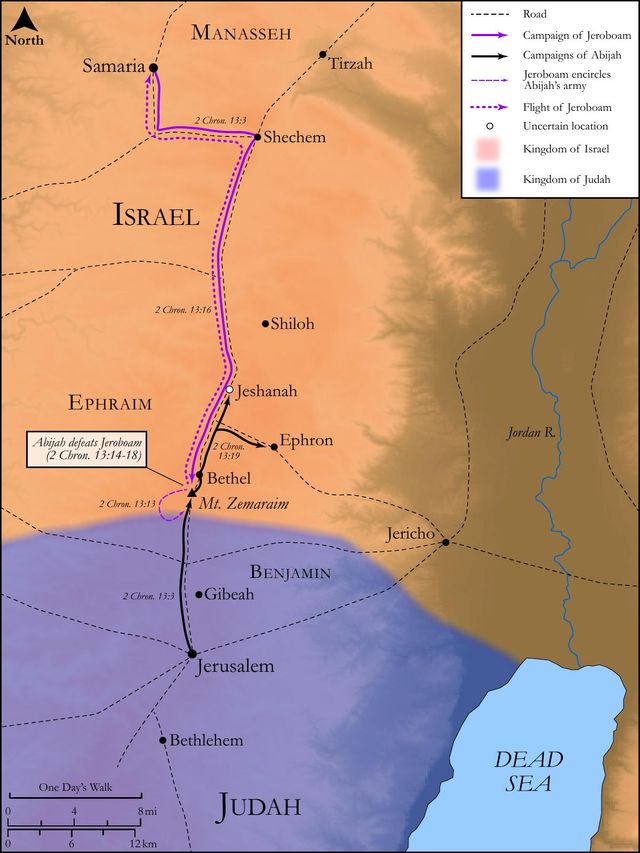
This verse acts as the definitive and climactic resolution to the preceding narrative detailing the significant battle between Abijah's Judah and Jeroboam's Israel in 2 Chronicles 13:1-19. The Chronicler meticulously recounts Abijah's impassioned speech to Jeroboam's vast army, emphasizing Judah's steadfast reliance on the Lord and their adherence to the Mosaic covenant, in stark contrast to Jeroboam's idolatry and rebellion. Despite being severely outnumbered, Judah achieved a miraculous victory, explicitly attributed to divine intervention: "they cried unto the LORD, and the priests sounded with the trumpets. Then the men of Judah gave a shout: and as the men of Judah shouted, it came to pass, that God smote Jeroboam and all Israel before Abijah and Judah" (2 Chronicles 13:14-15). Verse 20 functions as the ultimate divine postscript, confirming that the military defeat was not merely a temporary setback but a divinely orchestrated, irreversible blow to Jeroboam's reign and, ultimately, his life, sealing the theological implications of the battle.
Historical & Cultural Context
The historical setting is the tumultuous period of the divided kingdom, which emerged after the schism following Solomon's reign. Jeroboam I, as the inaugural king of the northern kingdom of Israel, established golden calves in Dan and Bethel (1 Kings 12:26-33) to consolidate his political power and prevent his subjects from journeying to Jerusalem for worship, an act of profound apostasy against the Mosaic Law and the covenant with Yahweh. Abijah, as king of Judah, represented the legitimate Davidic line and the continuation of true worship centered in Jerusalem. The conflict described in 2 Chronicles 13 was therefore not merely a territorial or political dispute but a deeply theological confrontation, pitting the legitimate worship of Judah against the syncretistic idolatry of Israel under Jeroboam. In the cultural understanding of the ancient Near East, such a sudden and definitive end to a ruler's power and life would have been readily interpreted as a direct manifestation of divine judgment, especially given the preceding narrative of God's explicit involvement in the battle.
Key Themes
ShowHideThis verse powerfully reinforces several key themes prevalent throughout the books of Chronicles and the broader Old Testament narrative. Firstly, it highlights Divine Judgment, demonstrating God's active and decisive intervention in human history to punish sin, particularly idolatry and rebellion against His established order. Jeroboam's death is explicitly stated as a direct act of "the LORD struck him," not a natural or accidental occurrence, underscoring God's righteous retribution against a king who led an entire nation into apostasy. Secondly, it emphasizes the Consequences of Disobedience, illustrating that persistent rebellion against God's commands, especially from those in leadership, inevitably leads to severe, often fatal, repercussions. Jeroboam's initial rise to power was even divinely sanctioned, but his subsequent disobedience sealed his fate, as warned in 1 Kings 11:38. Thirdly, the verse underscores God's Sovereignty in History, revealing that despite human plans and military might, God's ultimate will prevails. Jeroboam's inability to "recover strength" and his subsequent death confirm God's ultimate control over the destinies of nations and rulers, ensuring that His purposes are fulfilled. The narrative context also subtly reinforces the theme of Victory Through Faith, contrasting Jeroboam's reliance on human strength and false gods with Judah's reliance on the LORD, which brought them triumph and secured divine favor, as seen in 2 Chronicles 13:18.
Exposition and Analysis
ShowHideKey Word Analysis
ShowHideThe Hebrew word כּוֹחַ ( kôach ) denotes vigor, force, might, or capacity. It can refer to physical strength, military power, or political influence and authority. In this context, Jeroboam's inability to "recover strength" signifies a complete and permanent loss of his former vitality, military might, and political effectiveness. It implies that the divine judgment rendered against him was so profound that he could never again exert the power or authority he once possessed, marking the irreversible decline of his reign and influence.
The Hebrew verb נָגַף ( nâgaph ) carries a strong connotation of a sudden, forceful, and often punitive blow. It is frequently used in the context of divine judgment, signifying God's direct intervention to inflict a plague, defeat, or fatal wound. For instance, it describes God striking the Philistines (1 Samuel 7:10) or the plague that struck the Israelites (Numbers 14:45). In 2 Chronicles 13:20, the use of nâgaph unequivocally points to Jeroboam's death as a direct, decisive, and divinely orchestrated act, rather than a natural illness or the lingering effects of the battle. It emphasizes the immediate and non-negotiable nature of God's judgment.
The Hebrew verb מוּת ( mûwth ) is a primitive root meaning "to die," literally or figuratively, and causatively, "to kill." In this verse, its use in conjunction with "the LORD struck him" leaves no ambiguity: Jeroboam's death was not a natural occurrence but a direct act of divine execution. This emphasizes God's ultimate sovereignty over life and death, particularly as a consequence of His judgment against Jeroboam's persistent rebellion and idolatry.
Verse Breakdown
ShowHide"Neither did Jeroboam recover strength again in the days of Abijah"
This clause establishes the permanent and debilitating impact of the recent defeat on Jeroboam's power and influence. The battle with Abijah was not a temporary setback from which he could rebound; rather, it marked the irreversible decline of his reign. "Strength" here refers not only to military might but also to political vitality, authority, and the ability to effectively govern. The phrase "in the days of Abijah" further emphasizes that this diminished state persisted throughout the remainder of Abijah's rule, cementing Jeroboam's weakened and ineffective position.
"and the LORD struck him, and he died"
This is the definitive statement of divine judgment and its ultimate consequence. The conjunction "and" links Jeroboam's inability to recover strength directly to his ultimate demise, indicating a causal relationship rooted in divine action. The explicit declaration that "the LORD struck him" leaves no room for ambiguity; his death was not accidental, natural, or a consequence of battle wounds, but a direct, supernatural act of God. This divine intervention underscores the gravity of Jeroboam's sin and God's sovereign authority over life and death, particularly in the context of covenant faithfulness and rebellion.
Literary Devices
ShowHideThe verse employs several powerful literary devices to convey its profound theological message. Divine Intervention is the most prominent, as the text explicitly states "the LORD struck him," presenting God as the active and decisive agent in Jeroboam's demise. This highlights God's direct involvement in human history and His ultimate control over the destinies of kings and nations. There is also an element of Irony, as Jeroboam, who sought to secure his kingdom through idolatry and human strategy, ultimately loses both his power and his life through a divine act that he could neither control nor prevent. Furthermore, the verse serves as a Culmination or Climax to the narrative of the battle, providing the ultimate resolution to the conflict between Judah and Israel, and more profoundly, between true worship and idolatry. It delivers the final, decisive verdict on Jeroboam's rebellion, bringing the immediate narrative arc to a definitive close and affirming God's righteous judgment.
Theological and Thematic Connections
ShowHide2 Chronicles 13:20 profoundly illustrates the biblical principle of divine retribution and the severe consequences of leading others into sin. It serves as a stark reminder that God is not passive in the face of idolatry and rebellion, especially when His covenant people are led astray by their leaders. Jeroboam's death is a clear demonstration of God's justice, underscoring that while the wicked may seem to prosper for a time, ultimately, God holds all rulers accountable for their actions and their stewardship. This divine judgment also serves to vindicate Abijah and Judah's reliance on the Lord, affirming God's faithfulness to those who uphold His covenant and seek His face. The narrative reinforces the truth that true strength and lasting security come from obedience and trust in God, not from human cunning or the worship of false gods.
Reflection and Application
ShowHideThe tragic and divinely orchestrated end of Jeroboam serves as a timeless warning for all who wield influence, whether in leadership, family, or community: our choices have profound consequences, not only for ourselves but for those we lead. This verse challenges us to examine where our true strength lies. Do we rely on our own ingenuity, resources, or worldly strategies, or do we place our trust in the sovereign power of God? Jeroboam's inability to "recover strength" after God struck him reminds us that genuine power and lasting peace come from alignment with God's will, not from human ambition or defiance. It calls us to a life of humble obedience, recognizing that persistent rebellion against God's truth, even in subtle forms of modern idolatry (e.g., placing career, wealth, or comfort above God), can lead to spiritual debilitation and ultimate ruin. This account encourages us to actively seek God's face, repent of our sins, and trust in His unfailing justice and mercy, knowing that He is actively involved in the affairs of His creation and holds all accountable.
Questions for Reflection
ShowHideFAQ
ShowHideWas Jeroboam's death a direct result of the battle or a separate divine act?
ShowHideWhile Jeroboam's power was severely diminished by the battle with Abijah, his death was explicitly a separate, direct divine act. The text states, "the LORD struck him, and he died." This indicates that his death was not merely a natural consequence of battle wounds or a lingering illness, but a specific, punitive intervention by God. This divine judgment underscored the theological nature of the conflict and confirmed that Jeroboam's defeat and demise were God's righteous response to his persistent idolatry and rebellion against the covenant. It served as the ultimate fulfillment of the warnings given to Jeroboam earlier in 1 Kings 11:38-39 and 1 Kings 14:7-11.
Christ-Centered Fulfillment
ShowHideThe judgment upon Jeroboam in 2 Chronicles 13:20, where "the LORD struck him, and he died," profoundly foreshadows the ultimate divine judgment against sin, yet it also paradoxically points to the Christ-centered fulfillment of God's justice and mercy. Jeroboam, a king who led his people into idolatry and rebellion, faced the full weight of God's righteous wrath for his transgressions. In stark contrast, Jesus Christ, the true King of Israel and the world, did not lead His people into sin but bore the judgment for it. The striking of Jeroboam by the Lord finds its ultimate, paradoxical fulfillment in the striking of the Messiah, who was "smitten of God, and afflicted" (Isaiah 53:4), not for His own sin, but for ours. On the cross, Jesus became the recipient of divine wrath, taking upon Himself the wages of sin (Romans 6:23) so that those who trust in Him might not perish but have eternal life (John 3:16). Unlike Jeroboam, whose strength was permanently broken and whose reign ended in death, Christ's death led to His glorious resurrection, demonstrating His ultimate victory over sin and death (Colossians 2:15). He is the King whose kingdom will never be broken (Daniel 7:14) and whose strength is everlasting, offering true life and forgiveness where Jeroboam's reign brought only judgment and death.