


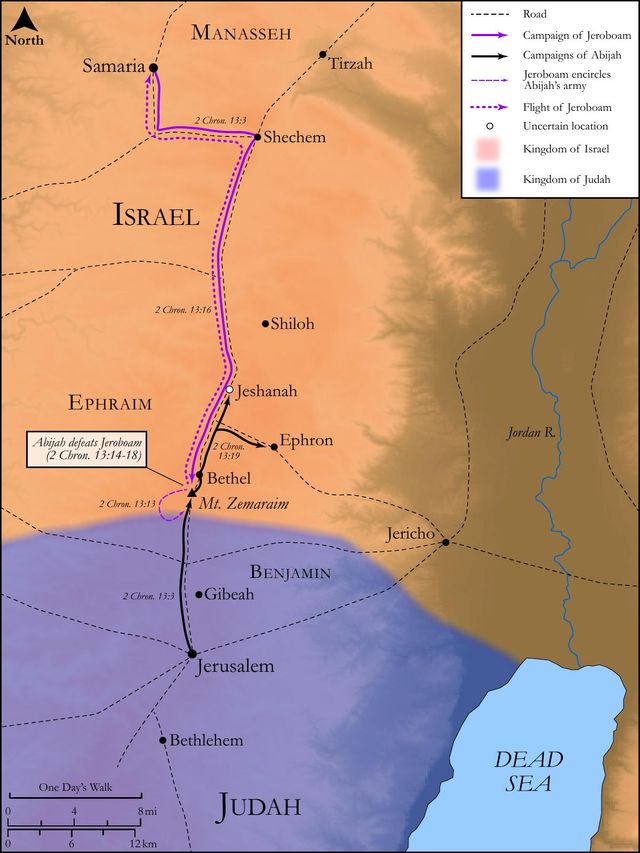
2 Chronicles 13:19
Bible text: King James Version (1769 Blayney text) · Public domain
Bible text: King James Version with Strong's numbers · Public domain
Bible text: Berean Standard Bible · Public domain
Bible text: American Standard Version (1901) · Public domain
Bible text: World English Bible, Messianic edition · Public domain
Bible text: Geneva Bible (1599) · Public domain
Bible text: Young's Literal Translation · Public domain
- וַיִּרְדֹּףvai·yir·Dofand he pursuedH7291Conj-w ¦ V-Qal-ConsecImperf-3msVerb Qal Consecutive Imperfect 3rd Singular Masculineוַandיִּרְדֹּףhe pursued
- אֲבִיָּה'a·vi·YahAbijahH29N-proper-mNoun Proper Masculine
- אַחֲרֵי'a·cha·ReiafterH310Adj-mpcAdjective Numerical Plural Masculine Construct
- יָרָבְעָםya·ra·ve·'AmJeroboamH3379N-proper-mNoun Proper Masculine
- וַיִּלְכֹּדvai·yil·Kodand he capturedH3920Conj-w ¦ V-Qal-ConsecImperf-3msVerb Qal Consecutive Imperfect 3rd Singular Masculineוַandיִּלְכֹּדhe captured
- מִמֶּנּוּmi·Me·nufrom himH4480Prep ¦ 3msPrepositionמִמֶּfromנּוּhim
- עָרִים'a·RimcitiesH5892N-mpNoun Plural Masculine Absolute
- אֶת'et<obj.>H853DirObjMParticle Object Indicator
- בֵּיתbeitBeth-H1008N-properNoun Proper Location
- אֵל'el-elH1008N-properNoun Proper Location
- וְאֶתve·'Etand <obj.>H853Conj-w ¦ DirObjMParticle Object Indicatorוְandאֶת<obj.>
- בְּנוֹתֶיהָbe·no·Tei·haits daughtersH1323N-fpc ¦ 3fsNoun Plural Feminine Constructבְּנוֹתֶיdaughtersהָits
- וְאֶתve·'Etand <obj.>H853Conj-w ¦ DirObjMParticle Object Indicatorוְandאֶת<obj.>
- יְשָׁנָהye·sha·NahJeshanahH3466N-properNoun Proper Location
- וְאֶתve·'Etand <obj.>H853Conj-w ¦ DirObjMParticle Object Indicatorוְandאֶת<obj.>
- בְּנוֹתֶיהָbe·no·Tei·haits daughtersH1323N-fpc ¦ 3fsNoun Plural Feminine Constructבְּנוֹתֶיdaughtersהָits
- וְאֶתve·'Etand <obj.>H853Conj-w ¦ DirObjMParticle Object Indicatorוְandאֶת<obj.>
- עֶפְרַיִןef·ronEphrayinH6085N-properNoun Proper Location
- וּבְנֹתֶיהָu·ve·no·Tei·haand its daughtersH1323Conj-w ¦ N-fpc ¦ 3fsNoun Plural Feminine Constructוּandבְנֹתֶיdaughtersהָits
English is a literal word-by-word gloss of the Hebrew, not the KJV's wording. Why?
This is the original text the KJV's translators worked from — each Hebrew word with its own literal English meaning in this verse, prepared by scholars at Tyndale House, Cambridge. The KJV translates whole sentences, not word by word, so its wording differs: one Hebrew word can become several English words, and the KJV may choose “the LORD” where the gloss reads “Yahweh”. Both are faithful — they answer different questions. For the KJV's own rendering, switch to the KJV text.
Details
See on the biblical-era map
Study this verse
Public-domain commentary
Matthew Henry
From his Commentary on the Whole Bible. Henry comments on passages, not single verses — this entry covers 2 Chronicles 13:13–22. His three-level outline is real structure in the source text, so it is rendered as structure.
We do not find that Jeroboam offered to make any answer at all to Abijah's speech. Though it was much to the purpose, he resolved not to heed it, and therefore he heard it as though he heard it not. He came to fight, not to dispute. The longest sword, he thought, would determine the matter, not the better cause. Let us therefore see the issue, whether right and religion carried the day or no.
I.Jeroboam, who trusted to his politics, was beaten.
He was so far from fair reasoning that he was not for fair fighting. We may suppose that he felt a sovereign contempt for Abijah's harangue. "One stratagem," thinks he, "is worth twenty such speeches; we will soon give him an answer to all his arguments; he shall soon find himself overpowered with numbers, surrounded on every side with the instruments of death, and then let him boast of his religion and his title to the crown." A parley, it is probable, was agreed on, yet Jeroboam basely takes the advantage of it, and, while he was treating, laid his ambushment behind Judah, against all the laws of arms. What honour could be expected in a servant when he reigned? Abijah was for peace, but, when he spoke, they were for war, Psa 120:7.
II.Abijah and his people, who trusted in their God, came off conquerors, notwithstanding the disproportion of their strength and numbers.
1.They were brought into a great strait, put into a great fright, for the battle was before and behind. A good cause, and one which is designed to be victorious, may for a season be involved in embarrassment and distress. It was David's case. They compassed me about like bees, Psa 118:10-12.
2.In their distress, when danger was on every side, which way should they look but upwards for deliverance? It is an unspeakable comfort that no enemy (not the most powerful or politic), no stratagem or ambushment, can cut off our communication with heaven; our way thitherward is always open.
(1.)They cried unto the Lord, Ch2 13:14. We hope they did this before they engaged in this war, but the distress they were in made them renew their prayers and quickened them to be importunate. God brings his people into straits, that he may teach them to cry unto him. Earnest praying is crying.
(2.)They relied on the God of their fathers, depended upon his power to help them and committed themselves to him, Ch2 13:18. The prayer of faith is the prevailing prayer, and this is that by which we overcome the world, even our faith, Jo1 5:4.
(3.)The priests sounded the trumpets to animate them by giving them an assurance of God's presence with them. It was not only a martial but a sacred sound, and put life into their faith.
(4.)They shouted in confidence of victory: "The day is our own, for God is with us." To the cry of the prayer they added the shout of faith, and so became more than conquerors.
3.Thus they obtained a complete victory: As the men of Judah shouted for joy in God's salvation, God smote Jeroboam and his army with such terror and amazement that they could not strike a stroke, but fled with the greatest precipitation imaginable, and the conquerors gave no quarter, so that they put to the sword 500,000 chosen men (Ch2 13:17), more, it is said, than ever we read of in any history to have been killed in one battle; but the battle was the Lord's, who would thus chastise the idolatry of Israel and own the house of David. But see the sad effect of division: it was the blood of Israelites that was thus shed like water by Israelites, while the heathen, their neighbours, to whom the name of Israel had formerly been a terror, cried, Aha! so would we have it.
4.The consequence of this was that the children of Israel, though they were not brought back to the house of David (which by so great a blow surely they would have been had not the determinate counsel of God been otherwise), yet, for that time, were brought under, Ch2 13:18. Many cities were taken, and remained in the possession of the kings of Judah; as Bethel particularly, Ch2 13:19. What became of the golden calf there, when it came into the hands of the king of Judah, we are not told; perhaps it was removed to some place of greater safety, and at length to Samaria (Hos 8:5); yet in Jehu's time we find it at Bethel, Kg2 10:29. Perhaps Abijah, when it was in his power to demolish it, suffered it to stand, for his heart was not perfect with God; and, not improving what he had got for the honour of God, he soon lost it all again.
Lastly, The death of both of the conquered and of the conqueror, not long after. 1. Jeroboam never looked up after this defeat, though he survived it two or three years. He could not recover strength again, Ch2 13:20. The Lord struck him either with some bodily disease, of which he languished, or with melancholy and trouble of mind; his heart was broken, and vexation at his loss brought his head, probably by this time a hoary head, with sorrow to the grave. He escaped the sword of Abijah, but God struck him: and there is no escaping his sword. 2. Abijah waxed mighty upon it. What number of wives and children he had before does not appear; but now he multiplied his wives to fourteen in all, by whom he had thirty-eight children, Ch2 13:21. Happy is the man that hath his quiver full of those arrows. It seems, he had ways peculiar to himself, and sayings of his own, which were recorded with his acts in the history of those times, Ch2 13:22. But the number of his months was cut off in the midst, and, soon after his triumphs, death conquered the conqueror. Perhaps he was too much lifted up with his victories, and therefore God would not let him live long to enjoy the honour of them.
Continue studying 2 Chronicles 13:19 across the web’s major study libraries — every link below opens this exact verse, chapter, or book on the destination site.
Read & Compare
 BibleGatewayThis verse in more than 200 translations and 70 languages.
 Bible.comThe YouVersion reader — hundreds of translations, reading plans, and highlights.
 ESV.orgCrossway's official English Standard Version reader.
 NET BibleThe NET translation with 60,000+ translators' notes on every rendering decision.
 STEP BibleTyndale House's free study tool — original text, vocabulary, and scholarly resources.
 BibliaLogos Bible Software's free web reader.
 USCCBThe New American Bible (Revised Edition) with the U.S. bishops' study notes.
Commentaries
 BibleHub CommentariesDozens of classic commentaries on this verse, gathered on one page.
 StudyLightMore than 100 commentary sets — the largest collection on the web.
 BibleRefPlain-English commentary on what this verse means, verse by verse.
 Enduring WordDavid Guzik's free commentary on this chapter, widely used by Bible teachers.
 Bible Study ToolsVerse commentary alongside Greek and Hebrew study aids.
Original Language & Research
- BibleHub InterlinearThe verse word by word — original language, transliteration, and English.
- BibleHub LexiconEvery word's original-language definition and Strong's entry.
 Blue Letter BibleDeep-study tools — Strong's numbers, concordance, and word studies.
 SefariaThe Hebrew text with Rashi and centuries of Jewish commentary.
Sermons, Hymns & Audio


TrulyRandomVerse is not affiliated with these sites and doesn’t control their content. They’re linked because they’re genuinely useful.
Summary
Following a decisive, divinely-granted victory over the northern kingdom of Israel, 2 Chronicles 13:19 records King Abijah of Judah's successful pursuit of Jeroboam's routed forces. This verse details the significant territorial gains made by Judah, specifically the capture of the strategic cities of Bethel, Jeshanah, and Ephrain, along with their surrounding dependent towns. It underscores the immediate and tangible consequences of the preceding battle, highlighting the extent of Judah's triumph and the severe blow dealt to Jeroboam's kingdom, both militarily and symbolically.
Context
ShowHideLiterary Context
This verse serves as the immediate aftermath and tangible outcome of the epic battle described in 2 Chronicles 13:1-18. Abijah, though vastly outnumbered by Jeroboam's forces (400,000 against 800,000), delivered a powerful speech emphasizing Judah's reliance on the Lord and Israel's apostasy. When Israel encircled Judah, the men of Judah cried out to the Lord, and God Himself routed Jeroboam and Israel before Abijah and Judah. The preceding verses culminate in the immense slaughter of Israelite troops, making this verse a direct continuation, detailing the territorial fruits of that divine intervention and military success. It demonstrates the Chronicler's consistent theme of immediate blessing for faithfulness.
Historical & Cultural Context
The setting is the divided monarchy, a period of ongoing tension and occasional conflict between the southern kingdom of Judah (loyal to the Davidic dynasty and the Jerusalem temple) and the northern kingdom of Israel (founded by Jeroboam I, who established alternative worship centers at Bethel and Dan). Bethel, in particular, was not just a strategic city on the main north-south road but also a profoundly significant religious site. It was where Jacob had his dream (Genesis 28:10-22), and later where Jeroboam set up one of his golden calves (1 Kings 12:28-30) to prevent his people from going to Jerusalem to worship. Its capture by Judah represented not only a military gain but a significant symbolic blow against Jeroboam's illegitimate religious system and a partial reclamation of territory and spiritual authority. Jeshanah and Ephrain were also strategically important, likely controlling key routes or agricultural areas, further solidifying Judah's control.
Key Themes
ShowHideThe verse powerfully illustrates several key themes prevalent in Chronicles. Firstly, it underscores Divine Sovereignty and Intervention, demonstrating that God actively intervenes in human affairs, granting victory to those who trust Him, even against overwhelming odds. Abijah's triumph is presented as a direct result of Judah's reliance on the Lord, contrasting sharply with Jeroboam's apostasy. Secondly, it highlights the Consequences of Faithfulness vs. Apostasy, showing the immediate blessings for Judah's adherence to the Lord and the severe judgment upon Israel for its idolatry and rebellion against the Davidic covenant. Thirdly, the capture of these cities, especially Bethel, represents a Partial Restoration and Reclamation of territory and spiritual influence that had been lost to the northern kingdom since the division. This act symbolically reasserts the legitimate worship of Yahweh and the authority of the Davidic line over areas that had fallen under the sway of false worship.
Exposition and Analysis
ShowHideKey Word Analysis
ShowHideThis verb (H7291) denotes an active, vigorous chase or follow-up, indicating that Abijah did not merely hold his ground but capitalized on Jeroboam's rout. It signifies a decisive and relentless military action to consolidate the victory and inflict further damage, ensuring the enemy's complete disarray and preventing regrouping.
This word (H3920) implies a forceful seizure or capture, emphasizing that these cities were acquired through conquest rather than peaceful negotiation or simple reoccupation. It highlights the military might and success of Judah in extending its dominion.
While the KJV translates "towns thereof" as a plural with a suffix, the root Hebrew word (H1323) is bath, literally "daughter." This idiomatic phrase refers to the smaller, dependent villages or satellite settlements surrounding the main city. Its inclusion signifies that the conquest was comprehensive, encompassing not just the central urban areas but also their entire administrative and agricultural hinterlands, thereby establishing full control over the region.
Verse Breakdown
ShowHide"And Abijah pursued after Jeroboam"
This clause establishes the immediate action taken by Abijah following the decisive victory. It indicates a strategic and relentless follow-up, ensuring that Jeroboam's forces were not merely defeated but thoroughly dispersed and prevented from regrouping effectively. This pursuit maximized the gains of the battle.
"and took cities from him"
This is a general statement of the territorial outcome of the pursuit, setting the stage for the specific enumeration of the captured locations. It signifies a significant shift in the balance of power and a reduction of Jeroboam's domain.
"Bethel with the towns thereof"
The capture of Bethel is highly significant. As a primary cultic center for Jeroboam's golden calf worship, its fall represented a profound blow to Israel's illegitimate religious system. Strategically, it was a vital border city. Its capture, along with its surrounding villages, indicates a comprehensive and impactful territorial gain.
"and Jeshanah with the towns thereof"
Jeshanah, though less prominent in biblical narrative than Bethel, was likely a strategically important city, perhaps controlling key routes or agricultural lands. Its capture, along with its dependent towns, further expanded Judah's control and solidified its northern border.
"and Ephrain with the towns thereof"
Ephrain (often identified with Ophrah or Ephraim in other texts) was another significant city, possibly located in the tribal territory of Ephraim. Its capture, again with its surrounding towns, demonstrates the depth of Abijah's penetration into Israelite territory and the extensive nature of Judah's territorial gains as a result of the divine victory.
Literary Devices
ShowHideThe Chronicler employs several literary devices in this concise verse to convey its profound significance. Narrative Progression is evident, as the verse immediately follows the dramatic account of the battle, detailing the tangible consequences of Judah's victory. This progression moves the story forward from conflict to resolution and territorial expansion. Geographical Detail is used effectively through the specific naming of Bethel, Jeshanah, and Ephrain. This grounds the historical account in concrete reality, making the victory palpable and verifiable. The specific mention of "with the towns thereof" for each city is a form of Repetition, which serves to emphasize the comprehensive and extensive nature of the conquest, highlighting that control was established not just over the main cities but over their entire administrative regions. Finally, the capture of Bethel carries significant Symbolism. Beyond its strategic value, Bethel's fall symbolizes the triumph of true Yahweh worship (represented by Judah) over the idolatrous practices (represented by Jeroboam's golden calves). It is a symbolic reclamation of a place that had been perverted, underscoring the spiritual dimension of the conflict.
Theological and Thematic Connections
ShowHideThis verse powerfully illustrates the Chronicler's consistent theological message: God is sovereign over the outcomes of human conflicts, and He actively intervenes on behalf of those who are faithful to Him and His covenant. Abijah's victory, culminating in these territorial gains, is not attributed to superior military strategy or strength but directly to God's routing of Jeroboam. This highlights the principle that obedience and reliance on God lead to blessing and triumph, while apostasy and rebellion lead to defeat and loss. The reclamation of these cities, especially Bethel, signifies a partial restoration of the ideal united kingdom under God's appointed Davidic line, even if only temporarily. It underscores God's commitment to His covenant promises and His willingness to vindicate His people when they turn to Him in genuine faith.
Reflection and Application
ShowHideThe account of Abijah's victory and subsequent territorial gains offers profound lessons for contemporary believers. It reminds us that our ultimate strength and success do not lie in our own resources, numbers, or strategies, but in our unwavering reliance on God. Just as Abijah cried out to the Lord, we are called to bring our "battles"—whether personal struggles, spiritual conflicts, or societal challenges—before God, trusting in His sovereign power to intervene. This narrative also serves as a stark reminder of the consequences of spiritual compromise and idolatry. Jeroboam's defeat, particularly the loss of Bethel, underscores that diverting our worship or allegiance from God to anything else ultimately leads to spiritual and practical loss. We are challenged to examine our own lives for "golden calves"—idols of success, comfort, security, or self-reliance—that may be subtly drawing our devotion away from the Lord. The recapture of territory, especially Bethel, speaks to the ongoing spiritual warfare and the importance of reclaiming ground for truth and righteousness in our lives and communities, ensuring that our worship remains pure and undivided.
Questions for Reflection
ShowHideFAQ
ShowHideWhat was the significance of Bethel being captured?
ShowHideThe capture of Bethel was immensely significant on multiple levels. Strategically, it was a key city located on the main north-south road, making its control vital for regional dominance. However, its primary significance was religious. Bethel was one of the two sites (the other being Dan) where Jeroboam I had established a golden calf cult (1 Kings 12:28-30) to prevent his people from worshipping at the Jerusalem Temple. By capturing Bethel, Abijah not only gained territory but also struck a profound blow against the illegitimate religious system of the northern kingdom, symbolically reclaiming a site that had been perverted for false worship and asserting the supremacy of the legitimate worship of Yahweh in Jerusalem.
How did Abijah, despite being outnumbered, achieve such a decisive victory?
ShowHideThe Chronicler explicitly attributes Abijah's decisive victory to divine intervention. 2 Chronicles 13:14-18 details how, when Judah was encircled and cried out to the Lord, God Himself "routed Jeroboam and all Israel before Abijah and Judah." The text emphasizes that Judah relied on the Lord, and it was God who struck down Jeroboam's army, leading to an overwhelming defeat for Israel. This highlights the Chronicler's theological emphasis that God grants victory to those who trust and obey Him, regardless of their numerical disadvantage.
What does "with the towns thereof" imply about the conquest?
ShowHideThe phrase "with the towns thereof" (Hebrew: bĕnōṯeha, literally "its daughters") signifies that the conquest was not limited to the main city centers alone but extended to their entire surrounding administrative and agricultural regions. It implies a comprehensive military victory where Judah gained full control over the principal cities and all their dependent villages, hamlets, and cultivated lands. This indicates a significant and lasting expansion of Judah's territorial control and a substantial weakening of Jeroboam's kingdom.
Christ-Centered Fulfillment
ShowHideThe victory of Abijah and the reclamation of cities like Bethel, a center of false worship, find their ultimate and spiritual fulfillment in the person and work of Jesus Christ. While Abijah's triumph was a physical, territorial conquest, it foreshadows Christ's far greater spiritual victory. Just as God routed Jeroboam's army, Christ, through His death and resurrection, utterly defeated the powers of sin, death, and the devil (Colossians 2:15). He did not merely pursue an enemy but disarmed and triumphed over them on the cross. The "taking of cities" and "towns thereof" by Abijah prefigures Christ's spiritual reclamation of humanity and the establishment of His kingdom. He delivers us from the dominion of darkness and transfers us into His kingdom of light (Colossians 1:13-14), taking captive every thought to make it obedient to Him (2 Corinthians 10:4-5). Furthermore, the symbolic significance of Bethel's capture, a blow against false worship, points to Christ as the ultimate and true object of worship. He is the one who fulfills the need for a physical temple or cultic center, for He Himself is the Way, the Truth, and the Life, through whom true worship in spirit and truth is offered to the Father (John 4:23-24). In Christ, the ultimate victory over spiritual idolatry and the full restoration of God's reign are realized.