


1 Samuel 31:7
Bible text: King James Version (1769 Blayney text) · Public domain
Bible text: King James Version with Strong's numbers · Public domain
Bible text: Berean Standard Bible · Public domain
Bible text: American Standard Version (1901) · Public domain
Bible text: World English Bible, Messianic edition · Public domain
Bible text: Geneva Bible (1599) · Public domain
Bible text: Young's Literal Translation · Public domain
- וַיִּרְאוּvai·yir·'Uand they sawH7200Conj-w ¦ V-Qal-ConsecImperf-3mpVerb Qal Consecutive Imperfect 3rd Plural Masculineוַandיִּרְאוּthey saw
- אַנְשֵׁי'an·shei[the] men ofH582N-mpcNoun Plural Masculine Construct
- יִשְׂרָאֵלYis·ra·'elIsraelH3478N-properNoun Proper Location
- אֲשֶׁר'a·SherwhoH834RelParticle Relative
- בְּעֵבֶרbe·'E·ver[were] on [the] other side ofH5676Prep-b ¦ N-mscNoun Singular Masculine Constructבְּ[were] onעֵבֶר[the] other side of
- הָעֵמֶקha·'E·mekthe valleyH6010Art ¦ N-msNoun Singular Masculine Absoluteהָtheעֵמֶקvalley
- וַאֲשֶׁרva·'a·Sherand whoH834Conj-w ¦ RelParticle Relativeוַandאֲשֶׁרwho
- בְּעֵבֶרbe·'E·ver[were] on [the] other side ofH5676Prep-b ¦ N-mscNoun Singular Masculine Constructבְּ[were] onעֵבֶר[the] other side of
- הַיַּרְדֵּןhai·yar·Denthe JordanH3383Art ¦ N-properNoun Proper LocationהַtheיַּרְדֵּןJordan
- כִּיkithatH3588PrtParticle Conditional
- נָסוּna·suthey had fledH5127V-Qal-Perf-3cpVerb Qal Perfect 3rd Plural common gender
- אַנְשֵׁי'an·Shei[the] men ofH582N-mpcNoun Plural Masculine Construct
- יִשְׂרָאֵלYis·ra·'ElIsraelH3478N-properNoun Proper Location
- וְכִיve·khiand thatH3588Conj-w ¦ PrtParticle Conditionalוְandכִיthat
- מֵתוּMe·tuthey had diedH4191V-Qal-Perf-3cpVerb Qal Perfect 3rd Plural common gender
- שָׁאוּלsha·'UlSaulH7586N-proper-mNoun Proper Masculine
- וּבָנָיוu·va·Navand his sonsH1121Conj-w ¦ N-mpc ¦ 3msNoun Plural Masculine Constructוּandבָנָיsonsוhis
- וַיַּעַזְבוּvai·ya·'az·Vuand they abandonedH5800Conj-w ¦ V-Qal-ConsecImperf-3mpVerb Qal Consecutive Imperfect 3rd Plural Masculineוַandיַּעַזְבוּthey abandoned
- אֶת'et<obj.>H853DirObjMParticle Object Indicator
- הֶעָרִיםhe·'a·Rimthe citiesH5892Art ¦ N-mpNoun Plural Masculine Absoluteהֶtheעָרִיםcities
- וַיָּנֻסוּvai·ya·Nu·suand they fledH5127Conj-w ¦ V-Qal-ConsecImperf-3mpVerb Qal Consecutive Imperfect 3rd Plural Masculineוַandיָּנֻסוּthey fled
- וַיָּבֹאוּvai·ya·Vo·'uand they cameH935Conj-w ¦ V-Qal-ConsecImperf-3mpVerb Qal Consecutive Imperfect 3rd Plural Masculineוַandיָּבֹאוּthey came
- פְלִשְׁתִּיםfe·lish·Tim[the] PhilistinesH6430N-mpNoun Gentilic Plural Masculine Absolute
- וַיֵּשְׁבוּvai·ye·she·Vuand they dweltH3427Conj-w ¦ V-Qal-ConsecImperf-3mpVerb Qal Consecutive Imperfect 3rd Plural Masculineוַandיֵּשְׁבוּthey dwelt
- בָּהֶןba·Henin <the> themPrep-b ¦ 3fpSuffix Personal 3rd Plural Feminineבָּin <the>הֶןthem
English is a literal word-by-word gloss of the Hebrew, not the KJV's wording. Why?
This is the original text the KJV's translators worked from — each Hebrew word with its own literal English meaning in this verse, prepared by scholars at Tyndale House, Cambridge. The KJV translates whole sentences, not word by word, so its wording differs: one Hebrew word can become several English words, and the KJV may choose “the LORD” where the gloss reads “Yahweh”. Both are faithful — they answer different questions. For the KJV's own rendering, switch to the KJV text.
Details
See on the biblical-era map
Study this verse
Public-domain commentary
Matthew Henry
From his Commentary on the Whole Bible. Henry comments on passages, not single verses — this entry covers 1 Samuel 31:1–7. His two-level outline is real structure in the source text, so it is rendered as structure.
The day of recompence has now come, in which Saul must account for the blood of the Amalekites which he had sinfully spared, and that of the priests which he had more sinfully spilt; that of David too, which he would have spilt, must come into the account. Now his day has come to fall, as David foresaw, when he should descend into battle and perish, Sa1 26:10. Come and see the righteous judgments of God.
I.He sees his soldiers fall about him, Sa1 31:1.
Whether the Philistines were more numerous, better posted, and better led on, or what other advantages they had, we are not told; but it seems they were more vigorous, for they made the onset; they fought against Israel, and the Israelites fled and fell. The best of the troops were put into disorder, and multitudes slain, probably those whom Saul had employed in pursuing David. Thus those who had followed him and served him in his sin went before him in his fall and shared with him in his plagues.
II.He sees his sons fall before him.
The victorious Philistines pressed most forcibly upon the king of Israel and those about him. His three sons were next him, it is probable, and they were all three slain before his face, to his great grief (for they were the hopes of his family) and to his great terror, for they were now the guard of his person, and he could conclude no other than that his own turn would come next. His sons are named (Sa1 31:2), and it grieves us to find Jonathan among them: that wise, valiant, good man, who was as much David's friend as Saul was his enemy, yet falls with the rest. Duty to his father would not permit him to stay at home, or to retire when the armies engaged; and Providence so orders it that he falls in the common fate of his family, though he never involved himself in the guilt of it; so that the observation of Eliphaz does not hold (Job 4:7), Who ever perished being innocent? For here was one. What shall we say to it?
1.God would hereby complete the vexation of Saul in his dying moments, and the judgment that was to be executed upon his house. If the family must fall, Jonathan, that is one of it, must fall with it.
2.He would hereby make David's way to the crown the more clear and open. For, though Jonathan himself would have cheerfully resigned all his title and interest to him (we have no reason to suspect any other), yet it is very probable that many of the people would have made use of his name for the support of the house of Saul, or at least would have come in but slowly to David. If Ishbosheth (who was now left at home as one unfit for action, and so escaped) had so many friends, what would Jonathan have had, who had been the darling of the people and had never forfeited their favour? Those that were so anxious to have a king like the nations would be zealous for the right line, especially if that threw the crown upon such a head as Jonathan's. This would have embarrassed David; and, if Jonathan could have prevailed to bring in all his interest to David, then it would have been said that Jonathan had made him king, whereas God was to have all the glory. This is the Lord's doing. So that though the death of Jonathan would be a great affliction to David, yet, by making him mindful of his own frailty, as well as by facilitating his accession to the throne, it would be an advantage to him.
3.God would hereby show us that the difference between good and bad is to be made in the other world, not in this. All things come alike to all. We cannot judge of the spiritual or eternal state of any by the manner of their death; for in that there is one event to the righteous and to the wicked.
III.He himself is sorely wounded by the Philistines and then slain by his own hand.
The archers hit him (Sa1 31:3), so that he could neither fight nor fly, and therefore must inevitably fall into their hands. Thus, to make him the more miserable, destruction comes gradually upon him, and he dies so as to feel himself die. To such an extremity was he now reduced that,
1.He was desirous to die by the hand of his own servant rather than by the hand of the Philistines, lest they should abuse him as they had abused Samson. Miserable man! He finds himself dying, and all his care is to keep his body out of the hands of the Philistines, instead of being solicitous to resign his soul into the hands of God who gave it, Ecc 12:7. As he lived, so he died, proud and jealous, and a terror to himself and all about him. Those who rightly understand the matter think it of small account, in comparison, how it is with them in death, so it may but be well with them after death. Those are in a deplorable condition indeed who, being bitter in soul, long for death, but it cometh not (Job 3:20, Job 3:21), especially those who, despairing of the mercy of god, like Judas, leap into a hell before them, to escape a hell within them.
2.When he could not obtain that favour he became his own executioner, thinking hereby to avoid shame, but running upon a heinous sin, and with it entailing upon his own name a mark of perpetual infamy, as felo de se - a self-murderer. Jonathan, who received his death-wound from the hand of the Philistines and bravely yielded to the fate of war, died on the bed of honour; but Saul died as a fool dieth, as a coward dieth - a proud fool, a sneaking coward; he died as a man that had neither the fear of God nor hope in God, neither the reason of a man nor the religion of an Israelite, much less the dignity of a prince or the resolution of a soldier. Let us all pray, Lord, lead us not into temptation, this temptation. His armour-bearer would not run him through, and he did well to refuse it; for no man's servant ought to be a slave to his master's lusts or passions of any kind. The reason given is that he was sorely afraid, not of death, for he himself ran wilfully upon that immediately; but, having a profound reverence for the king his master, he could not conquer that so far as to do him any hurt; or perhaps he feared lest his trembling hand should give him but half a blow, and so put him to the greater misery.
IV.His armour-bearer who refused to kill him refused not to die with him, but fell likewise upon his sword, Sa1 31:5.
This was an aggravating circumstance of the death of Saul, that, by the example of his wickedness in murdering himself, he drew in his servant to be guilty of the same wickedness, and perished not alone in his iniquity. The Jews say that Saul's armour-bearer was Doeg, whom he preferred to that dignity for killing the priests, and, if so, justly does his violent dealing return on his own head. David had foretold concerning him that God would destroy him for ever, Psa 52:5.
V.The country was put into such confusion by the rout of Saul's army that the inhabitants of the neighbouring cities (on that side Jordan, as it might be read) quitted them, and the Philistines, for a time, had possession of them, till things were settled in Israel (Sa1 31:7), to such a sad pass had Saul by his wickedness brought his country, which might have remained in the hands of the uncircumcised if David had not been raised up to repair the breaches of it. See what a king he proved for whom they rejected God and Samuel. They had still done wickedly (it is to be feared) as well as he, and therefore were consumed both they and their king, as the prophet had foretold concerning them, Sa1 12:25. And to this reference is had long after. Hos 13:10, Hos 13:11, "Where are thy saviours in all thy cities, of whom thou saidst, Give me a king and princes? I gave thee a king in my anger, and took him away in my wrath; that is, he was a plague to thee living and dying; thou couldst expect no other."
Historical interpretation
Historical reception
1 surviving comment on this verse from the historical church.
But the men of Israel saw, etc. Seeing, however, certain unlearned and ignorant of the true remedies of humility and the salutary washing of baptism, the learned in Judea, their own teachers, being defeated in the spiritual contest by the triumph of sin, and also the not small multitude of the common people, who had been close to their teaching, driven by the adversary from their ancient seat of constancy, they themselves, perturbed by the fall of their elders, lost all works of virtue and defenses of spiritual knowledge that they had; and the sins of the Gentiles came and all studies of virtue in the unbelieving Jews were corrupted by perverse inhabitation; unclean spirits came, and the hearts devoid of the constancy of faith were occupied; or certainly the Gentiles came and made the once best studies of the Jews their own by believing. For even in former times, they had themselves made the divine words, which they had already partly abandoned, be interpreted for them; and now they have received the faith of Christ cast away by them, along with the divine Scriptures, and they possess them as if by inhabitation. Indeed, that which was said, beyond the valley, and beyond Jordan, should be explained more clearly mystically, the very site of the place being intimated to a few. There is a great valley around the Jordan, itself flat, extending in immense length, called in Hebrew Elon or Aulon, which is surrounded on both sides by succeeding and coherent mountains, beginning from Lebanon and reaching beyond it to the desert of Pharan; and notable cities are in that Aulon, that is, in the flat valley, Scythopolis, Tiberias, and the lake near it; but also Jericho, the Dead Sea, and the surrounding regions; through which, as we said, the Jordan flows in the middle, rising from the sources of Paneas and ending in the Dead Sea. Since, therefore, it is not hidden that the valley signifies the lowliness of humility, and Jordan, in which the Lord deigned to be baptized, signifies the waters of baptism, it is rightly embraced by the valley of Jordan, so that the very site of the place may admonish us to seek humbly the entrance into the saving fountain and to behave humbly after we have left it. Whoever, therefore, were not in the valley of Jordan, but beyond the valley and beyond Jordan, they flee; because those who either neglect to receive or to keep the remedy of humility and baptism, can by no means prevail against evil spirits. This can generally be understood about Jews and pagans, about heretics and bad Catholics.
Continue studying 1 Samuel 31:7 across the web’s major study libraries — every link below opens this exact verse, chapter, or book on the destination site.
Read & Compare
 BibleGatewayThis verse in more than 200 translations and 70 languages.
 Bible.comThe YouVersion reader — hundreds of translations, reading plans, and highlights.
 ESV.orgCrossway's official English Standard Version reader.
 NET BibleThe NET translation with 60,000+ translators' notes on every rendering decision.
 STEP BibleTyndale House's free study tool — original text, vocabulary, and scholarly resources.
 BibliaLogos Bible Software's free web reader.
 USCCBThe New American Bible (Revised Edition) with the U.S. bishops' study notes.
Commentaries
 BibleHub CommentariesDozens of classic commentaries on this verse, gathered on one page.
 StudyLightMore than 100 commentary sets — the largest collection on the web.
 BibleRefPlain-English commentary on what this verse means, verse by verse.
 Enduring WordDavid Guzik's free commentary on this chapter, widely used by Bible teachers.
 Bible Study ToolsVerse commentary alongside Greek and Hebrew study aids.
Original Language & Research
- BibleHub InterlinearThe verse word by word — original language, transliteration, and English.
- BibleHub LexiconEvery word's original-language definition and Strong's entry.
 Blue Letter BibleDeep-study tools — Strong's numbers, concordance, and word studies.
 SefariaThe Hebrew text with Rashi and centuries of Jewish commentary.
Sermons, Hymns & Audio


TrulyRandomVerse is not affiliated with these sites and doesn’t control their content. They’re linked because they’re genuinely useful.
Summary
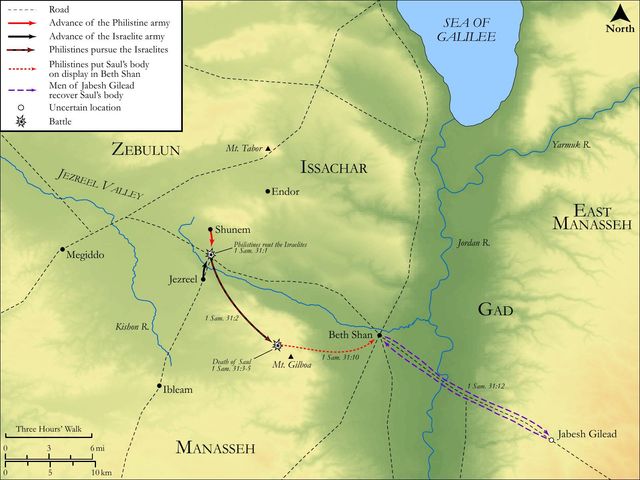
1 Samuel 31:7 vividly portrays the devastating aftermath of Israel's catastrophic defeat on Mount Gilboa, following the tragic deaths of King Saul and his sons. This verse reveals a profound national collapse, as Israelite inhabitants residing across the valley and beyond the Jordan River, upon witnessing the rout of their army and the demise of their leadership, abandoned their cities in widespread panic. This desperate flight allowed the victorious Philistines to immediately occupy and settle in these vacated territories, thereby solidifying their dominance and marking a dark period for the nascent Israelite monarchy.
Context
ShowHideLiterary Context
This verse serves as the grim climax to the battle described in 1 Samuel 31:1-6. Having witnessed the complete collapse of Israel's forces and the tragic deaths of King Saul, his three sons—including the beloved Jonathan, who had a covenant with David—and his armor-bearer, the immediate narrative shifts from the battlefield to the broader civilian population. It sets up the Philistine desecration of the bodies in 1 Samuel 31:8-10 and the valiant rescue by the men of Jabesh-Gilead in 1 Samuel 31:11-13. This verse acts as a crucial bridge, showing the immediate and widespread consequences of the military defeat on the civilian populace, thus concluding the narrative arc of Saul's reign and preparing the reader for the transition to David's kingship in 2 Samuel 1.
Historical & Cultural Context
Historically, the Philistines were a formidable and persistent enemy, constantly vying for control over the fertile crescent and strategic trade routes with Israel. Their decisive victory at Mount Gilboa, a crucial battleground, marked a significant resurgence of their power and delivered a severe blow to Israel's nascent monarchy. The mention of "the other side of the valley" (likely referring to the Jezreel Valley, a key strategic corridor) and "the other side Jordan" highlights the widespread impact of the defeat, indicating that the panic extended far beyond the immediate battle zone to communities in Transjordan. In the warfare of that day, the death of a king often signaled the complete collapse of an army and state, leading to widespread chaos, territorial loss, and often, the subjugation of the populace, as vividly portrayed here. The rapid occupation by the Philistines underscores their military efficiency and their clear intent to consolidate control over these newly vacated Israelite cities, exploiting the power vacuum created by Saul's demise.
Key Themes
ShowHideThis verse contributes significantly to several key themes within 1 Samuel. Foremost among these is the theme of consequences of disobedience and failed leadership. Saul's reign, marked by his repeated failures to fully obey God (e.g., 1 Samuel 13 and 1 Samuel 15), culminates in this devastating defeat, illustrating the spiritual and national ramifications of a king who has lost divine favor. The immediate flight of the people and the Philistine occupation underscore the theme of national vulnerability and divine judgment, as Israel is left exposed, humiliated, and without a clear leader. Furthermore, it highlights the power vacuum created by Saul's death, setting the stage for the divinely appointed successor, David, to eventually emerge and restore Israel's fortunes, a narrative arc that begins to unfold in 2 Samuel. The Philistine dominance depicted here reinforces the ongoing struggle between Israel and its enemies, a recurring motif throughout the historical books.
Exposition and Analysis
ShowHideKey Word Analysis
ShowHideThis verb (H5127), used twice in the verse ("men of Israel fled" and "they forsook the cities, and fled"), denotes a rapid, panicked, and often desperate flight. From its root meaning "to flit, i.e. vanish away," it conveys not merely a strategic retreat but an uncontrolled, fear-driven abandonment, emphasizing the complete rout and loss of morale among the Israelite populace. The repetition underscores the widespread nature of this terror and disarray.
This word (H5800) implies abandonment, leaving behind, or deserting. In this context, it highlights the Israelites' act of willingly giving up their homes and cities, not due to military strategy but out of overwhelming fear and despair. It conveys a profound sense of desolation and surrender, as they left their possessions and territories vulnerable to their enemies.
This verb (H3427) signifies settling, inhabiting, or taking up permanent residence. Its use here for the Philistines indicates a swift and decisive occupation. They didn't just raid or pass through; they established themselves, signifying a permanent or at least long-term claim over the vacated Israelite cities, thereby consolidating their victory and territorial gains and asserting their dominance.
Verse Breakdown
ShowHide"And when the men of Israel that [were] on the other side of the valley, and [they] that [were] on the other side Jordan, saw"
This opening clause establishes the widespread geographical reach of the ensuing panic. "The other side of the valley" likely refers to the Jezreel Valley, where the battle took place, indicating civilians living in the surrounding regions. "The other side Jordan" points to the Transjordanian tribes, demonstrating that the news and its terrifying implications had spread far and wide, affecting communities beyond the immediate conflict zone. Their "seeing" implies not necessarily direct visual observation of the battle, but rather the rapid dissemination of news about the defeat and the king's death.
"...that the men of Israel fled, and that Saul and his sons were dead"
This clause reveals the two primary triggers for the civilian panic. First, the sight or news of their own army "fleeing" signified a complete military collapse, stripping away any hope of defense and indicating the utter failure of their national security. Second, the devastating news that "Saul and his sons were dead" confirmed the loss of central leadership and the utter defeat of the monarchy. These two facts combined to create an overwhelming sense of vulnerability, hopelessness, and impending doom among the populace.
"...they forsook the cities, and fled; and the Philistines came and dwelt in them"
This final clause describes the immediate and dire consequences of the preceding events. The Israelites' response was to "forsake their cities"—to abandon their homes, livelihoods, and defensive positions—and "fled" in a desperate, unorganized retreat. This act of abandonment created a vacuum that the Philistines immediately exploited. The phrase "the Philistines came and dwelt in them" signifies a swift and decisive occupation, transforming Israelite territories into Philistine strongholds and underscoring the complete reversal of power and the profound national humiliation.
Literary Devices
ShowHideThe verse employs several potent literary devices to convey its stark message. Juxtaposition is powerfully evident in the sharp contrast between the Israelites' panicked, fear-driven flight and abandonment of their homes, and the Philistines' immediate, deliberate, and confident act of coming to "dwell in them." This highlights the complete reversal of fortunes and the swift, unchallenged transfer of power. The repetition of the verb "fled" (first describing the army, then the civilians) powerfully emphasizes the pervasive fear, disarray, and utter collapse of morale that gripped the entire nation, underscoring the total breakdown of order and security. There is also a strong sense of irony in this concluding scene of Saul's reign. Saul was chosen as king, in part, to deliver Israel from the Philistines, yet his reign ends with a decisive Philistine victory that results in their territorial expansion and further subjugation of Israel, demonstrating the tragic failure of his kingship and the devastating consequences of his disobedience.
Theological and Thematic Connections
ShowHideThis verse, while depicting a moment of profound national despair, is deeply interwoven with the broader theological narrative of Israel's history. It serves as a stark illustration of the consequences of a king who has lost divine favor and the vulnerability of a nation that relies on human strength rather than God's covenant faithfulness. The Philistine victory and subsequent occupation can be understood within the biblical framework of divine judgment or chastisement, a recurring theme where Israel's disobedience leads to oppression by foreign powers, as seen throughout the book of Judges. This catastrophic defeat underscores the inadequacy of human leadership apart from divine guidance and sets the stage for God's sovereign plan to establish a king "after His own heart," preparing the way for David's ascendance and the establishment of an enduring dynasty. It highlights the principle that true security and prosperity for Israel are found in covenant fidelity, not merely military might or human strategy.
Reflection and Application
ShowHideThe tragic events of 1 Samuel 31:7 offer profound lessons for believers today. Firstly, it underscores the immense responsibility and impact of leadership, both spiritual and temporal. Saul's failure led to national catastrophe, reminding us of the critical need for leaders who are not only competent but also deeply grounded in integrity, divine wisdom, and obedience to God's will. Secondly, it speaks to the human tendency towards despair and panic in the face of overwhelming adversity. When our perceived sources of security (leaders, armies, institutions, or even personal plans) collapse, it is natural to feel fear and a desire to flee. However, this passage implicitly challenges us to consider where our ultimate trust lies. Even in moments of apparent defeat and chaos, God's sovereign plan is at work, often preparing the ground for new beginnings and the fulfillment of His promises, as evidenced by David's subsequent rise. It calls us to cultivate resilience and unwavering faith, even when circumstances seem dire, remembering that God's purposes cannot be thwarted and His faithfulness endures beyond human failure.
Questions for Reflection
ShowHideFAQ
ShowHideWhy did the Israelites flee their cities so quickly?
ShowHideThe rapid flight of the Israelites from their cities was primarily driven by overwhelming fear and despair. The news of their army's complete rout on Mount Gilboa, coupled with the devastating confirmation of King Saul's death and the deaths of his sons, signaled a total collapse of national defense and leadership. Among the nations of that day, the death of a king in battle often meant the end of the state and brutal treatment by the victors, including pillaging, enslavement, and desecration. Lacking any organized defense or leadership, and facing the immediate threat of a victorious and ruthless Philistine army, the civilians perceived abandonment of their homes as their only means of survival. This immediate and widespread panic is further emphasized by the fact that those "on the other side of the valley" and "on the other side Jordan" also fled, indicating the news and its terrifying implications spread rapidly and profoundly affected all segments of the population.
What was the immediate impact of the Philistines "dwelling" in the vacated Israelite cities?
ShowHideThe Philistines' act of "dwelling" in the cities immediately vacated by the fleeing Israelites signified a swift and decisive consolidation of their victory and a significant expansion of their territorial control. This was not merely a temporary occupation or a raid; it implied a permanent or long-term settlement, establishing new Philistine strongholds within what was formerly Israelite territory. This act underscored Israel's profound national humiliation, the loss of sovereignty over strategic areas, and the immediate, tangible consequences of their military defeat. It marked a dark period for Israel, as the Philistines exerted their dominance and control, setting the stage for the arduous process of recovery and reclamation under the future leadership of David, as detailed in 2 Samuel.
Christ-Centered Fulfillment
ShowHide1 Samuel 31:7, with its depiction of a failed king, a scattered people, and a land occupied by enemies, powerfully foreshadows the profound need for a perfect, eternal King. Saul's reign, ending in defeat and despair, highlights the futility of human leadership apart from divine anointing and obedience. This tragic scene points forward to Jesus Christ, the true King of Israel, whose kingdom is not of this world (John 18:36), and whose victory is not achieved through military might but through sacrificial love. Unlike Saul, who fled from his enemies and whose death led to the scattering of his people, Jesus, the Lamb of God, willingly laid down His life on the cross—an apparent defeat that was, in fact, the ultimate victory over sin, death, and all spiritual enemies (Colossians 2:15). His resurrection ensures that His kingdom will never be defeated or occupied by enemies (Daniel 2:44), and His followers, unlike the fleeing Israelites, are gathered and secured in Him, for no one can snatch them out of His hand (John 10:28). Thus, Saul's tragic end serves as a stark backdrop, illuminating the glory and eternal security found in the reign of Christ, our victorious and faithful King.