


1 Samuel 7:10
Bible text: King James Version (1769 Blayney text) · Public domain
Bible text: King James Version with Strong's numbers · Public domain
Bible text: Berean Standard Bible · Public domain
Bible text: American Standard Version (1901) · Public domain
Bible text: World English Bible, Messianic edition · Public domain
Bible text: Geneva Bible (1599) · Public domain
Bible text: Young's Literal Translation · Public domain
- וַיְהִיvay·Hiand he wasH1961Conj-w ¦ V-Qal-ConsecImperf-3msVerb Qal Consecutive Imperfect 3rd Singular Masculineוַandיְהִיhe was
- שְׁמוּאֵלshe·mu·'ElSamuelH8050N-proper-mNoun Proper Masculine
- מַעֲלֶהma·'a·Lehoffering upH5927V-Hiphil-Prtcpl-msVerb Hiphil Participle Singular Masculine Absolute
- הָעוֹלָהha·'o·Lahthe burnt offeringH5930Art ¦ N-fsNoun Singular Feminine Absoluteהָtheעוֹלָהburnt offering
- וּפְלִשְׁתִּיםu·fe·lish·Timand [the] PhilistinesH6430Conj-w ¦ N-mpNoun Gentilic Plural Masculine Absoluteוּandפְלִשְׁתִּים[the] Philistines
- נִגְּשׁוּni·ge·Shuthey drew nearH5066V-Niphal-Perf-3cpVerb Niphal Perfect 3rd Plural common gender
- לַמִּלְחָמָהla·mil·cha·Mahfor <the> battleH4421Prep-l ¦ N-fsNoun Singular Feminine Absoluteלַfor <the>מִּלְחָמָהbattle
- בְּיִשְׂרָאֵלbe·Yis·ra·'Elin IsraelH3478Prep-b ¦ N-properNoun Proper LocationבְּinיִשְׂרָאֵלIsrael
- וַיַּרְעֵםvai·yar·'Emand he thunderedH7481Conj-w ¦ V-Hiphil-ConsecImperf-3msVerb Hiphil Consecutive Imperfect 3rd Singular Masculineוַandיַּרְעֵםhe thundered
- יְהוָהYah·wehYahwehH3068N-properNoun Proper Title
- בְּקוֹלbe·kolwith a soundH6963Prep-b ¦ N-msNoun Singular Masculine Absoluteבְּwithקוֹלa sound
- גָּדוֹלGa·dolgreatH1419Adj-msAdjective Singular Masculine Absolute
- בַּיּוֹםbai·Yomon the dayH3117Prep-b ¦ N-msNoun Singular Masculine Absoluteבַּon theיּוֹםday
- הַהוּאha·Hu'<the> thatH1931Art ¦ Pro-3msPronoun Personal 3rd Singular Masculineהַ<the>הוּאthat
- עַל'alonH5921PrepPreposition
- פְּלִשְׁתִּיםpe·lish·Tim[the] PhilistinesH6430N-mpNoun Gentilic Plural Masculine Absolute
- וַיְהֻמֵּםvay·hu·Memand he routed themH2000Conj-w ¦ V-Qal-ConsecImperf-3ms ¦ 3mpVerb Qal Consecutive Imperfect 3rd Singular Masculineוַandיְהֻמֵּhe routedםthem
- וַיִּנָּגְפוּvai·yi·na·ge·Fuand they were defeatedH5062Conj-w ¦ V-Niphal-ConsecImperf-3mpVerb Niphal Consecutive Imperfect 3rd Plural Masculineוַandיִּנָּגְפוּthey were defeated
- לִפְנֵיlif·Nei<to> beforeH6440Prep-l ¦ N-mpcNoun Plural Masculine Constructלִ<to>פְנֵיbefore
- יִשְׂרָאֵלYis·ra·'ElIsraelH3478N-properNoun Proper Location
English is a literal word-by-word gloss of the Hebrew, not the KJV's wording. Why?
This is the original text the KJV's translators worked from — each Hebrew word with its own literal English meaning in this verse, prepared by scholars at Tyndale House, Cambridge. The KJV translates whole sentences, not word by word, so its wording differs: one Hebrew word can become several English words, and the KJV may choose “the LORD” where the gloss reads “Yahweh”. Both are faithful — they answer different questions. For the KJV's own rendering, switch to the KJV text.
Details
See on the biblical-era maps
Study this verse
Public-domain commentary
Matthew Henry
From his Commentary on the Whole Bible. Henry comments on passages, not single verses — this entry covers 1 Samuel 7:7–12. His two-level outline is real structure in the source text, so it is rendered as structure.
Here, I. The Philistines invade Israel (Sa1 7:7), taking umbrage from that general meeting for repentance and prayer as if it had been a rendezvous for war, and, if so, they thought it prudent to keep the war out of their own country. They had no just cause for this suspicion; but those that seek to do mischief to others will be forward to imagine that others design mischief to them. Now see here, 1. How evil sometimes seems to come out of good. The religious meeting of the Israelites at Mizpeh brought trouble upon them from the Philistines, which perhaps tempted them to wish they had staid at home and to blame Samuel for calling them together. But we may be in God's way and yet meet with distress; nay, when sinners begin to repent and reform, they must expect that Satan will muster all his force against them, and set his instruments on work to the utmost to oppose and discourage them. But, 2. How good is, at length, brought out of that evil. Israel could never be threatened more seasonably than at this time, when they were repenting and praying, nor could they have been better prepared to receive the enemy; nor could the Philistines have acted more impolitely for themselves than to make war upon Israel at this time, when they were making their peace with God. But God permitted them to do it, that he might have an opportunity immediately of crowning his people's reformation with tokens of his favour, and of confirming the words of his messenger, who had assured them that if they repented God would deliver them out of the hand of the Philistines. Thus he makes man's wrath to praise him, and serves the purposes of his grace to his people even by the malicious designs of their enemies against them, Mic 4:11, Mic 4:12.
II.Israel cleaves closely to Samuel, as their best friend, under God, in this distress; though he was no military man, nor ever celebrated as a mighty man of valour, yet, being afraid of the Philistines, for whom they thought themselves an unequal match, they engaged Samuel's prayers for them: Cease not to cry unto the Lord our God for us, Sa1 7:8. They were here unarmed, unprepared for war, come together to fast and pray, not to fight; prayers and tears therefore being all the weapons many of them are now furnished with, to these they have recourse. And, knowing Samuel to have a great interest in heaven, they earnestly beg of him to improve it for them. They had reason to expect it, because he had promised to pray for them (Sa1 7:5), had promised them deliverance from the Philistines (Sa1 7:3), and they had been observant of him in all that which he had spoken to them from the Lord. Thus those who sincerely submit to Christ, as their lawgiver and judge, need not doubt of their interest in his intercession. They were very solicitous that Samuel should not cease to pray for them: what military preparations were to be made they would undertake them, but let him continue instant in prayer, perhaps remembering that when Moses did but let down his hand ever so little Amalek prevailed. O what a comfort is it to all believers that our great intercessor above never ceases, is never silent, for he always appears in the presence of God for us!
III.Samuel intercedes with God for them, and does it by sacrifice, Sa1 7:9.
He took a sucking lamb, and offered it for a burnt-offering, a whole burnt-offering, to the Lord, and, while the sacrifice was in burning, with the smoke of it his prayers ascended up to heaven for Israel. Observe,
1.He made intercession with a sacrifice. Christ intercedes in the virtue of his satisfaction, and in all our prayers we must have an eye to his great oblation, depending upon that for audience and acceptance. Samuel's sacrifice without his prayer would have been an empty shadow, his prayer without the sacrifice would not have been so prevalent, but both together teach us what great things we may expect from God in answer to those prayers which are made with faith in Christ's sacrifice.
2.It was a burnt-offering, which was offered purely for the glory of God, so intimating that the great plea he relied on in his prayer was taken from the honour of God. "Lord, help thy people now for thy name's sake." When we endeavour to give glory to God we may hope he will, in answer to our prayers, work for his own glory.
3.It was but one sucking lamb that he offered; for it is the integrity and intention of the heart that God looks at, more than the bulk or number of the offerings. This one lamb (typifying the Lamb of God) was more acceptable than thousands of rams or bullocks would have been without faith and prayer. Samuel was no priest, but he was a Levite and a prophet; the case was extraordinary, and what he did was by special direction, and therefore was accepted of God. And justly was this reproach put upon the priests because they had corrupted themselves.
IV.God gave a gracious answer to Samuel's prayer (Sa1 7:9):
The Lord heard him. He was himself a Samuel, asked of God, and many a Samuel, many a mercy in answer to prayer, God gave him. Sons of prayer should be famous for praying, as Samuel was among those that call upon his name, Psa 99:6. The answer was a real answer: the Philistines were discomfited (Sa1 7:10, Sa1 7:11), totally routed, and that in such a manner as highly magnified the prayer of Samuel, the power of God, and the valour of Israel.
1.The prayer of Samuel was honoured; for at the very time when he was offering up his sacrifice, and his prayer with it, the battle began, and turned immediately against the Philistines. Thus while he was yet speaking God heard, and answered in thunder, Isa 65:24. God showed that it was Samuel's prayer and sacrifice that he had respect to, and hereby let Israel know that as in a former engagement with the Philistines he had justly chastised their presumptuous confidence in the presence of the ark, on the shoulders of two profane priests, so now he graciously accepted their humble dependence upon the prayer of faith from the mouth and heart of a pious prophet.
2.The power of God was greatly honoured; for he took the work into his own hand, and discomfited them, not with great hail-stones, which would kill them (as Jos 10:11), but with a great thunder, which frightened them and put them into such terror and consternation that they fainted away, and became a very easy prey to the sword of Israel, before whom, being thus confounded, they were smitten. Josephus adds that the earth quaked under them when first they made the onset and in many places opened and swallowed them up, and that, besides the terror of the thunder, their faces and hands were burnt with lightning, which obliged them to shift for themselves by flight. And, being thus driven to their heels by the immediate hand of God (whom they feared not so much as they had feared his ark, Sa1 4:7), then,
3.Honour was put upon the hosts of Israel; they were made use of for the completing of the victory, and had the pleasure of triumphing over their oppressors: They pursued the Philistines, and smote them. How soon did they find the benefit of their repentance, and reformation, and return to God! Now that they have thus engaged him for them none of their enemies can stand before them.
V.Samuel erected a thankful memorial of this victory, to the glory of God and for the encouragement of Israel, Sa1 7:12.
He set up an Eben-ezer, the stone of help. If ever the people's hard hearts should lose the impressions of this providence, this stone would either revive the remembrance of it, and make them thankful, or remain a standing witness against them for their unthankfulness.
1.The place where this memorial was set up was the same where, twenty years before, the Israelites were smitten before the Philistines, for that was beside Eben-ezer, Sa1 4:1. The sin which procured that defeat formerly being pardoned upon their repentance, the pardon was sealed by this glorious victory in the very same place where they then suffered loss; see Hos 1:10.
2.Samuel himself took care to set up this monument. He had been instrumental by prayer to obtain the mercy, and therefore he thought himself in a special manner obliged to make this grateful acknowledgement of it.
3.The reason he gives for the name is, Hitherto the Lord hath helped us, in which he speaks thankfully of what was past, giving the glory of the victory to God only, who had added this to all his former favours; and yet he speaks somewhat doubtfully for the future: "Hitherto things have done well, but what God may yet do with us we know not, that we refer to him; but let us praise him for what he has done." Note, The beginnings of mercy and deliverance are to be acknowledged by us with thankfulness so far as they go, though they be not completely finished, nay, though the issue seem uncertain. Having obtained help from God, I continue hitherto, says blessed Paul, Act 26:22.
Historical interpretation
Historical reception
1 surviving comment on this verse from the historical church.
It happened therefore, when Samuel was offering a burnt offering, etc. It happened when the Lord offered himself as a sacrifice to God in the aroma of sweetness, that his persecutors, having set him on the cross, blasphemed or mocked him, and after his burial, attempted to obstruct the way of his resurrection, so that, as if he were condemned to eternal death, they would strip all hope of salvation from his faithful ones. But, with the earth shaken, rocks split, tombs opened, the dead rising, and other heavenly signs shining around his cross or burial, the enemies were terrified and scattered in different directions. Finally, at the tomb the guards were terrified and fell like dead men. And all the crowd that had gathered at the spectacle of the cross, and saw what was happening, beat their breasts and returned. Likewise also on the day of Pentecost, when the Lord thundered from above, and through the apostles, his own clouds, echoed the heavenly words, the enemies of the faith were confounded and struck by their words, with some being crushed by their impenitence and denial.
Continue studying 1 Samuel 7:10 across the web’s major study libraries — every link below opens this exact verse, chapter, or book on the destination site.
Read & Compare
 BibleGatewayThis verse in more than 200 translations and 70 languages.
 Bible.comThe YouVersion reader — hundreds of translations, reading plans, and highlights.
 ESV.orgCrossway's official English Standard Version reader.
 NET BibleThe NET translation with 60,000+ translators' notes on every rendering decision.
 STEP BibleTyndale House's free study tool — original text, vocabulary, and scholarly resources.
 BibliaLogos Bible Software's free web reader.
 USCCBThe New American Bible (Revised Edition) with the U.S. bishops' study notes.
Commentaries
 BibleHub CommentariesDozens of classic commentaries on this verse, gathered on one page.
 StudyLightMore than 100 commentary sets — the largest collection on the web.
 BibleRefPlain-English commentary on what this verse means, verse by verse.
 Enduring WordDavid Guzik's free commentary on this chapter, widely used by Bible teachers.
 Bible Study ToolsVerse commentary alongside Greek and Hebrew study aids.
Original Language & Research
- BibleHub InterlinearThe verse word by word — original language, transliteration, and English.
- BibleHub LexiconEvery word's original-language definition and Strong's entry.
 Blue Letter BibleDeep-study tools — Strong's numbers, concordance, and word studies.
 SefariaThe Hebrew text with Rashi and centuries of Jewish commentary.
Sermons, Hymns & Audio


TrulyRandomVerse is not affiliated with these sites and doesn’t control their content. They’re linked because they’re genuinely useful.
Summary
1 Samuel 7:10 records a pivotal moment in Israel's history where divine intervention dramatically secured victory against the Philistines. As Samuel was offering a burnt offering and interceding for a repentant Israel at Mizpah, the Philistines advanced for battle. In response, the LORD supernaturally thundered with a mighty sound, throwing the enemy into utter confusion and panic, leading to their decisive defeat before the Israelites. This event powerfully demonstrates God's sovereignty, His responsiveness to His people's repentance and prayer, and His willingness to fight on their behalf.
Context
ShowHideLiterary Context
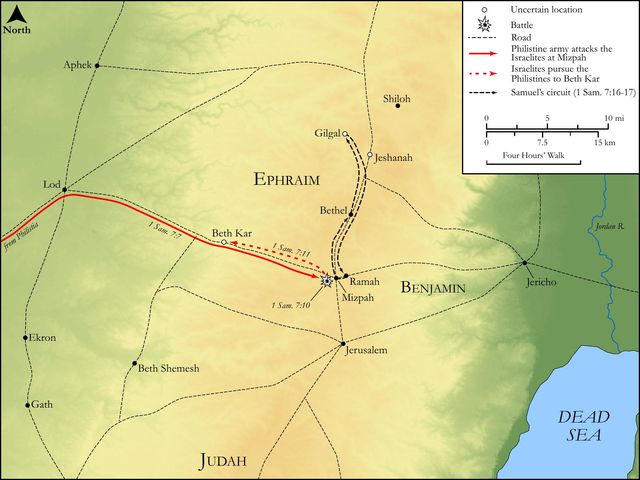
This verse is the climax of a significant spiritual revival in Israel, initiated by the prophet-judge Samuel. Following a period of severe Philistine oppression and Israel's spiritual decline (marked by the loss of the Ark in 1 Samuel 4), Samuel calls the nation to repentance at Mizpah. Verses 1 Samuel 7:3-4 describe Israel putting away their foreign gods and serving the LORD alone. The people then gather at Mizpah, confessing their sin and fasting (1 Samuel 7:5-6). The Philistines, hearing of this assembly, view it as a military threat and advance. In response to Israel's fear and plea, Samuel offers a burnt offering and cries out to the LORD on their behalf (1 Samuel 7:8-9). It is precisely at this moment of worship and intercession that the dramatic divine intervention of verse 10 occurs, immediately followed by Israel's pursuit of the routed Philistines (1 Samuel 7:11) and the setting up of the Ebenezer stone (1 Samuel 7:12).
Historical & Cultural Context
The period leading up to 1 Samuel 7 was characterized by Philistine dominance over Israel, particularly in military and economic spheres (1 Samuel 13:19-22). The Philistines were a formidable, technologically superior enemy, controlling key territories and often raiding Israelite lands. Mizpah, meaning "watchtower," was a strategically important site in Benjamin, frequently serving as a national assembly point for religious and judicial purposes (e.g., Judges 20:1). The burnt offering ('ôlâh) was a central act of Israelite worship, signifying complete dedication, atonement, and communion with God. For the Philistines to attack during such a sacred assembly underscored their contempt for Israel's God and their intent to crush any resurgence of Israelite identity or strength.
Key Themes
ShowHideThis verse powerfully illustrates several key themes central to the book of 1 Samuel and the broader Old Testament narrative. Foremost is the theme of Divine Intervention and Deliverance, where God actively and supernaturally intervenes on behalf of His people when they turn to Him. It underscores the Efficacy of Repentance and Prayer, demonstrating that sincere turning from sin and crying out to God elicits a divine response, even in the face of overwhelming odds. The event also highlights God's Sovereignty Over Creation, as He uses natural phenomena (thunder) as a weapon to achieve His purposes, echoing earlier displays of power against enemies (e.g., Exodus 14:24-25). Finally, it emphasizes Victory Through Reliance on God, contrasting Israel's previous military failures when they relied on human strength or idolatry, with this victory achieved through spiritual renewal and divine power.
Exposition and Analysis
ShowHideKey Word Analysis
ShowHideThis refers to the self-Existent or Eternal God, the covenant name of the God of Israel (H3068). The text explicitly states "the LORD thundered," emphasizing that this was not a random meteorological event but a direct, personal, and powerful act of the sovereign God of Israel. It highlights His active involvement and supreme authority over creation and human affairs, intervening on behalf of His people.
Derived from a root meaning "to tumble" or "be violently agitated," this verb specifically denotes the crashing sound of thunder (H7481). In biblical contexts, thunder is often associated with the voice or presence of God, signifying His majesty, power, and often His judgment. Here, it is a divine weapon, a terrifying and disorienting sound that emanates from God Himself, designed to incapacitate the enemy.
This powerful verb means "to put in commotion," "to disturb," "to drive," or "to destroy" (H2000). It describes a state of sudden, overwhelming panic, disorientation, and terror that renders the enemy helpless and unable to fight effectively. It's more than a simple defeat; it's a divinely orchestrated psychological and tactical collapse, making the Philistines easy prey for the Israelites. This term is also used in Exodus 14:24 to describe God's actions against the Egyptians at the Red Sea.
Verse Breakdown
ShowHide"And as Samuel was offering up the burnt offering"
This clause establishes the precise, divinely significant timing of the intervention. God's action occurs not before or after, but during a sacred act of worship and intercession. This underscores God's immediate responsiveness to Israel's repentance and Samuel's earnest prayer, emphasizing the spiritual nature of the impending victory.
"the Philistines drew near to battle against Israel"
This sets the immediate context of the conflict, highlighting the Philistines' aggressive intent. They advanced, confident in their military superiority, aiming to crush Israel's renewed spiritual and national identity, unaware they were about to confront a divine adversary.
"but the LORD thundered with a great thunder on that day upon the Philistines"
The pivotal turning point of the narrative. The conjunction "but" introduces a dramatic contrast, shifting from human aggression to divine power. The "great thunder" is God's direct, supernatural weapon, a terrifying sound and force that specifically targeted the Philistines, demonstrating His active presence and overwhelming power in the battle.
"and discomfited them; and they were smitten before Israel"
This describes the immediate and devastating effect of God's thunder. The Philistines were thrown into a state of utter confusion and panic, rendering them defenseless and unable to resist. Consequently, they were easily defeated and "smitten" (struck down) by the Israelites, who were now empowered and emboldened by God's miraculous intervention.
Literary Devices
ShowHideThe narrative in 1 Samuel 7:10 masterfully employs several literary devices to heighten its impact and convey its theological message. Theophany is central, as God directly manifests His power through the "great thunder," a divine display that is both auditory and impactful, signifying His active presence and judgment. The use of Juxtaposition is stark and effective: the peaceful, sacred act of Samuel offering the burnt offering is immediately contrasted with the Philistines' aggressive military advance, only to be swiftly followed by God's overwhelming and violent intervention. This creates a sense of Dramatic Irony, as the Philistines, intending to crush Israel, are instead crushed by an unseen, divine force. The phrase "great thunder" also serves as a form of Hyperbole or Emphasis, underscoring the extraordinary and supernatural nature of the event, distinguishing it from a mere natural storm and highlighting the immense power of God. The narrative structure itself builds Suspense, leading to the climactic moment of divine deliverance.
Theological and Thematic Connections
ShowHide1 Samuel 7:10 is a profound theological statement about God's character and His relationship with His people. It reveals God as a sovereign Deliverer who actively intervenes in human history, especially when His people humble themselves, repent, and seek Him. The timing of His intervention—precisely when Samuel was offering sacrifice and praying—underscores the efficacy of sincere worship and intercession. This event serves as a powerful reminder that true victory comes not from human might or strategic brilliance, but from divine power unleashed in response to faith and obedience. It reinforces the theme that God fights for those who are truly devoted to Him, turning confusion into victory and demonstrating His absolute control over all creation.
Reflection and Application
ShowHideThe account in 1 Samuel 7:10 offers timeless encouragement and profound lessons for believers today. It reminds us that even when facing seemingly insurmountable challenges or overwhelming opposition, our ultimate reliance must be on God's power and not our own. Just as Israel's victory was predicated on their repentance and turning back to the LORD, so too are our breakthroughs often contingent on our spiritual posture—humility, confession, and sincere prayer. This passage calls us to cultivate a deep trust in God's faithfulness, knowing that He is able to intervene in ways we cannot foresee, turning confusion into victory for His people. It challenges us to assess where our true strength lies and to remember that the battle is the LORD's, especially when we are committed to His will and His ways.
Questions for Reflection
ShowHideFAQ
ShowHideWas the "great thunder" a natural storm or a miracle?
ShowHideWhile natural storms occur, the biblical text strongly indicates that the "great thunder" in 1 Samuel 7:10 was a supernatural, targeted act of divine intervention, not merely a coincidental weather event. The phrasing "the LORD thundered" attributes the action directly to God. Furthermore, the immediate and precise effect—that the Philistines were "discomfited" or thrown into confusion—points to a miraculous, psychological impact specifically designed to incapacitate the enemy. This aligns with other instances in Scripture where God uses natural phenomena as instruments of His will to deliver His people or judge His enemies (e.g., the hailstones in Joshua 10:11). It was a theophany, a manifestation of God's power in battle.
What is the significance of "Mizpah" in this narrative?
ShowHideMizpah ("watchtower") was a highly significant location in Israel's history, often serving as a central gathering point for national assemblies, covenants, and acts of repentance or judgment. In this context (1 Samuel 7), Mizpah becomes the stage for Israel's spiritual renewal. It's where the people collectively confess their sins (1 Samuel 7:6), put away their idols, and commit to serving the LORD alone (1 Samuel 7:3-4). The Philistine attack on Mizpah, therefore, was not just a military maneuver but an assault on the very heart of Israel's renewed devotion to God. God's dramatic intervention at this specific site underscores His approval of their repentance and His commitment to defend His covenant people in their place of spiritual commitment.
Christ-Centered Fulfillment
ShowHideThe dramatic divine intervention at Mizpah in 1 Samuel 7:10, where the LORD supernaturally defeated Israel's enemies, powerfully foreshadows the ultimate and decisive victory achieved by Jesus Christ. Just as God fought for Israel, Christ, as the divine Warrior and ultimate Deliverer, has fought and won the battle against the powers of darkness, sin, and death. The "great thunder" that discomfited the Philistines points to the overwhelming authority and power of Christ, who, through His crucifixion and resurrection, "disarmed the powers and authorities, he made a public spectacle of them, triumphing over them by the cross" (Colossians 2:15). Samuel's intercession and the offering of the burnt offering, which preceded God's deliverance, find their perfect fulfillment in Christ, our Great High Priest, who offered Himself as the perfect, once-for-all sacrifice (Hebrews 7:27) and who "always lives to intercede for them" (Hebrews 7:25). The peace and recovery that followed Israel's victory at Mizpah ultimately find their truest expression in the spiritual peace and eternal life offered through the reign of Christ, who has overcome the world (John 16:33) and will one day return to fully establish His kingdom, judging all His enemies with the "breath of his mouth" (2 Thessalonians 2:8).