


1 Samuel 7:9
Bible text: King James Version (1769 Blayney text) · Public domain
Bible text: King James Version with Strong's numbers · Public domain
Bible text: Berean Standard Bible · Public domain
Bible text: American Standard Version (1901) · Public domain
Bible text: World English Bible, Messianic edition · Public domain
Bible text: Geneva Bible (1599) · Public domain
Bible text: Young's Literal Translation · Public domain
- וַיִּקַּחvai·yi·Kachand he tookH3947Conj-w ¦ V-Qal-ConsecImperf-3msVerb Qal Consecutive Imperfect 3rd Singular Masculineוַandיִּקַּחhe took
- שְׁמוּאֵלshe·mu·'ElSamuelH8050N-proper-mNoun Proper Masculine
- טְלֵהte·Leha lamb ofH2924N-mscNoun Singular Masculine Construct
- חָלָבcha·LavmilkH2461N-msNoun Singular Masculine Absolute
- אֶחָד'e·ChadoneH259N-fsNoun Singular Feminine Absolute
- וַיַּעֲלֵהוּvai·ya·'a·le·huand he offered up itH5927Conj-w ¦ V-Hiphil-ConsecImperf-3ms ¦ 3msVerb Hiphil Consecutive Imperfect 3rd Singular Masculineוַandיַּעֲלֵhe offered upהוּit
- עוֹלָהo·Laha burnt offeringH5930N-fsNoun Singular Feminine Absolute
- כָּלִילka·Lila whole offeringH3632Adj-msAdjective Singular Masculine Absolute
- לַיהוָהla·Yah·wehto YahwehH3068Prep-l ¦ N-properNoun Proper TitleלַtoיהוָהYahweh
- וַיִּזְעַקvai·yiz·'Akand he cried outH2199Conj-w ¦ V-Qal-ConsecImperf-3msVerb Qal Consecutive Imperfect 3rd Singular Masculineוַandיִּזְעַקhe cried out
- שְׁמוּאֵלshe·mu·'ElSamuelH8050N-proper-mNoun Proper Masculine
- אֶל'eltoH413PrepPreposition
- יְהוָהYah·wehYahwehH3068N-properNoun Proper Title
- בְּעַדbe·'AdforH1157Adj-cscAdjective Numerical Singular common gender Construct
- יִשְׂרָאֵלYis·ra·'ElIsraelH3478N-properNoun Proper Location
- וַיַּעֲנֵהוּvai·ya·'a·Ne·huand he answered himH6030Conj-w ¦ V-Qal-ConsecImperf-3ms ¦ 3msVerb Qal Consecutive Imperfect 3rd Singular Masculineוַandיַּעֲנֵhe answeredהוּhim
- יְהוָהYah·wehYahwehH3068N-properNoun Proper Title
English is a literal word-by-word gloss of the Hebrew, not the KJV's wording. Why?
This is the original text the KJV's translators worked from — each Hebrew word with its own literal English meaning in this verse, prepared by scholars at Tyndale House, Cambridge. The KJV translates whole sentences, not word by word, so its wording differs: one Hebrew word can become several English words, and the KJV may choose “the LORD” where the gloss reads “Yahweh”. Both are faithful — they answer different questions. For the KJV's own rendering, switch to the KJV text.
Details
See on the biblical-era maps
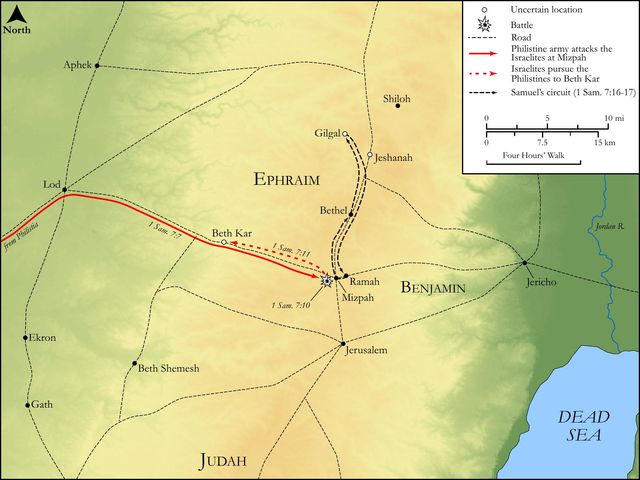
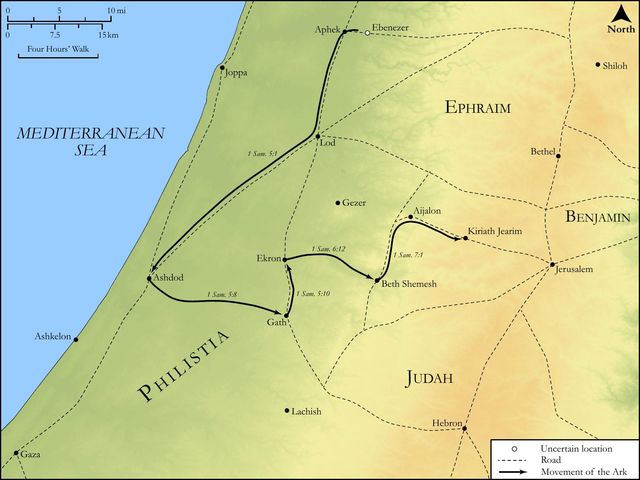
Study this verse
Public-domain commentary
Matthew Henry
From his Commentary on the Whole Bible. Henry comments on passages, not single verses — this entry covers 1 Samuel 7:7–12. His two-level outline is real structure in the source text, so it is rendered as structure.
Here, I. The Philistines invade Israel (Sa1 7:7), taking umbrage from that general meeting for repentance and prayer as if it had been a rendezvous for war, and, if so, they thought it prudent to keep the war out of their own country. They had no just cause for this suspicion; but those that seek to do mischief to others will be forward to imagine that others design mischief to them. Now see here, 1. How evil sometimes seems to come out of good. The religious meeting of the Israelites at Mizpeh brought trouble upon them from the Philistines, which perhaps tempted them to wish they had staid at home and to blame Samuel for calling them together. But we may be in God's way and yet meet with distress; nay, when sinners begin to repent and reform, they must expect that Satan will muster all his force against them, and set his instruments on work to the utmost to oppose and discourage them. But, 2. How good is, at length, brought out of that evil. Israel could never be threatened more seasonably than at this time, when they were repenting and praying, nor could they have been better prepared to receive the enemy; nor could the Philistines have acted more impolitely for themselves than to make war upon Israel at this time, when they were making their peace with God. But God permitted them to do it, that he might have an opportunity immediately of crowning his people's reformation with tokens of his favour, and of confirming the words of his messenger, who had assured them that if they repented God would deliver them out of the hand of the Philistines. Thus he makes man's wrath to praise him, and serves the purposes of his grace to his people even by the malicious designs of their enemies against them, Mic 4:11, Mic 4:12.
II.Israel cleaves closely to Samuel, as their best friend, under God, in this distress; though he was no military man, nor ever celebrated as a mighty man of valour, yet, being afraid of the Philistines, for whom they thought themselves an unequal match, they engaged Samuel's prayers for them: Cease not to cry unto the Lord our God for us, Sa1 7:8. They were here unarmed, unprepared for war, come together to fast and pray, not to fight; prayers and tears therefore being all the weapons many of them are now furnished with, to these they have recourse. And, knowing Samuel to have a great interest in heaven, they earnestly beg of him to improve it for them. They had reason to expect it, because he had promised to pray for them (Sa1 7:5), had promised them deliverance from the Philistines (Sa1 7:3), and they had been observant of him in all that which he had spoken to them from the Lord. Thus those who sincerely submit to Christ, as their lawgiver and judge, need not doubt of their interest in his intercession. They were very solicitous that Samuel should not cease to pray for them: what military preparations were to be made they would undertake them, but let him continue instant in prayer, perhaps remembering that when Moses did but let down his hand ever so little Amalek prevailed. O what a comfort is it to all believers that our great intercessor above never ceases, is never silent, for he always appears in the presence of God for us!
III.Samuel intercedes with God for them, and does it by sacrifice, Sa1 7:9.
He took a sucking lamb, and offered it for a burnt-offering, a whole burnt-offering, to the Lord, and, while the sacrifice was in burning, with the smoke of it his prayers ascended up to heaven for Israel. Observe,
1.He made intercession with a sacrifice. Christ intercedes in the virtue of his satisfaction, and in all our prayers we must have an eye to his great oblation, depending upon that for audience and acceptance. Samuel's sacrifice without his prayer would have been an empty shadow, his prayer without the sacrifice would not have been so prevalent, but both together teach us what great things we may expect from God in answer to those prayers which are made with faith in Christ's sacrifice.
2.It was a burnt-offering, which was offered purely for the glory of God, so intimating that the great plea he relied on in his prayer was taken from the honour of God. "Lord, help thy people now for thy name's sake." When we endeavour to give glory to God we may hope he will, in answer to our prayers, work for his own glory.
3.It was but one sucking lamb that he offered; for it is the integrity and intention of the heart that God looks at, more than the bulk or number of the offerings. This one lamb (typifying the Lamb of God) was more acceptable than thousands of rams or bullocks would have been without faith and prayer. Samuel was no priest, but he was a Levite and a prophet; the case was extraordinary, and what he did was by special direction, and therefore was accepted of God. And justly was this reproach put upon the priests because they had corrupted themselves.
IV.God gave a gracious answer to Samuel's prayer (Sa1 7:9):
The Lord heard him. He was himself a Samuel, asked of God, and many a Samuel, many a mercy in answer to prayer, God gave him. Sons of prayer should be famous for praying, as Samuel was among those that call upon his name, Psa 99:6. The answer was a real answer: the Philistines were discomfited (Sa1 7:10, Sa1 7:11), totally routed, and that in such a manner as highly magnified the prayer of Samuel, the power of God, and the valour of Israel.
1.The prayer of Samuel was honoured; for at the very time when he was offering up his sacrifice, and his prayer with it, the battle began, and turned immediately against the Philistines. Thus while he was yet speaking God heard, and answered in thunder, Isa 65:24. God showed that it was Samuel's prayer and sacrifice that he had respect to, and hereby let Israel know that as in a former engagement with the Philistines he had justly chastised their presumptuous confidence in the presence of the ark, on the shoulders of two profane priests, so now he graciously accepted their humble dependence upon the prayer of faith from the mouth and heart of a pious prophet.
2.The power of God was greatly honoured; for he took the work into his own hand, and discomfited them, not with great hail-stones, which would kill them (as Jos 10:11), but with a great thunder, which frightened them and put them into such terror and consternation that they fainted away, and became a very easy prey to the sword of Israel, before whom, being thus confounded, they were smitten. Josephus adds that the earth quaked under them when first they made the onset and in many places opened and swallowed them up, and that, besides the terror of the thunder, their faces and hands were burnt with lightning, which obliged them to shift for themselves by flight. And, being thus driven to their heels by the immediate hand of God (whom they feared not so much as they had feared his ark, Sa1 4:7), then,
3.Honour was put upon the hosts of Israel; they were made use of for the completing of the victory, and had the pleasure of triumphing over their oppressors: They pursued the Philistines, and smote them. How soon did they find the benefit of their repentance, and reformation, and return to God! Now that they have thus engaged him for them none of their enemies can stand before them.
V.Samuel erected a thankful memorial of this victory, to the glory of God and for the encouragement of Israel, Sa1 7:12.
He set up an Eben-ezer, the stone of help. If ever the people's hard hearts should lose the impressions of this providence, this stone would either revive the remembrance of it, and make them thankful, or remain a standing witness against them for their unthankfulness.
1.The place where this memorial was set up was the same where, twenty years before, the Israelites were smitten before the Philistines, for that was beside Eben-ezer, Sa1 4:1. The sin which procured that defeat formerly being pardoned upon their repentance, the pardon was sealed by this glorious victory in the very same place where they then suffered loss; see Hos 1:10.
2.Samuel himself took care to set up this monument. He had been instrumental by prayer to obtain the mercy, and therefore he thought himself in a special manner obliged to make this grateful acknowledgement of it.
3.The reason he gives for the name is, Hitherto the Lord hath helped us, in which he speaks thankfully of what was past, giving the glory of the victory to God only, who had added this to all his former favours; and yet he speaks somewhat doubtfully for the future: "Hitherto things have done well, but what God may yet do with us we know not, that we refer to him; but let us praise him for what he has done." Note, The beginnings of mercy and deliverance are to be acknowledged by us with thankfulness so far as they go, though they be not completely finished, nay, though the issue seem uncertain. Having obtained help from God, I continue hitherto, says blessed Paul, Act 26:22.
Historical interpretation
Historical reception
1 surviving comment on this verse from the historical church.
But Samuel took one suckling lamb, etc. The Lord took the innocent one, whom He had clothed in human form for the salvation of the world, and offered Him as a whole burnt offering on the altar of the cross to the Father. And it is rightly said that He offered a whole burnt offering, that is, wholly consumed, as one conceived without iniquity, born, and living in the flesh without sin, making all that He did through humanity worthy of the fire of the Holy Spirit of God. And the Lord prayed to the Father for His faithful, that their faith might not fail (Luke XXII). He prayed also for those who persecuted Him, that they might be forgiven the great sin of perfidy which they committed unknowingly (Luke XXIII). And the Father heard Him, strengthening the faith of those who almost lost it, and calling those who completely lacked faith to belief.
Continue studying 1 Samuel 7:9 across the web’s major study libraries — every link below opens this exact verse, chapter, or book on the destination site.
Read & Compare
 BibleGatewayThis verse in more than 200 translations and 70 languages.
 Bible.comThe YouVersion reader — hundreds of translations, reading plans, and highlights.
 ESV.orgCrossway's official English Standard Version reader.
 NET BibleThe NET translation with 60,000+ translators' notes on every rendering decision.
 STEP BibleTyndale House's free study tool — original text, vocabulary, and scholarly resources.
 BibliaLogos Bible Software's free web reader.
 USCCBThe New American Bible (Revised Edition) with the U.S. bishops' study notes.
Commentaries
 BibleHub CommentariesDozens of classic commentaries on this verse, gathered on one page.
 StudyLightMore than 100 commentary sets — the largest collection on the web.
 BibleRefPlain-English commentary on what this verse means, verse by verse.
 Enduring WordDavid Guzik's free commentary on this chapter, widely used by Bible teachers.
 Bible Study ToolsVerse commentary alongside Greek and Hebrew study aids.
Original Language & Research
- BibleHub InterlinearThe verse word by word — original language, transliteration, and English.
- BibleHub LexiconEvery word's original-language definition and Strong's entry.
 Blue Letter BibleDeep-study tools — Strong's numbers, concordance, and word studies.
 SefariaThe Hebrew text with Rashi and centuries of Jewish commentary.
Sermons, Hymns & Audio


TrulyRandomVerse is not affiliated with these sites and doesn’t control their content. They’re linked because they’re genuinely useful.
Summary
1 Samuel 7:9 marks a decisive turning point in Israel's history, showcasing Samuel's multifaceted leadership as a prophet, priest, and intercessor. In the face of imminent Philistine aggression, Samuel performs a complete burnt offering and fervently intercedes on behalf of the nation. The verse culminates with the powerful affirmation that "the LORD heard him," signifying divine acceptance and intervention that would lead to Israel's miraculous deliverance. This passage profoundly illustrates the transformative power of repentant prayer and wholehearted devotion in eliciting God's active response and securing His protection.
Context
ShowHideLiterary Context
This pivotal verse is situated at a critical juncture in the book of 1 Samuel, following a period of profound national distress and spiritual decline, vividly depicted by the Philistine capture of the Ark of the Covenant and the subsequent judgment on Eli's house in 1 Samuel 4-6. Chapter 7 opens with Samuel's powerful call for Israel to return to the LORD, urging them to put away foreign gods and serve Him alone (1 Samuel 7:3-4). In response, the people gather at Mizpah, a significant assembly point, where they confess their sins and renew their covenant commitment to God (1 Samuel 7:5-6). It is precisely at this moment of national spiritual awakening and vulnerability that the Philistines, perceiving Israel's assembly as a military threat, advance for battle (1 Samuel 7:7). Overwhelmed by fear, the Israelites implore Samuel to continue interceding for them (1 Samuel 7:8), setting the immediate stage for Samuel's actions in verse 9 and the dramatic divine intervention that follows in 1 Samuel 7:10-11.
Historical & Cultural Context
The events of 1 Samuel 7 unfold during the transitional period from the Judges to the establishment of the monarchy in Israel. During this era, Israel lacked a unified central government and was frequently subjected to external threats, most notably from the Philistines, a technologically advanced and militarily superior people who had established a strong foothold on the coastal plains. Mizpah, meaning "watchtower," was a strategically important tribal gathering place, often associated with significant national assemblies, covenant renewals, and judicial decisions (e.g., Judges 20:1). The practice of offering burnt offerings was a cornerstone of Israelite worship, meticulously prescribed in the Mosaic Law (e.g., Leviticus 1). Such offerings symbolized complete dedication, atonement for sin, and a fervent plea for divine favor. Samuel, uniquely functioning as both prophet and judge, also assumes a priestly role in this instance, which was not entirely uncommon for prominent spiritual leaders during this transitional period, especially in times of national emergency or when formal priestly structures were compromised.
Key Themes
ShowHideThis verse powerfully encapsulates several foundational themes prevalent throughout 1 Samuel and the broader Old Testament narrative. Firstly, it highlights the theme of National Repentance and Renewal, demonstrating God's responsiveness to a people who genuinely turn from idolatry and seek Him wholeheartedly, as seen in Israel's actions prior to this verse (1 Samuel 7:3-4). Secondly, it underscores the Efficacy of Intercessory Prayer, portraying Samuel as a crucial mediator whose fervent cries on behalf of the nation move God to decisive action. This echoes the powerful intercessions of figures like Moses (Exodus 32:11-14) and later, Elijah (James 5:16-18). Thirdly, the Nature of Acceptable Sacrifice is emphasized; the "wholly" offered lamb signifies complete dedication and surrender, a prerequisite for divine favor and a pleasing aroma to the Lord, aligning with principles found in Leviticus 1:9. Finally, the verse powerfully illustrates Divine Responsiveness and Sovereignty, affirming that God actively hears and intervenes on behalf of His people when they humble themselves and seek His deliverance, a truth consistently affirmed throughout the Psalms (e.g., Psalm 34:17).
Exposition and Analysis
ShowHideKey Word Analysis
ShowHideThis term refers to a young, tender lamb, often still suckling, indicating its youth and purity. In the context of Israelite sacrificial law, only unblemished animals were acceptable for offerings, symbolizing the perfection and innocence required for a sacrifice to be pleasing to God. The selection of a "sucking lamb" emphasizes the preciousness and unblemished nature of Samuel's offering, signifying the depth of devotion and the high value placed on the sacrifice.
Derived from a root meaning "complete" or "perfect," this adverb emphasizes the comprehensive nature of the burnt offering. Unlike other sacrifices where portions were consumed by priests or offerers, a "wholly" burnt offering (an 'olah) was entirely consumed by fire on the altar, ascending as smoke to God. This signifies total dedication, absolute surrender, and complete consecration to the LORD, leaving nothing for human consumption. It represents an unreserved act of worship and a plea for full reconciliation.
This primitive root denotes a loud, urgent, and often desperate shriek or cry for help, typically arising from anguish, danger, or oppression. It is not a casual prayer but an impassioned, fervent appeal, reflecting the intensity of Samuel's intercession and the dire, life-threatening circumstances facing Israel. The use of this verb underscores a profound sense of urgency, distress, and absolute reliance on God as the sole source of deliverance.
Verse Breakdown
ShowHide"And Samuel took a sucking lamb"
This opening clause establishes Samuel's immediate and decisive action in preparing for worship. His selection of a "sucking lamb" highlights his adherence to the highest standards of sacrifice—a pure, unblemished, and valuable offering. This act underscores his priestly function in this moment, acting as a spiritual leader on behalf of the entire nation.
"and offered [it for] a burnt offering wholly unto the LORD"
This phrase details the specific nature and purpose of the sacrifice. The "burnt offering" ('olah) signifies complete consumption by fire, symbolizing total dedication, consecration, and a plea for general atonement and divine favor. The crucial addition "wholly unto the LORD" emphasizes that the entire offering was consecrated exclusively to God, leaving no part for human consumption, thereby signifying absolute surrender and unreserved devotion in a time of profound national crisis.
"and Samuel cried unto the LORD for Israel"
This clause highlights Samuel's indispensable role as an intercessor. His "crying" signifies a fervent, desperate, and urgent prayer, reflecting the immense pressure and fear gripping the nation as they faced the Philistine army. This act of intercession demonstrates his profound spiritual leadership, his deep pastoral concern for the well-being of God's people, and his unwavering trust in divine intervention.
"and the LORD heard him"
This concluding statement serves as the theological climax and divine validation of the entire verse. "Heard him" implies far more than passive listening; it signifies active attention, acceptance of the plea, and a definitive commitment to respond and intervene. This declaration of divine responsiveness confirms that Samuel's sacrifice and fervent prayer were acceptable to God and effective in securing His immediate and miraculous intervention on behalf of Israel.
Literary Devices
ShowHideThe verse employs several potent literary devices to convey its profound message. Symbolism is prominent, with the "sucking lamb" symbolizing purity, innocence, and the unblemished nature required for an acceptable sacrifice, which points to the necessity of complete and undefiled surrender. The "burnt offering wholly unto the LORD" further symbolizes total dedication, complete consecration, and a fervent desire for full reconciliation with God. Juxtaposition is subtly present between Israel's prior spiritual apostasy and their current state of repentance and renewed devotion, highlighted by Samuel's actions. The structure of the phrase "Samuel cried unto the LORD for Israel; and the LORD heard him" demonstrates a clear Cause and Effect relationship, emphasizing the direct correlation between fervent, repentant prayer and divine responsiveness. This also functions as a powerful instance of Divine Intervention, where God's active hearing directly leads to His subsequent miraculous action, underscoring His sovereignty, faithfulness, and attentive care for His covenant people.
Theological and Thematic Connections
ShowHide1 Samuel 7:9 serves as a profound theological statement on the nature of God, the efficacy of intercessory prayer, and the transformative power of genuine repentance. It vividly illustrates that God is not a distant or indifferent deity but one who actively engages with His people, especially when they turn to Him with sincere hearts and complete devotion. Samuel's pivotal role as a mediator between God and Israel foreshadows the ultimate need for a perfect intercessor, while the lamb's complete sacrifice points to the ultimate atonement required for humanity's sin. The divine response, "the LORD heard him," powerfully affirms God's covenant faithfulness and His unwavering willingness to deliver His people from oppression when they humble themselves and seek Him in truth. This passage reinforces the enduring biblical principle that spiritual renewal, wholehearted obedience, and fervent prayer are essential prerequisites for experiencing God's miraculous intervention, demonstrating that true security and victory come not from human strength or military might but from divine favor and sovereign power.
Reflection and Application
ShowHideThis powerful verse offers timeless and profound lessons for believers today, inviting us to a deeper walk of faith and surrender. Samuel's decisive actions at Mizpah serve as a poignant reminder that genuine repentance and a sincere, wholehearted turning to God are foundational for experiencing His blessing, intervention, and deliverance in our lives. The "wholly" offered sacrifice challenges us to critically examine the completeness of our own dedication to the LORD. Are we holding anything back—our resources, time, talents, desires, or even our very selves—or are we offering our entire lives as a living sacrifice, holy and pleasing to Him (Romans 12:1)? Furthermore, Samuel's fervent crying out for Israel underscores the enduring and transformative power of intercessory prayer. In a world fraught with challenges, suffering, and spiritual battles, we are called to stand in the gap for our families, communities, and nations, bringing their needs before God with urgency, compassion, and unwavering faith. The profound assurance that "the LORD heard him" provides immense comfort, hope, and encouragement, reminding us that God is perpetually attentive to the cries of His people and is faithful to respond according to His perfect will, often in ways that transcend human expectation and capability. This passage ultimately invites us to cultivate a life characterized by deep devotion, persistent and passionate prayer, and an unwavering trust in God's sovereign power to deliver, transform, and sustain.
Questions for Reflection
ShowHideFAQ
ShowHideWhy did Samuel offer a burnt offering instead of a sin offering?
ShowHideWhile both the burnt offering ('olah) and the sin offering (chattat) addressed aspects of sin, their primary purposes differed. The 'olah was primarily an offering of complete dedication, consecration, and general atonement for unintentional sin or impurity, symbolizing the offerer's total devotion and a desire for fellowship with God. In the context of 1 Samuel 7, Israel had already engaged in national repentance, confessed their sins, and put away their idols (1 Samuel 7:3-6). Therefore, Samuel's burnt offering was not merely for specific transgressions but was a profound act of national consecration, a renewed plea for divine favor and protection, and a demonstration of Israel's re-established and complete commitment to the LORD. It was an act of worship and an appeal for God's manifest presence and power in the face of imminent Philistine attack.
What is the significance of the "sucking lamb" in this offering?
ShowHideThe "sucking lamb" refers to a young, unweaned lamb, typically unblemished and pure. In the Israelite sacrificial system, the quality and perfection of the offering were paramount. Only animals that were "without blemish" were acceptable for sacrifice, as prescribed in Leviticus 1:3 and elsewhere. Offering a young, tender, and pure lamb signified offering the very best, a sacrifice of high value and purity. This choice underscored the seriousness and sincerity of Samuel's act of worship and the nation's profound desire to approach God with the utmost respect, devotion, and a perfect offering, seeking His favor and intervention in their desperate situation.
Christ-Centered Fulfillment
ShowHide1 Samuel 7:9, with its vivid depiction of Samuel as intercessor and the "sucking lamb" offered as a whole burnt offering, profoundly foreshadows the person and redemptive work of Jesus Christ. Samuel, functioning uniquely as prophet, priest, and judge, serves as a powerful type of Christ, the ultimate and perfect mediator between God and humanity. Just as Samuel offered a pure, unblemished lamb and fervently cried out for Israel's deliverance, Jesus Christ, the spotless Lamb of God who takes away the sin of the world, offered Himself as the perfect, once-for-all burnt offering on the cross. His sacrifice was "wholly unto the LORD," a complete and perfect act of atonement that fully satisfied God's righteous demands, rendering the temporary and repeated animal sacrifices of the Old Covenant obsolete (Hebrews 9:11-14). Furthermore, just as the LORD "heard" Samuel's cry and intervened on behalf of Israel, God definitively "heard" and accepted Christ's perfect sacrifice, vindicating Him by raising Him from the dead and seating Him at His right hand (Romans 1:4). Now, Jesus continues His work as our great High Priest and perpetual intercessor, through whom believers can confidently approach God's throne of grace to find help in time of need (Hebrews 4:16). Thus, the temporary deliverance experienced by Israel in response to Samuel's actions finds its ultimate, eternal, and complete fulfillment in the salvation, reconciliation, and access to God secured by Christ's perfect sacrifice and unending intercession.